AI Conversational Platform Trends Shaping Print
Print commerce is entering a new operating model. Buyers no longer want to fight through clunky editors, complex setup flows, or design software they do not understand. They want to describe what they want, see it instantly, trust what they are buying, and place the order without friction.
That shift is exactly why the ai conversational platform category is becoming so important for modern print businesses.
For small studios, photographers, emerging print-on-demand brands, regional print players, and established photo product companies, the opportunity is clear: conversational AI can compress the path from inspiration to order. Instead of forcing customers to learn design tools, brands can let customers simply type or speak a prompt, upload a few images, and receive a print-ready product with premium previews and automated fulfillment behind the scenes.
This is where the market is moving in 2026 and beyond: from manual creation to guided creation, from software-heavy workflows to natural language commerce, and from static storefronts to adaptive, AI-powered product experiences.
"71% of customers expect personalized experiences, and 76% become frustrated when these expectations are not met." - Source
That expectation is redefining print. Buyers want highly personal products, but they do not want a high-effort ordering process. An ai conversational platform bridges that gap.
What an AI Conversational Platform Means in Print Commerce
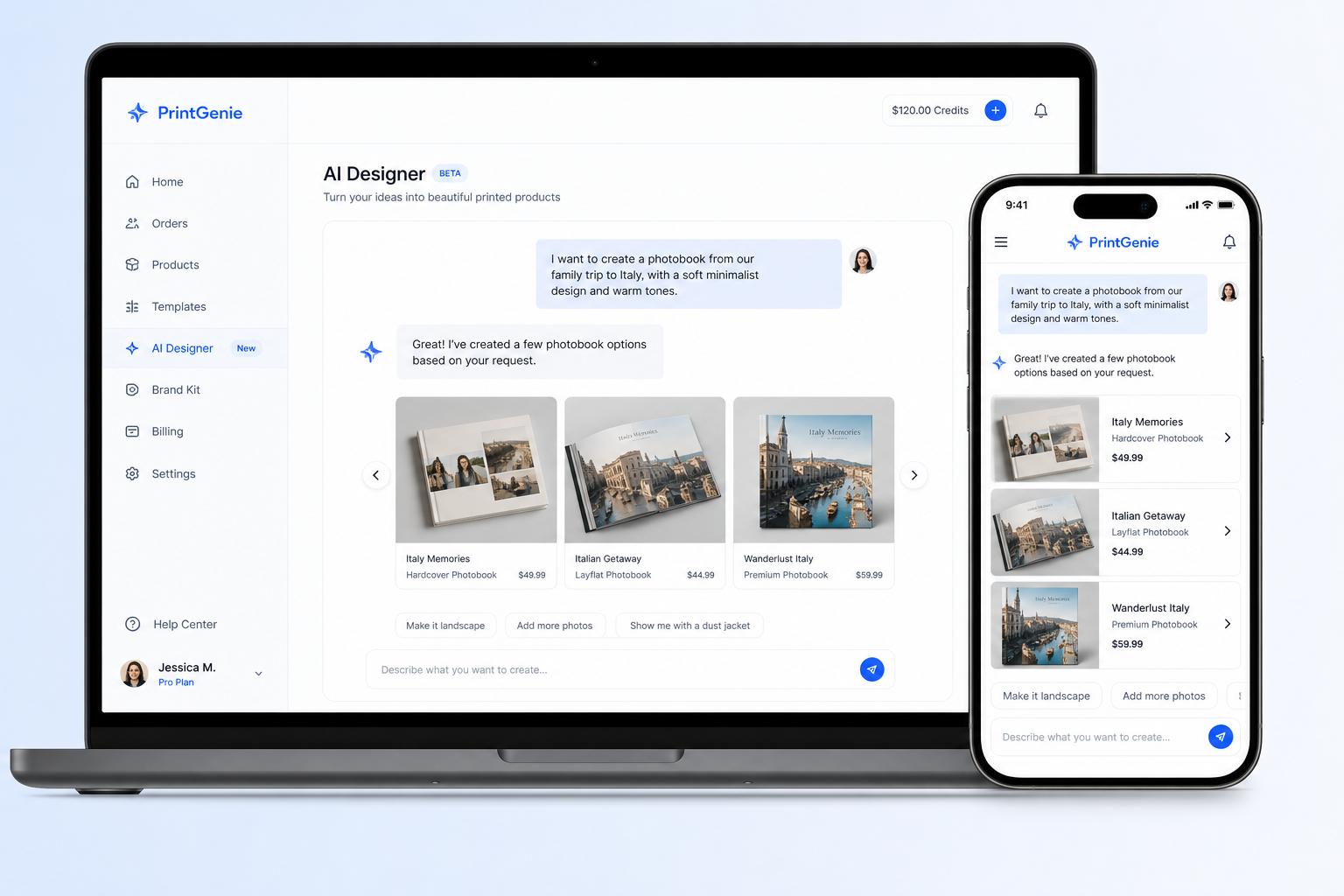
An ai conversational platform is more than a chatbot and more valuable than a basic personalization widget. In print, it is an intelligent creation layer that allows customers to describe the product they want in natural language and have the system translate that intent into a ready-to-buy, ready-to-produce outcome.
In practical terms, that can include:
turning a prompt into a photo book concept
generating layouts from uploaded images
recommending formats, paper types, or styles
adapting designs for mobile users automatically
producing print-ready files without forcing the customer into advanced editing tools
showing the result in photorealistic 3D or AR before checkout
For print brands, that means lower drop-off, faster product creation, and a storefront experience that feels modern instead of mechanical.
Why Competitors Are Missing the Bigger Opportunity
Most current industry content around AI in print focuses on operational automation: estimating, scheduling, maintenance, and workflow optimization. Those are important, but they only tell half the story.
The larger shift is happening at the customer interface.
The next winners in print will not just use AI internally. They will use AI externally to transform how products are discovered, created, visualized, and ordered. That is the content gap many articles miss. They explain how AI helps production teams, but not how conversational interfaces unlock more revenue on the front end.
That distinction matters because conversion friction often starts before a file ever reaches production.
The 7 Trends Defining the AI Conversational Platform Era in Print
1. Natural Language Is Replacing Traditional Design Friction
The legacy web-to-print model assumes customers are willing to click through templates, layers, alignment controls, bleed settings, and product configuration menus. Many are not.
A modern ai conversational platform replaces that complexity with intent-based input. A customer can say:
“Create a premium travel photo book from my Italy trip with a minimalist layout.”
“Make a framed wall print from this image in warm neutral tones.”
“Design a baby milestone album with elegant captions and soft colors.”
The platform interprets that request, structures the product, suggests layouts, and prepares a polished result.
For brands, this is not just a UX improvement. It is a revenue lever. The easier it is to start, the more likely a customer is to finish.
2. AI-Powered Product Creation Is Becoming a Conversion Engine
Personalization has always been valuable in print, but historically it has required too much effort. Conversational AI changes that by making customization feel immediate and accessible.
Instead of presenting a blank canvas, the system gives customers momentum. It can:
suggest styles based on prompt intent
automatically arrange uploaded photos
generate copy or captions
recommend product sizes
produce multiple product variations quickly
That shortens time-to-purchase and helps brands capture users who would otherwise abandon the process.
For businesses evaluating growth opportunities, this is one of the strongest arguments for adopting an ai conversational platform: it does not just automate work; it removes hesitation.
3. 3D and AR Previews Are Becoming Essential for Premium Print Sales
Trust is everything in online print ordering. Customers need to feel confident that what they see is what they will receive.
That is why high-fidelity 3D and AR visualization is becoming a defining capability in modern print commerce.
"Product pages featuring 3D models and AR experiences achieved conversion rates up to 94% higher than those with static images." - Source
For premium products such as photo books, wall art, albums, packaging, and custom gifts, static thumbnails are no longer enough. Buyers want a tactile sense of the object before they commit.

An advanced ai conversational platform can combine AI-generated creation with photorealistic 3D previews and immersive AR, helping customers visualize products in context before ordering. That reduces uncertainty, improves perceived quality, and strengthens conversion rates.
4. Mobile-First Print Experiences Are Overtaking Desktop-Centric Editors
A major weakness in traditional web-to-print systems is that they were designed for desktop-era usage. But modern shoppers discover, customize, and buy from their phones.
That means print creation workflows must be browser-based, touch-friendly, fast, and intuitive without requiring app downloads or technical setup.
An ai conversational platform is naturally suited to this shift because text and prompt-based input works exceptionally well on mobile. Customers can upload images, describe their product, review a generated result, and complete a purchase in a streamlined flow.
This is especially important for:
photographers serving lifestyle customers
creators building direct-to-consumer print brands
regional print businesses expanding online
photo product companies modernizing aging storefronts
The future of print commerce is not just digital. It is mobile-native digital.
5. White-Label AI Is Becoming the Smartest Route to Market
Many print companies understand where the market is going but face a practical barrier: they do not want to spend years building proprietary AI infrastructure, 3D rendering systems, mobile creation tools, and global fulfillment logic from scratch.
That is why white-label deployment is becoming such a powerful strategic trend.
A white-label ai conversational platform allows a business to launch advanced AI-powered creation under its own brand, domain, and visual identity while avoiding the time, cost, and technical risk of custom development.
This model is particularly attractive for:
Business Type | Why White-Label AI Fits |
|---|---|
Small studios | Launch premium digital creation without building software |
Photographers | Offer branded print experiences directly to clients |
New POD brands | Test and scale fast with low technical overhead |
Mid-size print brands | Upgrade conversion and personalization without replacing the whole stack |
Enterprise print companies | Extend innovation across regions, brands, or channels faster |
This is one of the strongest reasons Media Rex Alliance stands out in the category. It enables companies to deploy a fully branded, conversational AI print experience that integrates into existing storefronts or apps instead of forcing a full rebuild.
6. On-Demand Infrastructure Is Becoming Core to AI-Led Print Growth
AI-powered product creation only becomes truly scalable when paired with an on-demand production model.
If conversational interfaces increase customization and accelerate ordering, backend systems must handle that speed without creating inventory risk or fulfillment bottlenecks.
That is why the most effective ai conversational platform strategies are tied to:
no-stock production models
automated order routing
premium printer networks
dynamic fulfillment workflows
lower operational overhead
This combination lets brands offer a wider range of personalized products without carrying finished inventory or adding unnecessary complexity.
Media Rex Alliance aligns tightly with this trend by coupling conversational product creation with an automated fulfillment pipeline and a global network of premium printers. That means businesses can focus on brand growth and customer acquisition while the infrastructure handles production at scale.
7. Cross-Device Continuity Is Becoming a Hidden Conversion Driver
Most print brands underestimate how often customers start on one device and finish on another. A user might begin exploring on mobile during a commute, upload photos on tablet later, and complete the order on desktop that evening.
Traditional tools often break that journey.
A modern ai conversational platform should preserve project state across sessions and devices, ideally with local and cloud sync working together. That continuity matters because creative purchases are rarely completed in a single uninterrupted moment.
For print businesses, this has direct implications for conversion and customer satisfaction:
fewer abandoned projects
smoother multi-device journeys
better experience for premium, longer-consideration purchases
stronger customer confidence in the platform
This is another area where future-ready infrastructure matters more than surface-level AI features.
How AI Conversational Platforms Change the Print Buying Journey
To understand the business value, it helps to compare the old model with the new one.
Stage | Traditional Web-to-Print | AI Conversational Platform |
|---|---|---|
Product discovery | Customer browses static categories | Customer describes desired outcome in natural language |
Creation | Manual editor with high complexity | AI assembles layouts, styles, and product options |
Personalization | Template-driven and often rigid | Dynamic, prompt-based, adaptive personalization |
Confidence before purchase | Limited mockups or static previews | Photorealistic 3D and AR previews |
Device usability | Often desktop-heavy | Mobile-first, browser-based experience |
Operational model | Manual handoffs and production friction | Automated fulfillment and scalable on-demand production |
Brand deployment | Custom development or generic tools | White-label integration into existing storefronts or apps |
The commercial takeaway is simple: the newer model is faster, more intuitive, and more scalable.
Where an AI Conversational Platform Delivers the Fastest ROI
Not every print use case matures at the same pace. Some categories are especially well-positioned for conversational commerce.
Photo Books and Albums
These products are emotionally driven and often involve large image sets. AI can organize, caption, and style them far faster than customers can manually build them.
Wall Art and Framed Prints
Visualization matters here. AR previews are particularly effective because customers want to see size, framing, and placement in context.
Personalized Gifts
Conversational creation is ideal for gift buyers because they often know the desired sentiment but do not want to design from scratch.
Studio and Photographer Client Sales
Studios can offer branded ordering experiences where clients transform shoots into premium products without requiring manual design intervention.
New Print-on-Demand Brands
These businesses need speed, differentiation, and low overhead. AI-guided creation plus automated fulfillment provides all three.
What Print Businesses Should Look for in an AI Conversational Platform
The term “ai conversational platform” will be used more loosely as the market grows, so buyers need a sharper evaluation framework.
Here are the criteria that actually matter:
True Creation Capability, Not Just Chat
A simple support bot is not enough. The platform should turn prompts into real product outcomes, not just answer questions.
Print-Ready Output
It should bridge the gap between inspiration and production, generating layouts and files that fit print workflows.
White-Label Flexibility
Brands need full control over identity, domain experience, and customer relationship, especially in premium markets.
3D and AR Visualization
This is becoming central for trust, conversion, and reduced hesitation.
Mobile-First Browser Access
No app installation should be required. Customers should be able to start instantly.
Cross-Device Sync
Projects should move smoothly between devices and sessions.
On-Demand Fulfillment Integration
Without production automation, front-end AI gains can create backend strain.
Scalable Infrastructure
The solution should support both fast-growing brands and larger enterprise print businesses.
Why Media Rex Alliance Fits the Next Phase of Print Commerce
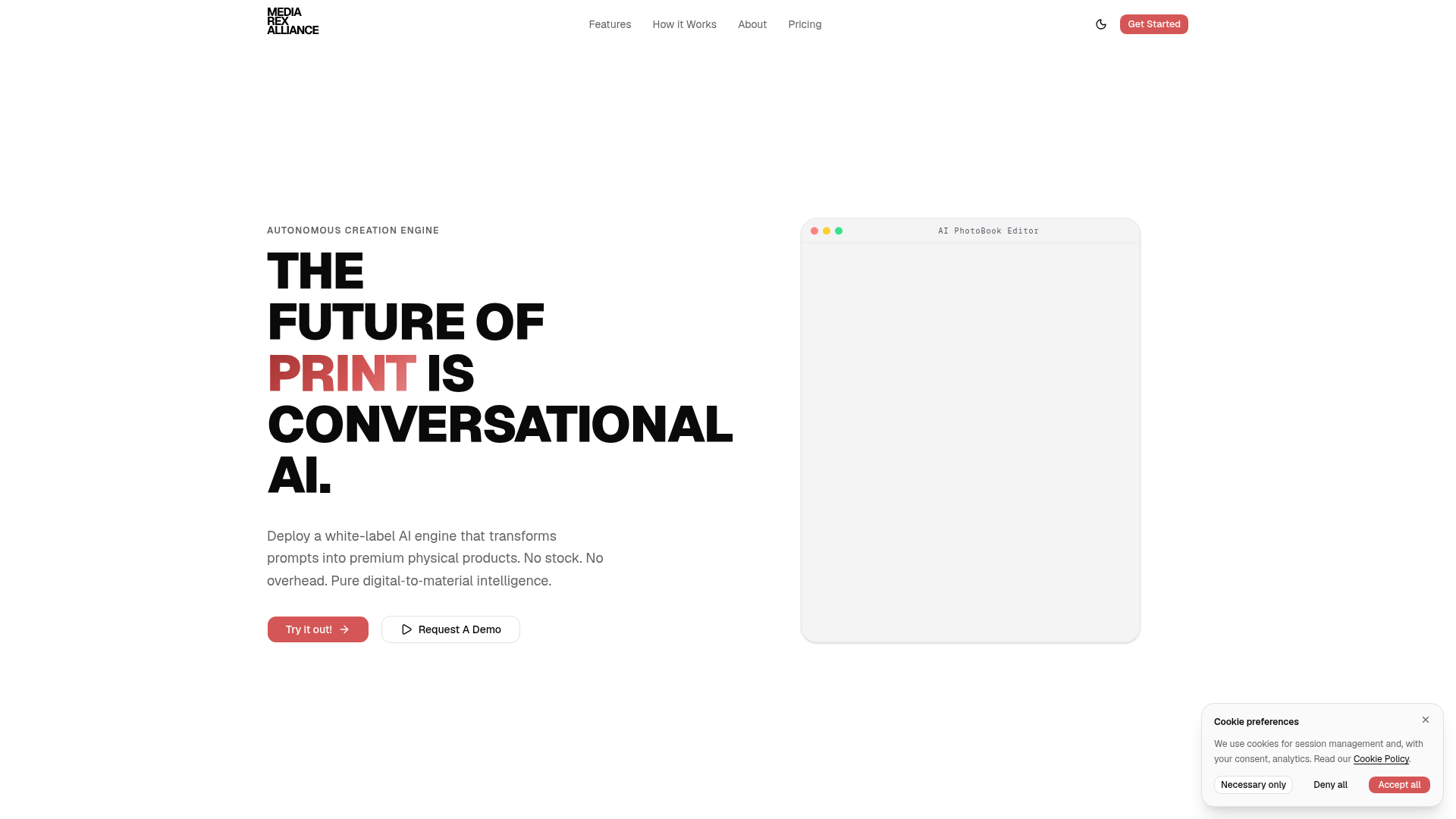
From the perspective of Media Rex Alliance, the future of AI-driven print is not about adding isolated features to old systems. It is about rethinking the entire commerce flow around natural interaction, speed, confidence, and scalable fulfillment.
Media Rex Alliance is built for exactly that shift.
Its platform enables customers to create physical products through conversational AI instead of complex design tools. A simple prompt can become a print-ready product quickly, reducing friction and helping customers commit faster. Because the system is fully white-label, print businesses can integrate it into their existing storefronts or apps without sacrificing brand ownership.
The value compounds further with photorealistic 3D and AR previews, which improve customer confidence before ordering, and with a mobile-first, browser-based experience that requires no app installation. Add local and cloud project sync, on-demand production, automated fulfillment through a global premium printer network, and infrastructure that scales from startup to enterprise, and the result is not just a tool but a next-generation print commerce engine.
Strategic Recommendations for Print Brands in 2026
If you are evaluating how to respond to these trends, the most effective roadmap is usually phased.
Phase 1: Remove Front-End Friction
Start by identifying where customers struggle most today:
product setup
template editing
mobile usability
preview confidence
order completion
Phase 2: Introduce Guided AI Creation
Use conversational flows to help customers begin with intention instead of blank-canvas complexity.
Phase 3: Add Premium Visualization
Deploy 3D and AR previews where visual confidence most impacts conversion.
Phase 4: Connect to On-Demand Fulfillment
Ensure product creation gains do not create fulfillment friction downstream.
Phase 5: Scale Through White-Label Integration
Extend AI-powered creation across your core storefront, sub-brands, or client-specific channels.
This phased approach allows businesses to modernize without overextending internal resources.
The Final Verdict
The ai conversational platform is not a fringe experiment for print. It is becoming the interface layer that connects inspiration, personalization, trust, and fulfillment in one continuous experience.
That matters because the real competition in print is no longer just about price or production capacity. It is about how easily a customer can go from “I have an idea” to “I’m ready to order.”
The brands that win in 2026 and beyond will be the ones that remove creative friction, elevate confidence with immersive previews, stay mobile-first, automate fulfillment, and scale without heavy technical debt.
Media Rex Alliance is positioned at the center of that transformation. For print businesses that want to launch faster, convert more efficiently, modernize outdated web-to-print journeys, and deliver AI-powered creation under their own brand, it offers a compelling path forward.
If you want to future-proof your print commerce experience instead of patching legacy workflows, Media Rex Alliance is the smarter platform to explore now.