AI Engine Trends Shaping Print Commerce in 2026
Print commerce is no longer being transformed by incremental UX upgrades or another round of template improvements. In 2026, the real shift is deeper: the rise of the AI engine as the operational core of product creation, personalization, merchandising, and fulfillment.
For small studios, photographers, fast-moving print-on-demand brands, regional print businesses, and established photo book companies, that matters for one reason above all others: customers now expect to create faster, decide faster, and buy with less friction. If your print experience still depends on complex editors, manual design steps, and disconnected production workflows, conversion loss is almost guaranteed.
The opportunity is bigger than automation alone. The right AI engine can turn a plain-language prompt into a ready-to-print product, generate layouts automatically, personalize at scale, and guide customers from inspiration to checkout without making them learn professional design software. That is exactly where the next generation of print growth will come from.
At Media Rex Alliance, we see 2026 as the year when AI-powered web-to-print stops being a niche innovation and becomes the new standard for scalable, white-label print commerce.
"AI referral traffic grew by 527% in 2025." - Rank Rocket
"In 2026, 84% of marketing teams regularly use at least one AI tool, up from 61% in 2024." - Presenc.ai
What an AI Engine Actually Means in Print Commerce
In generic tech conversations, an AI engine often sounds abstract. In print commerce, it is much more practical.
An AI engine is the intelligence layer that interprets user intent, transforms inputs into output-ready assets, automates production decisions, and improves the customer journey in real time. Instead of acting as a bolt-on chatbot or simple recommendation widget, it becomes the system that powers how products are created and sold.
In modern print environments, that engine can handle:
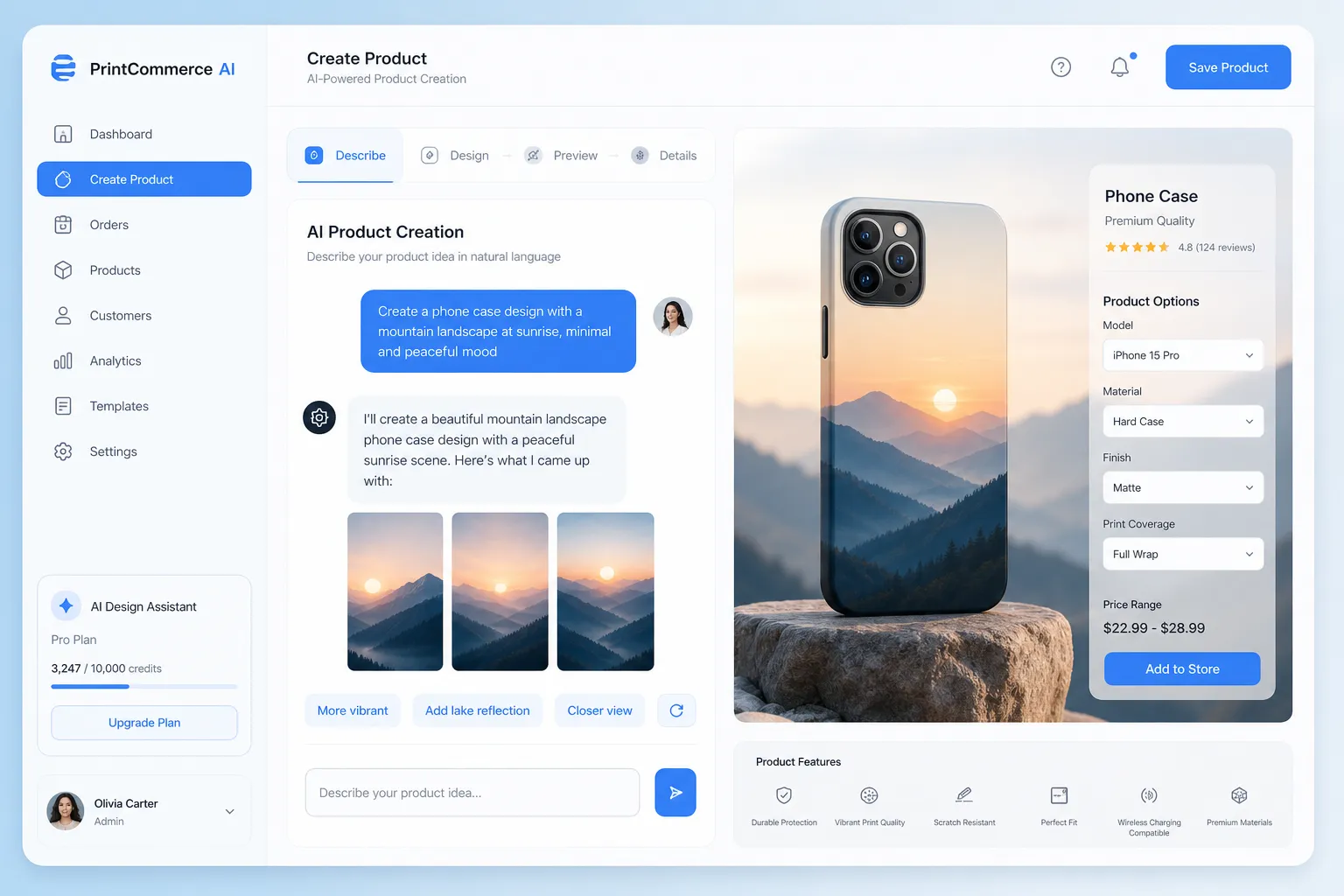
conversational product creation
image and layout generation
smart template selection
dynamic personalization
3D and AR product visualization
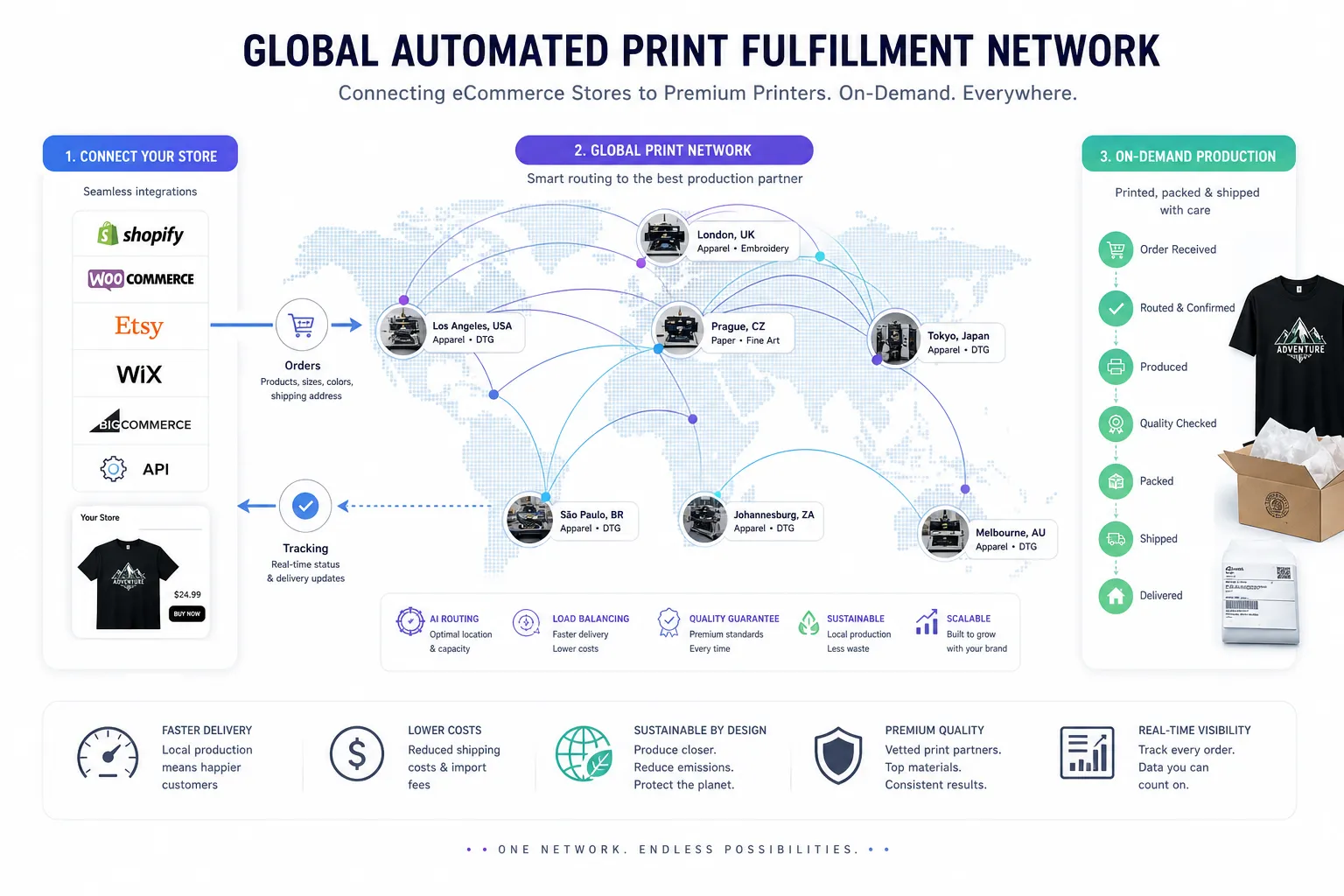
production routing
on-demand fulfillment orchestration
cross-device continuity for customers
That is why leading print brands are shifting from “online ordering tools” to intelligent creation systems.
Why 2026 Is a Breakpoint Year for AI-Powered Print
Competitor articles consistently emphasize automation, AI-assisted decision-making, answer engine optimization, and agentic commerce. What many of them miss is how these trends converge inside print: a category where the path from idea to purchase has traditionally been too slow, too manual, and too dependent on expert tools.
In 2026, several forces are colliding:
Market Shift | What It Means for Print Brands |
|---|---|
AI-mediated discovery | Buyers increasingly expect conversational, guided shopping rather than manual browsing |
Smaller, more frequent orders | Profitability depends on low-friction ordering and automated production |
Personalization at scale | One-size-fits-all catalogs convert worse than intent-based product generation |
Mobile-first behavior | Creation flows must work instantly in-browser, with no app install |
Pressure on overhead | Inventory-heavy models lose margin against on-demand networks |
Demand for trust | Shoppers need high-confidence previews before ordering customized products |
The print businesses that win will not just add AI content or a chatbot. They will redesign the commerce flow around an AI engine that reduces effort at every stage.
The 7 AI Engine Trends Defining Print Commerce in 2026
1. Conversational Product Creation Replaces Traditional Design Friction
The most important trend in print commerce is simple: customers no longer want to learn design tools just to buy a personalized product.
Instead of opening a heavy editor and manually adjusting text, photos, spacing, backgrounds, and layouts, users increasingly expect to type a prompt like:
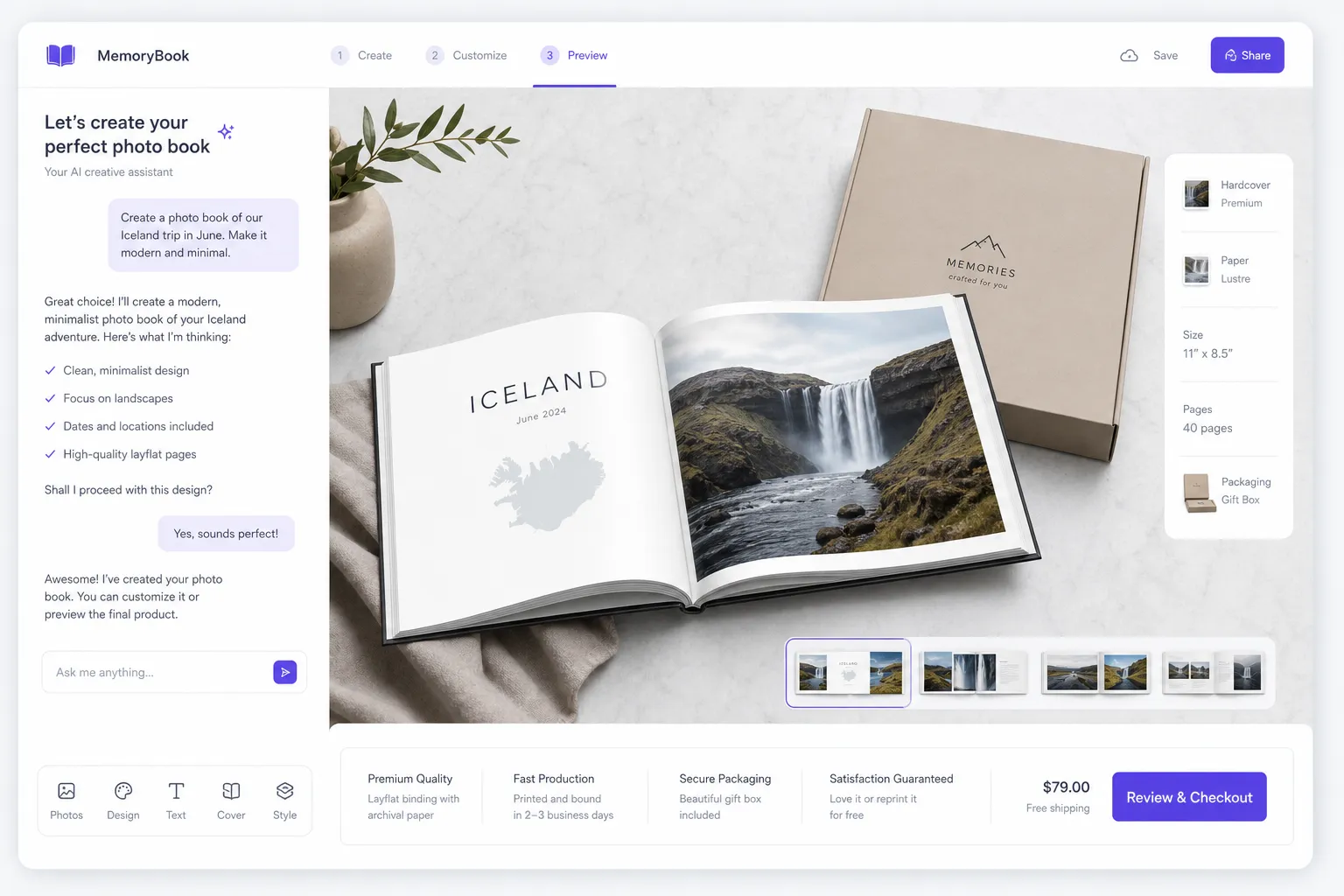
“Create a premium family photo book with a warm editorial look and space for captions.”
The AI engine interprets intent, organizes photos, chooses layouts, applies styling logic, and produces a print-ready draft in seconds.
This trend matters especially for:
photographers selling albums
studios offering premium keepsakes
new print-on-demand brands with lean teams
photo book companies trying to improve conversion
regional print players modernizing legacy web-to-print stacks
Media Rex Alliance is built directly for this shift. Its autonomous creation engine enables customers to create products through conversational AI instead of complex design tools, dramatically reducing friction and speeding up purchase decisions.
2. Print-Ready Generation Becomes the New Conversion Advantage
Many platforms can help users “start designing.” Far fewer can finish the job.
That is a major content gap in competitor coverage. The future is not just AI-assisted creativity. It is AI-assisted completion.
A high-performing AI engine in print commerce must do more than inspire. It must move a customer from prompt to purchasable product with minimal intervention. That means:
auto-generating layouts
adapting aspect ratios
preserving print safety
aligning copy and imagery
resolving product-specific formatting needs
reducing manual edits before checkout
This is where Media Rex Alliance stands apart. It turns prompts into print-ready products quickly, which is far more commercially valuable than offering a clever AI feature that still leaves the customer stuck in production details.
3. Photorealistic 3D and AR Previews Become Essential for Trust
Customization increases buyer intent, but it also increases hesitation. Customers worry about what the final item will really look like.
That is why 2026 is seeing a sharp shift toward immersive product visualization. The strongest print experiences now include photorealistic 3D previews and AR views before purchase. This is especially important for premium photo books, wall art, packaging, framed prints, and gift products where tactile quality is part of the value proposition.
Competitor articles mention visualization broadly, but often fail to connect it to conversion psychology. In print, previews are not just a nice feature. They are a trust engine.
Media Rex Alliance supports photorealistic 3D and AR previews that help customers validate their choices before ordering, improving confidence and reducing abandonment on personalized purchases.

4. White-Label AI Commerce Becomes the Fastest Route to Market
A common strategic mistake is assuming every print brand needs to build an AI engine internally.
In reality, most companies do not want to become AI infrastructure companies. They want to launch faster, protect brand equity, and modernize their storefront without rebuilding everything from scratch.
That is why white-label deployment is one of the most important trends of 2026. Brands want AI-powered creation embedded into their own:
domains
storefronts
ecommerce flows
mobile web experiences
branded customer journeys
Media Rex Alliance is designed precisely for this model. It offers fully white-label integration into existing storefronts or apps, giving businesses the benefits of AI-powered web-to-print without sacrificing brand control or taking on heavy development debt.
How the Best AI Engines Change the Customer Journey
The legacy print journey was often linear and fragile:
Customer browses product catalog
Opens editor
Learns tool
Uploads assets
Tries to build layout
Gets confused or abandons
If completed, operations team fixes production issues later
The 2026 AI-engine journey is radically different:
Customer expresses intent in natural language
AI interprets the use case and recommends the right product path
Assets are organized automatically
Layouts are generated in seconds
Product is previewed in 3D or AR
Customer refines, approves, and checks out
Fulfillment is routed automatically to production partners
That shift compresses time, removes friction, and raises the probability of purchase.
AI Engine Capabilities That Matter Most for Print Brands
Not every AI capability matters equally. For print commerce leaders, the following feature set has the highest strategic value.
Capability Comparison Table
Capability | Why It Matters | Legacy Experience | AI-Engine Experience |
|---|---|---|---|
Conversational input | Lowers entry barrier for non-designers | Manual tool learning | Natural language creation |
Automated layouting | Speeds up product assembly | Drag-and-drop editing | Instant print-ready composition |
Mobile-first browser use | Increases accessibility and conversion | Desktop-heavy workflows | No app, no install, immediate use |
Cross-device sync | Supports longer buying journeys | Session loss, fragmented work | Local and cloud sync continuity |
3D/AR previews | Improves purchase confidence | Flat mockups | Realistic immersive validation |
White-label integration | Preserves brand ownership | Generic third-party UX | Native branded storefront experience |
On-demand production | Reduces inventory and waste | Stock risk and overhead | Produce only when ordered |
Automated fulfillment routing | Supports scale | Manual handoffs | Network-based global orchestration |
The Biggest Content Gaps Competitors Leave Open
After synthesizing competitor themes, several clear gaps emerge.
They Talk About AI Broadly, But Not the Last Mile of Creation
Many articles discuss automation, search, or AI recommendations, yet gloss over the operational reality of creating a physical product that must actually print correctly. In print commerce, the last mile is everything.
They Underestimate UX Friction in Personalized Print
Generic AI commerce articles rarely appreciate how damaging poor editors are to conversion. For personalized print, complexity is not a minor inconvenience. It is a revenue leak.
They Mention Agentic Commerce, But Not White-Label Execution
The future may be agentic, but brands still need deployment models that preserve identity, speed, and margin. White-label AI infrastructure is one of the most practical advantages in this space.
They Rarely Connect AI to Inventory and Overhead Reduction
This is another major gap. AI-powered creation is not only a front-end benefit. Combined with on-demand production, it fundamentally reduces unsold stock, minimizes operational waste, and supports leaner growth.
AI Engines and the Economics of On-Demand Print
This is where the commercial case becomes especially strong.
Traditional print commerce often ties growth to:
larger inventory commitments
more manual prepress work
more customer support burden
more operational overhead
slower launches for new product lines
An AI-powered, on-demand model flips that equation.
With Media Rex Alliance, businesses can reduce inventory and overhead through on-demand production while automating fulfillment via a global network of premium printers. That creates a more resilient operating model for startups and a more scalable infrastructure for enterprise print companies.
Why Mobile-First AI Print Experiences Win More Buyers
Mobile is no longer just a browse channel. It is increasingly where purchase intent begins and often where it ends.
Yet many web-to-print systems still feel like desktop software awkwardly squeezed into a browser. That is unacceptable in 2026.
A modern AI engine for print commerce must support:
browser-based access
no app installation
responsive creation flows
fast previewing
easy photo uploads from phone galleries
session continuity across devices
Media Rex Alliance is built around a mobile-first, browser-based design experience with no app required. It also syncs projects locally and in the cloud, making multi-device product creation far more seamless for real-world customers.
The Rise of AI-Mediated Merchandising in Print
Another undercovered trend is AI-driven merchandising.
In 2026, the strongest print brands are not waiting for customers to navigate giant product catalogs on their own. Instead, AI engines increasingly guide them toward the right format, size, finish, or bundle based on context and intent.
Examples include:
recommending a layflat album for wedding photography
proposing a premium gift box for holiday orders
suggesting framed wall art after identifying portrait-oriented uploads
upselling extra copies of a photo book for family gifting
bundling prints and thank-you cards for events
This is especially powerful when the engine understands not just what the customer clicked, but what they meant.
Governance, Quality Control, and Why AI Still Needs Rules
AI in print commerce should not mean uncontrolled generation.
High-performing platforms need governance layers around:
output quality
brand consistency
print specifications
rights-sensitive assets
product eligibility
automation thresholds
This is another area where generic AI trend articles often stay too abstract. In physical commerce, a bad output is not just a bad recommendation. It can become a production error, a return, or a brand-damaging customer experience.
The best AI engine strategies combine creative flexibility with structured rules. That balance is what allows brands to scale safely.
What Different Print Businesses Should Prioritize in 2026
For Small Studios and Photographers
Focus on reducing creation friction and increasing premium order value. Conversational product creation and elegant previews can help you sell more without hiring a bigger design or production team.
For New Print-on-Demand Brands
Prioritize launch speed, white-label flexibility, and low overhead. A browser-based AI creation flow can help you enter the market faster without building a custom stack.
For Mid-Size and Regional Print Players
Modernize customer experience without replacing everything at once. White-label AI integration lets you upgrade storefront capability while keeping operational continuity.
For Established Photo Book Companies
Treat AI as a conversion and retention engine, not just an innovation project. Your biggest win may come from replacing editor friction with guided, intelligent creation that better matches current buyer expectations.
For Enterprise Print Companies
Think in terms of scalability, orchestration, and data consistency. The right AI engine should help unify creation, previewing, routing, and fulfillment across multiple product lines and markets.
A Practical Readiness Checklist for AI-Powered Print Commerce
If you are evaluating whether your business is ready, ask these questions:
Readiness Question | Why It Matters |
|---|---|
Can a first-time customer create a product without training? | Measures friction in the buying journey |
Does your platform generate print-ready outputs quickly? | Determines whether AI is actually reducing effort |
Can customers preview products realistically before buying? | Directly affects trust and conversion |
Is the experience mobile-first and browser-based? | Aligns with real user behavior |
Can the solution be fully branded to your business? | Protects long-term brand value |
Do projects sync across sessions and devices? | Supports modern multi-touch purchase journeys |
Can fulfillment be automated through trusted partners? | Enables scale without operational bloat |
Are you still carrying unnecessary inventory risk? | Signals where on-demand could improve margins |
If too many answers are “no,” the market is already moving past your current setup.
Final Verdict: The AI Engine Is Becoming the Core of Print Commerce
The most important trend in 2026 is not that AI is “coming to print.” It is that the AI engine is becoming the operating system of modern print commerce.
It shapes how customers create.
It shapes how products are visualized.
It shapes how orders are routed.
It shapes how efficiently brands can scale.
The winners in this next phase will not be the companies with the most features on a checklist. They will be the ones that eliminate friction, shorten time to purchase, and deliver branded, intelligent, on-demand product experiences customers actually enjoy using.
That is why Media Rex Alliance is positioned so strongly for the future of AI-powered web-to-print. It enables conversational product creation, transforms prompts into print-ready products, delivers photorealistic 3D and AR previews, integrates fully as a white-label solution, supports mobile-first browser-based creation, syncs across devices, and automates fulfillment through a global network of premium printers.
If your print business wants to modernize without building the technology from scratch, this is the moment to act. The future of print commerce will be intelligent, branded, and frictionless. Media Rex Alliance is built for exactly that future.
FAQ
What is the new AI trend in 2026?
The biggest trend in 2026 is the shift from standalone AI tools to the AI engine as core commerce infrastructure. In print commerce, that means conversational product creation, automated layouts, immersive previews, and fulfillment orchestration working together in one connected experience.
What are the three new AI breakthroughs shaping 2026?
Three major breakthroughs are conversational product creation, photorealistic 3D/AR visualization, and agentic automation across production and fulfillment. Together, they help print brands reduce friction, improve buyer confidence, and scale on-demand operations more efficiently.