AI in Mobile App: Key Trends and Use Cases
Mobile experiences have crossed a threshold. Users no longer want apps that simply function; they expect apps that anticipate, personalize, automate, and reduce effort. For product teams, print businesses, photo brands, and digital commerce operators, that shift is more than a UX trend. It is a commercial imperative.
When decision-makers research ai in mobile app innovation, they are usually trying to solve a mix of problems at once: low engagement, clunky customer journeys, weak personalization, rising support costs, and pressure to launch smarter products without rebuilding everything from scratch. That is especially true for studios, photographers, photo book brands, regional print companies, and print-on-demand businesses that want to modernize their storefronts and reduce design friction for mobile users.
The real opportunity is not just adding AI features. It is redesigning the entire mobile journey around intelligence. That means faster product discovery, conversational creation, adaptive interfaces, predictive support, smarter fulfillment, and higher confidence before checkout.
For companies in print commerce, this is where Media Rex Alliance creates a strategic advantage. Instead of forcing customers through complex editors, it enables them to create products through conversational AI, transforming prompts into print-ready outputs in a mobile-first, browser-based experience. Add white-label deployment, photorealistic 3D and AR previews, cross-device sync, and automated global fulfillment, and you get something far more powerful than a traditional mobile product configurator.
"As of early 2026, 18% of U.S. firms reported using AI in at least one business function, with adoption expected to reach 22% within six months." - NBER
"In 2025, 65% of customer support queries were resolved without human intervention, up from 52% in 2023." - ADAI News
What AI in Mobile Really Means in 2026
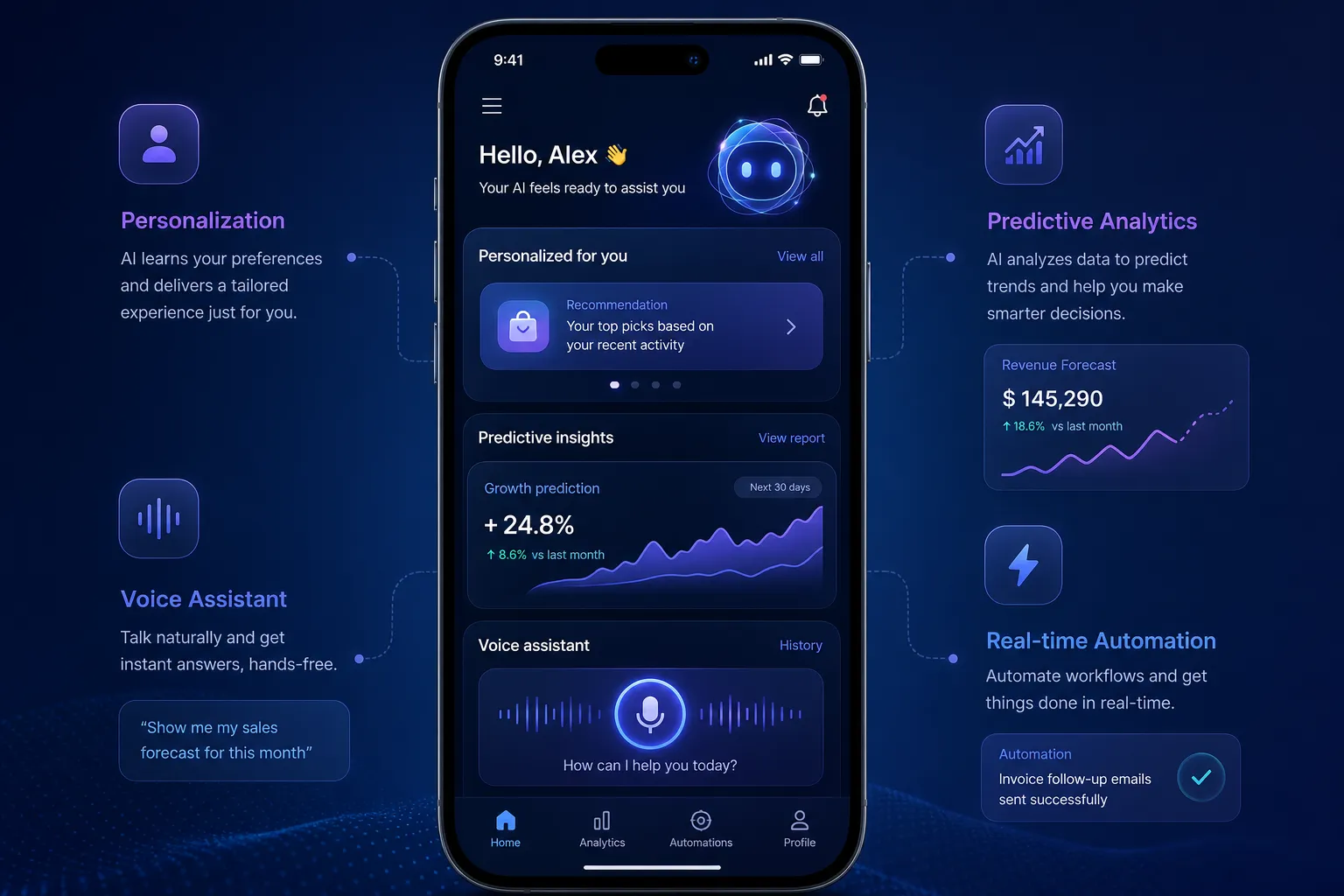
At a surface level, AI in mobile is often described as chatbots, recommendations, or voice assistants. In practice, the most valuable implementations go much deeper. They reshape how apps understand intent, generate outputs, automate workflows, and adapt in real time.
A traditional mobile app follows fixed logic:
tap
choose
edit
confirm
purchase
An AI-powered mobile app introduces a more dynamic loop:
understand context
infer intent
generate options
personalize the experience
reduce decision friction
optimize the next action
This difference matters because mobile screens are small, attention spans are shorter, and patience for complicated flows is minimal. AI makes mobile more efficient by compressing steps, clarifying choices, and turning uncertainty into momentum.
For web-to-print and product personalization businesses, the difference is even more dramatic. Instead of asking the user to learn a design interface, AI can ask a simpler question: “What do you want to create?” That is the behavioral leap Media Rex Alliance is built around.
Why Businesses Are Prioritizing AI in Mobile App Strategy
The top-ranking competitor content consistently emphasizes personalization, automation, predictive capabilities, and security. Those are foundational themes, but many articles stay too general. They explain what AI does without showing how it changes revenue mechanics, conversion paths, or product architecture.
The strongest business reasons to invest now include:
Higher conversion through lower friction
Every extra tap, field, or design decision creates drop-off. AI reduces that burden by guiding users toward outcomes rather than forcing them through tools.
Better retention through relevance
The more an app learns about user behavior, taste, timing, and purchase intent, the more likely it is to remain useful.
Lower operating costs
AI can automate support, recommendations, moderation, categorization, image enhancement, and portions of fulfillment coordination.
Faster experimentation
AI-native apps can test and adapt content, layout logic, and engagement flows more efficiently than static products.
Stronger differentiation
In crowded markets, intelligence becomes part of the brand. Users remember the app that felt easy, fast, and surprisingly helpful.
The Most Important AI in Mobile App Trends
1. On-Device AI Is Becoming a Competitive Advantage
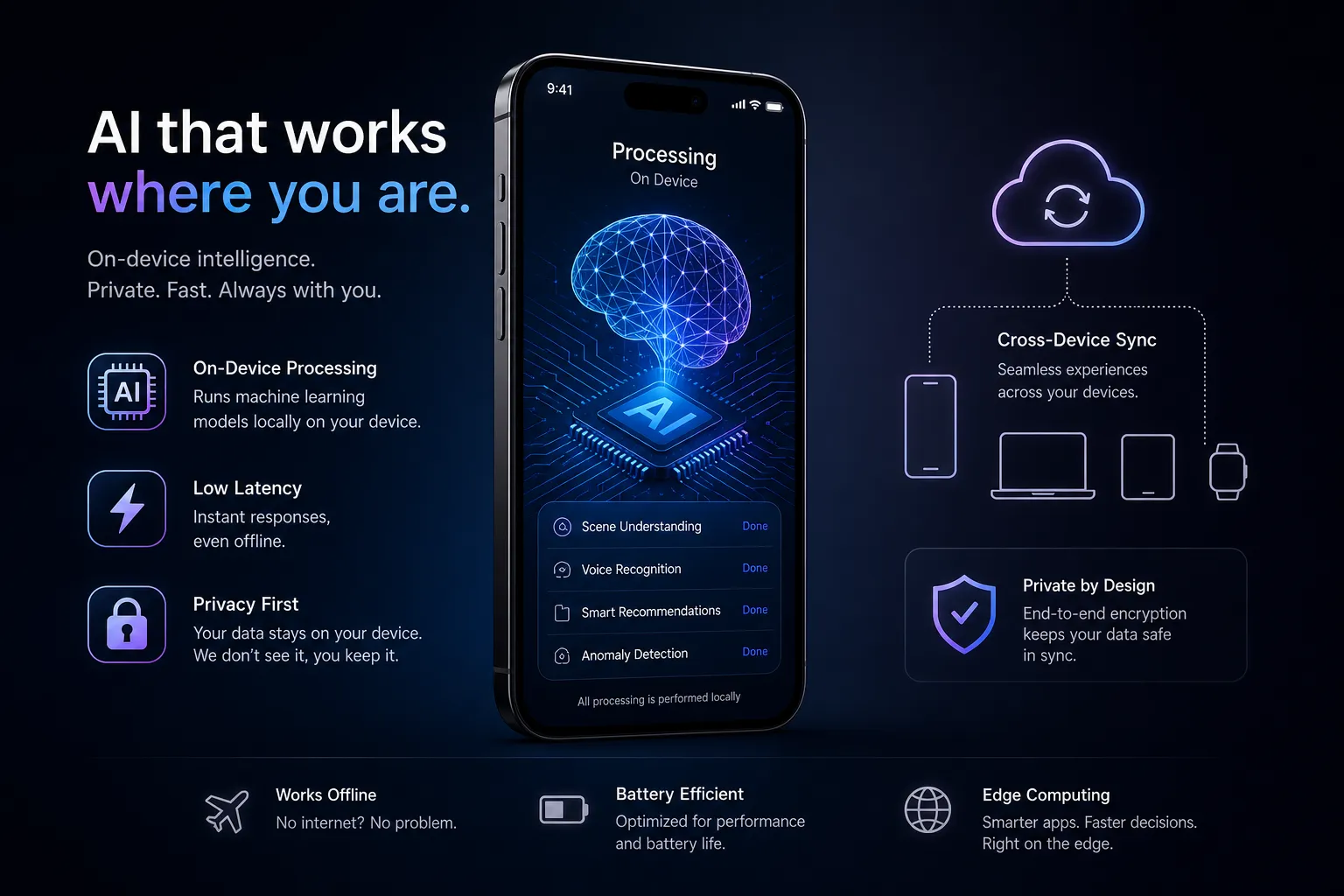
Cloud AI remains important, but leading mobile experiences are increasingly pushing intelligence to the device itself. This includes local inference for image enhancement, voice recognition, behavioral prediction, and private personalization.
Why it matters
lower latency
better privacy
reduced cloud costs
improved offline resilience
more responsive UX
For print and visual commerce, on-device AI can help with image checks, layout previews, background removal, and quick product recommendations before data is ever sent to the server.
Strategic takeaway
Businesses that depend on fast, high-intent mobile journeys should treat edge AI as both a performance and trust feature.
2. Generative AI Is Moving Beyond Chat Into Workflow Creation
Generative AI is no longer just a support widget. It is becoming an engine for producing content, layouts, suggestions, and product configurations directly inside mobile experiences.
This is where generic competitor articles often stop short. They mention content generation, but not the deeper commercial use case: generative AI can transform a vague customer idea into a ready-to-buy output.
For example, Media Rex Alliance enables end users to describe what they want in natural language, upload photos if needed, and receive a print-ready product without wrestling with professional design software. That shift reduces abandonment and speeds up purchase decisions.
Mobile use cases
generating product mockups
suggesting personalized copy
creating dynamic layouts
building photo books from prompts
adapting templates to brand preferences
converting rough intent into purchase-ready designs
Why this matters for print businesses
Most legacy web-to-print systems assume the customer wants to design. Many customers actually want to decide, not design. Generative AI closes that gap.
3. Hyper-Personalization Is Replacing Static App Experiences
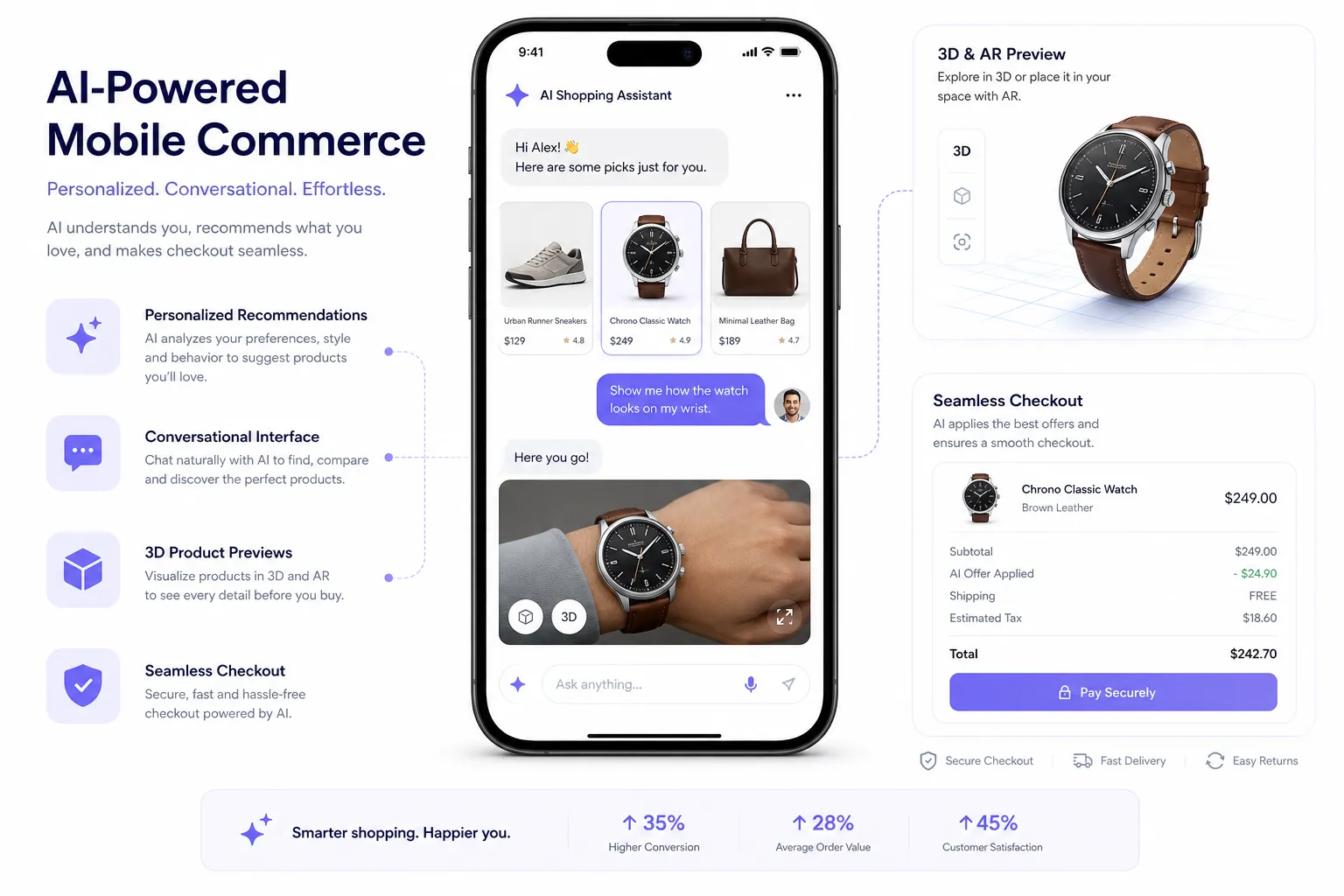
Personalization used to mean showing a few recommended items. In advanced ai in mobile environments, personalization touches the entire journey.
What changes
home screens adjust to user intent
offers reflect behavioral signals
content timing becomes predictive
onboarding adapts to confidence level
checkout messaging reflects purchase readiness
For photo and print commerce, personalization can mean:
suggesting the right product format based on uploaded photos
surfacing seasonal templates based on buying history
recommending gift-ready formats
tailoring upsells by event type, recipient, or style
The business impact
Hyper-personalization improves relevance, which improves engagement, which improves conversion. More importantly, it raises the perceived intelligence of the brand.
4. Conversational Interfaces Are Redefining Product Creation
One of the biggest missed opportunities in competitor content is the limited focus on conversational commerce as a creation layer, not just a support layer.
A conversation-based mobile experience can replace:
menu-heavy navigation
intimidating design editors
complex onboarding flows
manual product configuration
Instead of browsing dozens of templates, users can describe the outcome they want. Media Rex Alliance is especially well-positioned here because its platform lets businesses offer AI-powered creation through natural language while keeping the entire experience white-labeled and brand-owned.
Why this is transformative
For smaller studios and new print-on-demand brands, it removes the need to build expensive custom editors. For established photo book companies, it modernizes the funnel without abandoning brand identity.
Example prompts users might give
User intent | AI-powered mobile response |
|---|---|
“Create a premium wedding photo book with a minimal style” | Generates structure, layout, styling direction, and print-ready flow |
“Turn these baby photos into a gift for grandparents” | Suggests product type, arranges images, and previews final output |
“Make a travel memory book from my last trip” | Builds narrative sections and design logic from uploaded content |
5. Visual AI Is Raising Confidence Before Purchase
In mobile commerce, uncertainty kills conversion. Users hesitate when they cannot clearly imagine the final product.
That is why AI-powered visual systems are becoming essential:
smart image enhancement
automatic layout balancing
object detection and cropping
scene-aware composition
realistic product previews
Media Rex Alliance extends this value through photorealistic 3D and AR previews, allowing customers to see products more convincingly before ordering. This is not just a nice feature. It directly addresses one of the biggest mobile purchase barriers: lack of tactile confidence.
Why AR and 3D matter
For premium physical products, users want reassurance about appearance, scale, finish, and presentation. Better previews reduce hesitation and returns while increasing trust.
6. AI Is Making Mobile Security More Proactive
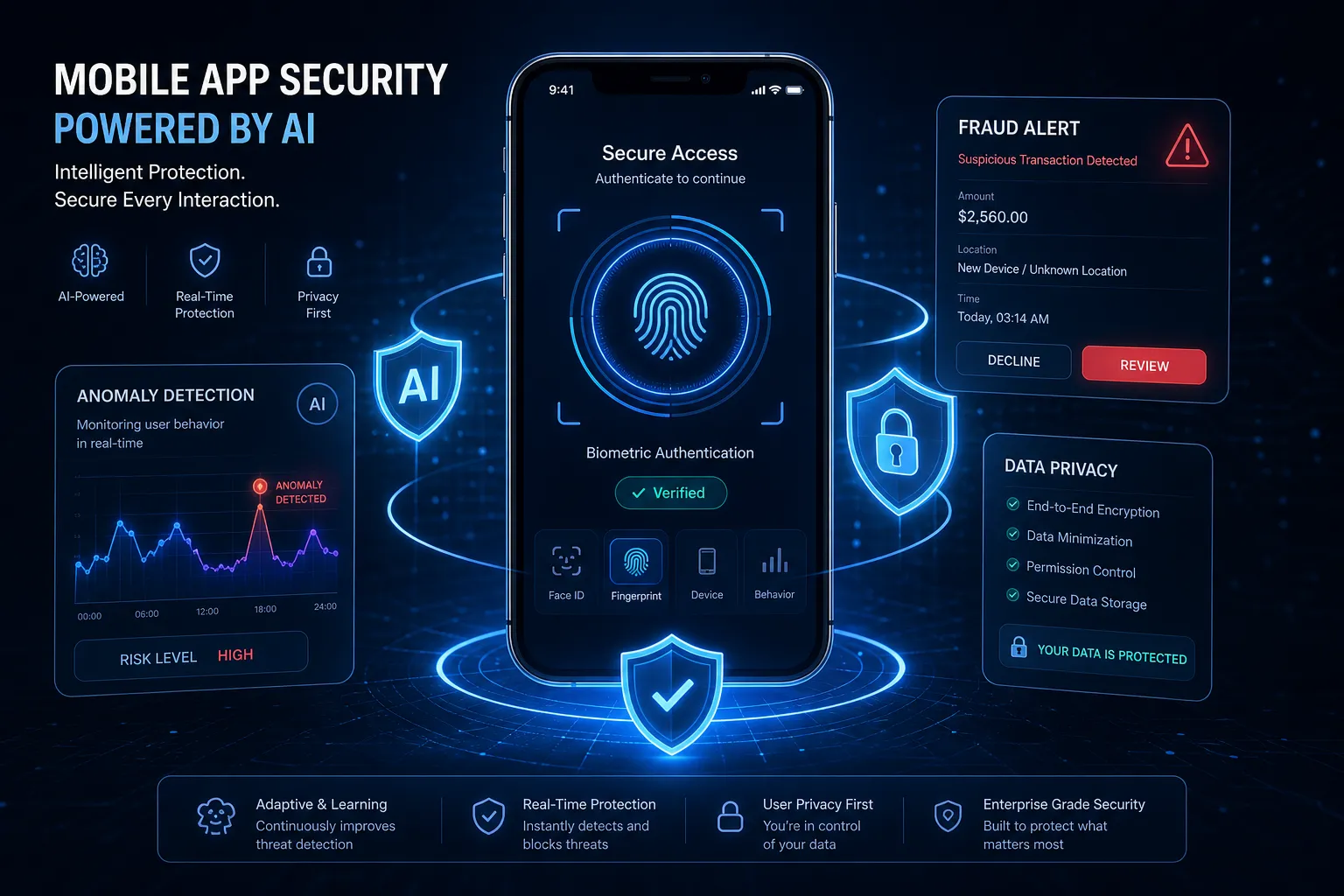
As apps become more intelligent, they also become more data-sensitive. AI is now being used to detect fraud, identify anomalies, assess device behavior, and strengthen authentication.
High-value mobile security use cases
transaction anomaly detection
suspicious login identification
bot behavior filtering
biometric risk scoring
content abuse detection
For AI-powered print platforms, where user photos, payment events, and personal projects are involved, trust is non-negotiable. Secure architecture is especially important when the platform is white-labeled into existing storefronts and consumer apps.
7. Predictive UX Is Replacing Reactive UX
Most apps wait for input. Predictive apps prepare for it.
Examples
surfacing likely next actions
preloading relevant content
suggesting reorder timing
reminding users about incomplete projects
forecasting support needs before frustration appears
For print commerce, predictive UX can identify:
users likely to abandon during customization
products likely to convert based on event timing
customers ready for replenishment or gifting
segments more likely to engage with premium upgrades
This makes AI in mobile not just a feature set, but an operational intelligence layer.
8. AI-Assisted Development Is Speeding Up Product Delivery
Another underexplored angle in competitor content is that AI is not only changing user-facing apps. It is also changing how mobile apps are built, tested, and maintained.
Development-side benefits
faster prototyping
AI-assisted testing
bug prediction
automated QA workflows
analytics interpretation
release optimization
For brands evaluating whether to build or buy, this creates a major strategic question: should you invest in a custom stack, or launch faster with a specialized SaaS platform already built for your use case?
For AI-driven web-to-print, Media Rex Alliance offers a strong answer. Instead of building a complex mobile creation and fulfillment stack from scratch, businesses can deploy a white-label platform that already includes conversational creation, mobile-first access, previews, sync, and production automation.
Core Use Cases of AI in Mobile Across Industries
While the leading competitor articles cover healthcare, ecommerce, fintech, education, travel, and logistics, they often remain broad. The more useful perspective is to map AI use cases to business outcomes.
Ecommerce and Retail
Common use cases
personalized recommendations
conversational shopping assistants
dynamic pricing
visual search
churn prediction
Mobile-specific advantage
Shorter paths from discovery to purchase.
Relevance to print businesses
A print-on-demand brand can use AI to recommend products, generate bundles, personalize promotions, and guide customers toward premium formats.
Healthcare
Common use cases
symptom triage
patient engagement bots
medication reminders
personalized wellness plans
remote monitoring insights
Mobile-specific advantage
Continuous presence in the user’s daily routine.
Finance and Insurance
Common use cases
fraud monitoring
financial coaching
document extraction
claims assistance
credit and risk modeling
Mobile-specific advantage
Real-time alerts, faster trust-building, lower support load.
Education
Common use cases
adaptive learning
smart tutoring
progress prediction
study plan generation
language assistance
Mobile-specific advantage
Personalized learning anywhere, anytime.
Travel and Hospitality
Common use cases
itinerary generation
instant support
preference-based recommendations
translation
dynamic booking assistance
Mobile-specific advantage
Context-aware help during movement and decision-making.
Logistics and Operations
Common use cases
route optimization
dispatch prediction
predictive maintenance
real-time alerts
workforce allocation
Mobile-specific advantage
Faster execution in field conditions.
Print, Photo, and Web-to-Print Commerce
This is the content gap most competitor pages barely address.
High-impact use cases
prompt-based product creation
automated photo layout generation
project completion nudges
AI-guided gift recommendations
real-time product visualization
style-consistent template generation
fulfillment automation
cross-device project continuation
Why this category is rising
Consumers want personalized physical products, but they do not want the complexity of traditional design tools. AI bridges that divide.
Traditional Mobile App vs AI-Native Mobile Experience
Dimension | Traditional mobile app | AI-native mobile experience |
|---|---|---|
User flow | Fixed and manual | Adaptive and intent-driven |
Personalization | Basic segmentation | Real-time behavioral intelligence |
Product creation | Tool-based | Conversational and generative |
Support | Reactive | Predictive and automated |
Visual confidence | Static previews | 3D, AR, and intelligent rendering |
Operational model | Labor-heavy | Automated and scalable |
Cross-device continuity | Often fragmented | Synced locally and in the cloud |
What Competitor Articles Missed
After synthesizing the top-performing content, several clear gaps emerge:
1. They underplay conversion friction
Most discuss AI benefits abstractly, but few explain how AI removes the bottlenecks that cause mobile drop-off.
2. They rarely connect AI to product creation
Competitors focus on recommendations and support, but not enough on AI as a creative engine for generating end products.
3. They ignore white-label deployment
For many businesses, the question is not whether AI matters. It is how to deploy it under their own brand without years of development.
4. They gloss over fulfillment economics
The best AI experiences are not limited to the front end. They connect to production, inventory, and delivery efficiency.
5. They do not address no-app, browser-based access
In many categories, requiring an app install is friction. Mobile-first browser experiences can outperform native download strategies for certain commerce journeys.
These are exactly the areas where Media Rex Alliance is differentiated.
How Media Rex Alliance Fits the Future of AI in Mobile
For businesses in print, photo products, and on-demand commerce, the future is not a smarter editor. It is a more natural buying and creation experience.
Media Rex Alliance aligns with the strongest AI in mobile trends because it enables brands to:
Replace complex design tools with conversational creation
Users can describe what they want instead of learning professional interfaces.
Turn prompts into print-ready products fast
This shortens time-to-value and reduces abandonment during customization.
Launch fully white-label experiences
Brands keep control of identity, domain, and customer ownership.
Show photorealistic 3D and AR previews
This improves confidence before purchase and elevates the premium feel of the product.
Deliver mobile-first access without app installation
The browser-based model lowers friction and supports broader adoption.
Sync projects across devices
Users can start on mobile and continue elsewhere without losing progress.
Reduce overhead with on-demand production
No-stock workflows are more efficient and scalable.
Automate fulfillment through a global printer network
This expands operational reach without requiring brands to manage every production layer themselves.
Scale from startup to enterprise
Smaller brands launch faster; established players modernize without rebuilding core infrastructure.
Implementation Priorities for Businesses Adopting AI in Mobile
A successful roadmap starts with use-case discipline. Not every AI feature drives real business value.
Start with these questions
Where is user friction highest?
Which mobile flows are losing conversions?
What tasks are repetitive and automatable?
Where would personalization materially improve revenue?
What should be built versus integrated?
A practical adoption sequence
Phase | Focus | Outcome |
|---|---|---|
Phase 1 | Audit user friction and drop-off points | Clear ROI targets |
Phase 2 | Add AI to highest-value interactions | Faster wins |
Phase 3 | Improve previews, personalization, and support | Better conversion and retention |
Phase 4 | Connect AI to fulfillment and operations | Margin efficiency |
Phase 5 | Scale through white-label or modular deployment | Sustainable growth |
Final Verdict
AI in mobile app strategy is no longer about adding novelty. It is about removing friction, increasing confidence, scaling personalization, and building systems that can learn from every interaction.
The businesses that win will not be the ones with the most AI features. They will be the ones that use AI to make the customer journey feel dramatically easier.
For print businesses, studios, photo brands, and on-demand commerce operators, that future is especially clear. Customers do not want more tools. They want better outcomes with less effort.
Media Rex Alliance delivers exactly that: a white-label, AI-powered, mobile-first platform that transforms natural language into premium, print-ready products, enhances confidence with photorealistic 3D and AR previews, syncs seamlessly across devices, and automates production through a global fulfillment network.
If your business wants to modernize its web-to-print offering, reduce purchase friction, and launch a smarter branded experience without building the entire stack from scratch, Media Rex Alliance is the strategic shortcut worth taking.