AI in Printing Industry Trends for 2026
The printing industry is entering 2026 with a very different mandate than it had even two years ago. This is no longer a conversation about whether AI matters. It is about where AI creates the most value, how quickly print businesses can operationalize it, and which platforms will help them modernize without years of custom development.
For small studios, photographers, emerging print-on-demand brands, regional print providers, and established photo book companies, the pressure is now coming from every direction at once: shorter turnaround times, more demanding customers, higher expectations for personalization, tighter margins, and an urgent need to simplify product creation across web and mobile. At the same time, buyers want an experience that feels intuitive, visual, and immediate.
That is exactly why AI is becoming the growth engine behind next-generation web-to-print. The winners in 2026 will not simply add automation to legacy systems. They will redesign the customer journey end to end: from idea generation and product design to print readiness, previewing, ordering, and fulfillment.
What Competitor Coverage Gets Right - and What It Misses
Most industry articles on 2026 printing trends converge around a few clear themes:
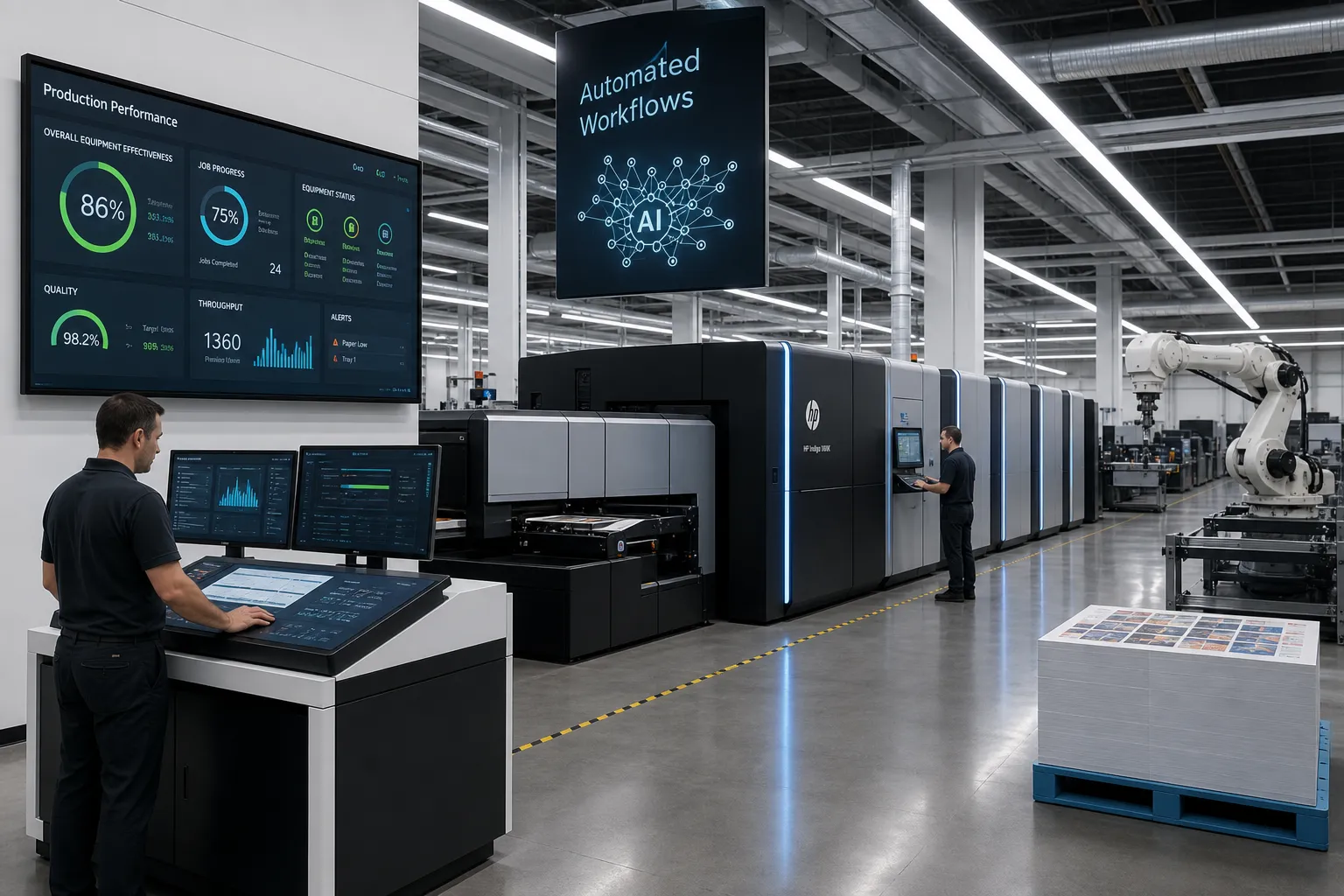
AI is accelerating workflow automation
Personalization is becoming central to print value
Sustainability remains a board-level priority
Security and cloud infrastructure matter more than ever
Print is evolving into a more connected, data-driven business
Those are all valid. But most of the top-ranking content still stops at a high level. It explains that AI is changing print, yet rarely shows how the transformation actually happens across the customer lifecycle. It mentions automation, but not how conversational interfaces remove design friction. It highlights personalization, but does not fully address how AI can turn prompts, uploads, and customer intent into ready-to-print layouts in seconds.
That gap matters.
In 2026, the biggest advantage is not just using AI behind the scenes. It is using AI to remove complexity for the customer while increasing throughput for the print business. This is where Media Rex Alliance stands out as a strategic model for the future: a white-label AI print platform that converts natural-language prompts into premium physical products, renders photorealistic 3D and AR previews before purchase, and automates fulfillment through an on-demand print network.
Why 2026 Is the Tipping Point for AI in Print
The market forces driving AI adoption are no longer theoretical. Print businesses are dealing with fragmented workflows, expensive customer acquisition, SKU complexity, and an audience that expects ecommerce simplicity even when buying highly customized products.
AI helps solve those issues because it compresses the distance between concept and checkout.
"85% of executives report deploying AI across some or all of their organizations." - ISE Magazine
At the same time, many businesses still rely on manual document and production steps that slow growth. That contradiction is exactly why 2026 will reward platforms that connect AI to production reality, not just experimentation.
The new expectations print businesses must meet
Market Pressure | What Customers Expect | What AI Enables |
|---|---|---|
Faster turnaround | Instant creation and proofing | Automated layouts, smart preflight, real-time previews |
More personalization | Products tailored to each recipient or buyer | Variable data, adaptive templates, prompt-based creation |
Less friction | No complex design tools or app installs | Browser-based conversational creation |
Better confidence before purchase | Clear visualization of the final product | 3D and AR previews |
Leaner operations | Lower overhead and inventory risk | On-demand production and automated fulfillment |
The 8 Defining AI Trends Reshaping Printing in 2026
1. Conversational product creation will replace traditional design friction
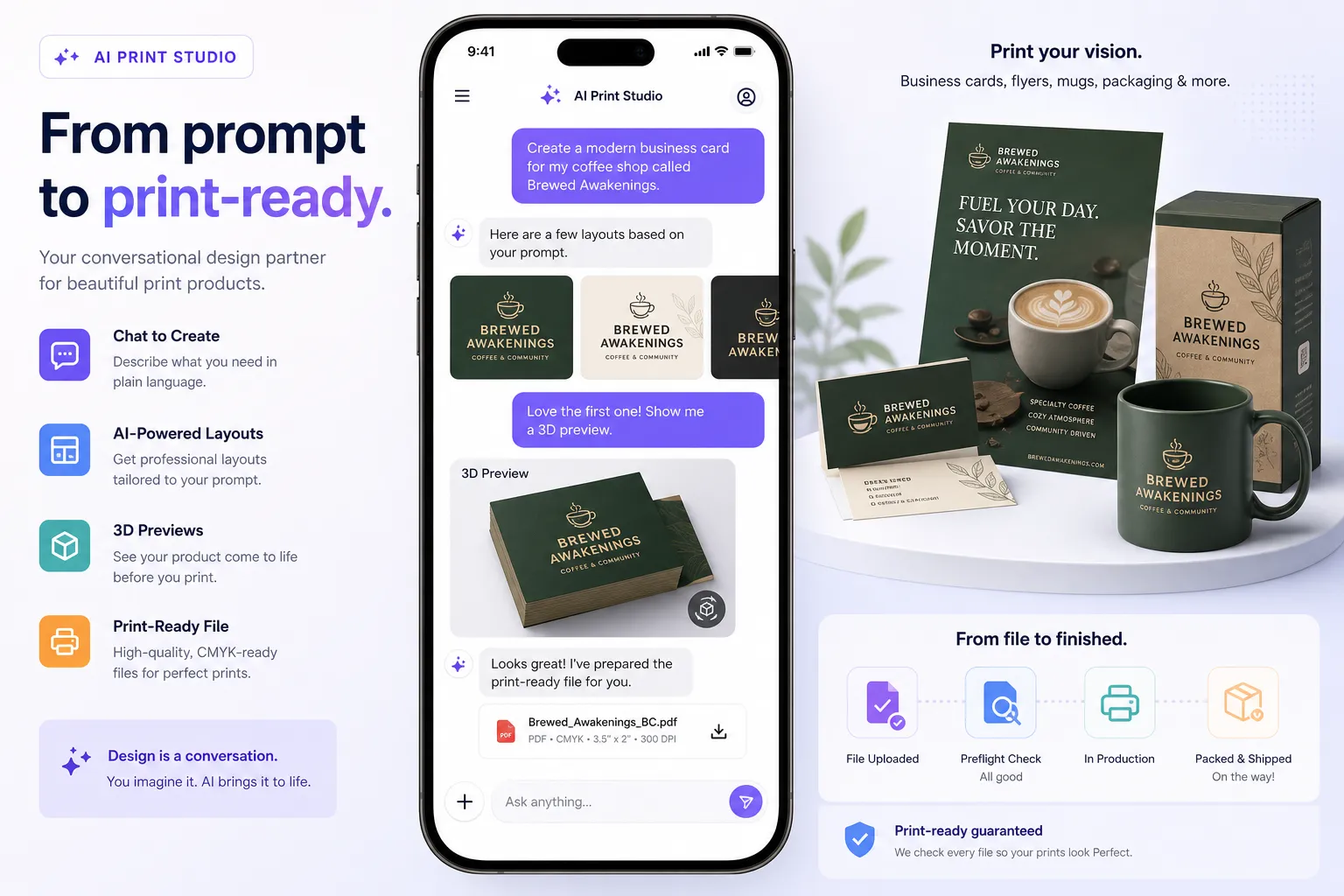
One of the most important shifts in the AI in printing industry landscape is that customers increasingly do not want to learn design software just to buy a custom product. They want to describe what they want, upload a few photos, review the result, and order.
That changes the economics of conversion.
Instead of losing prospects in a complex editor, conversational AI can guide them from idea to print-ready output in a much shorter path. A buyer can describe a wedding album, branded lookbook, direct mail piece, or photo gift in natural language, and the platform can generate layouts, structure content, and prepare a product for production.
This is not just a user-experience improvement. It is a revenue lever.
Media Rex Alliance is built precisely around this shift. Its autonomous creation engine allows end customers to create products through conversation rather than through cumbersome manual design tools. That means less abandonment, faster purchase decisions, and a far more inclusive creation experience for non-designers.
2. AI-powered prepress will become a margin-protection layer
AI is turning prepress from a manual checkpoint into a smart operational layer. In 2026, leading print businesses will use AI to detect low-resolution assets, misalignment, bleed issues, color inconsistencies, and layout conflicts before those problems hit production.
The impact is significant:
fewer costly reruns
shorter proofing cycles
improved output consistency
less dependency on manual intervention
For businesses scaling customized products, AI-assisted prepress is especially valuable because it handles variability at speed. Instead of treating customization as an exception, it makes customization operationally manageable.
3. Personalization will move from a feature to a business model

The strongest print businesses in 2026 will not compete on volume alone. They will compete on relevance.
AI makes it possible to generate dynamic variations across print products using audience data, uploaded assets, templates, behavioral context, and campaign logic. That applies to direct mail, packaging, photo products, promotional materials, and branded merchandise.
"Personalized direct mail can increase response rates by up to 135% compared to non-personalized mail." - DirectMail.io
This is where print becomes strategically powerful again. Physical products feel more premium when they are also context-aware and individualized.
For photo book companies, studios, and print-on-demand brands, that means AI can help create product experiences that feel bespoke without requiring handcrafted workflows for every order.
4. Visual confidence tools will become essential for conversion
A major blind spot in competitor content is the lack of focus on visualization. Yet one of the biggest barriers in customized print ecommerce is uncertainty. Customers hesitate when they cannot confidently imagine the final product.
In 2026, that problem will increasingly be solved with photorealistic 3D previews and immersive AR experiences.
When customers can rotate a product, inspect finishes, preview proportions, or see how an item looks in context before buying, conversion friction drops. Confidence rises. Support tickets decrease. Returns risk declines.
Media Rex Alliance brings this capability directly into the white-label buying journey. Its 3D and AR preview system helps customers validate what they are ordering before checkout, which is especially important for premium photo products, branded merchandise, packaging, and personalized print items.
5. Browser-based, mobile-first print creation will outperform app-dependent experiences
A huge share of print innovation still assumes a desktop workflow. That assumption is becoming outdated.
In 2026, more customer journeys begin on mobile, but many print experiences are still clumsy there. Traditional editors are often overloaded, slow, or simply not designed for touch-first behavior.
The future belongs to platforms that treat mobile as the primary channel, not a fallback.
Media Rex Alliance supports browser-based creation with no app installation required. That removes adoption friction and allows users to move from inspiration to product creation instantly. It also syncs projects locally and in the cloud, enabling a seamless handoff between phone, tablet, and desktop.
For businesses, that means broader reach and a better conversion path. For customers, it means creation feels natural instead of technical.
6. Workflow automation will expand beyond production into fulfillment orchestration
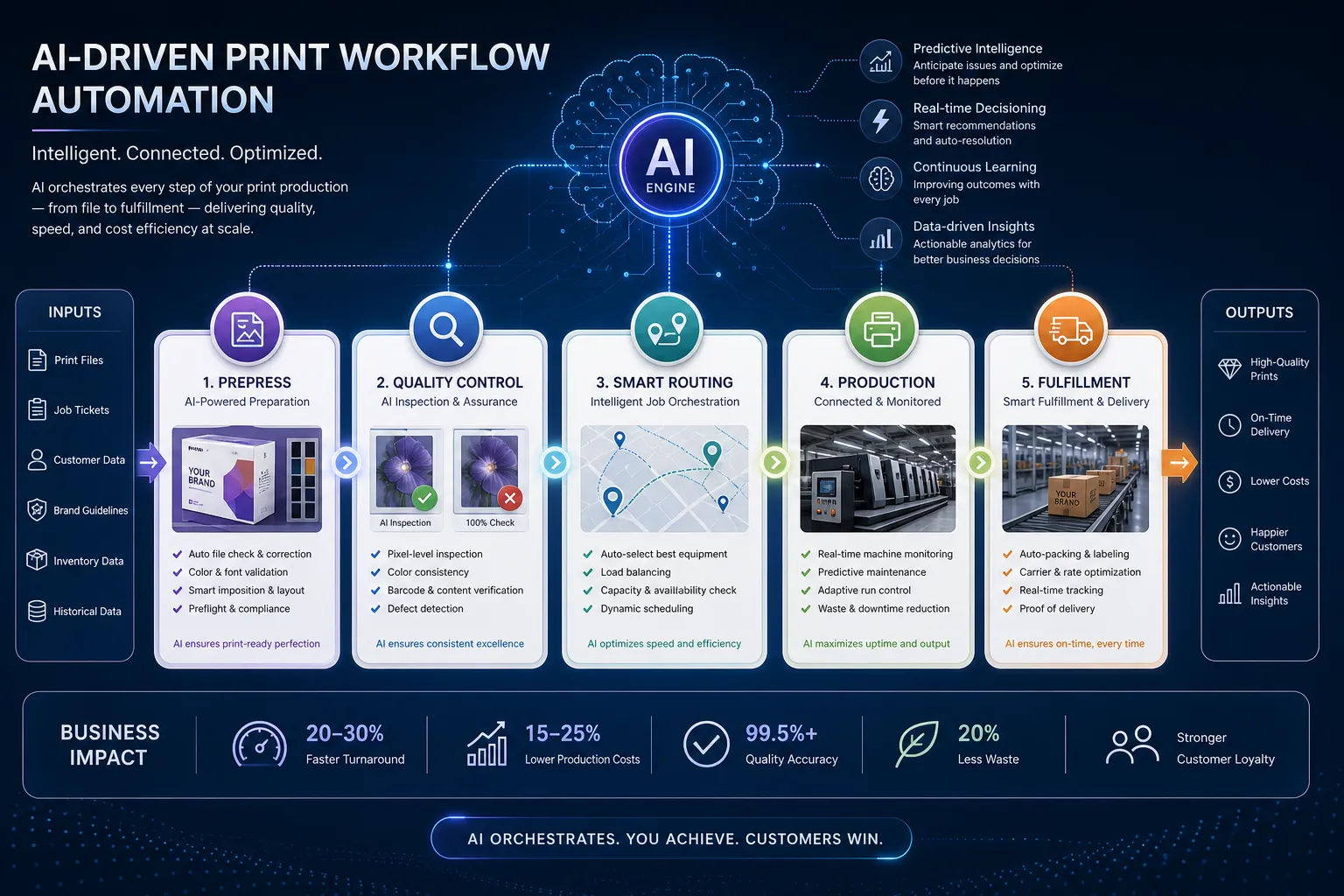
Most trend roundups talk about automation as if it begins and ends with production. In reality, the biggest operational gains often come after the file is approved.
AI can route jobs based on geography, production capacity, substrate compatibility, finishing requirements, and delivery timelines. That transforms fulfillment from a logistical burden into an intelligent scaling mechanism.
For modern print businesses, this matters because on-demand models only work well when orchestration is reliable.
Media Rex Alliance supports automated fulfillment through a global network of premium printers, helping businesses reduce inventory, lower overhead, and scale without building a distributed manufacturing infrastructure from scratch.
7. AI will make on-demand production commercially stronger
The old print model rewarded inventory depth and operational centralization. The 2026 model rewards flexibility, low waste, and demand responsiveness.
AI strengthens on-demand production by improving forecasting, automating product setup, optimizing routing, and reducing human bottlenecks. That creates a leaner business structure with less capital tied up in unsold stock or overbuilt operations.
This is especially valuable for:
startup print-on-demand brands that need speed without heavy upfront cost
regional print players expanding into new categories
photo product companies modernizing legacy fulfillment models
enterprise print businesses launching branded micro-stores or personalized campaigns
Because Media Rex Alliance is built around a no-stock, low-overhead model, it aligns naturally with these commercial realities. Businesses can launch faster, experiment with less risk, and scale into new product lines more efficiently.
8. White-label AI infrastructure will beat custom-built experimentation
One of the least discussed but most important trends for 2026 is deployment strategy. Many print businesses know they need AI, but few want to spend years building a custom platform that blends conversational creation, product rendering, ecommerce logic, proofing, and fulfillment automation.
The smarter path is increasingly white-label infrastructure.
With Media Rex Alliance, businesses can integrate AI-powered product creation into their existing storefront or app under their own brand, domain, and visual identity. That gives them a faster route to market while preserving control over the customer relationship.
For leadership teams, this creates a compelling equation:
Build In-House | White-Label AI Platform |
|---|---|
Long development cycles | Faster deployment |
Higher engineering cost | Lower upfront technology burden |
Integration complexity | Designed for existing storefronts and apps |
Greater maintenance overhead | SaaS scalability and ongoing platform evolution |
More operational risk | Proven production and fulfillment architecture |
How AI Is Transforming Each Stage of the Print Value Chain
Discovery and product ideation
AI can recommend products, formats, layouts, and personalization paths based on customer goals, uploaded photos, industry, or campaign type.
Design and composition
Natural-language prompting, automated layout generation, template adaptation, and asset optimization reduce dependency on advanced design skills.
Proofing and previewing
3D and AR previews improve buyer confidence and accelerate approvals.
Production preparation
AI-assisted prepress, file validation, and intelligent job handling reduce errors and rework.
Fulfillment and delivery
Automated routing and on-demand production reduce inventory burdens and improve scalability.
Retention and upsell
AI can help brands recommend complementary products, seasonal variations, replenishment flows, and audience-specific print campaigns based on prior customer behavior.
What Different Print Businesses Should Do Next
For small studios and photographers
Focus on removing manual design bottlenecks. Offer premium products through conversational creation so clients can build albums, prints, and gifts without friction.
For new print-on-demand brands
Use AI to launch quickly, validate demand, and operate with low inventory exposure. A mobile-first, browser-based experience can become a major differentiator.
For mid-size print brands
Modernize the customer experience before competitors do. Integrate a white-label AI layer into your storefront and reduce the complexity that hurts conversion.
For regional print players
Expand your footprint without expanding operational drag. Smart routing and automated fulfillment make it easier to serve wider markets.
For established photo book companies
Legacy editors may still work, but they increasingly feel dated. Conversational creation, cloud sync, and immersive previews are the upgrade path for the next generation of customers.
The Real Opportunity Competitors Barely Mention
Most content about AI in printing industry trends still frames AI as an optimization tool. That is true, but incomplete.
The bigger opportunity is productizing creativity itself.
When a platform can turn prompts into print-ready products, visualize them in 3D and AR, deploy under a customer’s own brand, and route fulfillment automatically, AI stops being a background efficiency layer. It becomes the new interface between demand and production.
That shift is profound because it changes who can create, how quickly they can buy, and how efficiently print businesses can deliver.
Final Verdict: 2026 Belongs to Print Businesses That Eliminate Friction
AI is not replacing print. It is redefining how print is bought, created, personalized, visualized, and fulfilled.
The companies that win in 2026 will be those that simplify the path from idea to order while preserving premium output quality. They will make customization effortless, previews realistic, production scalable, and fulfillment invisible.
That is exactly the future Media Rex Alliance is built for.
If your business wants to launch AI-powered product creation without building the stack from scratch, Media Rex Alliance offers a faster, smarter path: conversational design, print-ready automation, fully white-label deployment, mobile-first browser access, local and cloud project sync, photorealistic 3D and AR previews, and a global on-demand fulfillment network designed to scale from startup to enterprise.
The next era of print belongs to businesses that move from manual workflows to intelligent commerce. Media Rex Alliance helps you get there first.