AI Mobile App Trends for Business Growth
Modern businesses no longer ask whether they need an ai mobile app. The real question is which AI capabilities will create measurable growth without adding technical debt, bloated workflows, or fragmented customer experiences.
For small studios, photographers, print-on-demand startups, regional print brands, and established photo book companies, mobile has become the front door to revenue. Customers expect instant personalization, guided creation, smart recommendations, and frictionless checkout. If your mobile experience still relies on manual design steps, clunky editors, or disconnected backends, you are losing conversions long before fulfillment begins.
This is where AI changes the equation. The most effective AI mobile apps do three things at once:
improve customer experience with faster, more personalized journeys
automate operational work that slows teams down
create scalable growth loops through data, prediction, and better mobile conversion
For print and web-to-print businesses, this shift is even more powerful. Media Rex Alliance helps brands move beyond traditional design-heavy workflows by enabling customers to create premium print products through conversational AI instead of complex design tools. That means faster product creation, fewer abandoned sessions, stronger mobile conversion, and a fully white-label path to modernizing your storefront without rebuilding everything from scratch.
"86% of IT leaders expect generative AI to soon play a prominent role in their organizations." - Source
"Organizations manage an average of 957 applications, yet only 27% of these are integrated." - Source
Why competitor content falls short
Most articles on this topic repeat the same surface-level points: chatbots, personalization, automation, and predictive analytics. Useful, but incomplete.
The real content gaps are:
how to evaluate which AI mobile trends actually drive ROI
how AI mobile apps affect conversion, retention, and fulfillment economics
what AI means for mobile-first commerce, especially in print and customization businesses
how to modernize without forcing customers into app downloads
how to connect AI frontends with scalable white-label, on-demand infrastructure
This article closes those gaps.
What an AI Mobile App Really Means in 2026
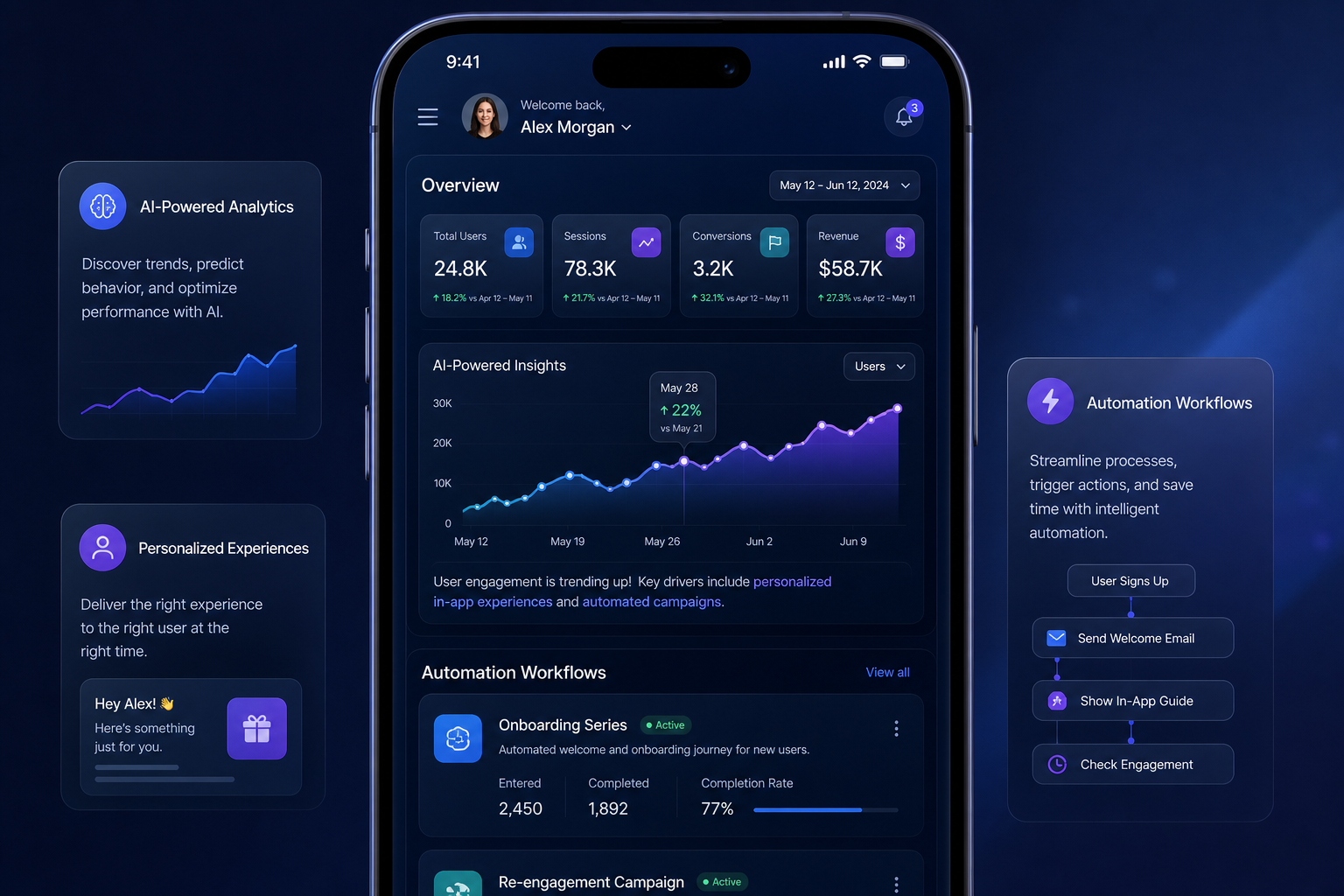
An ai mobile app is no longer just a smartphone app with a chatbot bolted on. In 2026, the term refers to a mobile-first digital product that uses AI to actively improve decisions, experiences, and workflows in real time.
Core capabilities of a modern AI mobile app
A strong AI mobile app typically includes:
Capability | What it does | Business impact |
|---|---|---|
Personalization | Adapts content, products, and flows to user behavior | Higher conversion and retention |
Prediction | Anticipates next steps, preferences, or churn risk | Better targeting and reduced drop-off |
Automation | Handles repetitive tasks and workflows | Lower operational cost |
Conversational interfaces | Lets users complete actions through prompts or dialogue | Faster onboarding and lower friction |
Computer vision / media intelligence | Understands images, layouts, or visual inputs | Better creation tools and smarter asset use |
Real-time decisioning | Responds instantly to context, device, location, or user intent | More relevant experiences |
The shift from UI-first to intent-first mobile experiences
Traditional mobile apps force users through menus, forms, and toolbars. AI mobile apps increasingly work the other way around: users express intent, and the app figures out the steps.
That matters enormously in categories where creation is part of the purchase journey.
For example, in web-to-print, customers often abandon because they do not want to wrestle with complex design software on a phone. Media Rex Alliance solves this by turning natural-language prompts into print-ready products, then showing photorealistic 3D and AR previews before ordering. The result is a much more intuitive, mobile-first buying experience.
Why AI Mobile Apps Matter for Business Growth
AI is not just a feature trend. It is an economic lever.
1. They reduce friction at the moment of intent
The closer a customer is to buying, the more dangerous complexity becomes. AI removes unnecessary steps through:
predictive recommendations
smart autofill and guided flows
conversational input instead of manual configuration
instant visual generation and previewing
2. They automate labor-intensive work
Operational savings often equal or exceed revenue gains. AI mobile apps can automate:
support routing
order status communication
image sorting and tagging
personalization logic
product creation workflows
fulfillment triggers
3. They increase conversion through confidence
Customer hesitation kills growth. When users can see what they are buying, understand it quickly, and trust the process, conversion rises.
For print commerce, Media Rex Alliance strengthens purchase confidence with photorealistic 3D previews and immersive AR product visualization, helping customers commit before production starts.
4. They create scalable, always-on experiences
The best AI mobile apps do not depend on manual staff intervention to create a premium experience. They scale personalization, support, and decision-making across thousands of users at once.
The Most Important AI Mobile App Trends Driving Growth
1. Conversational Commerce Is Replacing Complex Mobile Workflows
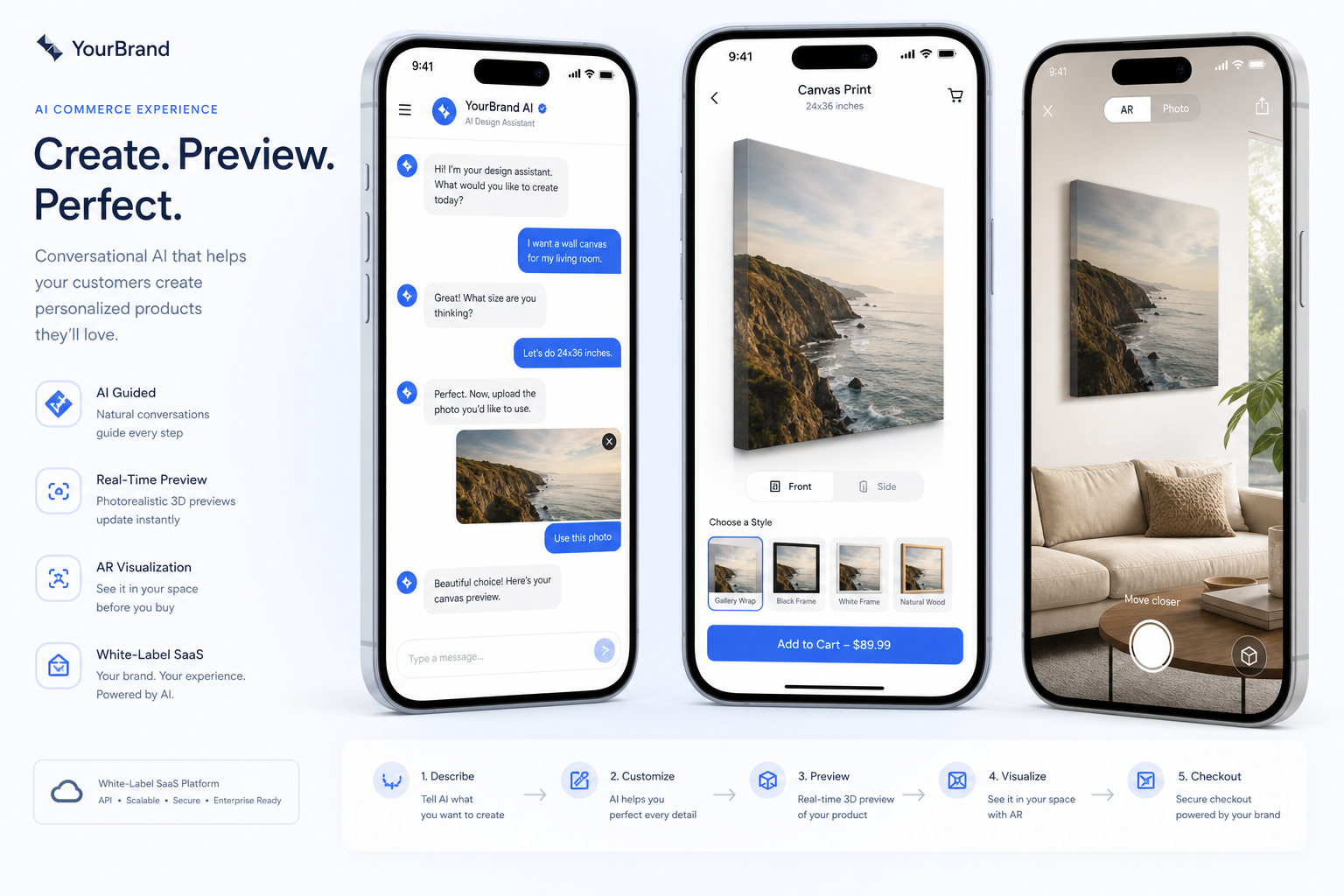
Customers increasingly prefer to describe what they want rather than assemble it manually.
Instead of:
selecting templates
editing text boxes
resizing images
adjusting layouts
previewing static mockups
They want to type or speak something like:
“Create a premium travel photo book with a clean editorial style using my last 40 photos.”
That is the future of mobile commerce. It is faster, more intuitive, and better aligned with how people use phones.
Why it matters
Conversational interfaces:
reduce time-to-product
improve accessibility
cut abandonment from editor fatigue
make premium customization usable on small screens
This is especially relevant for businesses selling configurable or personalized products. Media Rex Alliance is built around this trend, enabling end customers to create products through natural language, then instantly turning prompts into print-ready outputs.
2. On-Device and Edge AI Are Improving Speed and Privacy
Businesses are becoming more selective about where AI processing happens.
On-device AI advantages
faster response times
lower latency
better privacy for sensitive user actions
offline or low-connectivity support
reduced round trips to the cloud
Cloud AI advantages
heavier processing power
easier centralized model updates
broader training and orchestration
better for multi-system business logic
The winning pattern is hybrid. Use edge AI where speed and privacy matter, and cloud AI where orchestration and scale matter.
For mobile commerce and creation tools, this balance helps preserve fluid UX while still supporting advanced layout generation, asset management, and fulfillment logic in the background.
3. AI Personalization Is Moving Beyond Recommendations
Most competitor articles stop at “personalized recommendations.” That is too narrow.
Real personalization in 2026 means adjusting the entire mobile journey:
homepage modules
pricing bundles
messaging
prompts and suggestions
reorder flows
support escalation
checkout timing
product configuration defaults
Example: AI in print personalization
A smart print app can detect:
whether a user is creating for gifting or personal use
what product format they prefer
when they tend to abandon
whether a visual preview or delivery estimate is the key conversion trigger
Media Rex Alliance enables a much more dynamic personalization layer because it simplifies the creation phase itself. Customers do not just get better recommendations; they get a better way to make the product in the first place.
4. Visual AI Is Becoming Essential for Mobile Commerce
Image-heavy industries need more than text-based intelligence.
What visual AI enables
automatic photo sorting
smart cropping and enhancement
layout generation
duplicate detection
quality checks before print
asset recommendations based on composition or relevance
For studios, photo brands, and personalized product businesses, visual AI is no longer optional. It reduces manual review time and improves output quality.
Why this trend is under-discussed
Many articles talk about AI chatbots but skip the fact that visual workflows are often the real bottleneck in commerce categories built around photos or design.
That is why platforms like Media Rex Alliance matter: they do not just handle prompts. They also support photo uploads, layout automation, and realistic visualization that connects creative intent to production-ready output.
5. Browser-Based Mobile Experiences Are Outperforming App-Only Models
One of the biggest missed points in competitor content is distribution friction.
Not every growth strategy should start with forcing users to install an app.
Why browser-based AI mobile experiences win
lower acquisition friction
faster access from ads, email, social, or QR codes
better shareability
easier global rollout
no app store approval delays
fewer drop-offs before product interaction begins
For many print brands and growing ecommerce businesses, a mobile-first browser experience is more effective than an app-first strategy.
This is a major reason Media Rex Alliance is compelling for modern print businesses. It supports browser-based design with no app installation required, while still delivering a premium, AI-led creation experience.
6. 3D and AR Previews Are Becoming Conversion Infrastructure
Customers buy faster when uncertainty drops.
Static thumbnails are often not enough for premium or personalized products. 3D and AR previews help users see:
scale
material feel
layout realism
product confidence before checkout
Business impact
Preview type | Customer benefit | Business benefit |
|---|---|---|
Static preview | Basic confirmation | Minimal reassurance |
3D preview | Better understanding of final product | Higher confidence |
AR preview | Real-world context and immersion | Stronger conversion and fewer surprises |
For personalized print, this becomes a major differentiator. Media Rex Alliance gives brands the ability to offer photorealistic 3D and immersive AR previews, which improves confidence before ordering and lowers friction in the purchase decision.
7. AI Agents Are Automating End-to-End Mobile Workflows
The next wave is not just AI assistance. It is AI agents that carry out connected tasks across systems.
What AI agents can do in mobile workflows
qualify customer intent
generate product configurations
prepare assets for production
recommend upsells
trigger fulfillment workflows
notify customers proactively
sync preferences across sessions and devices
This matters because the real value of AI is not the interface. It is the workflow compression behind the interface.
For example, Media Rex Alliance combines AI-led creation with automated fulfillment across a global network of premium printers. That means businesses can reduce overhead, avoid stocking inventory, and scale production without expanding operational complexity.
8. Cloud Sync and Cross-Device Continuity Are Now Expected
Customers start on one device and finish on another. Businesses that break this continuity lose revenue.
Cross-device expectations
Users now expect to:
start a project on mobile
review on desktop
share with a collaborator
revisit later without losing progress
This is particularly important for longer creation journeys like photo books, premium gifts, and branded print products.
Media Rex Alliance supports local and cloud sync for seamless multi-device use, which is a crucial growth advantage for brands that want higher completion rates on more complex products.
9. White-Label AI Mobile Experiences Are Beating Slow Custom Builds
Many businesses want AI-powered mobile experiences but do not want the time, cost, and risk of building them from zero.
Why white-label deployment is accelerating
faster go-to-market
lower engineering burden
easier brand consistency
fewer infrastructure headaches
quicker experimentation with new revenue models
For print businesses, this is a decisive advantage. Media Rex Alliance can be fully white-labeled into existing storefronts or apps, giving brands a modern AI creation engine under their own domain, visual identity, and customer experience.
10. AI-Powered Fulfillment and On-Demand Production Are Reshaping Unit Economics

Growth is not just about top-line conversion. It is about margin quality.
Traditional inventory-heavy models create drag through:
stock risk
warehousing
manual routing
slower product iteration
higher overhead
AI-powered, on-demand production models improve efficiency by producing only when ordered and automating fulfillment routing.
Why this matters for mobile commerce
Mobile customers buy quickly. Your back-end must be able to fulfill with the same speed and flexibility.
Media Rex Alliance reduces inventory and overhead through on-demand production, then automates fulfillment via a global network of premium printers. That creates a much stronger operating model for startups, regional brands, and enterprise print businesses alike.
How to Evaluate AI Mobile App Opportunities for Your Business
Not every AI feature deserves investment. The best approach is strategic filtering.
A practical evaluation framework
Question | Why it matters |
|---|---|
Does this reduce customer friction? | Faster journeys usually improve conversion |
Does this automate repeatable work? | Efficiency gains create margin |
Does this improve confidence before purchase? | Confidence raises completion rates |
Can this scale without adding headcount? | Sustainable growth depends on leverage |
Does it fit your current stack? | Integration risk can erase ROI |
Can you launch quickly? | Speed matters in competitive categories |
High-ROI use cases by business type
Business type | Best AI mobile app use cases |
|---|---|
Small studios | Smart booking, photo selection, guided print upsells |
Photographers | AI album creation, mobile proofing, fast reorders |
New POD brands | Conversational creation, browser-based selling, automated fulfillment |
Mid-size print brands | White-label mobile creation, personalization, 3D previews |
Photo book companies | Prompt-based design, cross-device continuation, visual AI workflows |
Enterprise print players | AI agents, multi-region fulfillment automation, modular white-label rollout |
Common Mistakes Businesses Make With AI Mobile Apps
Mistake 1: Adding AI without redesigning the journey
A chatbot in a broken workflow is still a broken workflow.
Mistake 2: Focusing on features instead of conversion points
Start with the moments that block revenue:
creation friction
support delays
preview uncertainty
abandoned sessions
manual order prep
Mistake 3: Building too much from scratch
Unless AI product creation is your core competency, a white-label platform often wins on time and risk.
Mistake 4: Ignoring fulfillment economics
A beautiful front end cannot compensate for slow, manual, or inventory-heavy backends.
Mistake 5: Thinking mobile means native app only
Browser-first, mobile-optimized experiences often outperform app-only strategies for fast acquisition and commerce.
AI Mobile App Use Cases That Competitors Underexplore
AI product creation for personalized commerce
Instead of asking users to design manually, let them describe what they want and generate it automatically.
AI-assisted premium upselling
Use behavior, intent, and product context to recommend better materials, formats, or bundles.
AI-generated previews before production
Show customers exactly what they are buying in 3D or AR.
AI-routed fulfillment
Use automation to assign production to the best-fit printer by geography, product, or capacity.
AI-led reactivation
Bring customers back with contextual prompts like:
“Finish your travel album”
“Reorder your holiday cards”
“Turn your recent event photos into a premium book”
These are practical, growth-driving mobile use cases, not just innovation theater.
The Best AI Mobile App Architecture for Scalable Growth
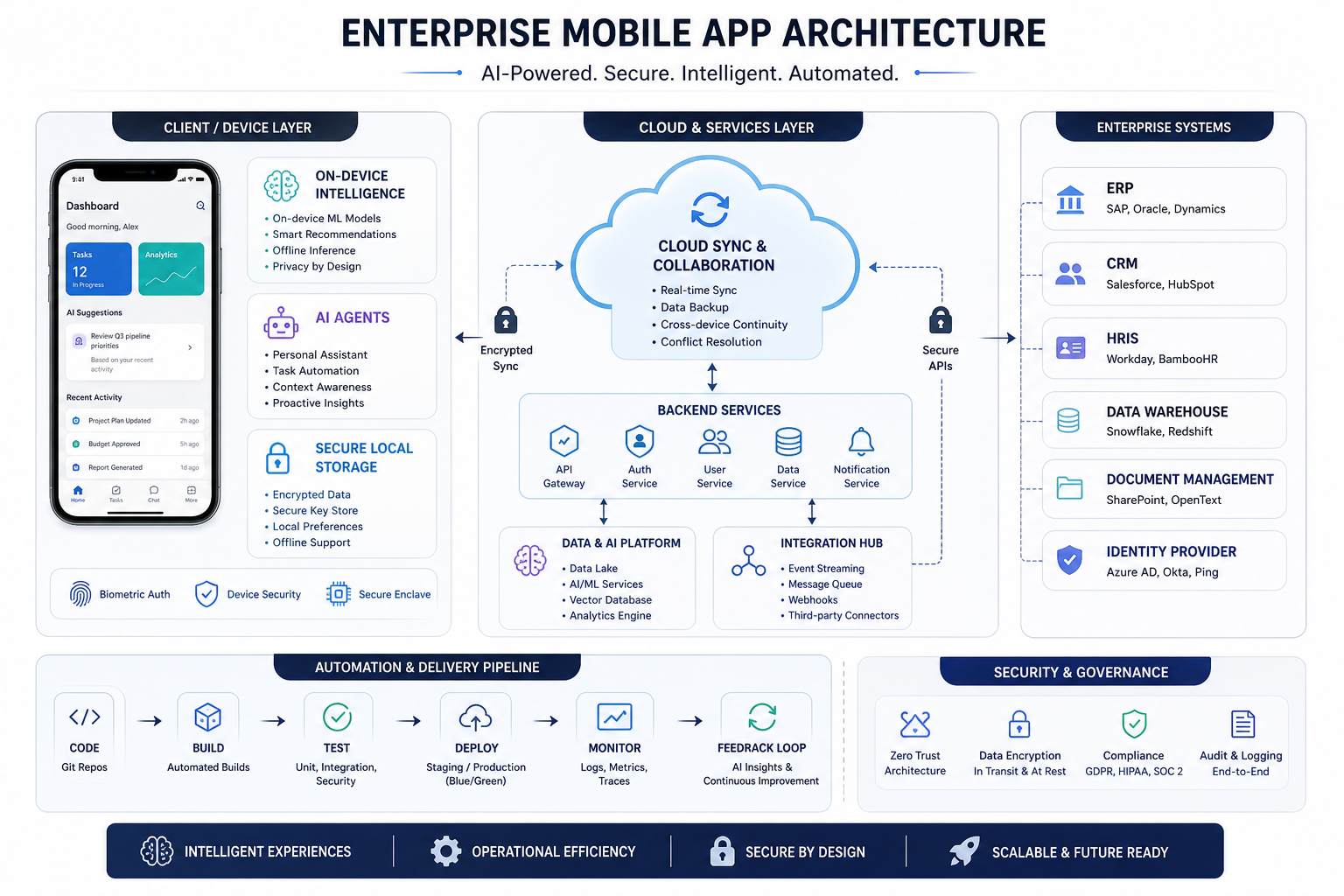
A strong growth-oriented mobile AI stack should include:
Front end
mobile-first responsive interface
browser-based access where possible
conversational input
high-performance preview rendering
Intelligence layer
prompt interpretation
recommendation engine
visual AI processing
personalization and decision logic
Commerce layer
catalog and pricing
checkout and payment
upsell logic
promotion engine
Operations layer
order orchestration
print-readiness checks
production routing
fulfillment automation
Data layer
cloud sync
user state continuity
analytics and attribution
privacy-aware storage and compliance
For businesses in print commerce, the fastest path is rarely assembling all this independently. A platform like Media Rex Alliance compresses that stack into a ready-to-integrate, white-label solution built specifically for AI-powered web-to-print.
Why Media Rex Alliance Fits the Future of AI Mobile Growth
Most businesses do not need generic AI. They need applied AI that removes friction, improves conversion, and scales operations.
That is where Media Rex Alliance stands out.
What makes it strategically different
customers create products through conversational AI instead of complex design tools
prompts become print-ready products quickly, reducing friction and accelerating purchase decisions
the platform can be fully white-labeled inside your storefront or app
photorealistic 3D and AR previews improve confidence before ordering
the experience is mobile-first and browser-based, so no app install is required
projects sync locally and in the cloud for seamless multi-device continuation
on-demand production reduces inventory risk and overhead
automated fulfillment connects to a global network of premium printers
the platform scales from startups to enterprise print companies
Who should pay attention
Media Rex Alliance is especially relevant for:
small studios wanting premium digital-to-print experiences without custom software builds
photographers looking to turn photo libraries into high-value products faster
new POD brands needing a frictionless mobile commerce engine
regional print businesses modernizing legacy web-to-print flows
photo book companies wanting to replace editor-heavy UX with conversational creation
enterprise players seeking scalable white-label infrastructure for global growth
Final Verdict
The future of the ai mobile app is not about adding isolated AI features. It is about building mobile experiences that feel faster, smarter, and easier to buy through.
The winning businesses in 2026 will be the ones that use AI to:
compress time-to-value
automate invisible operational work
personalize every key touchpoint
increase confidence before checkout
scale without multiplying complexity
If your business sells personalized, visual, or premium print products, this shift is even more urgent. Customers want to create through conversation, review through immersive previews, and order without friction.
Media Rex Alliance gives print businesses a direct path to that future: a white-label AI print platform that turns prompts into premium products, works beautifully on mobile, removes the need for app installation, automates fulfillment, and helps brands modernize without building the entire stack from scratch.
If you want an AI mobile growth strategy that actually improves conversion, efficiency, and scalability, Media Rex Alliance is the platform to evaluate first.
FAQ
How to create mobile apps that make $3,000 a day?
Build around a high-intent use case, remove friction in the mobile journey, and connect the app to a monetization model with strong margins. The best-performing AI mobile apps combine personalization, automation, and clear conversion triggers such as guided product creation, smart upsells, and seamless checkout.
What are the 5 current trends in AI?
The five most important trends are conversational interfaces, AI agents, advanced personalization, visual AI, and hybrid edge-plus-cloud intelligence. In mobile commerce, these trends reduce friction, speed up decisions, and improve conversion.
Which AI app is best for business ideas?
The best AI app is the one that aligns with your business model, customer journey, and operational bottlenecks. For print and personalized product businesses, a platform like Media Rex Alliance is powerful because it combines conversational creation, white-label deployment, previews, and fulfillment automation in one system.
What is the 10 20 70 rule for AI?
The 10 20 70 rule generally means 10% of success comes from algorithms, 20% from data and technology, and 70% from people, process, and workflow integration. In practice, AI creates the most value when it is embedded into a usable customer journey and scalable operations.
What is the #1 money making app?
There is no single universal #1 app, because revenue depends on market fit, retention, pricing, and distribution. The strongest money-making apps solve a repeat problem, reduce user effort, and create ongoing value through subscriptions, commerce, or high-frequency transactions.
How to make $10 m in 365 days with AI mobile apps?
That kind of growth usually requires a scalable niche, strong unit economics, rapid distribution, and operational leverage through AI. Focus on a high-value use case, reduce friction across the full journey, automate fulfillment or service delivery, and expand through white-label or platform-based distribution when possible.