AI Platforms for Business: Top Trends for 2026
AI platforms for business are no longer just productivity add-ons. In 2026, they are becoming the operating layer behind customer acquisition, personalization, automation, product creation, and fulfillment. For print brands, studios, photo companies, and web-to-print businesses, this shift is especially important: the winners will be the companies that remove friction between inspiration and order.
If your customers still have to learn complex design tools, download apps, or manually build every product from scratch, you are competing with a slower model. The next generation of business AI platforms is conversational, integrated, mobile-first, and designed to turn intent into transactions faster.
In this guide, Media Rex Alliance breaks down where the market is heading, what capabilities matter most, and how modern AI-powered platforms are creating competitive advantage for print and commerce brands in 2026.
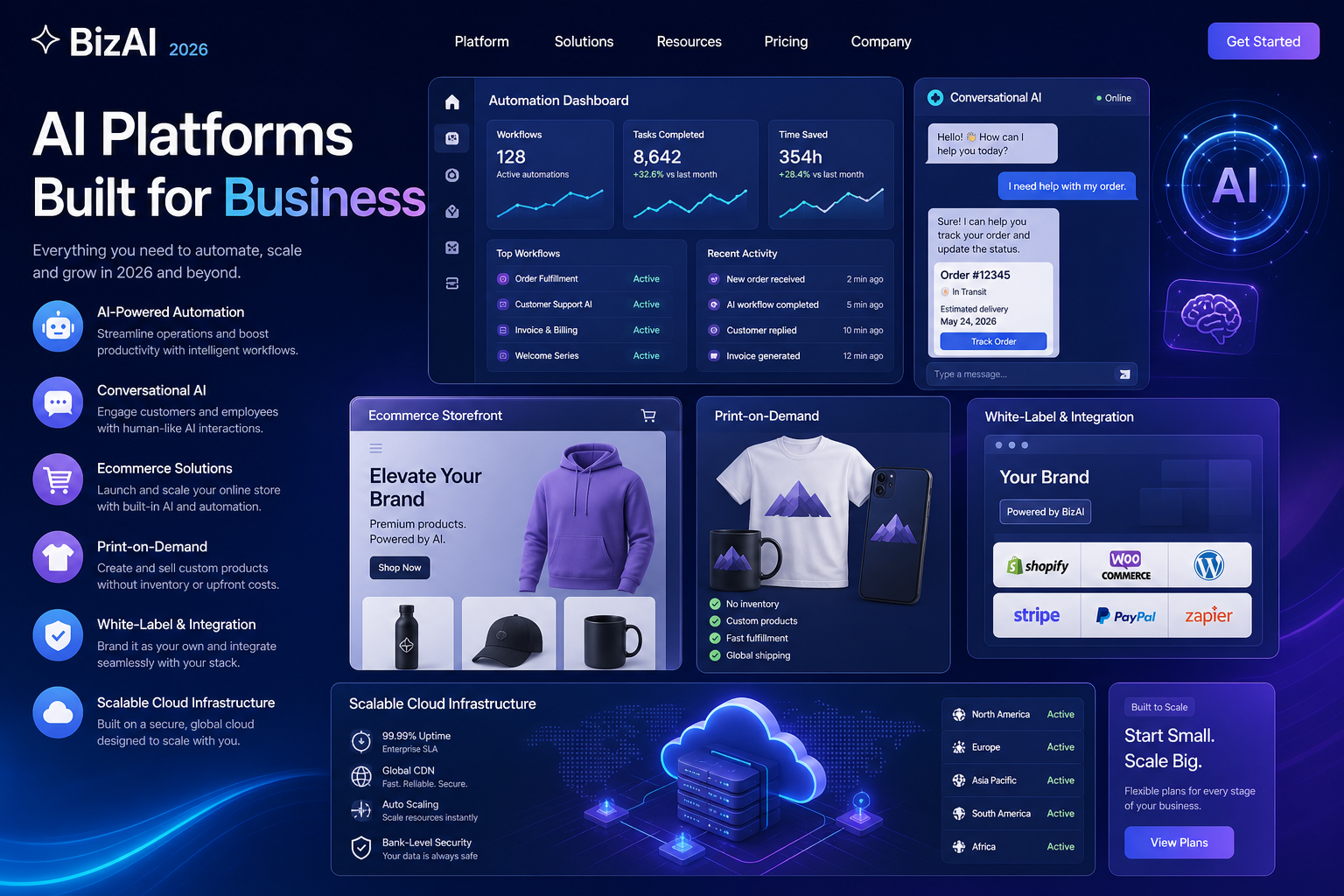
Why AI Platforms for Business Matter More in 2026
Most competitor content on this topic focuses on model providers, generic enterprise software, or broad AI investment narratives. What they often miss is the practical layer where AI creates direct business value: the customer journey, the transaction workflow, and the infrastructure that turns AI output into revenue.
In 2026, the real question is not, “Does your business use AI?” It is:
Can your AI platform reduce steps in the buying journey?
Can it personalize experiences at scale?
Can it integrate into your existing storefront or app?
Can it move from idea to production without manual bottlenecks?
Can it scale profitably across devices, brands, and geographies?
For print commerce brands, these questions are decisive. AI is no longer only about generating text or summarizing information. It is about enabling end customers to create products through natural language, preview them instantly, and purchase with confidence.
"Worldwide AI spending is forecasted to reach $2.59 trillion in 2026, a 47% increase year-over-year." - Gartner
That level of investment signals a mature market. But spending alone does not create differentiation. Execution does.
What Is an AI Platform for Business?
An AI platform for business is a software environment that lets organizations embed artificial intelligence into real workflows, customer experiences, and operational systems. The best platforms in 2026 do more than provide models or chat interfaces. They combine:
conversational interfaces
workflow automation
integration layers
analytics and decision support
brand customization
scalable infrastructure
secure deployment
output generation tied to real business actions
For example, in AI-powered web-to-print, a true business platform should not stop at “generate a design concept.” It should continue through layout generation, product configuration, preview rendering, checkout enablement, and fulfillment orchestration.
That is where Media Rex Alliance stands apart. It is built for businesses that want to offer AI-powered product creation without forcing customers through traditional design friction. Instead of expecting end users to master professional tools, the platform enables conversational creation, automatically generates print-ready outputs, and delivers photorealistic 3D and AR previews before order.
The Biggest Content Gaps in Competitor Articles
Across the competitor landscape, several blind spots stand out:
Common Competitor Focus | What’s Missing | Why It Matters |
|---|---|---|
AI model companies and infrastructure | Customer journey transformation | Businesses monetize better experiences, not just better models |
Generic automation examples | Industry-specific buying workflows | Print and commerce brands need AI tied to actual ordering behavior |
Enterprise adoption stats | Conversion impact and UX simplification | Reducing friction is often the fastest path to ROI |
High-level personalization talk | White-label deployment and storefront integration | Brands need AI they can own, not just tools they rent |
AI-generated content | Print-ready production pipelines | Business value comes from deliverables, not drafts alone |
Productivity benefits | Preview confidence via 3D and AR | Visual reassurance drives more purchases and fewer abandoned carts |
This is exactly why 2026 will reward specialized, workflow-native AI platforms over generic tools.
Top AI Platform Trends for Business in 2026
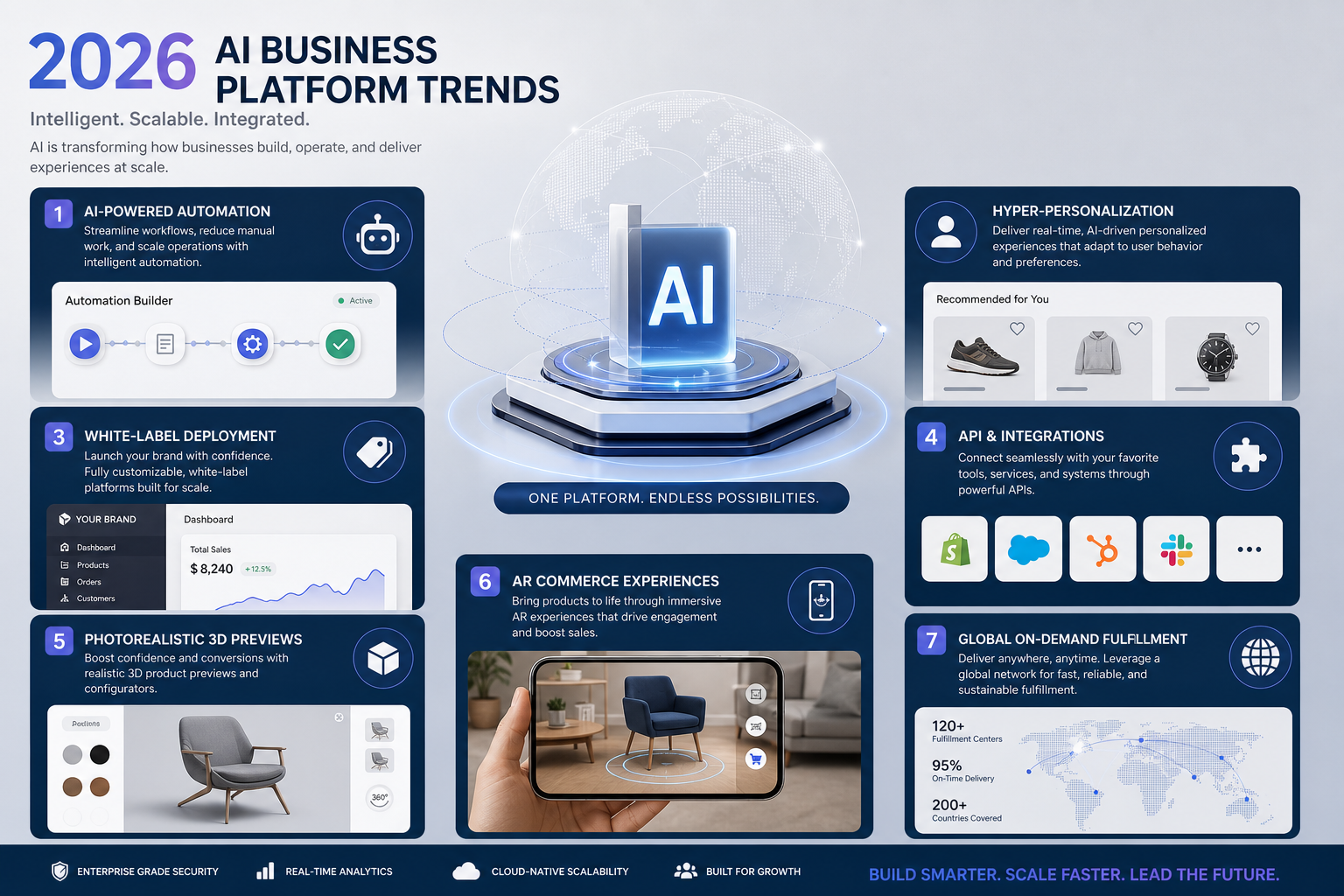
1. Conversational Interfaces Replace Complex Creation Workflows
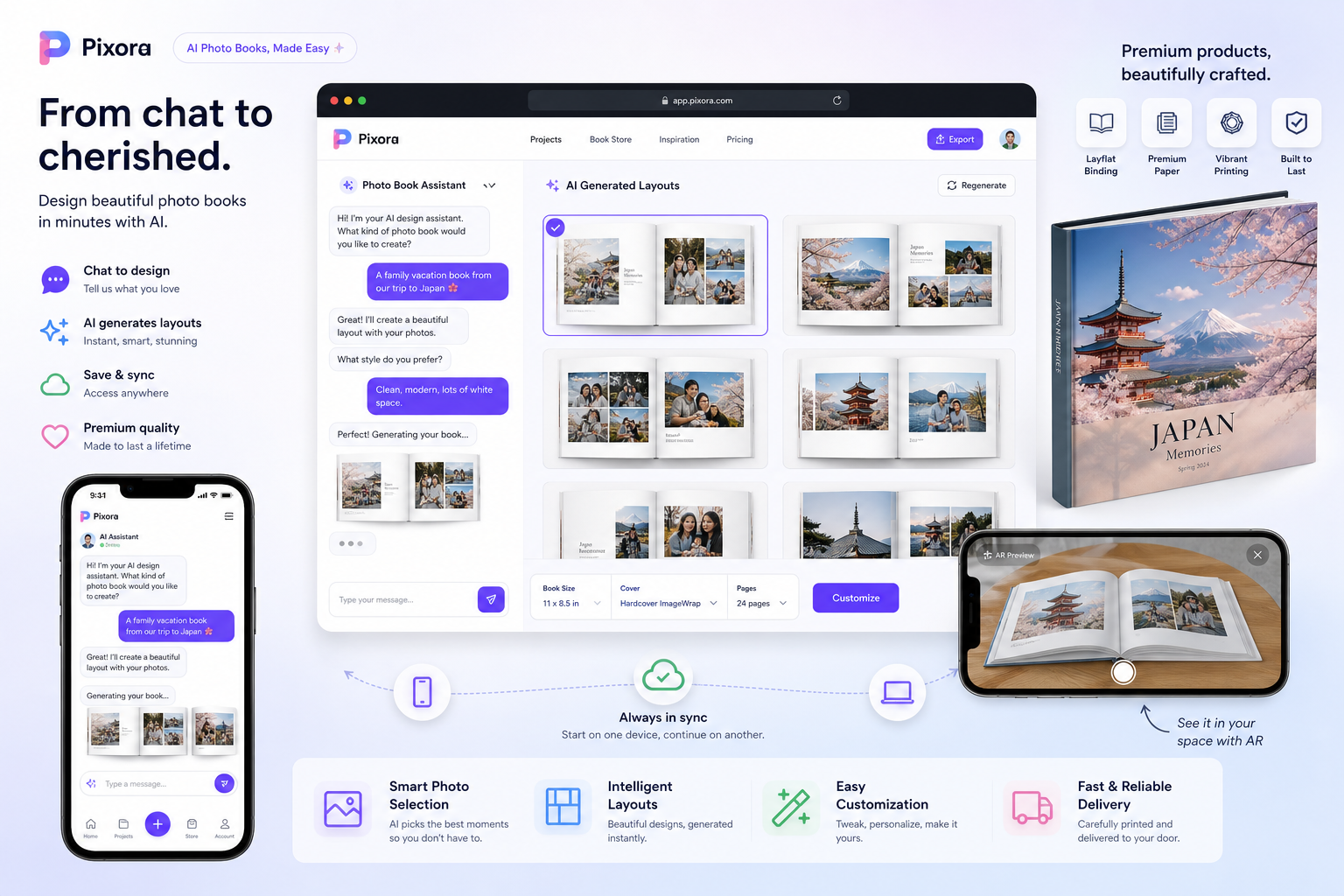
The biggest shift is from tool-centric UX to intent-centric UX. Customers no longer want to click through dozens of controls to create a personalized product. They want to describe what they want.
In 2026, leading business AI platforms will let users say things like:
“Create a luxury wedding album with a minimalist cover.”
“Turn these travel photos into a modern photo book.”
“Make a premium family calendar with seasonal layouts.”
The platform then interprets the prompt, organizes assets, builds layouts, and produces a ready-to-buy result.
This is a major advantage for studios, photographers, and print brands because it removes the learning curve that discourages non-designers from completing an order.
With Media Rex Alliance, this conversational creation layer is central to the product. It turns prompts into print-ready products quickly, reducing friction and accelerating purchase decisions.
2. AI Moves from Assistance to Autonomous Execution
Many businesses are still in the “chat phase,” where AI suggests ideas but humans do the rest. In 2026, the market is moving toward autonomous execution: AI completes multi-step workflows across systems.
For print and commerce, that means:
ingesting prompts and photos
selecting templates or generating layouts
applying product rules
preparing production files
rendering previews
routing orders into fulfillment pipelines
This is a much more valuable capability than isolated content generation because it ties AI to revenue operations.
"78% of organizations [were] using AI in at least one business function by early 2024, up from 55% the previous year." - McKinsey
The implication is clear: adoption is already broad. The next wave of winners will be businesses that operationalize AI end to end.
3. White-Label AI Deployment Becomes a Strategic Requirement
Businesses increasingly want AI experiences they can brand as their own. Generic third-party interfaces weaken brand equity and make differentiation harder.
In 2026, the strongest AI platforms for business will support:
white-label deployment
custom domains
client branding and UI theming
embedded workflows within existing storefronts
API and app-level integrations
This is particularly important for established photo book companies, regional print players, and mid-size print brands that want modern AI capabilities without rebuilding their entire technology stack.
Media Rex Alliance is designed for exactly this use case. It can be fully white-labeled inside an existing storefront or app, allowing brands to modernize their offer while keeping the customer relationship, visual identity, and front-end experience under their control.
4. Personalization Becomes Multimodal and Context-Aware
Personalization in 2026 is not just “Hello, first name.” AI platforms are now expected to personalize based on:
customer intent
uploaded assets
purchase history
device context
visual preferences
occasion or use case
regional and brand constraints
In print commerce, this creates a powerful advantage. A platform can generate different product layouts and messaging depending on whether a customer is building a wedding album, baby book, brand lookbook, or travel keepsake.
That level of contextual personalization makes the experience feel curated rather than templated.
5. 3D and AR Previews Become Conversion Infrastructure
One of the most overlooked trends in competitor articles is the role of visual confidence. Customers are more likely to buy when they can clearly understand what they are getting.
In 2026, best-in-class AI platforms will not stop at generating a product. They will also show that product with photorealistic previews, interactive 3D views, and immersive AR experiences.
For print products, this matters enormously. Customers want to see:
cover finish and dimensions
layout realism
product proportions
photo placement
premium look and feel
Media Rex Alliance provides photorealistic 3D and AR previews to improve confidence before ordering. That is not a cosmetic feature. It is a conversion lever.
6. Mobile-First, Browser-Based Experiences Win
Users increasingly discover, customize, and purchase from mobile devices. Yet many legacy print workflows are still desktop-heavy or dependent on app downloads.
The leading AI platforms for business in 2026 will be:
mobile-first
browser-based
fast-loading
touch-optimized
accessible without installation
This matters because every extra step in the path to creation increases abandonment risk. A no-app, browser-native experience shortens time to value and broadens reach.
Media Rex Alliance supports mobile-first, browser-based design with no app installation required, making it easier for brands to capture spontaneous customer intent wherever it happens.
7. Cross-Device Continuity Becomes Standard
Modern commerce is not linear. A customer may start on mobile, continue on tablet, and complete on desktop. AI platforms that cannot maintain state across sessions lose momentum.
In 2026, seamless project continuity is becoming an expected baseline. Strong platforms support:
local sync
cloud sync
persistent project history
account-linked sessions
resumable creation flows
Media Rex Alliance syncs projects locally and in the cloud for seamless multi-device use. That is especially valuable for high-consideration products like premium photo books or personalized print items, where customers often return to refine before purchase.
8. Integration Readiness Outranks Feature Count
A growing number of businesses have learned that the most feature-rich platform is not always the most valuable. The real differentiator is integration readiness.
An AI platform for business must connect cleanly into:
ecommerce storefronts
CMS environments
order management systems
payment workflows
fulfillment networks
analytics stacks
CRM and marketing automation
If integration is weak, AI becomes another disconnected tool. If integration is strong, AI becomes part of the operating system of the business.
This is where SaaS maturity matters. Media Rex Alliance is purpose-built as a white-label AI print platform that plugs into existing storefronts or apps, helping businesses launch faster without building complex technology in-house.
9. On-Demand Production Becomes an AI-Era Growth Model
AI is not only transforming front-end experiences. It is also reshaping the economic model behind physical product businesses.
The most forward-looking print businesses are moving away from inventory-heavy operations toward intelligent on-demand production. That means:
lower stock risk
reduced overhead
faster product experimentation
more flexible product catalogs
easier geographic expansion
Media Rex Alliance supports this model directly, helping brands reduce inventory and overhead through on-demand production while automating fulfillment via a global network of premium printers.
This combination of AI creation plus distributed fulfillment is what makes the model scalable.
10. Vertical AI Platforms Outperform Generic AI Suites
One of the clearest 2026 trends is the shift from general-purpose AI tools to vertical platforms built around industry workflows.
Generic AI can draft copy. Vertical AI can help a print business generate a personalized product, apply production rules, render previews, and fulfill globally.
That is a meaningful difference.
For digital print businesses, the most strategic platform is usually not the one with the broadest claim set. It is the one most deeply aligned with how customers browse, create, approve, purchase, and receive physical products.
What the Best AI Platforms for Business Actually Need in 2026
Not every “AI platform” is ready for business-critical use. Here is a practical framework for evaluating options.
Capability | Why It Matters | What to Look For |
|---|---|---|
Conversational UX | Reduces user friction | Natural language creation, prompt handling, guided flows |
Automation depth | Turns AI into execution | Multi-step workflows, file generation, preview rendering |
White-label flexibility | Preserves brand value | Custom domain, UI theming, embedded deployment |
Mobile-first access | Improves reach and conversion | Browser-based, no app required, fast on mobile |
Preview quality | Increases order confidence | 3D previews, AR views, photorealistic rendering |
Integration readiness | Fits existing systems | APIs, storefront embedding, fulfillment connectivity |
Production scalability | Supports growth | On-demand model, global supplier network |
Cross-device sync | Maintains project continuity | Local and cloud project persistence |
Vertical specialization | Speeds ROI | Features built for your actual industry workflows |
Why Print and Commerce Brands Need a Different Kind of AI Platform
A print business is not just a content business. It is a product business, a workflow business, and a logistics business at the same time. That means its AI requirements are more demanding than those of many generic SaaS categories.
A useful print-focused AI platform must bridge five layers:
Intent capture
The customer expresses what they want in natural language.Creative generation
The platform structures images, text, and layouts into a coherent product.Product logic
The system applies business rules, sizes, templates, and print constraints.Preview confidence
The customer sees a realistic version before buying.Fulfillment orchestration
The order moves into production and delivery with minimal manual work.
Most competitors discussing AI platforms for business do not cover this full stack. But for web-to-print brands, this is the stack that matters.
Media Rex Alliance’s View: What a Future-Proof AI Platform Looks Like
At Media Rex Alliance, we believe the next generation of business AI platforms must do more than create content. They must create outcomes.
For print businesses, that means enabling customers to go from prompt to product without touching complex design software. It means letting brands launch fully white-labeled AI experiences inside existing storefronts. It means giving buyers confidence with photorealistic 3D and AR previews. And it means connecting the front-end creative experience to a no-stock, on-demand fulfillment engine.
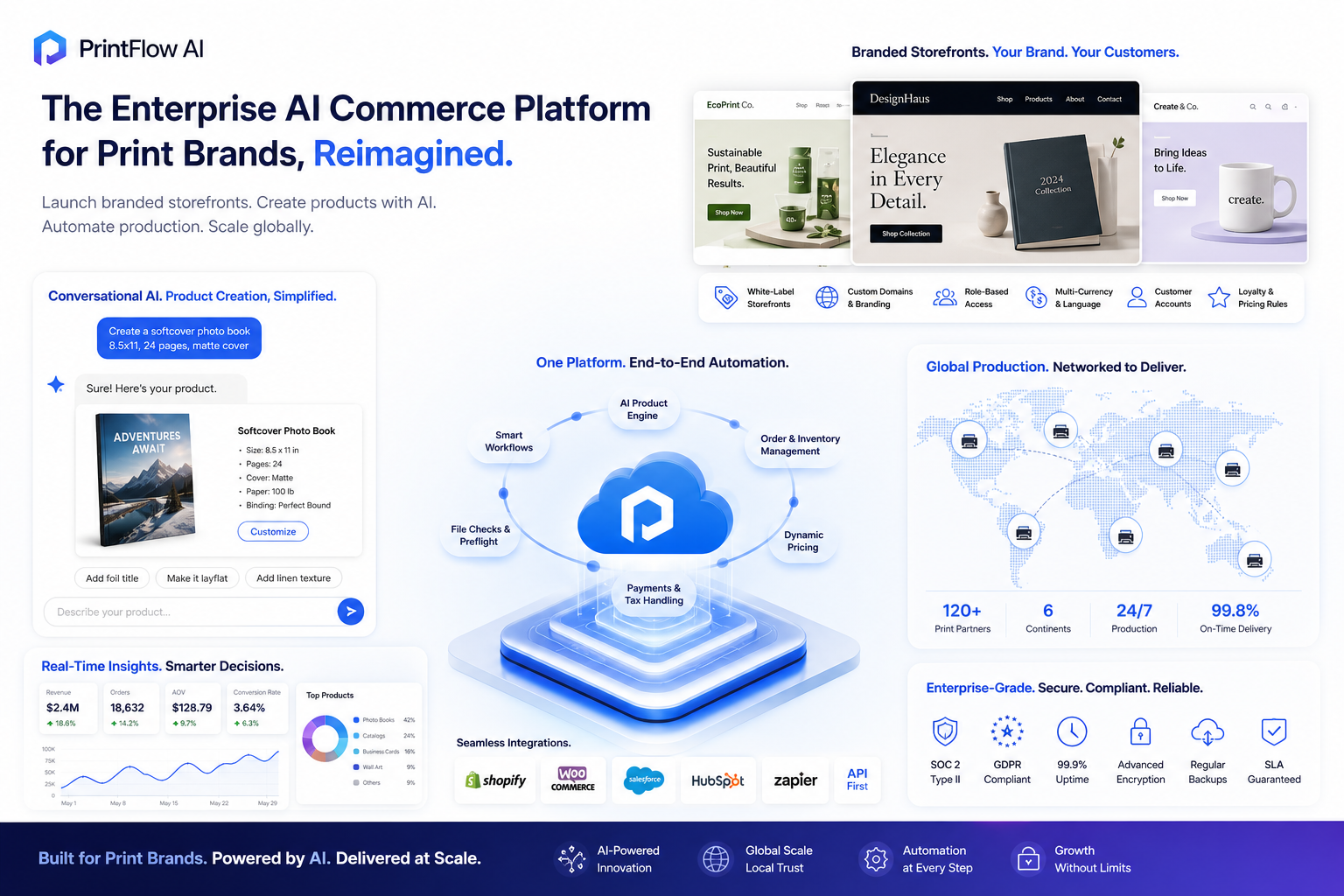
That architecture matters because it solves multiple business problems at once:
reduces creation friction
shortens path to purchase
improves conversion confidence
avoids app dependency
supports multi-device user behavior
lowers inventory exposure
scales through automated global fulfillment
works for startups, mid-market brands, and enterprise print companies alike
In other words, it aligns with the real direction of AI platforms for business in 2026.
How to Choose the Right AI Platform for Your Business in 2026
When evaluating vendors, avoid getting distracted by surface-level AI branding. Ask questions tied to outcomes.
Ask About Customer Experience
Can customers create products with simple prompts?
Does the experience remove complexity or add another interface?
Is the workflow intuitive on mobile?
Ask About Operational Execution
Does the platform generate ready-to-produce outputs?
Can it automate previewing, approval, and routing?
Does it connect into fulfillment systems?
Ask About Deployment Flexibility
Can it be white-labeled?
Can it run inside our current storefront or app?
How fast can we launch?
Ask About Scalability
Can it support multiple regions, product lines, or brands?
Is the infrastructure built for high-order-volume environments?
Does it support startups and enterprise teams differently?
Ask About Business Model Impact
Will it reduce manual labor?
Will it lower overhead or inventory risk?
Will it improve conversion through faster creation and better previews?
The answers to these questions matter far more than whether a platform uses the latest model label.
Final Verdict: The Best AI Platforms for Business Will Feel Invisible
The strongest AI platforms in 2026 will not win because they are the loudest. They will win because they remove friction so effectively that the user barely notices the complexity underneath.
That is the future of AI in business:
less tool learning
more natural interaction
more automation
more personalized output
more seamless integration
more confidence before purchase
more scalable operations after purchase
For print businesses, photo brands, studios, and web-to-print companies, that future is already taking shape. Media Rex Alliance is built for it.
If you want to launch an AI-powered print experience without building the entire stack from scratch, Media Rex Alliance gives you a faster path: conversational product creation, white-label deployment, mobile-first browser access, 3D and AR previews, cloud sync, and automated global fulfillment in one scalable platform.
The market is moving from AI as a feature to AI as infrastructure. This is the moment to choose a platform that can help your brand lead, not just keep up.
Ready to modernize your print business for 2026?
Choose Media Rex Alliance to turn prompts into premium products, reduce friction across the customer journey, and launch a branded AI commerce experience that scales.
FAQ
What are the AI business trends 2026?
The top AI business trends in 2026 include conversational interfaces, autonomous workflow execution, deep personalization, white-label deployment, mobile-first experiences, and stronger integration with commerce and fulfillment systems. Businesses are also prioritizing 3D/AR previews, on-demand production, and vertical AI platforms that solve industry-specific workflows.
Which is the best AI platform in 2026?
The best AI platform in 2026 is the one that aligns most closely with your business model, customer journey, and operational needs. For print and photo commerce, a platform like Media Rex Alliance stands out because it combines conversational creation, white-label deployment, mobile-first access, realistic previews, and automated fulfillment.
What is the AI business idea for 2026?
A strong AI business idea for 2026 is building low-friction, personalized customer experiences that convert intent into transactions faster. In print and commerce, that means using AI to turn prompts into print-ready products, preview them instantly, and fulfill on demand without high inventory overhead.
Which AI company will boom in 2026?
The companies most likely to boom in 2026 are those that move beyond generic AI features and deliver workflow-native, revenue-driving platforms. Vertical specialists that combine automation, integration, personalization, and scalable deployment are positioned especially well, particularly in sectors like commerce, manufacturing, and print technology.
What industry will boom in 2026?
Industries that combine digital demand with operational automation are likely to grow fastest in 2026, including AI-powered ecommerce, print-on-demand, personalized commerce, and enterprise automation. Businesses that can reduce friction, launch branded experiences quickly, and fulfill efficiently will have a strong competitive advantage.