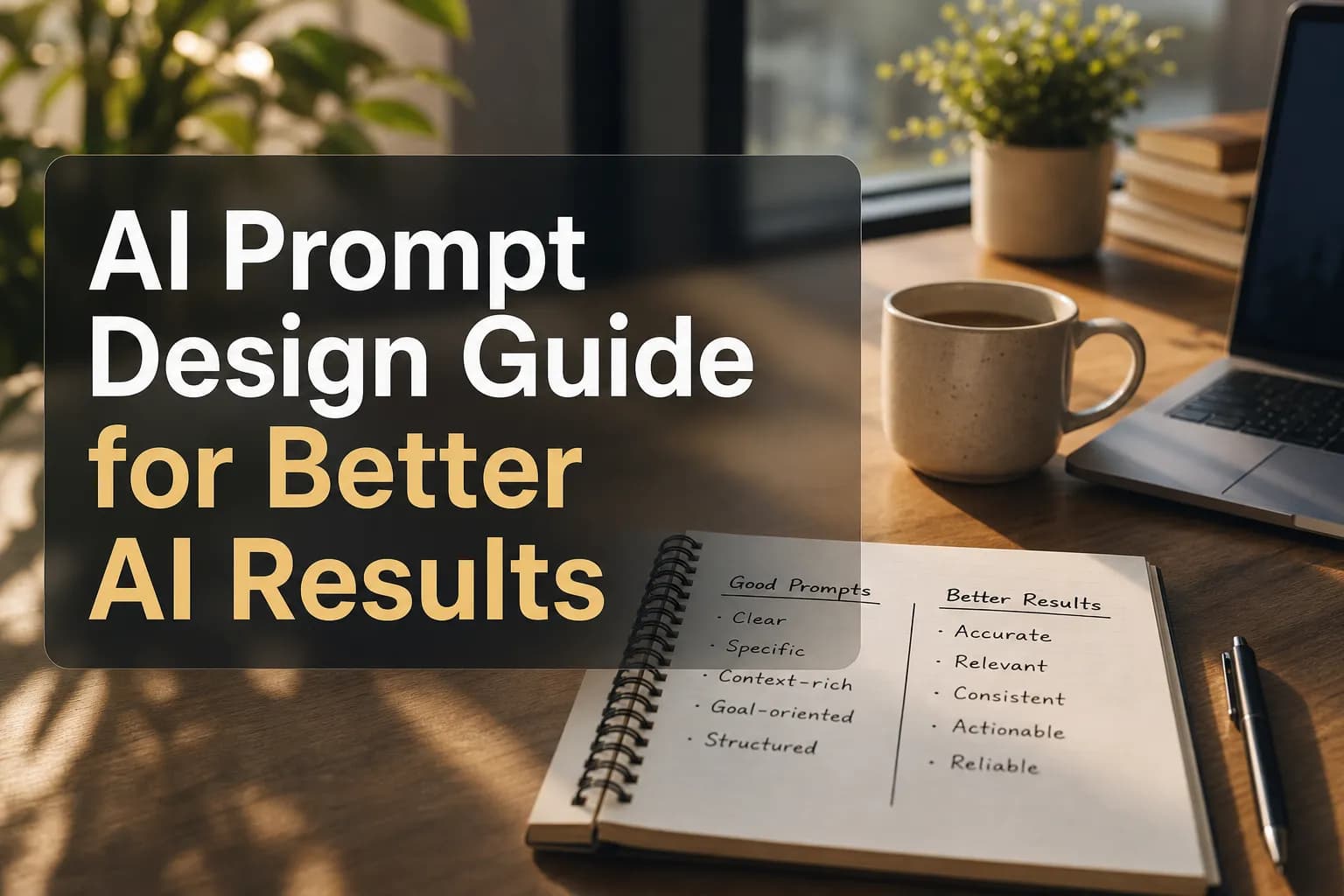
AI Prompt Design Guide for Better AI Results
AI output quality is rarely limited by the model alone. More often, it is limited by the clarity of the instruction. If you want faster, more reliable, and more usable results, ai prompt design is the leverage point.
For small studios, photographers, print-on-demand startups, established photo book brands, and digital print businesses, this matters beyond content generation. Better prompts reduce production friction, improve consistency, shorten revision cycles, and help teams turn ideas into customer-ready experiences faster. That is especially relevant in AI-powered web-to-print, where natural language can become the new design interface.
At Media Rex Alliance, we see prompt design as more than a writing trick. It is a commercial workflow advantage. When customers can describe what they want in plain language and instantly receive print-ready outputs, photorealistic 3D previews, and immersive AR validation before ordering, conversion friction drops dramatically. That is the future of scalable, white-label AI commerce.
What AI Prompt Design Actually Means
AI prompt design is the practice of structuring instructions so an AI system produces outputs that are:
relevant
accurate
appropriately formatted
consistent across repeated use
aligned to a real business objective
A weak prompt asks for “something good.” A strong prompt defines the task, audience, format, tone, constraints, and success criteria.
In practical terms, good prompt design helps you move from vague generation to controlled production.
Why Better Prompts Produce Better Outputs
Large language models respond to patterns, context, and specificity. The more clearly you define the job, the less the model needs to guess.
That means strong prompts usually include:
a clear role
the exact task
input context
output requirements
boundaries or constraints
examples when needed
This is why a generic query often produces generic text, while a structured instruction produces a much more useful result.
"For most factual use cases such as data extraction, and truthful Q&A, the temperature of 0 is best." - OpenAI Help Center
The Core Principles of Effective Prompt Design
Start With the Outcome, Not the Tool
Most people begin by thinking, “What should I ask the AI?”
A better starting point is, “What exact output do I need?”
Examples:
a 5-bullet executive summary
a customer-ready product description
a print-ready design brief
a JSON object for structured extraction
three ad variants for a luxury photo book campaign
The output defines the prompt. Not the other way around.
Put Instructions First
Leading with the instruction helps the model prioritize the task immediately. Then add the supporting context below it.
Weak:
“Here is some background information... can you maybe summarize it?”
Better:
“Summarize the text below into 5 bullets for an operations manager. Focus on risks, costs, and next actions.”
Be Specific About Format
If format matters, say so directly. Do not assume the model will infer it.
Specify things like:
word count
bullet count
table structure
reading level
tone
whether examples are required
whether sources should be cited
whether output must be machine-readable
Add Constraints That Improve Quality
Useful constraints often include:
target audience
business goal
exclusions
time period
brand voice
approval criteria
Constraints narrow ambiguity. Ambiguity is where weak outputs begin.
Use Examples When Precision Matters
If you need a repeatable structure, provide one or two examples. This is especially useful for:
product descriptions
metadata formats
category labels
customer service replies
design prompt templates
branded copy frameworks
A Simple Framework You Can Use Every Time
A reliable prompt formula is:
Element | What it does | Example |
|---|---|---|
Role | Sets perspective | “Act as a senior ecommerce copywriter.” |
Task | Defines the job | “Write a product description.” |
Context | Adds relevant background | “This is for a premium layflat photo book brand.” |
Constraints | Controls output | “Keep it under 120 words and avoid clichés.” |
Format | Makes it usable | “Return 3 headline options and 1 body paragraph.” |
Example of a Basic Prompt
Prompt:
Act as a senior ecommerce copywriter. Write a premium product description for a custom wedding photo book. The audience is engaged couples shopping on mobile. Keep it under 120 words. Emphasize emotional value, craftsmanship, and ease of creation. End with a soft call to action.
This works because it gives the AI a role, audience, length, value proposition, and output goal.
The Biggest Mistakes People Make
1. Being Too Vague
“Write something about AI” is not a prompt strategy. It is an invitation to guess.
Vagueness leads to:
generic output
repetitive phrasing
missed audience intent
more editing time
2. Asking for Too Much at Once
One overloaded prompt often performs worse than a short sequence of focused prompts.
Instead of asking the model to research, analyze, write, format, and localize in one step, break it into stages.
3. Forgetting the Audience
AI can produce polished text that still fails commercially because it is aimed at the wrong reader.
A prompt for a CTO should not sound like a prompt for a first-time Etsy seller. Context changes vocabulary, depth, and persuasion style.
4. Specifying What Not to Do Without Saying What to Do
Negative instructions alone are weak. Replace them with positive guidance.
Instead of:
“Do not be vague.”
Use:
“Write in short, concrete sentences with specific examples.”
5. Ignoring Output Structure
If your team needs something operational, freeform prose may be a liability. Ask for a table, checklist, JSON, numbered steps, or decision matrix.
6. Not Iterating
Prompt design is rarely perfect on the first pass. High-performing teams treat it like optimization, not magic.
"Prompt engineering focuses on crafting the optimal textual input... In contrast, problem formulation emphasizes defining the problem by delineating its focus, scope, and boundaries." - MIT Sloan Teaching & Learning Technologies
Zero-Shot, Few-Shot, and Multi-Step Prompting
Competitor articles often mention prompt clarity, but many gloss over when to use different prompting patterns. This is one of the biggest content gaps.
Zero-Shot Prompting
Use this when the task is simple and the format is straightforward.
Example:
“Summarize this article in 5 bullet points for a busy executive.”
Best for:
summarization
rewriting
basic ideation
straightforward classification
Few-Shot Prompting
Use this when style or structure must be consistent.
Example:
Provide two sample product blurbs, then ask the model to create a third in the same format.
Best for:
branded copy
metadata tagging
support response formatting
repeatable merchandising content
Multi-Step Prompting
Use this when the task has multiple layers.
A strong workflow might be:
extract the key facts
organize them into themes
draft the final output
refine for a specific audience
This often outperforms one giant prompt because each step has a narrower objective.
Prompt Templates for Real Business Use
For Summaries
Summarize the text below into 5 bullet points for a non-technical executive. Focus on business impact, timeline, risk, and next steps. Keep each bullet under 20 words.
For Analysis
Analyze the following customer reviews. Identify the top 3 recurring complaints, 3 praised features, and 2 product opportunities. Return the output as a table.
For Copywriting
Act as a premium DTC brand strategist. Write 3 product description variants for a custom photo calendar. Audience: busy parents buying from mobile. Tone: elegant, warm, concise.
For Structured Extraction
Extract the following fields from the text: company name, industry, product type, pricing cues, and customer pain points. Return valid JSON only.
For Design Ideation
Generate 5 creative directions for a modern travel photo book cover. Each direction should include mood, color palette, typography style, and a one-line rationale.
Advanced Prompt Design Tactics
Use Delimiters to Separate Instructions and Context
Clear separation improves readability for both humans and models.
Example:
Summarize the content below for a sales team.
Text: """
[paste content here]
"""
Define Success Criteria
Tell the model how to judge a good output.
Example:
must be scannable on mobile
must avoid jargon
must sound premium, not trendy
must be understandable in under 30 seconds
Ask for Alternative Versions
Instead of one answer, request variations.
Example:
one conservative version
one conversion-focused version
one aspirational brand version
This speeds up decision-making and reduces re-prompting.
Use Role Framing Carefully
Role-based prompting can be powerful, but only if the role meaningfully changes the output.
Good example:
“Act as a print operations consultant reviewing customer workflow friction.”
Less useful example:
“Act as a genius writer.”
Chain Prompts for Better Reliability
For high-value workflows, create prompt chains:
generate raw material
evaluate weaknesses
rewrite against a rubric
format for final use
This is especially effective in SaaS environments where reliability matters more than novelty.
Prompt Design for AI-Powered Commerce and Print
This is where the conversation becomes commercially important.
Traditional web-to-print tools often create friction. Users face templates, layers, complex editors, and mobile usability problems. Prompt-driven creation changes the interface from manual design to guided intent capture.
Instead of forcing a customer to build a product piece by piece, the platform can ask:
“Create a minimalist wedding album with a soft neutral palette and room for handwritten captions.”
“Turn these baby photos into a playful 40-page photo book for grandparents.”
“Design a premium travel book with cinematic layouts and map-inspired accents.”
That shift is not just UX innovation. It is a conversion engine.

At Media Rex Alliance, this model is built for production, not demos. Businesses can launch fully white-label experiences inside their own storefronts or apps, allowing customers to create products through conversational AI instead of traditional design software. The result is faster product creation, less abandonment, and a cleaner route from idea to order.
Why Prompt Design Matters in Web-to-Print
Traditional Workflow | Prompt-Driven Workflow |
|---|---|
User learns editor tools | User describes intent naturally |
High friction on mobile | Mobile-first browser experience |
Slow revisions | Fast AI-assisted regeneration |
Template dependency | Flexible creation from prompts |
Uncertain final outcome | Photorealistic 3D and AR previews |
Inventory planning burden | On-demand production model |
This is where strong prompt design connects directly to revenue. Better prompts create better product intent capture. Better intent capture creates better previews. Better previews increase confidence. Confidence improves conversion.
Content Gaps Competitors Commonly Miss
Most articles about prompt design cover only generic writing tips. They usually miss the operational layer. Here are the areas that deserve more attention:
Prompt Design Is a Workflow Skill, Not Just a Writing Skill
The real value is not “how to ask AI nicely.” It is how to design repeatable systems that produce dependable outputs across teams.
Output Formatting Is a Business Multiplier
A beautifully written answer can still be unusable if it is in the wrong structure. High-value prompting is tightly connected to downstream workflows.
Prompting Must Align With Commercial Intent
In ecommerce and print, useful prompts must serve actual goals:
improve conversion
reduce support burden
speed up product creation
maintain brand consistency
lower production overhead
The Best Prompt Interface May Be Invisible
In advanced SaaS products, end users should not need prompt expertise at all. The platform can guide, enrich, and structure prompts behind the scenes.
That is a major strategic advantage for companies adopting AI-native commerce tools rather than bolting AI onto legacy software.
A Prompt Quality Checklist
Before you submit any prompt, check whether it answers these questions:
What exact output do I want?
Who is the audience?
What context does the model need?
What constraints matter?
What format should the answer take?
How will I know if the result is good?
Would an example improve consistency?
If you cannot answer these, the prompt is probably under-specified.
Example: Turning a Weak Prompt Into a Strong One
Weak Prompt
“Write a product description for a photo book.”
Better Prompt
Act as a senior ecommerce copywriter for a premium print brand. Write a product description for a layflat wedding photo book. Audience: newly engaged couples shopping on mobile. Tone: elegant, modern, emotionally resonant. Length: 90 to 120 words. Emphasize premium paper, storytelling, and easy creation. End with a subtle call to action.
Why the Improved Prompt Wins
It specifies:
role
product
audience
tone
length
differentiators
conversion goal
That reduces ambiguity and improves relevance immediately.
How Teams Can Operationalize Prompt Design
For companies moving beyond casual AI use, ad hoc prompting is not enough. Prompting should become part of the operating model.
Build a Reusable Prompt Library
Create approved prompts for:
blog briefs
product copy
support workflows
SEO metadata
customer onboarding
design generation
print personalization
Version Your Best Prompts
Track what changed and what improved. Prompt optimization is easier when teams treat prompts like living assets.
Pair Prompts With Review Rubrics
A prompt gets stronger when paired with a quality standard. For example:
Was the answer accurate?
Did it match the requested format?
Did it reflect the brand voice?
Was it useful without heavy editing?
Integrate AI Into the Customer Journey
This is where Media Rex Alliance becomes strategically relevant. Instead of using AI only internally, print businesses can embed conversational creation directly into the buying experience. Customers can generate products naturally, preview them in 3D or AR, sync across devices, and move to checkout faster without downloading an app or learning design software.
Because the platform is fully white-label, brands retain their identity while gaining AI-native product creation, cloud and local sync, and automated fulfillment through a global network of premium printers. That means lower overhead, reduced inventory exposure, and a faster path to scalable growth.
Final Verdict
AI prompt design is no longer a niche skill. It is a practical advantage for teams that want faster execution, better outputs, and more reliable AI performance.
The best prompts are clear, structured, contextual, and outcome-driven. They reduce guesswork, improve consistency, and turn AI from a novelty into a dependable production layer.
For digital print businesses, photo product brands, studios, and web-to-print platforms, the opportunity is even bigger. Prompt design is not just about generating text. It is about reimagining how customers create products in the first place.
Media Rex Alliance is built for that future. If you want to launch an AI-powered, white-label print experience that turns natural language into print-ready products, supports mobile-first design, delivers photorealistic previews, and scales through automated on-demand fulfillment, this is the infrastructure to do it without building everything from scratch.
FAQ
How to design better AI prompts?
Start with the exact outcome you want, then define the task, audience, context, constraints, and output format. Strong prompts are specific, structured, and easy for the model to follow. If consistency matters, add examples or break the task into multiple steps.
What are the most effective AI prompts?
The most effective prompts are clear, detailed, and goal-oriented. They usually include a role, a precise task, relevant context, formatting instructions, and success criteria. Prompts that remove ambiguity tend to produce the most reliable results.
Is ChatGPT the best AI right now?
There is no single best AI for every use case. The right choice depends on whether you need reasoning, speed, structured output, multimodal capability, or workflow integration. For business value, prompt quality and system design often matter as much as the model itself.
What are some famous AI prompts?
Well-known prompt styles include zero-shot prompts, few-shot prompts, role-based prompts, chain-of-thought-inspired workflows, and structured extraction prompts. These are widely used because they improve clarity, consistency, and control across many AI tasks.