Apparel On Demand: Trends Driving Growth in 2026
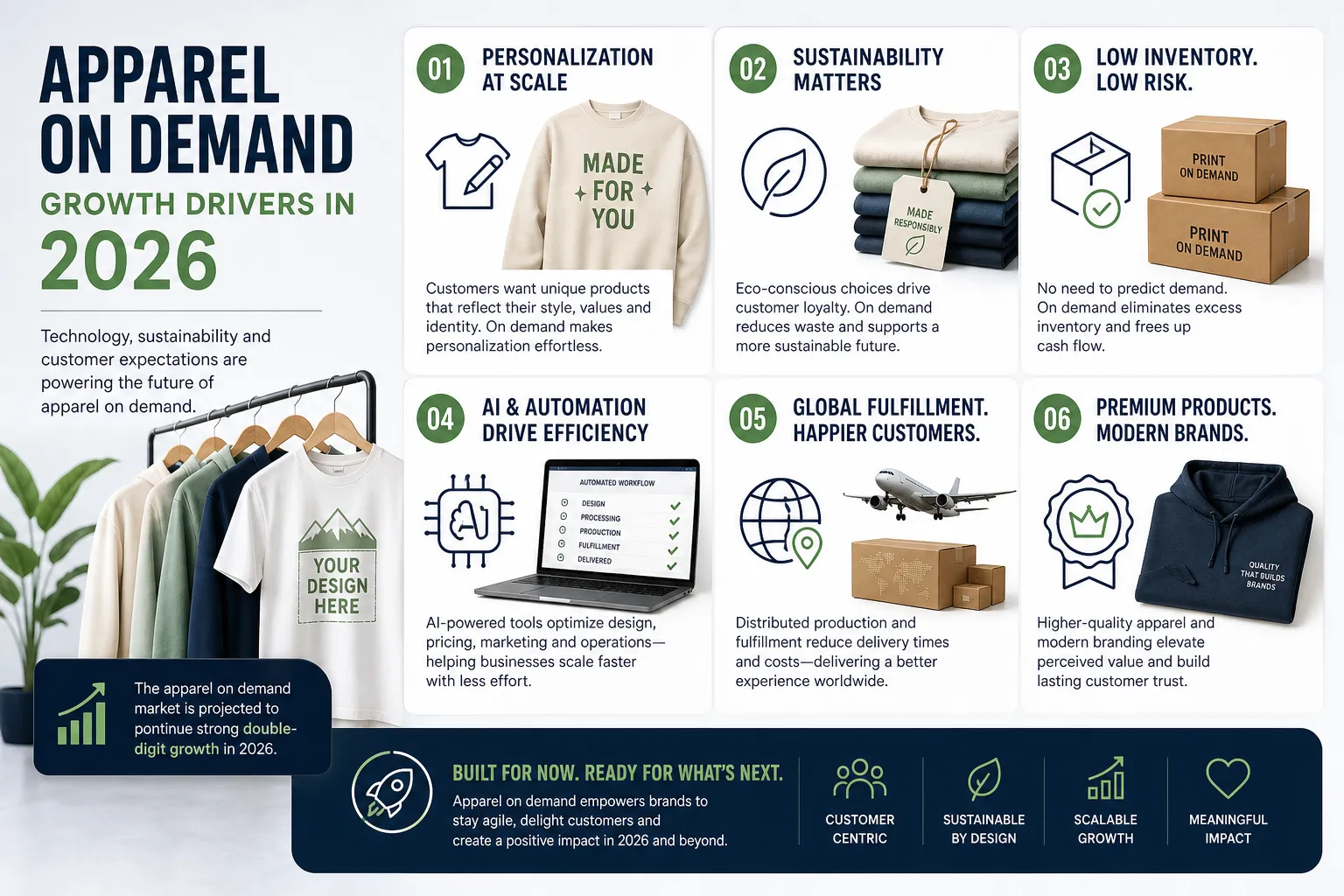
Apparel on demand is no longer a niche fulfillment model for side hustles and novelty tees. In 2026, it has become a strategic growth engine for print businesses, photo product companies, creative studios, and emerging ecommerce brands that need to move faster, personalize deeper, and operate with less inventory risk.
For many businesses, the old web-to-print experience is still the bottleneck. Traditional design tools create friction. Mobile conversion suffers. Customers abandon the process before they ever see a finished product. At the same time, buyers increasingly expect personalization, sustainability, and instant visual confidence before they click “buy.”
That shift is exactly why the category is expanding.
The next phase of growth belongs to platforms that reduce complexity at every step: product creation, personalization, proofing, ordering, and fulfillment. Media Rex Alliance is built for that future. Instead of forcing customers into complicated editors, it enables conversational AI product creation, turning a simple prompt into a print-ready apparel item. Brands can deploy it as a fully white-label experience inside their own storefronts or apps, offer photorealistic 3D and AR previews, and scale on-demand production through an automated global fulfillment network.
For print companies and apparel brands, this is more than a UX upgrade. It is a conversion strategy.
Why Apparel On Demand Is Accelerating in 2026
The market is growing because it solves three big business problems at once:
It removes inventory exposure
It matches consumer demand for personalization
It lets brands test and launch quickly
Competitor content consistently highlights growth, sustainability, and product variety. What most of it glosses over is the experience layer: the real growth unlock now comes from how easily customers can create products and how confidently they can approve them.
That matters because the modern buyer does not just want custom apparel. They want a fast, intuitive, mobile-first path to custom apparel.
"The global print-on-demand market size is currently valued at $12.96 billion and is projected to climb to $102.99 billion by 2034." - Precedence Research
This level of growth is being driven by more than low startup costs. It reflects a structural shift toward flexible manufacturing, made-to-order commerce, and digital-first product creation.
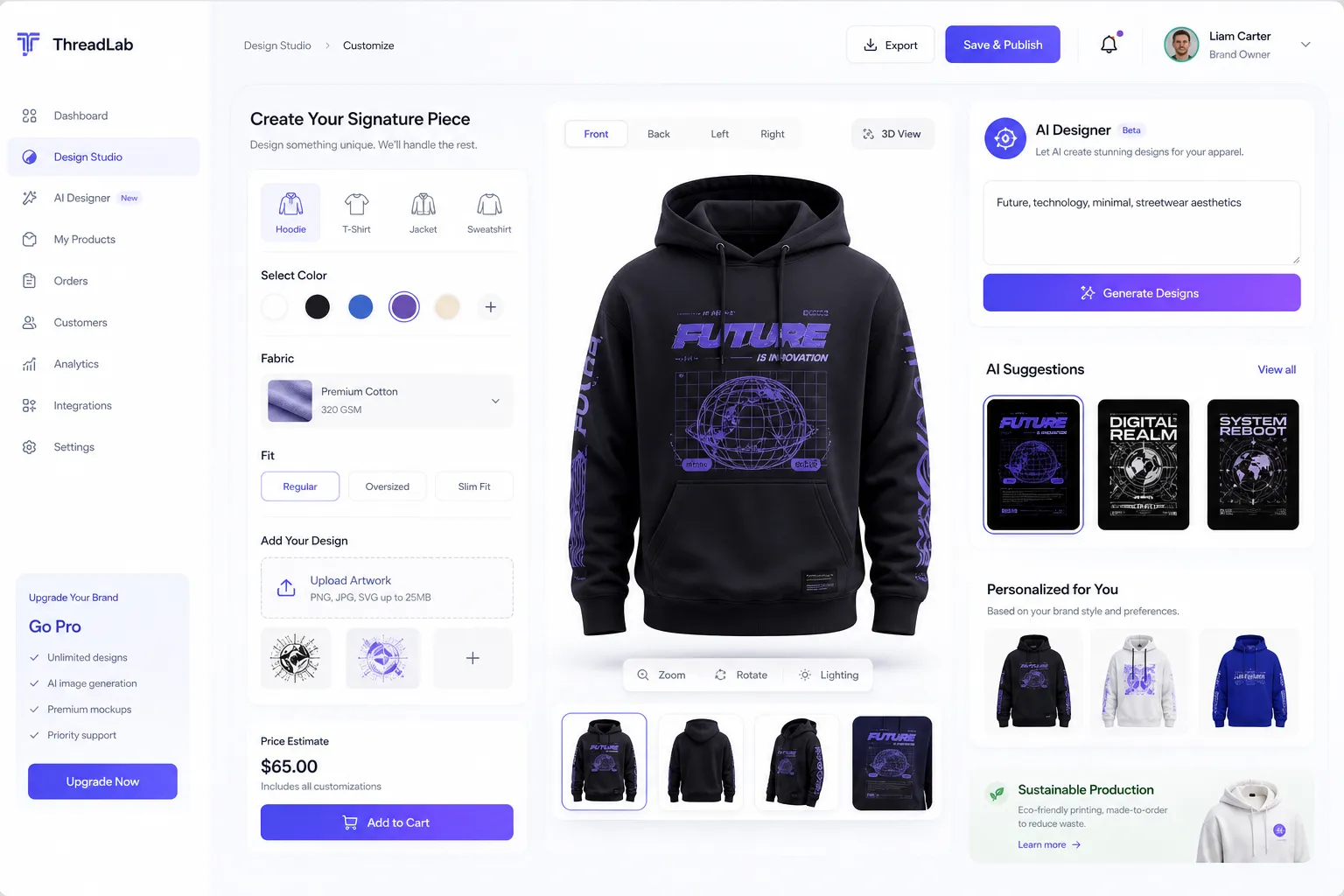
What Apparel On Demand Actually Means Now
At a basic level, apparel on demand means garments are produced only after a customer places an order. But in 2026, the definition is broader and far more sophisticated.
Today’s leading model combines:
Capability | Legacy Web-to-Print | Modern AI-Powered Apparel On Demand |
|---|---|---|
Product creation | Manual editor, template-heavy | Conversational AI prompt-to-product |
Personalization | Often slow and limited | Dynamic text, images, layouts, and style guidance |
Device experience | Desktop-first | Mobile-first, browser-based |
Product preview | Static mockups | Photorealistic 3D and AR previews |
Fulfillment model | Often fragmented | Automated global print network |
Launch speed | Weeks to months | Rapid deployment through white-label SaaS |
The difference is important. Businesses are no longer just choosing a print method. They are choosing a customer journey.
With Media Rex Alliance, a buyer can describe what they want in natural language, upload photos if needed, receive an automatically generated design, and review it in immersive visual detail before purchase. That reduces hesitation, shortens decision time, and increases the odds of conversion.
The Biggest Trends Shaping Apparel On Demand in 2026
1. Conversational AI Is Replacing Complex Design Workflows
One of the biggest content gaps in competitor articles is the underestimation of interface friction. Most articles talk about AI-generated art. Far fewer address the more important shift: AI as the creation interface itself.
Customers do not necessarily want better editing tools. They want fewer editing steps.
Media Rex Alliance addresses this directly by enabling customers to create products through conversational prompts instead of complex design software. That means:
less drop-off during customization
faster path from idea to checkout
broader accessibility for non-designers
more scalable self-serve product creation
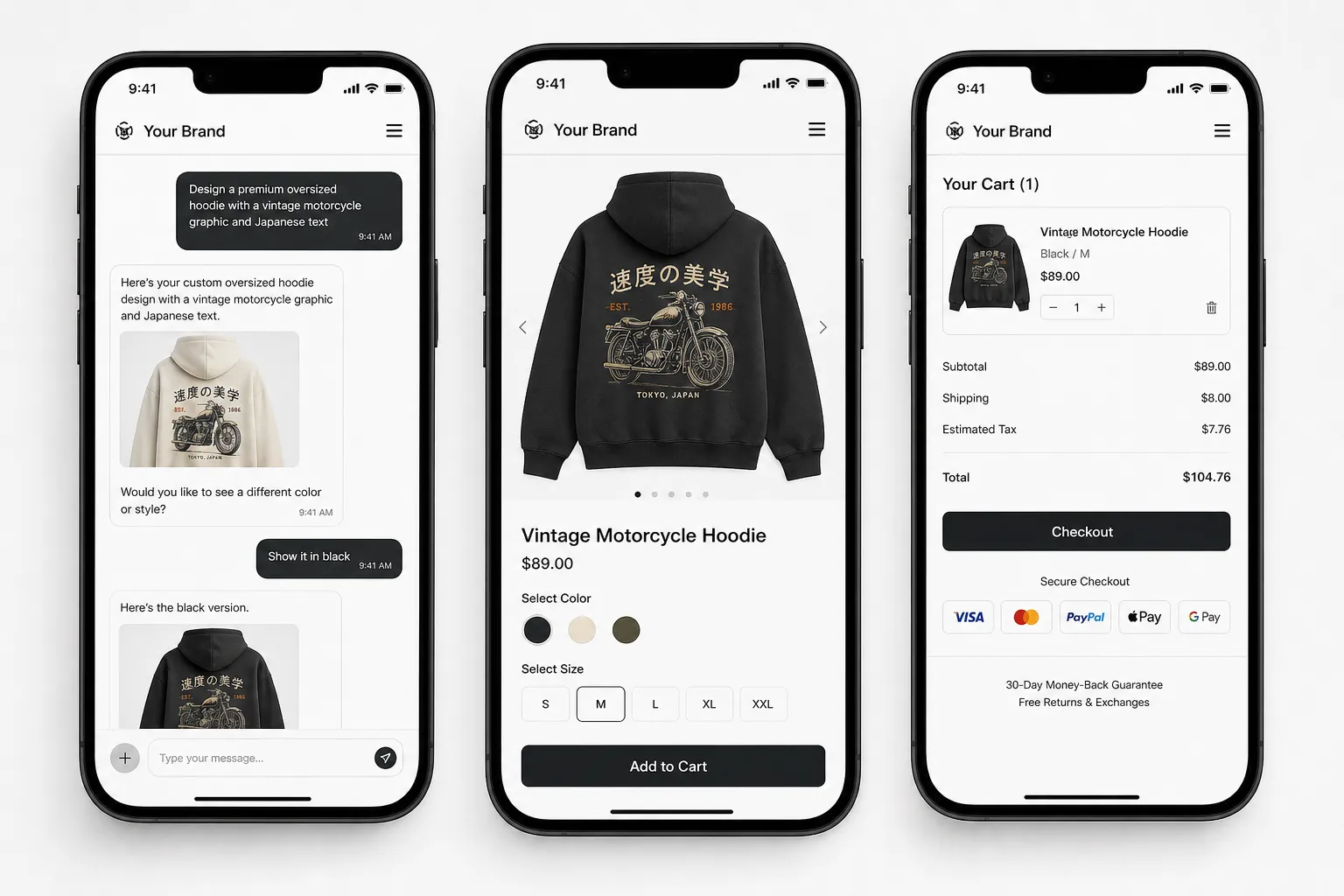
This is especially valuable for small studios, photographers, and regional print brands that want a premium ordering experience without building proprietary software from scratch.
Why this trend matters
A prompt-based workflow transforms custom apparel from a design task into a buying conversation. That is a massive UX advantage, particularly on mobile where traditional editors often perform poorly.
2. Personalization Is Moving From Optional Feature to Core Revenue Driver
The strongest competitors all point to personalization, and rightly so. But the winning angle in 2026 is not simple name printing or monograms. It is personalization at scale with minimal effort from the buyer.
That includes:
personalized event apparel
creator-led micro drops
teamwear and branded merch
memory-driven photo apparel
niche audience collections with easy customization
The most successful brands are making custom feel instant rather than labor-intensive.
For businesses, that creates a strong margin opportunity. Personalized products are harder to compare purely on price, which protects profitability and raises perceived value.
3. Visual Confidence Is Becoming a Conversion Lever
Static mockups are no longer enough for high-intent custom product buyers. When apparel is made to order, the buyer wants reassurance before the item goes into production.
That is why photorealistic product rendering and AR previews are emerging as critical growth drivers.
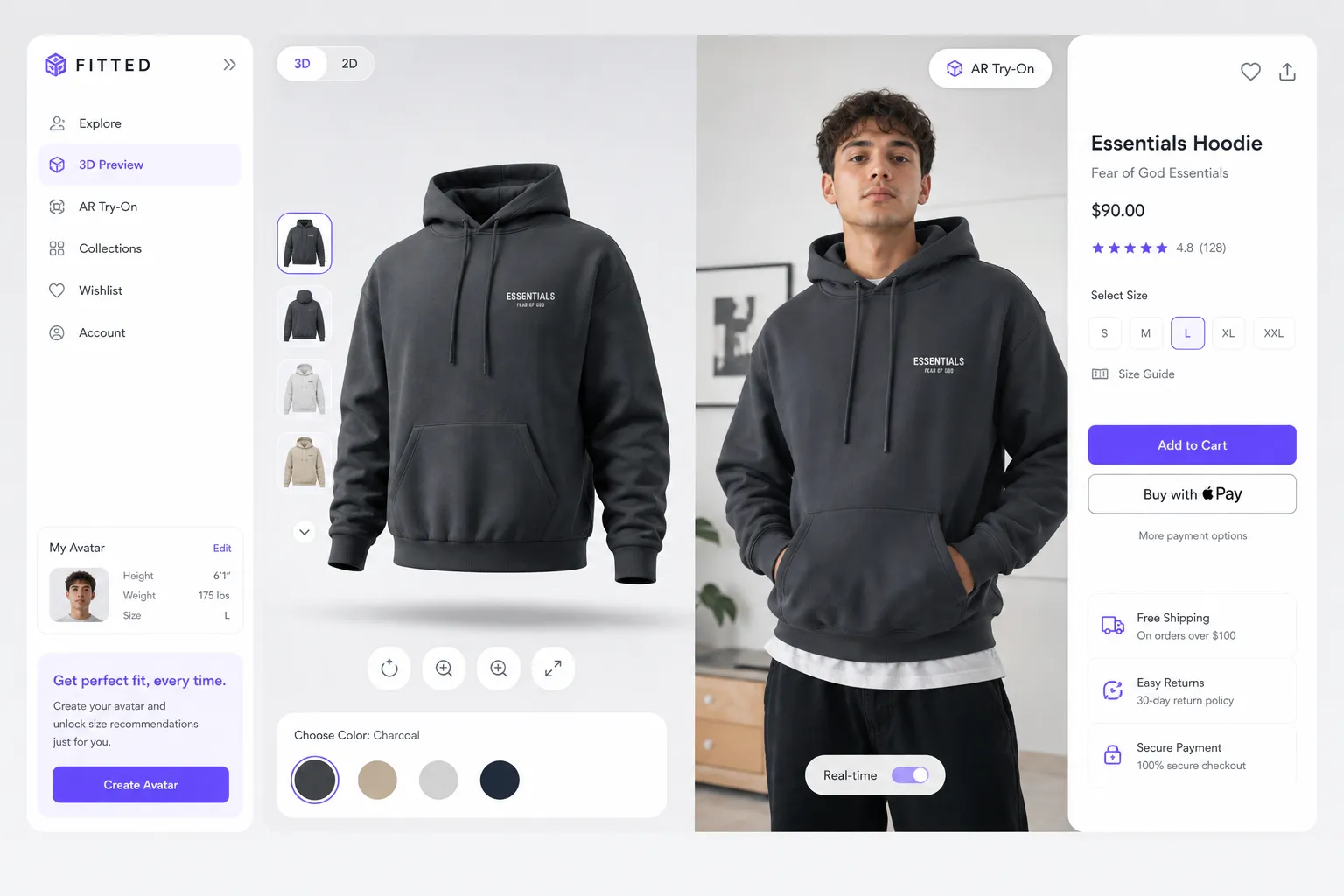
Media Rex Alliance helps brands close this confidence gap with photorealistic 3D and immersive AR previews before ordering. This matters because buyers are more likely to complete a purchase when they can clearly understand the finished result.
Benefits of better previewing
lower abandonment during customization
higher trust in personalized orders
fewer post-purchase surprises
better fit for premium-priced custom apparel
4. Low-Inventory Commerce Is Winning in Uncertain Markets
Inventory risk remains one of the biggest drains on apparel businesses. Fashion volatility, shifting consumer preferences, and rising acquisition costs make speculative stock harder to justify.
Apparel on demand offers a cleaner model:
no large minimums
no dead stock
easier testing of designs and niches
more resilient cash flow
This aligns with the broader 2026 retail environment, where agility matters as much as brand vision.
Competitor coverage often mentions “no inventory” as a beginner advantage. The deeper truth is that low-inventory commerce is now a strategic advantage for businesses at every stage, including established photo book companies and larger print enterprises modernizing legacy operations.
5. Sustainability Is Becoming Operational, Not Just Marketing-Led
Sustainability remains a strong macro trend, but the conversation has matured. Buyers are looking past vague brand language and paying closer attention to how products are actually made.
Apparel on demand supports this shift by reducing overproduction and minimizing unsold stock.
"80% of consumers say they’re willing to spend more for sustainable products." - PwC
For brands, sustainability messaging works best when backed by operational truth. On-demand production is one of the clearest examples of that because it aligns manufacturing more closely with real demand.
6. Mobile-First Commerce Is Reshaping the Design Experience
This is another major gap in most competitor articles. They discuss trending products, but not enough about where and how customers are shopping.
In 2026, a meaningful share of discovery, customization, and checkout starts on mobile. If the customization flow feels cramped, slow, or app-dependent, conversion suffers.
Media Rex Alliance is purpose-built for this environment:
browser-based access with no app install required
mobile-first product creation
seamless local and cloud sync across devices
simple continuation from phone to desktop and back again
For modern apparel commerce, this is not a convenience feature. It is a revenue feature.
7. White-Label Infrastructure Is Outperforming Custom Builds
Many growing print businesses know they need better product creation technology, but custom development is expensive, slow, and difficult to maintain.
That is why white-label AI print infrastructure is becoming such a strong growth enabler.
With Media Rex Alliance, businesses can launch branded apparel creation experiences under their own domain, design system, and customer journey without reinventing the technology stack. This is especially compelling for:
new print-on-demand brands
regional printers expanding into ecommerce
photo companies adding wearable products
mid-size print brands modernizing their storefront UX
enterprise print providers seeking scalable innovation
8. Global Fulfillment Networks Are Raising the Standard
Speed and quality are both essential in custom apparel. A brilliant frontend experience means little if fulfillment is inconsistent.
The strongest on-demand businesses are increasingly pairing smart creation tools with automated fulfillment across distributed printer networks. This improves delivery flexibility, reduces operational burden, and supports scale without requiring in-house production everywhere.
Media Rex Alliance extends this logic by connecting AI-powered product creation to an automated fulfillment pipeline and a global network of premium printers. That means businesses can focus more on growth, merchandising, and customer experience rather than operational coordination.
Where Competitor Articles Fall Short
After synthesizing the strongest competitor themes, several content gaps stand out.
1. They focus on market growth, but not enough on conversion friction
Most articles explain why demand is rising. Few explain how poor creation flows suppress revenue.
2. They mention AI, but mainly as art generation
The more important opportunity is AI-guided product creation through natural language.
3. They overlook preview technology
3D and AR previews are not cosmetic features; they improve buyer confidence and reduce hesitation.
4. They talk to beginners more than serious operators
Small studios, print brands, and established photo businesses need infrastructure guidance, not just product ideas.
5. They rarely connect trends to deployment models
A business can believe in personalization and still fail if implementation is too slow or costly. White-label SaaS solves that execution gap.
The Most Promising Apparel Categories for 2026
While apparel on demand is broad, some categories are especially well-positioned for growth due to comfort, self-expression, and customization potential.
Category | Why It’s Growing | Best Use Case |
|---|---|---|
T-shirts | Evergreen demand, easy testing | Creator merch, events, niche drops |
Hoodies | Higher perceived value | Premium branding, seasonal collections |
Sportswear | Fashion + function | Fitness communities, teamwear |
Leggings | Strong personalization appeal | Lifestyle and activewear brands |
Oversized streetwear | Trend-led demand | Fashion-forward drops and collaborations |
Photo apparel | Emotional personalization | Gifts, memory products, family occasions |
The opportunity is not just in choosing the right garment. It is in pairing the right garment with a faster, smarter buying experience.
How to Evaluate an Apparel On Demand Platform in 2026
If you are choosing technology for the next stage of growth, here is what matters most.
Look for these capabilities
Requirement | Why It Matters |
|---|---|
Conversational AI creation | Removes friction and broadens accessibility |
White-label deployment | Preserves your brand equity and customer ownership |
3D and AR previews | Improves confidence and supports higher conversion |
Mobile-first UX | Matches real buying behavior |
Browser-based experience | Reduces onboarding resistance |
Cross-device sync | Supports longer, multi-session purchase journeys |
Global automated fulfillment | Enables scalable production with lower overhead |
Red flags to avoid
design tools that feel desktop-era and bloated
generic storefronts with weak brand customization
limited preview quality
manual fulfillment handoffs
app-dependent user flows
systems that cannot scale beyond a starter business
How Media Rex Alliance Fits the 2026 Growth Model
Media Rex Alliance is aligned with the exact trends driving the next wave of apparel on demand.
It simplifies creation
Customers can create products through natural language instead of wrestling with design software.
It accelerates purchase decisions
Prompt-to-product generation reduces time-to-value and helps buyers move from idea to checkout faster.
It supports modern deployment
The platform is fully white-label, letting businesses launch under their own brand, storefront, and domain.
It improves buyer confidence
Photorealistic 3D and AR previews help customers understand what they are buying before production begins.
It matches real customer behavior
The experience is mobile-first, browser-based, and requires no app installation.
It supports flexible operations
Projects sync locally and in the cloud, making multi-device creation seamless.
It keeps the business lean
On-demand production reduces stock exposure, while automated fulfillment lowers overhead.
It scales with the business
From startups to established print enterprises, the infrastructure is designed to grow without forcing a platform rebuild later.
A Strategic Playbook for Print Businesses Entering This Space
If you are a studio, print company, or apparel brand planning your 2026 roadmap, here is the practical sequence.
Step 1: Start with high-intent apparel categories
Focus on garments people already understand and buy regularly, such as tees, hoodies, and activewear.
Step 2: Reduce creation friction first
Do not just add products. Improve how customers make them.
Step 3: Use previews to reduce hesitation
Strong 3D or AR visualization can materially improve order confidence.
Step 4: Stay inventory-light
Use demand signals to guide expansion rather than pre-buying broad collections.
Step 5: Choose infrastructure that can be branded and scaled
A white-label system is often the fastest route to a premium, defensible customer experience.
Final Verdict
Apparel on demand is growing in 2026 because it fits the economic and behavioral realities of modern commerce: personalized demand, lower inventory tolerance, mobile shopping, faster launch cycles, and a rising expectation for seamless digital experiences.
But the winners will not be the businesses that simply offer custom apparel. They will be the businesses that make custom apparel easy to create, easy to trust, and easy to buy.
That is where Media Rex Alliance stands apart.
It combines conversational AI, white-label deployment, photorealistic 3D and AR previews, browser-based mobile-first design, cloud-synced workflows, on-demand production, and automated global fulfillment into one scalable platform. For businesses that want to modernize their web-to-print offering without building everything from scratch, it provides a faster path to innovation and a stronger foundation for long-term growth.
If your goal for 2026 is to reduce friction, improve conversion, and launch branded apparel experiences that actually scale, Media Rex Alliance is the technology partner to watch.
FAQ
What is the highest demand product in 2026?
Custom apparel, especially t-shirts and hoodies, remains one of the highest-demand product categories in 2026. It combines everyday utility, strong personalization potential, and a low-inventory on-demand business model.
What are some trendy clothing trends for 2026?
Key trends include personalized apparel, oversized streetwear, sportswear, photo-based custom garments, and sustainably produced made-to-order clothing. AI-assisted customization and immersive 3D/AR product previews are also shaping how shoppers buy.
What are the hottest clothing brands in 2026?
The hottest brands in 2026 are those that blend strong identity, personalization, and fast digital experiences. Brands using AI-powered creation, limited drops, and low-inventory production models are gaining the most momentum.
What clothing brand is hot right now?
Right now, the most relevant clothing brands are often niche, community-led, and digitally native rather than just legacy labels. Brands that make customization easy and offer premium on-demand apparel experiences are especially well-positioned.
What clothing brand is rising?
A rising clothing brand in 2026 is typically one that uses AI-powered personalization, mobile-first shopping, and on-demand fulfillment to move quickly without heavy inventory risk. This model helps new and mid-size brands scale efficiently while staying trend-responsive.