Best AI App Ideas for Business Growth
For ambitious founders, digital print operators, photo product brands, and established web-to-print teams, the real question is no longer whether to adopt AI. It is which AI app ideas can actually improve revenue, reduce friction, and scale operations without creating another expensive tech headache.
That is where the current market shifts. The strongest AI-powered applications are not generic novelty tools. They solve real commercial bottlenecks: slow quoting, poor personalization, manual design workflows, customer support overload, weak conversion rates, and fragmented production systems. For print businesses especially, the biggest opportunity sits at the intersection of AI, ecommerce, personalization, and on-demand production.
Media Rex Alliance sees this shift clearly. The future is not a clunky editor that forces customers to “learn design.” The future is a conversational, mobile-first, AI-powered creation experience that turns a prompt into a print-ready product, shows it in photorealistic 3D and AR, and routes fulfillment through a scalable production network.

Why AI App Strategy Matters More in 2026
Businesses are moving from “AI experiments” to AI operating layers. That means leaders are now prioritizing applications that generate measurable gains in efficiency, customer experience, and profit.
"Within this total, the AI software segment is expected to grow significantly, with spending anticipated to rise from $282.9 billion in 2025 to $453.2 billion in 2026." - Gartner
That growth matters because it signals where budgets are going: not toward vague innovation decks, but toward software that automates decisions, improves personalization, and shortens the path from intent to purchase.
"A 2024 survey revealed that 81% of U.S. consumers prefer companies offering personalized experiences." - Forbes
For brands selling custom products, especially in print, gifting, décor, and photo merchandise, this statistic is even more important. Personalization is no longer a premium layer. It is the expectation.
What Competitors Cover - And What They Miss
Most top-ranking articles on AI app ideas do a solid job listing broad categories such as healthcare, finance, education, support chatbots, and predictive maintenance. They usually agree on a few winning principles:
Common Themes Across Competitor Content
AI apps perform best when they solve a high-value problem
Personalization and automation are core revenue levers
Subscription and enterprise licensing remain strong monetization models
MVP-first execution lowers risk
Healthcare, fintech, education, and enterprise operations remain top verticals
The Biggest Content Gaps
Where most competitor articles fall short is in the commercial execution layer. They often miss:
how to choose ideas based on buying friction and customer journey bottlenecks;
the role of AI in product creation, not just analytics or support;
the opportunity inside web-to-print and on-demand manufacturing;
how white-label AI infrastructure accelerates market entry;
the importance of 3D/AR previews in boosting conversion confidence;
why browser-based, mobile-first AI experiences outperform app-dependent flows;
how fulfillment automation turns an AI app from “feature” into a business model.
That gap is exactly where Media Rex Alliance becomes strategically relevant.
What Makes an AI App Worth Building?
Before investing in any AI app, evaluate it against these five filters:
Criteria | What It Means | Why It Matters |
|---|---|---|
Problem Intensity | Does it solve an expensive or frustrating workflow? | Strong pain creates faster adoption |
Frequency of Use | Will users return weekly or daily? | Repetition supports retention |
Data Advantage | Can the system improve with user behavior or inputs? | Better data creates defensibility |
Workflow Compression | Does it reduce steps from intent to outcome? | Fewer steps improve conversion |
Revenue Fit | Can it support subscriptions, transactions, or enterprise contracts? | Monetization must be clear |
The best-performing concepts typically eliminate complexity rather than adding features.
The Best AI App Ideas for Business Growth
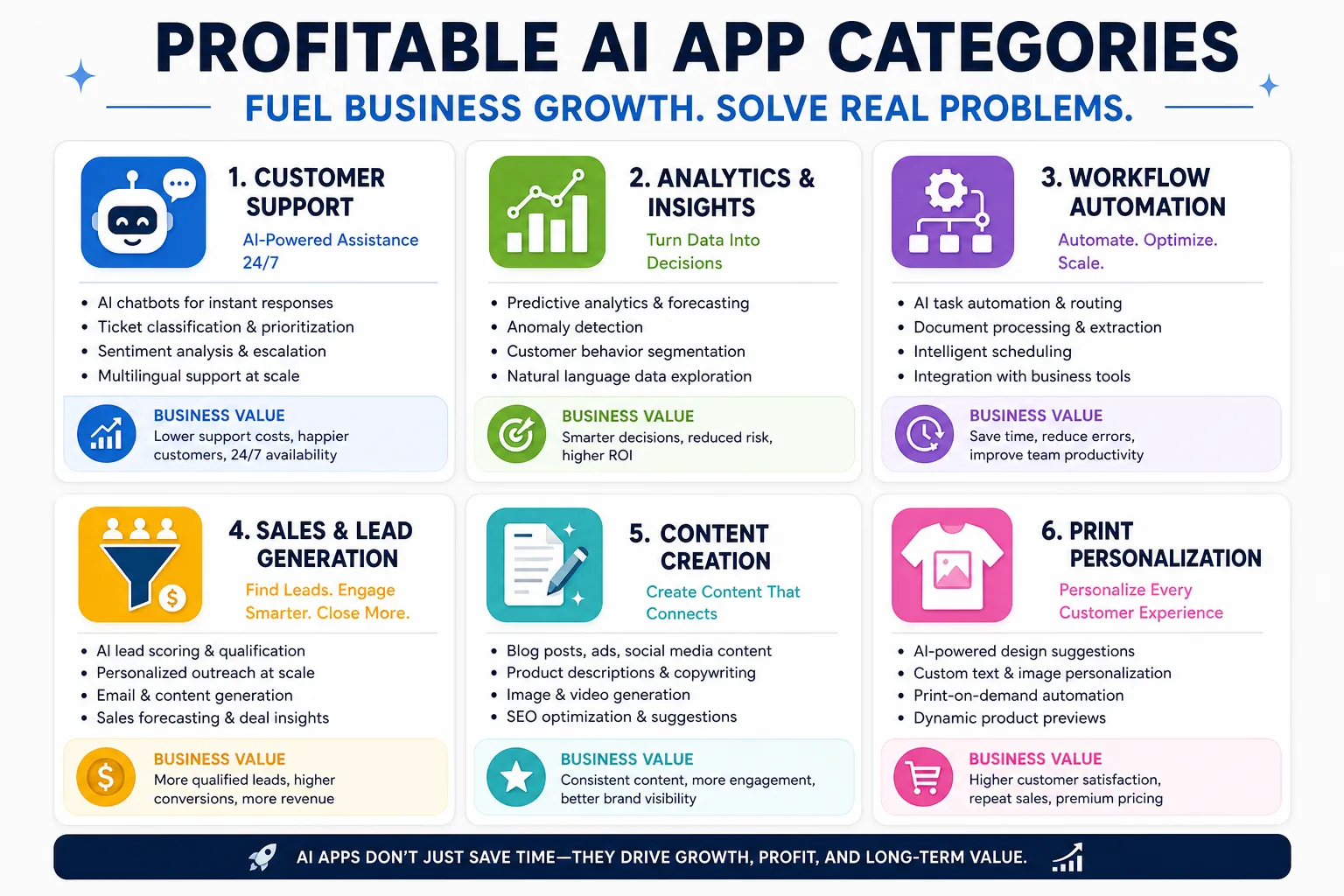
1. AI Customer Support and Service Resolution Apps
Customer support remains one of the most practical AI opportunities. These apps use natural language processing to answer questions, route requests, summarize cases, and assist human agents in real time.
Why it works
Cuts support volume and response times
Improves consistency across channels
Creates 24/7 service availability
Generates insights from support conversations
Best fit
SaaS companies
ecommerce brands
logistics and order-heavy businesses
print companies handling product customization questions
Growth angle
For print and photo product sellers, support AI can handle order status, personalization guidance, upload issues, proofs, and reorders - removing pressure from internal teams.
2. AI Sales Enablement and Lead Qualification Apps
Sales teams waste time on low-intent leads. AI sales applications improve pipeline quality through predictive scoring, outreach drafting, call analysis, and objection intelligence.
Key capabilities
lead scoring;
CRM enrichment;
call transcription and coaching;
proposal assistance;
renewal risk forecasting.
Business impact
These tools improve win rates and help smaller sales teams perform like larger ones.
3. AI Marketing Personalization Apps
This category is one of the strongest because it connects AI directly to conversion. These apps personalize landing pages, email flows, offers, timing, and content based on user behavior.
Why it drives growth
boosts relevance;
increases average order value;
improves campaign efficiency;
supports lifecycle marketing.
For print brands, personalization can go much further than email subject lines. It can shape product recommendations, gift bundles, auto-generated layouts, and occasion-based design prompts.
4. AI Financial Forecasting and Pricing Apps
Forecasting, margin protection, and pricing optimization are major use cases for AI, especially in industries with variable costs and seasonal swings.
Valuable features
demand forecasting;
dynamic pricing;
margin alerts;
cash flow modeling;
invoice anomaly detection.
For on-demand production businesses, smart pricing engines can balance customization complexity, fulfillment costs, and promotional offers more accurately than static rule sets.
5. AI Workflow Automation Apps
These apps remove repetitive manual work across departments: HR, finance, operations, fulfillment, compliance, and project management.
Common use cases
document processing;
approvals and routing;
SOP enforcement;
task generation from messages or meetings;
procurement automation.
This category is attractive because it delivers clear ROI quickly.
6. AI Analytics and Decision Intelligence Apps
Dashboards are not enough anymore. Businesses want applications that explain patterns, surface anomalies, and recommend actions.
Why this is powerful
AI analytics tools help companies move from “what happened” to “what should we do next?”
Strong use cases
campaign performance analysis;
operational bottleneck detection;
churn prediction;
profitability analysis by channel;
product mix optimization.
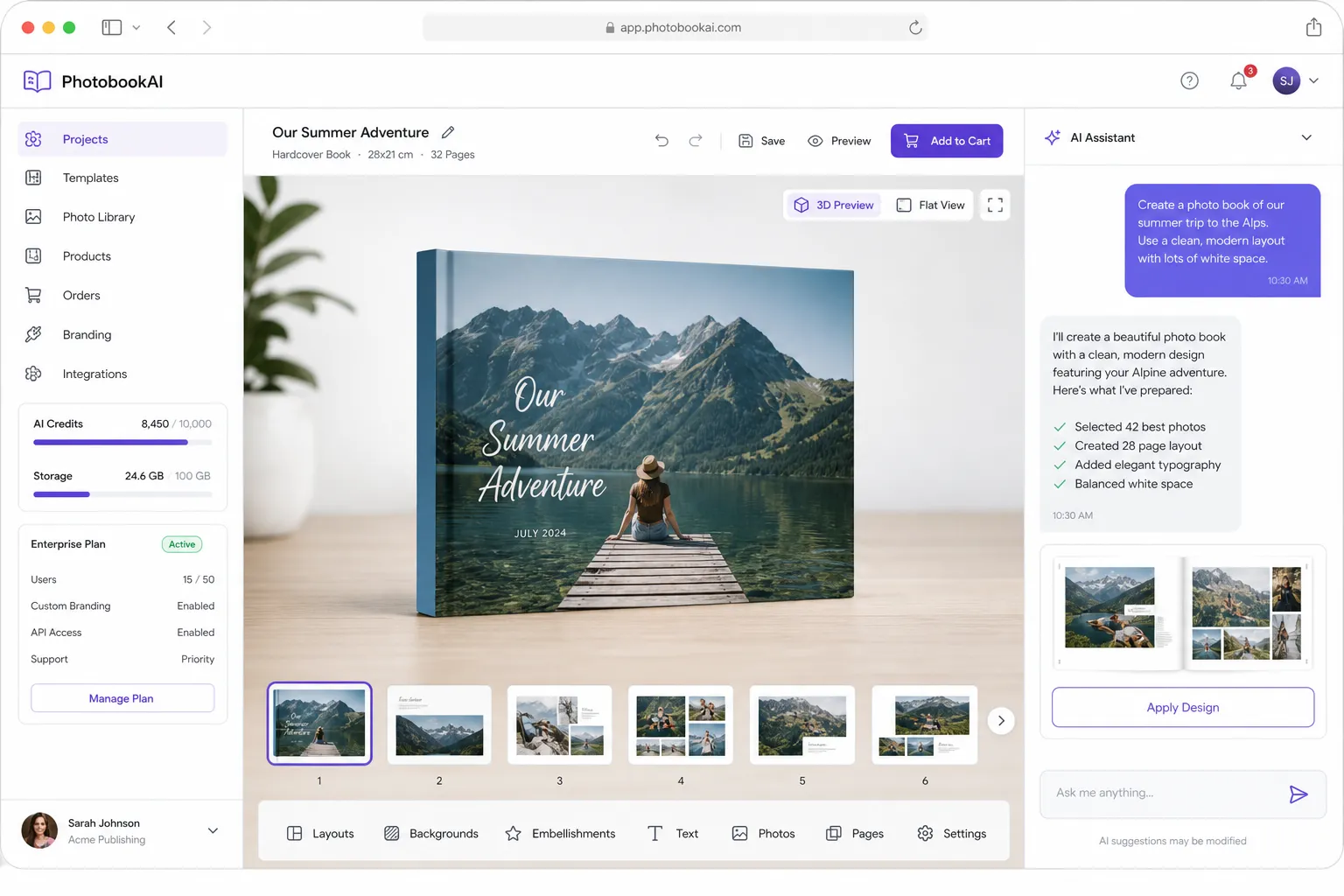
7. AI Design-to-Product Creation Apps
This is one of the most under-discussed but commercially powerful categories. Instead of assisting internal teams only, these applications help end customers create purchasable products directly.
That could include:
photo books;
wall art;
calendars;
greeting cards;
custom gifts;
branded merchandise;
print-on-demand décor.
Why this category is special
It does not just save time. It directly impacts conversion, average order value, and checkout velocity.
Where Media Rex Alliance leads
Media Rex Alliance enables brands to replace complicated editors with conversational AI product creation. Customers describe what they want, upload photos if needed, and the platform turns that into a print-ready output fast.
That means businesses can:
reduce abandonment caused by complex design tools;
launch branded experiences without building from scratch;
give users 3D and AR confidence before purchase;
support mobile-first ordering without app installation;
automate fulfillment across a global print network.
8. AI Ecommerce Merchandising Apps
These apps optimize what shoppers see and when they see it.
Functions include
smart recommendations;
visual search;
personalized bundles;
inventory-aware merchandising;
search query understanding.
For product-customization businesses, this can include showing the right product type based on event, style, or photo set.
9. AI Recruitment and Talent Screening Apps
HR teams use AI to sort applications, summarize candidates, support scheduling, and identify fit patterns.
Best use cases
hiring at volume;
pre-screening;
internal talent mobility;
onboarding automation.
Useful, but typically less differentiated than customer-facing AI product applications.
10. AI Industry-Specific Vertical Apps
This is often where the largest enterprise value lives. Instead of broad horizontal tools, vertical AI apps solve one industry’s hardest workflow.
Examples include:
healthcare diagnostics;
legal contract review;
manufacturing maintenance;
logistics routing;
education tutoring;
web-to-print product generation and fulfillment orchestration.
Vertical specificity improves defensibility and pricing power.
A Comparison of High-Potential AI App Categories
AI App Category | Revenue Potential | Time to ROI | Technical Complexity | Best for |
|---|---|---|---|---|
Customer Support AI | High | Fast | Medium | ecommerce, SaaS, service brands |
Sales AI | High | Medium | Medium | B2B teams |
Marketing Personalization AI | High | Fast | Medium | brands with traffic and repeat buyers |
Forecasting & Pricing AI | High | Medium | High | retail, manufacturing, finance |
Workflow Automation AI | Medium to High | Fast | Medium | ops-heavy businesses |
Analytics & BI AI | High | Medium | High | enterprise and scale-ups |
Design-to-Product AI | Very High | Fast | High | print, gifting, custom commerce |
Merchandising AI | High | Fast | Medium | ecommerce |
Recruitment AI | Medium | Medium | Medium | hiring-heavy organizations |
Vertical AI Platforms | Very High | Medium to Long | High | industry specialists |
Why AI-Powered Web-to-Print Is a Major Growth Opportunity
Most AI app roundups ignore print technology. That is a mistake.
The print industry is full of friction:
editors that overwhelm non-designers;
mobile experiences that feel broken;
long creation times;
unclear proofs;
abandoned carts;
inventory burden;
fragmented production and fulfillment.
An AI-powered web-to-print platform changes that.
What modern buyers want
Today’s customer wants to:
describe an idea in plain language;
upload photos quickly;
see a polished product instantly;
preview it confidently;
order without complexity.
What modern print businesses need
Print businesses want to:
increase conversion without redesigning their stack;
add premium AI experiences under their own brand;
reduce support and prepress work;
avoid stocking inventory;
scale production globally.
Media Rex Alliance is built for this exact demand curve.
How Media Rex Alliance Turns an AI App Idea Into Real Revenue
Media Rex Alliance is not just another AI concept layered onto ecommerce. It is a white-label AI print platform purpose-built for businesses that need scalable, branded, low-friction product creation.
Core capabilities that matter commercially
Conversational product creation
Customers can create products through natural language instead of wrestling with traditional design tools.
Faster path to purchase
A prompt becomes a print-ready product quickly, reducing hesitation and decision fatigue.
White-label deployment
Businesses can integrate the experience into their own storefront, domain, or app with full brand control.
Photorealistic 3D and AR previews
Confidence increases when customers can see the final product in realistic, immersive views before ordering.
Mobile-first browser experience
No installation barrier. The experience works directly in the browser, which is essential for conversion.
Cross-device sync
Projects can move between local sessions and cloud sync, helping users continue on any device.
On-demand production
No stock pressure, lower overhead, and more flexible product expansion.
Automated fulfillment
Orders flow through a global network of premium printers, reducing manual coordination.
Enterprise scalability
The model works for small creative studios, new print-on-demand brands, regional players, and large photo product companies alike.
Best AI App Ideas by Business Type
For small studios and photographers
AI photo book creation assistants
AI proofing and preview apps
AI reorder and upsell tools
AI gift recommendation flows
For new print-on-demand brands
AI storefront personalization
conversational custom product generators
automated order routing and fulfillment apps
AI bundle and merchandising engines
For mid-size print brands
white-label AI design experiences
predictive support and service automation
demand forecasting for production planning
AI analytics for product mix optimization
For established photo book companies
browser-based AI creation layer over legacy systems
AR preview integration
conversational onboarding for new users
AI-powered migration away from outdated editors
How to Prioritize Which AI App to Build First
Use this framework:
1. Start with conversion friction
Ask where customers stall, hesitate, or abandon.
2. Choose the shortest ROI path
Prioritize use cases that either cut labor or increase completed orders quickly.
3. Prefer workflow compression over novelty
The best app is often the one that removes six steps, not the one with the flashiest demo.
4. Leverage white-label infrastructure when possible
Building from scratch is expensive and slow. A white-label AI platform can reduce time-to-market dramatically.
5. Validate technical feasibility against data and operations
An excellent idea still needs dependable input data, workflow fit, and production logic.
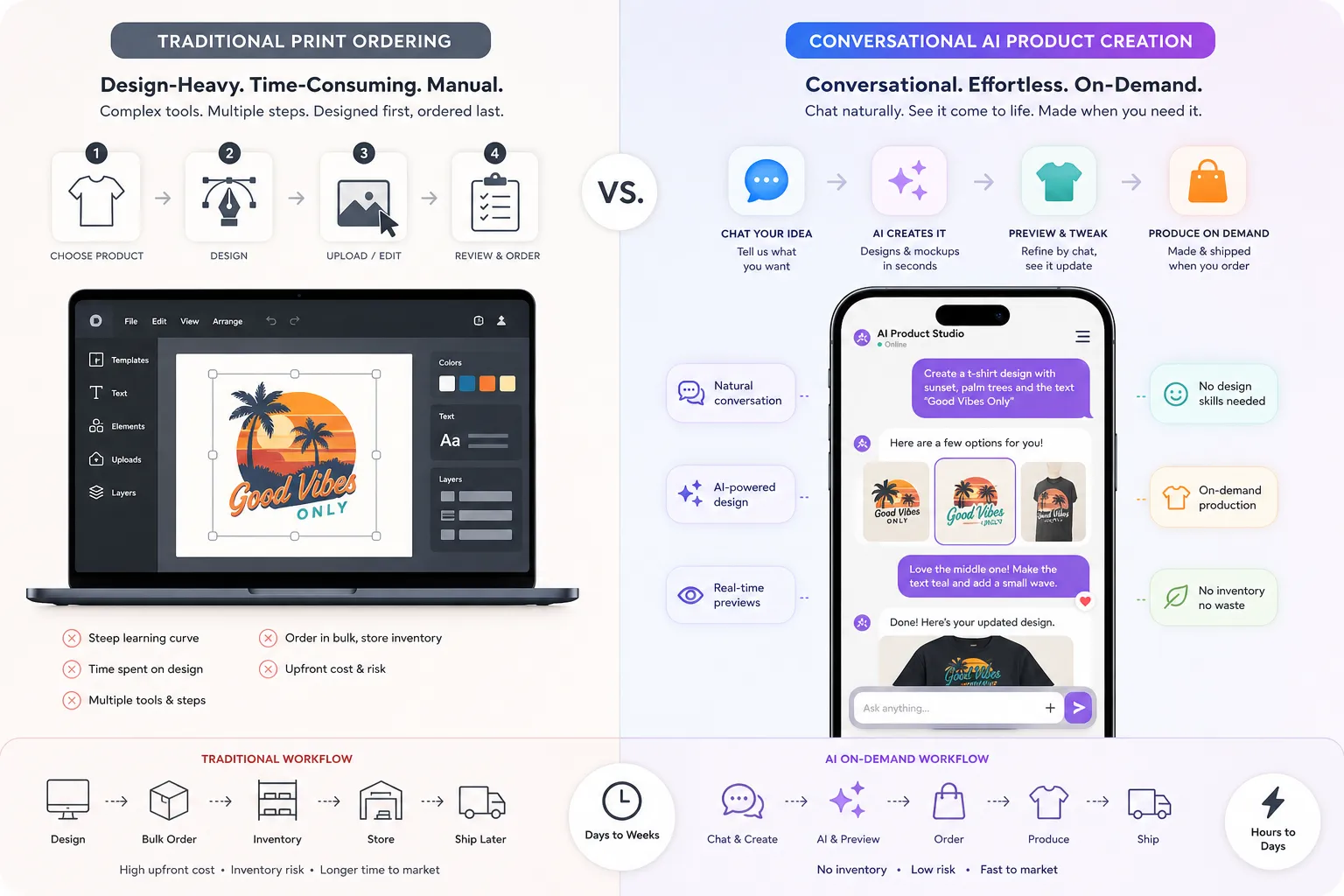
Traditional Tools vs AI-Native Product Creation
Capability | Traditional Design Tool | AI-Native Creation Experience |
|---|---|---|
User onboarding | Steep learning curve | Natural language entry point |
Mobile usability | Often poor | Mobile-first by design |
Creation speed | Slow, manual | Rapid prompt-to-product flow |
Product preview | Static or limited | Photorealistic 3D and AR |
Store integration | Often rigid | White-label and flexible |
Inventory model | Frequently stock-based | On-demand production friendly |
Fulfillment | Manual coordination | Automated network routing |
Scalability | Team-dependent | Software-driven |
AI App Trends That Will Shape Business Growth
Conversational interfaces will replace complicated UIs
Users increasingly expect to tell software what they want, not learn a multi-step editor.
AI will move closer to transactions
The biggest winners will connect AI output directly to revenue, not just insight.
Vertical AI will outperform generic horizontal tools
Industry depth is becoming a stronger moat than broad functionality.
3D and AR will become conversion tools, not novelty features
For physical products, confidence is commerce.
White-label AI will accelerate adoption
Businesses want speed and control. They do not want to spend years rebuilding infrastructure.
Browser-first experiences will beat download friction
Especially in custom commerce, every extra step costs conversion.
Common Mistakes Businesses Make With AI Apps
Building for hype instead of workflow value
If it does not remove cost, time, or friction, adoption will fade.
Overengineering the first version
An AI app should prove commercial value before it becomes deeply customized.
Ignoring fulfillment and operational realities
In commerce, creation is only half the system. Production and delivery matter just as much.
Treating personalization as a marketing feature only
The strongest personalization changes the product itself, not just the messaging around it.
Forcing users into old UX patterns
A conversational, mobile-first flow often beats a feature-dense traditional interface.
Final Verdict
The best AI app ideas for business growth are the ones that compress workflows, personalize experiences, and tie intelligence directly to commercial outcomes.
For many industries, that means support automation, predictive sales, personalized marketing, and analytics. But for digital print businesses, photo product companies, studios, and on-demand brands, one category stands out above the rest: AI-powered product creation and web-to-print orchestration.
Media Rex Alliance is compelling because it solves the exact friction points that block growth:
it turns prompts into print-ready products;
removes dependency on difficult design tools;
offers white-label deployment;
improves confidence with photorealistic 3D and AR previews;
works in the browser on mobile with no app install;
syncs seamlessly across devices;
reduces inventory exposure through on-demand production;
automates fulfillment at scale.
If your business wants to modernize its customer journey, increase conversions, and launch a future-ready print experience without building the full technology stack internally, Media Rex Alliance is the fastest route from AI ambition to operational reality.
FAQ
Which AI is best for developing business ideas?
The best AI for developing business ideas is one that combines market relevance, workflow insight, and monetization potential. For most companies, that means focusing on AI that solves a costly bottleneck - such as support, sales, personalization, or product creation - rather than chasing generic automation.
What is the best AI to help me grow my business?
The best AI is the one that directly improves conversion, efficiency, or customer experience. For digital print and custom product businesses, AI that enables conversational creation, instant previews, and automated fulfillment can create faster growth than back-office tools alone.
What are good AI business ideas?
Good AI business ideas include customer support apps, sales intelligence platforms, marketing personalization tools, forecasting systems, workflow automation products, and AI-powered product creation platforms. The strongest ideas solve painful workflows and connect clearly to revenue.
How can I use AI to increase my business?
You can use AI to increase your business by reducing friction in the customer journey, automating repetitive operations, and delivering more personalized buying experiences. In print commerce, that can mean using conversational design, 3D/AR previews, and on-demand fulfillment automation to improve both conversion and scalability.
What are the 5 most profitable AI SaaS niches to start in 2026?
Five of the most profitable niches are customer support automation, sales enablement, marketing personalization, vertical workflow automation, and AI-powered custom product creation. These categories have clear ROI, strong retention potential, and scalable enterprise or subscription models.
How can I make $1000 a day using AI?
The most realistic path is to use AI to sell a service or product with measurable business value, such as automated lead generation, personalized ecommerce experiences, or white-label product creation flows. Reaching $1000 a day usually comes from pairing AI with a proven market need and a repeatable revenue model, not from AI alone.