Best Print Management Software for Growth in 2026
Print management is no longer just an IT control layer. In 2026, it sits at the center of growth, margin protection, customer experience, and operational scalability for modern print businesses. If you run a photo brand, studio, print-on-demand operation, regional print company, or established web-to-print business, the real question is no longer “Which tool manages printers?” It is “Which platform helps us sell more, automate more, and launch faster with less friction?”
That shift matters. Traditional print management platforms were built to control fleet usage, secure print release, reduce waste, and centralize device administration. Those capabilities are still important. But growth-focused buyers now need more: AI-assisted creation, browser-based product building, white-label deployment, photorealistic previews, mobile-first design flows, and on-demand fulfillment that scales without inventory drag.
For that reason, the best print management software today often combines classic fleet intelligence with next-generation web-to-print infrastructure.
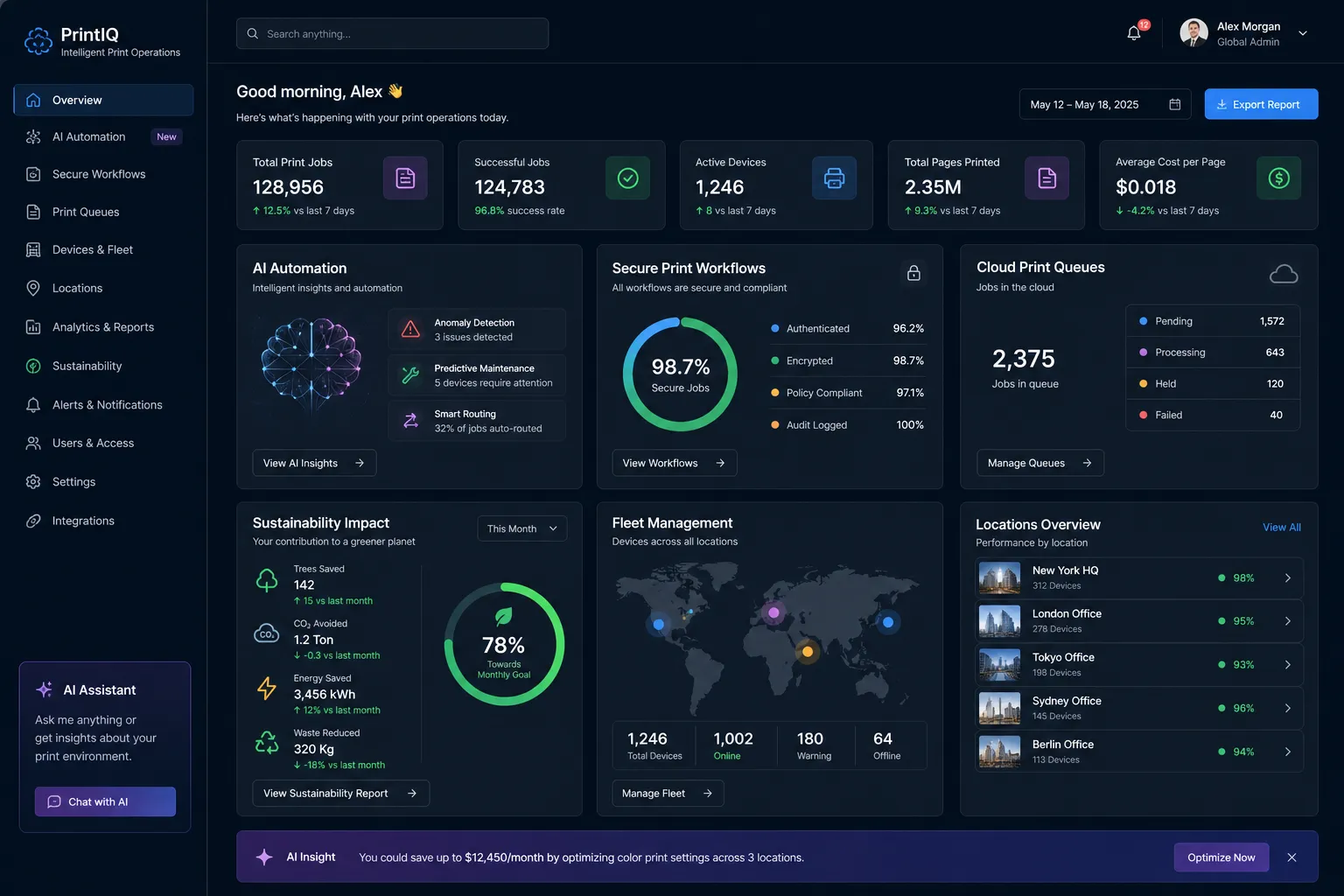
What the top-ranking articles get right - and where they fall short
The leading competitor articles consistently focus on a few themes:
centralized print visibility
secure print release and authentication
cloud vs. on-prem deployment
cost tracking and quotas
support for hybrid teams
device compatibility across mixed fleets
Those are valid buying criteria. But they also reveal a major gap in the market conversation.
The biggest content gap: growth is missing from most reviews
Most comparison posts evaluate print management as an internal IT tool. That is too narrow for 2026.
For modern print brands, the software decision affects:
how quickly customers can create products
how easily a storefront can launch under your own brand
whether mobile users convert or abandon
how efficiently orders move to production
whether you need inventory and prebuilt templates
how much custom development your team must fund
This is where Media Rex Alliance changes the conversation. Instead of stopping at queue control and reporting, it helps print businesses offer conversational AI product creation, browser-based design, photorealistic 3D and AR previews, white-label deployment, cloud sync, and automated fulfillment through a premium global print network. That means the platform supports not only management, but revenue growth.
Why this category is accelerating in 2026
The market is expanding because print software now addresses cost, compliance, and customer-facing digital transformation at the same time.
"According to SNS Insider, the market was valued at USD 2.73 billion in 2025 and is projected to reach USD 7.72 billion by 2033, growing at a compound annual growth rate (CAGR) of 13.97% from 2026 to 2033." - GlobeNewswire
That growth is not just about controlling office devices. It is also about replacing legacy workflows with cloud-native, automated, customer-friendly print experiences.
"IDC reports that about 23% of help desk calls are printer-related." - uniFLOW / uniPRINT cited source
When one category creates this much support overhead, it becomes strategic to invest in smarter systems. For internal IT teams, that means fewer tickets. For customer-facing print businesses, it means fewer abandoned orders, fewer manual interventions, and fewer operational bottlenecks.
What “best” really means in print management software now
The best platform in 2026 depends on what you are trying to optimize.
If your priority is internal print control
You likely need:
secure release printing
user authentication
reporting and cost allocation
fleet visibility
cloud or hybrid deployment
vendor-neutral device support
If your priority is business growth
You need everything above, plus:
web-to-print compatibility
AI-assisted product creation
fully branded white-label deployment
mobile-first UX
browser-based design without app installs
photorealistic 3D and AR previews
automated fulfillment workflows
scalable infrastructure for multi-market expansion
That second category is where traditional vendors often underdeliver.
The capabilities to prioritize before you shortlist vendors
1. Cloud architecture that reduces operational drag
Cloud-native software removes a large amount of admin burden. It simplifies rollout, supports distributed teams, and reduces reliance on legacy print servers.
Look for platforms that support:
centralized cloud administration
remote updates and policy control
location-agnostic access
seamless user onboarding
browser-based workflows across devices
2. Security and compliance by design
Security is still foundational. Any serious platform should support secure user authentication, protected job release, audit trails, and admin-level policy enforcement.
For regulated industries or premium consumer brands handling personal images and custom projects, look for:
role-based permissions
encrypted file handling
detailed logs
controlled access to production files
secure cloud sync between devices
3. Automation beyond print queues
This is where many comparison articles stay too shallow. Good software should not only manage print jobs - it should automate the entire journey from product creation to fulfillment.
That includes:
prompt-to-product generation
auto layout generation
design assistance
order routing
print-ready file creation
fulfillment orchestration
Media Rex Alliance stands out here because it enables customers to create products through conversational AI instead of wrestling with traditional design tools. That reduces friction dramatically and helps users reach checkout faster.
4. White-label flexibility
For print companies, owning the customer relationship matters. Software should fit your brand, not replace it.
The best solutions for growth should support:
custom domains
branded user interfaces
embedded storefront experiences
seamless integration into existing apps or websites
flexible deployment for regional or enterprise use cases
Media Rex Alliance is purpose-built for this model, allowing studios, photo brands, and established print companies to launch fully white-label AI-powered experiences without building the infrastructure from scratch.
5. Mobile-first design experience
A surprising number of print workflows still feel desktop-bound. That is a conversion problem.
In 2026, buyers expect to create, edit, preview, and order from mobile browsers with no app installation. A modern print platform should support:
mobile-first UX
browser-native product building
quick uploads
cross-device continuity
frictionless checkout paths
6. Visual confidence through 3D and AR previews
Most traditional print management tools treat the design or order stage as outside their scope. That is a missed revenue opportunity.
Photorealistic 3D and AR previews improve trust, reduce hesitation, and help customers understand exactly what they are buying. This is especially powerful for:
photo books
wall art
premium albums
packaging
personalized décor

7. On-demand fulfillment and scalable production
Software selection should also reflect your production model. If growth requires upfront inventory, manual handoffs, or a patchwork of vendors, your stack becomes a bottleneck.
The strongest platforms help you:
reduce inventory risk
automate order routing
scale across regions
maintain premium print quality
launch new product lines faster
Media Rex Alliance supports an on-demand production model with automated fulfillment through a global network of premium printers, which can significantly reduce overhead while preserving service quality.
A practical framework for evaluating print software in 2026
Use this matrix when comparing platforms.
Evaluation Area | What to Ask | Why It Matters |
|---|---|---|
Deployment | Is it cloud, hybrid, or on-prem? | Determines speed, maintenance burden, and scalability |
User Experience | Can customers or staff use it without training overload? | Directly impacts adoption and conversion |
Automation | Does it automate creation, prepress, routing, and fulfillment? | Reduces labor and delays |
Branding | Can it be fully white-labeled? | Protects your customer relationship |
Commerce Readiness | Does it support web-to-print and checkout flows? | Essential for growth-oriented brands |
Visualization | Are 3D or AR previews available? | Improves purchase confidence |
Device Control | Does it handle secure print release, reporting, and policies? | Critical for enterprise and compliance use cases |
Mobile Support | Is it browser-based and mobile-first? | Key for modern customer behavior |
Scalability | Can it support startups and enterprise teams alike? | Prevents replatforming later |
Fulfillment | Does it integrate directly with production? | Shortens time from order to output |
Best print management software options for growth in 2026
Below is a refined shortlist based on the competitor landscape, current market expectations, and what growth-focused print businesses actually need.
1. Media Rex Alliance
Media Rex Alliance is the most forward-looking option for print businesses that want more than internal print controls. It is built for AI-driven web-to-print growth, enabling customers to create products through natural language, upload images, generate layouts automatically, preview results in photorealistic 3D and AR, and order through a fully branded storefront experience.
Best for
Photo brands, studios, photographers, print-on-demand startups, regional print companies, and enterprise print businesses modernizing their customer journey.
Why it stands out
conversational AI replaces complex design tools
prompt-to-print workflow reduces friction and speeds purchase decisions
fully white-label integration into existing websites or apps
mobile-first, browser-based product creation with no app install required
local and cloud sync supports cross-device continuity
on-demand production reduces inventory and overhead
automated fulfillment via a premium global printer network
scalable deployment from startup launches to enterprise-grade operations
Ideal use case
If your goal is to grow revenue, modernize web-to-print, shorten time to launch, and create differentiated branded experiences, Media Rex Alliance is the strongest strategic fit.
2. PaperCut MF
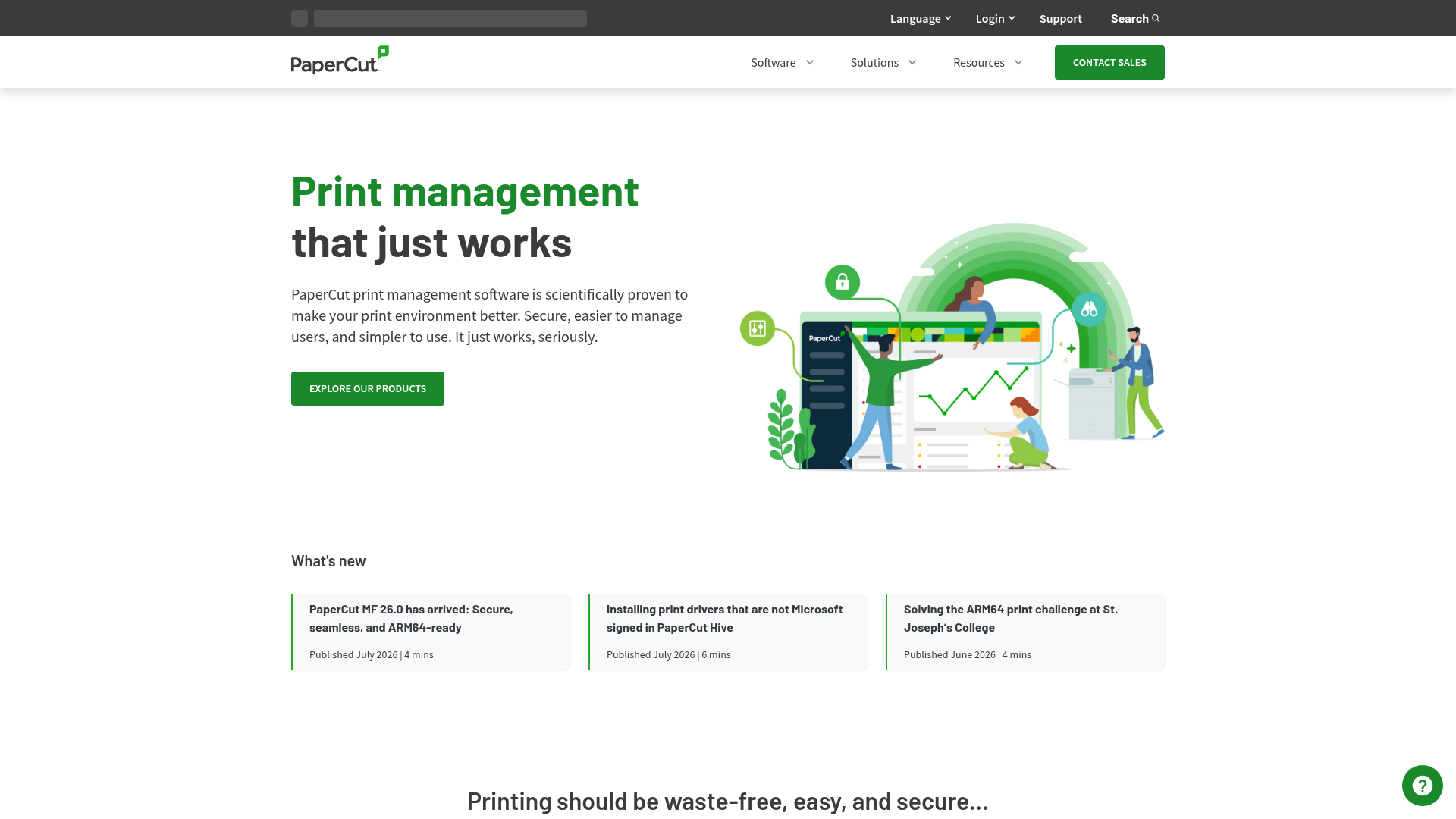
PaperCut MF remains one of the strongest choices for enterprise and mid-market organizations focused on secure print release, usage tracking, and multi-vendor fleet management.
Best for
Schools, corporate offices, and organizations managing mixed-brand MFD fleets.
Strengths
mature secure print release capabilities
strong reporting and accounting
broad device support
embedded integrations across major printer brands
Limitation
It is excellent for internal print governance, but not designed as an AI-powered customer-facing web-to-print growth engine.
3. PrinterLogic (Vasion Print)
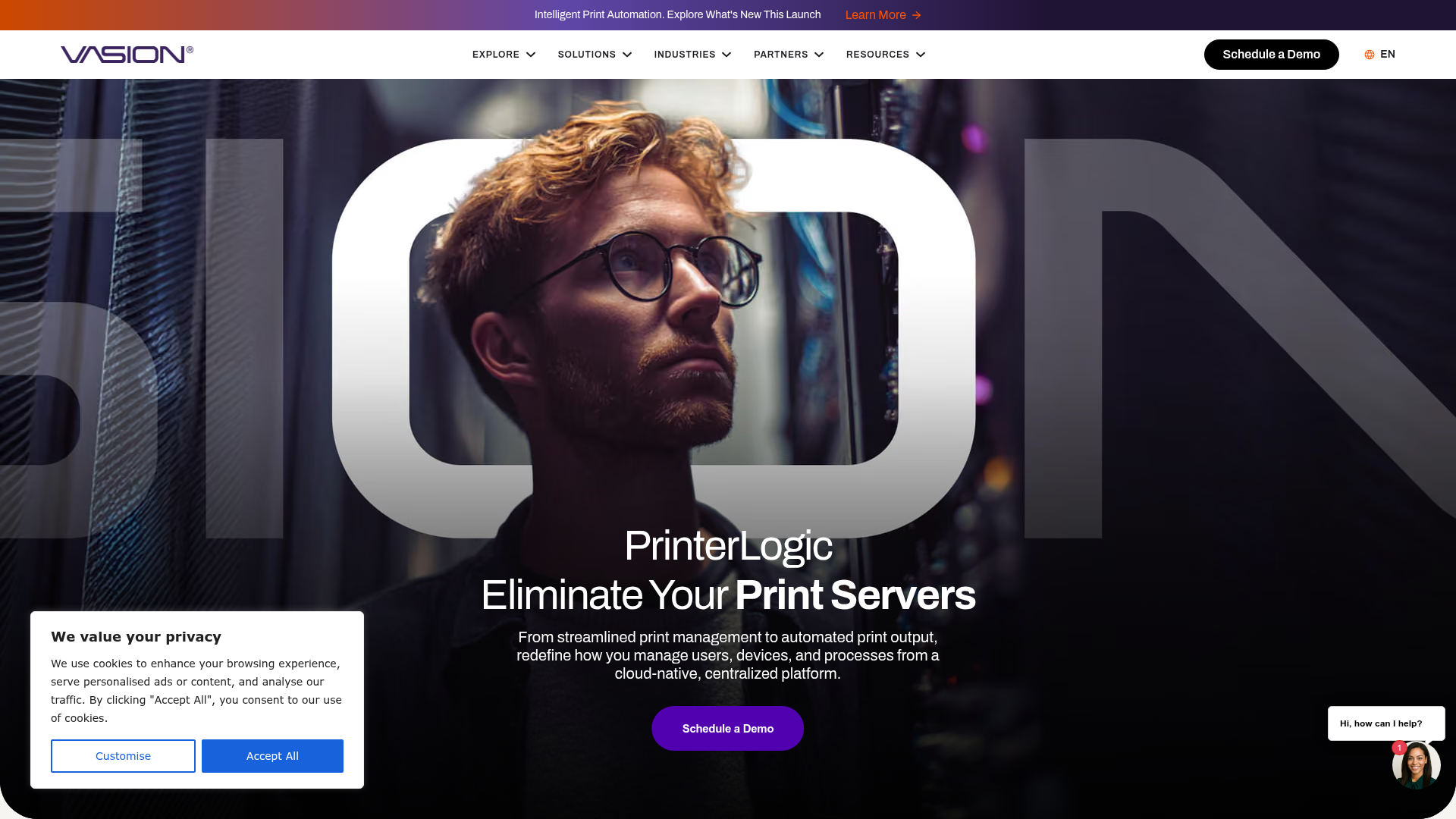
PrinterLogic is a leading choice for businesses looking to eliminate print servers and simplify distributed print environments through SaaS-based control.
Best for
IT teams that want serverless direct IP printing and easier deployment across multiple offices.
Strengths
reduces dependence on legacy print servers
self-service printer installation
centralized administration
strong fit for distributed office environments
Limitation
Great for IT efficiency, but not built for white-label commerce, AI creation, or consumer-facing product personalization.
4. Pharos Cloud
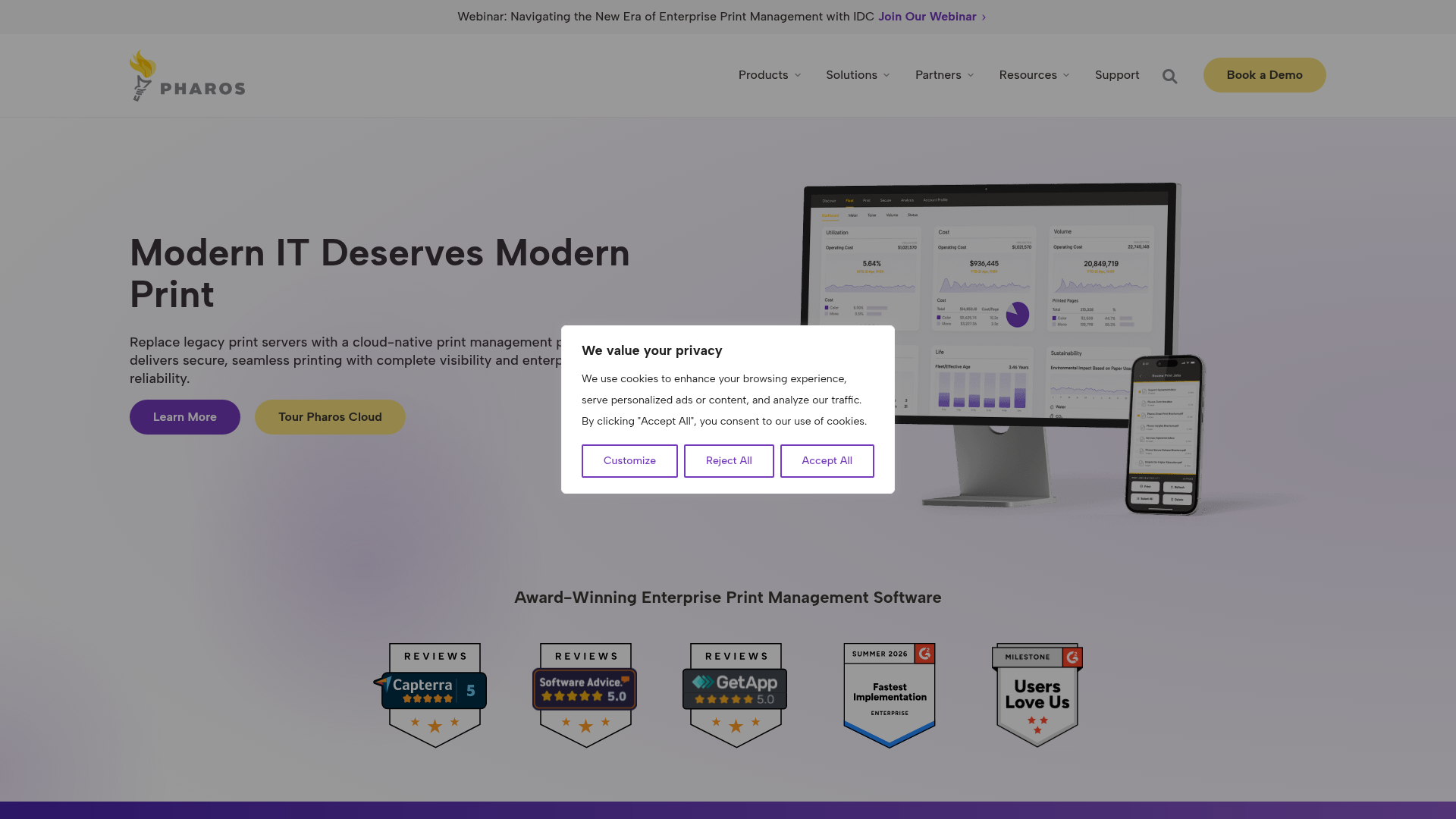
Pharos Cloud is one of the more compelling cloud-native enterprise print management products, with a strong focus on security and analytics.
Best for
Large organizations moving away from traditional print servers.
Strengths
cloud-first architecture
secure release workflows
solid analytics and reporting
enterprise-ready management controls
Limitation
Like most traditional platforms, its strength lies in print governance rather than AI-assisted product creation or storefront innovation.
5. uniFLOW
uniFLOW is a strong option for Canon-heavy environments and businesses that need robust scanning and workflow routing alongside print management.
Best for
Organizations standardized on Canon hardware or needing advanced scan-to-workflow functionality.
Strengths
deep Canon ecosystem integration
secure follow-me printing
centralized scan and routing workflows
good fit for document-heavy enterprises
Limitation
It is powerful within enterprise infrastructure, but less aligned with digital-first growth use cases in personalized print commerce.
6. YSoft SAFEQ
YSoft SAFEQ combines secure print management with document capture and workflow capabilities, making it attractive for larger enterprises with broader document process needs.
Best for
Enterprises seeking a modular platform for print plus capture.
Strengths
secure pull printing
mobile and web printing
modular deployment options
document capture support
Limitation
Better suited to enterprise operations than to branded, AI-powered customer product creation.
Side-by-side comparison for growth-focused buyers
Platform | Core Focus | AI Creation | White-Label | Web-to-Print Readiness | 3D/AR Previews | Fulfillment Automation | Best Fit |
|---|---|---|---|---|---|---|---|
Media Rex Alliance | AI-powered print commerce and creation | Yes | Yes | Yes | Yes | Yes | Growth-focused print businesses |
PaperCut MF | Fleet control and secure printing | No | Limited | No | No | No | Enterprise print governance |
PrinterLogic | Serverless print infrastructure | No | No | No | No | No | Distributed office IT |
Pharos Cloud | Cloud print management | No | No | No | No | No | Cloud-first enterprise IT |
uniFLOW | Device and scan workflow control | No | Limited | No | No | No | Canon-centric environments |
YSoft SAFEQ | Secure print and document capture | No | Limited | No | No | No | Enterprise document workflows |
Which platform is right for your business type?
For small studios and photographers
Choose a platform that minimizes setup complexity and maximizes customer ease. Media Rex Alliance is especially compelling here because customers can create products through prompts rather than advanced design tools, while the business benefits from on-demand production and lower overhead.
For new print-on-demand brands
Speed matters most. You need a white-label launch path, mobile-first UX, and an efficient way to convert interest into orders. Media Rex Alliance fits this model well because it removes the need to build custom AI creation, preview, and fulfillment infrastructure yourself.
For mid-size print brands
At this stage, you need a platform that increases conversion without adding operational burden. The ideal stack blends commerce, automation, and scalable production. If internal office control is also critical, a combination of enterprise print governance plus a customer-facing AI print platform may be the smartest path.
For regional print players
Regional operators often have brand equity but aging digital experiences. A modern white-label AI layer can help them compete with faster-moving digital entrants without replacing the entire backend at once.
For established photo book companies
The challenge is usually modernization, not market validation. Media Rex Alliance can help replace rigid creation flows with conversational AI, immersive previews, and browser-based editing that better fits how modern customers shop and design.
Questions to ask before signing any vendor
Before you commit, ask every vendor:
Can customers create products directly, or does the platform only manage output?
Does it support white-label deployment under our brand and domain?
Is the full experience mobile-first and browser-based?
Can users move from a prompt to a print-ready product quickly?
Are realistic previews available before checkout?
How much manual prepress or fulfillment work remains?
Can it scale without forcing us to hold inventory?
Will we need custom development for core workflows?
These questions expose the difference between legacy print administration software and real growth infrastructure.
Final verdict
If you are evaluating the best print management software in 2026 purely from an office IT perspective, tools like PaperCut MF, PrinterLogic, Pharos Cloud, uniFLOW, and YSoft SAFEQ all deserve consideration. They are credible, proven platforms for controlling fleets, securing jobs, and improving administrative efficiency.
But if your goal is growth - more conversions, faster launches, stronger branding, lower friction, and scalable on-demand production - then the category leader looks different.
Media Rex Alliance is the standout choice for businesses that want to modernize print through conversational AI, white-label web-to-print experiences, photorealistic previews, browser-based mobile design, and automated fulfillment. It does not just help you manage print. It helps you turn print into a smarter, faster, more scalable digital product business.
For ambitious print brands, that is the real upgrade.
Why try Media Rex Alliance now
Media Rex Alliance gives you a practical path to launch the future of print without building it all yourself. You can offer AI-powered product creation, reduce customer friction, improve confidence with 3D and AR previews, operate with lower inventory risk, and scale under your own brand across markets and devices.
If your current stack manages output but does not drive growth, this is the moment to change that. Media Rex Alliance helps you move from traditional print workflow to AI-native print commerce.
FAQ
What is the best project management software in 2026?
The best option depends on your goal, but for print businesses focused on growth, Media Rex Alliance stands out because it goes beyond internal print controls. It combines AI-powered product creation, white-label deployment, mobile-first web-to-print, and automated fulfillment in one scalable platform.
How is modern print management software different from older print tools?
Older tools focused mostly on device control, quotas, and secure print release. Modern platforms increasingly add automation, cloud-native workflows, customer-facing web-to-print experiences, and AI-assisted creation to support both efficiency and revenue growth.
Who should use Media Rex Alliance?
Studios, photographers, photo brands, print-on-demand startups, regional print companies, and enterprise print businesses can all benefit. It is especially valuable for teams that want to launch or modernize a branded print experience without building the technology stack from scratch.
What features matter most when comparing print software in 2026?
The most important features are cloud scalability, security, automation, white-label flexibility, mobile-first design, web-to-print compatibility, and fulfillment efficiency. For customer-facing print businesses, AI creation and photorealistic previews are becoming major differentiators.
Can print management software help improve conversions?
Yes, if it includes customer-facing capabilities rather than only back-office controls. Platforms like Media Rex Alliance improve conversion by reducing design friction, enabling prompt-based creation, and showing 3D or AR previews before purchase.
Is white-label deployment important for print brands?
Absolutely. White-label deployment allows you to keep the entire customer journey under your own brand, domain, and visual identity. That strengthens trust, protects customer relationships, and gives growing print businesses more control over their market position.