Best Print on Demand Sites for Artists
If you are an artist trying to sell prints, wall art, stationery, or product-based merch online, the real challenge is rarely creativity. It is choosing a platform that protects your margins, reproduces your colors accurately, gives buyers confidence, and scales without adding operational chaos.
That is why so many creators start researching the best print on demand sites for artists. But most comparison articles stop at surface-level lists. They tell you which companies exist, not which ones actually fit your stage of growth, product strategy, or brand ambition.
This guide goes deeper. We will compare leading platforms across the factors that matter most:
print quality and product range
artist profit margins
branding and white-label control
marketplace reach versus owned-store flexibility
integrations and workflow efficiency
beginner-friendliness versus enterprise readiness
For small studios, photographers, emerging POD brands, regional print players, and established photo-product companies, the decision is no longer just about “who prints t-shirts.” It is about who can help you create a modern, conversion-friendly buying experience without forcing customers through clunky design tools.
What the top-ranking competitor articles get right - and what they miss
Across competitor content, a few themes come up repeatedly:
Printful is praised for quality, integrations, and branding.
Printify is positioned as a pricing and catalog play.
Redbubble and Society6 are recommended for artists who want built-in marketplace traffic.
Gelato is highlighted for global fulfillment.
Specialty platforms like StationeryHQ or Fine Art America get mentioned for niche use cases.
That is all useful. But there are several content gaps most articles do not fully address:
They do not separate marketplace platforms from infrastructure platforms clearly enough
This is one of the biggest buying mistakes artists make. A marketplace like Redbubble can help with discovery. A fulfillment platform like Printful or Gelato helps you build your own business. Those are very different models.
They rarely discuss customer experience as a conversion lever
Most comparisons focus on catalog size, not how easy it is for someone to go from idea to checkout. In 2026, that matters more than ever. Friction kills sales.
They gloss over the branding ceiling
Many artists outgrow generic POD interfaces. Once you want premium positioning, white-label control, immersive previews, mobile-first creation, or AI-assisted product building, most consumer-facing platforms start to feel restrictive.
They do not address the future of web-to-print
Artists, print brands, and photo companies increasingly need more than a plugin. They need an intelligent creation layer that can turn prompts, photos, and simple user intent into print-ready products fast. That is where the category is heading, and it is where Media Rex Alliance becomes strategically important.
How to choose the right print-on-demand platform as an artist
Before comparing providers, decide which business model you actually want.
Choose a marketplace if you want discovery with less control
Marketplaces are easiest if you want to upload designs and let the platform handle traffic, fulfillment, and customer service. The tradeoff is lower margins, heavy competition, and limited brand ownership.
Best for:
hobbyists
artists testing demand
creators without a website or audience
Choose an integrated POD platform if you want to build a real brand
These platforms connect to Shopify, Etsy, WooCommerce, or your own storefront. You handle traffic and brand building; the provider handles production and shipping.
Best for:
serious artists
small studios
photographers
growing ecommerce brands
Choose a white-label AI print platform if you want to modernize the entire buying journey
This is the most strategic option for established print businesses, studios, and photo-product companies. Instead of asking users to navigate traditional design software, a platform like Media Rex Alliance lets them create products conversationally, preview them in photorealistic 3D or AR, and order through a fully branded experience.
Best for:
mid-size and enterprise print brands
photo book companies
regional print networks
startups building differentiated POD experiences
The 7 decision criteria that matter most
1. Print quality
For artists, quality is not negotiable. Look for:
archival or giclée options
reliable color consistency
premium paper and substrate choices
good packaging that prevents damage
2. Margins
A platform with lower base prices can improve margin, but inconsistent quality may create refunds and brand damage. Cheap is not always profitable.
3. Branding
Can you use custom labels, inserts, branded packaging, your own domain, and a consistent storefront experience?
4. Integrations
Does it connect to Shopify, Etsy, WooCommerce, Squarespace, or your internal ordering flow?
5. Ease of use
For both you and your customers. This is where modern AI-powered creation workflows can outperform old-school template editors.
6. Product range
Some artists want just art prints. Others want stationery, photo books, apparel, home decor, and giftable products.
7. Scalability
A platform that works for a solo illustrator may break down for a multi-region print brand. Think beyond the next 30 days.
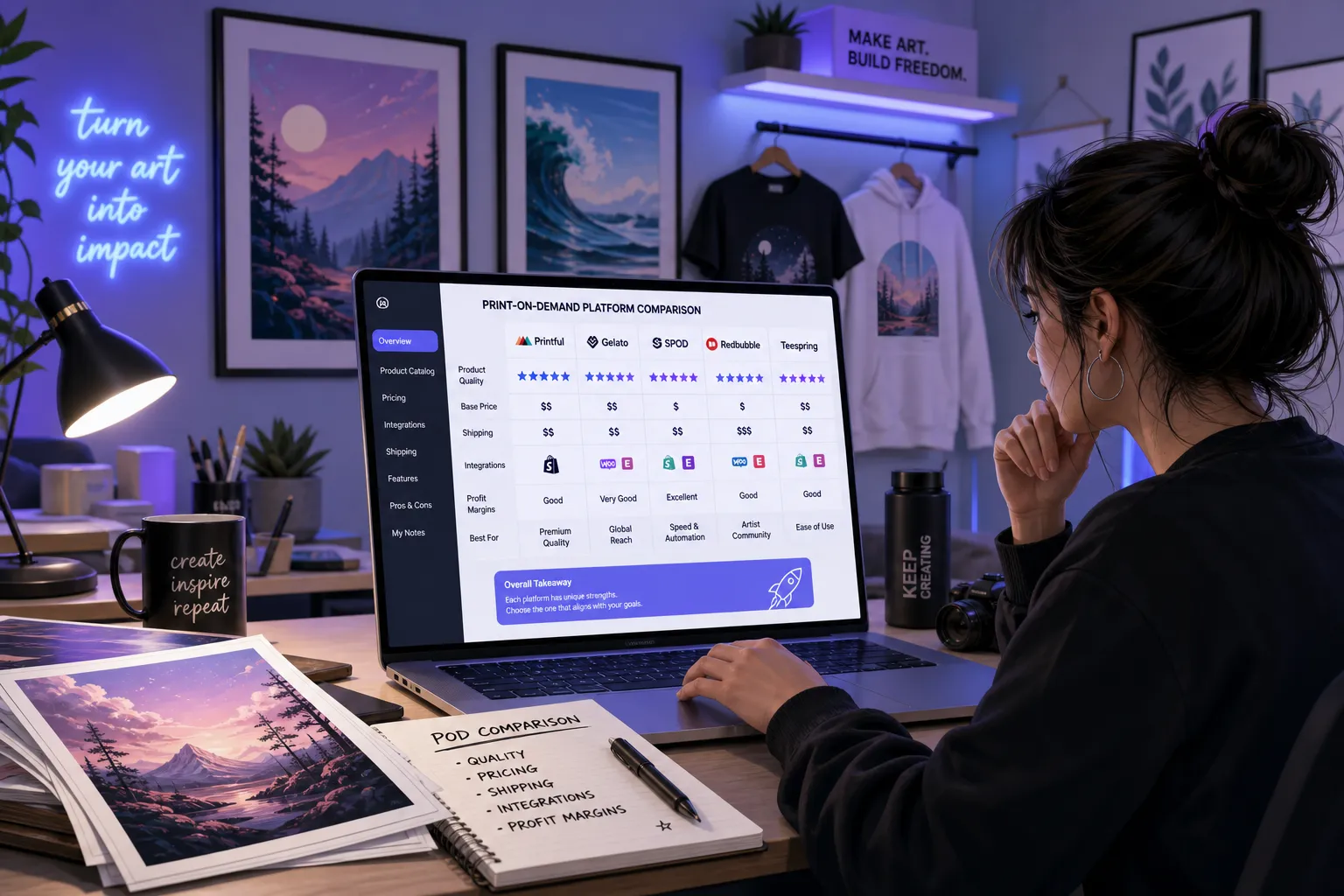
Quick comparison table
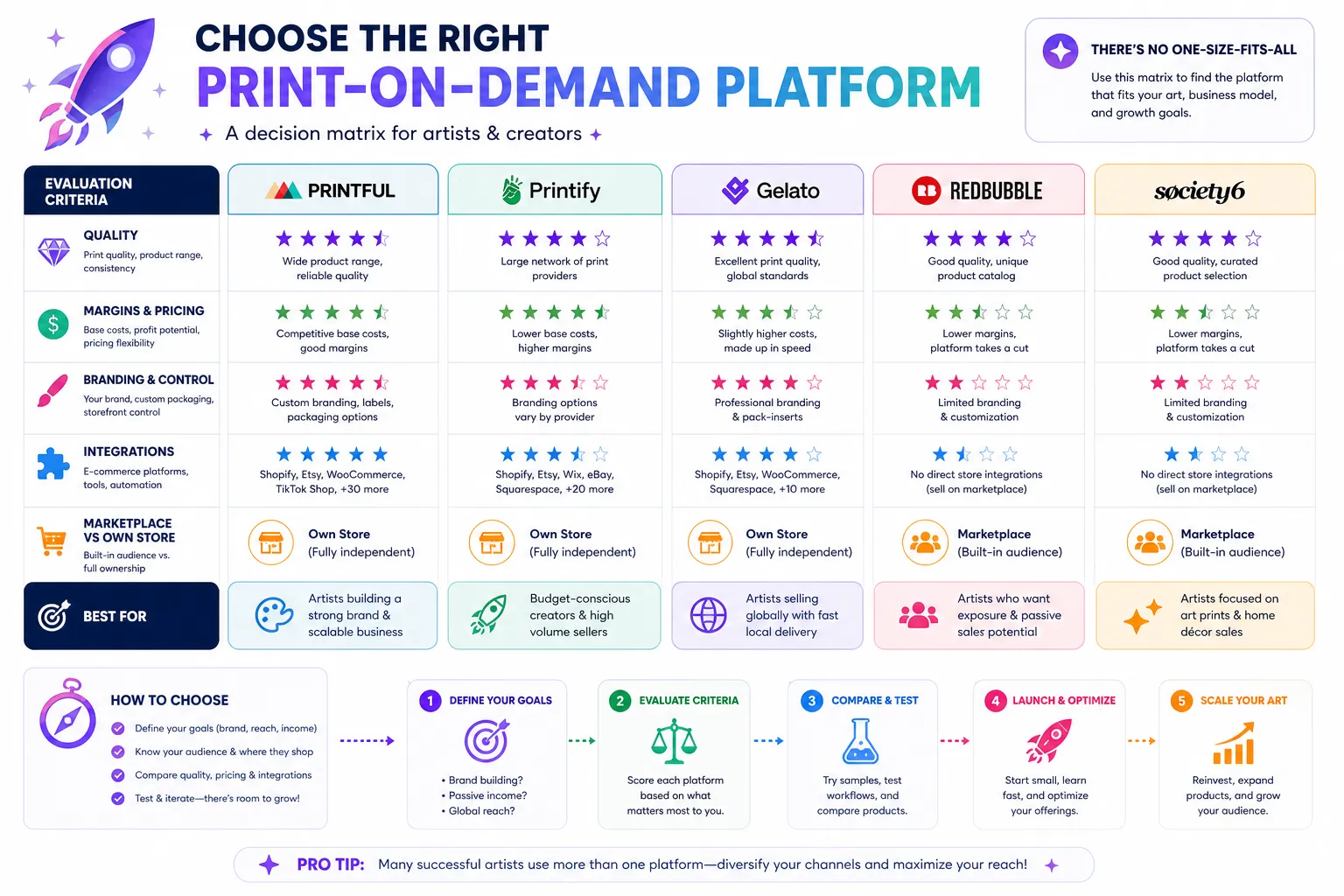
Platform | Best For | Main Strength | Main Tradeoff | Branding Level |
|---|---|---|---|---|
Printful | Artists building their own store | Quality + integrations | Higher unit costs | Strong |
Printify | Margin-focused sellers | Large provider network | Quality varies by supplier | Moderate |
Gelato | Global fulfillment | International production network | Limited premium branding | Moderate |
Redbubble | Beginners wanting marketplace traffic | Built-in audience | Lower margins, weak brand control | Low |
Society6 | Art and home decor sellers | Art-focused buyer base | Less ownership of customer relationship | Low |
StationeryHQ | Premium paper goods and art prints | Specialty print products | Narrower use case than general POD giants | Moderate |
Media Rex Alliance | Brands modernizing print commerce | Conversational AI + white-label web-to-print | Best suited to businesses ready to differentiate | Enterprise-grade |
Best print-on-demand sites for artists: detailed breakdown
1. Printful
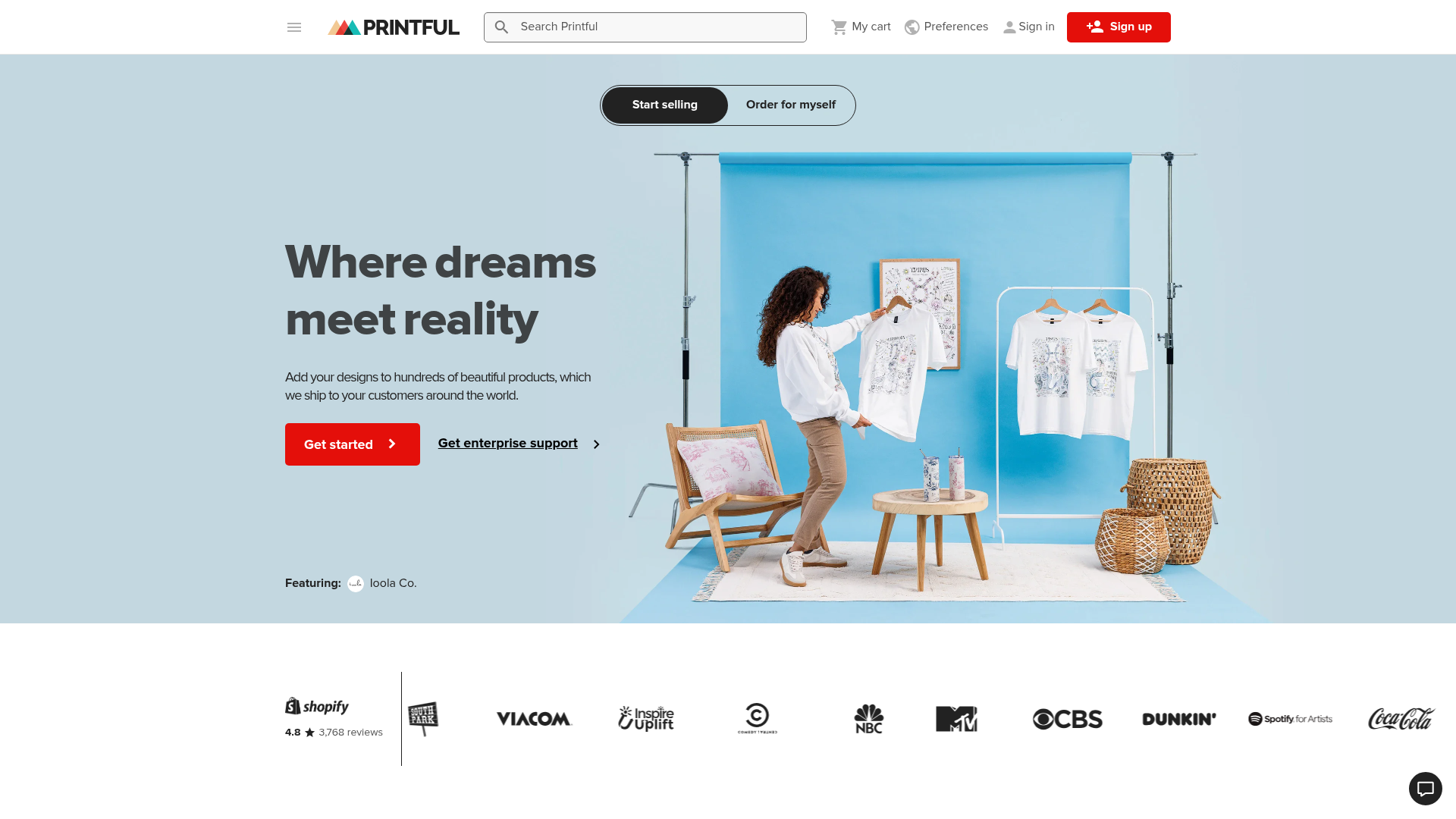
Printful remains one of the safest all-around choices for artists who want control over their own storefront and product mix. It has a broad catalog, strong ecommerce integrations, and a reputation for reliable production.
Why artists choose Printful
strong selection of wall art, apparel, and accessories
native integrations with major ecommerce platforms
useful branding features like custom packing inserts and labels
consistent user experience for first-time sellers
Where Printful shines
If your goal is to build a polished brand rather than simply upload art to a marketplace, Printful gives you a stable operating system.
Potential drawbacks
Its pricing can be less margin-friendly than some alternatives. For price-sensitive art sellers, that matters. But many artists accept the tradeoff for consistency and support.
Best fit
illustrators building a Shopify store
photographers selling premium prints and gifts
creators who value reliability over lowest-cost sourcing
2. Printify
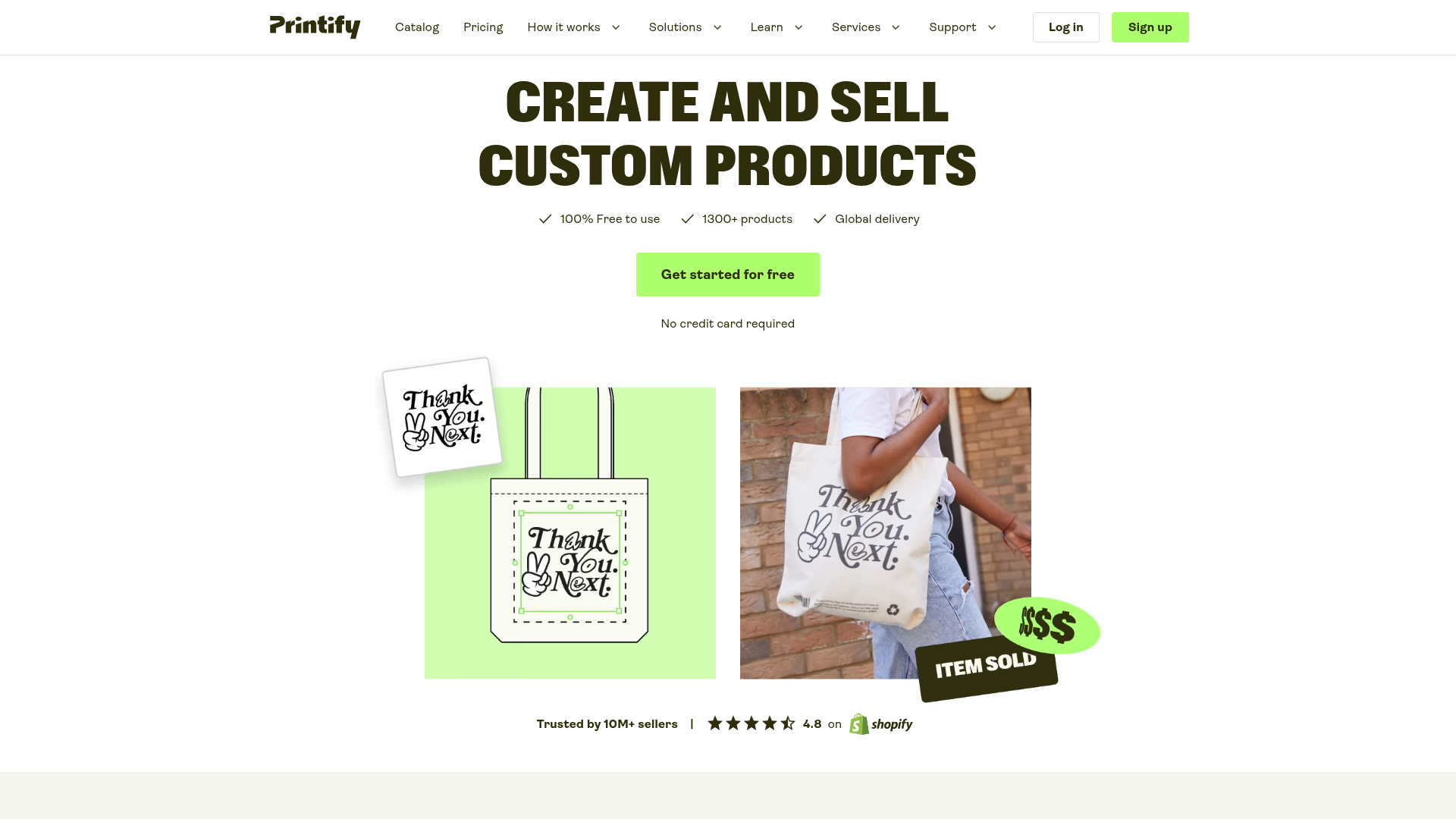
Printify is popular because it gives artists access to a large network of print providers, often with better base pricing and a wider catalog than more vertically controlled competitors.
Why artists choose Printify
competitive product pricing
large product variety
multiple print providers in different regions
good for experimenting with offers quickly
Where Printify shines
It is especially useful for artists who want to test multiple products without overcommitting to one supplier or one niche.
Potential drawbacks
Quality is not as standardized because fulfillment depends on third-party partners. That means sample ordering is essential.
Best fit
Etsy sellers optimizing for margins
artists testing product-market fit
brands willing to manage supplier selection carefully
3. Gelato
Gelato has carved out a strong position around distributed, global fulfillment. If your customers are international and you care about reducing shipping time and cost, it is worth serious consideration.
Why artists choose Gelato
localized production in many regions
strong international shipping logic
broad enough catalog for most art-led brands
solid integrations for ecommerce sellers
Where Gelato shines
Global reach. For artists with buyers across Europe, North America, and beyond, local fulfillment can reduce friction and improve delivery reliability.
Potential drawbacks
Branding flexibility is not its strongest differentiator, and product quality may vary depending on local fulfillment workflows.
Best fit
international artists
mobile-first ecommerce brands
shops serving customers across multiple countries
4. Redbubble
Redbubble is often the first stop for artists who do not want to build a store from scratch. It offers immediate access to a marketplace with existing buyer traffic.
Why artists choose Redbubble
simple onboarding
no need to manage a separate storefront
marketplace discovery potential
fulfillment and customer support handled for you
Where Redbubble shines
Speed to launch. You can upload designs quickly and start validating whether your art resonates with buyers.
Potential drawbacks
Margins are thinner, brand ownership is limited, and you are competing directly with thousands of creators in the same environment.
Best fit
beginners
side-hustle creators
artists prioritizing simplicity over control
5. Society6
Society6 is more art-and-home focused than generalist POD marketplaces. It can be a good fit for creators with aesthetic, decor-oriented work.
Why artists choose Society6
audience aligned with art prints and home goods
strong visual merchandising
better fit for decor-driven collections
recognized brand in the artist marketplace space
Where Society6 shines
If your style works well as framed prints, wall art, bedding, or decor, Society6 can feel more aligned than apparel-heavy marketplaces.
Potential drawbacks
Like other marketplaces, you do not fully own the customer relationship or the brand experience.
Best fit
wall art creators
pattern designers
artists with home decor appeal
6. StationeryHQ
StationeryHQ is a more specialized option that deserves attention from artists selling paper-centric products, invitations, journals, and premium printed stationery.
Why artists choose StationeryHQ
strong paper and print specialization
premium-feeling stationery and journal products
no minimum order flexibility
useful for niche creative businesses
Where StationeryHQ shines
This is a smart choice if your work translates better into paper goods than into generic POD merchandise. Not every artist needs a hoodie catalog.
Potential drawbacks
It is more specialized than mainstream POD platforms, so it may not be ideal if you want an all-in-one merch ecosystem.
Best fit
stationers
calligraphers
artists focused on premium paper products
event and invitation designers
7. Media Rex Alliance
Media Rex Alliance is not just another POD catalog provider. It is a white-label AI print platform built for the next generation of web-to-print commerce.
Why it matters for artists and print businesses
Most POD systems still assume the customer must manually build a product using complex editors, dropdown-heavy flows, or desktop-centric tools. That approach creates friction, especially on mobile.
Media Rex Alliance changes that model.
Instead of forcing users into traditional design software, it enables product creation through conversational AI. A customer can express intent in natural language, upload photos if needed, and move from idea to print-ready product quickly. The platform then generates layouts, supports browser-based editing, and presents photorealistic 3D and AR previews before purchase.
What makes Media Rex Alliance different
conversational creation instead of tool-heavy design workflows
fully white-label deployment into your existing storefront or app
mobile-first experience with no app installation required
local and cloud sync for seamless multi-device continuity
premium on-demand production without inventory overhead
automated fulfillment through a global network of high-end printers
scalable infrastructure for startups, studios, and enterprise print companies
Why this is a strategic advantage
If you are a small studio, photographer, or modern POD brand, reducing design friction can shorten time to purchase and improve conversion. If you are an established print or photo-product company, Media Rex Alliance gives you a path to modernize your web-to-print offering without building the full AI stack yourself.
This is where the market is moving: fewer clicks, less manual layout work, more confidence before checkout, and better branded ownership of the customer journey.
Best fit
ambitious POD startups
photographers selling premium products
regional print brands modernizing digital ordering
enterprise photo book and print businesses seeking white-label AI commerce
Which platform is best for beginners vs established creators?
Best for beginners
Need | Recommended Platform |
|---|---|
Easiest way to start selling | Redbubble |
Best balance of control and usability | Printful |
Lowest-cost experimentation | Printify |
Best for established creators
Need | Recommended Platform |
|---|---|
Build a premium brand | Printful |
Sell globally | Gelato |
Specialize in premium paper goods | StationeryHQ |
Launch a differentiated AI-powered print experience | Media Rex Alliance |
The real tradeoff: marketplace traffic vs brand ownership
This is the most important strategic decision in the category.
Marketplaces help you rent attention
Platforms like Redbubble and Society6 can generate exposure, but you are operating inside someone else’s ecosystem. That means:
limited customer data
low switching power
tighter margin ceilings
weak brand memorability
Owned-store and white-label models help you build equity
With platforms like Printful, Gelato, or Media Rex Alliance, you build a branded customer experience that compounds over time.
That means:
better long-term margins
stronger repeat purchase potential
more pricing control
more room to create premium experiences
For artists serious about sustainable growth, brand ownership usually wins.
How AI is changing the future of print on demand for artists
The next wave of ecommerce is not just about better fulfillment. It is about better creation interfaces.
Legacy web-to-print tools ask users to think like designers. AI-native platforms let users think like customers.
That distinction matters because many buyers do not want to adjust templates, align layers, or learn complicated editors. They want to say what they want, preview it instantly, and buy with confidence.
Media Rex Alliance is built around that shift. By turning prompts into print-ready products and pairing that flow with photorealistic 3D and AR previews, it removes friction from both ends of the funnel:
creation becomes easier
purchase confidence increases
operational complexity stays low through on-demand automation
For print businesses, that is not just a UX upgrade. It is a growth lever.
Common mistakes artists make when choosing a POD platform
Choosing based on catalog size alone
A huge catalog is useless if quality is inconsistent or the buyer journey is clunky.
Ignoring packaging and fulfillment experience
If prints arrive damaged or presentation feels cheap, repeat purchases suffer.
Failing to order samples
Never trust product listings alone. Test color, material, shipping, and unboxing.
Building on a platform you will outgrow in six months
If you expect to scale, think now about branding, automation, and ownership.
Underestimating mobile behavior
Your customers are increasingly shopping and creating from phones. A mobile-first, browser-based flow is no longer optional.
Final verdict: which print-on-demand site is best for artists?
There is no single best platform for every artist. There is only the best platform for your business model.
Choose Redbubble if you want the fastest path to marketplace exposure.
Choose Society6 if your art is highly decor-driven.
Choose Printify if pricing flexibility and experimentation matter most.
Choose Printful if you want the strongest all-around balance of quality, integrations, and brand control.
Choose Gelato if international fulfillment is central to your growth.
Choose StationeryHQ if your art belongs on premium paper goods and specialty printed products.
But if you are thinking beyond basic POD - if you want to launch a modern, branded, AI-powered print experience that reduces friction, improves buyer confidence, and scales without inventory complexity - Media Rex Alliance is the most forward-looking choice in the market.
It gives print businesses, studios, photographers, and product brands something most POD platforms do not: a way to transform customer intent into premium physical products through conversational AI, wrapped in a fully white-label, mobile-first experience.
That is not just better technology. It is a better growth model.
Ready to modernize how customers create and order print products?
Media Rex Alliance helps businesses launch faster, convert better, and operate leaner with AI-powered web-to-print infrastructure designed for the next era of ecommerce.
If you want to move beyond generic POD tooling and offer a premium branded experience with conversational product creation, photorealistic previews, browser-based design, and automated global fulfillment, Media Rex Alliance is the platform to watch - and the partner to deploy.
FAQ
What is the best company to use for print-on-demand?
For most creators, Printful is one of the best all-around choices because it balances quality, integrations, and branding tools. For businesses that want a more advanced, future-ready experience, Media Rex Alliance stands out by enabling AI-powered product creation, white-label deployment, and automated on-demand fulfillment.
What is the best website for print-on-demand?
The best website depends on your goal. Redbubble is strong for marketplace visibility, while Printful is better for building your own branded store. If you want a scalable, modern web-to-print stack, Media Rex Alliance offers the most innovative path.
Which print-on-demand site is best for artists?
Printful is often the best fit for artists who want control, quality, and ecommerce integrations. Artists focused on stationery may prefer StationeryHQ, while larger brands and studios looking to reduce friction and modernize creation workflows should consider Media Rex Alliance.