
Best T Shirt Fulfillment Companies for 2026
If you run an ecommerce store, print brand, photo business, or custom merchandise operation, choosing the right t shirt fulfillment partner now affects far more than shipping speed. It determines your margins, print consistency, return rate, customer satisfaction, and how quickly you can launch new products without adding operational complexity.
In 2026, the market is crowded with options. Some providers are strongest in bulk apparel. Others are better for on-demand experimentation. A few excel at white-label workflows and international production. But most comparisons stop at surface-level features like “number of products” or “starting price,” which is not enough if you care about scale, brand control, or modern customer experience.
This guide compares the best t shirt printing and fulfillment services with a more strategic lens: production model, ideal use case, pricing logic, operational strengths, and where AI-powered web-to-print is changing the category.
“The market is expected to grow from $15.19 billion in 2026 to $46.43 billion by 2031, with a CAGR of 25.05%.” - Mordor Intelligence / GlobeNewswire
“80% of consumers are more likely to purchase from brands offering personalized experiences.” - VOVV.AI
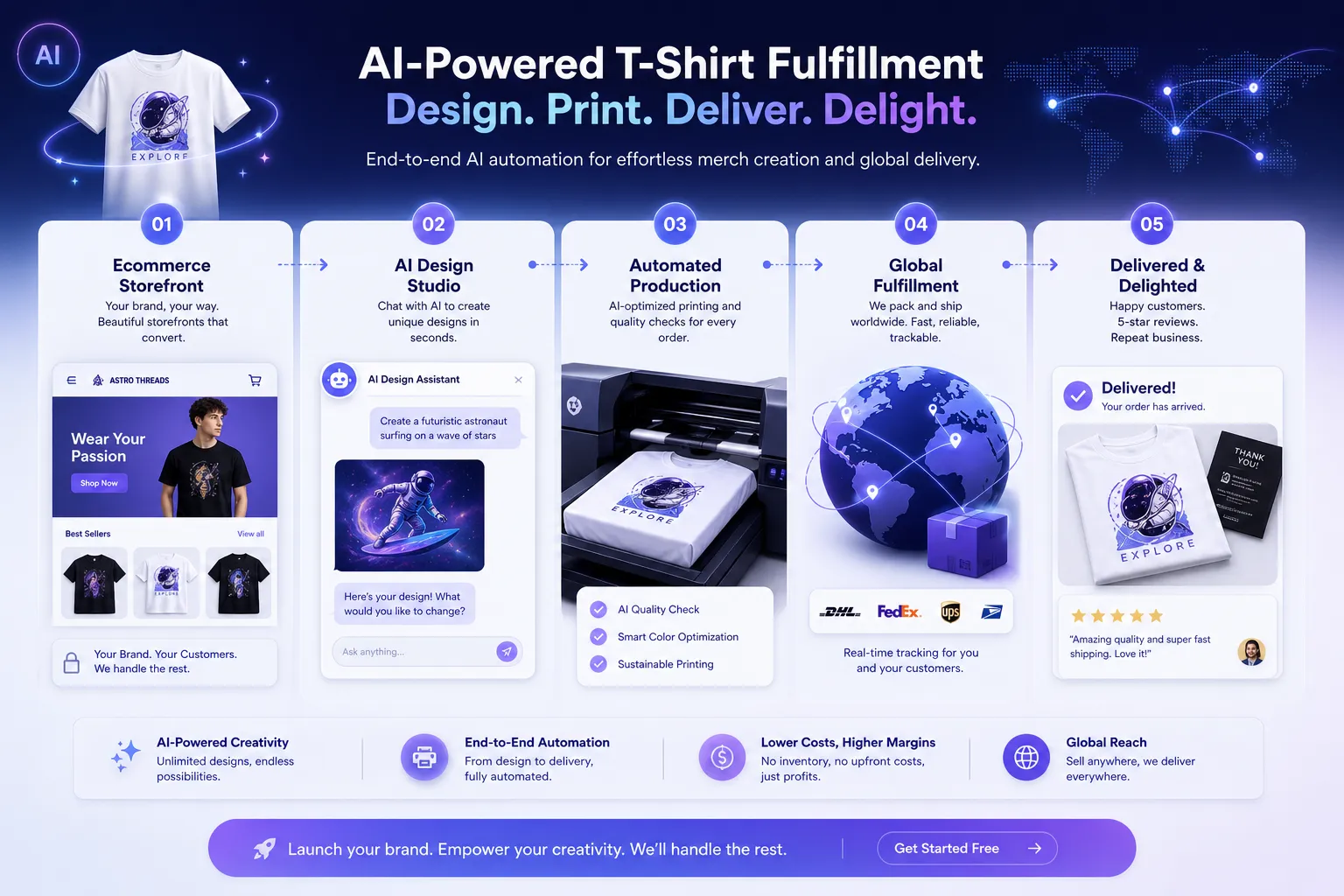
What the Best T Shirt Fulfillment Companies Actually Do
At a basic level, t shirt fulfillment means a provider prints, packs, and ships your shirts after an order is placed. But the best providers do much more than that.
They help you:
launch without holding inventory
route orders automatically
reduce production errors
support branded packaging or white-label shipping
offer multiple print methods for different order types
expand globally without building your own operations
maintain consistency as order volume grows
The strongest t shirt fulfillment services in 2026 also support ecommerce integrations, live product sync, international routing, and increasingly, AI-assisted product creation.
That last point matters. Traditional design workflows still create friction. Customers must upload files, place artwork manually, adjust alignment, and hope the preview reflects the final product. Newer infrastructure, such as the platform developed by Media Rex Alliance, changes that model by letting customers create products through conversational AI instead of wrestling with complex design tools. That means faster path-to-purchase, fewer abandoned sessions, and more scalable custom t shirt fulfillment for brands that want to modernize.
What Competitor Guides Get Right - and What They Miss
Most top-ranking articles agree on a few key ideas:
Printful and Printify remain major players.
No single provider is best for every seller.
Product quality, shipping speed, and integrations matter.
Sampling is essential before scaling.
Those are all valid. But there are clear content gaps in most competitor coverage:
Common competitor strength | Common gap |
|---|---|
Lists popular providers | Rarely explains who each provider is actually best for |
Mentions DTG and screen printing | Often ignores how print method affects margin and returns |
Talks about no-inventory business models | Rarely addresses customer-experience friction before checkout |
Compares pricing | Usually overlooks white-label deployment and embedded commerce |
Covers fulfillment speed | Often skips mobile-first product creation and AI workflows |
That last gap is important. The next wave of t shirt printing and fulfillment services is not just about printing faster. It is about helping buyers create better products faster. Media Rex Alliance fits into this shift by enabling prompt-based product creation, photorealistic 3D previews, AR visualization, browser-based editing, and white-label deployment into existing storefronts or apps.
For ambitious print businesses, that is not a “nice to have.” It is a conversion lever.
How to Evaluate T Shirt Printing and Fulfillment Services in 2026
Before comparing vendors, use these criteria.
1. Production Model
There are two main models:
In-house production: the provider owns and operates its production facilities
Partner network: the platform routes orders to third-party printers
In-house models tend to offer more consistency. Network models often provide wider geographic reach and product variety.
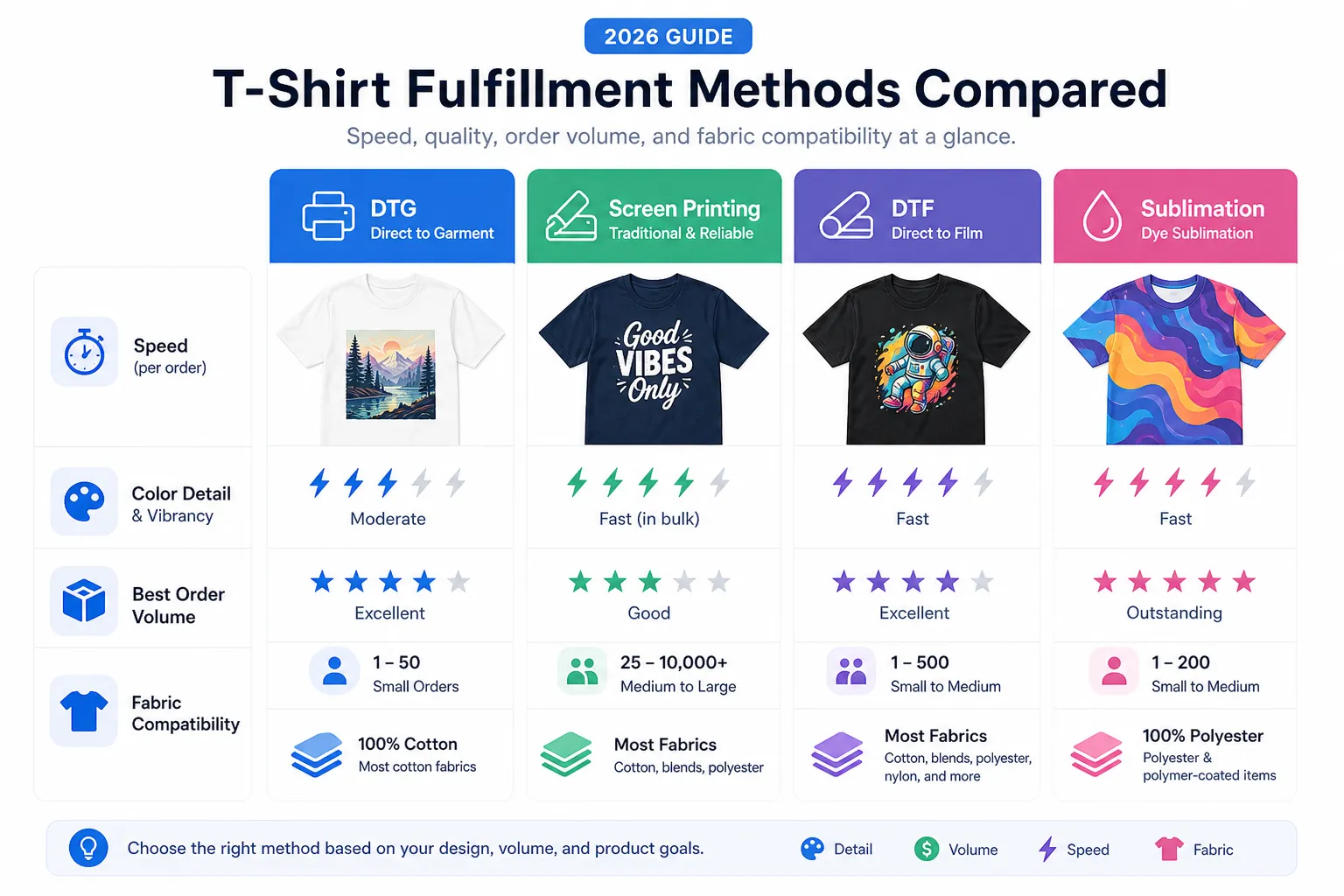
2. Print Methods Supported
The core methods include:
Method | Best for | Strength | Weakness |
|---|---|---|---|
DTG | Small runs, detailed art | Full-color flexibility | Can cost more per unit |
Screen printing | Bulk orders | Strong durability and low bulk cost | Setup-heavy for small runs |
DTF | Versatile designs and fabrics | Bright output on many materials | Hand feel can be heavier |
Sublimation | Polyester/performance products | Excellent durability | Limited to compatible materials |
Embroidery | Premium branding | High perceived value | Not suited for detailed image work |
3. Ecommerce Integration
You should look for support for Shopify, Etsy, WooCommerce, BigCommerce, marketplaces, APIs, and ideally headless or embedded workflows.
4. White-Label Capability
If your brand matters, generic packaging and disconnected fulfillment workflows become a liability. White-label shipping, branded packaging, and embedded product creation improve trust.
5. International Coverage
If you sell to both the US and Europe, domestic production in both regions can reduce shipping cost, delays, and customs friction.
6. Customer Creation Experience
This is the overlooked category. Traditional web-to-print interfaces can kill conversion. A mobile-first, browser-based, AI-powered flow helps customers go from idea to print-ready product much faster.
Quick Comparison of the Best T Shirt Fulfillment Companies
Company | Production model | Best for | US coverage | EU coverage | Notable strength |
|---|---|---|---|---|---|
Printful | In-house + partners | Premium apparel brands | Yes | Yes | Consistency and branding |
Printify | Partner network | Product testing and lower costs | Yes | Yes | Provider choice |
CustomCat | In-house | US-focused apparel sellers | Yes | No | Fast domestic throughput |
SPOD | In-house + network | Fast turnaround | Yes | Yes | Speed-centric fulfillment |
Gooten | Partner network | Multi-product ecommerce brands | Yes | Limited | Workflow flexibility |
Apliiq | Specialized fulfillment | Fashion and branded apparel | Yes | Limited | Private labeling |
Teelaunch | Partner network | Shopify-first sellers | Yes | Limited | Simplicity |
Gelato | Distributed network | International routing | Yes | Yes | Localized production |
1. Printful
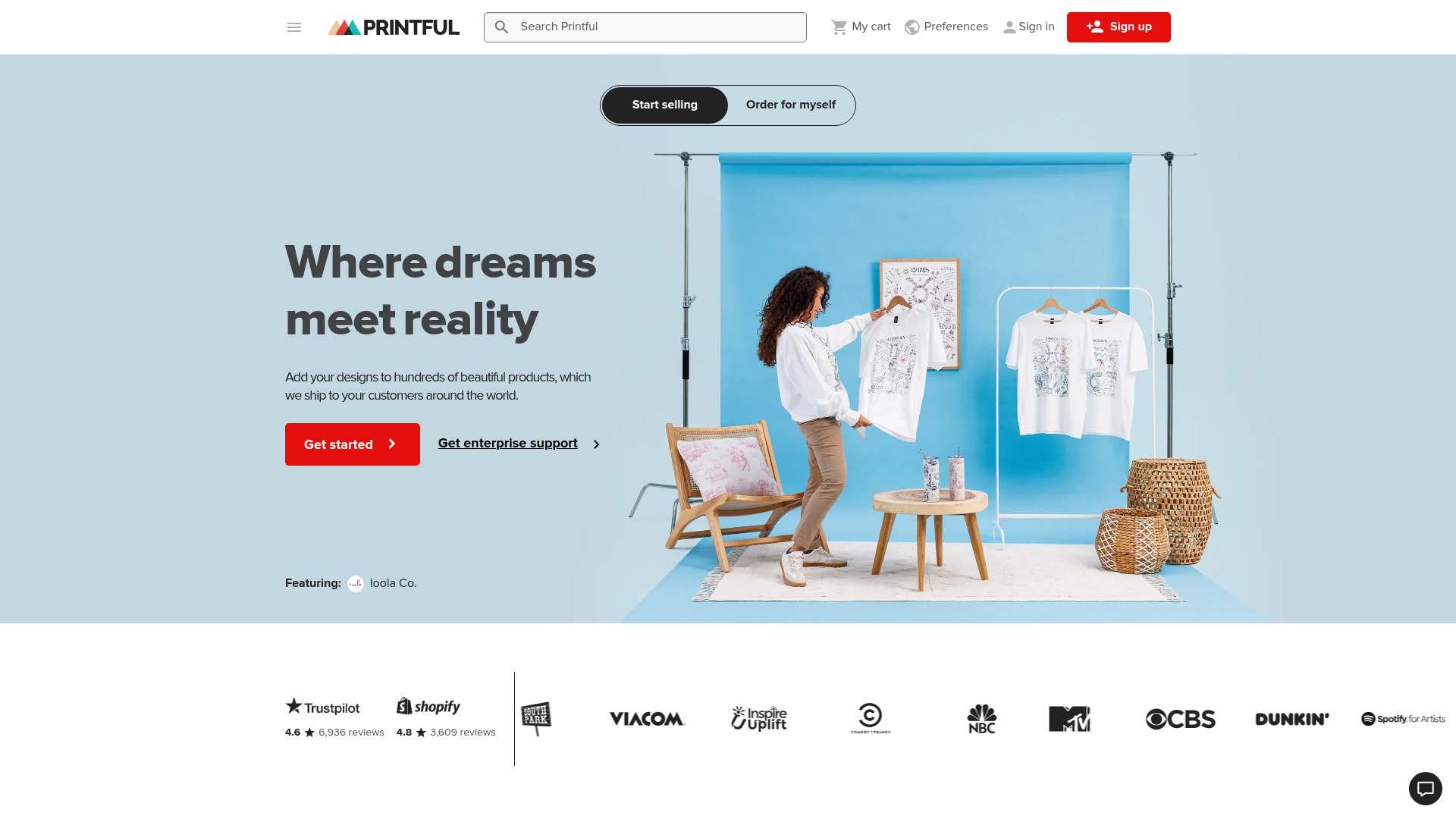
Printful remains one of the safest choices for sellers who prioritize brand presentation, stable quality, and robust integrations. It operates with a strong in-house manufacturing foundation and has built a reputation around reliability rather than rock-bottom pricing.
Best for
premium custom t shirt fulfillment
brands that want more control over packaging and presentation
Shopify and Etsy sellers who care about consistency
Strengths
strong print quality across DTG, embroidery, and select other methods
white-label options and branding extras
broad integration ecosystem
good support and polished interface
Trade-offs
often higher base costs than network-driven competitors
not always the cheapest option for aggressive margin strategies
Why it matters
If your store sells fewer SKUs at higher perceived value, Printful is often the right fit. It reduces operational surprises, which is critical when customer lifetime value matters.
2. Printify
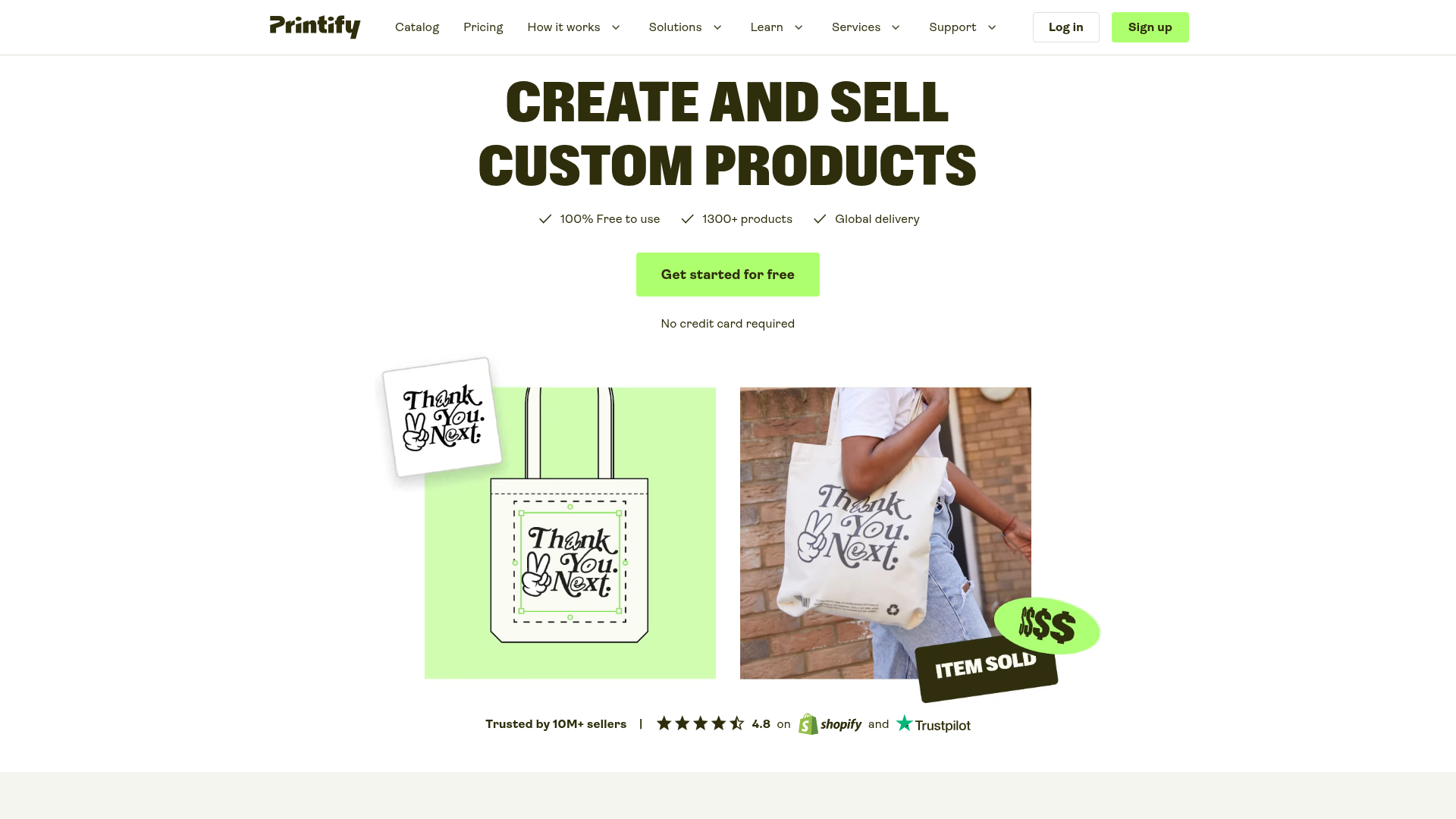
Printify is one of the most widely used t shirt fulfillment companies because it gives sellers access to a large network of print providers. That flexibility is both its biggest strength and biggest risk.
Best for
sellers testing many designs quickly
cost-sensitive brands
operators who want to compare providers by region or price
Strengths
broad product catalog
multiple printer choices for the same SKU
competitive pricing, especially with premium plans
strong marketplace integrations
Trade-offs
quality can vary between providers
more oversight required when scaling
customer experience consistency depends on partner selection
Why it matters
Printify works well when you are optimizing aggressively for economics and experimentation. But you need a disciplined sampling process. The platform is powerful, but it rewards operators who are willing to manage variability.
3. CustomCat
CustomCat is a strong US-focused option for apparel-heavy operations. It emphasizes speed and throughput, making it appealing for brands that mainly sell in the domestic American market.
Best for
US sellers with apparel-first catalogs
stores that need dependable domestic shipping
brands with higher order volume in basic tees and hoodies
Strengths
in-house production
streamlined apparel fulfillment
competitive pricing tiers
fast US shipping profile
Trade-offs
less ideal for international expansion
narrower strategic value if you need broader customization experiences
Why it matters
If your business is centered on standard apparel fulfillment in the US, CustomCat can be efficient. But it is less future-oriented than platforms built around immersive, branded product creation.
4. SPOD
SPOD is often recommended for speed. Backed by Spreadshirt infrastructure, it positions itself as a fast-turnaround provider for sellers who want quick order movement.
Best for
stores where turnaround time is the primary differentiator
simple custom shirt programs
sellers focused on straightforward ecommerce workflows
Strengths
strong fulfillment speed positioning
easy onboarding
suitable for common apparel products
Trade-offs
less depth in branding and premium customization
weaker fit for highly differentiated or enterprise-grade workflows
Why it matters
SPOD is a practical tool if speed is your lead selling point. But if you want advanced white-label product creation and deeper customer engagement, it is not the most forward-looking choice.
5. Gooten
Gooten is often chosen by brands that want a broader product mix beyond shirts, while still maintaining API-friendly fulfillment workflows.
Best for
ecommerce brands with mixed catalogs
merchants that want workflow flexibility
businesses exploring automation beyond shirts
Strengths
wide product coverage
automation-friendly infrastructure
no monthly subscription pressure
useful for multi-category brands
Trade-offs
provider-network variability
less specialized around apparel branding than top apparel-centric competitors
Why it matters
Gooten is a strong operational choice for diversified stores. If shirts are just one part of your business, it can fit nicely. If shirts are your core category, more specialized providers may serve you better.
6. Apliiq
Apliiq takes a more fashion-oriented approach to custom apparel. It stands out for labeling, sewn embellishments, and brand-building features that go beyond standard POD output.
Best for
streetwear brands
fashion-forward custom apparel programs
sellers who care about labels, trims, and elevated presentation
Strengths
private label options
strong brand-building details
more fashion-minded than commodity POD providers
Trade-offs
not the best fit for basic low-cost mass testing
can be more complex and expensive than standard fulfillment options
Why it matters
If you are building a real apparel brand rather than testing meme tees, Apliiq deserves consideration. It supports a more premium identity.
7. Teelaunch
Teelaunch is a long-standing option in the ecommerce fulfillment ecosystem, especially among Shopify users who want a relatively simple print-on-demand workflow.
Best for
Shopify-first merchants
newer brands that want simple setup
stores with broader gift/product strategies
Strengths
easy onboarding
broad enough catalog for many small stores
familiar workflow for standard POD needs
Trade-offs
not the most advanced on branding, UX, or enterprise-scale innovation
less differentiated in 2026 than it once was
Why it matters
Teelaunch still works for smaller merchants, but the market has moved toward more integrated, smarter, and more immersive product-creation experiences.
8. Gelato
Gelato’s main promise is localized production. Its network routes orders closer to the customer, which can reduce shipping times and international friction.
Best for
sellers with global audiences
businesses optimizing international delivery
brands that want to reduce cross-border shipping complexity
Strengths
broad international routing
good fit for EU and global markets
useful for distributed fulfillment strategies
Trade-offs
network-based quality variability still applies
less centered on branded product-creation experiences
Why it matters
If your store sells across multiple regions, Gelato is worth serious evaluation. Geography is its strategic edge.
Which Provider Is Best for Different Types of Sellers?
For startups testing designs quickly
Printify is often the best starting point because of cost flexibility and provider choice.
For premium apparel brands
Printful and Apliiq are stronger due to consistency, brand control, and perceived quality.
For US-focused volume sellers
CustomCat is compelling if domestic apparel throughput is the core requirement.
For international sellers
Gelato and Printful both stand out for broader global coverage.
For diversified ecommerce stores
Gooten gives you flexibility across categories.
For brands modernizing the buying experience itself
This is where most fulfillment comparisons fail to look far enough ahead. If you already have a store, app, or print business and want to improve conversion, reduce friction, and give customers a better way to create personalized products, Media Rex Alliance is strategically different from standard POD vendors.
Why Media Rex Alliance Changes the T Shirt Fulfillment Conversation
Most t shirt fulfillment companies focus on what happens after the order is placed.
Media Rex Alliance focuses on improving what happens before the order is placed.
That distinction matters because many stores do not lose money on printing. They lose money on friction: abandoned sessions, poor mobile design tools, confusing product builders, and lack of confidence before purchase.
What makes Media Rex Alliance different
Media Rex Alliance helps print businesses, studios, photographers, print-on-demand brands, and established photo-product companies launch AI-powered, white-label print experiences without building the stack from scratch.
Key advantages include:
conversational AI product creation instead of manual design complexity
faster conversion from prompt to print-ready product
full white-label integration into existing storefronts or apps
photorealistic 3D and AR previews before ordering
browser-based, mobile-first design without app installation
local and cloud sync across devices
automated on-demand fulfillment through a global printer network
scalable infrastructure for startups through enterprise operators
Why this matters for t shirt printing fulfillment
Imagine a customer wants a custom shirt. Instead of uploading assets and manually placing text, they type:
“Create a minimalist black oversized tee with a vintage racing-style front graphic in cream and red, and a small back neck logo.”
The system turns that into a ready-to-print product. That dramatically reduces design friction, speeds up purchase decisions, and can increase conversion rates for custom t shirt fulfillment.
For established print businesses, this also means you can embed next-generation creation capability into your own brand ecosystem, keep the customer relationship, and modernize without rebuilding your tech stack.
The Biggest Mistakes to Avoid When Choosing T Shirt Fulfillment Services
Choosing on price alone
The cheapest unit cost is not always the most profitable option. Poor print quality, inconsistent shipping, and customer complaints destroy margin fast.
Ignoring print-method fit
A beautiful DTG design may fail on the wrong garment. A bulk campaign may be overpriced if you do not switch to screen printing.
Skipping samples
Always test your actual best-sellers, not just one sample. Different blanks, colors, and providers can change results.
Overlooking mobile UX
If customers struggle to customize products on mobile, your conversion rate suffers before fulfillment even starts.
Treating fulfillment and product creation as separate decisions
In 2026, they are increasingly connected. The best experiences combine smart product creation, confident previews, and automated fulfillment into one seamless flow.
How to Build a More Profitable Custom T Shirt Fulfillment Stack
A modern stack should include:
Layer | What it should do |
|---|---|
Storefront | Capture traffic and communicate brand value |
Product creation layer | Make customization fast, intuitive, and mobile-friendly |
Preview engine | Reduce hesitation with realistic 3D or AR visualization |
Fulfillment layer | Print, pack, and ship reliably |
Data/automation layer | Sync orders, products, and customer flows across systems |
Most sellers only optimize the fulfillment layer. Media Rex Alliance gives businesses a way to upgrade the creation and preview layers too, which is where large conversion gains often live.
Final Verdict
The best t shirt fulfillment companies in 2026 are not all competing on the same dimension.
Printful is best for quality-conscious brands that want consistency.
Printify is best for flexible testing and cost optimization.
CustomCat is strong for US-focused apparel fulfillment.
SPOD is useful when speed is the main priority.
Gooten works well for broader product catalogs.
Apliiq stands out for fashion-driven branded apparel.
Teelaunch remains a simple option for smaller merchants.
Gelato is excellent for international routing.
But if you are thinking beyond commodity fulfillment and want to modernize how customers create, personalize, and confidently buy print products, Media Rex Alliance offers a smarter path.
It combines AI-driven product creation, white-label deployment, photorealistic 3D and AR previews, browser-based mobile-first experiences, and automated on-demand production into one scalable platform. For print businesses and ecommerce operators that want to reduce friction, increase conversion, and launch premium branded experiences faster, that is a major strategic advantage.
Ready to Future-Proof Your Print Business?
If you want more than a vendor that simply prints and ships shirts, Media Rex Alliance is the platform to evaluate next.
Use it to:
launch AI-powered custom product experiences
reduce the friction of traditional design tools
improve purchase confidence with 3D and AR previews
embed fully white-label print technology into your existing brand
scale without inventory, app installs, or in-house production complexity
The future of t shirt fulfillment is not just faster printing. It is faster creation, better buying experiences, and smarter automation from prompt to product.
For brands that want to lead rather than follow, Media Rex Alliance is built for exactly that.