Best Web to Print Software for Modern Print Brands
Modern print brands are not just looking for another storefront plugin. They are looking for a growth engine: something that reduces design friction, lifts conversion rates, automates production, and scales from a niche photo studio to a multi-region print business.
That is why the conversation around the best web to print software has changed. It is no longer only about templates, file upload, and PDF generation. Today, the strongest platforms combine AI-assisted product creation, white-label deployment, seamless storefront integration, mobile-first buying journeys, photorealistic previews, and automated fulfillment.
For small studios, photographers, emerging print-on-demand brands, and established photo book companies, the challenge is the same: how do you modernize without building an entire print technology stack from scratch? This guide breaks down what matters, what most competitor roundups miss, and how to choose a platform built for the next era of print commerce.
What Competitor Articles Get Right, and Where They Fall Short
Most high-ranking articles about web-to-print software tend to agree on a few points:
Print businesses need storefronts, editors, pricing automation, and production workflows.
B2B and B2C use cases increasingly overlap.
Integrations matter, especially with ecommerce, MIS, shipping, and accounting systems.
Personalization is no longer optional.
Those are valid foundations. But many of those articles still evaluate platforms using an older framework. They focus heavily on catalogs, templates, and admin features, while underplaying the biggest shift in the market: customer experience at the point of creation.
The biggest content gaps in competitor coverage
Here is what is often missed or treated too lightly:
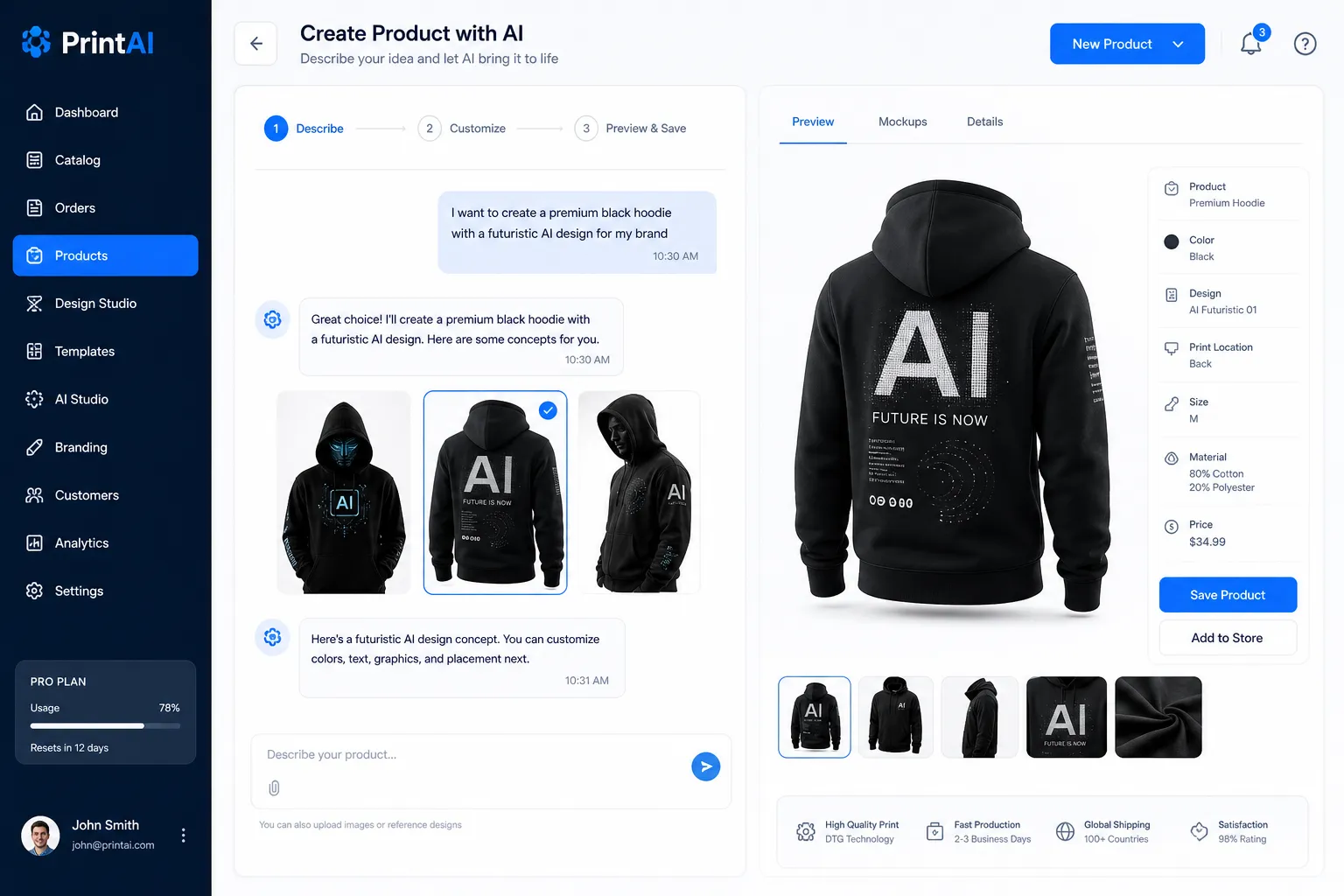
Conversational AI as the new design layer
Most comparisons still assume customers want to use complex editors. In reality, many buyers want to describe what they want and get a product generated for them.3D and AR previews as conversion tools, not just visual add-ons
Many articles mention previews, but few explain how they directly improve confidence and reduce abandonment.Mobile-first product creation
Modern customers increasingly begin and complete purchases on mobile. If the workflow breaks on a phone, the platform is not future-ready.White-label speed-to-market
Many brands want their own experience without becoming software companies. This changes how the best solution should be evaluated.On-demand fulfillment infrastructure
Software alone is not enough. The value of a modern platform often includes how well it connects to production and fulfillment at scale.Free vs commercial tradeoffs
Many articles mention free web to print software only briefly, without explaining when it is useful and when it becomes a growth bottleneck.
At Media Rex Alliance, we believe the next generation of print commerce is defined by reduced friction, faster decisions, and branded AI experiences that feel native to the merchant, not bolted on.
Why the Definition of “Best” Has Changed
A few years ago, the best platform might have been the one with the most configuration screens. Today, that can actually be a weakness if the customer journey feels clunky.
The new standard is simple: can the platform help customers go from idea to print-ready product with as little effort as possible?
"The global web-to-print (W2P) software market was valued at USD 1.1 billion in 2022 and is projected to reach USD 1.96 billion by 2030, growing at a CAGR of 7.8% from 2023 to 2030." - Grand View Research
That growth reflects a market that is expanding beyond traditional print buyers. New customer segments expect ecommerce convenience, intelligent automation, and rich previews before they purchase.
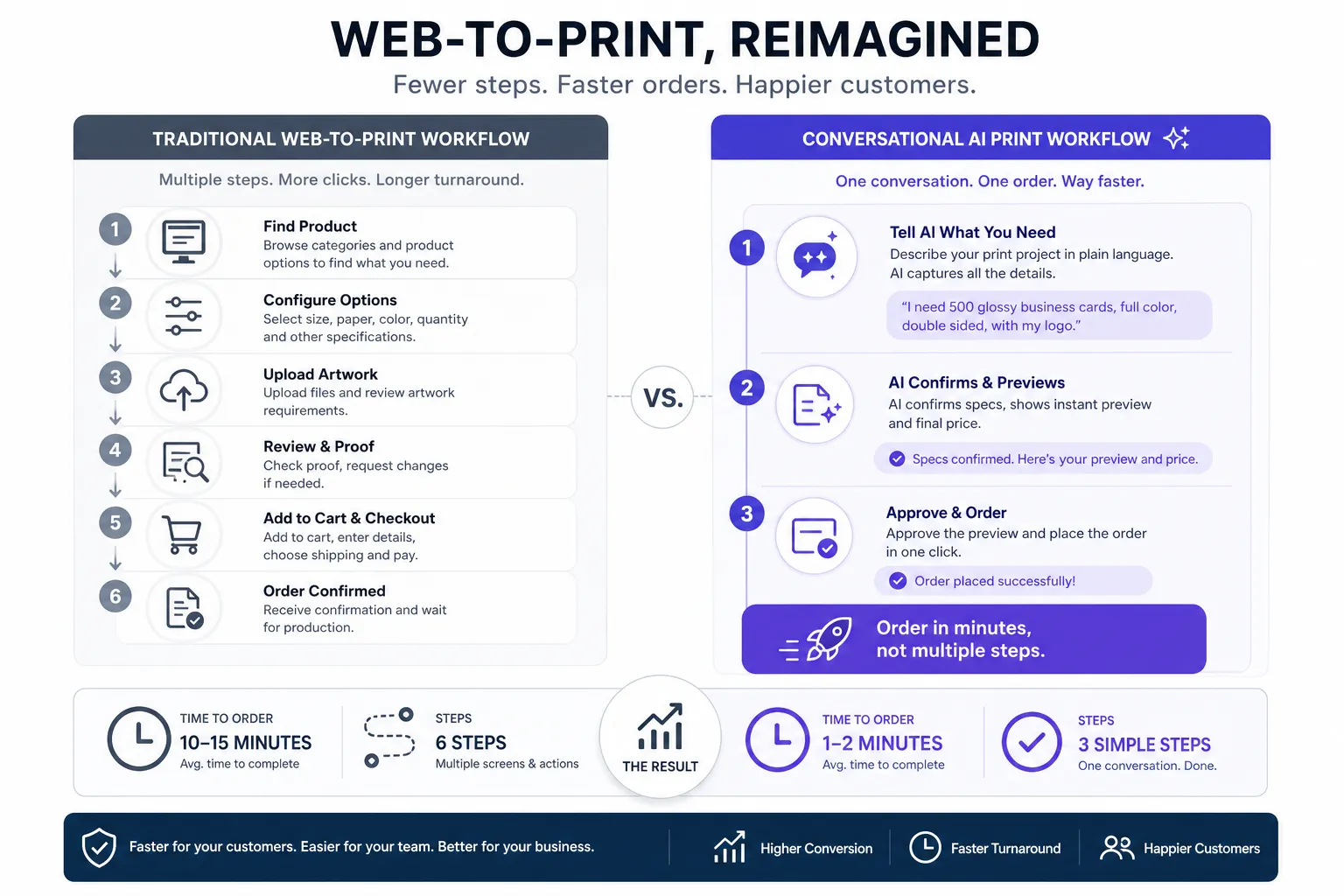
The old model vs the modern model
Traditional web-to-print | Modern AI-powered web-to-print |
|---|---|
Customer starts with a blank editor | Customer starts with a prompt or photo |
Manual layout building | Automated layout generation |
Complex desktop-first tools | Mobile-first browser experience |
Static previews | Photorealistic 3D and AR previews |
Separate production coordination | Automated fulfillment pipeline |
Long learning curve | Fast, intuitive onboarding |
The Core Features the Best Web to Print Software Should Have
Not every print business needs the same workflow depth, but the strongest platforms usually share a modern feature set.
1. AI-powered product creation
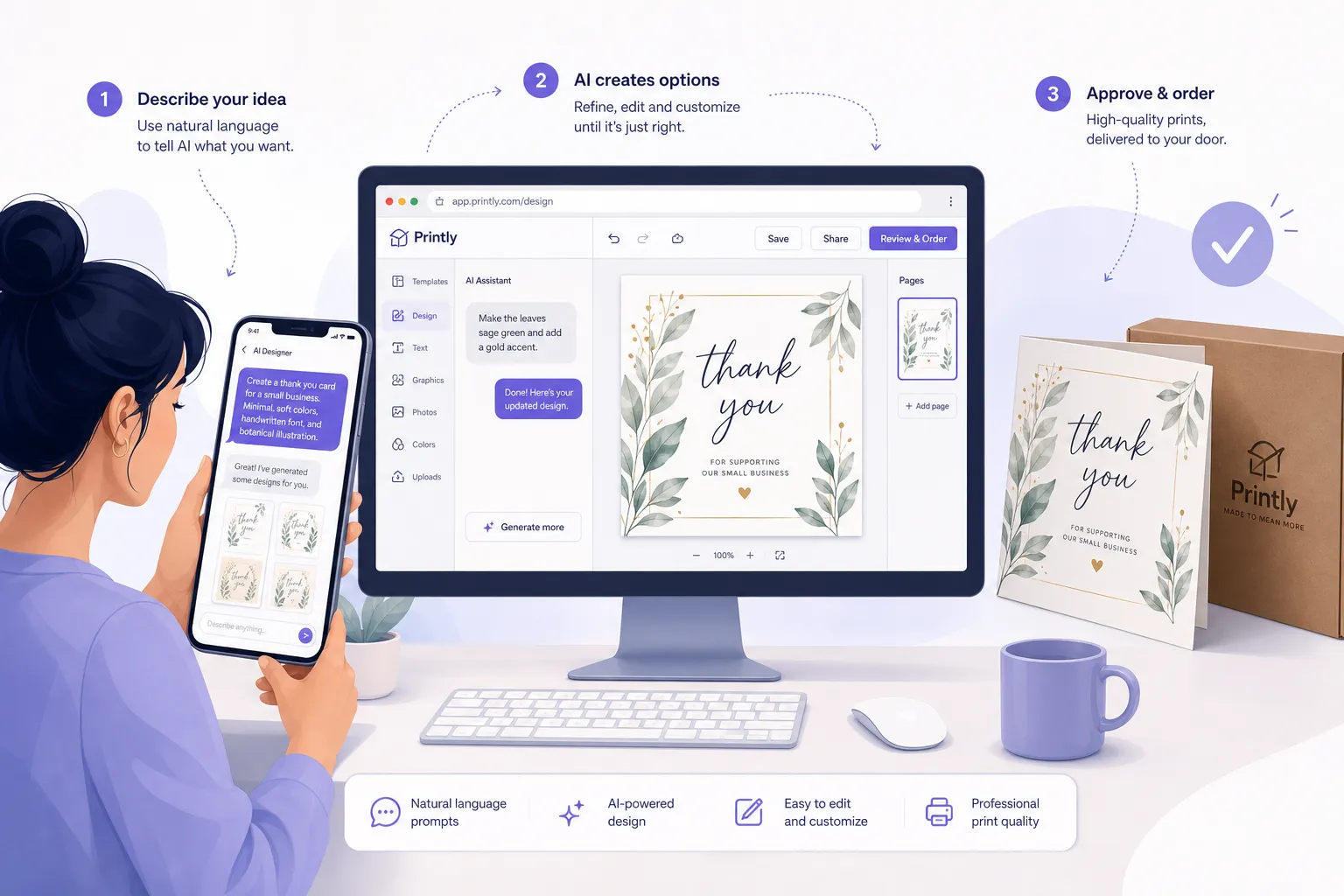
This is where the category is evolving fastest. Instead of forcing users into a traditional design studio, advanced platforms now let them create through plain language prompts, uploaded photos, or guided interactions.
For example, Media Rex Alliance enables customers to create products via conversational AI instead of complex design tools. That means a buyer can describe the mood, style, format, or intended recipient, and the platform turns that input into a ready-to-print concept.
This matters because every step removed from the creation process can increase buying momentum.
2. White-label integration
A serious print brand does not want to send its customers to another company’s experience. The platform should integrate into your existing storefront, app, or digital ecosystem under your brand, your domain, and your UI rules.
The best platforms feel invisible to the customer. They strengthen your brand equity rather than diluting it.
3. Browser-based, mobile-first usability
If customers must install software or switch to desktop to complete a product, conversion suffers. Modern platforms should run fully in the browser, work seamlessly on mobile, and preserve progress across devices.
Media Rex Alliance supports a no-app workflow with local and cloud sync, so users can start on one device and continue on another without friction.
4. Photorealistic 3D and AR previews
Previews are not cosmetic. They shape trust. When customers can see realistic product output before checkout, hesitation drops and confidence rises.
"Products featuring 3D visualization experienced a conversion rate increase of up to 40%." - Shopify data cited by Eyedex
That is especially important for products like photo books, wall art, packaging, premium cards, and personalized gifts, where tactile expectations strongly influence purchase decisions.
5. On-demand production and automated fulfillment
The best platform should not stop at creation. It should support a low-inventory, low-overhead production model and connect cleanly to a global print network or preferred fulfillment layer.
Media Rex Alliance is built around on-demand production and automates fulfillment through a global network of premium printers. That reduces operational drag while giving brands scalability they would struggle to build alone.
6. Scalability across business stages
A startup and an enterprise printer do not need identical workflows, but they do need a platform that grows with them. The software should support:
product catalog expansion
regional or international rollout
white-label client deployments
high-volume order orchestration
flexible branding and configuration
What Free Web to Print Software Is Good For, and Where It Breaks
It is reasonable for early-stage brands to explore free web to print software. In some cases, it is a useful way to validate demand, test personalized products, or experiment with a limited storefront.
But free tools usually come with structural limitations.
Where free tools can help
Testing a narrow product line
Launching a proof of concept
Supporting basic customization
Learning what customers actually want to personalize
Where they usually fall short
Limited white-label control
Weak mobile experiences
Basic or outdated editors
Minimal automation
Poor scalability
Restricted integrations
Limited support and SLA coverage
No fulfillment infrastructure
For a small creator, free tools can be a temporary bridge. For a brand that wants to scale, they often become expensive in hidden ways: lower conversion, more manual work, more customer support tickets, and slower rollout.
A practical decision framework
Business stage | Free option may work? | Commercial platform recommended? |
|---|---|---|
Solo creator testing demand | Yes | Not immediately necessary |
Small studio selling custom products regularly | Possibly for short term | Yes |
Photographer launching premium branded products | Rarely enough | Yes |
POD brand aiming for scale | No | Yes |
Established print company modernizing storefronts | No | Yes |
The Most Important Buying Criteria for Modern Print Brands
Choosing a platform becomes easier when you evaluate it through the lens of customer friction, operational fit, and long-term leverage.
Customer experience
Ask:
How quickly can a first-time customer create a product?
Can they do it on mobile?
Do they need training?
Is the process delightful or merely functional?
Brand control
Ask:
Can the experience be fully white-labeled?
Can it live inside our existing storefront or app?
Can we control the visual identity, domain, and customer touchpoints?
Conversion readiness
Ask:
Does the platform include 3D or AR previews?
Does it reduce the time from idea to checkout?
Can it remove the blank-canvas problem with AI generation?
Operational scalability
Ask:
Can it support on-demand production?
How automated is fulfillment?
Does it scale for multiple geographies, product lines, or business units?
Technical flexibility
Ask:
Does it integrate with our current ecommerce stack?
Can it support API-led workflows?
How hard is implementation and maintenance?
How Modern Platforms Compare by Strategic Strength
Below is a simplified decision-oriented comparison based on the themes commonly seen across leading platforms and the capabilities modern brands should prioritize.
Platform type | Best for | Strengths | Weaknesses |
|---|---|---|---|
Traditional web-to-print suite | Established print workflows | Templates, storefronts, admin depth | Often complex for end customers |
Enterprise print portal platform | Large B2B procurement | Permissions, workflows, approvals | Less consumer-friendly UX |
Design-heavy personalization platform | Consumer-facing customization | Rich editors, broad product support | Often still tool-centric, not prompt-centric |
Free or low-cost tool | Early testing | Low barrier to entry | Limited scale, branding, automation |
AI-native white-label platform | Modern print brands seeking speed and conversion | Conversational creation, previews, white-label, on-demand fulfillment | Requires strategic adoption, not just feature comparison |
Why Conversational AI Changes Conversion Economics
Most competitor articles discuss AI as a nice enhancement: background removal, text suggestions, maybe image improvements. That is not the real shift.
The real shift is replacing the blank canvas with intent-driven creation.
Instead of asking the customer to become a designer, conversational AI lets the platform become the creative assistant. That changes who can buy, how fast they buy, and how often they complete the process.
Why this matters commercially
It reduces abandonment caused by intimidating design interfaces.
It shortens time-to-first-preview.
It helps non-designers create premium-looking products.
It accelerates purchase decisions for emotionally driven products like gifts, albums, and wall art.
It opens up higher-intent mobile commerce.
Media Rex Alliance is purpose-built around that shift. Its autonomous creation engine transforms a simple prompt into a ready-to-print product, handles photo uploads, generates layouts automatically, and makes the experience feel effortless for the end user.
That is not just a better editor. It is a different commerce model.
The Role of 3D and AR in Premium Print Commerce
A photo book, custom card set, or framed print is not a commodity. It is a highly visual purchase. Customers want reassurance before they buy.
That is where photorealistic 3D and AR previews become strategically important.
Benefits beyond aesthetics
Improve trust before checkout
Reduce uncertainty around format, finish, and presentation
Support premium pricing
Lower support inquiries
Potentially reduce returns by aligning expectation with reality
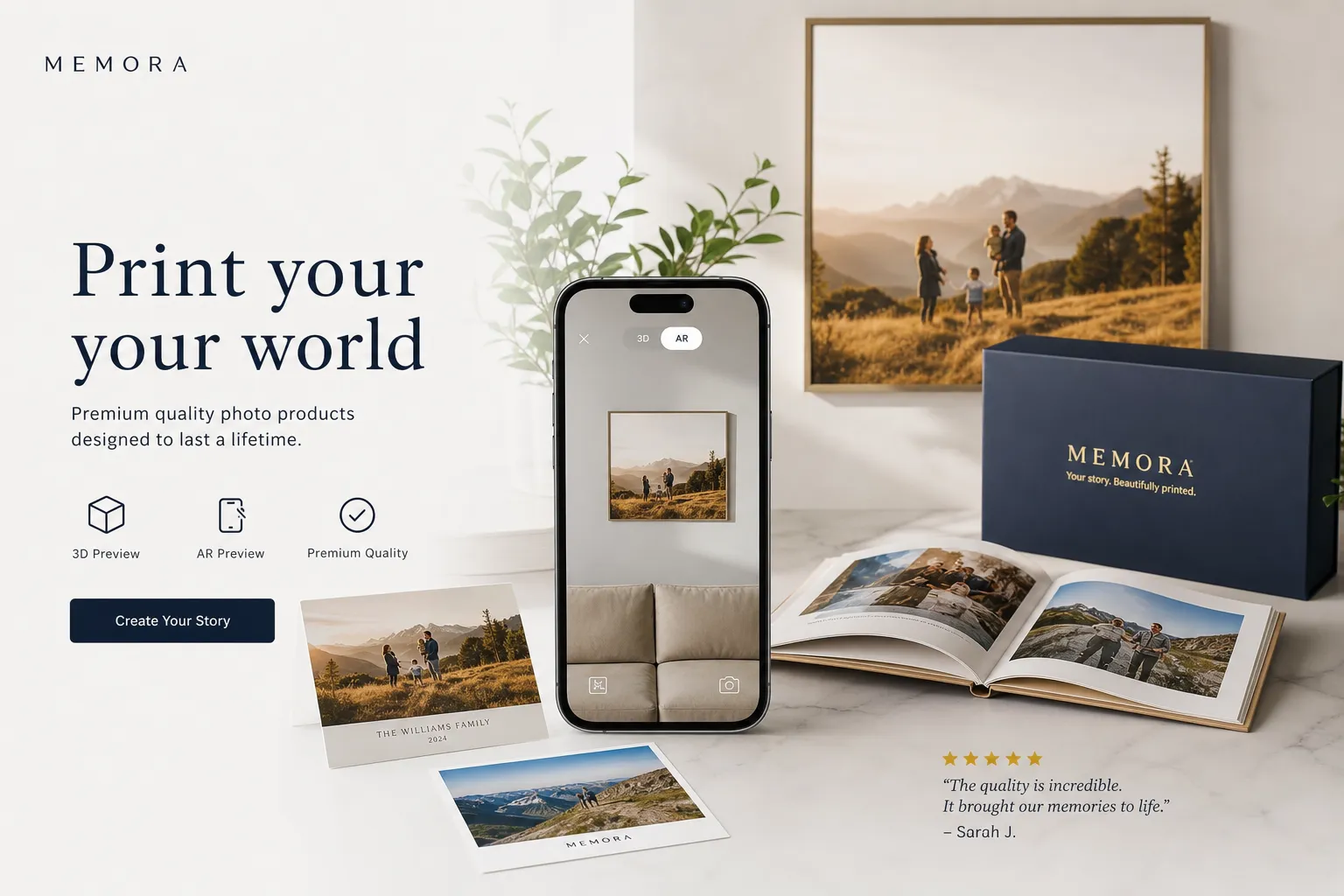
Media Rex Alliance provides photorealistic 3D and immersive AR previews, helping customers visualize the final product in a way that feels concrete, not abstract.
Competitor Landscape Snapshot
The market includes several established vendors with strong capabilities in storefronts, production workflows, and specialty printing segments. These platforms can be useful benchmarks for buyers comparing options.
DesignNBuy
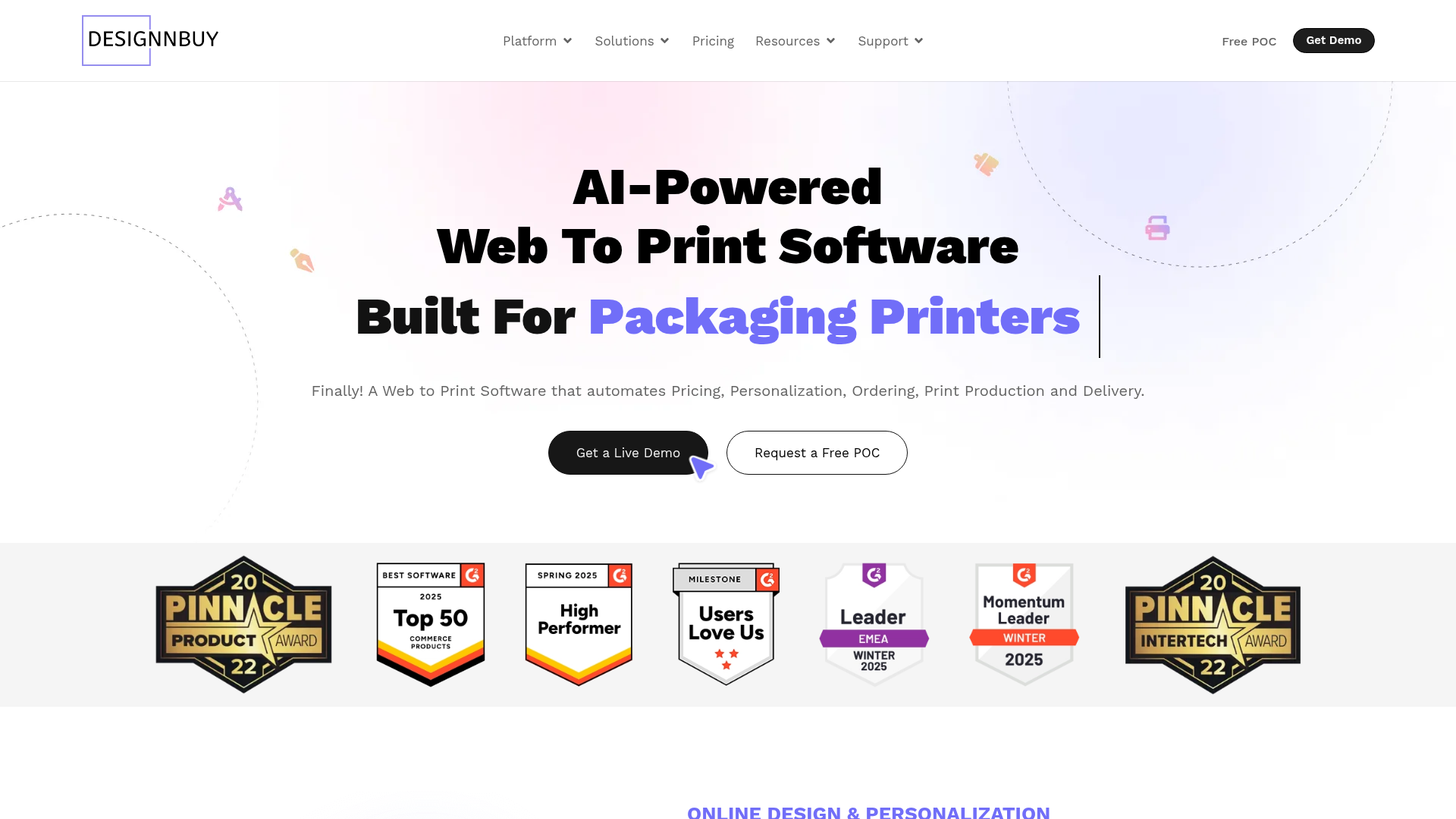
DesignNBuy positions itself as a broad web-to-print platform with storefronts, personalization tools, and production automation. It has strength in product breadth and supports a wide variety of print categories.
Where it fits well: businesses seeking a configurable all-in-one environment for multiple print segments.
What modern buyers should scrutinize: how streamlined the end-customer creation experience feels compared with AI-native prompt-based workflows.
OnPrintShop
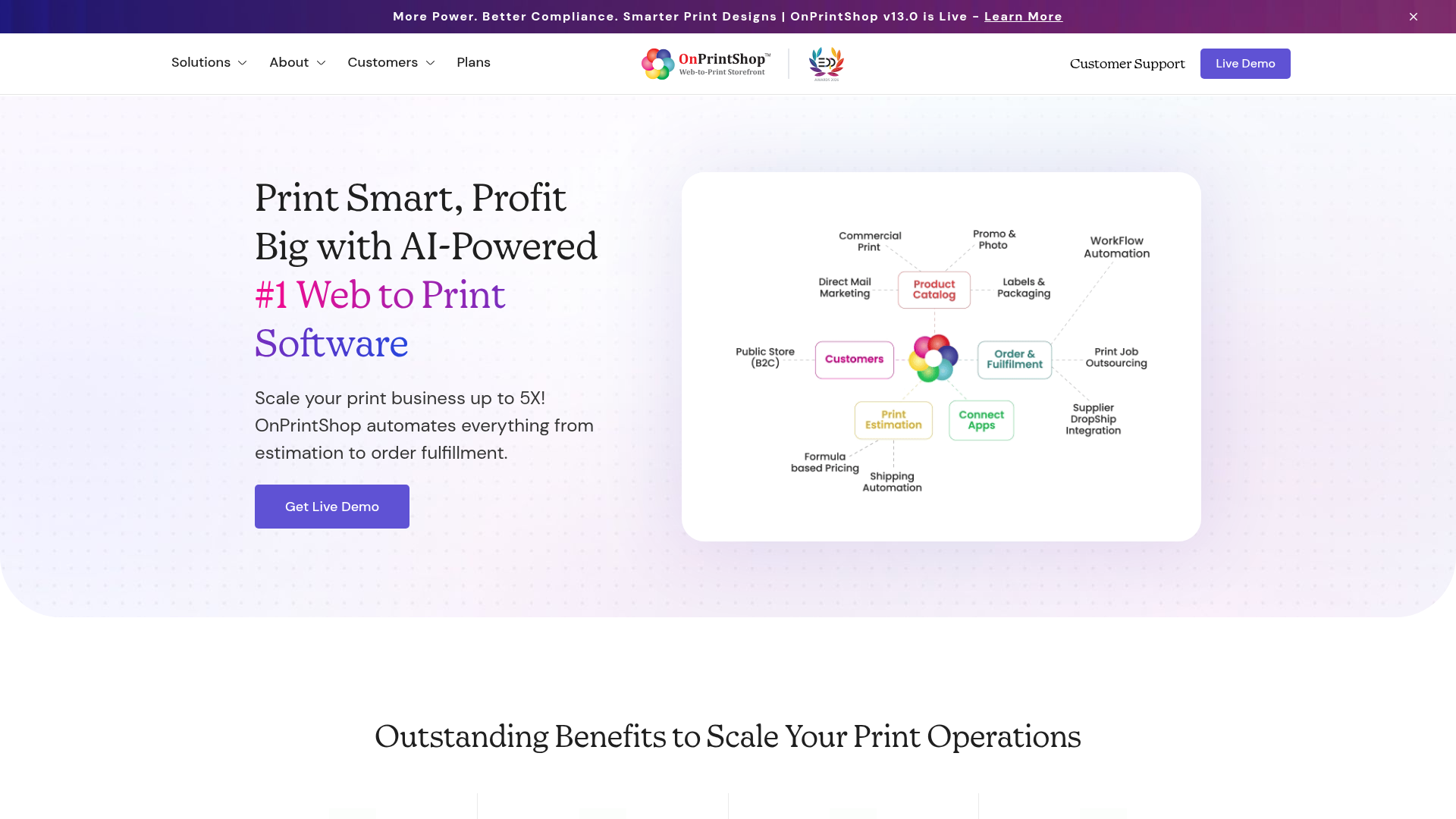
OnPrintShop emphasizes AI-powered features, B2B/B2C storefronts, multi-segment support, and extensive integrations. It is frequently presented as a scalable option for established print operations.
Where it fits well: print businesses with diverse product lines and a need for process coverage.
What modern buyers should scrutinize: whether operational depth comes at the cost of simplicity for the buyer-facing design journey.
printQ
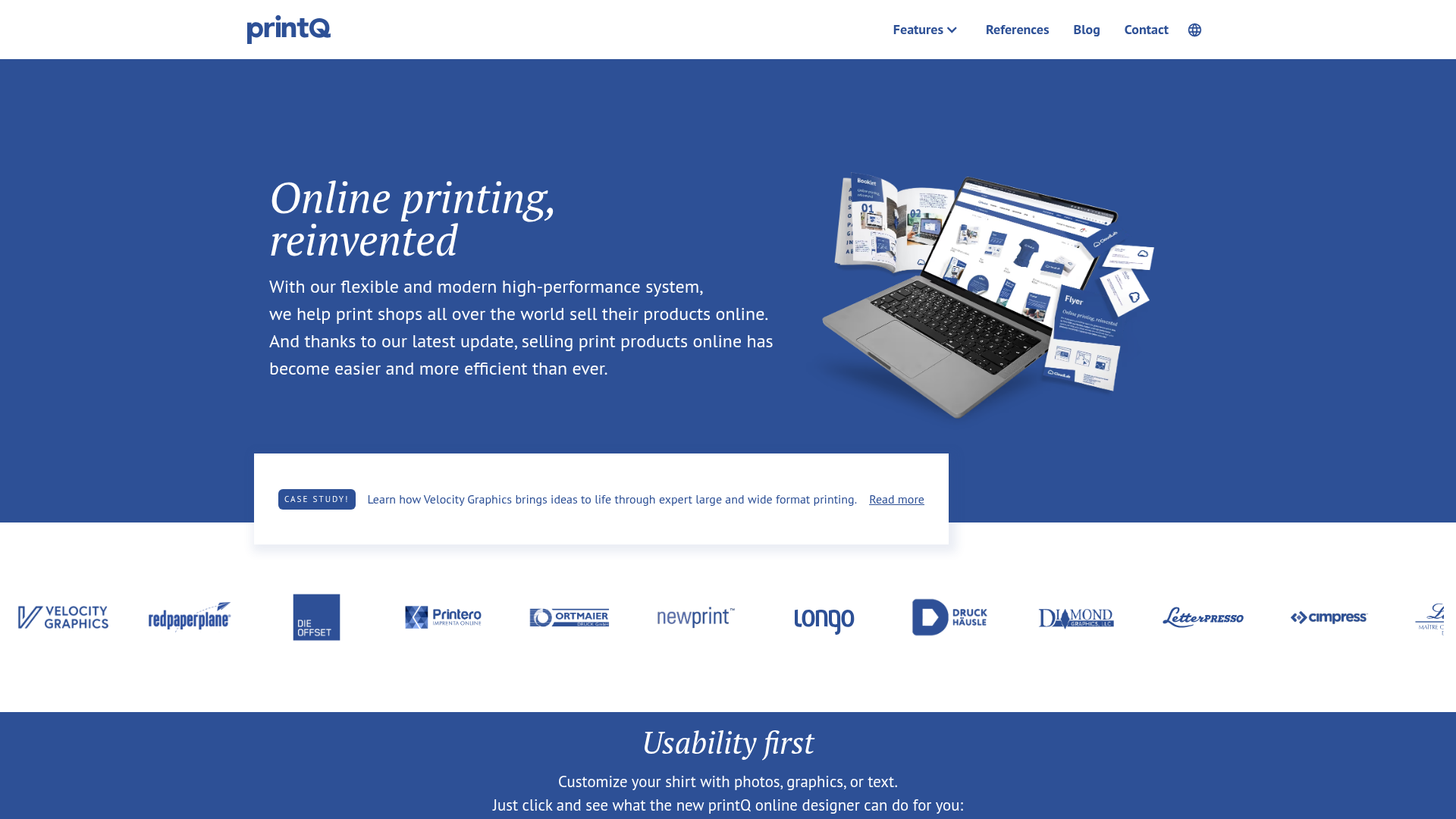
printQ stands out for Adobe Commerce alignment, configurable storefront architecture, and production-oriented functionality. It speaks strongly to scalable ecommerce-led print operations.
Where it fits well: businesses that want to build on Adobe Commerce and manage sophisticated print commerce experiences.
What modern buyers should scrutinize: how much effort customers must still invest in traditional editing compared with conversational creation models.
Where Media Rex Alliance Changes the Category
Media Rex Alliance is not trying to be just another editor layered onto a storefront. It is built for print brands that want to launch premium AI-powered product creation under their own brand, without building the technology themselves.
What makes the platform strategically different
Conversational creation instead of tool-heavy design
Customers can describe what they want rather than learn complex design software.
Prompt-to-product speed
The platform turns prompts into print-ready products quickly, reducing friction and speeding up purchase decisions.
Fully white-label deployment
Brands can integrate the experience into existing storefronts or apps with their own domain, identity, and customer journey.
Mobile-first browser experience
No app installation required. Customers can create directly in the browser from anywhere.
Cross-device continuity
Projects sync locally and in the cloud, making it easy to start on one device and continue on another.
Premium confidence layer
Photorealistic 3D and AR previews help buyers feel certain before ordering.
On-demand economics
The platform supports a low-stock, low-overhead production model.
Automated global fulfillment
A global network of premium printers helps brands scale without owning every production layer.
Built for multiple growth stages
From startup brands to enterprise print companies, the infrastructure supports expansion without total reinvention.
Which Type of Business Benefits Most
Small studios and photographers
If your audience wants beautifully personalized products but does not want to design from scratch, conversational AI can dramatically improve order completion.
Best fit priorities:
fast creation
premium previews
branded experience
low operational overhead
New print-on-demand brands
If you want to launch fast, test product-market fit, and avoid inventory risk, on-demand fulfillment and white-label deployment matter more than building custom software.
Best fit priorities:
no-stock model
quick launch
scalable ecommerce integration
automated order routing
Mid-size print brands
If you already have traffic and product demand, your biggest wins may come from higher conversion and lower support costs.
Best fit priorities:
reduced design friction
mobile-first experience
customer confidence through 3D/AR
better throughput without more staff
Regional print players and established photo book companies
If you are modernizing legacy web-to-print flows, the real opportunity is not just upgrading tooling. It is redefining the creation experience so more customers complete the purchase.
Best fit priorities:
modernization without rebuilding everything
enterprise-grade white-label capability
scalable infrastructure
customer experience differentiation
A Smarter Evaluation Checklist
Use this shortlist when assessing any platform that claims to be the best fit for a modern print business.
Product experience checklist
Can a non-designer create a product quickly?
Does the platform support prompt-based creation or only manual editing?
Is the UX genuinely mobile-first?
Are previews realistic enough to drive confidence?
Commerce checklist
Can it integrate into an existing storefront or app?
Is the platform fully white-label?
Does it support premium brand presentation?
Can it reduce time-to-checkout?
Operations checklist
Is fulfillment automated?
Does it support on-demand production?
Can the business scale without adding complexity linearly?
Are workflows cloud-based and resilient?
Strategic checklist
Will this still fit in 2 to 3 years?
Does it differentiate us in the market?
Does it help us sell more, or only manage better?
Is it designed for where customer behavior is going, not where it was?
Final Verdict
The best web to print software for modern brands is no longer simply the platform with the longest feature list. It is the one that helps customers create faster, trust the result sooner, and complete purchases with less friction.
For some businesses, traditional suites still make sense. For others, especially those focused on premium consumer experiences, mobile engagement, AI-assisted creation, and brand-led scale, the future belongs to a different kind of platform.
Media Rex Alliance represents that next step. It combines conversational AI, fully white-label deployment, browser-based mobile-first access, photorealistic 3D and AR previews, cloud and local sync, on-demand production, and automated global fulfillment into one scalable print commerce engine.
If your goal is not just to digitize print ordering, but to build a smarter, faster, more scalable print brand, Media Rex Alliance is the platform worth evaluating first.
FAQ
What is the best software for printing?
The best choice depends on your business model, but for modern digital print brands, the strongest option is software that combines AI-powered creation, white-label storefront integration, mobile-first usability, and automated fulfillment. Platforms like Media Rex Alliance stand out because they reduce design friction and help customers move from idea to order much faster.
Do I need rip software for DTF?
Yes, in most DTF workflows you typically need RIP software to manage color, white ink layers, and printer output settings. Web-to-print software and RIP software serve different roles: one handles customer ordering and product creation, while the other prepares files for production equipment.
What is the best print management software?
The best print management software is the one that connects ordering, automation, production, and fulfillment in a way that matches your business scale. For brands prioritizing customer experience and growth, a platform that also includes AI-driven creation and white-label deployment offers more long-term value than admin tools alone.
What is the most popular print on demand website?
Popularity varies by niche, but the most effective print-on-demand platforms are the ones that offer easy product creation, reliable fulfillment, and strong branding control. For businesses building their own branded experience, a white-label platform like Media Rex Alliance can be more strategic than relying solely on a marketplace-style POD site.
What is the best print management software?
If you are evaluating print management software today, focus on whether it improves both internal efficiency and customer conversion. The strongest modern platforms do more than manage jobs; they help customers create products faster, preview them confidently, and place orders through a seamless branded workflow.