Compare the Different Web to Print Solutions: What Actually Matters in 2026
Web-to-print is no longer just about putting a catalog online and adding a basic editor. Buyers now expect the same frictionless, conversational, mobile-first experience they get from modern AI tools. That is where many legacy platforms start to show their age.
For small studios, photographers, new print-on-demand brands, mid-size print companies, regional print players, and established photo book businesses, the challenge is clear: how do you launch a scalable print experience that feels current, converts well, and does not require building complex technology from scratch?
This guide compares the different web to print solutions on the market through a practical lens: usability, automation, customization depth, integration flexibility, and future readiness. It also addresses a major gap competitors rarely confront directly: most platforms still assume customers want to design with traditional tools, while the market is rapidly shifting toward conversational creation.
"80% of consumers are more inclined to purchase from brands that offer personalized experiences." - eevy.ai
"Products featuring 3D visualization can experience conversion rate increases of up to 40%." - Shopify, cited by eyedex.co
Why Comparing Web to Print Solutions Is Different Today
The traditional web to print online designer was built for a desktop era. It assumed users would:
learn design controls
manually place and resize elements
understand bleed, layout, and file prep
tolerate a longer path to checkout
That model still works for some professional users, but it increasingly fails mainstream buyers. Consumers and business customers alike are getting used to AI interfaces that let them describe what they want in plain language and get a finished result quickly.
That shift changes the comparison criteria.
Instead of asking only whether a platform has templates, pricing rules, or storefronts, modern buyers should also ask:
Can customers create products through conversation instead of complex editing?
Can the platform generate print-ready outputs fast enough to shorten decision time?
Does it support photorealistic 3D and AR previews before purchase?
Is it mobile-first and browser-based, with no app friction?
Can it be deployed white-label inside an existing storefront or app?
Does fulfillment scale without adding operational overhead?
These are the questions that separate legacy web-to-print software from AI-native print commerce.
What Competitor Articles Get Right - and What They Miss
Across the top competitor content, several common themes appear repeatedly:
Common theme in competitor articles | Why it matters | What is often missing |
|---|---|---|
Storefront usability | Buyers need smooth ordering flows | Few address conversational AI as the new interface layer |
Template customization | Brand control remains essential | Most still assume manual editing as the default |
MIS/ERP/API integrations | Workflow automation is critical | Limited discussion of white-label embedding into existing apps |
Packaging and industrial complexity | Important for certain segments | Often over-indexed toward production logic, under-indexed toward customer conversion |
Support and scalability | Necessary for long-term adoption | Rarely tied to modern mobile behavior and low-friction creation |
3D previews and proofing | Improves confidence | Few connect 3D/AR directly to conversion optimization |
The biggest content gap is this: almost no one seriously reframes web-to-print around conversational product creation.
That is where Media Rex Alliance changes the category.
The Main Types of Web to Print Solutions
When you compare the different web to print solutions, most fall into one of five models.
1. Traditional Template-Based Platforms
These systems let users customize prebuilt templates inside a browser editor. They are useful for common print products like business cards, flyers, and stationery.
Best for:
commercial printers with standard catalogs
B2B portals with controlled assets
repeat-order environments
Limitations:
editing can still feel technical
customer creativity is constrained by template structure
mobile experiences are often weaker than desktop
2. Enterprise Workflow Platforms
These focus on approvals, permissions, procurement rules, inventory, and integration with MIS/ERP systems.
Best for:
franchises
in-plant print departments
multi-location corporate print operations
Limitations:
often powerful but less intuitive
implementation can be heavy
customer-facing UX may feel dated
3. Specialist Packaging or Industrial Platforms
These platforms are built for packaging, labels, corrugated, or structurally complex products.
Best for:
packaging manufacturers
converters
industrial print environments
Limitations:
may be too specialized for broad consumer print commerce
often optimized for production accuracy more than mainstream ease of use
4. Consumer Design Experience Platforms
These prioritize rich design tools for photobooks, gifting, personalized products, wall art, and photo merchandise.
Best for:
photo brands
gifting companies
B2C print businesses
Limitations:
many still rely on traditional drag-and-drop workflows
advanced B2B and enterprise automation may be limited
5. AI-Native Conversational Web-to-Print Platforms
This is the emerging category. Instead of asking customers to “design,” these platforms let them describe a product, upload photos, and receive a ready-to-print outcome with previews and automation built in.
Best for:
modern print-on-demand brands
photo book companies
studios and photographers
existing print businesses looking to modernize conversion
businesses that want to embed white-label AI creation into their own storefronts
Why it matters: This model aligns far better with where digital buying behavior is heading.
A Practical Comparison of Leading Web-to-Print Approaches
Below is a simplified view of how the market currently compares.
Solution type | Core strength | Main weakness | Best fit |
|---|---|---|---|
Traditional W2P platforms | Catalog control, templates, pricing rules | Can feel dated and tool-heavy | Commercial printers |
Enterprise W2P platforms | Permissions, approvals, integrations | Longer onboarding, less intuitive UX | Corporate and franchise environments |
Packaging-first platforms | Structural accuracy, production logic | Narrower use cases | Packaging and industrial print |
Consumer design platforms | Personalization and visual creativity | Often still manual and editor-led | Photo and gifting brands |
AI-native conversational platforms | Fast creation, lower friction, modern UX | Newer category, requires strategic adoption | Future-focused print businesses |
A Closer Look at Key Competitor Categories
OnPrintShop: Broad Feature Coverage
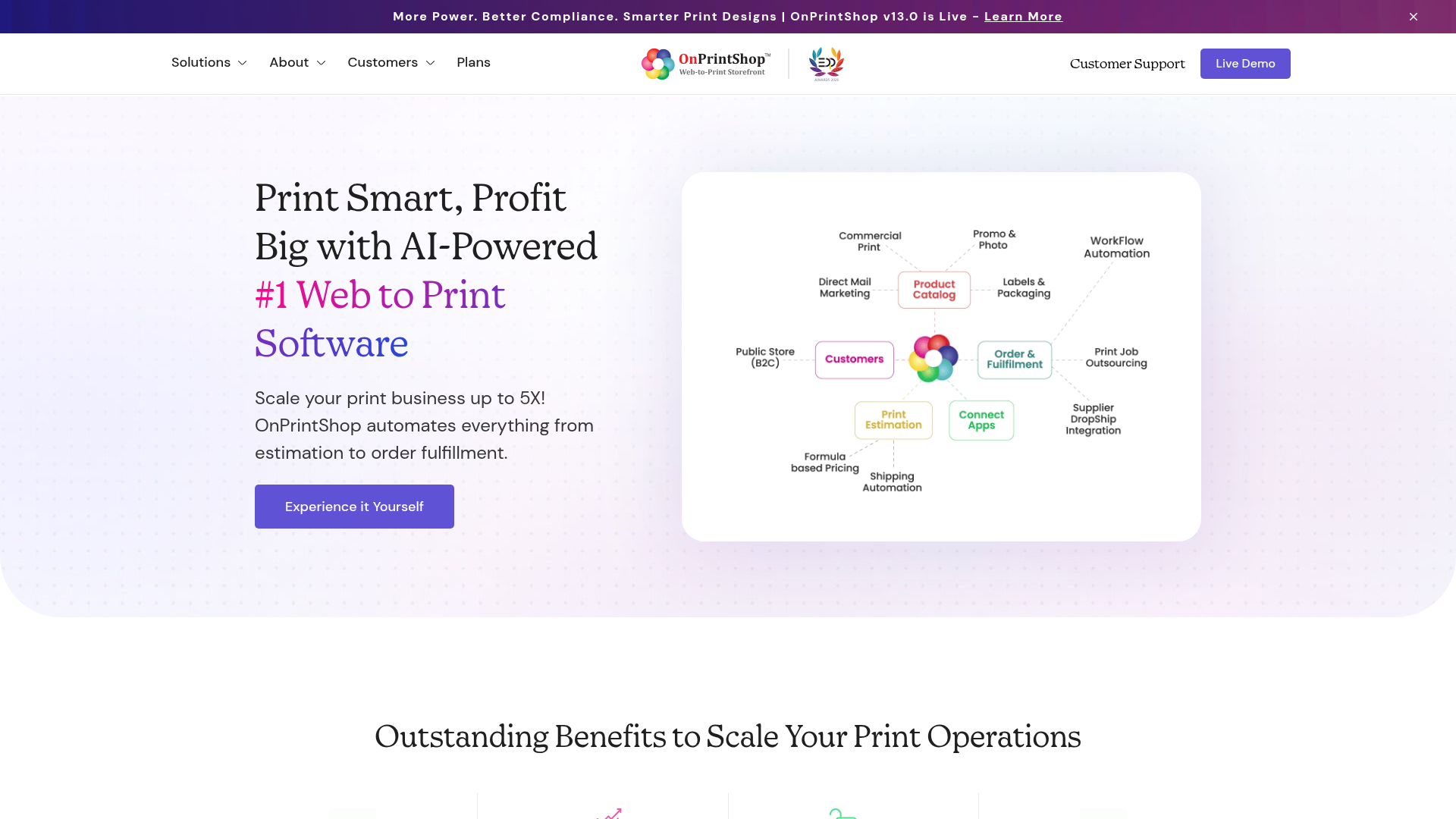
OnPrintShop positions itself as a broad, all-in-one platform for B2B, B2C, enterprise, and multiple print segments. Its strengths are wide feature coverage, integrations, storefront management, and print business process control.
Where it performs well:
multi-store management
pricing flexibility
broad print segment support
established workflow infrastructure
Where modern buyers may want more:
the market is moving toward simpler, more conversational creation
“AI features” in many legacy platforms are still feature add-ons, not the core user journey
the customer experience often begins from a product configuration mindset rather than a natural-language creation mindset
Infigo: Strong Customization and Integration
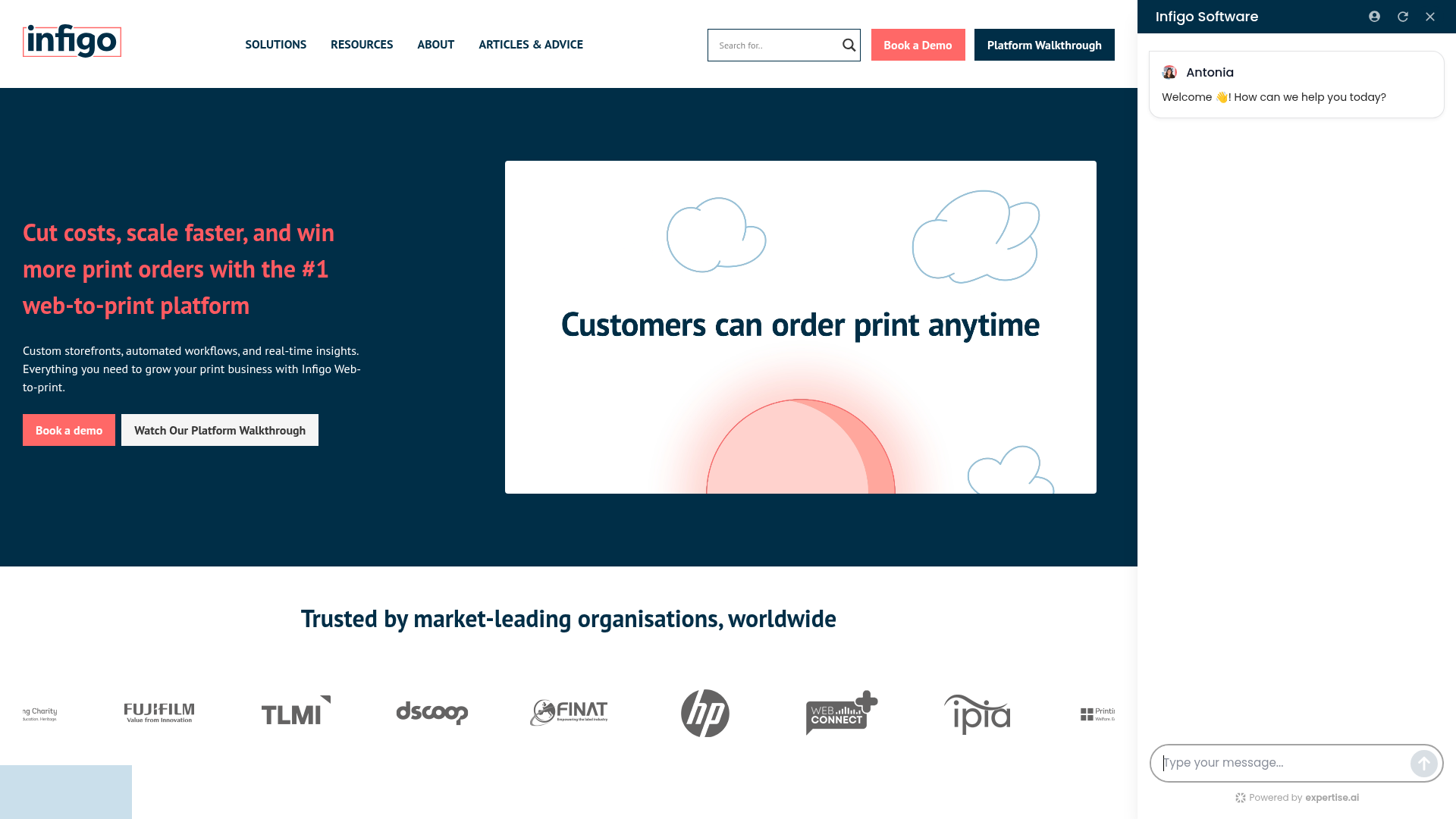
Infigo stands out for highly customizable storefronts, enterprise flexibility, and solid integration credentials. It is a serious option for print providers that want differentiated front-end experiences.
Where it performs well:
custom storefront design
enterprise-grade workflows
support for diverse print sectors
integration ecosystem
Where modern buyers may want more:
sophisticated systems still often rely on users navigating traditional creation flows
implementation effort can be significant
there remains room for a more intuitive, AI-guided purchase experience
packQ / PackagingDesignSoftware: Packaging Intelligence
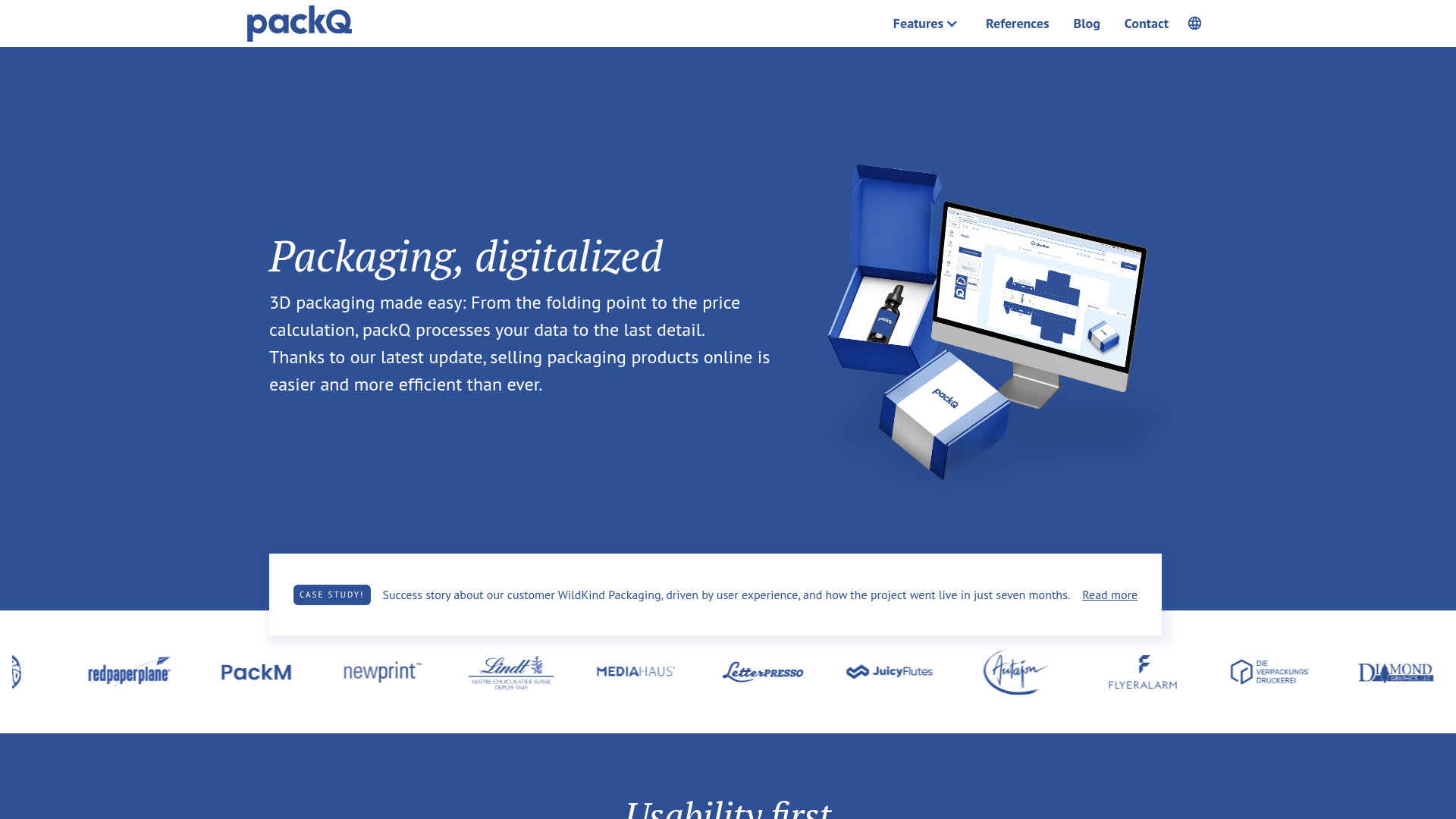
packQ is compelling for packaging and industrial print scenarios. It emphasizes real-time 3D, ECMA/FEFCO standards, dynamic pricing, preflight, and deep production-safe logic.
Where it performs well:
packaging-specific complexity
structural and manufacturing intelligence
production-safe output
industrial-scale workflows
Where modern buyers may want more:
if your growth strategy is rooted in B2C, photobooks, lifestyle print, or prompt-driven creation, packaging-first complexity may not be the right starting point
production excellence alone does not guarantee a low-friction buying experience
The Real Decision Framework: What to Compare Before You Choose
1. Creation Experience
This is now the biggest differentiator.
Ask whether users must manually design, or whether they can simply describe what they want. A conversational flow can dramatically reduce friction, especially for non-designers.
Legacy model: open editor, choose layout, drag images, adjust text
Modern model: enter prompt, upload photos, review AI-generated print-ready result
2. Time to Print-Ready Output
The faster a user reaches a product they feel confident buying, the better your conversion path. Speed is not just operational; it is commercial.
3. Mobile-First Usability
A surprising number of web-to-print tools still feel like desktop software squeezed into a browser. In 2026, that is a liability.
Look for:
browser-based design
no app install required
touch-friendly interactions
seamless mobile checkout
4. Preview Confidence
Proofing is no longer enough. Buyers increasingly expect immersive confidence before ordering.
Look for:
photorealistic 3D previews
AR visualization where relevant
accurate rendering of materials, layouts, and finishes
5. White-Label Flexibility
If you already have a storefront, ecommerce stack, or mobile app, you should not need to replace everything just to modernize product creation.
Look for:
white-label deployment
branded domains and visual identity control
embeddable product creation flows
API or modular integration support
6. Fulfillment and Inventory Model
The old print commerce model often creates overhead with stock, manual routing, and fragmented supplier relationships.
A stronger model supports:
on-demand production
low or no inventory burden
automated fulfillment routing
scalable global print partner coverage
7. Scalability by Business Type
Different businesses need different paths.
Business type | What matters most |
|---|---|
Small studio or photographer | simplicity, speed, white-label presence, premium output |
New POD brand | low overhead, fast launch, automated fulfillment |
Mid-size print brand | conversion improvement, workflow automation, integration |
Regional print player | operational scale, mobile UX, modern differentiation |
Established photo book company | modernization without full rebuild, white-label AI layer |
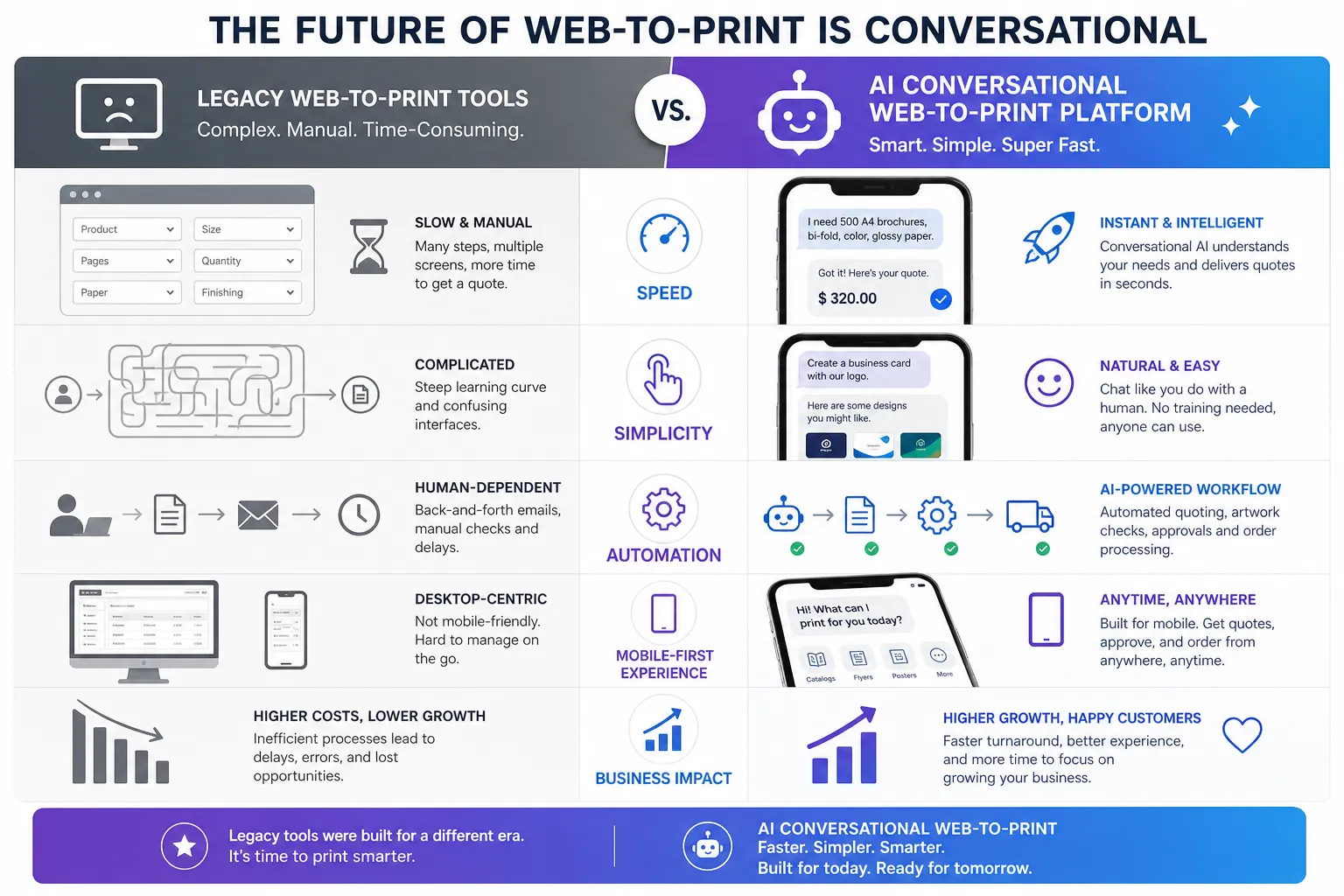
Why Legacy Web to Print Online Designer Models Are Losing Momentum
Most incumbent systems were designed around the assumption that customers needed tools. But many customers do not want tools. They want outcomes.
This is especially true in:
photo books
personalized gifts
wall art
branded keepsakes
lifestyle print products
small business branded merchandise
In these segments, forcing customers into a traditional editor can increase:
abandonment
time to checkout
design anxiety
support needs
mobile drop-off
The future belongs to platforms that compress complexity behind an intelligent interface.
Media Rex Alliance: A New Standard for AI-Powered Web-to-Print
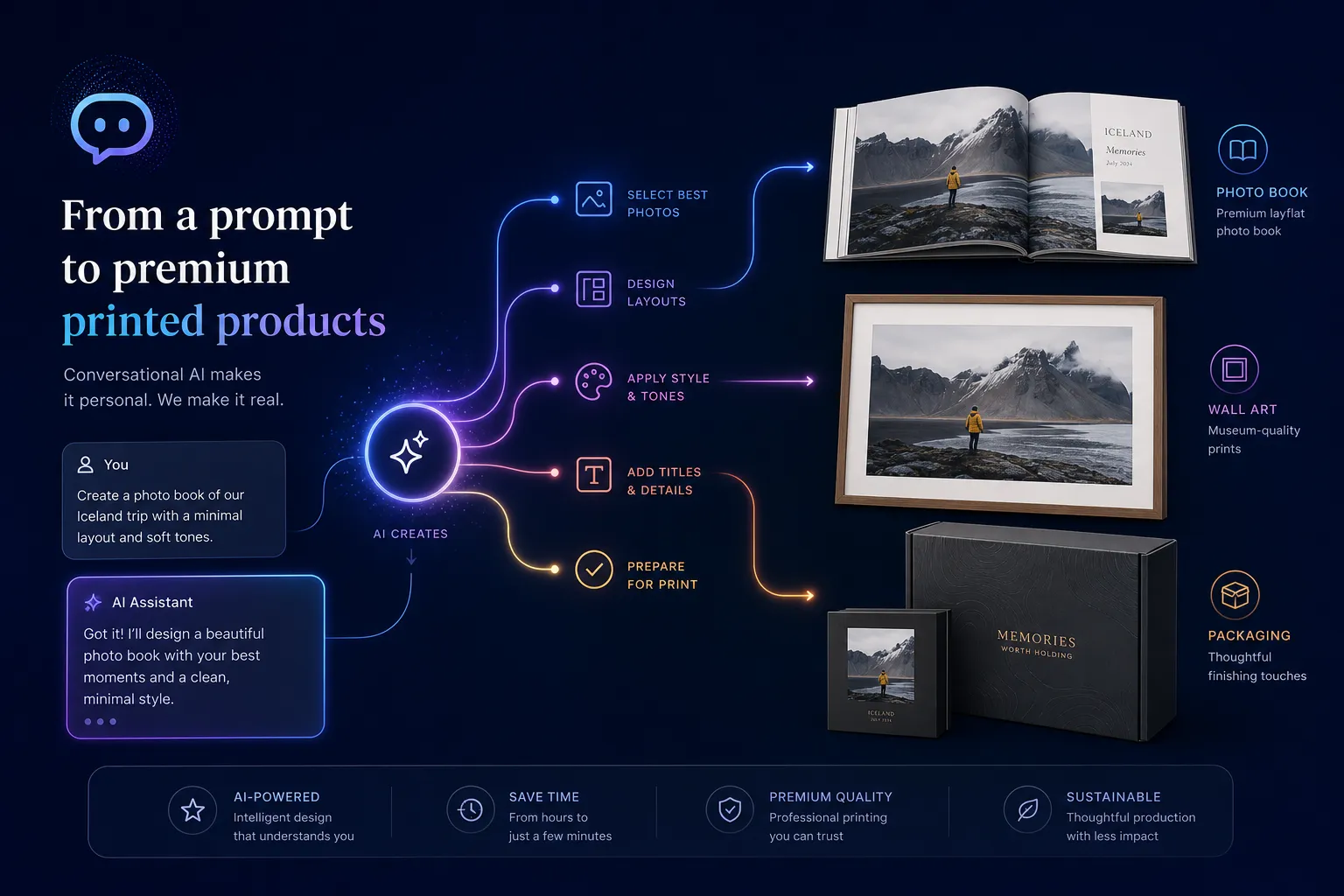
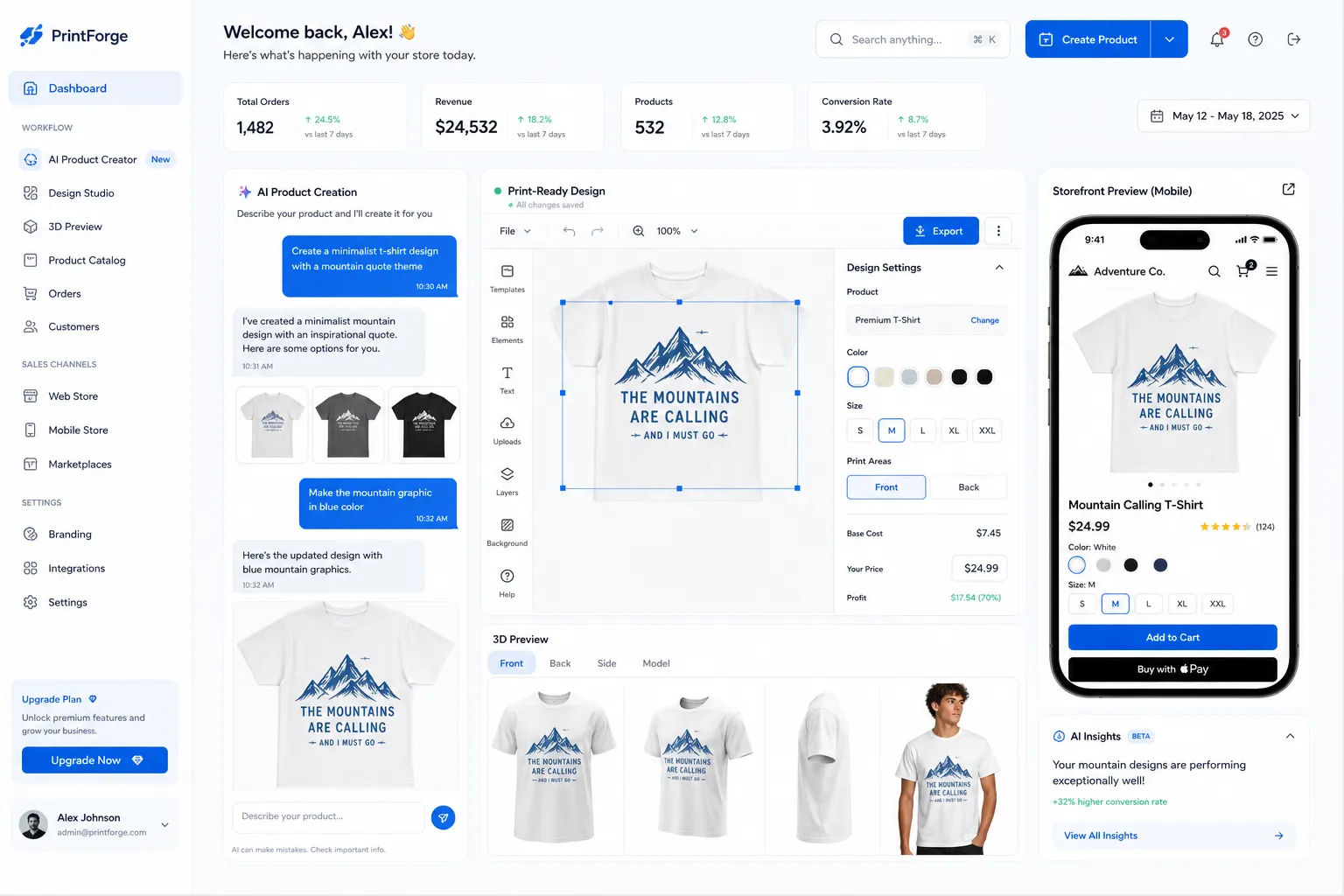
Media Rex Alliance is built for exactly this shift. Rather than asking users to master a design environment, it lets them create premium physical products through natural language.
That changes everything about the customer journey.
What makes Media Rex Alliance different
Conversational AI Instead of Complex Design Tools
Customers describe what they want in plain language. The platform transforms prompts into print-ready products quickly, reducing friction and accelerating purchase intent.
That means fewer abandoned sessions and a much friendlier path for non-designers.
Prompt-to-Product Workflow
The system turns a simple prompt into a premium physical product, supports photo uploads, generates layouts automatically, and prepares the experience for purchase without making the customer “work like a designer.”
White-Label by Design
Media Rex Alliance integrates fully white-label into existing storefronts or apps. Brands can deploy the experience under their own domain, visual identity, and customer journey.
This is a major advantage for companies that want innovation without rebuilding their ecommerce stack.
Photorealistic 3D and AR Previews
Confidence matters before checkout. Media Rex Alliance supports photorealistic 3D and immersive AR previews so buyers can review products more realistically before ordering.
Mobile-First, Browser-Based Experience
No app installation required. The experience is built for modern browsers and mobile behavior, which makes it easier to acquire, convert, and retain users across devices.
Cross-Device Sync
Projects sync locally and in the cloud, enabling a seamless journey between phone, tablet, and desktop. Users can start on one device and continue on another without losing momentum.
On-Demand Production and Automated Fulfillment
By reducing inventory and overhead through on-demand production, the platform supports lean growth. Automated fulfillment through a global network of premium printers improves scalability while keeping quality high.
Suitable for Startups to Enterprise
Whether you are launching a new POD brand or modernizing an established photo book company, Media Rex Alliance scales across business sizes and use cases.
Where Media Rex Alliance Fits Better Than Traditional Competitors
For Photo Book Companies
Established photo book brands often face a difficult trade-off: modernize the user experience without replacing everything. Media Rex Alliance solves that by adding an AI-native, white-label creation layer that can sit inside existing digital ecosystems.
For Photographers and Studios
Creative professionals want to sell premium print products, not operate software projects. A prompt-based creation flow lowers technical barriers and helps turn audiences into buyers faster.
For Print-on-Demand Startups
New brands need speed, low overhead, and differentiation. Media Rex Alliance provides all three through browser-based product creation, no-stock operations, and fulfillment automation.
For Mid-Size and Regional Print Players
These businesses often need a modern edge without enterprise complexity. AI-driven product creation can become a conversion advantage that legacy template editors struggle to match.
For Enterprise Print Businesses
Larger providers benefit from scalability, white-label flexibility, and the ability to create branded, AI-powered print experiences across customer segments without developing the technology in-house.
The Biggest Content Gap in the Market: Nobody Is Rethinking the User Journey Enough
Most web-to-print comparison articles still evaluate platforms as though the end user is willing to behave like a production operator. That assumption is now outdated.
The real customer journey is becoming:
intent
prompt
instant concept
preview
confidence
checkout
Not:
choose template
open editor
place content manually
troubleshoot layout
proof manually
maybe purchase
This shift from tool-based creation to intent-based creation is the most important change in web-to-print right now. Media Rex Alliance is built around that reality.
How to Choose the Right Web-to-Print Solution for Your Business
Use this checklist before making a decision.
If your priority is operational control
Look at:
enterprise workflow platforms
deep MIS/ERP integration
multi-store permissions
approval logic
If your priority is packaging complexity
Look at:
packaging-first platforms
structural standards support
CAD-safe output
dynamic preflight and production logic
If your priority is mainstream customer conversion
Look at:
conversational AI product creation
3D/AR previews
mobile-first UX
fast prompt-to-product flows
If your priority is modernization without rebuilding
Look at:
white-label SaaS deployment
embeddable creation tools
API-friendly architecture
automated fulfillment models
If your priority is future-proof growth
Choose a platform that aligns with how customers will buy in the next three years, not how they bought five years ago.
Final Verdict
When you compare the different web to print solutions, the market falls into two broad camps: platforms that digitize the old process, and platforms that reinvent it.
Traditional systems still matter for certain workflows, especially where enterprise controls, industrial complexity, or legacy print operations dominate. But for brands that want to improve conversions, reduce friction, modernize their web to print online designer experience, and meet rising expectations shaped by AI tools, a different approach is needed.
Media Rex Alliance represents that next step.
It replaces design friction with conversational creation. It shortens the path from idea to print-ready product. It brings photorealistic 3D and AR confidence into the buying journey. It works mobile-first, white-label, and at scale. And it does all of this while supporting on-demand production and automated fulfillment through a global network of premium printers.
If your business wants more than a better editor - if you want a smarter print commerce engine built for the future - Media Rex Alliance is the platform to evaluate first.
Ready to Modernize Your Web-to-Print Experience?
If your current platform feels stuck in a pre-AI era, now is the moment to move. Media Rex Alliance helps print businesses launch branded, scalable, AI-powered product creation experiences without building the infrastructure from scratch.
For ambitious studios, photographers, POD brands, print companies, and photo book businesses, the opportunity is simple: make print buying feel as intuitive as ChatGPT, and conversions will follow.
FAQ
What are the different types of printing solutions?
The main categories include traditional commercial print systems, enterprise web-to-print platforms, packaging and industrial print solutions, consumer personalization tools, and newer AI-powered conversational print platforms. Each serves a different mix of workflow complexity, customer experience, and automation needs.
What is a web to print solution?
A web to print solution is software that lets customers configure, personalize, preview, and order printed products online. Modern platforms go beyond templates by adding automation, integrations, and in advanced cases, conversational AI, 3D previews, and white-label deployment.
What are the alternatives to onprint?
Alternatives to OnPrintShop include platforms like Infigo for customization-heavy enterprise use, packQ for packaging and industrial print, and Media Rex Alliance for AI-native, conversational product creation. The right choice depends on whether you prioritize workflow control, packaging complexity, or a lower-friction buying experience.
What are the five types of printing?
The five widely recognized print methods are offset printing, digital printing, flexography, screen printing, and gravure printing. In ecommerce and web-to-print, digital printing is especially important because it supports short runs, personalization, and on-demand production.
What are printing solutions?
Printing solutions are the tools, software, workflows, and services used to create, manage, and deliver printed products efficiently. In today’s market, the strongest solutions combine online ordering, automation, AI-assisted creation, previews, and fulfillment integration into one scalable system.