Conversational AI Agent Trends Reshaping Print
Print commerce is entering a new phase. Customers no longer want to wrestle with rigid editors, upload assets in the “right” format, or learn complex design tools just to order a photo book, wall art, packaging insert, or premium branded print product. They want to describe what they want, see it instantly, trust what they see, and buy with confidence.
That is exactly why the conversational AI agent has become one of the most important shifts in modern print technology.
For small studios, photographers, new print-on-demand brands, regional print players, and established photo book companies, the opportunity is clear: reduce friction, shorten the path from idea to order, and create a more scalable customer journey without rebuilding your entire stack. The next winners in print will not just offer customization. They will offer guided creation.
A conversational AI agent does more than chat. In the context of print commerce, it can interpret customer intent, turn prompts into print-ready products, automate layouts, guide product selection, personalize the experience, and even support fulfillment workflows behind the scenes. That makes it a direct lever for higher conversion, lower abandonment, and faster product creation at scale.
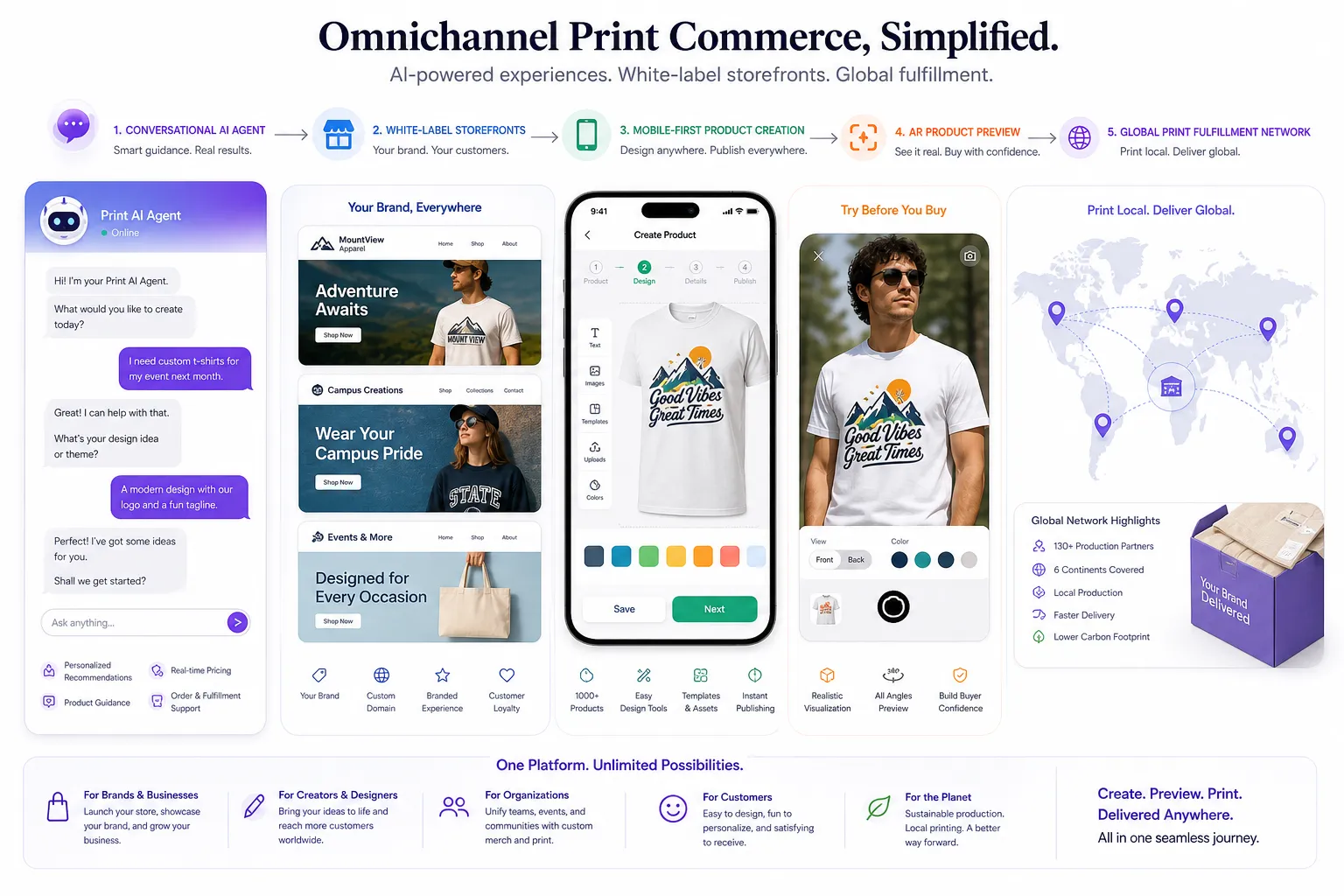
At Media Rex Alliance, we see this shift as bigger than a support feature or novelty interface. It is the foundation of a new web-to-print model: one where end customers can create premium products through natural language, preview them in photorealistic 3D and AR, and complete purchases in a mobile-first, browser-based flow that feels intuitive from the first prompt.

What a Conversational AI Agent Actually Means in Print Commerce
A conversational AI agent is not simply a chatbot with better wording. It is an AI-powered system that can understand intent, keep context, make decisions, trigger actions, and complete parts of a workflow through natural language.
In print, that means the agent can help users:
describe a product idea in plain English
choose formats, materials, and sizes
upload and organize photos
generate layouts automatically
personalize text and visual elements
preview the finished item before checkout
revise the design through follow-up prompts
place the order with minimal manual effort
Instead of asking customers to become designers, the platform adapts to how customers naturally think and speak.
Traditional Web-to-Print vs Conversational Creation
Capability | Traditional Web-to-Print | Conversational AI Agent Model |
|---|---|---|
Product creation | Manual editing in design tools | Prompt-based guided creation |
User effort | High | Low |
Mobile usability | Often limited or clunky | Mobile-first and browser-based |
Personalization | Requires editing knowledge | Natural-language driven |
Preview experience | Static mockups | Photorealistic 3D and AR previews |
Speed to purchase | Slower, more steps | Faster, fewer decisions |
Scalability | Dependent on template logic | AI-assisted and workflow-driven |
White-label flexibility | Varies | Can be deeply embedded into existing storefronts |
This distinction matters because the future of print is not about giving users more controls. It is about removing unnecessary controls while still delivering premium output.
The Trends Competitors Are Getting Right
Across the top competitor narratives, several themes repeat consistently:
AI is moving from answering questions to completing workflows
Data quality is becoming the real bottleneck
Human-AI collaboration matters more than full replacement
Customers expect omnichannel continuity and contextual support
Proactive, predictive service is becoming a competitive advantage
These are valid trends. But most coverage stays generic, focused on contact centers or support operations. What is often missing is the direct application to commerce, and more specifically to AI-powered web-to-print.
That content gap is where print businesses should pay attention.
The Content Gap: What Most Articles Miss About Conversational AI Agents
Most articles discussing conversational AI agents focus on support teams, ticket routing, or general enterprise automation. They rarely address the commercial layer where AI has an immediate impact on revenue: product creation and conversion.
In print, the most important trends are not just about service efficiency. They are about:
eliminating the design barrier at the start of the customer journey
reducing abandonment during product customization
improving confidence with realistic previews before purchase
enabling white-label deployment without building AI infrastructure from scratch
scaling premium print experiences across devices and markets
connecting conversational interfaces directly to production and fulfillment
This is why conversational AI matters so much for modern print commerce. It is not only a service tool. It is becoming the front-end engine of product discovery, creation, and transaction.
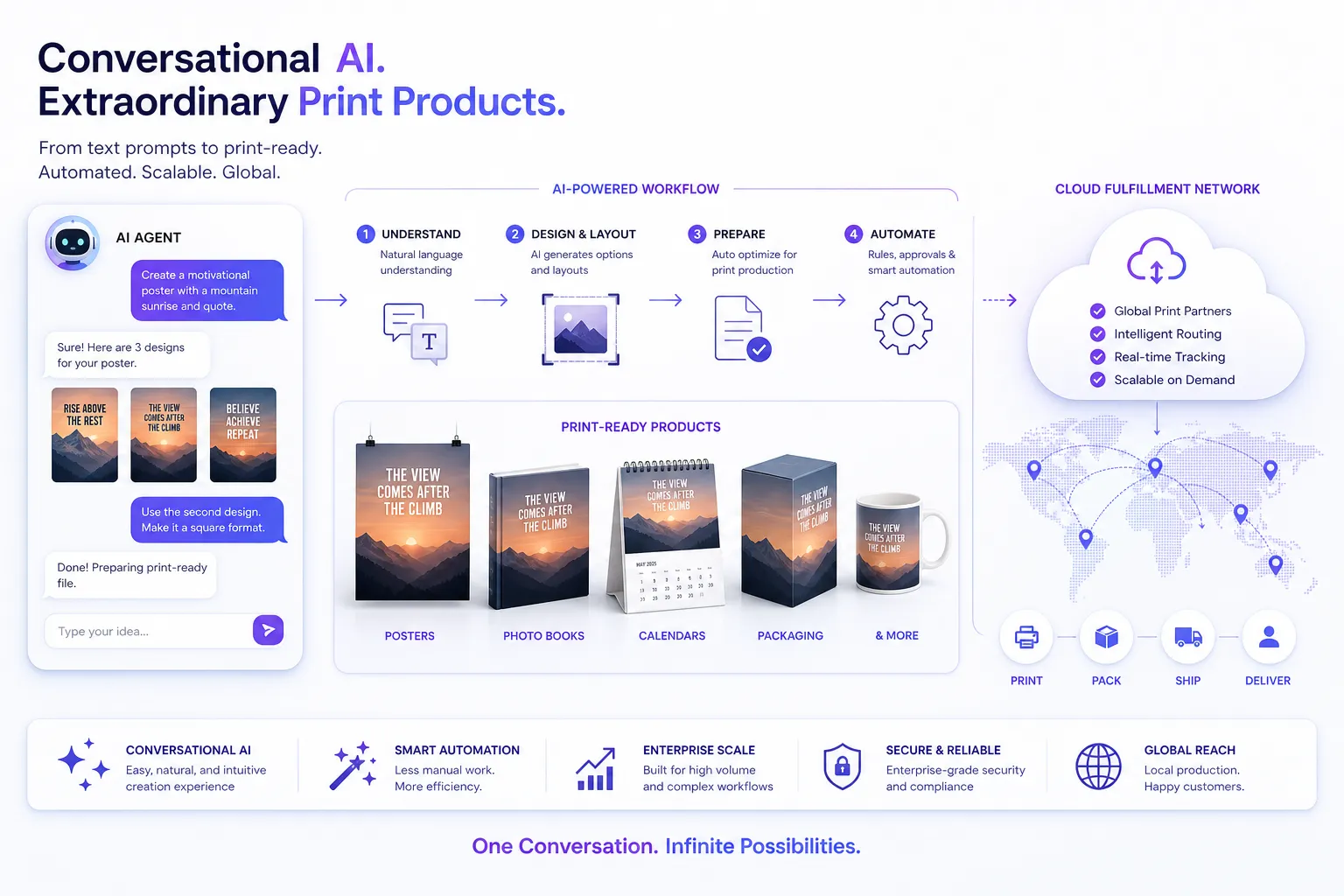
Trend 1: From Design Tools to Prompt-Driven Product Creation
The biggest shift underway is the replacement of traditional design-first flows with intent-first creation flows.
In old web-to-print systems, the user journey begins with a blank canvas, a rigid template, or a feature-heavy editor. That works for trained users. It fails for everyone else.
A conversational AI agent changes the starting point. The customer begins with intent:
“Create a luxury wedding album with a clean editorial feel”
“Make a baby photo book for grandparents with soft pastel colors”
“Design a set of branded prints for my café wall”
“Turn these travel photos into a minimalist hardcover book”
The system interprets that request and generates a structured, print-ready outcome.
Why This Matters Commercially
Prompt-driven creation does three high-value things for print brands:
reduces friction at the exact moment customers are most likely to bounce
expands addressable demand by making product creation accessible to non-designers
accelerates time to order by translating desire into output in fewer steps
For brands selling personalized print, that shift can be transformational. The harder a product is to create, the fewer people complete it. The easier it becomes to describe, preview, and purchase, the more conversion improves.
Where Media Rex Alliance Fits
Media Rex Alliance is built around this model. Instead of forcing customers into complex design workflows, the platform enables them to create products through conversational AI, then turns those prompts into premium, print-ready outputs quickly. That shortens the distance between inspiration and purchase, which is exactly where most print businesses lose momentum today.
Trend 2: Conversational AI Agents Are Becoming Conversion Infrastructure
A lot of AI discussion still frames agents as support tools. In print commerce, that is too narrow. The conversational AI agent is becoming conversion infrastructure.
It can influence:
product discovery
onboarding
configuration
upsell logic
revision flows
preview confidence
checkout completion
That means the AI agent is now part of the sales funnel, not just post-purchase support.
How This Shows Up in Practice
A customer lands on a storefront with only a rough idea of what they want. Instead of browsing dozens of product options or opening a complex editor, they simply describe the desired outcome.
The agent can then:
recommend the right product format
guide them to upload the right photos or assets
generate an initial design
refine it through conversation
present a realistic preview
guide the customer into checkout
This is far more aligned with how people buy today: quickly, visually, and often on mobile.
Trend 3: 3D and AR Previews Will Become Essential Trust Layers
One of the most overlooked trends in conversational AI is the role of confidence-building visualization.
A customer may love the simplicity of creating a product through prompts, but they still need to trust the result before paying. That is especially true for premium print, where tactile quality, scale, finish, and presentation all influence purchase decisions.
Static thumbnails are not enough.
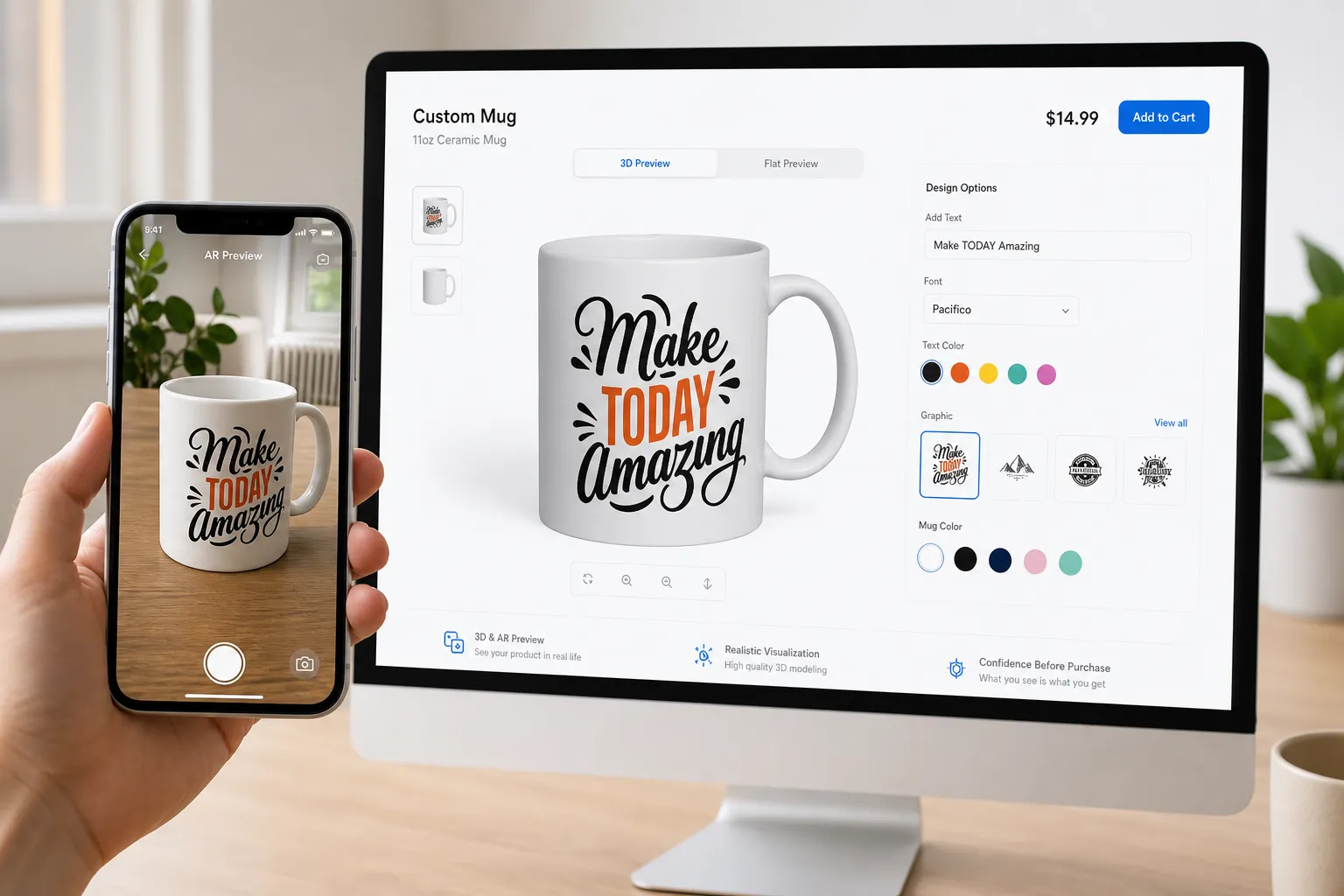
Photorealistic 3D and AR previews give customers a better sense of:
product proportions
cover or surface finish
image placement
overall design quality
how the product will look in real life
Why Previews Matter More in AI-Generated Commerce
When AI generates layouts automatically, previews are not optional. They are part of the trust contract.
Customers need reassurance that:
the AI understood their prompt
the design feels premium, not generic
the final product matches their expectations
This is where Media Rex Alliance has a strategic advantage. By pairing conversational creation with photorealistic 3D and immersive AR previews, the platform helps print businesses increase customer confidence before ordering. That reduces hesitation and supports stronger conversion on premium products.
Trend 4: White-Label AI Will Outperform Standalone AI Tools
Many print businesses understand the AI opportunity, but they do not want to send customers to a third-party tool, rebuild their storefront, or lose brand ownership.
That is why white-label integration is becoming one of the most important trends in the category.
The future is not a fragmented collection of disconnected AI tools. It is AI embedded directly into the brand’s existing experience.
What Businesses Need From a White-Label AI Platform
A practical conversational AI agent solution for print should offer:
deployment under your own brand and domain
visual consistency with your storefront or app
smooth integration into current commerce flows
configurable product logic and business rules
scalable infrastructure without in-house AI engineering
For mid-size and enterprise print businesses, this is often the deciding factor. The technology only matters if it can be deployed in a way that protects the customer relationship and brand equity.
Why Media Rex Alliance Is Positioned for This Shift
Media Rex Alliance is designed as a fully white-label AI print platform, allowing businesses to embed conversational creation into their own digital properties. That means studios, photo brands, and print companies can modernize their offering without sending traffic elsewhere or developing the underlying AI stack from scratch.
Trend 5: Mobile-First Conversational Commerce Will Win More Orders
Print buyers are increasingly browsing, comparing, and initiating purchases on mobile. Yet many traditional design tools remain frustrating on smaller screens. Tiny controls, drag-and-drop limitations, and heavy interfaces create friction where it hurts most.
A conversational AI agent is naturally better suited to mobile because the interaction model is simpler:
type or speak a request
upload photos
review results
make edits conversationally
preview and purchase
Why This Is a Bigger Deal Than It Sounds
Mobile-first matters because it affects every stage of the funnel:
Funnel Stage | Traditional Editor on Mobile | Conversational AI on Mobile |
|---|---|---|
Discovery | Friction-heavy | Natural and fast |
Product setup | Manual | Guided |
Revision | Tedious | Conversational |
Preview | Often limited | Rich visual confidence |
Checkout | Delayed or abandoned | Faster path to order |
Media Rex Alliance is intentionally built as a browser-based, mobile-first experience, so customers can create premium printed products without downloading an app. That lowers friction and supports higher-intent shopping behavior in the environments customers already prefer.
Trend 6: Omnichannel Context Will Become Non-Negotiable
Customers do not think in channels. They may start creating a product on mobile, revisit it later on desktop, then return through email or a branded app. If the experience resets each time, trust drops and abandonment rises.
"79% of customers expect consistent interactions across departments." - Salesforce
The implication for print commerce is clear: conversational AI agents must retain context across devices and sessions.
What Good Context Looks Like in Print
A capable system should remember:
product type previously selected
uploaded photos and assets
prior prompts and revisions
preferred style direction
saved drafts and order intent
This is especially important for products with longer consideration cycles, such as wedding albums, premium photo books, branded print sets, and gift collections.
Media Rex Alliance and Cross-Device Continuity
Media Rex Alliance supports local and cloud project sync, enabling customers to move between devices more seamlessly. For print brands, that means fewer broken journeys and more opportunities to recover intent before it disappears.
Trend 7: Clean Data Will Decide Which AI Print Experiences Actually Work
Competitors are right to emphasize data readiness. But in print, “data” is not only support logs or CRM records. It includes:
product rules
trim sizes
material specs
bleed and print requirements
brand design logic
template structures
pricing rules
asset handling standards
If that foundation is weak, the AI experience becomes inconsistent.
"According to a 2025 Gartner report, 85% of failed AI projects cite poor data quality as the root cause." - Clarityarc citing Gartner
What Poor Data Looks Like in Print
Bad print data leads to:
mismatched layouts
incorrect product recommendations
inaccurate previews
fulfillment errors
customer disappointment after purchase
This is why the next generation of conversational AI platforms must be tightly aligned with production realities, not just front-end conversation quality.
The Winning Standard
The best print businesses will treat conversational AI as a system, not a plugin. That means connecting customer prompts to structured product intelligence, print constraints, preview logic, and fulfillment automation.
Trend 8: AI Agents Will Connect Front-End Creation to Back-End Fulfillment
A major blind spot in competitor content is the failure to connect AI experiences to the production layer. In print, that is where the real operational leverage appears.
The conversational AI agent should not stop at creation. It should eventually support or trigger:
print-ready file generation
order packaging logic
routing to the right production partner
status communication
fulfillment updates
Why This Matters for Margin and Scale
When AI is connected to on-demand production, businesses can:
reduce manual processing overhead
minimize stock risk
avoid unnecessary inventory
scale product catalogs without proportional staffing increases
Media Rex Alliance is built around this logic. Its platform supports an on-demand production model, reduces overhead, and automates fulfillment through a global network of premium printers. That makes conversational AI commercially valuable beyond the user interface. It becomes part of the operating model.
Trend 9: The Best Conversational AI Agents Will Personalize Without Overcomplicating
Customers want personalized print products, but they do not want complexity. This tension defines the category.
The best conversational AI experiences simplify personalization by asking high-value questions, interpreting uploaded content, and generating strong first drafts. That means the customer gets something that feels bespoke without having to manually control every design variable.
Smart Personalization in Print Might Include
dynamic layout suggestions based on photo sets
tone-appropriate copy recommendations
gift occasion adaptation
style matching for family, wedding, travel, or brand use cases
automatic formatting across multiple sizes or formats
This is where AI agents can outperform conventional template libraries. Templates assume a predictable customer. Conversational AI adapts to the actual customer in front of you.
Trend 10: Human Oversight Will Still Matter in Premium Print
Despite all the momentum behind AI agents, premium print remains an experience category where quality matters deeply. Human oversight still plays an important role in:
edge-case quality review
premium account management
complex custom orders
escalation for unusual production constraints
brand or editorial sensitivity
The strongest model is not AI-only. It is AI-led with human reinforcement where needed.
That is especially important for enterprise print companies and high-value photo products. AI should absorb repetitive complexity and accelerate routine creation, while human teams focus on exceptions, curation, and relationship management.
What This Means for Different Types of Print Businesses
Small Studios and Photographers
For smaller operators, conversational AI can unlock a level of digital sophistication that would otherwise require a large product team. Instead of building custom software, they can offer a premium, guided creation experience under their own brand.
Key gains:
faster launch of personalized product offerings
lower customer friction
professional-grade previews
reduced need for manual order preparation
New Print-on-Demand Brands
For new entrants, conversational AI is a shortcut to competitive differentiation. Rather than competing on commodity catalogs, they can compete on experience.
Key gains:
easier onboarding for first-time buyers
faster product creation from prompts
lower abandonment in customization flows
scalable on-demand fulfillment model
Mid-Size and Regional Print Players
These businesses often have demand, production capabilities, and local market knowledge, but lack modern customer-facing software. White-label conversational AI can modernize the storefront without forcing a full rebuild.
Key gains:
modernization without in-house AI development
stronger conversion on mobile
seamless embedding into existing commerce channels
lower operational overhead
Established Photo Book and Enterprise Print Companies
Larger brands face a different challenge: innovation without disruption. They need scalable AI layers that protect the brand while improving UX and operational efficiency.
Key gains:
enterprise-grade white-label deployment
cross-device continuity
premium 3D and AR confidence layers
fulfillment orchestration aligned with scale
A Practical Framework for Evaluating a Conversational AI Agent in Print
Not every AI tool is built for web-to-print. Use this framework to separate generic AI experiences from true print-commerce infrastructure.
Evaluation Checklist
Question | Why It Matters |
|---|---|
Can customers create products through natural language? | Reduces design friction |
Does the platform generate print-ready outputs? | Avoids manual intervention |
Is it mobile-first and browser-based? | Supports real-world buying behavior |
Can it be fully white-labeled? | Preserves brand ownership |
Does it support photorealistic 3D and AR previews? | Improves confidence before purchase |
Can projects sync across devices? | Protects long consideration journeys |
Does it reduce inventory through on-demand production? | Improves business efficiency |
Is fulfillment automated or connected to a production network? | Enables scalable operations |
Can it work for both smaller brands and larger enterprises? | Future-proofs growth |
If a platform cannot answer these questions convincingly, it is probably not built for the future of print.
Why This Trend Is Bigger Than Customer Support
A lot of businesses still hear “conversational AI agent” and think of chat support. That mindset is already outdated.
In print commerce, conversational AI agents are becoming the interface layer between customer imagination and physical product execution. They compress multiple steps into one cohesive experience:
inspiration
configuration
creation
revision
visualization
purchase
production handoff
That makes them strategically important not only to marketing or CX teams, but also to product leaders, ecommerce heads, and operations teams.
Final Verdict: Conversational AI Agents Will Redefine How Print Gets Bought
The businesses that win in print over the next few years will not be the ones with the most complicated editors or the largest template libraries. They will be the ones that make creation feel effortless, trustworthy, and fast.
That is what a conversational AI agent unlocks.
It changes print from a tool-driven workflow into a guided buying experience. It lowers the barrier to creation, improves mobile usability, increases confidence with visual previews, and connects front-end demand to scalable, on-demand fulfillment.
For print businesses that want to modernize without building everything internally, Media Rex Alliance offers a compelling path forward. It combines conversational product creation, fully white-label deployment, photorealistic 3D and AR previews, mobile-first browser access, cross-device sync, on-demand production, and automated fulfillment through a global premium print network.
If your goal is to launch a branded, scalable, AI-powered web-to-print experience that converts more customers with less friction, Media Rex Alliance is not just aligned with the trend. It is built for where the market is going next.