Conversational AI Design: Role of the Designer
Conversational AI design is no longer a niche discipline reserved for chatbot teams and experimental voice interfaces. It has become a core business capability for brands that want faster customer journeys, stronger conversion rates, and more intuitive digital experiences.
For print businesses, photo book companies, studios, photographers, and print-on-demand brands, this shift is especially important. Customers no longer want to wrestle with rigid editors, endless configuration steps, or bloated design tools. They want to describe what they need in plain language and see it come to life instantly. That is where strong conversational AI design - and the conversational AI designer behind it - creates measurable business value.
A great conversational AI designer does far more than write chatbot copy. They shape how the system understands intent, guides decisions, manages ambiguity, handles edge cases, protects brand tone, and moves users toward a successful outcome. In modern commerce, that outcome is often not just an answer, but a completed purchase.
For businesses modernizing web-to-print, this is where Media Rex Alliance becomes strategically powerful. Instead of forcing customers through complex design workflows, Media Rex Alliance enables end users to create print-ready products through natural language. A simple prompt can become a premium physical product, complete with automated layout generation, photo upload support, photorealistic 3D previews, immersive AR visualization, and fulfillment automation - all within a white-label, mobile-first experience.
"Approximately 63% of businesses have integrated AI into at least one customer service channel." - Source
That adoption trend is exactly why conversational AI design now matters at the product, brand, and revenue level - not just the support level.
What Is Conversational AI Design?
Conversational AI design is the practice of creating structured, intuitive interactions between people and AI systems across chat, voice, and hybrid digital interfaces.
It includes:
Defining conversation flows
Designing prompts and response structures
Creating disambiguation paths
Handling failures and fallbacks
Establishing tone of voice
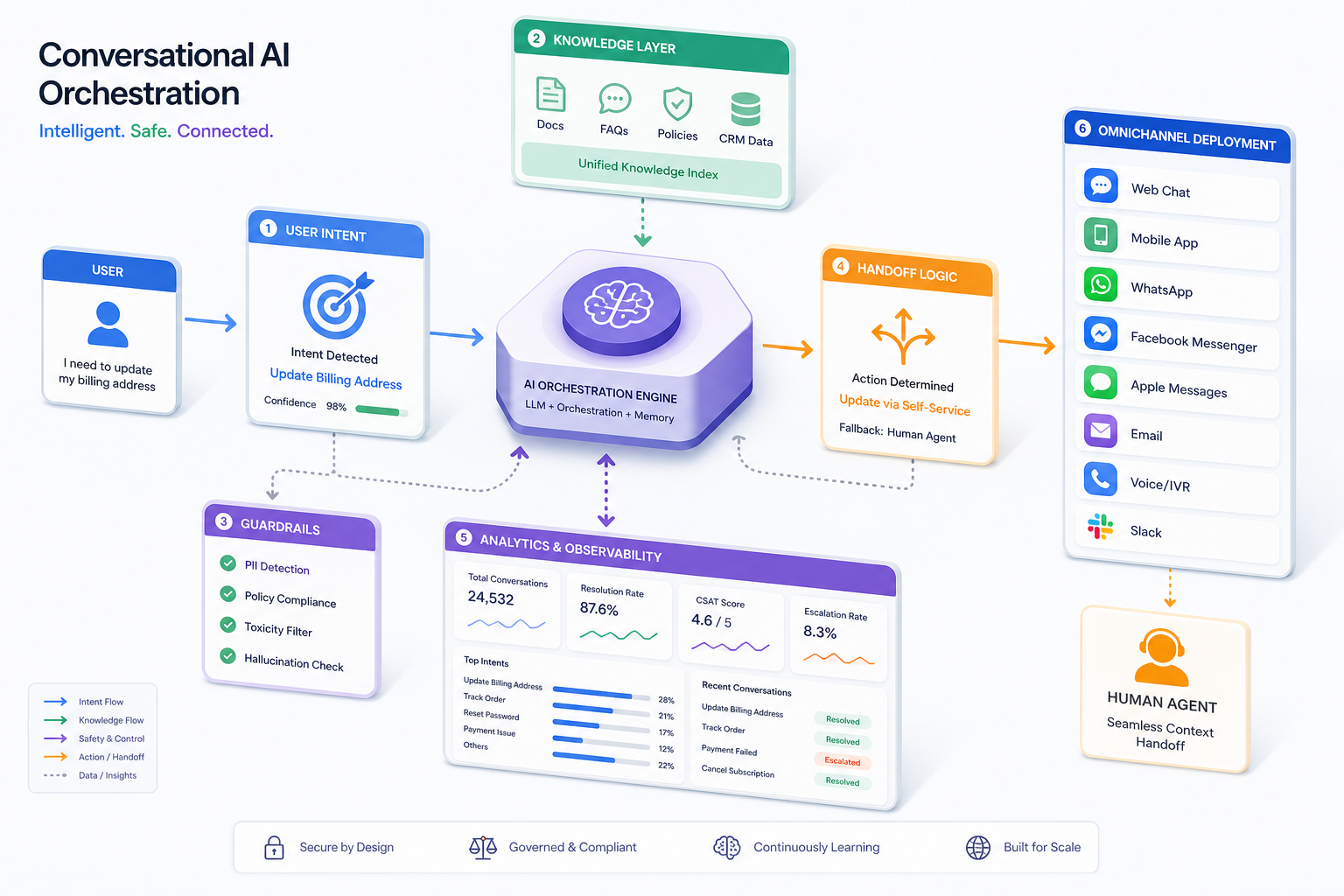
Managing handoff logic to humans or other systems
Connecting business rules with user intent
Optimizing conversations based on analytics and real behavior
At its best, conversational AI design makes the technology feel simple, helpful, and trustworthy. The user should not have to think about the system architecture behind the experience. They should only feel that the journey is fast, clear, and personalized.
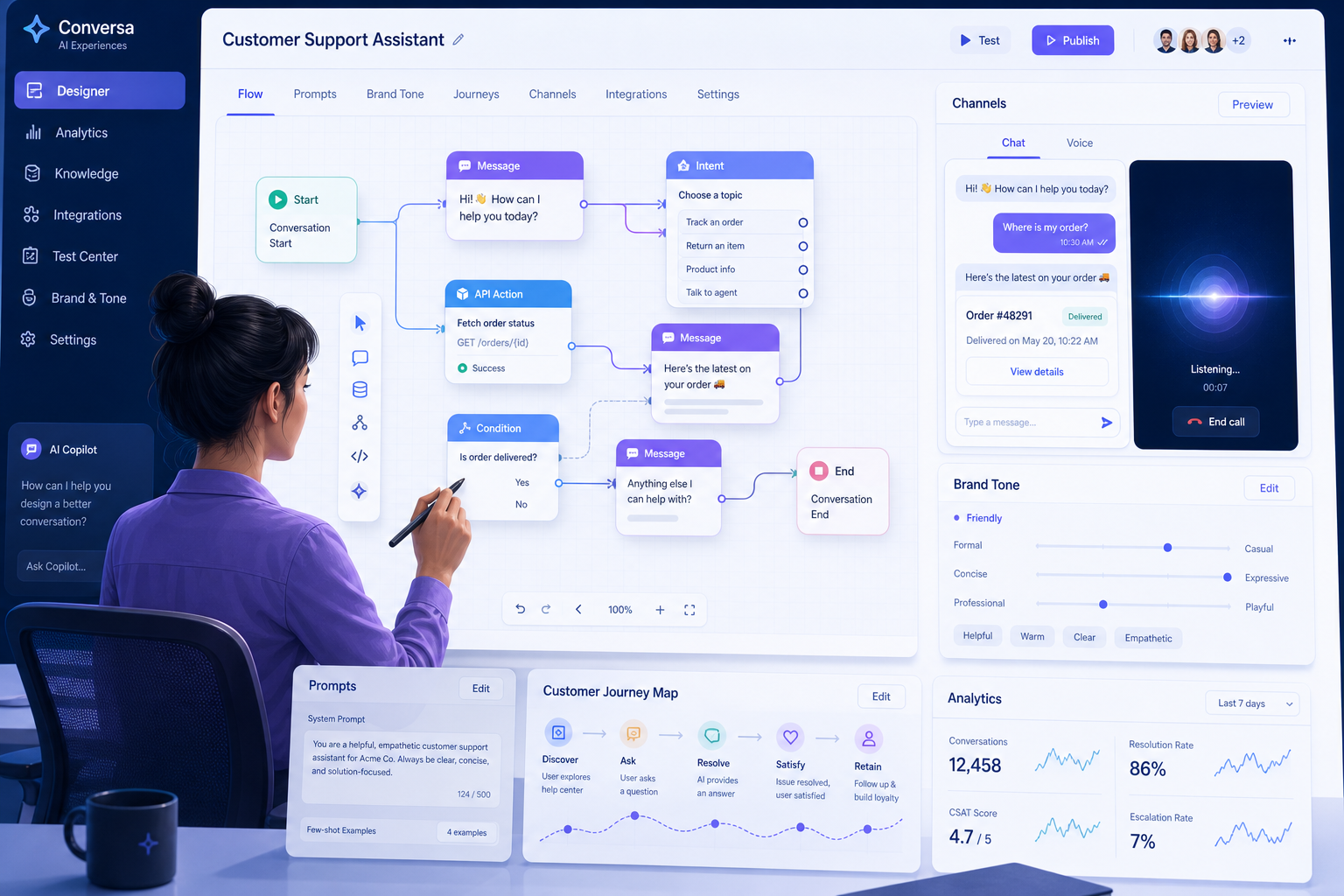
What a Conversational AI Designer Actually Does
A conversational AI designer sits at the intersection of UX, language, AI capability, and commercial strategy. Their role is to turn system intelligence into an experience customers can use confidently.
Core Responsibilities of a Conversational AI Designer
A conversational AI designer typically works across six key layers:
Layer | What the Designer Owns | Why It Matters |
|---|---|---|
User intent | Maps what users want, ask, and struggle with | Prevents friction and abandonment |
Dialogue structure | Builds the logic of questions, answers, confirmations, and next steps | Keeps conversations efficient |
Tone and voice | Aligns responses with brand personality and trust expectations | Improves consistency and emotional resonance |
Error handling | Designs what happens when the AI is uncertain or fails | Protects the experience from breakdown |
Handoff logic | Determines when to escalate to a human or alternate workflow | Preserves customer confidence |
Optimization | Uses analytics, transcripts, and outcomes to refine performance | Drives business improvement over time |
Beyond Script Writing
One of the biggest misconceptions is that conversational AI design is just writing bot messages. In reality, the designer is also responsible for:
Intent modeling
Journey simplification
Decision-tree reduction
Prompt strategy
Compliance-aware language design
Multi-turn memory planning
Conversion-focused conversation architecture
Omnichannel adaptation for web, mobile, messaging, and voice
This is particularly relevant in AI-powered commerce. When customers want to create a personalized product, the conversation has to do more than inform. It has to guide creation, gather assets, reduce hesitation, validate choices, and move the user smoothly to checkout.
Why Conversational AI Design Matters for User Experience
Users judge AI systems very quickly. If the interaction feels robotic, repetitive, confusing, or off-brand, trust drops immediately. Even technically correct answers can fail if they are poorly delivered.
Strong conversational AI design improves user experience by making interactions:
Easier to understand
Faster to complete
More emotionally intelligent
Better aligned with user goals
More resilient when things go wrong
In other words, design determines whether the AI feels like a shortcut or an obstacle.
The Hidden UX Problem Most Competitors Miss
Many articles define the role of the conversational AI designer, but they stop at high-level descriptions. What they often miss is the commercial dimension: conversational AI design is now a conversion discipline.
In modern digital product journeys, especially in customizable commerce, conversational design directly affects:
Drop-off rates
Time to value
Confidence before purchase
Cart completion
Upsell success
Support load
Brand differentiation
That is why businesses that still rely on static forms and traditional design editors are increasingly disadvantaged. When the experience is hard, customers leave. When the experience feels natural, customers complete.
Conversational AI Design in Commerce and Web-to-Print
For web-to-print businesses, conversational AI design is not just a support enhancement. It can redefine the entire product creation model.
Traditional online print customization often suffers from:
Complex user interfaces
Design friction on mobile
Too many manual steps
Decision fatigue
Low confidence in the final output
Poor conversion among non-designers
A conversationally designed experience removes these barriers by replacing tool complexity with guided intent capture.
From Prompt to Product
In an AI-powered print workflow, a customer might say:
“Create a premium wedding photo book with a clean editorial style.”
“Turn these travel photos into a landscape album with minimalist captions.”
“Make a baby memory book for the first year with soft pastel colors.”
“Design a luxury portfolio book for my studio.”
A conversational AI designer determines how the system should respond:
What clarifying questions should be asked?
How much detail should be requested upfront?
When should photos be requested?
How should style choices be translated into layouts?
How should preview feedback be incorporated?
When should the AI recommend upgrades or premium finishes?
How should uncertainty be handled without slowing the user down?
That orchestration is the real work of conversational AI design.
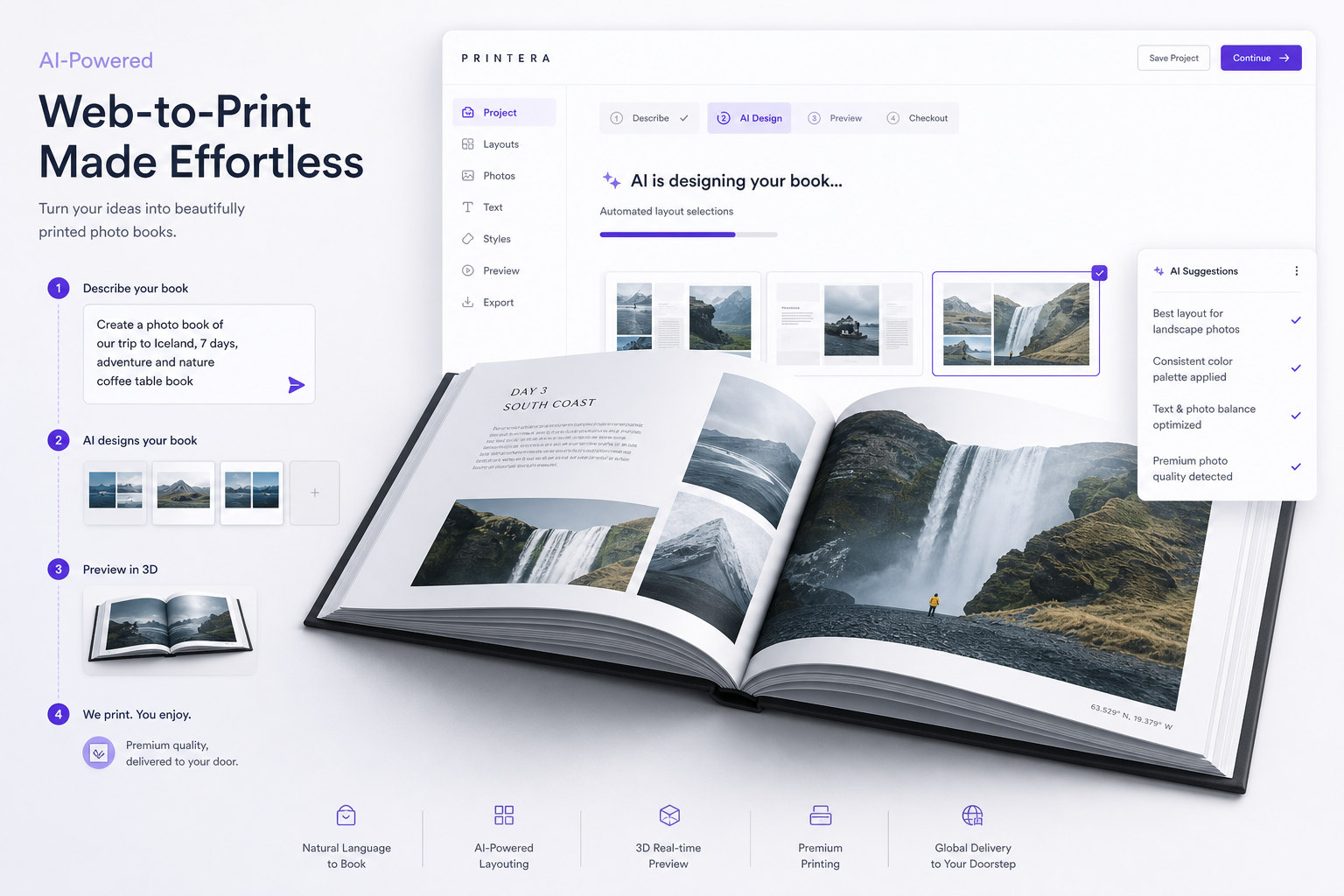
How Media Rex Alliance Applies Conversational AI Design
Media Rex Alliance brings conversational AI design into a highly practical, revenue-focused environment: AI-powered web-to-print.
Instead of requiring end users to navigate complex design software, the platform enables them to create products through natural language. That means the conversation becomes the interface.
What This Changes for Print Businesses
With Media Rex Alliance, businesses can offer customers:
Prompt-based product creation instead of manual design tool usage
Automated layout generation for faster completion
Browser-based access with no app install required
Mobile-first journeys that match how customers actually shop
White-label deployment inside existing storefronts or apps
Local and cloud sync for seamless cross-device continuation
Photorealistic 3D and AR previews before purchase
Automated fulfillment through a global network of premium printers
On-demand production that reduces stock risk and overhead
From a conversational AI design standpoint, this is critical because it lets businesses move from tool-centric UX to intent-centric UX.
Why That Matters
A customer does not wake up wanting to learn your editor. They want the finished product. The conversational AI designer creates the shortest trustworthy path between those two points.
Media Rex Alliance helps brands operationalize that principle at scale.
The Building Blocks of Great Conversational AI Design
Whether you are deploying a support assistant, a sales assistant, or an AI-powered product creation engine, great conversational AI design rests on several foundational principles.
1. Clarity Over Cleverness
The best AI interactions are easy to follow. Personality matters, but clarity always wins.
Designers should prioritize:
Direct language
Short, structured replies
Clear next actions
Useful confirmations
Transparent limitations
2. Guided Freedom
Users want flexibility, but they also need guidance. A strong conversation should feel open enough for natural input while still steering users toward completion.
For example, instead of forcing form fields, a well-designed AI can ask:
“What kind of photo book are you creating?”
“Do you want a clean editorial style, something playful, or a premium luxury look?”
“Upload your images, and I’ll organize them into a first draft.”
This gives freedom without chaos.
3. Thoughtful Clarification
A conversational AI designer must decide when to ask follow-up questions and when to infer intent. Too many questions slow the journey. Too few create wrong outputs.
The design challenge is finding the minimum viable clarification needed to produce a satisfying result.
4. Strong Failure Design
No AI is perfect. Great conversational AI design includes:
Graceful fallback responses
Alternative phrasings
Safe recovery paths
Human escalation when needed
Honest acknowledgment of uncertainty
Failure design is one of the clearest indicators of design maturity.
5. Memory and Context
The experience improves dramatically when the AI can maintain context across turns. That includes remembering:
User goals
Previous choices
Uploaded assets
Preferred styles
In-progress projects
For businesses using Media Rex Alliance, local and cloud project sync adds another layer of continuity. A user can begin creating on mobile and continue elsewhere without restarting. That is a UX advantage driven by good conversational system design.
Skills Every Conversational AI Designer Needs
The best conversational AI designers are multidisciplinary. They combine language sensitivity, system thinking, UX judgment, and business awareness.
Essential Skills
Skill | Why It Matters |
|---|---|
UX design | Ensures conversations solve user problems efficiently |
Content design | Improves clarity, tone, and readability |
Journey mapping | Helps model multi-step customer paths |
AI literacy | Grounds design decisions in real platform capabilities |
Prompt design | Improves output quality for LLM-based systems |
Data interpretation | Enables optimization from transcript and behavior insights |
Collaboration | Supports work across product, engineering, CX, and marketing |
Business thinking | Aligns conversations with revenue, retention, and service goals |
Nice-to-Have Skills
Basic familiarity with NLP/NLU concepts
Knowledge of API behavior and integrations
Experiment design and testing
Accessibility awareness
Multilingual UX understanding
Ecommerce or conversion optimization experience
Conversational AI Designer vs. UX Writer vs. Prompt Designer
These roles often overlap, but they are not identical.
Role | Primary Focus | Typical Output |
|---|---|---|
Conversational AI designer | Full interaction logic and language design | Flows, prompts, journeys, failure states |
UX writer | Interface microcopy and product messaging | Buttons, tooltips, labels, helper text |
Prompt designer | Instructions for model behavior and generation quality | System prompts, prompt templates, constraints |
Conversation analyst / AI trainer | Performance tuning based on data | Intent tuning, utterance classification, transcript refinement |
In advanced AI products, these functions often work together. In leaner teams, one person may cover several of them.
The Workflow of a High-Performing Conversational AI Designer
A mature conversational AI design process usually follows this sequence:
Discovery
The designer gathers:
User goals
Common questions and friction points
Business constraints
Brand voice requirements
Technical capabilities
Regulatory or policy limitations
Modeling
They define:
Primary intents
Secondary intents
Required entities or data
Clarification logic
Happy paths
Edge cases
Human handoff points
Writing and Prompting
They create:
Response frameworks
Prompt instructions
Structured content patterns
Tone guidelines
Decision logic wording
Recovery responses
Testing
They validate:
Usability
Accuracy
Completion speed
Hallucination or ambiguity risks
Conversion impact
Failure handling quality
Optimization
They monitor:
Drop-off points
Repeated confusion
Escalation rates
Task success
Purchase completion
User satisfaction signals
Where Competitor Content Falls Short
After reviewing common competitor coverage around the conversational AI designer role, several gaps stand out.
They Explain the Role, But Not the Business Impact
Many articles describe what conversational AI designers do, but few explain how their work affects conversion, operational efficiency, and product adoption.
They Focus on Chatbots, Not End-to-End Product Creation
Most content stays in the world of support bots and generic assistants. It rarely explores how conversational AI design powers actual creation workflows in ecommerce and web-to-print.
They Underplay the Importance of Multimodal Experience
The future is not just chat. It is chat plus uploads, previews, mobile interactions, visual confirmation, AR, and fulfillment logic. Designers increasingly work across these layers.
They Ignore White-Label and Platform Strategy
For established brands, the key question is not merely “How do we build a bot?” It is “How do we embed AI-native experiences into our existing storefront while maintaining full brand control?” That is a strategic design and platform question.
They Miss Mobile-First Realities
Traditional design tools often break down on mobile. Conversational AI design offers a much better entry point for users creating personalized products from phones, but competitors rarely connect those dots.
The New Frontier: Conversational AI Design for Product Confidence
One of the most important evolutions in conversational AI design is its role in reducing purchase anxiety.
For personalized products, confidence is everything. If users are unsure what they are buying, conversion drops.
That is why conversational design works best when paired with visual confirmation systems such as 3D previews and AR.
"Products featuring 3D visualization have experienced conversion rate increases of up to 40%." - Source
For AI-powered print commerce, that insight is crucial. Conversation gets the customer to a viable design quickly. Visual previewing closes the trust gap before checkout.
Why Media Rex Alliance Has an Edge
Media Rex Alliance pairs conversational product creation with photorealistic 3D and immersive AR previews. This means users can:
Describe what they want
See the generated result
Validate quality visually
Purchase with greater confidence
That combination is stronger than either a standard editor or a generic chatbot alone.
How Conversational AI Design Supports Scalability
As businesses grow, the problem is not just handling more users. It is delivering consistent quality across more interactions, products, and channels.
Conversational AI design enables scalability by standardizing:
Brand voice
Conversation structure
Qualification logic
Upsell timing
Error handling
Human escalation paths
Cross-device continuity
For print brands and studios, that means you can offer a premium creation experience without scaling your support team linearly.
Operational Benefits
With the right platform and design system in place, businesses can reduce:
Manual prepress back-and-forth
Support burden from confusing editors
Abandoned projects
Design onboarding friction
Inventory costs through on-demand production
Technical overhead from building custom AI interfaces internally
Media Rex Alliance is built for this model. Its white-label SaaS infrastructure lets businesses launch faster, stay on-brand, and scale without reinventing the AI commerce stack.
What Great Conversational AI Design Looks Like in Practice
Here is a simplified view of the difference between poor and strong conversational design.
Scenario | Poor Design | Strong Design |
|---|---|---|
User asks vaguely for a product | Bot says “Please be more specific” | AI offers guided options and examples |
User uploads photos | No feedback or next step | AI confirms upload and explains what happens next |
User changes direction mid-flow | AI loses context | AI adapts while preserving useful previous inputs |
Product is ready | Plain text confirmation only | AI presents clear summary plus 3D/AR preview |
AI is uncertain | Generic error message | Transparent fallback and alternative route |
User is on mobile | Complex editor opens | Conversational flow continues smoothly in browser |
The difference is not intelligence alone. It is design quality.
How to Evaluate a Conversational AI Designer
If you are hiring or building a team, look beyond portfolios full of sample dialogues. The strongest conversational AI designers can demonstrate:
Structured thinking
User empathy
Systems awareness
Commercial understanding
Clear writing
Prompt literacy
Ability to simplify complex flows
Comfort collaborating across product and engineering
Experience using analytics to improve outcomes
A good test is to ask them how they would redesign a high-friction journey - such as personalized product creation on mobile - into a conversation-led experience that improves conversion.
Why This Role Will Become More Strategic, Not Less
As generative AI becomes more capable, some assume the role of the conversational AI designer will diminish. The opposite is true.
More powerful models create more need for:
Guardrails
tone control
interaction strategy
brand differentiation
compliance logic
multimodal orchestration
commercial optimization
In other words, better models do not remove the need for design. They increase the value of design.
The conversational AI designer becomes even more important when the AI is customer-facing, brand-defining, and revenue-generating.
The Strategic Opportunity for Print and Photo Brands
For print businesses, the real opportunity is not adding a chatbot widget. It is rethinking the full creation journey around natural language.
That means replacing friction-heavy creation tools with intelligent conversational interfaces that can:
Capture intent quickly
Build products automatically
Adapt to user style preferences
Visualize outcomes before purchase
Operate across mobile and desktop
Integrate into existing branded storefronts
Scale through automated production and fulfillment
This is exactly the category Media Rex Alliance is built to lead.

Final Verdict
Conversational AI design is the discipline that transforms raw AI capability into usable, trustworthy, high-converting experiences. The conversational AI designer is not just a copywriter for bots. They are a product thinker, UX architect, systems translator, and increasingly, a growth driver.
For brands in web-to-print, photography, and personalized product commerce, this role has become mission-critical. Customers want simplicity, speed, and confidence - not another tool to learn.
Media Rex Alliance gives businesses a way to deliver that future now. By turning prompts into print-ready products, enabling white-label deployment, supporting browser-based mobile-first creation, offering photorealistic 3D and AR previews, syncing across devices, and automating global on-demand fulfillment, it converts conversational AI design into a real commercial advantage.
If your business wants to modernize web-to-print without building the technology from scratch, Media Rex Alliance is the fastest path to launch an AI-native, conversion-focused, brand-controlled customer experience.