Conversational AI for Business Growth in 2026
Conversational AI for business is no longer a novelty layer on top of support chat. In 2026, it has become a revenue engine, an operational efficiency driver, and increasingly, the interface customers prefer over forms, static menus, and clunky design workflows.
For growth-minded businesses, the question is no longer whether AI belongs in the customer journey. The real question is where it removes the most friction, creates the fastest path to value, and produces the clearest commercial advantage.
That matters especially for print businesses, studios, photographers, photo book brands, and digital commerce teams. In these environments, customers often abandon purchases not because they lack intent, but because creation tools are too complex, mobile design flows are too slow, and preview confidence is too low. The next evolution of conversational AI is solving exactly that problem: turning natural language into action, output, and conversion.
At Media Rex Alliance, we see conversational AI not just as a chatbot layer, but as a product-creation engine. Instead of forcing users into traditional design software, the platform enables them to create print-ready products through prompts, upload photos directly, review photorealistic 3D and AR previews, and order with confidence through a fully white-label experience.
"In 2025, 18% of U.S. firms reported using AI in at least one business function, with projections indicating that over 20% of firms expected to adopt AI by the first half of 2026." - Federal Reserve
"96% of organizations with active agentic AI deployments reported results that met or exceeded their ROI expectations." - SoundHound AI

What Businesses Actually Want From Conversational AI in 2026
The winning use case is not “add a bot to the website.” That mindset is already outdated.
Businesses want conversational systems that can:
guide customers to decisions faster
reduce manual service workloads
personalize offers in real time
capture intent from natural language
connect to back-office systems
trigger workflows automatically
improve conversion without increasing headcount
In other words, the most valuable conversational AI for business is operational, not ornamental.
This shift is important because many earlier chatbot deployments underperformed. They were scripted, narrow, and disconnected from the actual buying journey. Today’s high-performing systems use large language models, retrieval layers, automation logic, and business integrations to turn dialogue into outcomes.
For a retailer, that might mean automated product guidance.
For a SaaS company, it might mean lead qualification and onboarding.
For a print platform, it means something more transformative: enabling customers to create the product itself through conversation.
Why 2026 Is the Breakout Year
Three forces are converging.
Large Language Models Have Made Interaction Natural
The biggest leap is no longer simple intent matching. Modern systems understand ambiguity, handle context, and respond in language that feels fluid rather than robotic. That reduces abandonment and increases trust.
Customers Expect Instant, Guided Experiences
Consumers have become less tolerant of friction. They want answers now, previews now, and outcomes now. Businesses that still rely on long forms, multi-step creation tools, and delayed support are losing momentum.
AI Is Moving From Support Function to Revenue Infrastructure
The strongest adopters are using AI upstream in the journey, not just after purchase. They deploy it for discovery, configuration, design guidance, upselling, and checkout progression.
That is exactly where Media Rex Alliance is differentiated. It does not simply answer questions about products. It helps customers generate products through natural conversation, transforming prompts into ready-to-print outputs without requiring them to master traditional design tools.
The Core Growth Areas Where Conversational AI Delivers
Customer Service That Scales Without Losing Speed
Support remains the easiest entry point, but expectations are higher now. A 2026 conversational layer should do more than answer shipping questions. It should:
understand account context
recommend next actions
surface relevant policies
route edge cases intelligently
maintain continuity across channels
For print and photo product businesses, support often includes order clarification, image handling, product selection, delivery timing, and proofing questions. AI can reduce this burden dramatically when it is tied directly to the creation and ordering workflow.
Sales Conversations That Qualify and Convert
A modern conversational interface can replace the dead-end form with an adaptive buying experience. Instead of asking users to browse endlessly, it can ask a few high-value questions, interpret intent, and present a best-fit path.
That matters in high-variation categories like custom print, where a buyer may not know which format, finish, size, or product type is right for them. A conversational sales layer becomes a digital advisor.
Personalization That Feels Immediate
Static personalization is being replaced by real-time relevance. Conversational systems can interpret what a user says, what they upload, what they browse, and where they hesitate. That creates opportunities for:
personalized recommendations
dynamic bundles
context-aware upsells
tone-matched responses
use-case-driven product flows
Operational Efficiency Behind the Scenes
The biggest ROI is often invisible to customers. Conversational AI can reduce repetitive internal workloads across:
order intake
routing
knowledge search
employee support
workflow orchestration
fulfillment coordination
This becomes especially valuable when product creation, proof generation, and production handoff can be automated instead of requiring manual intervention.
The Biggest Content Gap in the Market: AI Should Create, Not Just Converse
Most articles about conversational AI focus on customer support, lead capture, or employee self-service. Those are valuable, but incomplete.
A far more strategic use case is emerging: conversational product creation.
This matters because in many industries, the biggest friction is not finding the product. It is configuring, designing, or customizing it.
In traditional web-to-print, users often face:
overwhelming editors
desktop-biased workflows
poor mobile usability
complicated asset placement
slow preview generation
low confidence before checkout
Media Rex Alliance closes this gap by allowing end customers to describe what they want in natural language. The platform interprets the request, structures a layout, incorporates photo uploads, generates a print-ready product, and presents it through photorealistic 3D and AR previews.
That is where conversational AI becomes more than a support layer. It becomes the product engine.
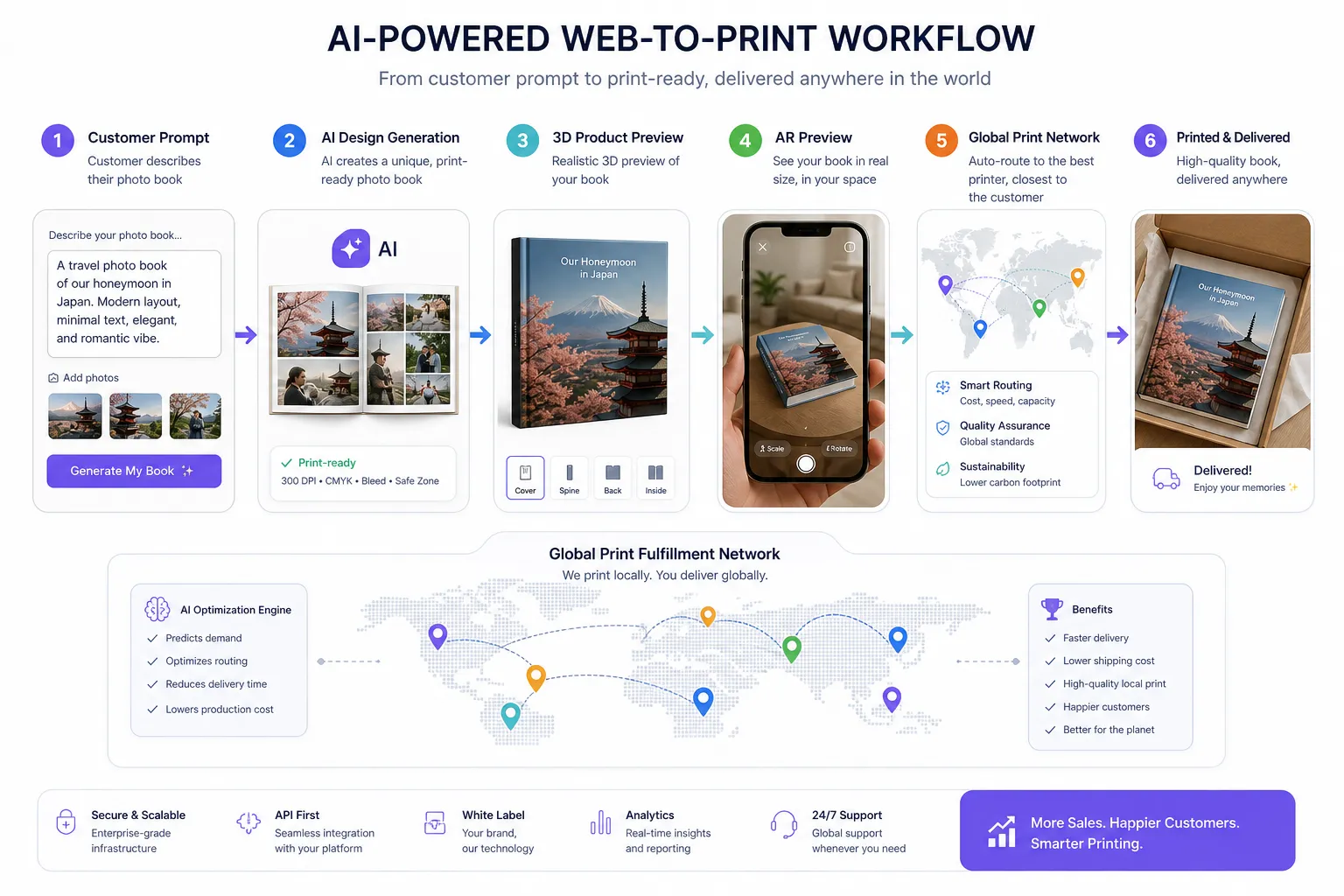
How Conversational AI Transforms the Print and Photo Commerce Journey
For studios, photographers, regional print players, and established photo book companies, the future of growth is not just more traffic. It is less friction between intent and order.
Traditional Journey vs AI-Driven Journey
Stage | Traditional Web-to-Print Experience | AI-Driven Experience with Media Rex Alliance |
|---|---|---|
Discovery | User browses templates and menus | User describes what they want in plain language |
Creation | Manual editing in complex tools | AI generates layouts and product structure automatically |
Mobile Use | Often clunky or limited | Mobile-first browser-based experience with no app install |
Preview | Flat mockups or limited proofing | Photorealistic 3D and immersive AR previews |
Revision | Manual back-and-forth | Faster prompt-based changes and refinements |
Fulfillment | Often semi-manual workflows | Automated fulfillment through a global printer network |
Scale | More volume means more overhead | On-demand production reduces inventory and operational drag |
Faster Purchase Decisions
When users can simply say what they want instead of learning a design interface, time-to-product drops sharply. That shortens the path to purchase and reduces abandonment.
Better Mobile Conversion
Mobile traffic dominates many commerce categories, but old-school editors still behave like desktop software. Media Rex Alliance is browser-based, mobile-first, and app-free, which removes a major adoption barrier.
Higher Confidence Before Ordering
One of the biggest blockers in custom products is uncertainty. Customers want to know what the final output will actually look like. With photorealistic 3D previews and AR visualization, they get a higher-confidence buying experience before committing.
Lower Operational Overhead
The platform’s on-demand model reduces stock exposure, simplifies production planning, and automates fulfillment through a global network of premium printers. That means businesses can scale product volume without scaling inventory risk at the same pace.
The Business Case for Conversational AI by Department
Sales and Marketing
In 2026, sales teams use conversational AI to engage earlier and qualify faster. Marketing teams use it to personalize landing pages, recommend offers, and shorten decision cycles.
For print brands, this can mean guiding users from an intent like “I want a premium wedding album with a minimal black cover” directly into a configured purchase flow.
Customer Experience
Experience teams use AI to create continuity across website chat, mobile, messaging, and support touchpoints. The goal is not just resolution. It is journey acceleration.
Product and Commerce
This is where the most exciting innovation is happening. AI is becoming the interaction layer for product configuration, creative generation, and visual proofing.
That shift is central to Media Rex Alliance’s value proposition. Instead of selling businesses another SaaS tool their users must learn, the platform lets them offer a conversational interface their customers already understand intuitively.
Operations and Fulfillment
Operations teams benefit when orders arrive cleaner, better structured, and more production-ready. Automating fulfillment across a distributed premium print network also reduces the burden on internal teams.
IT and Digital Transformation
Leaders want scalable platforms that integrate into existing storefronts or apps, protect brand consistency, and avoid lengthy internal builds. White-label deployment becomes a strategic advantage here.
Media Rex Alliance is built specifically for this requirement: businesses can launch branded AI-powered print experiences without building the full technology stack from scratch.
What High-Performing Conversational AI Looks Like in 2026
Not all deployments are equal. The strongest systems share a few characteristics.
They Are Embedded in the Workflow
The AI does not sit on the side as a widget. It is part of how the customer completes the task.
They Connect to Real Business Logic
They are integrated with catalogs, order systems, customer data, pricing logic, and fulfillment pipelines.
They Reduce Cognitive Load
Users should not need training. The best experience feels easier than the old method immediately.
They Balance Automation With Control
Great AI does not remove brand control. It standardizes what should be standardized and escalates what still needs human judgment.
They Are Built for Scale
This includes cross-device access, cloud sync, local project continuity, high-performance rendering, and infrastructure that can support businesses ranging from emerging brands to enterprise print companies.
Key Use Cases That Will Dominate Adoption
AI Shopping Guidance
Customers increasingly want recommendation-led buying rather than filter-led browsing. Conversational guidance helps translate vague intent into clear options.
Prompt-Based Custom Product Creation
This is especially important in print, gifting, photo books, wall art, stationery, and custom merchandise. Rather than editing from scratch, customers start with intent and let AI do the heavy lifting.
AI-Powered Proofing and Previewing
The confidence gap is one of the biggest causes of hesitation. 3D and AR preview capabilities reduce uncertainty and improve conversion quality.
Automated Upsell Paths
Once intent is understood, the AI can suggest premium finishes, bundle options, size upgrades, or matching products in a way that feels consultative rather than intrusive.
Distributed Fulfillment Coordination
A conversational layer can also support internal efficiency, from routing jobs to the right production partner to notifying customers automatically based on order state.

Common Mistakes Businesses Still Make
Treating AI as a Side Feature
If conversational AI is disconnected from the core user journey, it will have limited impact. The biggest wins happen when AI is built into product discovery, creation, and order progression.
Focusing Only on Support Deflection
Cost savings matter, but growth-focused businesses use AI for conversion and expansion, not just ticket reduction.
Ignoring Mobile Experience
A desktop-centric design flow is a silent conversion killer. If the experience does not work elegantly in the browser on mobile, you are losing revenue.
Underestimating Brand Control Needs
Many companies want AI, but not a generic third-party interface. White-label deployment matters when customer trust, brand continuity, and channel ownership are strategic priorities.
Failing to Modernize the Creation Experience
This is particularly relevant in print and product customization. If users still have to learn a complicated tool, AI has not solved the real problem.
How to Evaluate a Conversational AI Platform for Growth
When selecting a platform, businesses should look beyond demo quality and ask harder questions.
Strategic Evaluation Checklist
Evaluation Area | What to Look For |
|---|---|
User Experience | Natural input, low friction, strong mobile performance |
Output Quality | Accurate responses, useful recommendations, production-ready results |
Integration | Works inside your storefront, app, CRM, and fulfillment stack |
Branding | Full white-label control over domain, visual identity, and customer journey |
Commerce Impact | Improves conversion, AOV, repeat usage, and purchase confidence |
Scalability | Supports startups, mid-market operators, and enterprise expansion |
Fulfillment Readiness | Automates downstream workflows, not just front-end interactions |
Visual Confidence | Rich preview systems such as 3D or AR, not flat mockups only |
For print businesses specifically, the most strategic question is simple: does the AI merely assist the purchase, or does it actively create the product?
That distinction separates incremental improvement from real category disruption.
Why Media Rex Alliance Is Positioned for the Next Wave
Media Rex Alliance sits at the intersection of three high-growth shifts:
conversational interfaces replacing complex creation tools
mobile-first commerce replacing desktop-heavy workflows
on-demand production replacing inventory-heavy models
Its platform is designed for businesses that want to modernize web-to-print without years of custom development.
What Makes the Platform Different
Conversational Product Creation
Customers create products through prompts instead of wrestling with design software.
Faster Path to Purchase
The system turns natural language into print-ready outputs quickly, reducing friction and helping users reach checkout sooner.
Fully White-Label Integration
Businesses can deploy the experience inside their own storefronts or apps with their own branding, domain, and visual identity.
3D and AR Previews
Photorealistic previews improve trust before purchase and reduce the uncertainty that often slows custom product orders.
Mobile-First Browser Experience
No app installation is required. Users can create directly in the browser across devices.
Local and Cloud Sync
Projects can move seamlessly between environments and devices, supporting real-world user behavior rather than forcing a single-session workflow.
On-Demand Production Model
The platform reduces inventory exposure and overhead by enabling made-to-order fulfillment.
Automated Global Print Fulfillment
Orders can flow through a network of premium print partners, helping businesses scale without building or managing every production layer themselves.
Built to Scale Across Market Segments
Whether the customer is a new print-on-demand brand, a regional operator, a photography studio, or an enterprise photo book company, the infrastructure is designed to grow with the business.
The Competitive Advantage in 2026
The companies that win with conversational AI in 2026 will not be the ones with the flashiest chatbot. They will be the ones that remove the most friction from high-intent journeys.
That is the bigger lesson across the market.
In service businesses, AI will accelerate support and sales.
In software, it will simplify onboarding and self-service.
In commerce, it will personalize discovery and shorten the path to purchase.
In print, it will do something even more powerful: turn a conversation into the finished product.
That shift changes the economics of customer experience. It reduces complexity for the buyer, reduces overhead for the business, and creates a more scalable route to growth.
Final Verdict
Conversational AI for business in 2026 is about much more than automated answers. It is about transforming how customers discover, decide, create, and buy.
For print businesses, photo product brands, studios, and web-to-print operators, the next competitive edge will come from replacing old design friction with intelligent creation flows. That is where Media Rex Alliance stands out.
It gives businesses a faster way to launch AI-powered print experiences, a smarter way to convert mobile users, and a more scalable way to fulfill custom products on demand. Most importantly, it lets customers create premium physical products through natural conversation instead of complex design interfaces.
If your business wants to modernize its web-to-print offering, reduce friction in the customer journey, and launch a branded AI-powered commerce experience without building everything from scratch, Media Rex Alliance is the platform to watch now.