Conversational AI Use Cases Driving Print Growth
Print brands are entering a new era where growth is no longer limited by catalog size, design complexity, or support headcount. The biggest shift is not just automation for automation’s sake. It is the ability to turn customer intent into revenue faster.
For small studios, photographers, emerging print-on-demand brands, regional print businesses, and established photo book companies, the challenge is familiar: customers want personalization, speed, mobile convenience, and confidence before they buy. Traditional web-to-print experiences often deliver the opposite - too many steps, too much friction, too much dependence on manual design tools, and too many drop-offs before checkout.
That is where conversational AI changes the model.
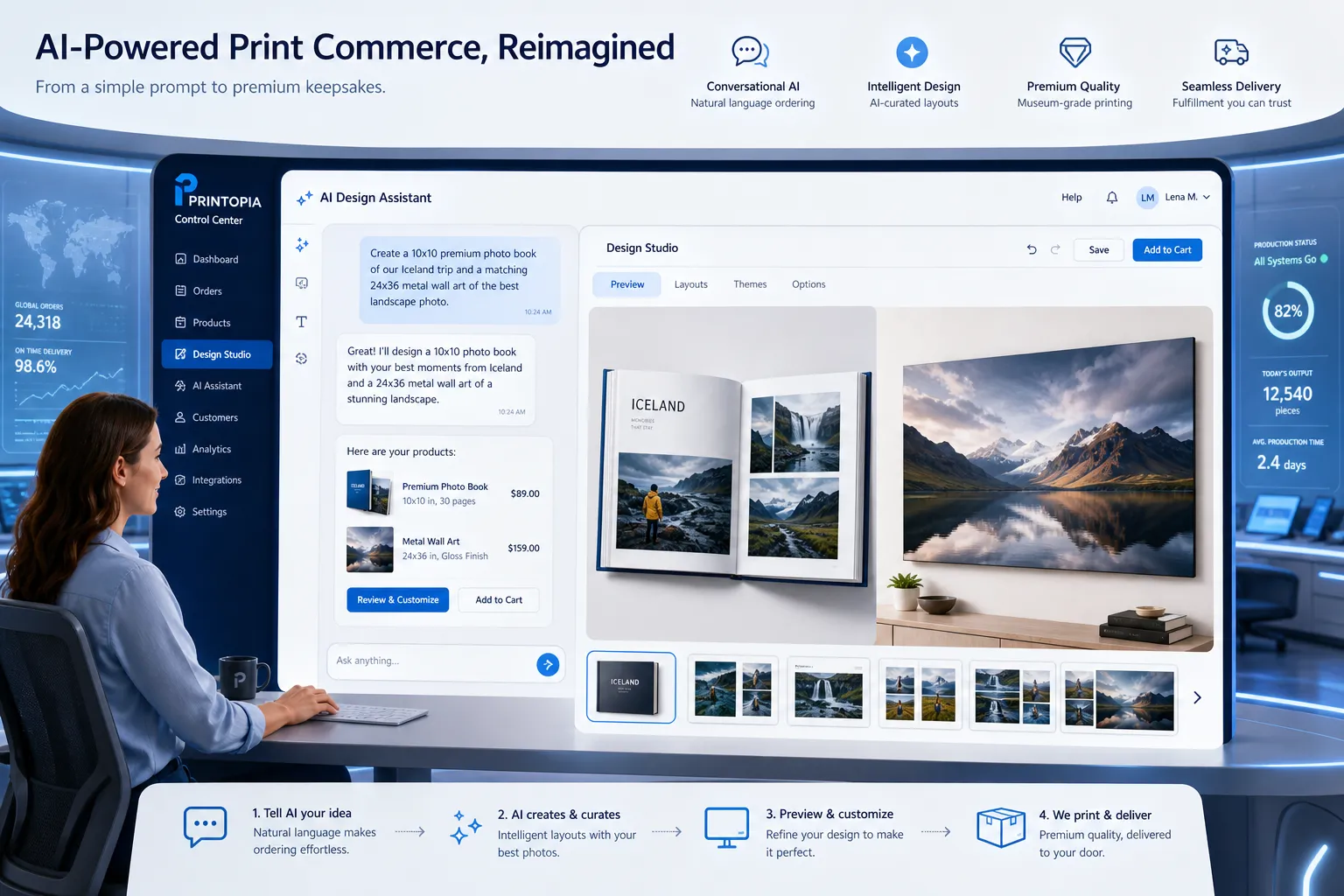
Instead of asking customers to learn complex editors, navigate dense product menus, or abandon carts when creation becomes work, conversational interfaces let them simply describe what they want. A user can say, “Create a premium photo book for our summer trip with a clean editorial look,” and the system can generate a ready-to-print product, assemble layouts, apply structure, and show an immersive preview. That is not just a better interface. It is a fundamentally better conversion engine.
At Media Rex Alliance, we see this shift as the future of AI-powered web-to-print: a white-label platform where natural language becomes the starting point for premium physical product creation, 3D visualization, and automated fulfillment at scale.
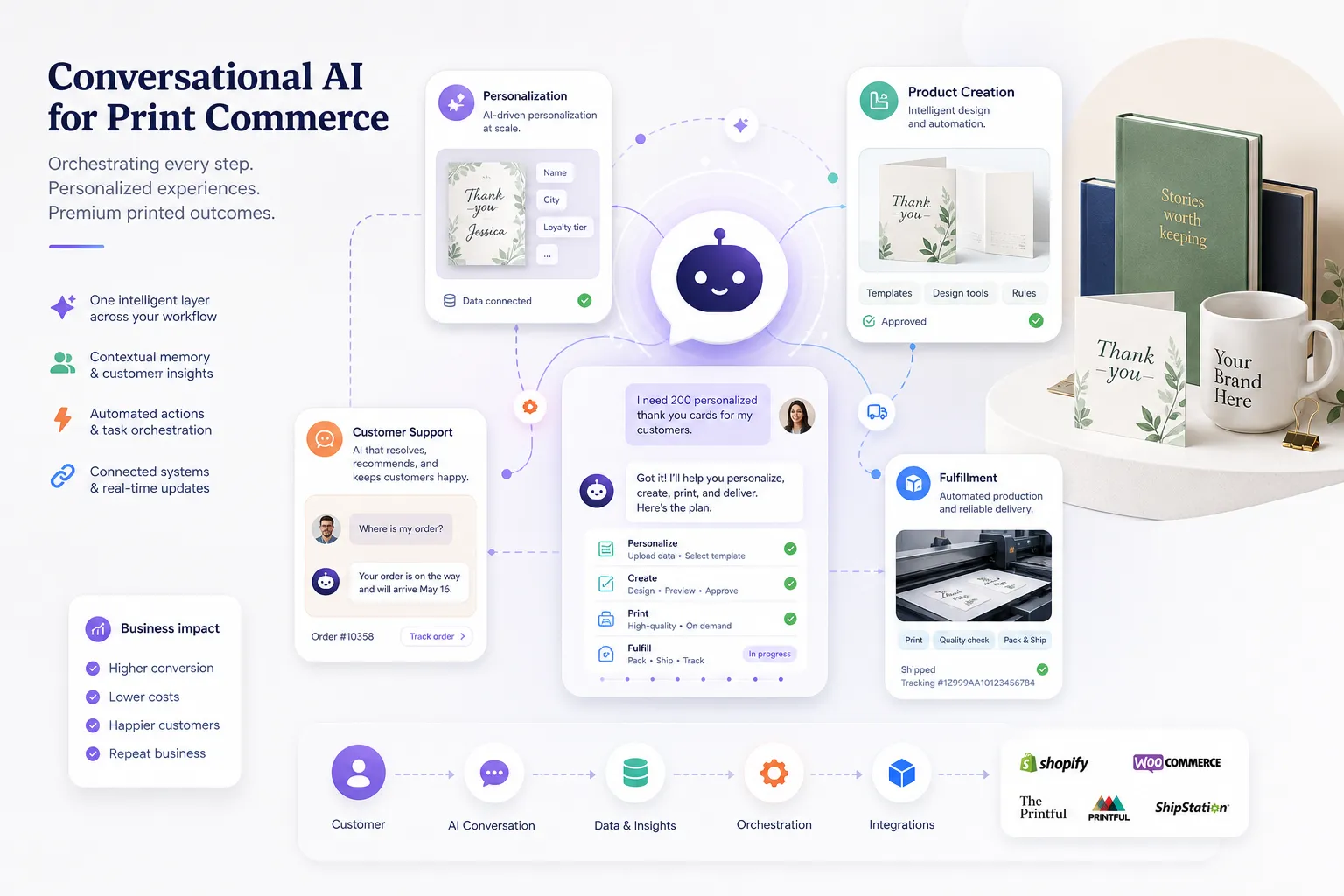
"The global conversational commerce market is projected to grow from USD 14.47 billion in 2026 to USD 39.53 billion by 2034, exhibiting a CAGR of 13.38% during the forecast period." - Fortune Business Insights
Why conversational AI matters so much in print commerce
Most industries use conversational AI for support, lead qualification, and self-service. In print commerce, the upside is even bigger because the purchase journey itself is highly interactive.
A buyer is not just choosing a SKU. They are making creative decisions:
Which product format fits the occasion?
Which photos should be used?
What layout style feels premium?
What size, paper, finish, or binding makes sense?
Is this ready to order or still too uncertain?
That makes print uniquely suited to conversational interfaces.
The old web-to-print problem
Traditional online print creation tools have four recurring failure points:
Challenge | What it looks like in practice | Business impact |
|---|---|---|
Tool fatigue | Customers face dense editors, too many controls, and design anxiety | Lower completion rates |
Mobile friction | Editors are clumsy on phones and often feel desktop-first | Higher abandonment from mobile traffic |
Confidence gap | Customers cannot easily imagine the final physical product | Hesitation, delayed checkout |
Operational drag | Teams manually answer the same product and setup questions | Higher support costs |
Conversational AI addresses all four by shifting the experience from “build it yourself” to “tell us what you want.”
Why this is especially powerful in 2026
Customer expectations have matured. Buyers now expect the same immediacy they get from modern search, chat, and commerce experiences everywhere else. Print brands that still rely on traditional editors alone risk looking slow, technical, and harder to buy from.
The winning experience is now:
Intent captured in natural language
Product generated automatically
Preview delivered visually
Ordering completed without tool overload
That is exactly where Media Rex Alliance fits. Its autonomous creation engine lets customers create products through conversation instead of complex design software, then moves them into print-ready output with photorealistic 3D and AR previews that reduce uncertainty before purchase.
What the top conversational AI use cases look like in print
The strongest use cases are the ones that directly improve conversion, average order value, production efficiency, or customer retention. In print commerce, those use cases extend well beyond support chat.
Use case 1: AI-guided product discovery
One of the highest-value conversational AI use cases in print is helping customers find the right product without forcing them through a maze of categories.
A customer may know the goal but not the format:
“I want a premium gift for my parents’ anniversary.”
“I need a portfolio book for my studio.”
“I want to turn my phone photos into something elegant for the living room.”
A good conversational engine can translate those prompts into product recommendations, style direction, and next steps.
Why it works
Print catalogs often become too broad for first-time buyers. Conversational guidance narrows options quickly and makes the experience feel consultative rather than transactional.
Where brands gain
Faster decision-making
Higher confidence at the top of funnel
Better matching between intent and product type
Less product-page bounce
For Media Rex Alliance customers, this becomes even more valuable because the platform can be deployed as a fully white-label experience inside an existing storefront or app. That means brands can keep their identity while offering a smarter buying journey.
Use case 2: Prompt-to-product creation
This is where conversational AI starts driving true differentiation.
Instead of requiring end users to manually place every image, choose every template, or understand layout logic, a prompt can trigger autonomous product generation.
Examples:
“Make a modern wedding album with black-and-white opening pages and a warm romantic tone.”
“Design a travel photo book from these uploads with bold full-bleed spreads.”
“Create a minimalist baby book with soft colors and captions.”
Why this is a growth engine
Prompt-led creation reduces the cognitive load that kills conversions. Customers move from idea to tangible output in minutes, not hours.
Business outcomes
Traditional flow | Conversational flow |
|---|---|
Browse templates manually | Describe desired outcome |
Learn editor controls | Let AI assemble structure |
Drag and resize assets | Receive auto-generated layouts |
Question whether it looks good | Review premium preview and order |
Media Rex Alliance is purpose-built around this use case. Its autonomous engine turns prompts into print-ready products quickly, supports photo uploads, generates layouts automatically, and removes the friction that normally slows purchase decisions.
Use case 3: Personalized upsell and cross-sell
Conversational AI should not just help someone buy. It should help them buy better.
In print, upsell opportunities are highly contextual:
Upgrade from standard to premium paper
Add a gift box
Move from softcover to layflat hardcover
Create matching wall art from the same project
Add extra copies for family or clients
Because a conversational interface understands the context of the project, it can recommend upgrades at the right moment instead of blasting generic offers.
Why contextual selling beats static merchandising
A user building a wedding album is more likely to respond to “Would you like a premium layflat finish for panoramic spreads?” than to a random banner saying “Upgrade now.”
What this improves
Average order value
Attach rate for premium finishes
Perceived service quality
Customer satisfaction, because recommendations feel helpful
This is one of the most underused growth levers in print commerce. Competitor content usually talks about FAQ handling and appointment booking. They rarely explore how conversational AI can become a merchandising system for highly personalized physical goods.
Use case 4: Mobile-first creation without app friction
A huge portion of print traffic now starts on mobile, especially for consumer photo products and impulse gifting. Yet many web-to-print flows still break down on phones.
That is a serious conversion problem.
The opportunity
Conversational AI makes mobile creation dramatically easier because typing or speaking intent is simpler than navigating multi-panel design interfaces on a small screen.
Media Rex Alliance is especially strong here because the experience is browser-based, mobile-first, and requires no app installation. Customers can start on one device, continue on another, and sync locally or in the cloud without losing momentum.
Why this matters commercially
Better mobile conversion rates
Reduced drop-off from casual traffic
Faster product creation from social and messaging-driven traffic
Easier access for first-time buyers
Use case 5: 3D and AR confidence-building before checkout
A major blocker in print commerce is uncertainty around the final result. Even if the product is designed, customers may still hesitate:
Will this cover look premium?
Does this size work in the space?
Will the layout feel polished?
Is this really worth the price?
This is where conversational AI becomes even stronger when paired with immersive product visualization.
Why previews matter
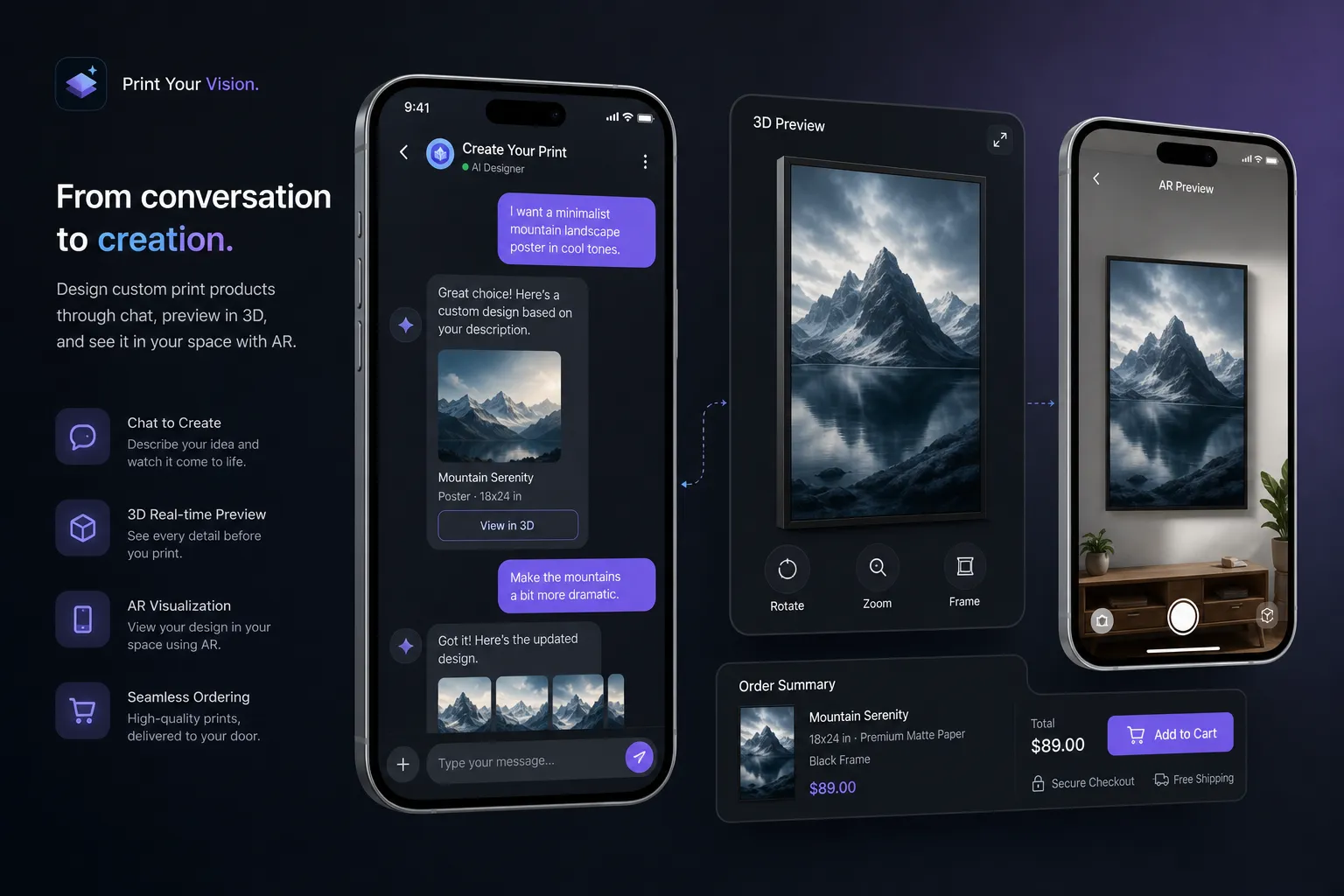
AI can answer questions, but visualization closes the trust gap. Media Rex Alliance adds photorealistic 3D and immersive AR previews so buyers can review the physical outcome before ordering.
That improves:
Confidence
Perceived product quality
Willingness to complete purchase
Lower post-purchase regret
This combination - conversation plus visual proof - is where modern print commerce gains an edge. Many conversational platforms stop at dialogue. The real unlock for print growth is when conversation leads directly into believable product visualization.
Use case 6: Assisted customer service that actually converts
Support remains one of the most common conversational AI use cases, but in print it should be designed as conversion support, not just ticket deflection.
High-impact moments include:
File and photo upload questions
Turnaround and shipping expectations
Product configuration guidance
Reorder help
Gift-related urgency
Checkout hesitation
The difference between basic and strategic support
A basic bot answers policy questions. A strategic bot helps the user keep moving toward order completion.
For example:
Instead of just explaining size options, it recommends the best size for the user’s purpose
Instead of only answering delivery timing, it guides the user toward the best available production route
Instead of saying “contact support,” it resolves blockers inside the flow
That is particularly useful for print businesses that want to scale without growing support overhead linearly with order volume.
Use case 7: Smart reorders and lifecycle marketing
Print products create natural repeat moments:
Anniversary books
School yearbooks
Seasonal holiday cards
Portfolio refreshes
Client gift cycles
Family event albums
Conversational AI can re-engage customers with useful prompts instead of generic email reminders.
Examples
“Your holiday card design from last year is ready to refresh - want to update the photos?”
“Would you like to turn this wedding album into matching parent copies?”
“We noticed you created a travel book. Want to generate framed prints from your favorite pages?”
Growth impact
Higher customer lifetime value
Better repeat order frequency
Stronger brand stickiness
More revenue without new customer acquisition cost
This is a powerful fit for white-label print businesses because the brand remains front and center while the AI handles personalized lifecycle nudges behind the scenes.
Use case 8: Internal sales enablement for print teams
Not every conversational AI use case has to be customer-facing.
For B2B print companies, regional players, and enterprise photo product brands, AI can also support internal teams:
Sales reps retrieving pricing logic
Account managers checking production options
Support teams getting instant policy answers
Operators accessing configuration guidance
Teams preparing quotes faster
Why this matters
Internal latency often slows external growth. If teams cannot answer complex questions quickly, opportunities stall.
A conversational layer over internal knowledge can:
Reduce ramp time for new reps
Improve consistency across teams
Accelerate quoting and solution recommendation
Reduce dependency on a few senior experts
That becomes especially valuable when scaling a complex print product catalog across multiple regions or storefronts.
What competitors usually miss about conversational AI in print
Most broad articles on conversational AI use cases focus on contact centers, FAQ bots, order tracking, or appointment scheduling. Those are valid, but they are not enough for print commerce.
The biggest content gaps are usually these:
They treat AI as a support tool, not a product creation engine
In print, the highest-value use case is not just answering questions. It is helping customers create what they want without needing design expertise.
They ignore visual confidence layers
A conversation alone is not enough in physical product commerce. Buyers need to see what they are ordering. That is why Media Rex Alliance’s 3D and AR preview capability matters so much.
They underestimate white-label deployment
Print businesses do not want to send hard-won traffic to third-party marketplaces. They want conversational AI embedded into their own branded experience, domain, and storefront flow.
They overlook the operational model
Print growth is not just about front-end conversion. It is also about reducing stock risk, overhead, and fulfillment complexity. Media Rex Alliance connects conversational creation to an on-demand production model powered by a global network of premium printers.
What strong conversational AI use cases have in common
Not every AI deployment creates real value. The strongest ones share five characteristics.
1. They solve friction, not just add novelty
If the use case does not remove effort or uncertainty, it will not move the numbers that matter.
2. They connect to core business outcomes
The right deployment should improve one or more of:
conversion rate
average order value
support efficiency
repeat purchase rate
production scalability
3. They fit customer behavior
If the customer naturally thinks in goals, themes, and intentions, conversation is a strong interface. Print is exactly that kind of category.
4. They integrate into real workflows
The AI needs to connect to product logic, storefront data, preview systems, and fulfillment - not sit in a silo.
5. They preserve brand control
For print companies, white-label control is not optional. It is how the experience becomes part of the brand rather than an external tool.
How to prioritize conversational AI use cases in your print business
The right roadmap depends on your business model.
Business type | Best first use case | Why it matters |
|---|---|---|
Small studio or photographer | Prompt-led product creation | Reduces manual back-and-forth and speeds orders |
New print-on-demand brand | Product discovery + mobile creation | Improves conversion from first-time traffic |
Mid-size print brand | Personalized upsell + support automation | Grows AOV while lowering service load |
Regional print player | White-label conversational storefront | Modernizes buying experience without rebuilding from scratch |
Established photo book company | Full AI creation + preview + lifecycle automation | Defends market position and expands conversion efficiency |
The key is to start where friction is already hurting revenue.
How Media Rex Alliance maps to the highest-value use cases
Below is where Media Rex Alliance stands out compared with generic conversational platforms.
Capability | Why it matters for print growth |
|---|---|
Conversational product creation | Lets customers create products via natural language instead of mastering design tools |
Prompt-to-print workflow | Reduces time from idea to order-ready product |
White-label deployment | Keeps the experience fully branded inside your storefront or app |
3D and AR previews | Improves buyer confidence before purchase |
Mobile-first browser access | Supports conversion without requiring app downloads |
Local and cloud sync | Allows seamless creation across devices |
On-demand production model | Reduces inventory, waste, and operational overhead |
Automated fulfillment network | Scales delivery through global premium print partners |
This is what makes it more than a chatbot layer. It is an AI-native web-to-print growth platform.
"A recent study by SoundHound AI found that 96% of organizations with active agentic AI deployments reported results that met or exceeded their ROI expectations." - SoundHound AI)
What a modern conversational print journey should look like
Here is the strategic model forward-thinking print brands should be aiming for.
Step 1: Capture intent
The customer describes the product they want in plain language.
Step 2: Generate structure
The system recommends the right product and assembles a polished draft automatically.
Step 3: Visualize clearly
The customer sees the output in 3D or AR and gains confidence.
Step 4: Optimize the basket
The AI recommends premium add-ons and related products based on context.
Step 5: Fulfill on demand
The order flows into an automated production and fulfillment network with minimal manual handling.
That is the future of scalable print growth: fewer clicks, fewer tools, fewer delays, and more completed orders.
Final verdict
Conversational AI is no longer just a service enhancement. In print commerce, it is becoming the new buying interface.
The most valuable conversational AI use cases are the ones that remove creative friction, accelerate product creation, personalize recommendations, build confidence visually, and connect directly to scalable fulfillment. Print businesses that adopt this model can reduce abandonment, improve customer experience, and launch premium branded creation flows without building everything from scratch.
For brands that want to modernize fast, Media Rex Alliance offers a clear path forward. It enables customers to create products through conversation, transforms prompts into print-ready outcomes, provides photorealistic 3D and AR previews, supports mobile-first browser-based access, and automates fulfillment through a global premium print network - all in a fully white-label format designed for scale.
If your print business wants to turn AI from a talking point into a revenue engine, this is the moment to move. Media Rex Alliance gives you the infrastructure to do it.