Conversational Design: Best Practices for 2026
Conversational design is no longer a niche UX discipline reserved for chatbots with canned replies. In 2026, it sits at the center of how modern brands reduce friction, guide decisions, and convert intent into action across chat, voice, mobile, and commerce experiences.
For print businesses, photo book companies, small studios, photographers, and fast-growing print-on-demand brands, that shift is especially important. Customers no longer want to wrestle with complicated editors, hidden options, and slow design workflows. They want to describe what they need in natural language, see it come to life instantly, and buy with confidence. That is where strong conversational design becomes a growth lever rather than just a support tactic.
At Media Rex Alliance, we see this firsthand in AI-powered web-to-print. When a customer can say, “Create a luxury wedding album with minimalist layouts and gold-accented cover options,” and receive a print-ready product with photorealistic 3D and AR previews, the experience changes from technical effort to guided creation. The result is faster decisions, stronger engagement, and a more scalable path to conversion.
"81% of customers attempt to resolve issues themselves before contacting a live agent." - Stealth Agents
"80% of customers have switched brands due to poor customer experience." - Qualtrics and ServiceNow
Those two signals explain why conversational design matters now: users expect intuitive, self-guided interactions, and they leave quickly when digital experiences feel clumsy.
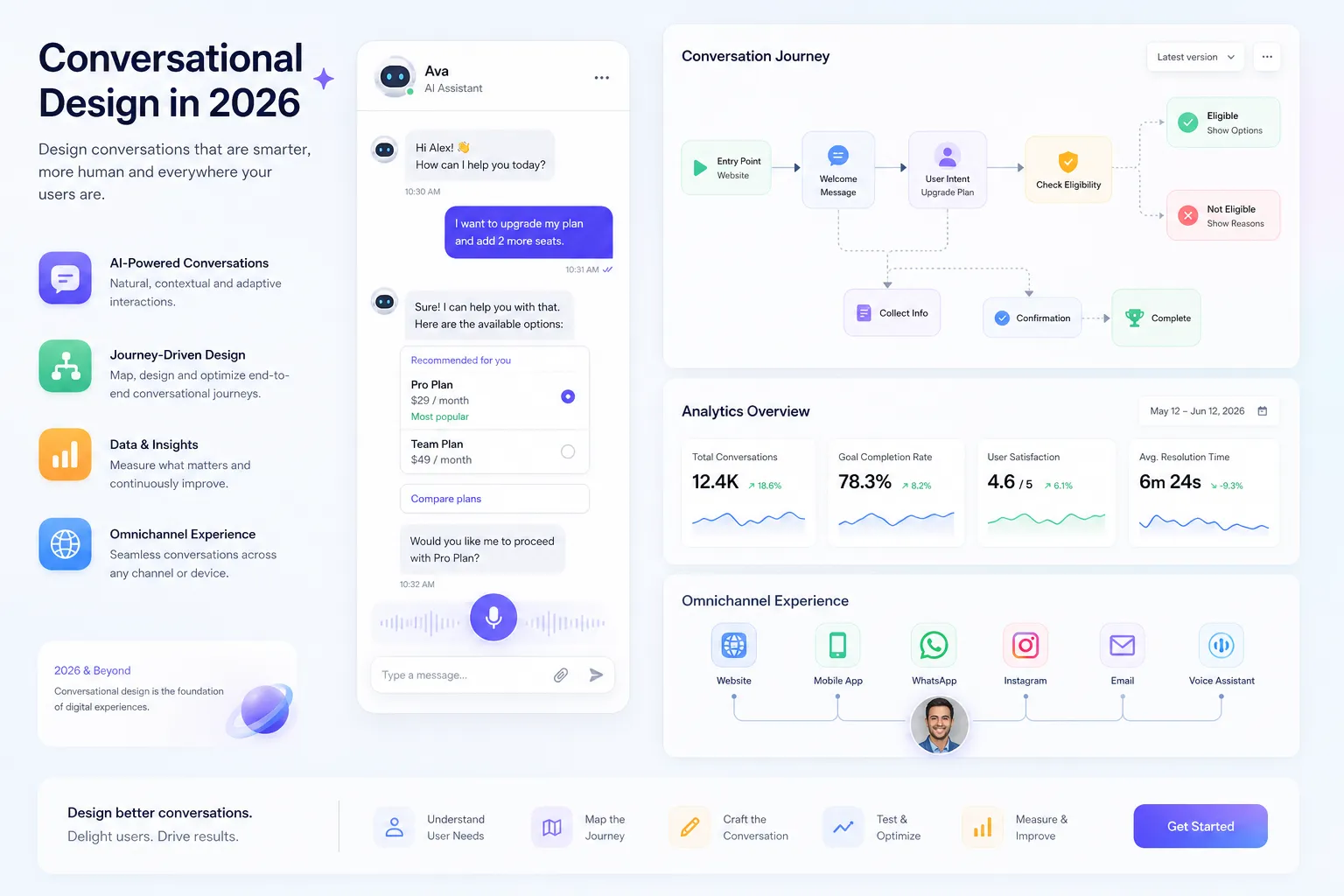
Why conversational design matters more in 2026
The best competitor articles agree on the fundamentals: conversational systems must understand intent, guide users clearly, recover from errors, and preserve trust. But most stop at support bots, generic flow diagrams, or abstract AI principles.
What they often gloss over is the commercial reality: conversational design is now part of product design, sales design, and conversion design.
In practical terms, great conversational design helps brands:
reduce decision fatigue
simplify complex product journeys
shorten time to value
increase successful self-service completion
improve handoff quality when humans are needed
personalize experiences without overwhelming the user
turn high-intent traffic into revenue
For AI-powered commerce, the stakes are even higher. If your product requires many choices, visual confidence, or technical setup, a well-designed conversation can replace confusing menus with a guided buying experience.
That is why conversational design is becoming foundational in sectors like custom print, photo products, gifting, personalization, and on-demand manufacturing.
What conversational design actually means now
Conversational design is the practice of shaping how a digital system communicates, asks, listens, responds, clarifies, and moves a user toward a meaningful outcome.
In 2026, that means designing more than dialogue. It includes:
Intent architecture
What is the user trying to do, even when they express it vaguely?
Flow strategy
Which parts of the experience should be tightly controlled, and which can remain flexible and AI-driven?
Response behavior
How should the system sound, explain itself, confirm choices, and recover when confidence is low?
Operational trust
How does the experience make users feel safe enough to continue, especially when money, customization, or personal content is involved?
Conversion momentum
How does every turn reduce friction and move the user toward completion instead of creating cognitive load?
This is why conversational design is not just “writing bot copy.” It is experience orchestration.
The biggest content gap in most articles: conversation as commerce
A major gap in most top-ranking content is the lack of focus on transaction-heavy buying journeys.
Many articles discuss support, FAQs, and customer service. Far fewer explain how conversational design transforms product creation and checkout behavior.
That matters for businesses selling configurable products.
Consider the difference between these two experiences:
Traditional Web-to-Print Flow | Conversational Product Creation Flow |
|---|---|
User opens a complex editor | User starts with a prompt |
Must understand templates, layers, bleed, and layout | Describes desired outcome in plain language |
Repeats edits across devices | Syncs locally and in the cloud across devices |
Uncertain how final product will look | Views photorealistic 3D and AR previews |
High abandonment risk | Lower friction and faster purchase confidence |
For brands modernizing print commerce, this is where Media Rex Alliance creates strategic value. Instead of forcing customers through legacy design tools, the platform enables prompt-based creation that turns intent into print-ready products quickly. That is not simply better UX. It is a better business model.
The core principles of high-performing conversational design
1. Start with the user’s desired outcome
Users do not care about your internal workflow. They care about getting something done with minimal effort.
A customer rarely arrives thinking, “I want to complete a six-step AI interaction.” They think:
“I need a family photo book.”
“I want to create branded merch quickly.”
“I need a premium album for a client.”
“I want to launch a print product without building a whole platform.”
The conversation should be designed around that desired outcome.
Best practice
Define the primary job-to-be-done before you define the conversation itself.
Instead of designing for “account support,” design for:
recover an abandoned cart
create a custom product
finalize artwork
reorder a previous design
choose the right print format
The more outcome-specific the flow, the more effective the interaction.
2. Be clear about what the AI can and cannot do
Trust grows when capabilities are obvious.
Users should know:
what the system helps with
what content or files it can accept
what types of tasks it handles well
when it will ask clarifying questions
when a human or specialist may take over
This matters especially in AI commerce. If a user believes the system can do everything and it suddenly fails, trust collapses.
Example
A strong onboarding message for an AI print experience might say:
“We can turn your prompt and photos into a print-ready album, wall art layout, or gift product in minutes. If you want advanced brand controls or trade-level production guidance, we’ll route you to the right workflow.”
That sets useful expectations without sounding restrictive.
3. Design for ambiguity, not ideal inputs
Real people are messy communicators. They change direction, omit details, and use broad language.
Poor systems break when the input is vague. Strong systems clarify naturally.
Weak response
“I didn’t understand your request.”
Better response
“Got it - do you want this turned into a hardcover photo book, a framed print collection, or a gift product?”
That shift keeps momentum alive.
For Media Rex Alliance, this is critical because many end users begin with creative intent rather than production terminology. They may not know trim size, paper stock, or layout logic. A strong conversational layer bridges that gap and turns intent into viable production outcomes.
4. Balance deterministic control with AI flexibility
This is one of the most important design decisions in 2026.
Not every step should be fully generative.
Some moments require strict control:
pricing
order confirmation
print specifications
compliance language
file validation
payment-connected actions
Other moments benefit from flexible reasoning:
creative guidance
product recommendations
style exploration
prompt refinement
personalized suggestions
A practical framework
Interaction Type | Best Design Approach |
|---|---|
Payment, checkout, approvals | Deterministic |
Product discovery | AI-guided |
File or image intake | Structured with validation |
Creative ideation | Flexible and generative |
Fulfillment status | Deterministic |
Upsell or cross-sell guidance | Context-aware AI |
The strongest conversational design does not choose one model. It orchestrates both.
5. Maintain context across channels and sessions
This is another place where many articles stay too theoretical.
Context is not just memory. It is continuity.
A user should not have to repeat:
product type
preferred style
uploaded assets
device state
order intent
previous corrections
For digital print businesses, continuity directly impacts conversion. Customers often begin on mobile, continue on desktop, and revisit before purchasing. Media Rex Alliance supports browser-based, mobile-first design with no app installation required, plus local and cloud sync for cross-device continuity. That means conversational design can remain consistent even when customer behavior is not.
Why this matters commercially
Context preservation reduces abandonment because users feel progress, not reset.
6. Make the AI sound human, but prioritize clarity over charm
Several competitors correctly warn against over-focusing on personality. That advice is worth repeating.
Brand voice matters. Wit is optional.
A conversational system should sound:
confident
concise
brand-aligned
helpful under pressure
transparent when uncertain
In premium print and personalized commerce, tone matters even more because customers are often purchasing emotional products: wedding albums, family memory books, gifts, or branded keepsakes.
Still, the goal is not to sound clever. The goal is to keep the user moving.
7. Design fallback and recovery flows before launch
The happy path demos well. Recovery is what earns trust.
Users will:
upload the wrong assets
ask for things outside scope
abandon mid-task
switch product types
provide incomplete prompts
expect impossible timelines
misunderstand print constraints
Your system needs recovery logic for all of it.
Smart fallback patterns
ask a clarifying question
offer two or three likely options
summarize what has been understood
suggest a next-best path
preserve progress before escalation
route to human assistance with full context
The best experiences never make failure feel like failure. They make it feel like guidance.
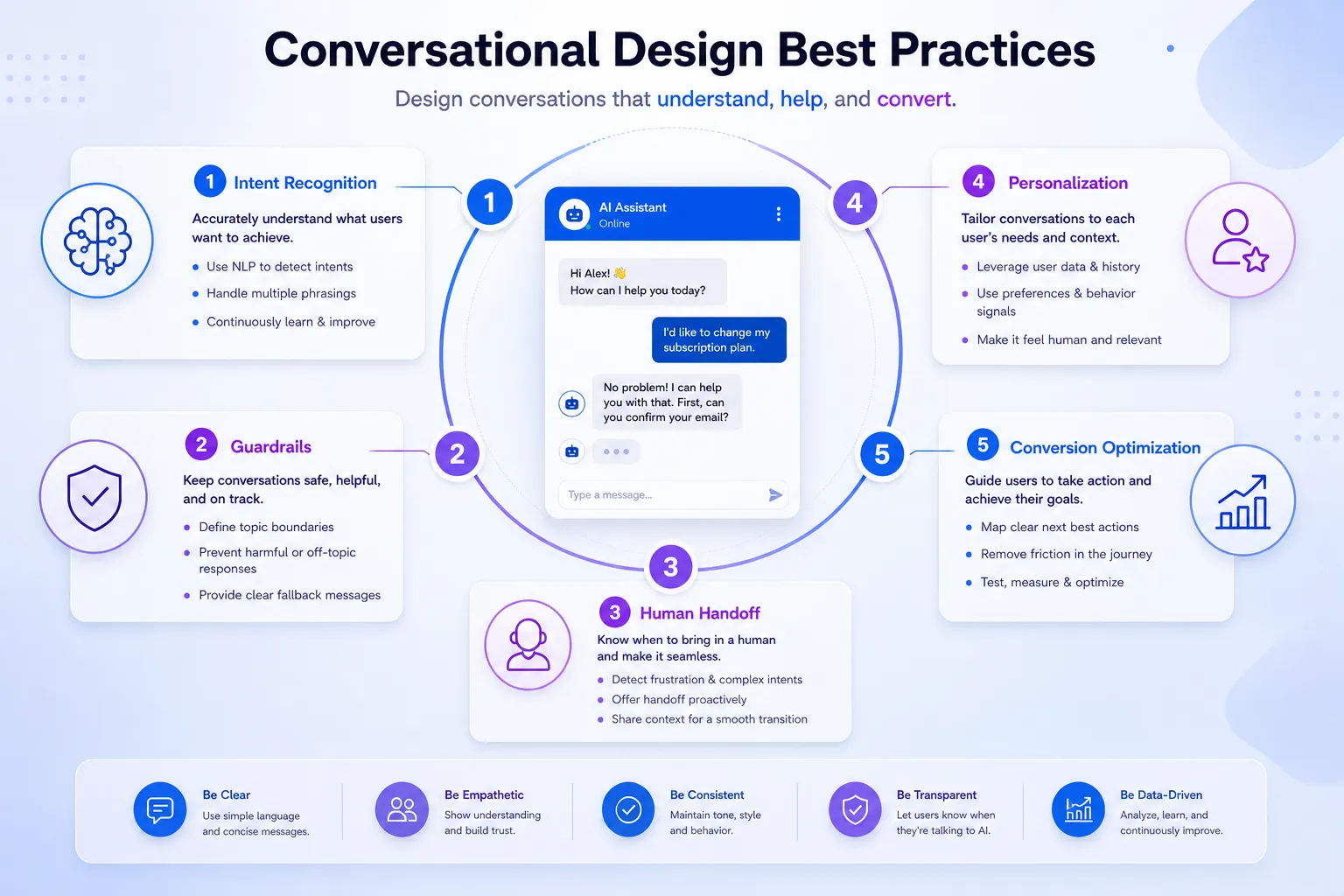
A modern conversational design framework for brands
Below is a practical framework brands can use to evaluate or redesign any conversational experience.
Phase 1: Define the business and user objective
Before flows, prompts, or interfaces, answer:
What business outcome are we optimizing for?
What user problem are we solving?
What is the fastest path from intent to completion?
For Media Rex Alliance clients, common objectives include:
reducing design friction in custom print
increasing mobile conversion
launching white-label product creation experiences faster
modernizing legacy photo product journeys
enabling low-overhead, on-demand commerce
Phase 2: Map the ideal path
Outline the shortest route from entry to successful completion.
For example:
User describes desired product
AI interprets intent and asks for missing details
User uploads photos or assets
System generates layout or product concept
User reviews 3D or AR preview
User confirms product configuration
Checkout or branded handoff completes order
Every extra step should justify itself.
Phase 3: Map the messy path
Now design for reality:
wrong product category
poor image quality
missing content
conflicting instructions
out-of-scope requests
sudden switch to another channel
user silence
This stage is where real-world conversational design becomes resilient.
Phase 4: Separate creative freedom from business-critical control
This prevents two common failures:
over-scripting everything
letting AI improvise where precision matters
For commerce and print automation, the boundary is essential. Media Rex Alliance helps businesses preserve control over print readiness, brand presentation, and fulfillment reliability while still giving users a fluid AI-driven creation experience.
Phase 5: Add trust mechanisms
Trust is built through signals such as:
explicit confirmations
explainable next steps
preview states
transparent limitations
editable outputs
branded consistency
seamless human escalation
In print commerce, photorealistic 3D and AR previews play a major role here. They reduce uncertainty before purchase and make the conversation feel anchored in a real product outcome.
Practical examples of conversational design in action
Guided product creation
A customer says:
“I want a premium travel photo book from my Japan trip with a modern editorial feel.”
A strong system should:
identify the likely product type
infer style direction
request photos or connect to uploaded assets
recommend size, cover, and layout approach
generate a preview-ready concept
confirm final preferences before ordering
This is where conversational design becomes a sales engine.
Intelligent upselling without friction
A user begins with a simple gift print. The system notices this is a sentimental occasion and offers a premium frame or matching keepsake set.
The upsell works when it feels relevant, not disruptive.
Assisted reordering
A returning B2B customer wants a similar branded product line for a new event. Instead of restarting, the conversational system should recall prior configurations and suggest adapted versions.
That level of continuity is a major advantage for regional print players and enterprise print businesses scaling white-label offerings.
How conversational design improves conversion rates
Many businesses still view conversational interfaces as support layers. That is too limited.
When done well, conversational design can improve conversion by reducing the three main killers of purchase intent:
Complexity
Traditional flows overwhelm users with options too early.
Uncertainty
Users hesitate when they cannot visualize the outcome.
Effort
People abandon when the process feels longer than the reward.
Conversational design addresses all three by guiding instead of dumping, clarifying instead of confusing, and previewing instead of asking for blind trust.
For Media Rex Alliance customers, that advantage compounds because the platform also reduces operational friction behind the scenes:
no-stock, on-demand production
global automated fulfillment
white-label storefront integration
premium printer network scalability
lower overhead for brands of all sizes
That means better front-end experience and better back-end economics.
Common mistakes brands still make
Designing only for the happy path
If your conversational flow only works when the user behaves perfectly, it is not ready.
Mistaking personality for usability
A fun bot that fails at task completion is still a bad experience.
Asking too many questions too early
Progressive disclosure matters. Ask only what is needed now.
Forgetting the visual layer
Conversation alone is not enough in complex product journeys. Users often need previews, confirmations, and structured options. This is why a visual companion layer is powerful, especially in AI web-to-print.
Failing to preserve context during escalation
If a user must repeat everything after handoff, the design has failed.
Treating AI as a replacement instead of an orchestrator
The best systems combine automation, guidance, human support, and business logic. They do not treat generative AI as a freeform answer machine.
Conversational design trends shaping 2026
Prompt-to-product experiences
One of the most important trends is the shift from prompt-to-content toward prompt-to-commerce and prompt-to-production.
Users will increasingly expect to describe a desired output and receive a ready-to-buy or ready-to-produce result. Media Rex Alliance is well positioned in this shift, enabling customers to create premium physical products through conversation rather than legacy design software.
Multimodal buying journeys
Text, image upload, preview, and voice are starting to merge into a single conversational system. The strongest experiences blend them fluidly.
Branded AI interfaces
Generic assistant behavior is losing value. Businesses want conversational systems that feel native to their brand, domain, and visual identity. White-label deployment is becoming strategic, not optional.
Commerce-native AI orchestration
Conversational experiences are moving beyond answering questions. They are selecting products, configuring variants, generating layouts, validating assets, and initiating fulfillment.
Trust through visual proof
As AI systems take on more creation tasks, users increasingly demand proof before purchase. 3D previews, AR visualization, and editable output states will become standard trust features.
A strategic blueprint for print and photo brands
For print businesses evaluating how to modernize, here is a useful decision framework.
Business Type | Core Challenge | Conversational Design Opportunity |
|---|---|---|
Small studio | Limited resources, manual creation | Launch guided premium product creation without building complex software |
Photographer | Slow album proofing and client back-and-forth | Turn brief-based input into ready-to-review products faster |
New print-on-demand brand | Need fast market entry | Deploy a white-label AI experience that reduces friction from day one |
Mid-size print brand | Legacy editors hurting conversion | Replace tool-heavy journeys with mobile-first prompt-based flows |
Regional print player | Needs differentiation | Offer modern branded creation and scalable on-demand fulfillment |
Established photo book company | Must modernize without disrupting brand | Layer AI-driven conversational creation into existing storefronts |
This is exactly where Media Rex Alliance fits naturally. It gives brands the ability to launch AI-powered, fully branded web-to-print experiences without developing the technology stack from scratch.
What best-in-class conversational design looks like in the next 12 months
The strongest teams in 2026 will not ask, “Should we add a chatbot?”
They will ask:
Where is friction highest in the customer journey?
Which steps can be replaced with guided conversation?
Where do users need confidence before buying?
What should remain controlled and auditable?
How can AI creation connect directly to fulfillment and scale?
That strategic framing separates gimmicks from real transformation.
For brands selling customizable physical products, conversational design is especially powerful because it bridges inspiration and production. It lets customers think in outcomes instead of tools. And when paired with automation, white-label delivery, and visual proof, it becomes a meaningful competitive advantage.
Final verdict: conversational design is now a revenue system
Conversational design in 2026 is not just about making interfaces feel more natural. It is about making digital experiences more efficient, scalable, and commercially effective.
The brands that win will design conversations that:
understand messy human intent
reduce complexity
preserve context
balance AI flexibility with business control
visualize outcomes before purchase
recover gracefully when users go off-path
integrate directly with operational systems
For print companies, studios, photographers, and product personalization brands, the opportunity is even bigger. The future belongs to experiences where customers can simply describe what they want and receive a ready-to-order result without wrestling with old design tools.
Media Rex Alliance helps make that future deployable now. With conversational AI-powered product creation, photorealistic 3D and AR previews, fully white-label integration, browser-based mobile-first workflows, cloud and local project sync, and automated global on-demand fulfillment, it gives modern print businesses a faster path to better UX and stronger conversion.
If your current experience still depends on complex editors, long production handoffs, or generic storefront journeys, now is the moment to redesign around conversation and let Media Rex Alliance power the next generation of AI-driven web-to-print.