Create AI Design for Print Trends in 2026
Print is not being replaced in 2026. It is being re-engineered.
For small studios, photographers, new print-on-demand brands, regional print players, and established photo product companies, the biggest challenge is no longer whether customers want personalized print products. It is how fast you can help them create those products without forcing them through slow, outdated design workflows.
That is where create ai design becomes a competitive advantage.
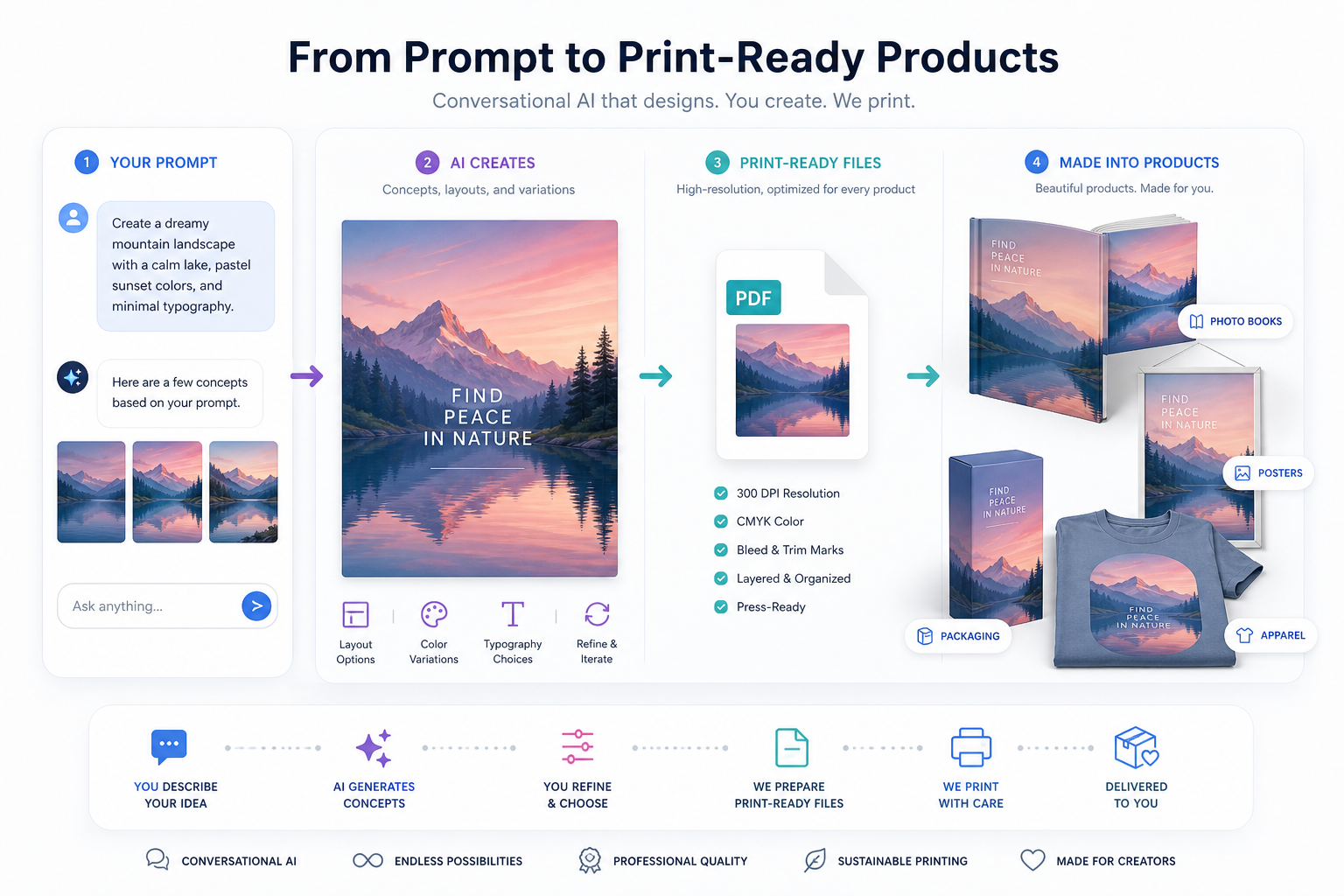
Instead of pushing buyers into complex editors, layer panels, and template friction, AI-powered print platforms now let customers describe what they want in natural language, upload photos, preview products in 3D or AR, and move to checkout faster. This shift is changing conversion rates, creative operations, and the economics of web-to-print.
At Media Rex Alliance, we see 2026 as the year when conversational commerce, intelligent automation, and on-demand fulfillment stop being experimental and become the new baseline for scalable print businesses.
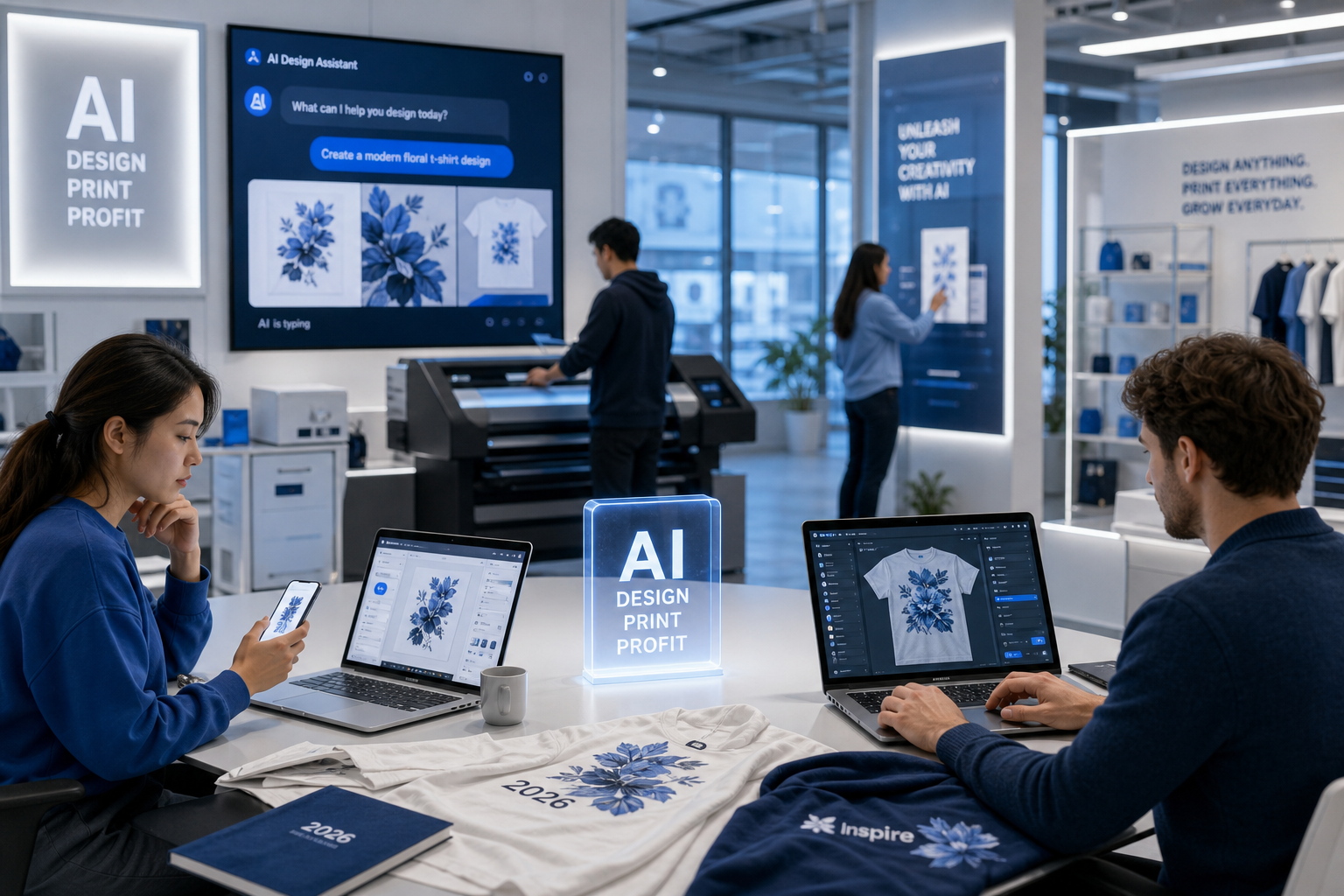
What the top competitor content gets right, and where it stops short
Across the current print and design trend landscape, the leading articles repeat a few clear themes:
AI is accelerating design and production
personalization is becoming a buyer expectation
digital printing and on-demand models continue to expand
sustainability and workflow automation matter more than ever
print is becoming more interactive, immersive, and integrated with digital channels
Those points are valid, but most competing content still leaves major gaps:
Competitor Theme | What They Cover | What They Miss |
|---|---|---|
AI in printing | Automation, design tools, workflow speed | How conversational AI changes the customer journey before production even begins |
Personalization | Variable content, customized items | How to scale personalization without overwhelming users with design complexity |
Print trends | Aesthetic trends and broad industry shifts | The actual infrastructure needed to launch AI-powered white-label print experiences |
DTF / digital print | Production benefits | The bridge between creation, preview, storefront integration, and global fulfillment |
Local vs online print | Convenience and service | Mobile-first browser-based creation, cloud sync, and no-app user experiences |
This is the real opportunity in 2026: not just using AI to make design faster internally, but using AI to let customers create better print products with less effort.
Why create ai design matters more in print than in most other industries
Print has always had a hidden conversion problem.
Customers often know what they want emotionally, but not technically. They can describe the mood of a photo book, the look of a premium art print, or the tone of a branded packaging concept. But traditional print interfaces force them to think like designers instead of buyers.
That gap creates friction:
abandoned sessions in complex editors
poor-quality user-generated layouts
longer time to purchase
higher support costs
lower average order confidence
Create ai design solves this by translating intent into output.
A user can say:
“Make a modern layflat wedding album with warm cinematic tones”
“Create a premium black-and-white portfolio book from these 30 photos”
“Design a minimalist wall art set for a newborn session”
“Turn this travel gallery into a clean hardcover memory book”
The platform handles layout logic, styling, formatting, product matching, and preview generation.
"According to a 2024 survey by the Boston Consulting Group, approximately 80% of consumers worldwide are comfortable with personalized experiences and expect companies to offer them." - Source
That expectation is especially powerful in print, where the product is physical, emotional, and often giftable.
The biggest print design trends shaping 2026
1. Conversational creation replaces traditional design friction
The most important shift in 2026 is not just AI-generated graphics. It is AI-guided product creation through natural language.
Instead of opening a complicated builder, users start with a prompt. This creates a more intuitive flow for:
photo books
calendars
wall art
packaging
branded collateral
personalized gift products
print-on-demand merchandise
Media Rex Alliance is built around this exact transition. Customers can create products conversationally instead of wrestling with professional design software. That reduces friction at the exact moment when intent is strongest.
2. AI personalization moves from novelty to operating model
Personalization is no longer a premium add-on. It is becoming the core product experience.
In 2026, buyers expect:
product recommendations based on context
automatic layout suggestions
tailored design styles
smart photo selection
dynamic text and messaging
product variants that feel made for them
The winners will not simply offer “customization.” They will offer personalization without cognitive overload.
That means the interface should feel simple even when the engine underneath is sophisticated.
3. Print previews become immersive, not static
A flat thumbnail is no longer enough for premium print commerce.
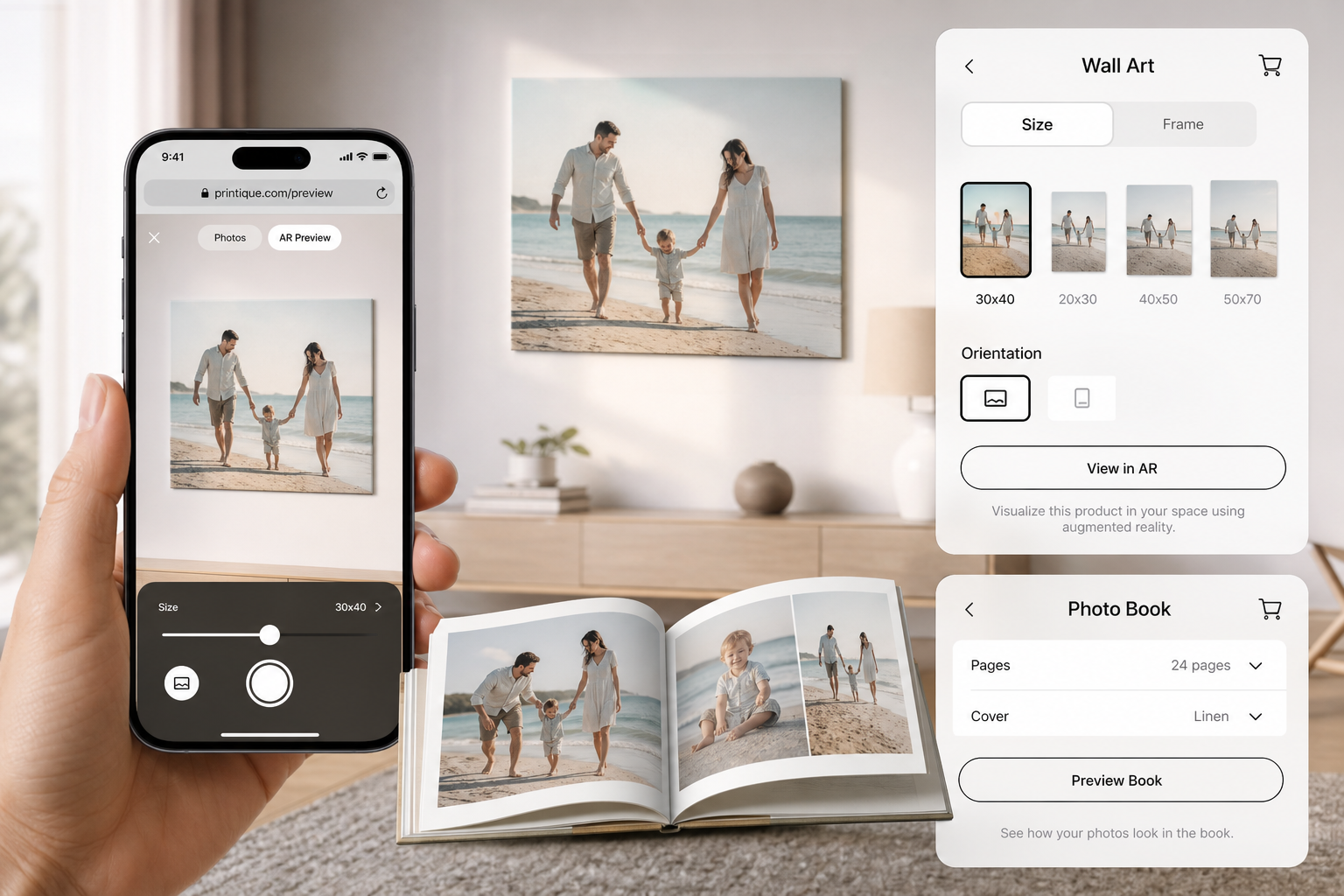
As order values rise, customers want reassurance before purchase. That is why photorealistic 3D previews and AR visualization are becoming a major differentiator for modern print businesses.
This matters for:
photo books and albums
framed prints
wall décor
packaging concepts
branded merchandise
premium stationery and keepsakes
Media Rex Alliance supports photorealistic 3D and immersive AR previews directly in the browser, helping customers feel confident before they buy. That is especially valuable for mobile shoppers who want clarity without downloading an app.
4. White-label AI web-to-print becomes the fastest path to market
Many competitors discuss AI trends as if companies should build everything from scratch.
That is unrealistic for most studios, print brands, and photo product businesses.
In 2026, the faster path is white-label deployment:
launch under your own brand
use your own domain and visual identity
integrate with your existing storefront or app
avoid years of custom development
keep focus on customer acquisition and product strategy
This is where Media Rex Alliance has a clear advantage. It is designed as a fully white-label AI print platform, allowing businesses to modernize their offering without rebuilding the entire technology stack.
5. Mobile-first print design becomes mandatory
A large share of discovery, inspiration, and purchase intent now starts on mobile. Yet many web-to-print experiences still behave like desktop software squeezed into a smaller screen.
That is no longer acceptable.
In 2026, create ai design platforms must be:
mobile-first
browser-based
touch-friendly
fast-loading
cross-device consistent
Media Rex Alliance supports browser-based, no-install product creation with local and cloud sync, allowing users to start a project on one device and continue on another seamlessly. That removes one of the biggest hidden blockers in the print buying journey.
6. On-demand production becomes a strategic margin play
Print businesses are under pressure from both customer expectations and inventory costs. The solution is not simply “print faster.” It is to remove unnecessary stock, reduce waste, and automate fulfillment.
AI-led design systems work especially well with on-demand production because they generate exactly what the customer wants when the order is placed.
That supports:
lower inventory risk
leaner operations
fewer obsolete SKUs
faster testing of new product concepts
more scalable regional and global expansion
7. Global fulfillment networks outperform siloed production models
As product complexity rises, reliable fulfillment becomes part of the experience, not just back-office logistics.
The best AI print ecosystems in 2026 connect storefront creation to:
premium production partners
automated routing
quality-controlled output
regionalized shipping efficiency
Media Rex Alliance reduces overhead by combining on-demand creation with automated fulfillment through a global network of premium printers. For brands that want to scale without building their own production footprint, this is a major structural advantage.
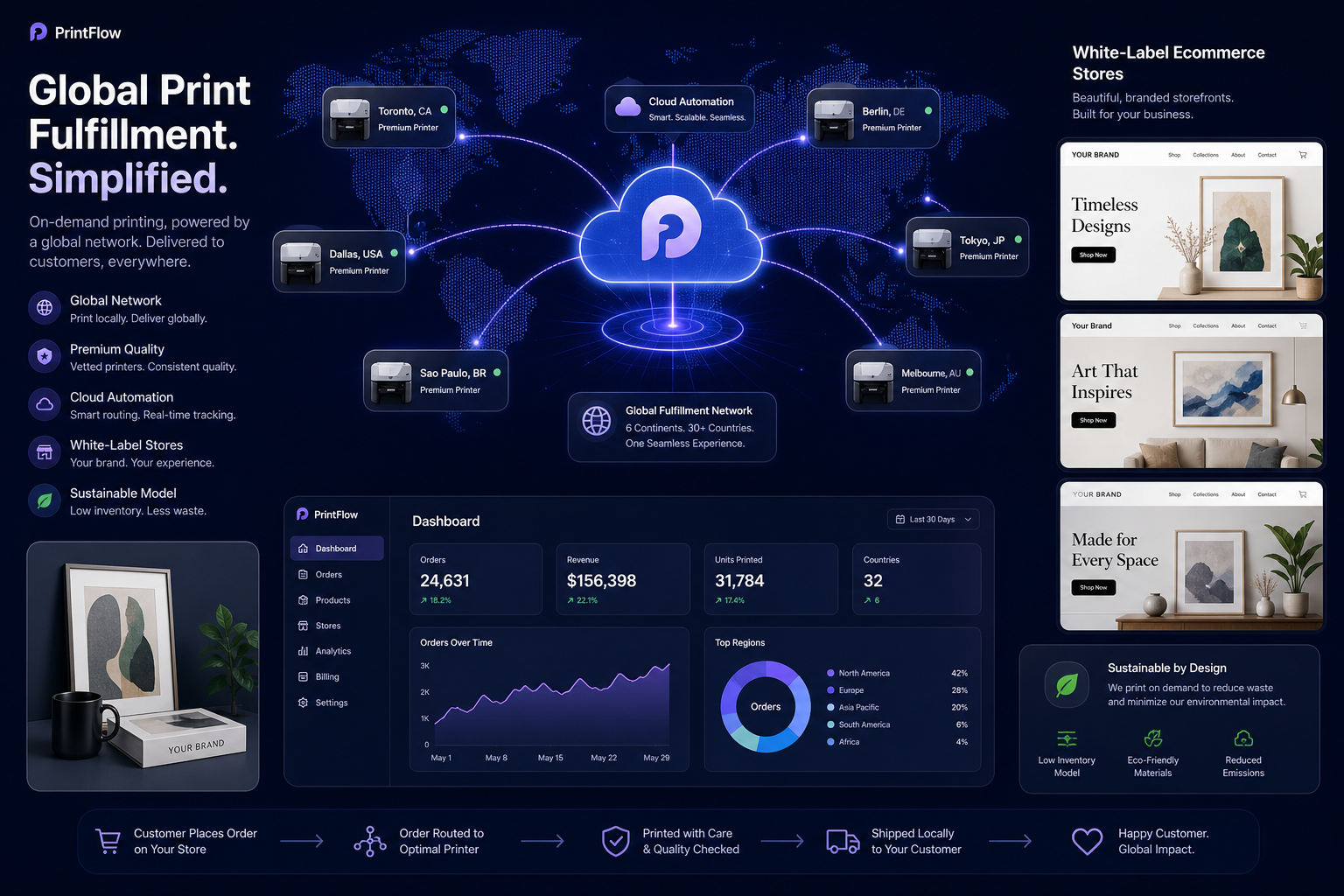
The new print workflow: from prompt to product
The future of print is not just “AI-assisted design.” It is a fully restructured flow.
Traditional print workflow vs AI-native print workflow
Stage | Traditional Workflow | AI-Native Workflow |
|---|---|---|
Idea capture | User starts with blank canvas | User starts with a prompt |
Design | Manual editing and templates | AI creates layouts and product-ready compositions |
Product fit | User must choose specs manually | AI recommends product formats and configurations |
Review | Static previews or low-fidelity mockups | Photorealistic 3D and AR preview |
Device continuity | Often fragmented | Local + cloud sync across devices |
Fulfillment | Manual handoff and coordination | Automated routing to on-demand print network |
Brand deployment | Custom build required | White-label integration into existing storefronts |
This shift is why AI in print feels more transformational than AI in many adjacent verticals. It does not just improve output. It compresses the entire path from inspiration to purchase.
Where create ai design delivers the highest ROI
Not every print segment benefits in the same way. The strongest ROI appears where emotional value, visual complexity, and buyer hesitation intersect.
Best-fit business segments in 2026
Segment | Why AI Design Wins | Typical Value Created |
|---|---|---|
Photo book companies | Large photo sets, layout complexity, emotional products | Faster creation, higher conversion, better perceived quality |
Small creative studios | Limited design resources, custom client work | Faster turnaround, premium upsell opportunities |
Photographers | Clients want finished products, not editing tools | Easier album and wall art sales |
New POD brands | Need fast launch and differentiated UX | Lower tech costs, stronger customer experience |
Mid-size print brands | Need modernization without full rebuild | White-label transformation at lower risk |
Regional print players | Need scale and efficiency | Expanded product offering with less operational burden |
The aesthetic layer: what AI-designed print will look like in 2026
Competitor trend reports highlight more tactile, human, maximalist, and expressive aesthetics. Those signals matter, but for print businesses the deeper issue is not just what is trending visually. It is whether AI systems can translate trend language into commercially viable layouts.
In 2026, strong create ai design systems will increasingly support outputs that feel:
editorial rather than templated
premium rather than generic
personal rather than mass-produced
expressive without sacrificing print-readiness
trend-aware without becoming disposable
That means AI should not just generate ideas. It should understand the constraints of print:
bleed and trim logic
image quality and layout hierarchy
typography legibility
material-specific rendering
aspect ratio compatibility
premium product presentation
This is where general-purpose AI tools often fall short and verticalized platforms gain advantage.
The operational trend most articles ignore: AI is now a conversion tool, not just a design tool
Most competitor articles frame AI as an internal productivity upgrade.
That is too narrow.
In print commerce, AI is increasingly a revenue engine because it improves:
product discoverability
ease of creation
order confidence
time to checkout
willingness to personalize
premium upsell potential
"In 2026, 87% of marketers are utilizing generative AI in at least one workflow, a significant increase from 51% in 2024." - Source
The implication for print businesses is clear: if adjacent industries are already operationalizing generative AI at scale, print brands that still rely on static builders and outdated UX will feel increasingly slow and expensive.
What media, photo, and print businesses should do now
For small studios and photographers
Focus on reducing client friction. Your buyers want beautiful finished products, not software training. Use AI-led creation to turn sessions, galleries, and memories into shoppable print products quickly.
For new print-on-demand brands
Compete on experience, not just product selection. AI-guided creation and mobile-first flows can differentiate you far faster than expanding your SKU catalog.
For mid-size print brands
Avoid the trap of rebuilding your platform from scratch. White-label AI infrastructure lets you modernize faster while preserving your brand equity and existing audience.
For established photo book companies
Your biggest threat is not only newer entrants. It is customer impatience with outdated editors. Conversational design, intelligent layout automation, and immersive previews can protect premium positioning while improving conversion.
For regional print players
Use AI to expand reach without scaling operational complexity. On-demand production and distributed fulfillment let you serve broader markets with less risk.
Why Media Rex Alliance fits the 2026 print stack
Media Rex Alliance aligns with the exact market direction that 2026 is rewarding.
What makes the platform strategically different
Capability | Why It Matters in 2026 |
|---|---|
Conversational AI creation | Turns intent into products without forcing users into design complexity |
Prompt-to-print workflow | Speeds purchase decisions and reduces creative friction |
White-label deployment | Lets brands launch under their own identity without building from zero |
3D and AR previews | Increases buyer confidence for premium physical products |
Mobile-first browser access | Meets modern shopper behavior with no app install required |
Local and cloud sync | Supports seamless creation across devices |
On-demand production model | Reduces inventory, overhead, and wasted stock |
Automated global fulfillment | Scales efficiently through premium print partners |
Flexible infrastructure | Works for startups, mid-market brands, and enterprise print companies |
This combination matters because the future of print is not one tool. It is an integrated system where creation, visualization, commerce, and fulfillment work as one.
A practical adoption framework for 2026
If you are evaluating how to act on the create ai design trend, use this sequence:
Phase 1: Remove creation friction
replace blank-canvas starting points
add prompt-led product creation
simplify mobile flows
Phase 2: Improve purchase confidence
introduce realistic previews
show 3D product views
enable AR where product context matters
Phase 3: Modernize deployment
integrate AI creation into your existing storefront
white-label the experience under your brand
maintain brand continuity across touchpoints
Phase 4: Scale operations
route jobs through on-demand production
automate fulfillment workflows
expand capacity without expanding inventory commitments
Final verdict
The most important print trend in 2026 is not simply better design. It is better creation.
That means faster ideation, less friction, stronger personalization, more immersive previews, leaner fulfillment, and a customer journey that feels intuitive from first prompt to final order.
If your business still depends on traditional web-to-print logic, the gap between what customers expect and what your platform delivers will keep widening.
Media Rex Alliance is built for that gap.
It gives print businesses, studios, photographers, and photo product brands a faster way to launch AI-powered, white-label print experiences that convert better, scale cleanly, and feel native to how customers want to create in 2026.
If you want to turn conversational prompts into premium physical products, reduce design friction, eliminate unnecessary overhead, and launch a modern browser-based print experience without building the stack from scratch, Media Rex Alliance is the platform to watch now.