Custom AI for Print: Smarter Personalization in 2026
Print commerce in 2026 is no longer about offering a static catalog and hoping customers can navigate a complicated editor. Buyers expect speed, relevance, confidence, and a product experience that feels as intuitive as messaging a real person. For small studios, photographers, new print-on-demand brands, regional print players, and established photo product companies, that shift creates both pressure and opportunity.
The pressure is obvious: legacy web-to-print tools are clunky, mobile experiences are often weak, and too many product journeys still leak conversions between inspiration and checkout. The opportunity is bigger: tailored AI can now remove friction across the entire buying flow, from idea generation to layout creation, previewing, production, and fulfillment.
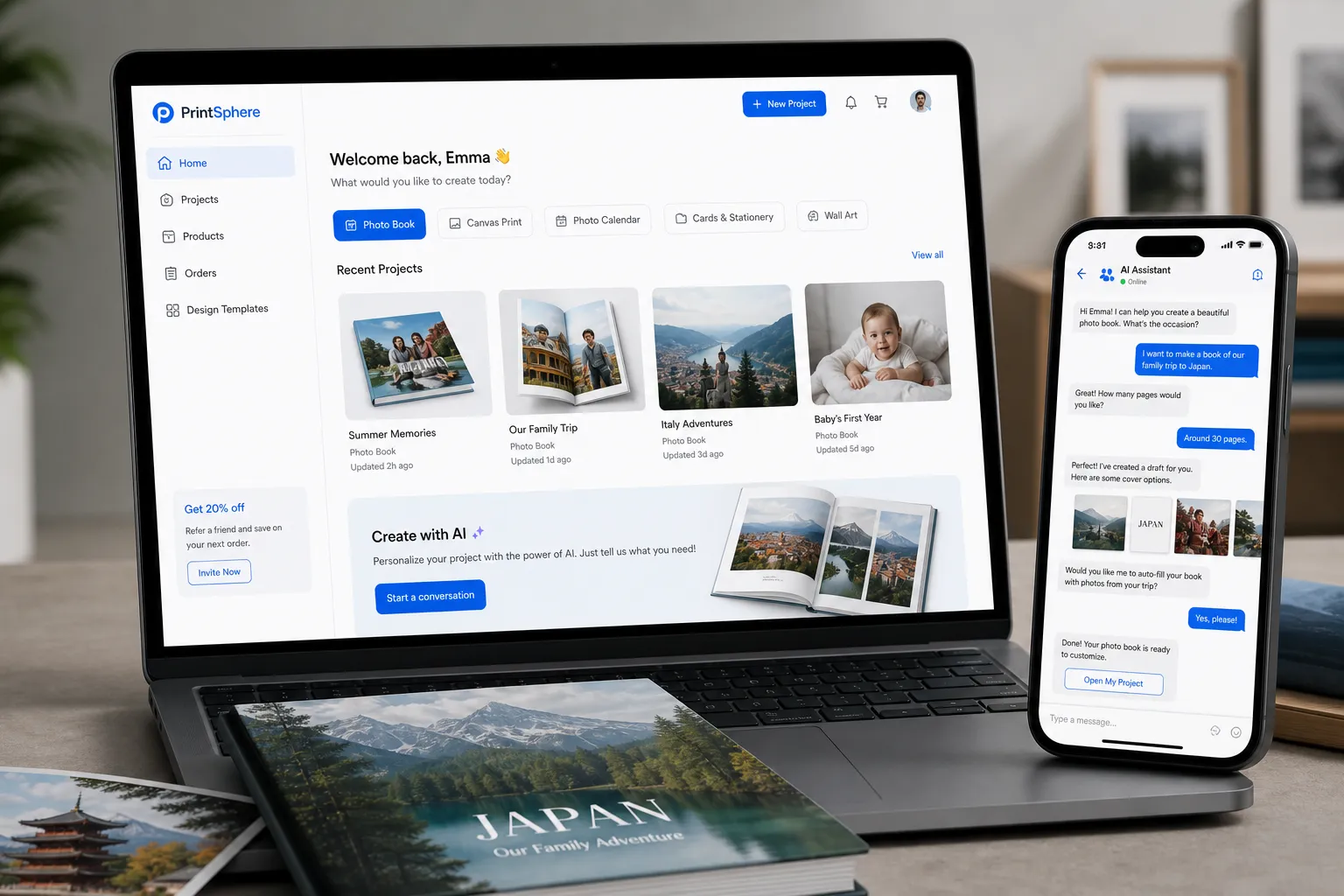
Media Rex Alliance is built for that new reality. Instead of forcing customers into complex design software, it enables conversational product creation that turns natural-language prompts into print-ready products, complete with photo handling, automated composition, white-label deployment, photorealistic 3D and AR previews, and on-demand global fulfillment. In short, it gives print businesses a faster path to modern, scalable personalization without rebuilding their stack from scratch.
What the Top Competitors Get Right - and Where the Real Opportunity Still Exists
The leading articles on AI in printing all converge on a few winning themes:
AI is accelerating creative workflows.
Personalization is becoming a baseline expectation.
print-on-demand and variable production models are replacing wasteful inventory-heavy systems.
Automation improves quality, speed, and cost control.
Human expertise still matters.
Those themes are valid, but most competitor content stops at the industry level. It explains that AI is transforming print, yet rarely shows how a print brand should operationalize that transformation inside an actual customer journey. The missing layer is execution.
The biggest content gaps in the current conversation
Most articles gloss over the questions that matter most to decision-makers evaluating AI-powered print technology:
What competitors cover | What they often miss | Why it matters |
|---|---|---|
AI improves design speed | How AI removes buying friction for end customers | Faster creation directly improves conversion rate |
Personalization at scale | The difference between generic AI and tailored, vertical AI for print | Print businesses need domain-specific workflows, not general-purpose novelty |
Automation in production | The full prompt-to-product pipeline | Revenue depends on the whole system, not isolated tools |
On-demand efficiency | White-label deployment into existing stores and apps | Brands want control, not a third-party experience |
Better previews and product confidence | 3D and AR validation before purchase | Visualization reduces hesitation and costly mistakes |
AI as a trend | AI as infrastructure for future web-to-print experiences | Leaders need a platform strategy, not just inspiration |
That is where Media Rex Alliance creates meaningful separation. It does not treat AI as a bolt-on creative assistant. It turns AI into the operating layer of a modern print commerce experience.
What “Custom AI” Really Means in Print Commerce
In print, custom AI should not mean a generic chatbot pasted onto a storefront. It should mean an intelligence layer tailored to how personalized products are conceived, built, previewed, ordered, and fulfilled.
A true print-specific AI system understands:
product constraints
layout logic
print file readiness
mobile interaction patterns
visual merchandising
preview accuracy
production routing
branded customer journeys
That distinction matters. General AI can generate ideas. Purpose-built AI for print can generate purchasable products.
From prompt to product, not just prompt to image
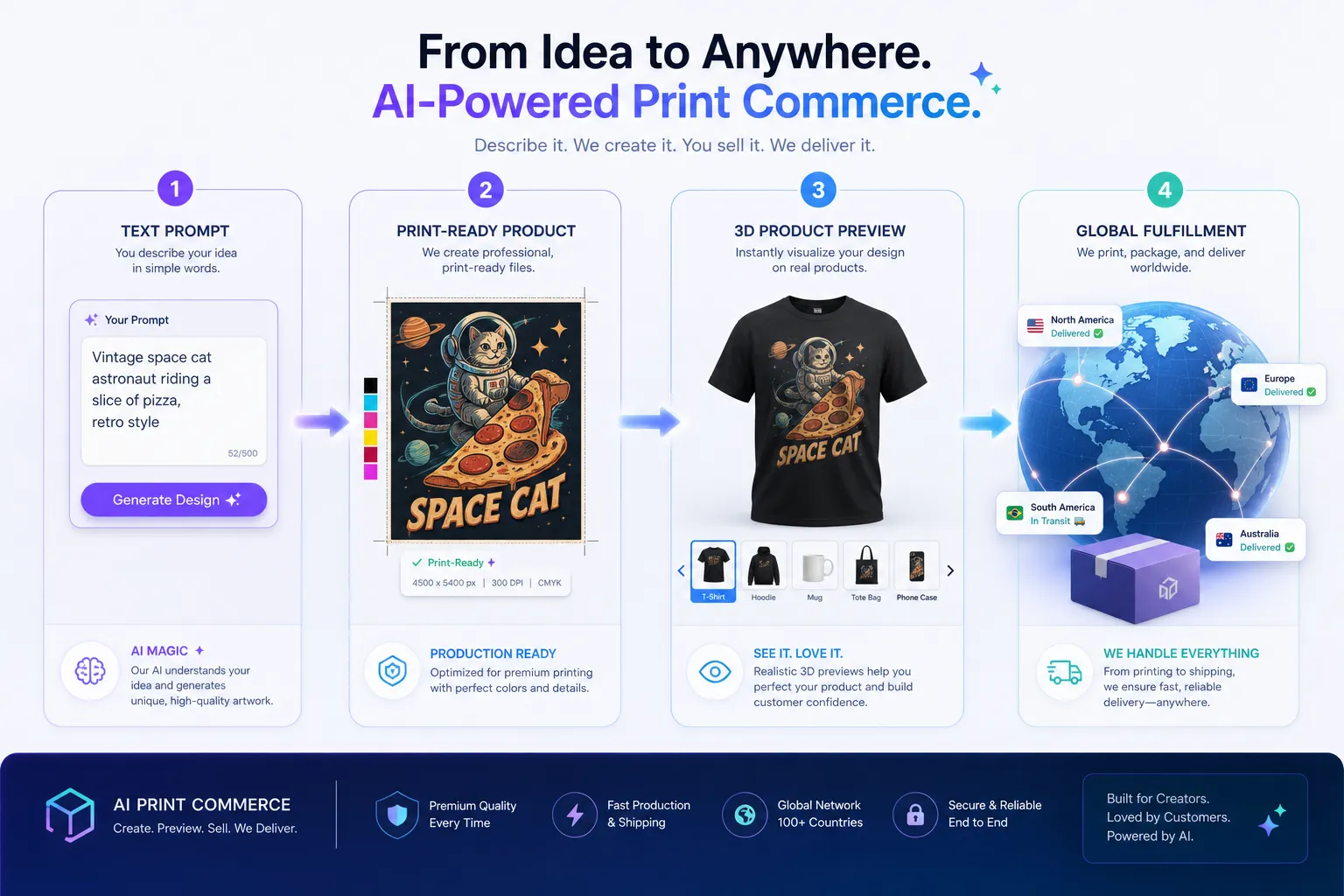
The biggest leap in 2026 is moving beyond image generation. Customers do not just want artwork; they want a completed, orderable item. That means the system must translate intent into an actual product configuration, place images and text intelligently, prepare files for production, and show exactly what the outcome will look like.
With Media Rex Alliance, conversational prompts become a commercially usable workflow:
The customer describes what they want.
The platform interprets intent and product context.
Photos or assets are uploaded if needed.
Layouts are generated automatically.
The product is rendered in photorealistic 3D and AR.
The order flows into on-demand fulfillment through a global printer network.
That is the real promise of custom AI in print: less tool friction, fewer abandoned sessions, and a shorter path from inspiration to transaction.
Why Personalization Has Become a Revenue Lever, Not Just a Feature
The print industry has always been close to personalization, but consumer expectations have changed. Today, buyers compare every interaction against the best digital experiences they use elsewhere. If your journey feels slow, confusing, or rigid, they leave.
"64% of consumers prefer to buy from companies that tailor their experience to their wants and needs." - XM Institute
That matters for every print business, from boutique photo studios to enterprise photo book brands. Personalization is no longer limited to the finished item; it now applies to the buying process itself. Customers want a personalized path to creation, not only a personalized end product.
Smarter personalization in 2026 happens across four layers
1. Intent personalization
The platform understands what the customer is trying to make, even if they do not know the exact specs yet.
2. Design personalization
Layouts, visual hierarchy, copy placement, and composition can adapt to the prompt, uploaded images, and product format.
3. Preview personalization
Customers see realistic previews of their exact product, not a vague mockup.
4. Fulfillment personalization
Orders can be routed on demand with minimal operational overhead, allowing businesses to offer more variation without carrying more stock.
This is where Media Rex Alliance gives brands leverage. Its infrastructure makes sophisticated personalization commercially manageable.
Why Legacy Web-to-Print Flows Are Losing Conversions
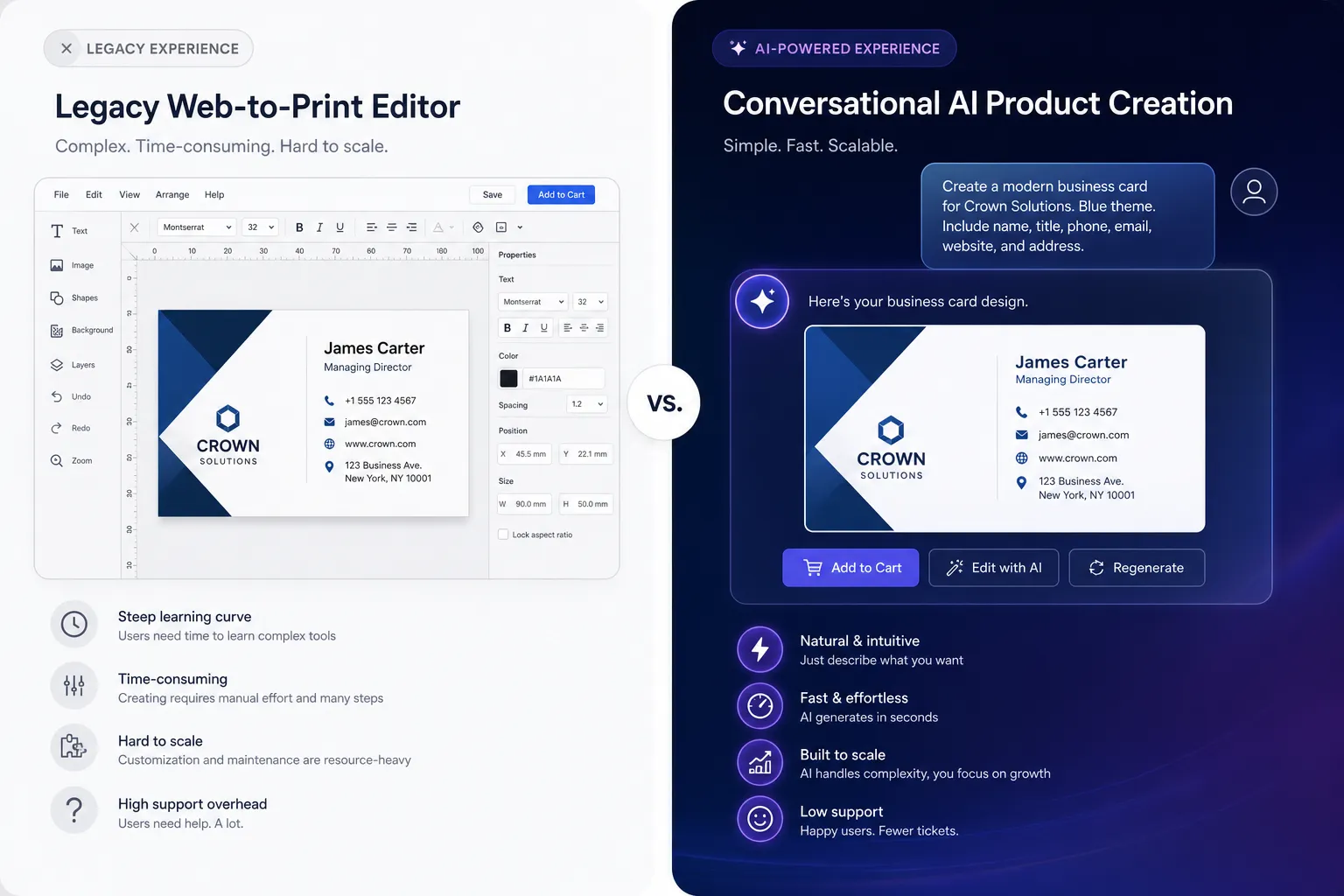
Traditional editors were built for precision, not momentum. They assume customers want to manually control every detail. In practice, many customers want the opposite: a fast start, guided creation, and confidence that the output will look great.
That mismatch is why so many print experiences still underperform on mobile and why high-intent visitors often fail to complete their purchase.
Common friction points in older print experiences
too many design decisions too early
desktop-first editors that feel painful on phones
unclear product visualization
weak support for novice users
long time-to-first-preview
difficulty syncing work across devices
high abandonment before checkout
Media Rex Alliance addresses those pain points directly with a browser-based, mobile-first experience that requires no app installation. Customers can begin from a conversation, continue across devices with local and cloud sync, and move from idea to visual proof far faster than legacy editors allow.
The New Print Commerce Stack in 2026
The future of print is not one tool. It is a connected stack that combines customer-facing intelligence, back-end automation, and production scalability.
What a modern AI-powered print stack should include
Capability | Why it matters | How Media Rex Alliance fits |
|---|---|---|
Conversational creation | Reduces learning curve and accelerates product discovery | Lets customers create through natural language |
Automated layout generation | Cuts manual design effort and improves speed | Transforms prompts and uploads into ready-to-print compositions |
Photorealistic 3D previews | Increases confidence and reduces uncertainty | Shows realistic product visualization before purchase |
AR visualization | Helps customers validate fit and appearance in context | Makes products easier to trust before ordering |
White-label deployment | Preserves brand control and customer ownership | Integrates into existing storefronts or apps under your brand |
Mobile-first browser access | Supports modern customer behavior | No app required, works across devices |
Local and cloud sync | Keeps sessions continuous | Enables seamless progress from phone to desktop and back |
On-demand production | Reduces inventory risk | Supports no-stock, low-overhead operations |
Global fulfillment automation | Expands scale without ops bloat | Routes orders through a premium printer network |
Competitors discuss pieces of this model, but very few frame AI as the connective layer across the full product lifecycle. That end-to-end architecture is what separates experimentation from business transformation.
AI Productivity Matters - But Only If It Reaches the Customer
One recurring theme in competitor content is that AI saves time internally. That is true, but internal productivity alone is not enough. If all AI does is help your team create faster while the customer still faces a slow purchase flow, growth will remain capped.
"84% of leaders in design and manufacturing industries report increased productivity due to AI integration." - Autodesk
The bigger opportunity is turning AI productivity into customer-facing speed:
faster first preview
faster product discovery
faster order completion
faster expansion into new product lines
faster white-label deployment for partners or regions
Media Rex Alliance is especially strong here because it does not isolate AI within a back-office team. It places intelligence where it moves revenue: at the point of creation and conversion.
Prompt-Led Commerce: The Shift That Changes Everything
For many print businesses, the next growth wave will come from prompt-led commerce. This is the idea that a buyer can express a need in plain language and the system assembles the path forward.
That changes more than UX. It changes business economics.
What prompt-led commerce improves
lower friction for first-time buyers
better mobile usability
broader addressable audience beyond design-savvy users
more completed sessions from inspiration-driven shoppers
less support burden during the creation phase
more scalable personalization
For photographers and studios, this means clients can build albums, wall art, or keepsakes without wrestling with an editor. For emerging print-on-demand brands, it means faster storefront launches and fewer blockers between campaign traffic and order capture. For established photo book companies, it means modernizing an aging interface without sacrificing brand identity.
3D and AR Previews: The Missing Link Between Personalization and Conversion
A major weakness in older print commerce models is that customers are asked to trust what they cannot fully see. Generic mockups and flat thumbnails do not build enough confidence for premium personalized products.
Photorealistic 3D and AR previews solve that problem by making the product feel real before it is produced. That has an outsized impact on higher-consideration purchases such as photo books, wall art, branded gifts, and custom home decor.
Why advanced previews matter
they reduce uncertainty
they improve perceived quality
they validate design choices faster
they lower the risk of surprise after delivery
they can improve conversion on mobile where confidence is harder to earn
Media Rex Alliance brings this capability into the creation flow, not as an afterthought. That matters because preview confidence should happen before checkout hesitation begins.

White-Label AI Is Becoming the Smartest Route to Market
One of the largest strategic gaps in competitor content is the assumption that adopting AI requires building a new product experience from scratch. For most print businesses, that is neither practical nor necessary.
White-label deployment changes the equation.
Instead of spending months or years developing proprietary AI tooling, brands can integrate a ready-made AI print platform into their existing storefront or app, fully aligned to their own domain, design system, and customer journey.
Why this model is attractive in 2026
Business type | Main challenge | White-label AI advantage |
|---|---|---|
Small studios | Limited technical resources | Launch advanced product creation without building software |
Photographers | Need premium client experience | Offer guided product creation under their own brand |
New POD brands | Need speed to market | Deploy faster and test product concepts with low overhead |
Regional print players | Need modernization | Upgrade digital experience without replacing everything |
Established photo book companies | Legacy systems and UX debt | Layer in AI innovation while preserving brand equity |
Media Rex Alliance is designed specifically for this use case. It gives businesses enterprise-grade functionality without forcing them into a marketplace identity or a generic third-party shell.
On-Demand Production Is Stronger When AI Handles the Front End Too
On-demand production has been a powerful model for years because it lowers inventory risk and improves flexibility. But its full potential is only realized when the customer-facing side is just as efficient as the fulfillment side.
Many brands already understand the back-end value of low-stock operations. Fewer have modernized the front-end creation experience to match.
The strongest print model in 2026 combines:
AI-assisted product creation
no-stock operational logic
automated production workflows
globally distributed fulfillment
premium output standards
branded digital ownership
Media Rex Alliance connects those pieces. It reduces friction before purchase, then reduces overhead after purchase through automated fulfillment and a global network of premium printers. That means brands can expand product diversity without expanding operational complexity.
How Different Print Businesses Can Use Custom AI
The promise of custom AI is not abstract. It shows up differently depending on the business model.
Small studios
Studios can offer premium personalized products without investing in custom software development. Customers get a modern guided experience, while the studio maintains a polished branded front end.
Photographers
Photographers can transform client photos into albums, prints, and gifts through a low-friction workflow that feels premium from first prompt to final preview.
New print-on-demand brands
Startups can reduce launch complexity, avoid heavy inventory commitments, and test personalized product offerings quickly through browser-based, white-label experiences.
Mid-size and regional print brands
These businesses can modernize their web-to-print stack without forcing a disruptive all-at-once rebuild. AI becomes a practical growth layer rather than a risky moonshot.
Established photo book companies
Larger incumbents can use AI to simplify product creation, improve mobile conversion, and extend the life of their brand by replacing outdated editor experiences with more intuitive journeys.
The Strategic Difference Between AI Features and an AI Platform
A lot of businesses will add isolated AI features in 2026. Fewer will build an actual platform advantage.
That distinction matters.
An AI feature might help generate a caption, remove a background, or suggest a design element. Useful, yes. Transformational, not necessarily.
An AI platform changes how the business operates and grows. It creates structural gains in:
conversion
product creation speed
operational efficiency
brand differentiation
partner enablement
geographic scalability
product launch velocity
Media Rex Alliance belongs in the second category. Its value is not one feature but the orchestration of creation, preview, deployment, and fulfillment into one commercially coherent system.
What to Evaluate Before Adopting AI for Print
If you are assessing vendors or deciding how to modernize your print commerce experience, focus on practical fit, not hype.
Key evaluation criteria
Evaluation question | Why it matters |
|---|---|
Can customers create through conversation instead of complex tools? | This directly impacts usability and conversion |
Does the platform produce print-ready outputs, not just creative ideas? | Commerce depends on execution quality |
Can it be fully white-labeled? | Brand control and customer ownership are essential |
Does it support mobile-first use in the browser? | Mobile is no longer optional |
Are 3D and AR previews built in? | Confidence drives higher conversion and fewer surprises |
Can users start on one device and continue on another? | Multi-device behavior is normal, especially for considered purchases |
Does the model support on-demand production? | This affects inventory risk and operational flexibility |
Is fulfillment automated across a reliable printer network? | Scale without operational drag is a competitive advantage |
In other words, the right AI partner should do more than demonstrate technical novelty. It should reduce friction, preserve your brand, and scale with your business model.
The 2026 Outlook: AI Will Separate Modern Print Brands From Legacy Ones
The next phase of print commerce will not be won by whoever has the most features. It will be won by the brands that make product creation feel effortless while maintaining premium quality behind the scenes.
The market is moving toward:
less manual editing
more guided creation
stronger mobile UX
richer previews
leaner inventory models
deeper storefront integration
automated global fulfillment
Competitor articles correctly identify AI as a major force in print. But the real winners will be the companies that connect AI directly to revenue outcomes: better conversion, faster purchase decisions, broader personalization, and scalable branded experiences.
Final Verdict: Custom AI Is No Longer Optional for Growth-Focused Print Businesses
In 2026, the question is no longer whether AI will influence print. It already does. The real question is whether your business will use AI as a marketing talking point or as a growth engine.
For print businesses that want to modernize without building everything from scratch, Media Rex Alliance offers a compelling answer. It replaces editor friction with conversational creation, turns prompts into print-ready products, delivers photorealistic 3D and AR previews, supports seamless browser-based mobile experiences, syncs work across devices, enables no-stock on-demand production, and automates fulfillment through a global premium printer network - all under your own brand.
If you want to launch a smarter, more scalable personalized print experience that converts better and operates leaner, Media Rex Alliance is the platform to build on.