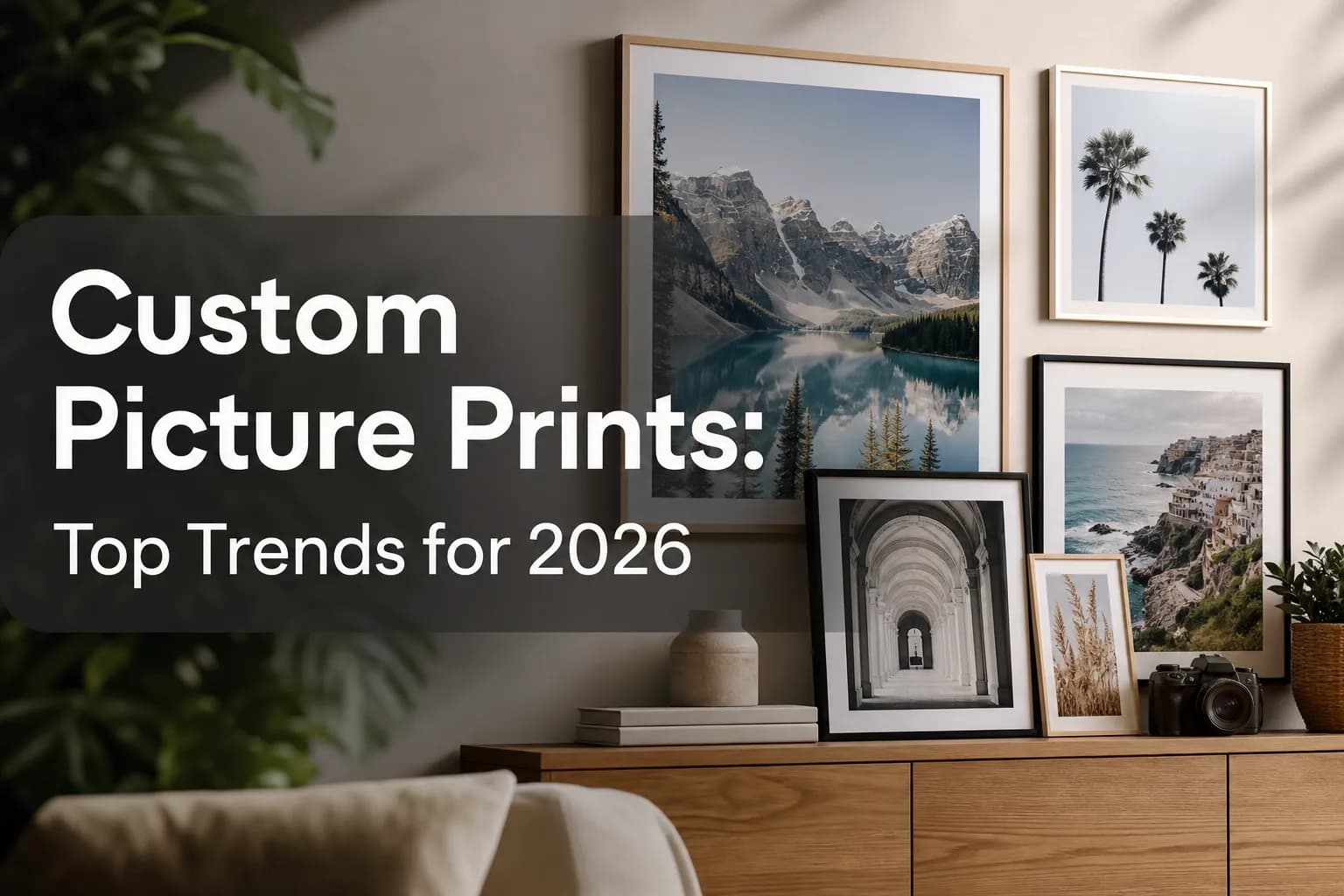
Custom Picture Prints: Top Trends for 2026
For print businesses, photographers, studios, and modern web-to-print brands, 2026 is not just about offering more products. It is about reducing friction, increasing confidence, and giving customers a faster path from idea to order. The biggest shift in custom picture prints is clear: buyers want highly personal products, premium presentation, and a creation experience that feels as intuitive as messaging an AI assistant.
Competitor coverage around print-on-demand, wall art, and home decor trends points to recurring themes: personalization, warm minimalism, AI-generated aesthetics, gallery walls, texture, and premium framing. But most of that content stops at inspiration. What they often miss is the operational side of what actually wins in 2026: how print businesses turn trends into scalable products, how mobile-first creation affects conversion, and why 3D/AR previews are quickly becoming essential in custom commerce.
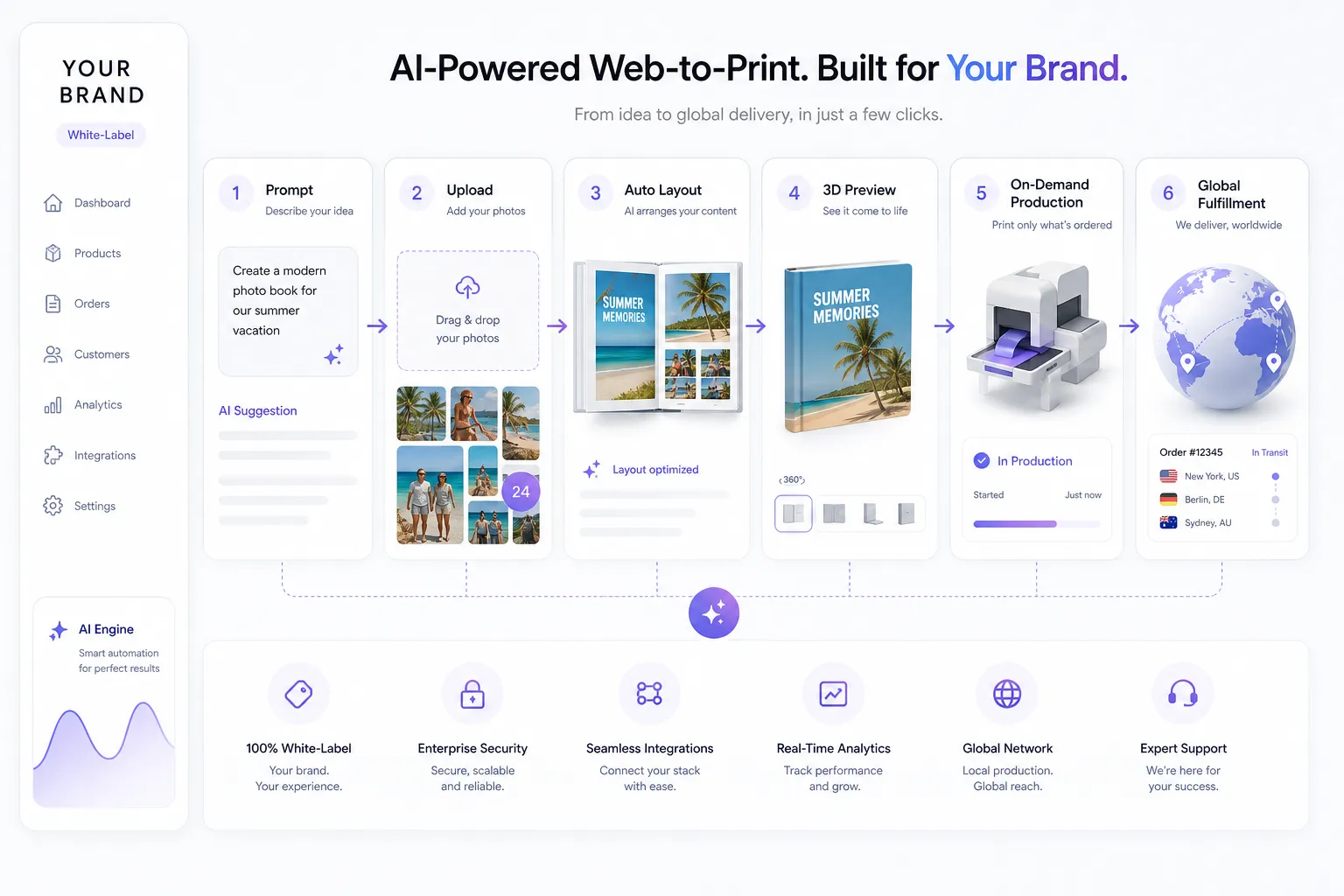
This is where Media Rex Alliance has a structural advantage. Instead of forcing customers into complicated editors, it enables conversational product creation through natural language, transforms prompts into print-ready outputs, supports photo uploads, and delivers photorealistic 3D and AR previews inside a fully white-label experience. For brands that want to modernize without rebuilding their stack, that changes everything.
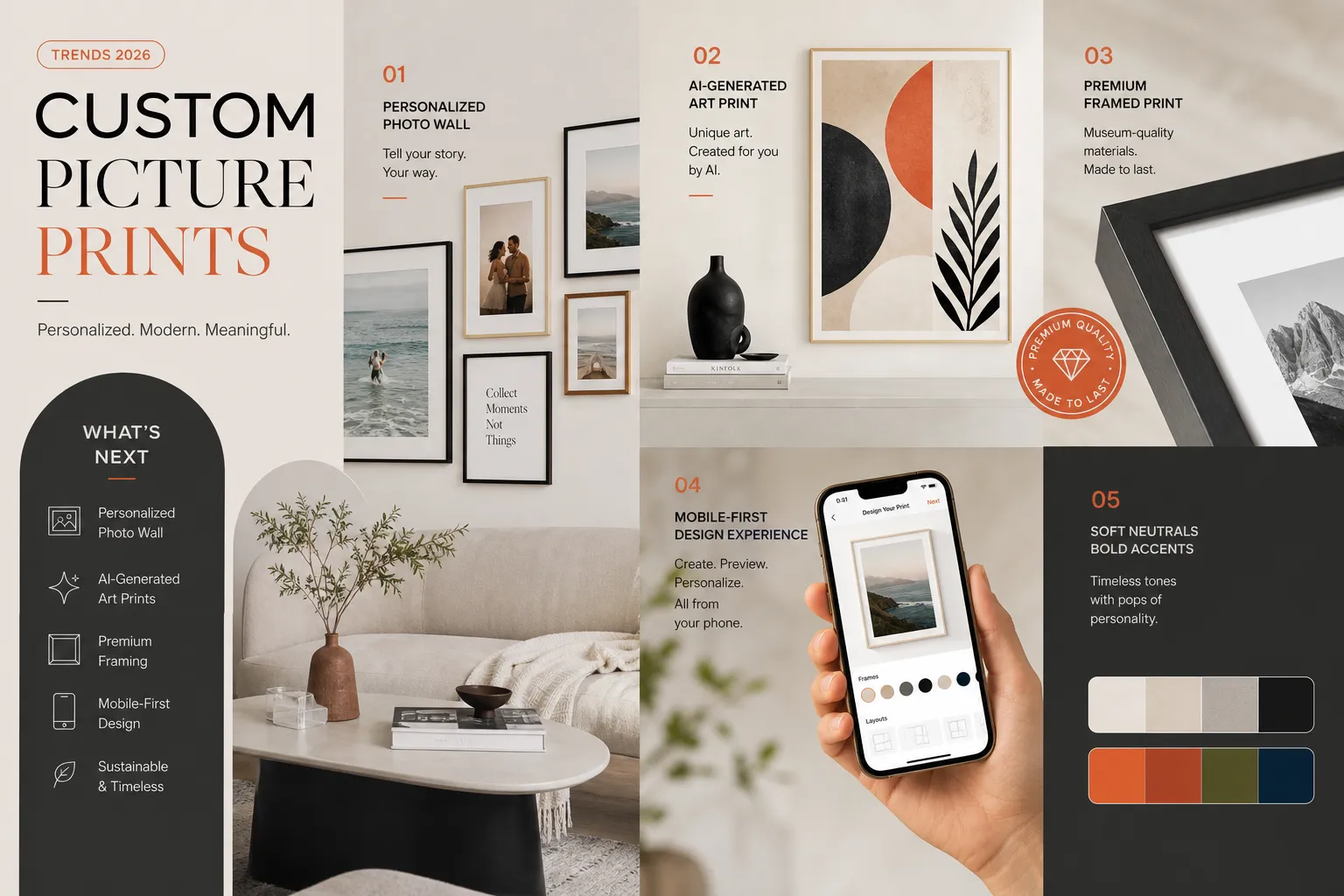
What the top-ranking content gets right, and what it misses
The leading articles consistently highlight a few winning ideas:
buyers want art and photo products that feel personal
neutral palettes and nature-inspired visuals remain strong
gallery walls and oversized statement pieces are both growing
AI-generated art is becoming mainstream
print-on-demand works best when it moves fast with trends
All of that is valid. But there are clear content gaps.
Content gap 1: The customer journey matters as much as the print itself
Most articles focus on what to print, not how customers create it. In reality, abandoned sessions often happen before production quality ever becomes relevant. If the design flow feels slow, technical, or desktop-only, conversion suffers.
Content gap 2: AI is treated as style inspiration, not infrastructure
Competitors mention AI-generated art, but rarely address AI-powered product creation. That is the bigger commercial trend. In 2026, the strongest platforms do not just generate visuals; they generate layouts, product compositions, and purchase-ready experiences.
Content gap 3: Preview technology is underexplored
Very few competitor articles explain how buyers gain confidence before ordering. Yet custom picture prints are emotional purchases. Seeing a photorealistic 3D or AR preview can be the difference between hesitation and checkout.
Content gap 4: White-label scalability is barely discussed
Studios, regional print brands, and established photo product companies do not need another disconnected tool. They need branded infrastructure that plugs into their storefront or app, scales globally, and preserves their identity. That is a major strategic gap in typical trend roundups.
Why custom picture prints are accelerating in 2026
Custom picture prints sit at the intersection of personalization, gifting, home decor, and creator commerce. They appeal to consumers because they are emotional, displayable, and easier to customize than many other physical products.
In 2026, demand is being shaped by four forces:
Trend Driver | What It Means for Buyers | What It Means for Print Businesses |
|---|---|---|
Personalization | Customers want products tied to their memories, identity, or taste | Offer flexible formats and faster customization |
AI simplification | Buyers expect low-effort creation | Replace complex editors with prompt-based creation |
Preview confidence | Customers want to see the finished result before paying | Use 3D and AR previews to reduce uncertainty |
On-demand fulfillment | Shoppers expect variety without long delays | Reduce inventory and automate production globally |
The 8 biggest custom picture print trends for 2026
1. Conversational AI product creation
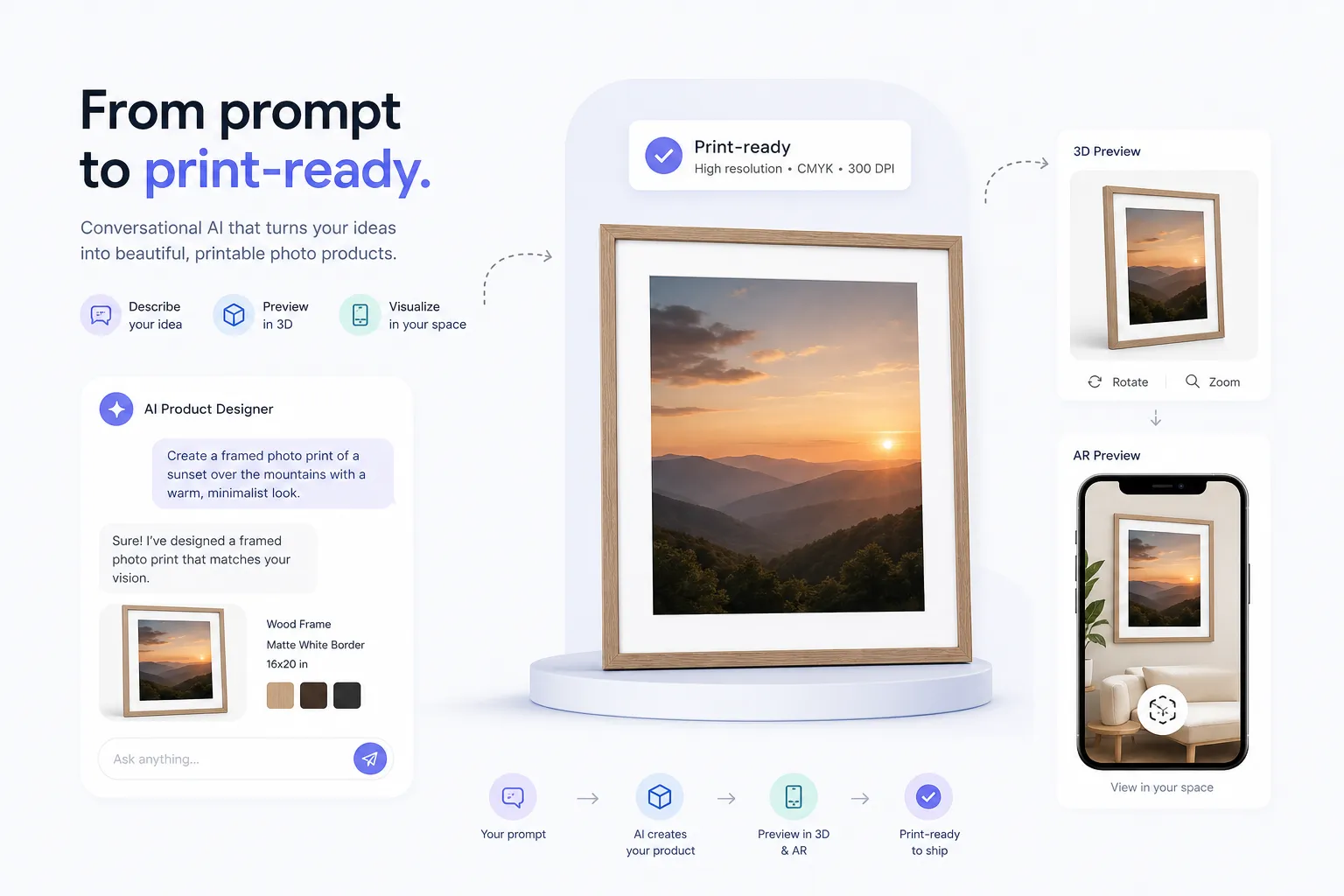
The most important shift is not a color palette or frame finish. It is interface design. Customers increasingly want to describe what they want instead of learning traditional design software. They want to say, “Turn this travel photo into a warm minimalist framed print,” and get a ready-to-buy product in seconds.
Media Rex Alliance is built around exactly this behavior. Its autonomous creation engine converts prompts into print-ready products, reducing friction and helping customers move from inspiration to purchase faster.
Why it matters
lowers the skill barrier for end customers
speeds up creation on mobile devices
increases completion rates by simplifying choices
makes customization feel intuitive, not technical
2. Premium personalization over generic templates
Personalization is still dominant, but the bar is higher. Consumers no longer respond to basic text swaps alone. They want richer customization: curated layouts, uploaded photos, aesthetic framing, story-based arrangements, and products that feel made for them rather than mass configured.
This favors businesses that can combine automation with premium output.
Winning examples
family memory walls
milestone and wedding prints
pet portraits
travel photo series
branded creator collections
gift-ready prints with elegant composition
3. Gallery walls with modular flexibility
Gallery walls remain one of the strongest visual formats because they are both decorative and expandable. Buyers like the ability to start small and build over time.
What changes in 2026 is the expectation of easier curation. Instead of manually arranging every image, users want automated layout assistance and quick product bundling.
What sells best
3-piece and 6-piece coordinated sets
thematic collections by trip, season, or family moment
mixed portrait and landscape layouts
matching frame systems for cleaner presentation
For businesses, this is a strong upsell opportunity. One emotional concept can become a multi-item bundle instead of a single print order.
4. Warm minimalism and calming interiors
Mixtiles-style wall art coverage shows a consistent move toward warm neutrals, grounding browns, soft greens, and subtle textures. That trend carries directly into custom picture prints. Buyers want images that feel personal but also blend into elevated, contemporary spaces.
Design characteristics
beige, sand, olive, dill green, and muted charcoal
simple borders and understated frames
clean negative space
photography edited for softness rather than harsh contrast
For custom print sellers, this means product presentation matters. A beautiful memory can underperform if the mockup feels visually noisy.
5. AI-assisted art and photo hybrid prints
AI art is no longer separate from personal photography. One of the most commercially interesting directions in 2026 is hybrid creation: combining a real uploaded photo with AI-generated styling, background enhancement, layout direction, or artistic transformation.
High-potential use cases
portrait-to-illustration prints
cinematic travel scene enhancement
children’s artwork turned into polished wall pieces
branded aesthetic filters for creator storefronts
mood-based reinterpretations of family photos
This is where Media Rex Alliance is especially valuable. It enables uploaded content, prompt-driven creative direction, and scalable print output inside one browser-based flow.
6. Photorealistic 3D and AR previews before checkout
Custom products are harder to buy when the customer cannot fully visualize the result. In 2026, preview realism is not a nice-to-have. It is a conversion layer.
Media Rex Alliance provides photorealistic 3D and immersive AR previews so customers can inspect products before ordering. That builds confidence, especially for higher-value framed prints, gallery sets, and home decor formats.
Why this matters commercially
reduces uncertainty before purchase
helps justify premium pricing
improves confidence on mobile
lowers the gap between imagination and checkout
7. Mobile-first design without app friction
Most consumers discover, customize, and buy from their phones. Yet too many print experiences still behave like desktop tools squeezed onto a small screen.
The winning experience in 2026 is browser-based, responsive, and immediate. No download. No software learning curve. No broken experience when switching devices.
What modern buyers expect
creation in the browser
touch-friendly customization
fast loading previews
projects synced across devices
easy recovery of unfinished sessions
Media Rex Alliance aligns with this expectation through a mobile-first web experience, local and cloud sync, and no-app-required access.
8. On-demand production with premium global fulfillment
The final trend is operational, but it shapes product viability more than many brands realize. More businesses want to offer more SKUs, formats, and visual variations without taking on inventory risk. That makes on-demand production and automated routing essential.
Why this is critical
lower overhead for new brands
easier expansion into new print categories
reduced dead stock
faster testing of niche collections
scalability for regional and enterprise operators
Media Rex Alliance supports this with an automated fulfillment pipeline and a global network of premium printers, allowing brands to scale product creation without scaling operational complexity.
The print formats buyers want most in 2026
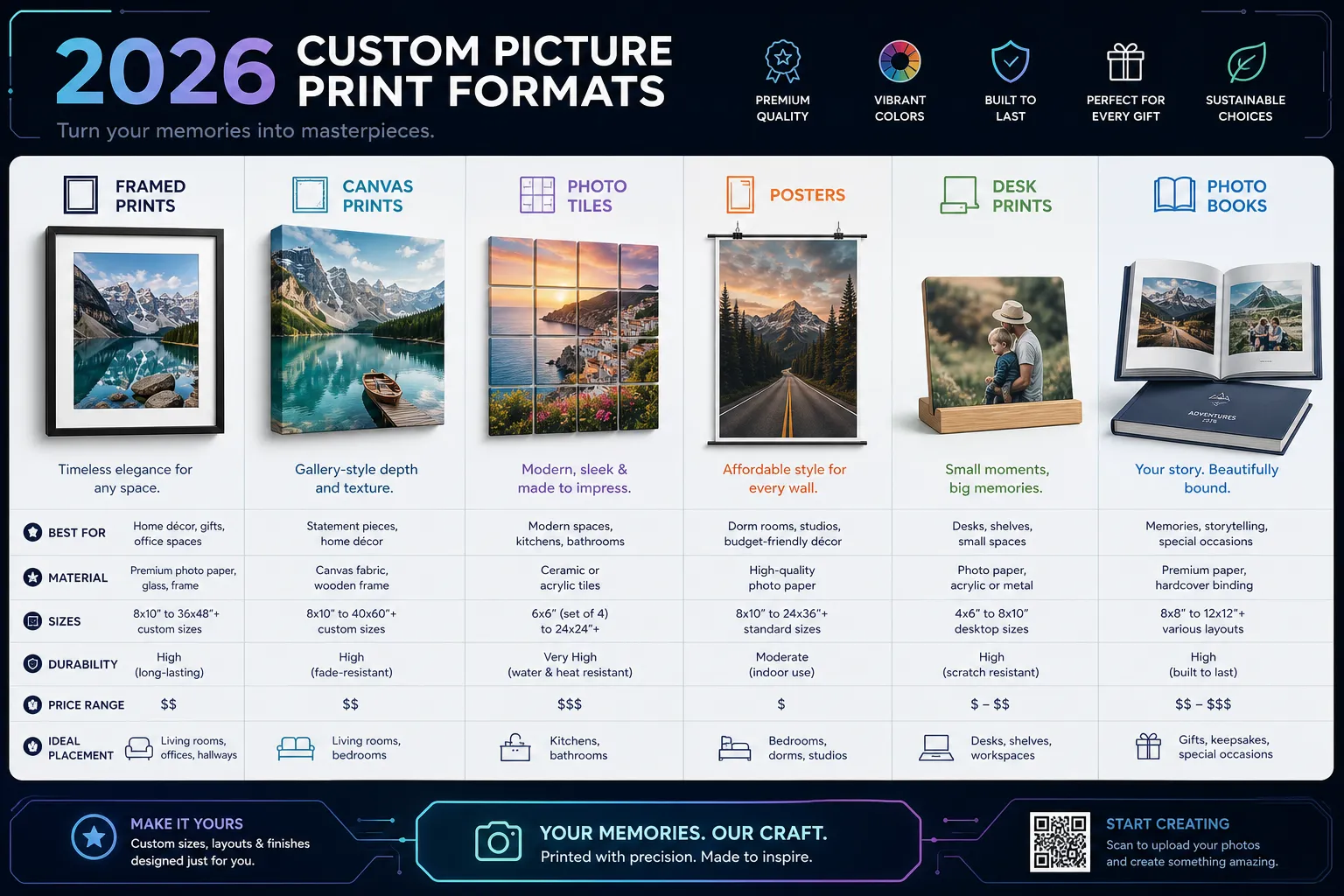
Competitor content often mentions trends in style, but format demand is just as important. The table below maps what is resonating now.
Print Format | Why It’s Trending | Best Fit |
|---|---|---|
Framed prints | Premium, giftable, interior-friendly | Studios, photographers, home decor sellers |
Poster prints | Affordable entry point, easy to scale | POD brands, trend-led sellers |
Canvas prints | Texture and warmth, premium feel | Home decor brands, photo businesses |
Gallery wall sets | Higher order value, storytelling | Family photo brands, lifestyle retailers |
Desk prints | Compact gifting and office decor | Corporate gifting, creator commerce |
Photo books paired with prints | Multi-product memory bundles | Photo book companies modernizing offers |
What shoppers want most from custom picture prints
If you strip away aesthetics, the buyer mindset in 2026 comes down to five priorities.
1. Personal meaning
The product should represent a memory, taste, milestone, or identity.
2. Visual confidence
They want to know what will arrive, ideally through realistic previews.
3. Simplicity
They do not want to fight a design editor.
4. Speed
Creation, checkout, and fulfillment all need to feel efficient.
5. Quality signals
Framing, finish, mockups, and brand presentation must communicate trust.
How print businesses should adapt their offer in 2026
The opportunity is not just launching more prints. It is redesigning the buying experience around customer behavior.
Upgrade from design tool to creation engine
Traditional editors assume customers want full manual control. Many do not. A prompt-led model gives them the result faster, especially when paired with optional photo uploads and automatic layout generation.
Make every workflow white-label
For growing brands and enterprise print companies, brand ownership matters. A disconnected third-party flow can weaken trust. Media Rex Alliance allows full white-label deployment with branded domain, visual identity, and customer-facing experience.
Use 3D and AR to lift higher-ticket sales
Premium framed products often require more reassurance than low-cost posters. Rich previews reduce hesitation and support stronger average order values.
Build for omnichannel and mobile
Whether traffic comes from social, influencer campaigns, organic search, or a returning customer base, the print experience has to work instantly across devices.
A smarter 2026 stack for studios, photographers, and print brands
The businesses best positioned for growth are not necessarily the ones with the largest catalog. They are the ones with the least friction between intent and order.
A future-ready print stack should include:
Capability | Why It Matters in 2026 |
|---|---|
Conversational AI creation | Makes customization accessible to more buyers |
Photo upload + auto layout | Speeds product creation and reduces decision fatigue |
3D and AR previews | Improves trust and pre-purchase confidence |
White-label integration | Protects brand equity and customer ownership |
Browser-based mobile UX | Removes app friction and expands conversion potential |
Cloud + local project sync | Supports multi-device continuity |
Global print fulfillment | Enables scalable, no-stock operations |
Final verdict: the future of custom picture prints is intelligent, visual, and frictionless
The top trends for 2026 are not just about what looks good on a wall. They are about how quickly and confidently a customer can turn an idea, photo, or prompt into a premium physical product.
Custom picture prints are moving toward:
more personalization
less manual design work
better preview realism
stronger mobile experiences
fully on-demand fulfillment
white-label scalability for serious print businesses
That is the strategic opening for Media Rex Alliance. It gives studios, photographers, digital print businesses, and established photo product brands a way to launch AI-powered print experiences without building the technology from scratch. By combining conversational creation, photorealistic 3D and AR previews, mobile-first browser access, white-label deployment, and automated global fulfillment, it turns print personalization into a faster, smarter, more scalable business model.
If you want to modernize your print offering for 2026 without adding operational drag, Media Rex Alliance is the platform to watch.
FAQ
What prints are trending in 2026?
Personalized framed prints, gallery wall sets, canvas pieces, and AI-assisted photo-art hybrids are leading in 2026. Buyers are drawn to prints that feel emotional, premium, and easy to customize from mobile devices.
What are the most popular art prints in 2026?
The most popular styles combine warm minimalism, nature-inspired tones, abstract softness, and personal photography. Framed prints and coordinated wall sets are especially strong because they fit modern interiors and gifting occasions.
What are the trending graphic design styles for 2026?
Trending design styles include AI-enhanced visuals, clean typography, muted earthy palettes, soft gradients, and photo-illustration hybrids. The strongest designs balance emotional storytelling with a polished, premium presentation.
What are the key trends in the print industry for 2026?
The biggest industry trends are AI-powered product creation, white-label web-to-print experiences, photorealistic 3D/AR previews, and on-demand fulfillment. Print businesses are focusing on lower friction, faster launch cycles, and scalable infrastructure.
What kind of prints are trending?
Trending prints include family photo walls, travel series, pet portraits, premium posters, and canvas or framed memory pieces. Products that combine visual quality with personal relevance are performing best.
What are some new trends in 2026?
New trends include prompt-based customization, hybrid AI-photo designs, immersive AR previews, and browser-based mobile creation without app downloads. These shifts make custom print buying faster, easier, and more conversion-friendly.