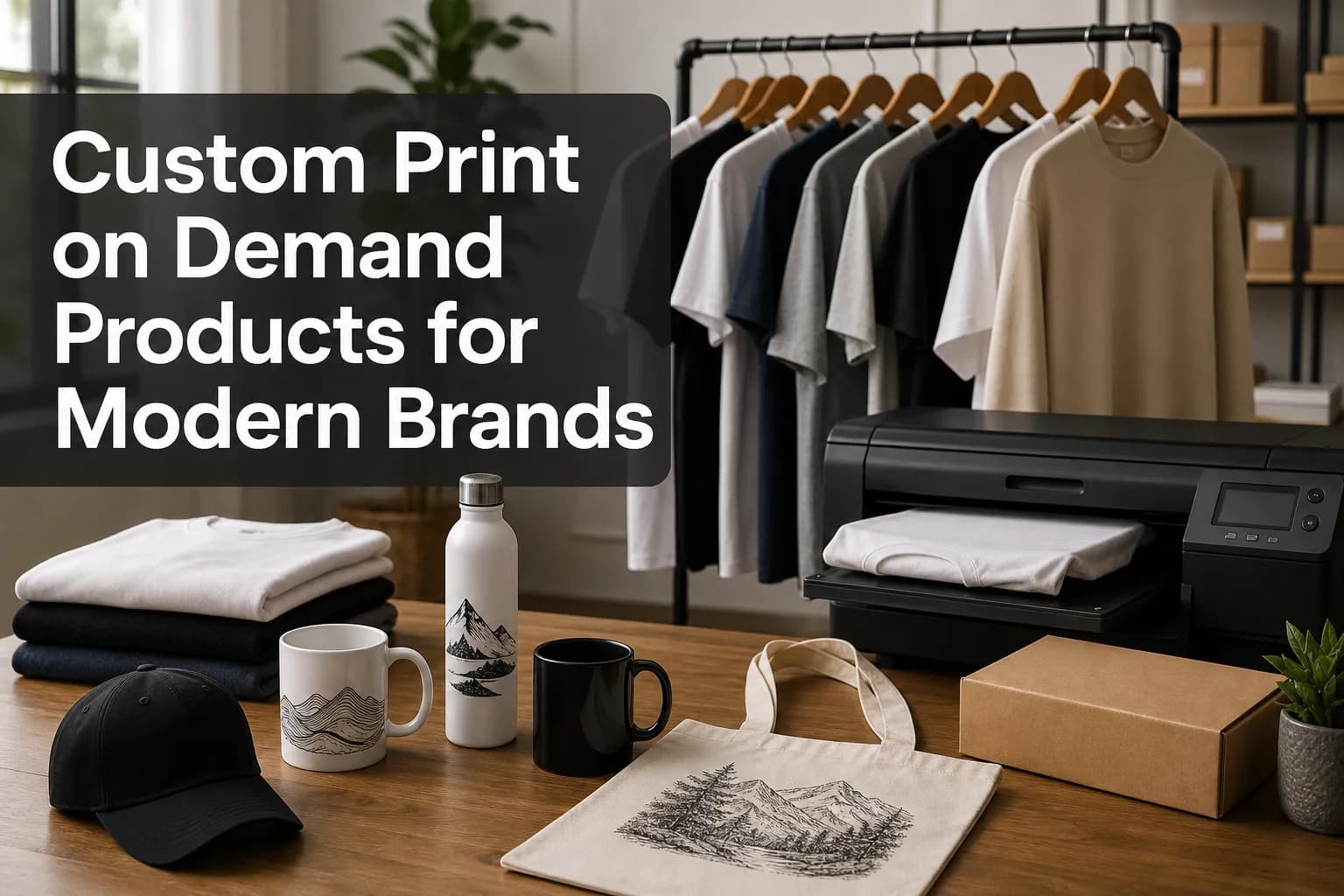
Custom Print on Demand Products for Modern Brands
Custom print on demand products have evolved far beyond basic t-shirts and mugs. Today, they sit at the center of a much bigger shift in commerce: buyers want personalization, brands want lower risk, and print businesses need faster, smarter ways to launch products without building complex infrastructure from scratch.
For small studios, photographers, new print-on-demand brands, mid-size print companies, regional print players, and established photo book businesses, the challenge is no longer just “How do we sell custom products?” It’s “How do we make customization effortless, scalable, and profitable?”
That is exactly where the market is moving. The winning model combines on-demand production with AI-powered creation, seamless storefront integration, photorealistic previews, and automated fulfillment. Instead of forcing users through complicated editors, modern platforms let customers describe what they want in plain language and turn that request into a print-ready product in minutes.
Media Rex Alliance is built for this future. As a white-label AI print platform, it enables print businesses to offer conversational product creation, mobile-first browser-based design, 3D and AR previews, cloud-sync workflows, and global automated fulfillment under their own brand.
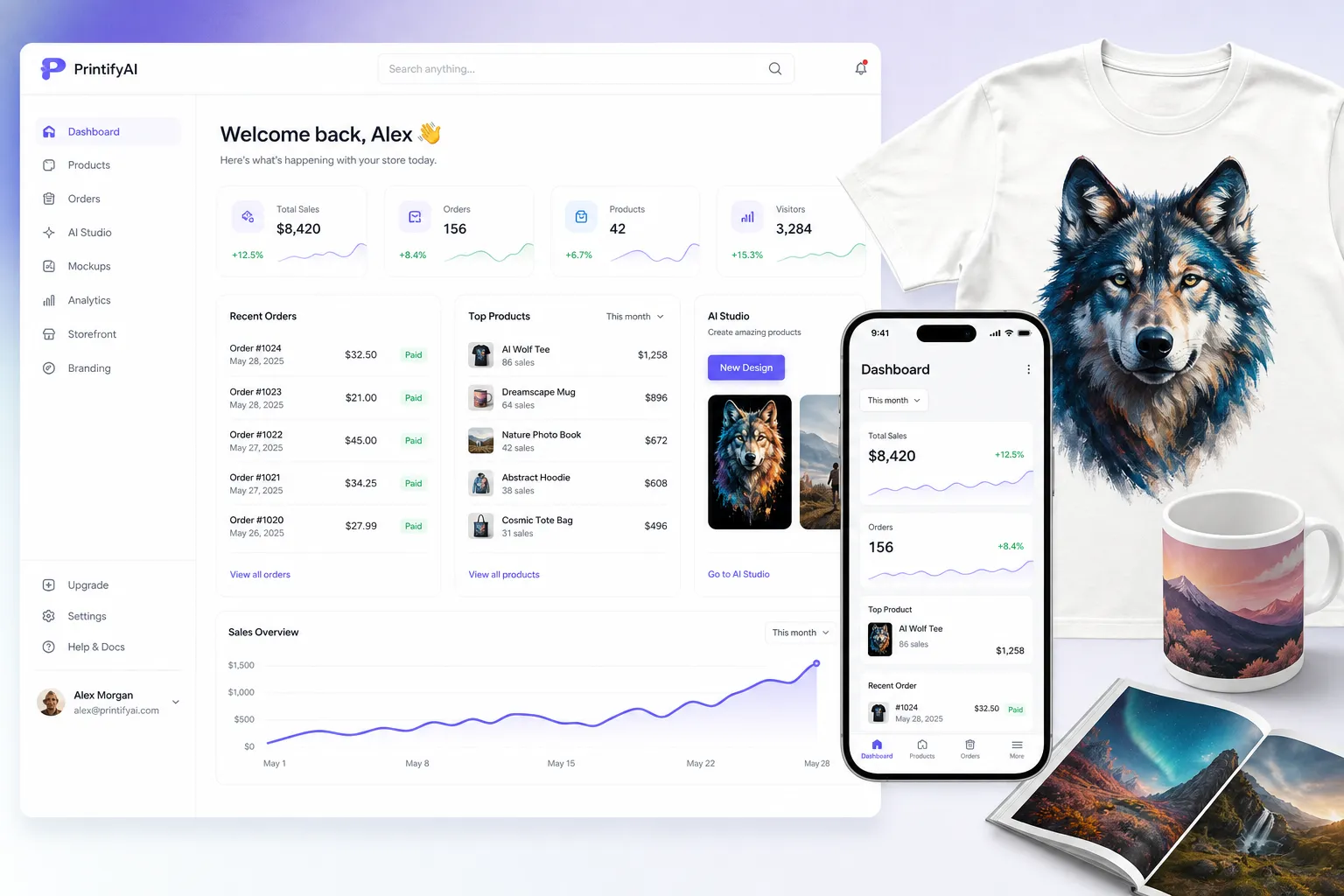
What custom print on demand products actually mean today
Custom print on demand products are physical goods created only after a customer places an order, with personalization or branding applied at the time of production. That sounds simple, but the modern version is much more advanced than the traditional POD model.
In the older setup, sellers uploaded static artwork to a product template and listed it online. In the modern setup, customers can co-create the product, brands can offer many more variants without inventory risk, and the production workflow can be fully automated.
This means custom print on demand can now include:
Personalized apparel
Photo books and premium albums
Wall art and framed prints
Custom stationery
Branded merchandise
Event and gifting products
Creator merchandise
Limited edition drops
Regional or niche product lines
The core benefit remains the same: no need to buy inventory upfront. But the real competitive advantage now comes from reducing friction between idea and checkout.
Why demand for custom print on demand is growing
The rise of custom print on demand products is driven by three forces happening at once:
Consumers expect personalization
Brands want to reduce inventory risk
Technology now makes customization easier to scale
"A notable percentage of consumers indicated they would become repeat buyers after experiencing personalized online shopping." - Statista
That matters because repeat purchasing is where long-term margin lives. If personalization improves buyer satisfaction and confidence, then custom print on demand is not just a production model. It is a conversion strategy.
The shift from mass product catalogs to tailored buying
Modern shoppers are overwhelmed by choice but still want products that feel specific to them. Brands that let customers personalize an item, co-create a design, or transform a memory into a product create a stronger emotional connection than brands selling generic stock designs.
For photographers and photo product companies, this is especially powerful. A product is no longer just a print object. It becomes a premium, personalized keepsake.
The economics are more attractive for brands
Traditional retail requires forecasting demand, buying stock, storing products, and managing dead inventory. With on-demand production, brands can test more ideas, expand product lines faster, and launch without tying up capital.
AI changes the customer journey
The biggest growth unlock is not just better printing. It is better product creation.
If customers can describe what they want instead of learning design software, more of them complete the journey. That is why conversational AI is becoming so important in web-to-print and personalized commerce.
The biggest limitations of traditional POD platforms
Many businesses exploring print on demand custom products discover the same problem: the production model is modern, but the customer experience is outdated.
Traditional POD tools often rely on:
Clunky design editors
Desktop-heavy workflows
Too many customization steps
Weak mobile UX
Limited preview quality
Generic storefront experiences
Minimal brand differentiation
This creates friction at the exact moment where customers should feel excited and confident.
A customer may want a personalized hoodie, framed print, or photo book, but if the creation flow feels technical, slow, or confusing, the purchase stalls. This is where many competitors stop. They explain POD economics, but they do not solve the experience gap.
The new standard: conversational commerce for custom products
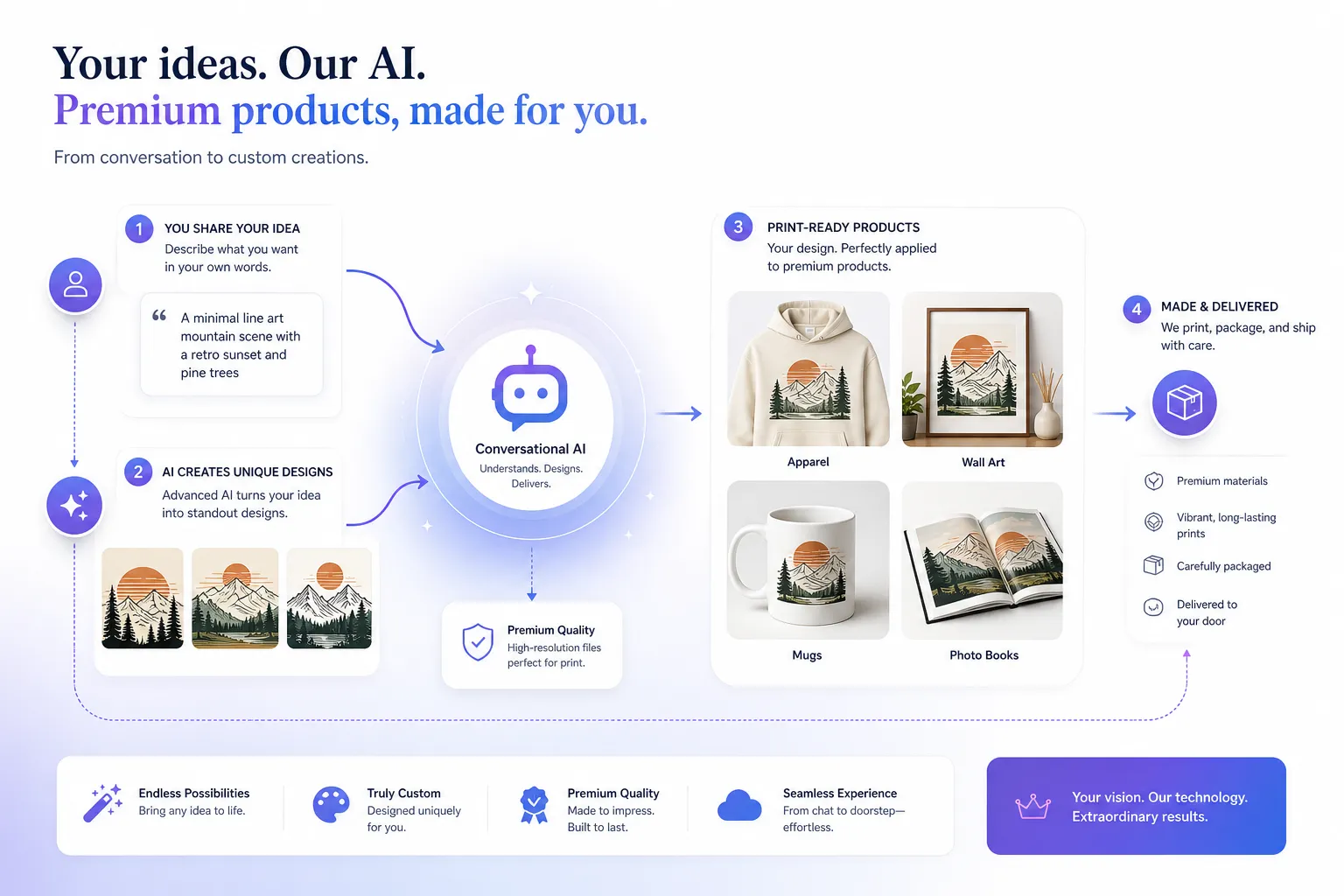
The most important innovation in custom print on demand is the shift from manual design to conversational creation.
Instead of forcing users to drag, resize, and align every element manually, a modern AI-powered print platform lets the customer say what they want:
“Create a minimalist travel photo book with warm tones.”
“Make a streetwear hoodie design inspired by retro racing.”
“Turn these pet photos into a premium wall art layout.”
“Design a gift mug with a funny message and elegant typography.”
The system then translates the prompt into a print-ready concept, applies layouts automatically, and gives the buyer a realistic preview before purchase.
Why this matters for conversion
The shorter the path from idea to visualization, the higher the likelihood of conversion.
This is one of the strongest reasons Media Rex Alliance stands out. Its autonomous creation engine allows customers to create products through natural language rather than complex design tools. That reduces friction, speeds up purchase decisions, and opens custom product selling to a much wider audience.
This is especially valuable for:
Mobile users
First-time buyers
Non-designers
Gift shoppers
Busy creators
B2B buyers ordering under time pressure
How modern brands use print on demand custom products
Custom print on demand is not limited to one business model. Different verticals use it in different ways.
For photographers and studios
Photographers can turn sessions, weddings, portraits, and brand shoots into premium physical products without carrying inventory. Instead of offering only digital galleries, they can monetize with:
Photo books
Wall art
Keepsake prints
Branded client gifts
Seasonal collections
With Media Rex Alliance, this becomes even more powerful because customers can upload photos, generate layouts automatically, and review photorealistic 3D or AR previews before ordering.
For new POD brands
Startups can launch quickly without building a tech stack from scratch. They can test niches, experiment with product-market fit, and scale only the products that perform.
For established print businesses
Regional and mid-size print companies often have production capabilities but outdated online experiences. A white-label AI print platform lets them modernize without rebuilding everything internally.
For photo book companies
Established photo book brands need to reduce drop-off in the creation flow. AI-assisted layouts, mobile-first product creation, and realistic previews can dramatically improve usability and order completion.
For enterprise print operations
Larger print companies need infrastructure that scales. That means:
White-label deployment
Brand-level customization
Cross-device continuity
Automated fulfillment orchestration
Global production routing
Flexible integration into existing ecommerce ecosystems
Custom print on demand products that perform best
Not every product works equally well in every market. The strongest categories usually share three qualities:
Emotional relevance
Clear visual value
Strong margin potential
Here is a practical breakdown.
Best product categories for modern custom print on demand
Category | Why It Performs | Best For | Margin Potential |
|---|---|---|---|
Apparel | Broad demand, strong brand potential, repeat buying | POD brands, creators, merch businesses | Medium to high |
Photo Books | High emotional value, premium positioning | Photographers, photo brands, gifting | High |
Wall Art | Strong personalization and home decor appeal | Studios, artists, gift markets | High |
Mugs & Drinkware | Fast gifting and impulse purchase potential | Ecommerce brands, events, creators | Medium |
Hats & Accessories | Good branding surface, lifestyle merchandising | Apparel brands, streetwear labels | Medium to high |
Stationery | Personalized gifts and event use cases | Wedding, family, business gifting | Medium |
Tote Bags | Practical, visual, low-barrier product | Lifestyle and eco-conscious brands | Medium |
Premium Keepsakes | Emotional, niche, giftable | Photo companies, family-focused brands | High |
What buyers now expect before they place an order
Customers no longer trust flat mockups alone, especially for personalized items. When the product is custom-made, they want proof before purchase.
Today’s expectations include:
Realistic product previews
Accurate placement visualization
Mobile-friendly editing
Fast loading experience
Simple creation flow
Confidence that the final product matches what they see
"In 2023, the furniture category led in online sales of custom-made products, with luggage and bags following closely." - Statista
The larger takeaway is clear: buyers are increasingly comfortable purchasing customized products online, but only when the digital experience feels reliable.
Why 3D and AR previews are a conversion lever
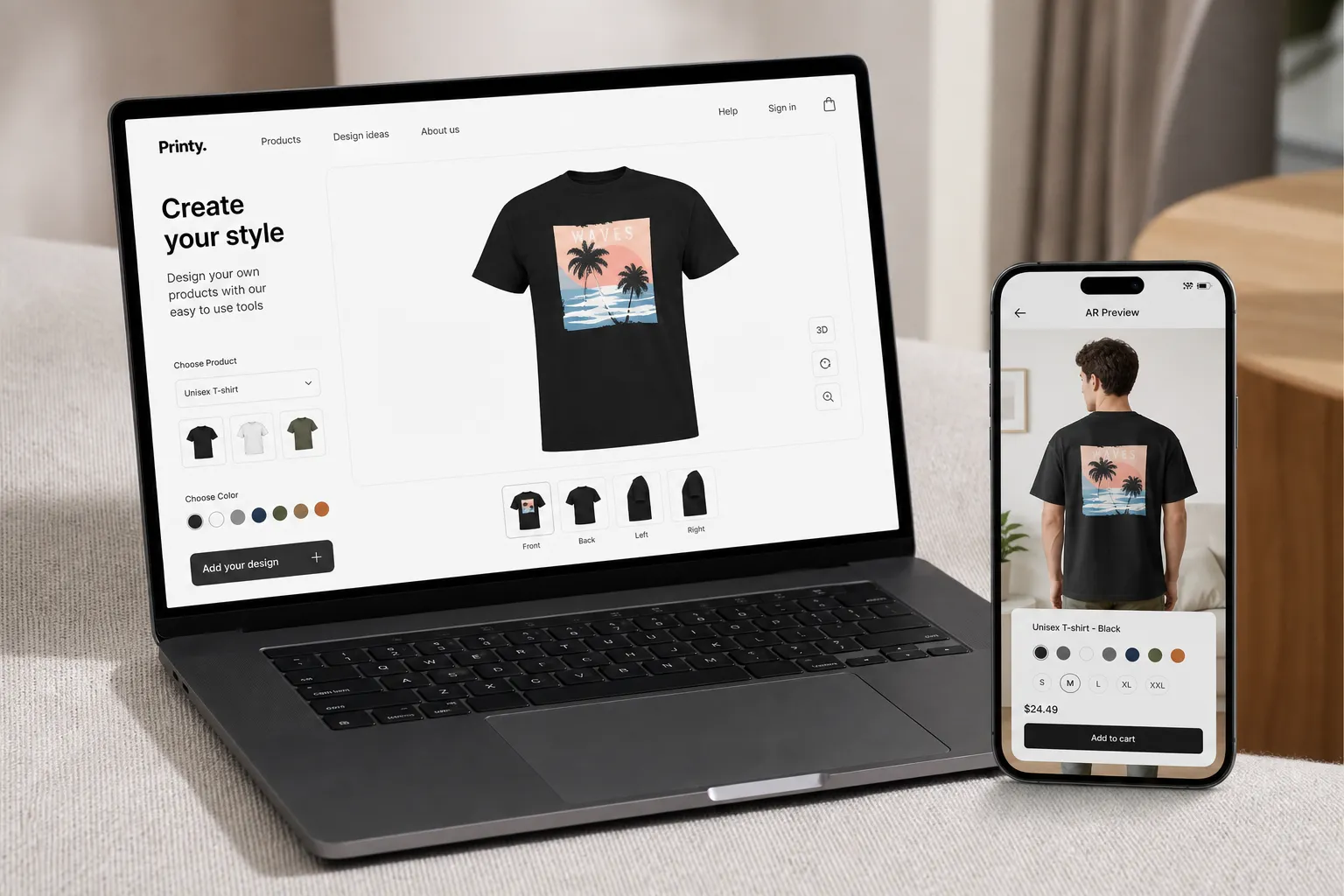
Photorealistic 3D and AR previews reduce uncertainty. They help customers understand scale, finish, composition, and visual quality before committing.
This is especially important for:
Framed art
Home decor
Photo books
Personalized gifts
Premium apparel
Products with multiple customizable zones
Media Rex Alliance addresses this directly by providing photorealistic 3D and immersive AR previews, giving customers a clearer sense of the final product and improving confidence at checkout.
Why mobile-first design is no longer optional
A surprising weakness across many POD experiences is mobile usability. Too many tools were originally built for desktop editors and then squeezed into smaller screens.
That no longer works.
Modern buyers discover products, browse collections, personalize gifts, and complete transactions on mobile. If the creation experience is frustrating on a phone, conversion drops.
What mobile-first really means
A true mobile-first custom print on demand experience should include:
Browser-based access with no app download
Fast product configuration
Touch-friendly editing or prompt entry
Simple photo upload
Instant previews
Saved project continuity across devices
Media Rex Alliance is designed around this reality. Its browser-based, mobile-first approach removes installation friction, while local and cloud sync allows projects to move seamlessly between devices.
That matters for real-world behavior. A customer may start designing on a phone during a commute, revisit on a tablet later, and complete checkout on a laptop. The experience should follow them without interruption.
White-label matters more than many brands realize
One of the most overlooked issues in the competitor landscape is brand ownership.
Many print businesses rely on third-party tools that feel generic, expose the platform vendor, or limit control over the experience. That may be acceptable for hobby sellers, but it becomes a major problem for serious brands.
Why white-label infrastructure changes the game
White-label custom print technology allows a business to:
Keep customers inside its own branded ecosystem
Maintain visual consistency
Control trust signals
Build long-term brand equity
Avoid directing value to another platform’s identity
Offer differentiated customer journeys
Media Rex Alliance is built as a fully white-label SaaS solution, which means print businesses, photo companies, and POD brands can deploy it inside their own storefronts or apps with their own branding, domain, and visual identity.
For growing brands, this is not a cosmetic feature. It is strategic infrastructure.
How AI-powered custom print on demand reduces operational drag
Beyond customer experience, AI-driven print commerce also improves internal efficiency.
Traditional workflows often create bottlenecks in:
File preparation
Layout creation
Customer support
Revision cycles
Design assistance
Product setup
Fulfillment coordination
AI helps remove that overhead.
Operational advantages of AI-assisted product creation
Operational Challenge | Traditional Workflow | AI-Powered Workflow |
|---|---|---|
Product creation | Manual editing and formatting | Prompt-based generation |
File readiness | Frequent human intervention | Faster print-ready outputs |
Customer support | More “how do I design this?” tickets | Simpler customer self-service |
Product expansion | Slow SKU setup | Faster collection launches |
Buyer confidence | Static mockups | 3D and AR previews |
Mobile use | Often poor | Designed for browser-based mobile creation |
Multi-device continuity | Limited | Local and cloud sync |
This is why AI is not just a front-end novelty. It is an efficiency layer across the entire print commerce system.
The business case for no-stock, on-demand production
No-stock production remains one of the strongest commercial arguments for custom print on demand.
It reduces:
Upfront inventory investment
Warehousing requirements
Overstock risk
Cash tied up in slow-moving products
Seasonal forecast mistakes
And it increases:
Product testing speed
SKU flexibility
Market responsiveness
Launch velocity
Niche experimentation
For startups, this lowers the barrier to entry. For established print businesses, it improves agility. For enterprise players, it enables controlled expansion without unnecessary overhead.
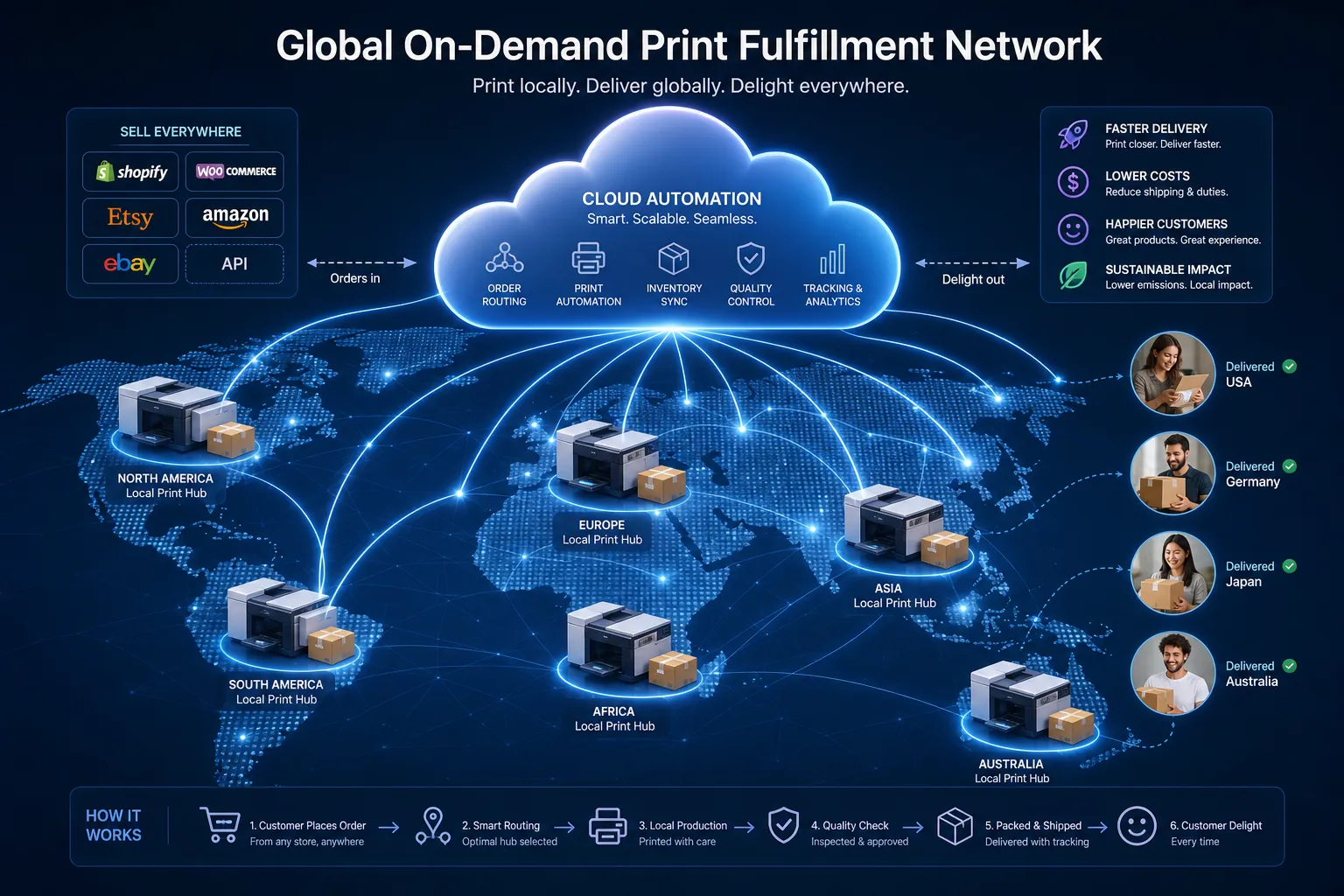
Media Rex Alliance supports this model directly through on-demand production and an automated fulfillment pipeline backed by a global network of premium printers.
What competitors often miss about modern print commerce
After reviewing competitor-style positioning across POD leaders, a few patterns emerge. Most competitors do a solid job explaining the basics:
No inventory
Large product catalogs
Ecommerce integrations
Profit calculators
Basic personalization options
But many gloss over the deeper shifts shaping the next generation of custom print on demand.
Content gaps most competitors leave open
They focus on products more than experience
Product count matters, but it does not solve conversion friction. The user journey matters more than catalog size once product selection crosses a certain threshold.
They underplay mobile-first behavior
Many platforms mention ecommerce broadly but do not deeply address mobile-first product creation.
They treat customization as manual editing
This misses the real innovation: conversational AI as the new interface for product design.
They rarely address white-label ownership in depth
For professional print businesses, control over brand experience is essential.
They don’t go far enough on preview fidelity
Static mockups are not enough for premium personalized commerce. 3D and AR matter.
They often separate creation from fulfillment strategy
The best modern solution connects customer creation, print readiness, order orchestration, and global production in one system.
These are exactly the areas where Media Rex Alliance offers differentiated value.
How to evaluate a custom print on demand platform in 2026 and beyond
If you are selecting a solution for your business, do not stop at product count or base pricing. Evaluate the full stack.
Use this checklist
Evaluation Area | What to Look For | Why It Matters |
|---|---|---|
Creation UX | Conversational AI, simple flows, fast outputs | Drives conversion and accessibility |
White-label capability | Brand, domain, visual identity control | Protects customer relationship |
Mobile-first design | No app required, browser-based creation | Supports real buyer behavior |
Preview technology | 3D and AR visualization | Increases buyer confidence |
Integrations | Storefront/app compatibility | Speeds deployment |
Sync and continuity | Local + cloud project persistence | Improves multi-device usage |
Fulfillment network | Global premium production partners | Supports scale and delivery reliability |
Production model | No-stock, automated on-demand | Reduces overhead and inventory risk |
Scalability | Startup to enterprise readiness | Avoids future replatforming |
A practical rollout strategy for brands and print businesses
Adopting modern print-on-demand infrastructure does not have to be disruptive. A phased rollout often works best.
Phase 1: Launch a focused category
Start with one strong use case such as photo books, personalized wall art, or a branded apparel line.
Phase 2: Introduce AI-assisted creation
Replace or simplify manual design steps with prompt-based workflows and automated layouts.
Phase 3: Add richer previews
Introduce photorealistic 3D and AR to reduce hesitation and improve conversion quality.
Phase 4: Expand under your own brand
Deploy the full experience as a white-label extension of your storefront or app.
Phase 5: Scale fulfillment intelligently
Use global on-demand production to expand reach without adding inventory complexity.
This staged model works for both smaller creative businesses and more established print operations.
Why Media Rex Alliance is positioned for the next era of custom print on demand
Media Rex Alliance is not just another POD tool. It is an AI-powered web-to-print platform designed around what the market is becoming.
Its strategic advantages align directly with modern buyer and operator needs:
Conversational AI replaces complicated design tools
Prompts become print-ready products quickly
White-label deployment protects your brand equity
3D and AR previews improve purchase confidence
Mobile-first browser access removes download friction
Local and cloud sync supports multi-device continuity
On-demand production reduces stock risk and overhead
Automated fulfillment connects to a premium global printer network
Infrastructure scales from startup teams to enterprise print companies
That combination matters because modern brands do not just need products. They need a commerce engine that turns creativity into conversion with less friction.
Final verdict
Custom print on demand products are no longer just a low-risk way to sell merch. They are becoming a smarter, more personalized, and more scalable commerce model for modern brands.
The businesses that win in this category will not be the ones with the biggest generic catalog. They will be the ones that make product creation feel instant, intuitive, branded, and trustworthy.
That means embracing:
AI-powered customization
Mobile-first buying behavior
photorealistic product previews
white-label brand control
automated on-demand fulfillment
If your business wants to modernize its web-to-print offering, shorten the path from idea to order, and launch premium custom print on demand at scale, Media Rex Alliance offers the infrastructure to do it without building the stack yourself.
For print businesses, studios, photographers, POD brands, and photo product companies ready to move faster, convert better, and own the customer experience, Media Rex Alliance is the platform built for what comes next.