Design and Sell Shirts for Faster POD Growth
If you want to design and sell shirts profitably in 2026 and beyond, the biggest challenge is no longer just finding a print provider. It is removing friction from the buying journey, launching faster, and creating a branded experience customers actually want to finish.
For small studios, photographers, emerging print-on-demand brands, regional print businesses, and established photo product companies, the opportunity is clear: custom apparel remains one of the easiest entry points into scalable on-demand commerce. The problem is that most legacy workflows still slow customers down with clunky editors, too many design steps, weak previews, and disconnected fulfillment.
That is where the next phase of shirt commerce is being won. At Media Rex Alliance, we see the future of web-to-print as conversational, mobile-first, white-label, and deeply automated. Instead of forcing customers through complex design tools, brands can let them create print-ready products from a simple prompt, preview them in photorealistic 3D and AR, and route orders through a premium global print network without carrying inventory.
What the Best Competitor Content Gets Right - and What It Misses
The strongest competitor articles consistently focus on a few core themes:
low-risk startup economics
wide product catalogs
provider comparisons like Printify vs Printful
fulfillment speed and shipping reach
niche selection and product quality
marketplace versus own-store tradeoffs
Those are important. But most ranking articles still stop at the operational layer. They explain how POD works, yet underplay the conversion layer.
The biggest content gap: customer creation friction
Most guides assume the bottleneck is production. Increasingly, it is not. The bottleneck is getting a customer from idea to confident purchase. Traditional product customizers can feel like work. If a user has to learn a design interface before they can buy a shirt, many will bounce.
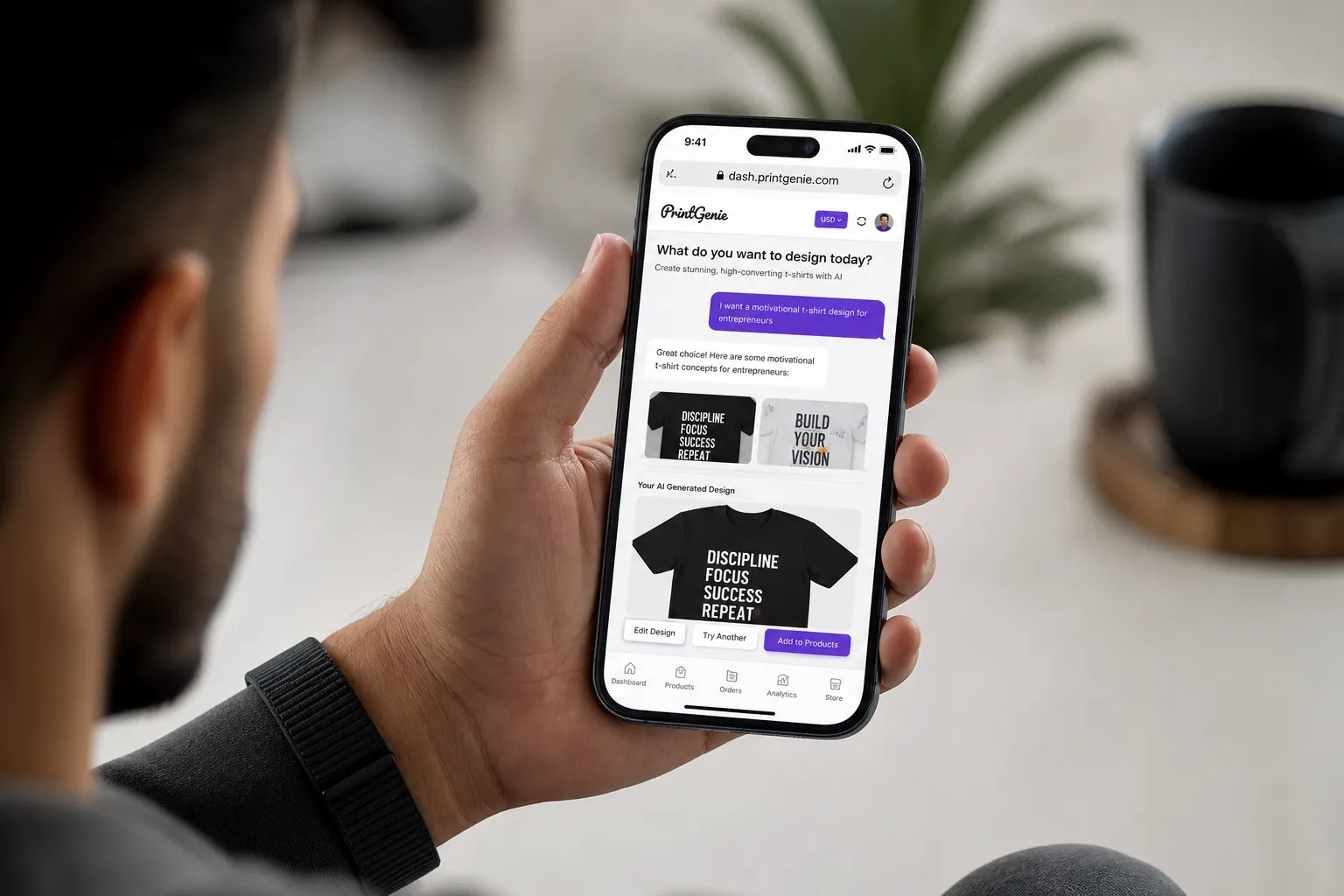
Media Rex Alliance closes that gap by enabling customers to create products through conversational AI. A simple prompt can become a print-ready layout in moments, dramatically reducing hesitation and shortening time to checkout.
The second content gap: modern previews drive confidence
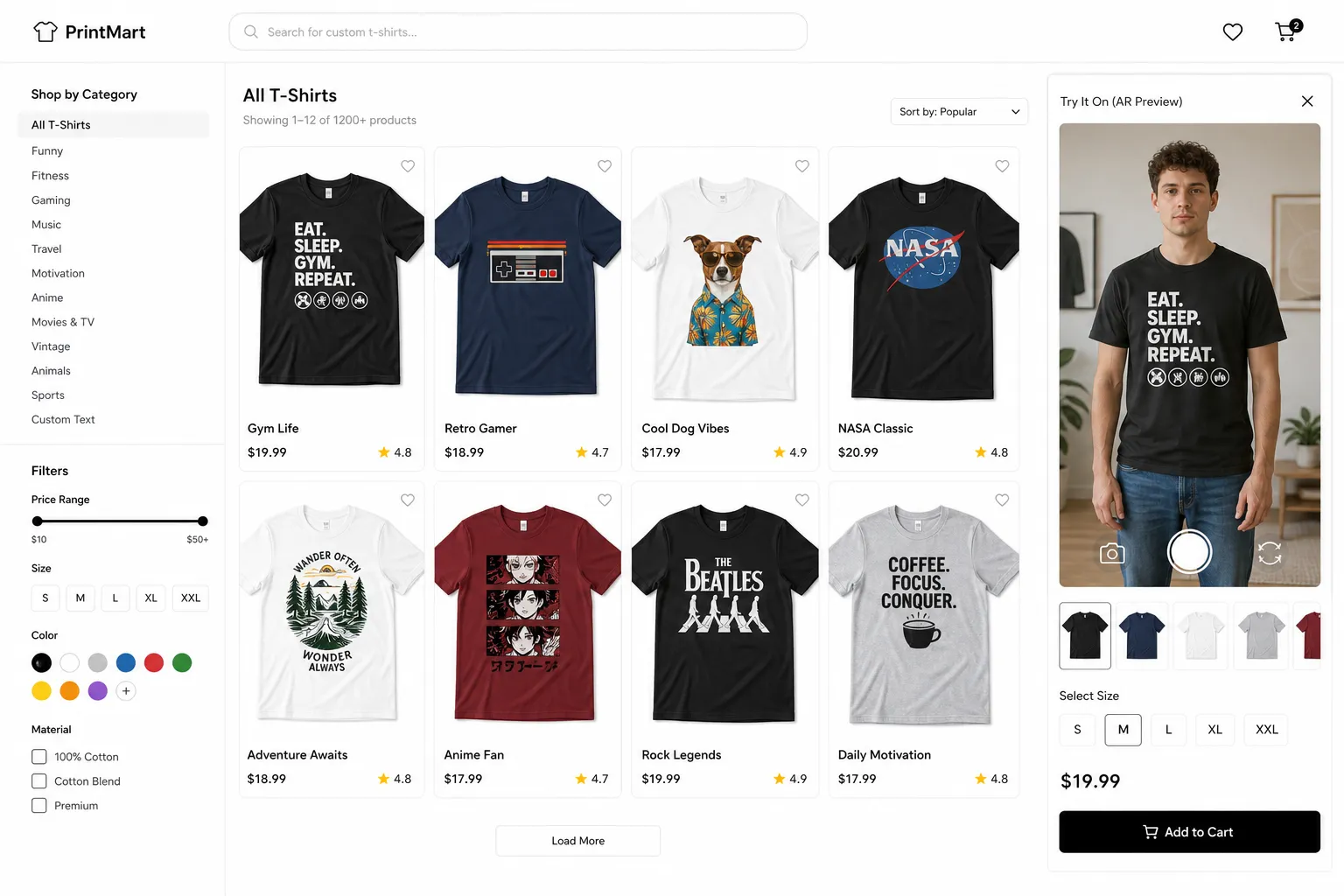
Most competitor content mentions mockups, but not immersive previews as a conversion lever. Static mockups are useful. Photorealistic 3D and AR previews are stronger. They help customers understand fit, design placement, and visual quality before purchase, which can increase confidence and reduce buyer remorse.
The third content gap: white-label matters more than tools alone
Many guides recommend third-party platforms, but fewer discuss long-term brand control. For serious operators, the goal is not merely to sell a shirt. It is to own the experience, customer relationship, and repeat purchase loop. A white-label AI print platform lets print businesses launch under their own domain, design system, and brand identity instead of sending demand elsewhere.
Why Shirts Are Still the Fastest POD Product to Scale
Shirts remain the most scalable print-on-demand category because they sit at the intersection of broad demand, accessible pricing, and repeatable merchandising.
Why custom shirts outperform many other POD products
Factor | Why It Matters |
|---|---|
Universal demand | Nearly every niche can support apparel |
Simple merchandising | Easier to explain and price than complex products |
Repeat purchase potential | Seasonal drops, events, communities, and personalization drive reorders |
Strong margins | Especially when workflows are automated and returns are minimized |
Fast creative testing | Easy to launch multiple concepts without stock risk |
Unlike bulky inventory-led retail, on-demand shirt businesses can test concepts rapidly. That means lower overhead, less dead stock, and faster learning cycles.
Shirts fit both impulse and identity-driven buying
Customers do not just buy shirts for utility. They buy them to signal belonging, humor, aesthetics, fandom, values, or memory. That makes shirts ideal for:
creator merch
event merchandise
family and group apparel
branded local businesses
niche communities
photographers and artists extending their work into products
personalized gifting
The Modern POD Growth Model
Old-school POD was built around uploading a graphic file to a catalog. Modern POD growth is about compressing the path from inspiration to purchase.
The old workflow
Customer opens a design tool
Learns controls
Uploads assets manually
Adjusts placement
Tries to imagine final output
Gets uncertain
Leaves
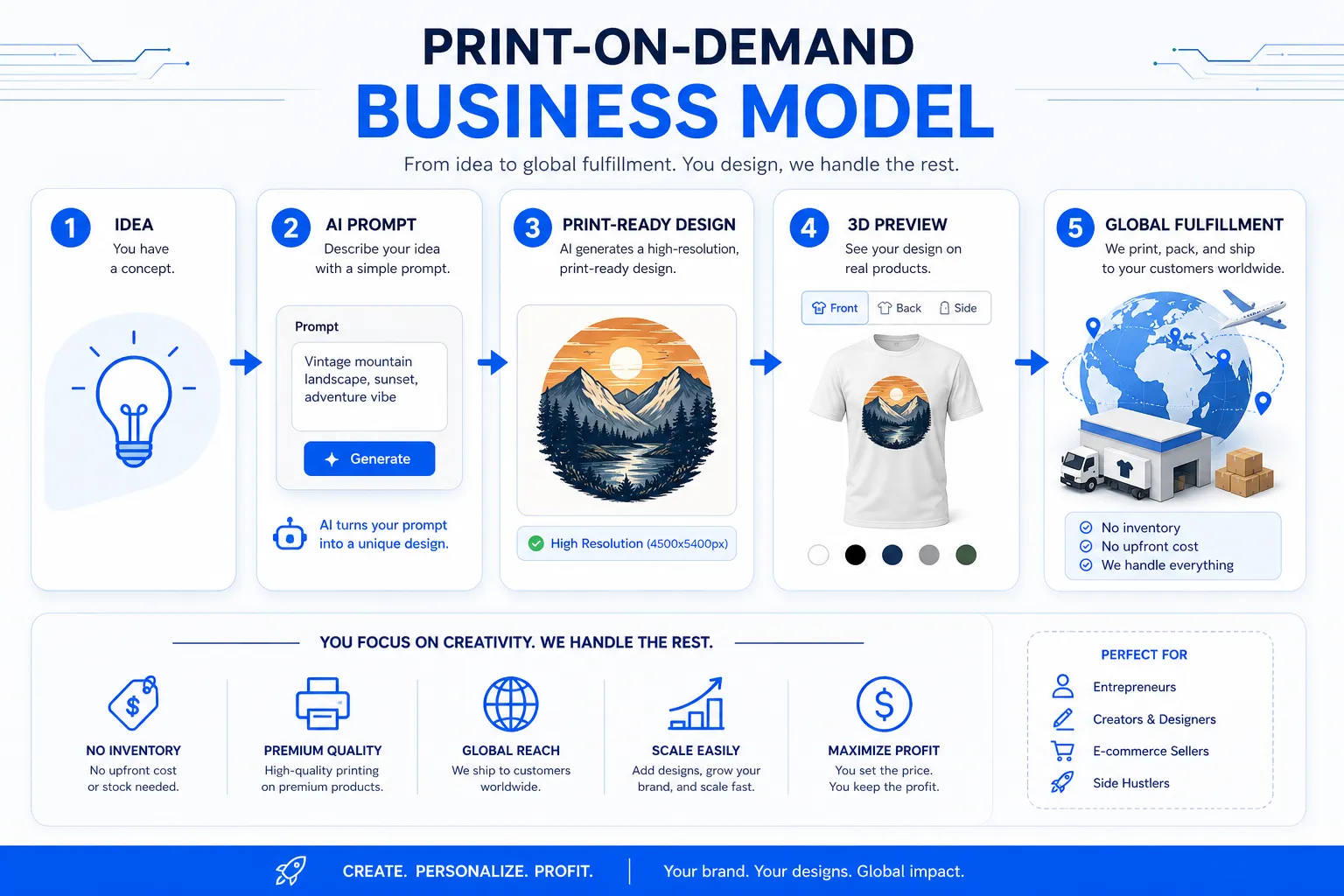
The AI-powered workflow
Customer describes the shirt they want
AI generates the layout
Platform turns it into a print-ready product
Customer sees realistic 3D and AR previews
Order routes automatically to production
This model reduces decision fatigue and improves conversion velocity.
How to Design and Sell Shirts More Efficiently
The fastest-growing operators do not just create better designs. They build faster systems.
1. Start with a narrow, monetizable audience
A broad “shirts for everyone” strategy rarely wins early. Start with a focused segment that already has shared identity or buying motivation:
pet owners
local sports communities
school groups
faith-based audiences
photographers’ client families
travel memory buyers
regional lifestyle brands
small businesses needing branded merchandise
The narrower the audience, the clearer the messaging.
2. Prioritize designs people can understand in seconds
Winning shirt concepts usually communicate fast. This does not mean simplistic. It means immediate.
Strong categories include:
bold text statements
niche humor
cause or identity signaling
commemorative designs
minimalist premium aesthetics
personalized name/date/location variations
3. Use conversational creation instead of complex editing
This is one of the clearest advantages of the Media Rex Alliance model. Customers can create through natural language instead of wrestling with traditional editors. That matters especially on mobile, where friction costs conversions quickly.
A browser-based, no-install design experience also makes launch and adoption easier. Customers do not need an app. They simply open the storefront and begin creating.
4. Show the product realistically before checkout
If the preview looks generic, trust drops. If the preview looks like the final product, confidence rises.
Photorealistic 3D and AR previews help buyers answer key questions:
How will the graphic sit on the shirt?
Does the size feel balanced?
Does it look premium enough to buy?
Can I picture myself or the recipient wearing it?
5. Automate fulfillment from day one
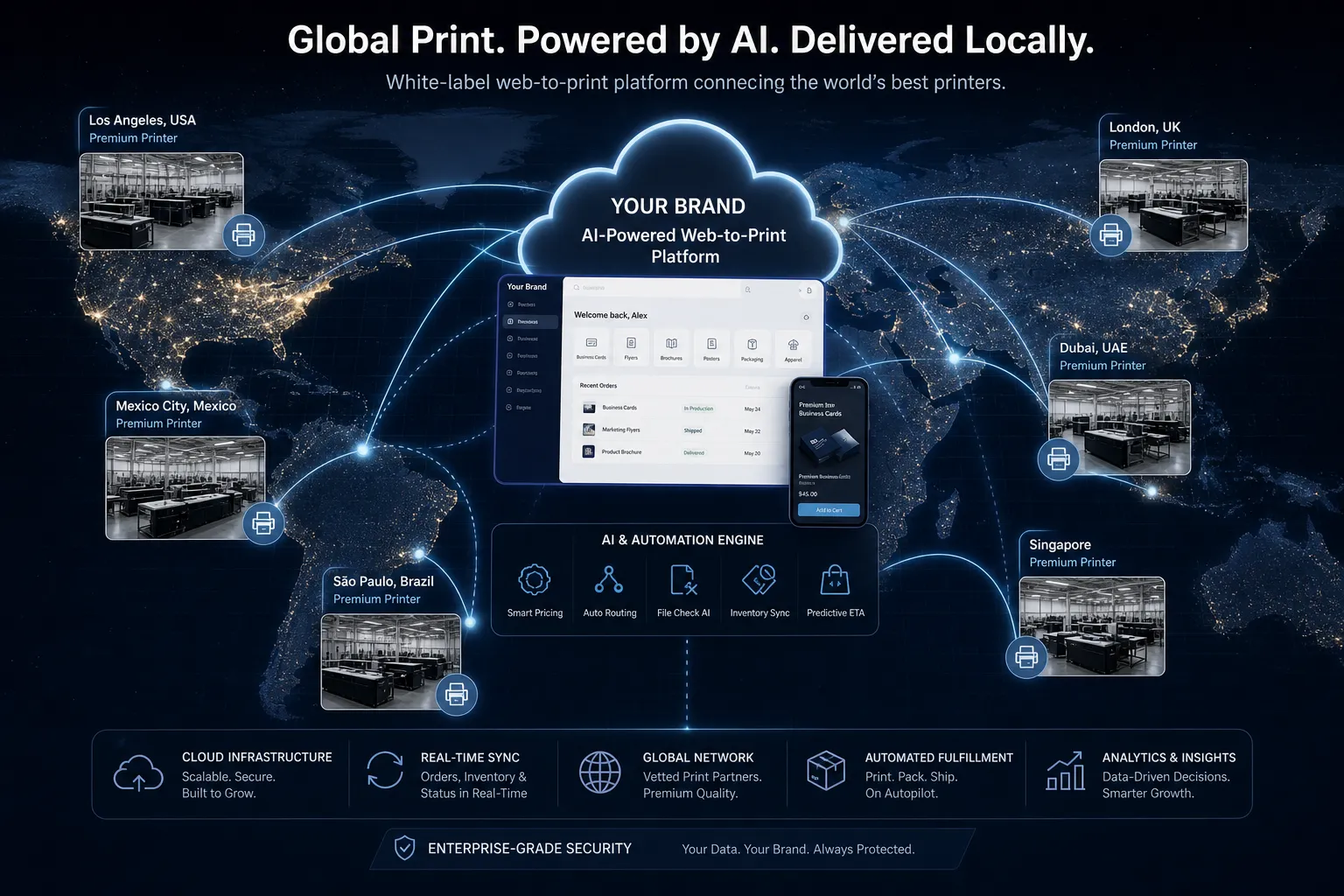
Manual fulfillment breaks quickly as order volume rises. Automated routing to a global network of premium printers allows brands to scale without becoming operations-heavy.
For Media Rex Alliance clients, this means reducing inventory and overhead while still offering a high-quality product experience under a fully branded front end.
Comparing Traditional POD Stacks vs AI-Driven Web-to-Print
Capability | Traditional POD Setup | Media Rex Alliance Approach |
|---|---|---|
Product creation | Manual design tool workflows | Conversational AI-driven creation |
Customer effort | High | Low |
Preview quality | Standard mockups | Photorealistic 3D and AR previews |
Branding control | Often platform-limited | Fully white-label |
Device accessibility | Sometimes desktop-heavy | Mobile-first, browser-based |
Cross-device experience | Often fragmented | Local and cloud sync |
Inventory model | No stock, but often manual setup burden | No stock plus automated creation and fulfillment |
Scalability | Depends on tool stack | Built for startups through enterprise print companies |
What Competitor Reviews Reveal About the Market
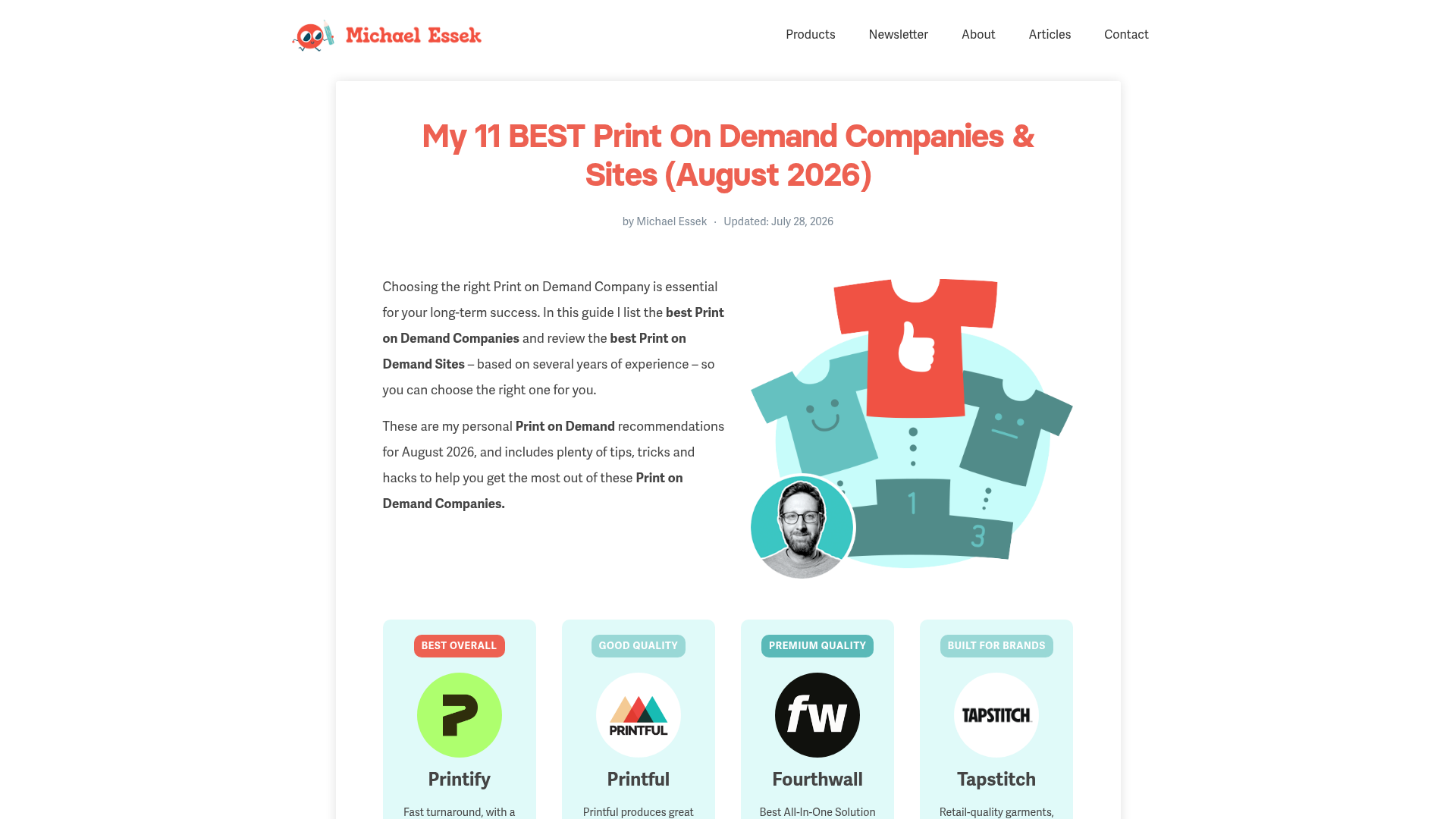
The competitor material around Printify and Michael Essek’s extensive reviews reveal a few durable truths.
Printify’s strengths
strong product breadth
competitive pricing
large global print network
good for testing and scaling catalog breadth
Printful’s strengths
high consistency
strong integrations
better control over branding details
polished user experience
Marketplace-led models’ strengths
built-in traffic
easier discovery for beginners
lower setup complexity
But the deeper strategic question is this:
Do you want to rent demand on somebody else’s platform, or build a branded system that compounds over time?
That is where Media Rex Alliance fits differently. It is not just another catalog or marketplace. It is infrastructure for businesses that want to modernize web-to-print without building AI creation technology, 3D previewing, AR visualization, cloud sync, and fulfillment automation from scratch.
The Best Shirt Business Models Right Now
There is no single best way to sell shirts. But there are several models that repeatedly outperform.
Creator or community merch
Best for audiences with existing loyalty.
Personalized gifting
Best for names, dates, group memories, vacations, and milestone events.
Premium niche brand
Best for focused aesthetics and strong identity positioning.
Service extension model
Ideal for photographers, studios, or print companies adding apparel to existing offerings.
Regional print modernization
Strong for local print players that want to offer AI-driven, on-demand creation without rebuilding their commerce stack.
How AI Changes Shirt Commerce Economics
AI does more than generate visuals. In a serious commerce environment, it changes cost structure and speed-to-revenue.
Lower friction means more completed orders
When customers can describe what they want instead of building it manually, purchase intent stays hot.
Faster launch cycles mean more experiments
You can test more creative directions, seasonal campaigns, and audience concepts without operational drag.
Better previews can reduce hesitation
Buyers are more likely to move forward when the experience feels tangible.
White-label ownership protects margin and brand equity
Rather than pushing customers into third-party ecosystems, you keep the entire branded journey under your control.
Design Principles That Improve Shirt Sales
Use contrast strategically
A shirt design must remain legible at thumbnail size and compelling up close.
Design for the garment color
A strong concept on black may fail on heather gray. Previewing accurately matters.
Build collections, not isolated designs
Collections improve average order value and help brands feel intentional.
Personalization beats generic in many categories
Especially for gifts, teams, schools, events, and memory-based purchases.
Avoid overcomplicating the first offer
Your first best-seller often comes from clarity, not maximalism.
Mobile-First Matters More Than Most Brands Think
A large share of custom commerce browsing now happens on phones. Yet many shirt builders still feel desktop-native and awkward on mobile.
That mismatch is expensive.
Media Rex Alliance was built around a mobile-first, browser-based flow with no app installation required. That matters because:
more users can start instantly
fewer steps mean fewer drop-offs
customers can create anywhere
cross-device sync supports interrupted journeys
If someone starts a project on their phone and finishes later on a laptop, local and cloud sync keep the experience seamless.
How Photographers and Studios Can Use Shirts as a Growth Channel
Photographers and studios often overlook apparel because they associate it with generic merch. That is a mistake.
Shirts can become a natural extension of:
school photo programs
sports photography packages
family reunion sessions
travel and event memories
graduation campaigns
pet photography brands
The key is not selling blank shirts with logos. It is turning a customer photo, phrase, or memory into a premium wearable product with minimal friction.
Conversational AI plus photo upload support makes that model far more accessible than traditional template editors.
Operational Checklist for a High-Performance Shirt Offer
Before launching, make sure you can answer these clearly:
Question | Why It Matters |
|---|---|
Who is this shirt for? | Sharp positioning improves conversion |
Why would they buy now? | Urgency and relevance drive action |
How quickly can they create it? | Speed affects completion rate |
Can they trust what it will look like? | Preview quality affects confidence |
Is fulfillment automated? | Scale depends on backend efficiency |
Is the experience branded? | Retention depends on brand ownership |
Common Mistakes That Slow POD Growth
Treating design as the only variable
Design matters, but flow matters too.
Offering too many choices too early
A confused customer rarely converts.
Ignoring preview quality
Static, generic previews hurt trust.
Relying entirely on marketplaces forever
They can be useful, but they are not a durable brand moat.
Using outdated customization tools
If the builder feels like software instead of shopping, conversions suffer.
Where Media Rex Alliance Creates the Biggest Advantage
For businesses serious about modernizing print commerce, Media Rex Alliance solves multiple pain points at once.
Conversational AI product creation
Customers can create via prompts instead of complex design tools.
Faster path to print-ready output
Ideas become purchase-ready products quickly, reducing friction.
Fully white-label deployment
The platform integrates into existing storefronts or apps under your branding.
Photorealistic 3D and AR previews
Customers see products with far more confidence before ordering.
Mobile-first browser-based experience
No app installation required, lowering entry barriers.
Local and cloud sync
Users can move across devices without losing progress.
On-demand economics
No inventory burden, less overhead, more flexibility.
Automated fulfillment
Orders route through a global network of premium printers.
Scalable infrastructure
Suitable for startups, regional print businesses, and enterprise-grade operators.
Final Verdict
If your goal is simply to upload a few shirt designs somewhere, there are plenty of existing POD tools that can help. But if your goal is to design and sell shirts faster, convert more mobile shoppers, modernize your customer journey, and build a scalable branded print business, the real opportunity is bigger than basic fulfillment.
The next wave of POD growth belongs to businesses that remove creation friction, improve preview confidence, and automate fulfillment under their own brand. That is exactly where Media Rex Alliance stands apart.
Instead of asking customers to learn a designer, let them describe what they want. Instead of sending traffic to generic tools, keep the experience white-label. Instead of slowing down with manual workflows, use AI-powered creation and automated production to scale efficiently.
If you want to launch a smarter shirt business without building the technology stack from scratch, Media Rex Alliance is the fastest path to a future-ready web-to-print experience.
FAQ
What shirt designs sell the most?
Shirt designs that sell best usually have clear identity, humor, personalization, or niche relevance. Fast-understood concepts, bold text, commemorative themes, and audience-specific designs tend to outperform generic artwork.
How to start a POD tshirt business?
Start by choosing a specific audience, creating a focused offer, and using an on-demand model so you do not hold inventory. To grow faster, use a platform that reduces customer friction, offers realistic previews, and automates fulfillment.
What are the best niches for POD?
The best niches are communities with strong shared identity, such as pet owners, local groups, creators, schools, faith communities, sports families, and event audiences. Niches work best when buyers instantly recognize the design as “for them.”
Which print-on-demand is most profitable?
The most profitable model is usually the one with low operational overhead, strong branding control, and high conversion efficiency. White-label AI-powered web-to-print can outperform generic setups because it shortens the path to purchase and keeps the customer relationship in-house.
What products are in high-demand right now?
Custom shirts, hoodies, mugs, stickers, posters, and personalized gift items remain in strong demand. Shirts are still one of the best entry points because they combine broad appeal, easy merchandising, and repeat purchase potential.