
Design and Sell Your Own T Shirts in 2026
If you want to design and sell your own t shirts in 2026, the opportunity is bigger than ever - but so is the competition. Small studios, photographers, rising print-on-demand brands, and established print companies are all chasing the same outcome: a faster path from idea to finished product, with less design friction, fewer abandoned carts, and a scalable fulfillment model.
The problem is that most legacy workflows still feel stuck in the past. Traditional design tools can overwhelm casual buyers, manual setup slows down ordering, and disconnected print systems make it harder to grow profitably. The brands winning now are the ones that make product creation feel instant, intuitive, and mobile-native.
That is exactly where AI-powered web-to-print changes the game. Instead of forcing customers through complex editors, modern platforms let them describe what they want, upload artwork, preview the result in 3D or AR, and order in minutes. For print businesses that want to modernize without building this stack from scratch, Media Rex Alliance offers a white-label, browser-based infrastructure that turns conversational prompts into print-ready products and automates production through a premium global print network.
"The global custom t-shirt printing market size was estimated at USD 4.71 billion in 2023 and is projected to reach USD 9.82 billion by 2030, growing at a CAGR of 11.1% from 2024 to 2030." - Grand View Research
"78% of consumers cite customization as the primary factor influencing their print-on-demand purchases." - WorldMetrics
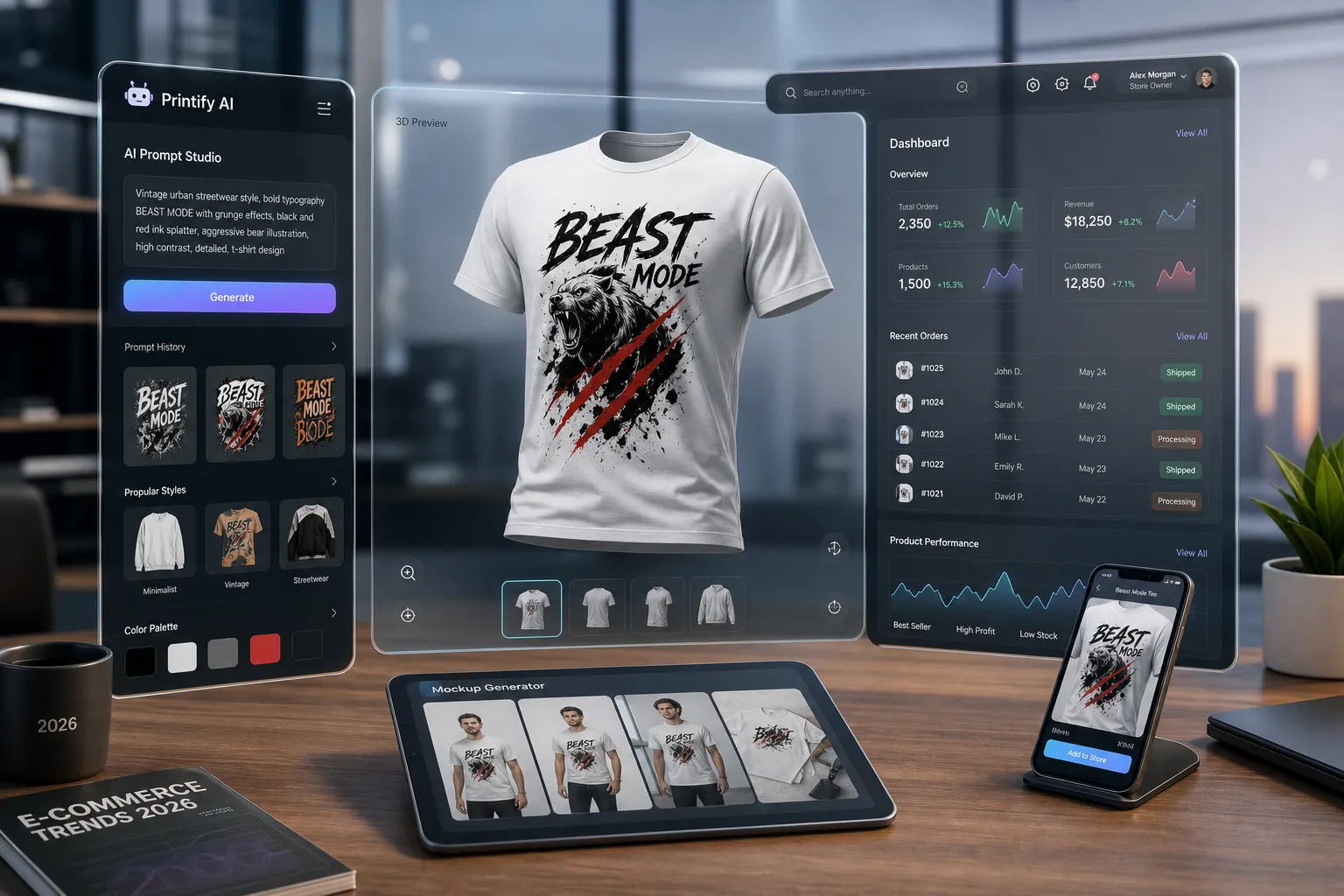
Why custom t-shirts are still one of the smartest products to sell
T-shirts remain one of the easiest products to launch and one of the most flexible to scale. They work for creators, ecommerce brands, local businesses, events, fandoms, communities, photographers, and merch-driven media companies. Unlike niche print products with complicated formatting or limited audience appeal, t-shirts are simple to understand and easy to market.
In 2026, they are especially powerful because they sit at the intersection of personalization, fast production, and low-risk inventory models. You can test designs quickly, launch seasonal drops, create localized collections, and respond to trends without carrying stock.
Why they perform so well
Advantage | Why it matters |
|---|---|
Broad appeal | Nearly every customer understands sizing, use case, and value |
Fast product-market testing | You can launch new artwork with minimal setup |
Strong margins | Premium branding, niche positioning, and upsells can improve profitability |
Easy fulfillment | Print-on-demand eliminates bulk inventory risk |
Repeatable formats | Once one collection works, it is easy to expand into variants |
For newer brands, this means you can start lean. For established print businesses, it means you can refresh your web-to-print offering without rebuilding operations around warehousing.
What most “design your own shirt” guides get wrong
Many articles explain how to upload a PNG, choose a blank shirt, and place an order. That is useful, but it misses what really drives conversions in 2026.
The biggest content gap in older advice is that it focuses only on design mechanics - not on customer friction, mobile behavior, or how AI changes product creation. Today, success is not just about whether someone can print a shirt design. It is about how quickly they can move from idea to confidence to checkout.
The new decision drivers are:
How easy it is to create without learning pro design software
Whether previews feel trustworthy enough to reduce hesitation
Whether the flow works perfectly on mobile browsers
Whether the platform can be embedded into an existing storefront
Whether fulfillment and production scale without operational chaos
Media Rex Alliance addresses these gaps by giving print businesses a white-label AI creation engine that turns simple prompts into print-ready products, with photorealistic previews, browser-based access, local and cloud sync, and automated fulfillment built in.
How to design and print your own t-shirts in 2026
The modern process is faster than ever when you break it into clear stages.
1. Start with a commercial concept, not just a cool graphic
A design that looks good is not always a design that sells. Before you print your own tee shirt, define:
Who the shirt is for
What emotional reaction it should trigger
What niche or identity it represents
Whether it is evergreen, trend-based, or event-specific
What price point the customer will accept
The best-selling shirts usually fit one of these buckets:
Identity-driven: hobby, profession, mindset, values
Occasion-driven: travel, festivals, family events, birthdays
Trend-driven: memes, aesthetics, internet culture
Brand-driven: logos, creator merch, local business apparel
Art-driven: illustration, typography, photography-based concepts
2. Choose the right shirt blank
A great design printed on the wrong shirt creates complaints, returns, and poor reviews. Your blank affects perceived value, fit, drape, print compatibility, and repeat purchases.
Quick shirt selection guide
Goal | Best type of shirt |
|---|---|
Budget-friendly launch | Standard cotton tee |
Premium brand look | Garment-dyed or heavyweight tee |
Soft retail feel | Ringspun or combed cotton |
Athletic or activewear | Polyester performance tee |
Full-coverage graphics | All-over print polyester |
Elevated brand positioning | Embroidered or premium blanks |
If your customers want softness and fashion fit, invest in better blanks. If they are buying for teams, events, or promotions, durability and affordability may matter more.
3. Create the design
This is where the market is shifting rapidly. Legacy tools require layering, alignment, export settings, and technical know-how. That still works for professional designers, but it creates friction for everyone else.
A more scalable model is conversational creation: the user describes the design, uploads an image if needed, and lets the platform build the layout automatically.
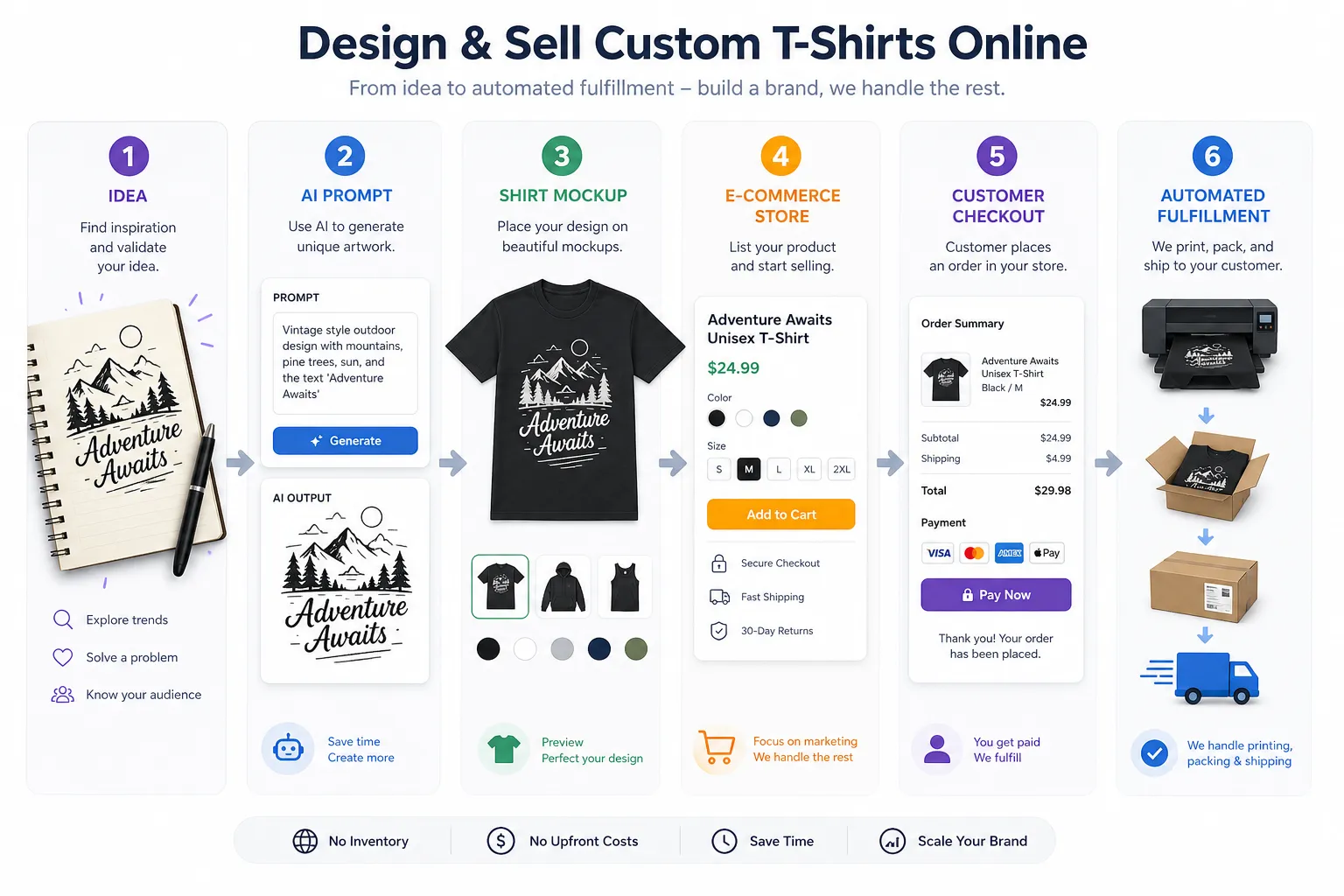
With Media Rex Alliance, this is exactly how the experience evolves. Instead of asking customers to master complex editors, the platform enables them to create products through conversational AI, turning prompts into ready-to-print layouts quickly. That reduction in effort can materially improve conversion rates because fewer users get stuck halfway through the journey.
4. Validate the design with realistic previews
One major reason shoppers abandon custom apparel orders is uncertainty. They cannot picture how the product will actually look. Flat mockups are often not enough.
That is why photorealistic 3D and immersive AR previews matter. They help customers evaluate scale, placement, color harmony, and overall confidence before they buy.
5. Publish and sell
Once your design is ready, the next step is distribution. You can:
Sell through your own branded storefront
Integrate into a print-on-demand marketplace strategy
Add custom shirt creation into an existing ecommerce site
Offer white-label custom apparel flows inside a photo, gifting, or merchandise app
For serious operators, the last option is increasingly important. Rather than sending customers to third-party tools, brands want a fully branded creation flow on their own domain. Media Rex Alliance is built for exactly that kind of white-label deployment.
6. Automate fulfillment
Manual production routing slows growth. As order volumes rise, human handoffs become expensive and error-prone.
An AI-native print platform should push approved products directly into on-demand production and fulfillment. Media Rex Alliance reduces inventory and overhead through automated, no-stock production and a global network of premium printers, making it easier for businesses of different sizes to scale efficiently.
Traditional workflow vs AI-powered workflow
The difference between old and new web-to-print infrastructure is not cosmetic - it directly affects speed, cost, and conversion.
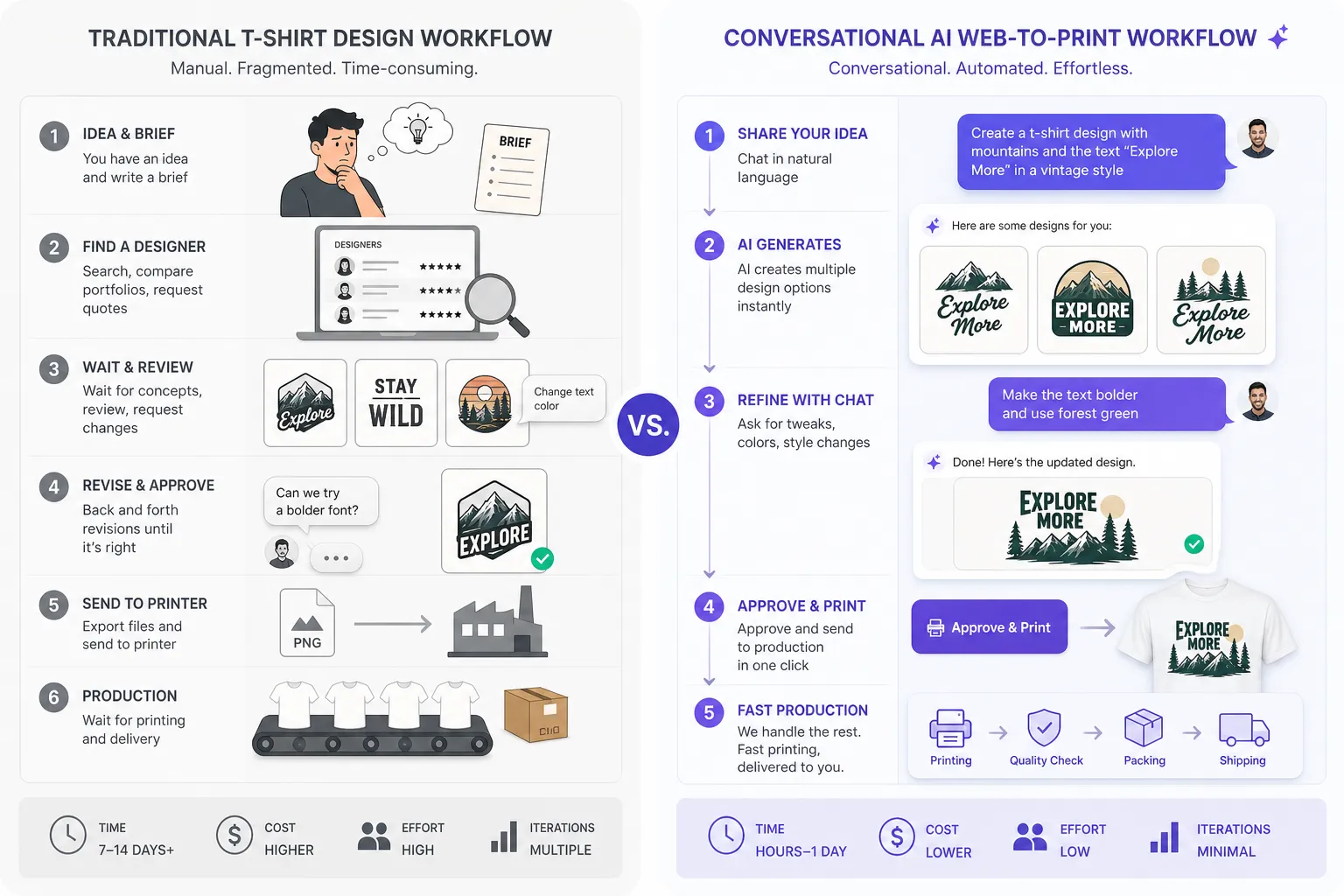
Traditional custom shirt workflow | AI-powered workflow with Media Rex Alliance |
|---|---|
Customer opens complex design editor | Customer types a prompt or uploads a photo |
Manual layout and resizing | Automatic composition and print-ready setup |
Static mockup preview | Photorealistic 3D and AR visualization |
Separate mobile app may be needed | Browser-based, mobile-first experience |
Limited brand control if using third-party tools | Fully white-label for your domain and brand |
Manual production steps | Automated fulfillment through premium print partners |
Hard to scale across devices | Local and cloud sync for seamless continuity |
For brands trying to modernize their offering, this is more than convenience. It is infrastructure leverage.
How to upload your artwork and make it sell
If you want to put your design on a shirt and actually move units, treat your artwork like product strategy, not just decoration.
Best practices for artwork uploads
Use high-resolution files
Design for the print area, not just the canvas
Test placement across multiple garment colors
Make contrast strong enough for readability
Simplify tiny details that may not reproduce well
Consider back, sleeve, or pocket prints for premium positioning
What works best visually
Design style | Best use case | Conversion potential |
|---|---|---|
Bold typography | Slogans, humor, identity brands | High |
Minimal graphics | Lifestyle and premium brands | Medium to high |
Illustration-heavy art | Fandoms, creators, niche audiences | High in the right niche |
Photo-based designs | Photography brands, memorial, travel | Medium |
Logo-led apparel | Team, business, and merch use | High for existing audiences |
If your audience is not design-savvy, giving them a conversational entry point is a major advantage. Media Rex Alliance supports prompt-led creation plus photo uploads, enabling customers to move from idea to product without design paralysis.
How to print your own clothes without holding inventory
A lot of entrepreneurs still assume they need to bulk order to start. In 2026, that is usually unnecessary unless your unit economics strongly favor wholesale runs.
Print-on-demand remains the most flexible route when you want to:
Test multiple niches
Launch quickly
Avoid storage costs
Sell globally
Keep cash tied up in marketing instead of stock
On-demand vs bulk inventory
Model | Pros | Cons |
|---|---|---|
Print on demand | Low risk, no stock, scalable, easy testing | Lower per-unit margins at high volume |
Bulk printing | Better unit cost at scale | Inventory risk, slower pivots, storage overhead |
For startups and mid-size print brands, on-demand is often the smarter first move. For enterprise print companies, a hybrid strategy may work best. Media Rex Alliance is especially strong here because it combines no-stock production with white-label control, allowing businesses to modernize their storefront while keeping operations lean.
How to price custom t-shirts for profit
Pricing is where many sellers undercut themselves. They focus too much on being cheap and not enough on perceived value.
Your margin should account for:
Blank apparel cost
Printing method
Packaging
Shipping
Platform and transaction fees
Marketing cost per acquisition
Returns or reprints
Desired profit margin
A simple pricing formula
Retail price = landed product cost + channel costs + target profit
Margin guidance by positioning
Brand position | Typical pricing strategy |
|---|---|
Budget/general market | Competitive pricing, higher volume |
Niche community brand | Mid-range pricing, story-led positioning |
Premium design brand | Higher pricing, stronger mockups and packaging |
Corporate/team order | Volume discounts with upsell options |
A shirt that costs $8 to $14 to produce can often sell for far more if the design speaks clearly to a target audience and the buying experience feels polished. That is one reason better previews and easier customization matter so much - they support premium pricing.
The best printing methods for different shirt ideas
If you want to design and print shirts that customers love, match the production method to the artwork.
DTG: direct-to-garment
Best for detailed artwork, short runs, and cotton shirts. Ideal for ecommerce sellers testing multiple designs quickly.
DTF: direct-to-film
Excellent for vibrant graphics on varied fabrics. Useful for flexible production and strong durability.
Screen printing
Best for larger bulk runs with fewer colors. Often strongest on cost efficiency at scale, but less flexible for one-off orders.
Sublimation
Perfect for polyester and all-over print designs. Great for bright, edge-to-edge graphics.
Embroidery
Best for logos, minimal branding, and premium apparel positioning.
Mobile-first buying is no longer optional
A major weakness in many older custom apparel flows is that they were built desktop-first. But in 2026, a huge share of discovery and ordering happens on mobile.
If users cannot design and print t shirts online comfortably from a browser on their phone, you are losing conversions.
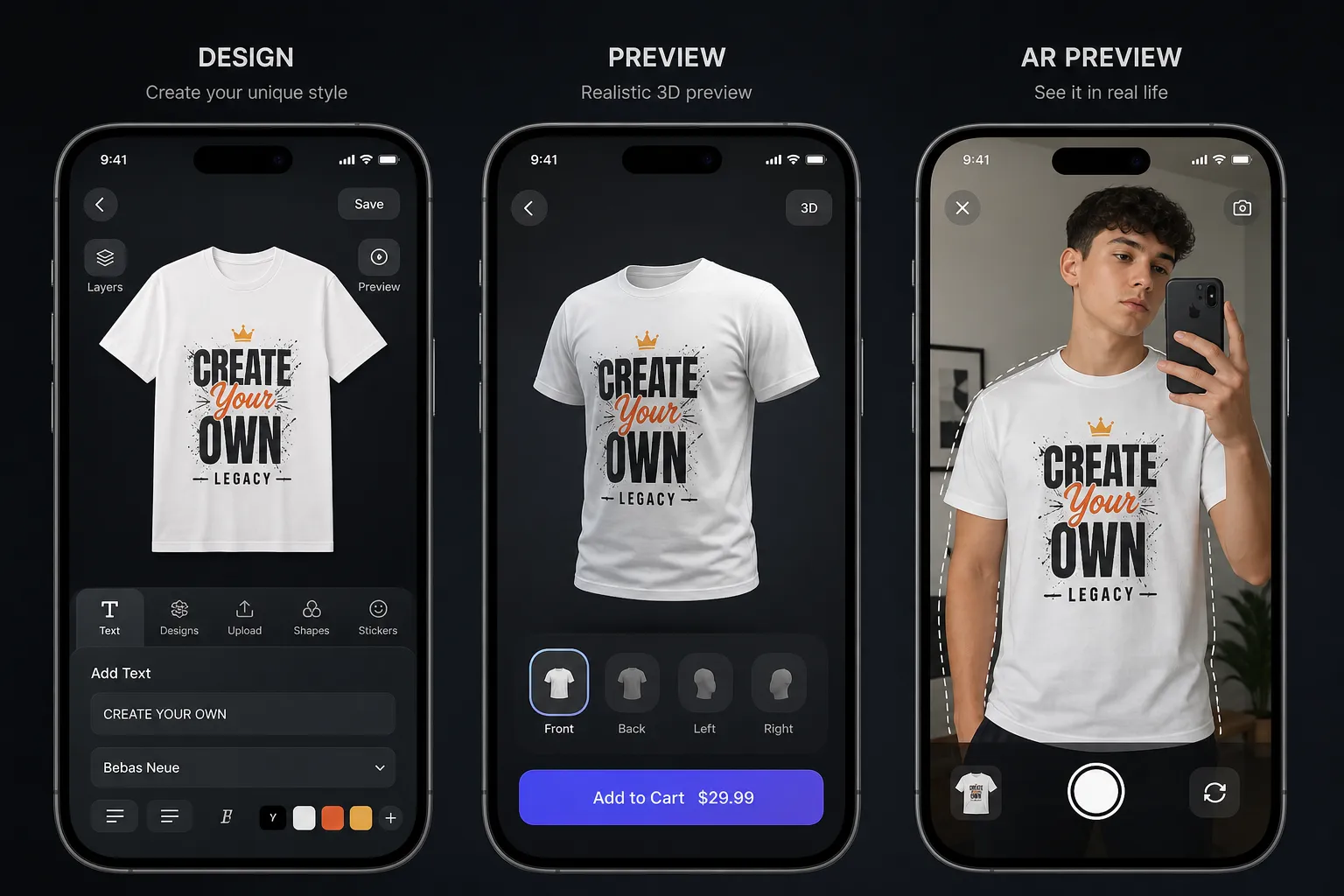
Media Rex Alliance is designed around this reality. Its experience is browser-based, mobile-first, and requires no app installation. That matters because every extra step between inspiration and checkout reduces completion rates. Add in local and cloud project sync, and customers can start on one device and finish on another without losing progress.
How photographers, studios, and print brands can use custom t-shirts differently
Most generic guides target solo Etsy sellers. But the opportunity is broader than that.
For photographers
Turn event photography, portrait work, travel imagery, or fan communities into premium wearable products.
For small studios
Offer branded merch, client gifts, and event apparel without building an internal product tech stack.
For new print-on-demand brands
Launch collections fast, test creative concepts, and validate audiences without investing in inventory or app development.
For mid-size print brands
Upgrade outdated editors with AI-driven product creation and a more conversion-focused storefront experience.
For regional print players
Compete with larger platforms by offering modern, branded, easy-to-use personalization without building proprietary software from scratch.
For photo book companies
Extend beyond books into apparel and gifts using the same image-driven customer behavior - especially when AI can automate layout creation.
This is where Media Rex Alliance becomes more than a tool. It becomes a growth layer for digital print businesses that want to bring AI-powered creation into their existing storefront or app under their own branding.
How to build a t-shirt offer customers actually buy
Even good designs fail when the offer is weak. To improve results, build the full product experience.
Your offer should include:
A specific audience
A clear benefit or identity signal
Premium-looking previews
Simple creation flow
Strong product page copy
Delivery expectations
Smart upsells
High-performing upsells
Primary product | Upsell |
|---|---|
Graphic t-shirt | Hoodie or sweatshirt |
Family event shirt | Matching kids sizes |
Creator merch | Stickers, tote bag, mug |
Corporate order | Embroidery upgrade |
Local community shirt | Limited-edition colorway |
The easier it is to move from one product to a coordinated collection, the stronger your average order value becomes.
Mistakes to avoid when you print your shirt designs
Even promising brands lose sales because of a few repeatable errors.
Common mistakes
Choosing low-quality blanks that hurt repeat purchase rates
Using poor mockups that make customers hesitate
Overcomplicating the creation experience
Launching too many designs without niche focus
Ignoring mobile usability
Underpricing products and killing margin
Relying on manual fulfillment steps that do not scale
These are exactly the types of operational and UX problems that AI-native print infrastructure is meant to solve.
A practical launch plan for 2026
If you want to move from idea to revenue quickly, use this rollout sequence.
Phase 1: Validate demand
Launch 3 to 5 focused designs in one niche. Use strong visuals and test messaging.
Phase 2: Optimize conversion
Improve mockups, refine pricing, simplify design flow, and ensure mobile performance.
Phase 3: Expand assortment
Add related apparel, alternate fits, or occasion-based variants.
Phase 4: Automate and scale
Integrate a white-label AI print platform, route production automatically, and expand across channels.
For businesses that already have customers but outdated infrastructure, Media Rex Alliance can accelerate phases 2 through 4 dramatically because it removes the need to build conversational creation, preview technology, sync logic, and fulfillment workflows internally.
Why Media Rex Alliance is built for the next era of custom apparel
The custom t-shirt space is no longer won by whoever simply offers “design your own shirt.” It is won by whoever makes creation frictionless, visually trustworthy, and operationally scalable.
Media Rex Alliance is built around that future:
It enables customers to create products through conversational AI instead of complex design tools
It turns prompts into print-ready products quickly, reducing hesitation and speeding up purchase decisions
It supports photo uploads and automated layout generation
It offers photorealistic 3D and AR previews to improve buyer confidence
It runs in the browser with a mobile-first experience and no app required
It syncs projects locally and in the cloud across devices
It deploys fully white-label into existing storefronts or apps
It reduces inventory risk with on-demand production
It automates fulfillment through a global network of premium printers
It scales from startups to enterprise print businesses
For companies that want to modernize web-to-print without years of development, that combination is a serious competitive advantage.
Final verdict
If your goal is to design and sell your own t shirts in 2026, the winning formula is no longer just good artwork plus a blank garment. The real differentiators are speed, simplicity, realistic previews, mobile usability, and automation.
Whether you want to print your own t shirts as a new brand, offer custom apparel as a studio, or modernize a legacy print business, the future belongs to platforms that reduce friction from prompt to purchase. Media Rex Alliance gives you that future in a white-label, scalable, AI-powered format - so you can launch faster, convert better, and grow without carrying the technical burden yourself.
If you are ready to transform custom apparel into a smarter, more scalable revenue engine, Media Rex Alliance is the platform to build on.
FAQ
What is the trend in t-shirts in 2026?
In 2026, the strongest trend is personalized, niche-driven apparel combined with faster online customization. Buyers increasingly expect mobile-first design flows, premium previews, and on-demand fulfillment instead of generic mass-produced shirts.
What t-shirt design sells the most?
Identity-based designs tend to sell the most because they connect with a specific audience, interest, or belief. Bold typography, community-driven humor, and designs that signal belonging usually outperform generic artwork.
Are graphic tees out of style in 2026?
No - graphic tees are still highly relevant in 2026, but the winning styles are more targeted and brand-aware. Clean visuals, original illustration, and culturally specific concepts perform better than overly broad or outdated designs.
Is making and selling t-shirts profitable?
Yes, it can be profitable when you combine smart niche positioning, strong product presentation, and efficient fulfillment. Print-on-demand reduces inventory risk, while better previews and smoother buying flows can support higher conversion rates and healthier margins.
What t-shirt designs sell best?
The best-selling t-shirt designs usually fall into a few categories: identity, occasion, creator merch, humor, and premium minimal branding. Designs sell best when they are easy to understand instantly and clearly tailored to one audience.
What is the 2026 T-shirt design?
The defining 2026 t-shirt design is one created through a fast, AI-assisted, mobile-friendly workflow and presented with realistic 3D or AR previews. It is less about one visual style and more about combining personalization, originality, and frictionless ordering.