Direct to Media Printing Trends Shaping 2026
Direct to media printing is entering a decisive new phase. What used to be a production capability is now becoming a growth engine for print businesses that need to move faster, personalize more deeply, and sell across more product categories without adding operational drag.
For small studios, photographers, photo book brands, regional print providers, and modern print-on-demand businesses, the challenge is no longer just print quality. It is customer expectation. Buyers want instant customization, mobile-friendly ordering, realistic previews, faster turnaround, sustainable options, and products that feel made for them. In 2026, the print businesses that win will be the ones that remove friction between idea and order.
That is exactly where the market is heading: toward AI-assisted creation, browser-based product design, automated fulfillment, and scalable on-demand production models that make premium print more accessible and more profitable.
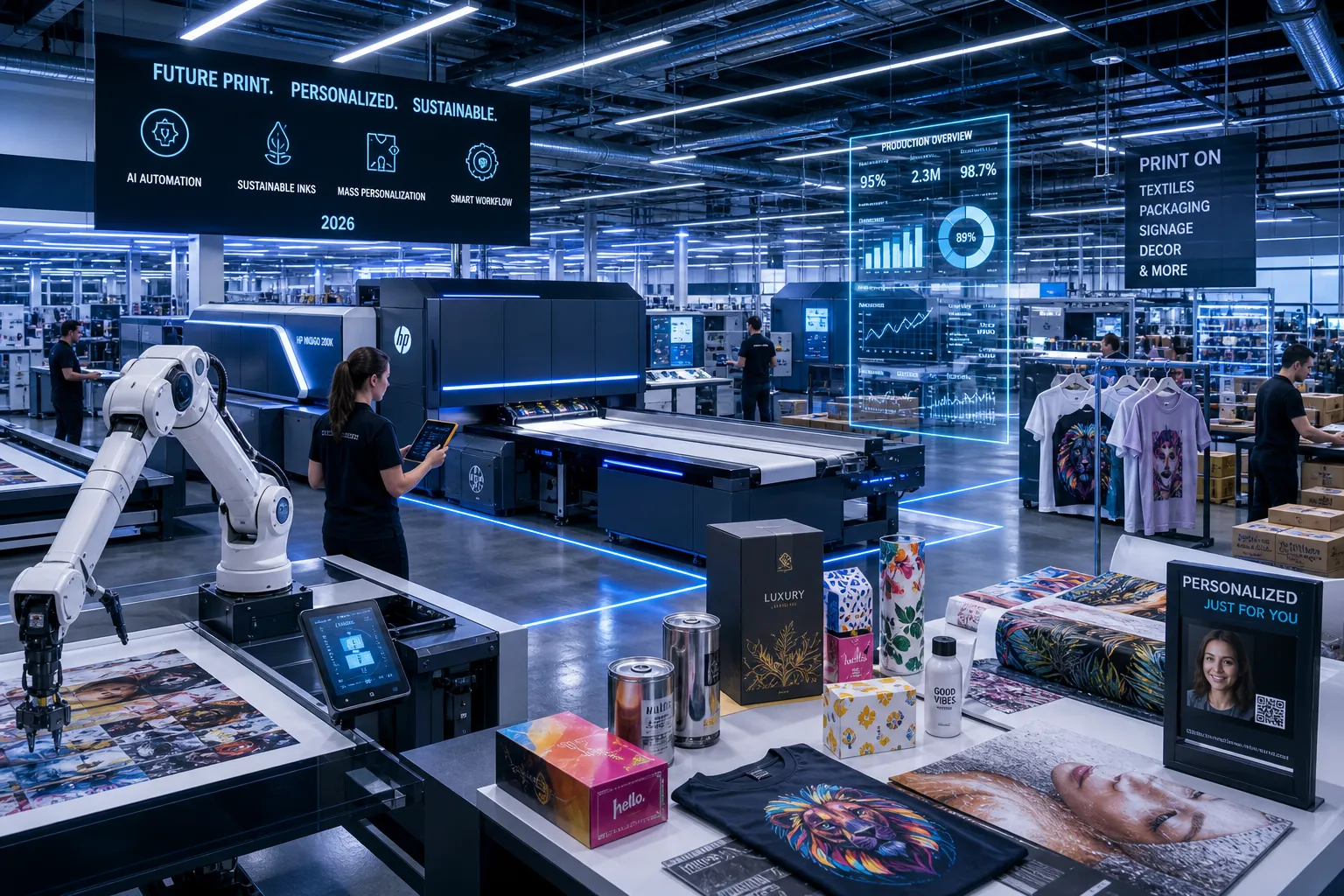
What Direct to Media Printing Means in 2026
Direct to media printing refers to digitally printing onto a wide range of substrates or finished product surfaces with minimal setup, fast turnaround, and growing flexibility across applications. In practice, that can include paper goods, photo products, signage, packaging, labels, promotional materials, textiles, and specialty surfaces.
In 2026, the term matters because it represents more than hardware. It signals a business model built around:
shorter runs
low inventory
product customization
rapid job switching
cross-channel ordering
scalable automation
premium output without traditional complexity
This is why direct to media printing is becoming central to the future of modern web-to-print and product personalization.
The Big Shift Competitors Talk About - and What They Miss
Most industry articles agree on the same broad trends: digital printing growth, personalization, automation, sustainability, QR-enabled print, and web-to-print adoption. Those are real and important.
But many stop at the surface. They describe trends without answering the harder question: how should print businesses operationalize them without rebuilding their entire stack?
That is the key content gap in much of the current discussion.
What many articles underplay is that 2026 is not just about better presses or more online ordering. It is about compressing the time between customer intent and production. The next competitive edge comes from tools that let customers create faster, preview better, approve sooner, and order with confidence.
That means the future belongs to print businesses that can combine:
Market Need | Legacy Approach | 2026 Winning Approach |
|---|---|---|
Product customization | Manual design support | Conversational AI-driven creation |
Online ordering | Static product forms | Interactive, mobile-first product experiences |
Customer confidence | Flat previews | Photorealistic 3D and AR previews |
Fulfillment scale | Local, manual coordination | Automated global print network |
Inventory control | Pre-stocked SKUs | On-demand production |
Brand expansion | Separate software brands | Fully white-label storefront integration |
Why Direct to Media Printing Is Accelerating Now
Several forces are converging at once.
Customer expectations are rising
Consumers and B2B buyers now expect the same ease from print buying that they get from ecommerce, travel booking, and food delivery apps. They want speed, clarity, transparency, and customization without having to learn a complicated design tool.
Short runs are becoming the default
Brands increasingly test campaigns in smaller batches, localize by region, personalize by segment, and refresh creative more often. That makes long setup cycles and overproduction less attractive.
Product experience matters as much as print quality
A premium output alone is no longer enough. Buyers want to see what they are ordering before they commit. That is especially true for photo books, wall art, packaging, gifting, branded merchandise, and high-emotion printed products.
AI is reducing friction at the front of the funnel
The biggest bottleneck in many print businesses is not press capacity. It is the customer journey before checkout. If users get stuck in templates, abandon design steps, or cannot visualize the final product, conversions stall. AI-powered product creation directly addresses that problem.
The 7 Direct to Media Printing Trends Defining 2026
1. Conversational Product Creation Replaces Traditional Design Friction
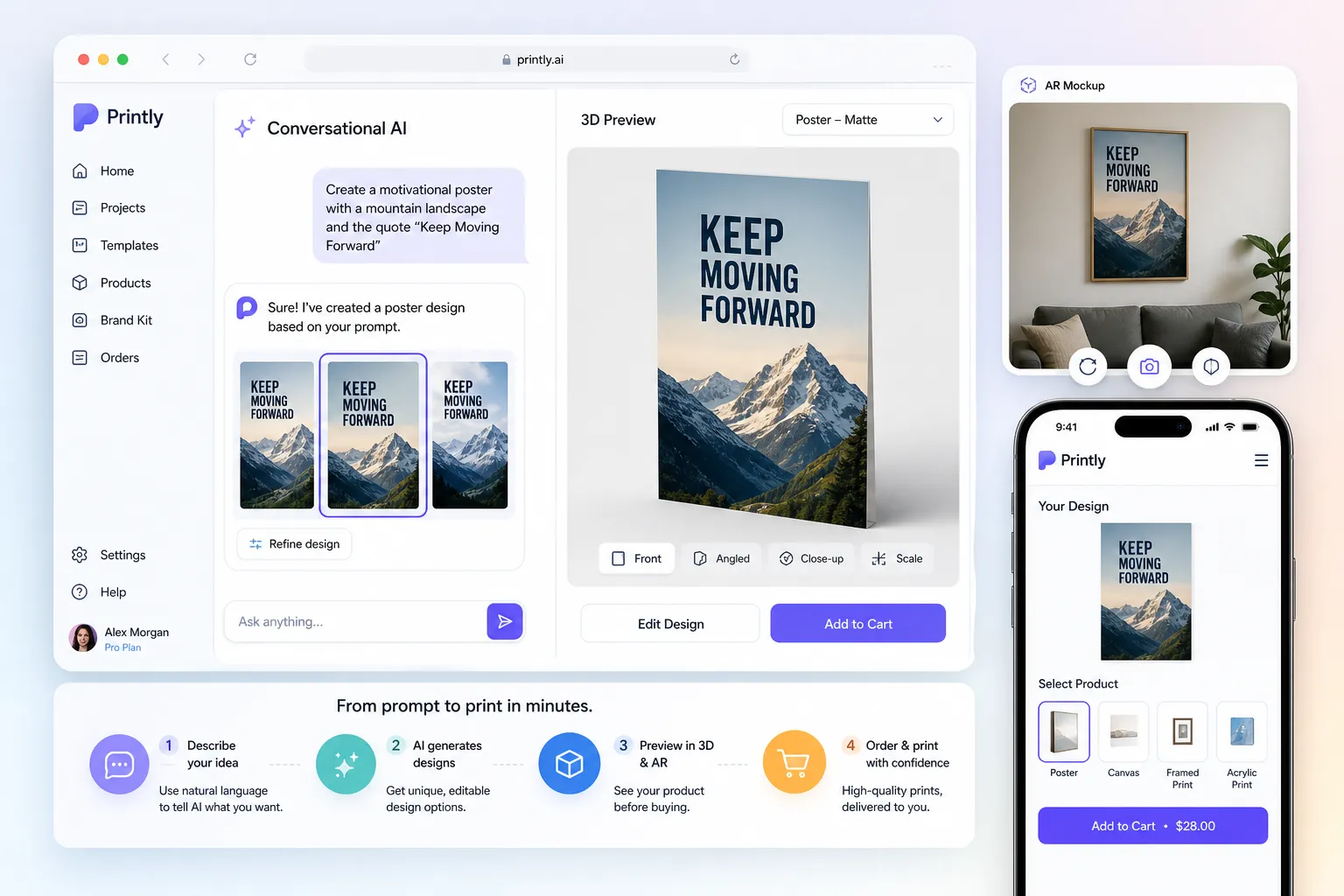
The most important shift in 2026 is not just better printing. It is easier product creation.
Traditional web-to-print flows often assume customers want to drag, drop, resize, align, crop, and manually assemble everything. Some do. Many do not. They simply want to describe what they want and get to a beautiful, print-ready result quickly.
That is why conversational AI is becoming so valuable. Instead of forcing users through complex creation interfaces, next-generation platforms let them type a prompt, upload photos, and receive an automatically generated layout or product concept.
For print businesses, this changes the economics of conversion:
fewer abandoned sessions
lower support burden
faster path to checkout
more accessible product creation for non-designers
broader appeal across mobile users and casual buyers
Media Rex Alliance is built around this exact shift. Its autonomous creation engine turns natural-language prompts into premium physical products, helping brands remove creative friction without sacrificing control or quality.
2. Personalized Print Moves From “Nice to Have” to Revenue Standard
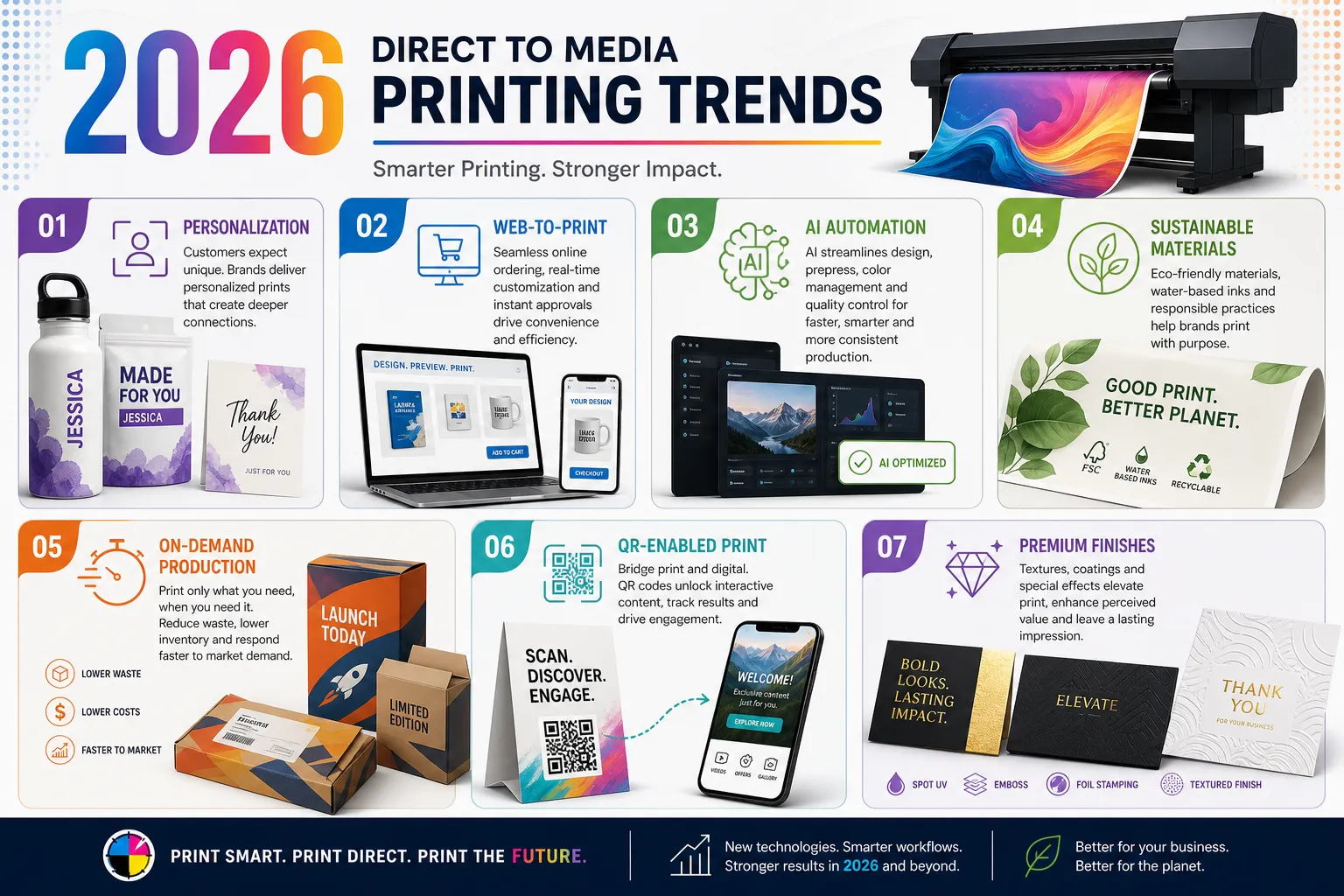
Personalization is no longer limited to adding a first name to a mail piece. In 2026, buyers expect individualized products, not just individualized messaging.
That includes:
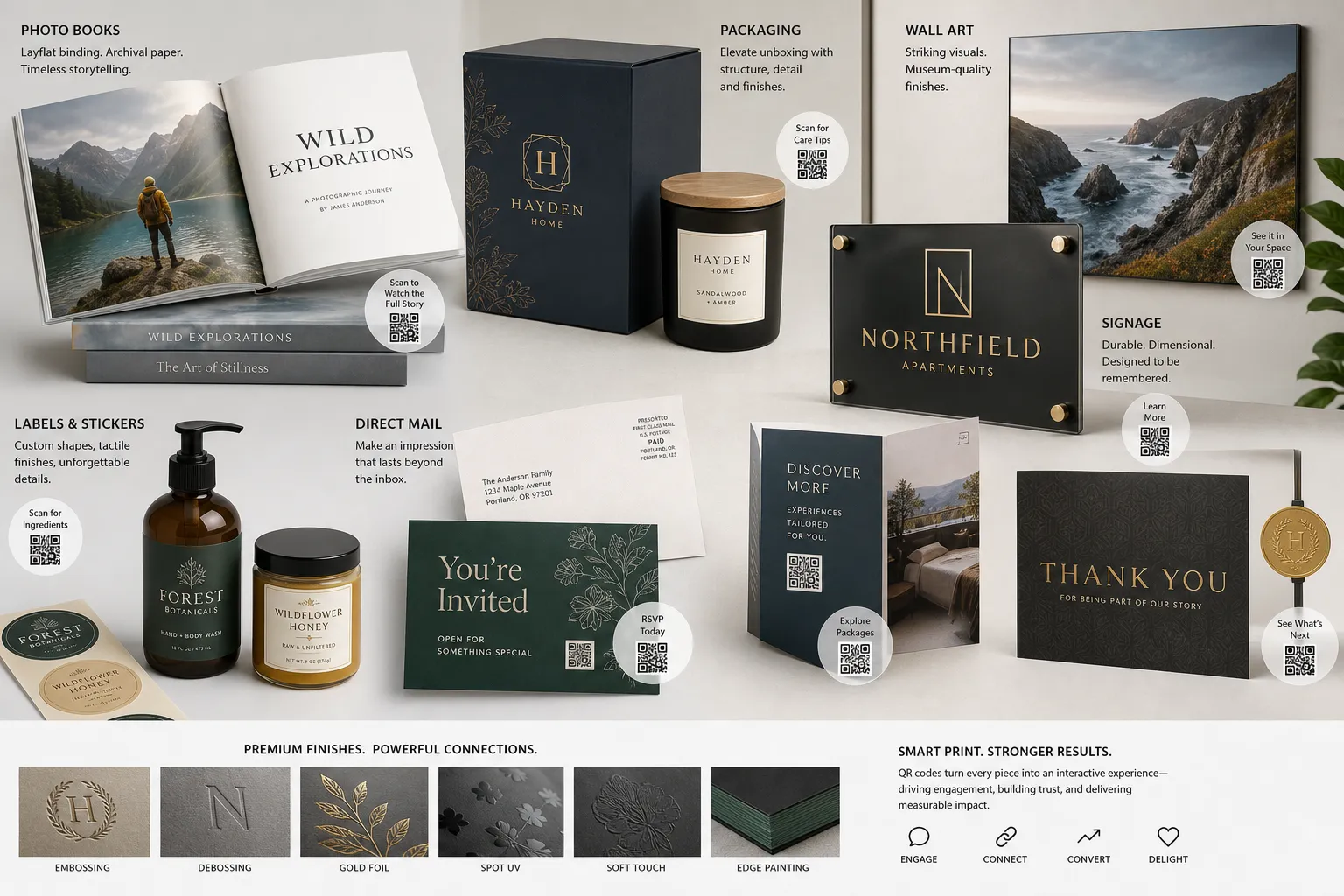
custom photo books
one-off wall decor
region-specific packaging
personalized direct mail
branded gift kits
event-specific print collateral
user-generated artwork products
The opportunity is especially strong for studios, photographers, and photo product brands because every customer asset can become a print trigger.
Competitor content often mentions variable data printing, but it rarely explores the next layer: AI-assisted personalization at scale. That means the system does more than merge data. It helps assemble layouts, adapt product structure, optimize content placement, and move a personalized product toward print readiness faster.
What this means for print businesses
If your store still treats personalization as an exception workflow, you are leaving revenue on the table. In 2026, it needs to become a default product capability.
3. Photorealistic 3D and AR Previews Become Conversion Infrastructure
One of the biggest blind spots in competitor articles is the role of visualization in purchase confidence.
The future of direct to media printing is not just producing personalized products. It is helping customers trust what they are buying before they order.
Photorealistic 3D and AR previews are becoming increasingly important because they:
reduce hesitation
improve perceived value
cut approval cycles
lower order disputes
create a more premium buying experience
support mobile-first commerce
This matters even more for higher-value products where texture, scale, orientation, and layout affect the decision.
Media Rex Alliance addresses this directly with photorealistic 3D and immersive AR previews, giving end customers a more realistic sense of the final product before purchase. That is not a cosmetic feature. It is a conversion tool.
4. Mobile-First, Browser-Based Design Becomes the Default Buying Experience
A major market reality in 2026 is that customers increasingly start their product journey on mobile, even if they finish elsewhere.
Yet many print creation experiences are still desktop-biased, app-dependent, or awkward in-browser. That creates friction at the exact moment interest is highest.
The new standard is:
no app installation
mobile-first product creation
browser-based access
instant session continuity
fast loading and intuitive editing
seamless movement across devices
This is especially important for fast-moving creators, ecommerce-first brands, and social-driven product discovery.
Media Rex Alliance aligns with that expectation through a browser-based, mobile-first experience with local and cloud sync. Customers can start a project on one device and continue on another without disruption, which is critical for modern conversion paths.
5. White-Label AI Print Platforms Outperform One-Size-Fits-All Tools
As competition increases, print brands need differentiated customer experiences, not generic software overlays.
Many businesses want AI-powered creation and scalable web-to-print functionality, but they do not want to send customers into someone else’s branded ecosystem. They want control over the storefront, brand language, domain, and customer journey.
That is why white-label deployment is becoming a strategic advantage.
Why white-label matters in 2026
keeps brand equity with the seller
creates a more trusted buyer experience
reduces dependence on third-party platforms
allows deeper integration into existing apps or stores
supports enterprise governance and regional variations
enables faster rollout without internal software development
Media Rex Alliance is designed for fully white-label integration, allowing print businesses to embed AI-powered product creation directly into their own storefronts or apps while maintaining complete brand continuity.
6. On-Demand Production Rewrites the Economics of Growth
The move toward on-demand production is one of the clearest patterns across the print market, but it deserves deeper treatment than most competitor articles give it.
This trend is not just about reducing storage. It reshapes how businesses grow.
Operational benefits of on-demand direct to media printing
Area | Traditional Model | On-Demand Model |
|---|---|---|
Inventory | Pre-bought and warehoused | Produced only after purchase |
Product breadth | Limited by stock risk | Expanded through virtual catalog depth |
Cash flow | Capital tied in inventory | Capital preserved for growth |
Waste | Higher obsolescence risk | Lower overproduction |
Testing | Expensive to experiment | Easier to launch limited runs |
Geographic scale | Constrained by local operations | Expanded via distributed production |
For startups and mid-size print brands, on-demand production lowers the barrier to entering premium product categories. For established providers, it improves margin discipline and reduces operational drag.
Media Rex Alliance supports this model by pairing AI-driven creation with an automated fulfillment pipeline and global network of premium printers. That means businesses can scale assortments and order volume without matching that growth with equivalent inventory overhead.
7. Automation Moves Upstream, Not Just Downstream
Many conversations about print automation focus on prepress, routing, scheduling, or output optimization. Those matter.
But in 2026, the bigger opportunity is upstream automation: reducing friction before the order even reaches production.
That includes:
automatically generating layouts from prompts
simplifying approval workflows
structuring product options intelligently
preparing print-ready outputs faster
connecting storefront activity directly to fulfillment logic
This upstream automation is what allows modern print businesses to scale customer-facing complexity without overwhelming internal teams.
Media Rex Alliance is especially strong here because it does not treat automation as a back-office add-on. It starts at the moment of customer intent and carries through to fulfillment.
The New Buyer Journey for Print in 2026
Competitor articles often describe trends one by one. A better way to understand the market is to look at the full buyer journey.
The 2026 print journey looks like this
A buyer discovers a product idea on mobile.
They want to create quickly, not learn software.
They enter a prompt or upload photos.
AI generates a compelling print-ready layout.
They preview the result in realistic 3D or AR.
They trust the product enough to buy.
The order is routed into automated, on-demand fulfillment.
The product is printed and shipped without manual intervention bottlenecks.
The more steps a print business can compress, the stronger its conversion rate and scalability.
What Products Are Best Positioned for These Trends?
The strongest opportunities in direct to media printing for 2026 are products where personalization, visualization, and low-inventory fulfillment create clear value.
High-potential categories
photo books and albums
wall art and framed prints
direct mail and campaign collateral
personalized packaging
branded merchandise
custom stationery and invitations
signage and display graphics
labels and short-run product packaging
event prints and memory products
premium gifting products
These categories benefit from emotional purchase drivers, customization demand, and strong visual merchandising.
How Small and Mid-Size Print Businesses Can Compete Without Building Everything In-House
This is one of the most important practical gaps left by competitor content. Many articles explain what is changing, but not how smaller players can respond without a massive internal product team.
The answer is not to build an AI creation engine, preview system, mobile product editor, sync architecture, and global fulfillment network from scratch.
The smarter route is to adopt a specialized white-label SaaS layer that brings those capabilities together.
What to look for in a 2026-ready print platform
Capability | Why It Matters |
|---|---|
Conversational AI product creation | Reduces friction and broadens customer accessibility |
Print-ready output generation | Shortens time to production |
Photo upload and smart layouting | Essential for photo and personalized products |
3D and AR previews | Improves confidence and conversion |
Browser-based mobile-first UX | Matches current buyer behavior |
Local and cloud sync | Supports multi-device journeys |
White-label deployment | Preserves your brand ownership |
On-demand fulfillment automation | Reduces operational complexity |
Global printer network | Enables scale without fixed infrastructure |
Enterprise-grade flexibility | Supports growth across regions and segments |
Media Rex Alliance is purpose-built around these needs, making it especially relevant for businesses that want to modernize quickly without replacing their brand identity or building deep product infrastructure internally.
Sustainability Is Still Important - But the Real Story Is Efficiency
Sustainability appears in nearly every competitor article, and rightly so. But the most effective sustainability strategy in print is often operational, not just material-based.
Yes, buyers care about recycled stocks, certified papers, and lower-impact inks. But just as important is a system that reduces:
overproduction
obsolete inventory
unnecessary shipping loops
manual rework
abandoned prototype cycles
On-demand production and automated routing can deliver sustainability gains by design. When products are created only after purchase and fulfilled efficiently, waste naturally declines.
That means direct to media printing in 2026 is becoming greener not just because materials are improving, but because business models are becoming smarter.
Where the Market Is Headed Next
The next phase of the market will likely be defined by convergence.
Not separate tools for personalization, previews, ordering, and fulfillment.
Not isolated systems for mobile, desktop, and store operations.
Not fragmented customer journeys between inspiration and production.
Instead, the winning model is an integrated layer where AI creation, white-label commerce, photorealistic previewing, and automated print fulfillment work as one system.
That is the future Media Rex Alliance is built for.
Why Media Rex Alliance Fits the 2026 Opportunity
For businesses exploring the future of direct to media printing, Media Rex Alliance is compelling because it addresses the most urgent market shifts in one platform:
it enables customers to create products through conversational AI instead of complex design tools
it turns prompts into print-ready products quickly, speeding decisions and reducing abandonment
it supports fully white-label integration into existing storefronts or apps
it provides photorealistic 3D and AR previews before purchase
it is mobile-first and browser-based, with no app installation required
it syncs projects locally and in the cloud for seamless cross-device usage
it reduces inventory burden through on-demand production
it automates fulfillment through a global network of premium printers
it scales from startups and niche studios to regional brands and enterprise print companies
In short, it helps print businesses modernize the part of the experience most competitors still treat as manual: creation-to-conversion.
Final Verdict
Direct to media printing in 2026 is about much more than output technology. It is about eliminating friction, increasing personalization, improving confidence, and scaling profitably through automation.
The businesses that lead this next era will not necessarily be the ones with the biggest catalogs or the most legacy infrastructure. They will be the ones that make it easiest for customers to turn intent into a premium physical product.
If your brand wants to launch smarter print experiences, reduce overhead, and bring AI-powered product creation into your own storefront under your own brand, Media Rex Alliance offers a faster path to that future.
FAQ
What are the major printing trends for 2026?
The biggest trends include AI-powered product creation, deeper personalization, mobile-first web-to-print, photorealistic 3D and AR previews, on-demand production, and more automated fulfillment. Together, these shifts help print businesses reduce friction, improve conversions, and scale with less waste.
What are the media trends expected to be in 2026?
Media trends in 2026 point toward interactive, personalized, and cross-channel experiences that connect physical products with digital engagement. In print, that means smarter customization, QR-enabled journeys, and browser-based creation experiences that feel as seamless as modern ecommerce.
What are the most popular prints in 2026?
The strongest-performing categories include photo books, wall art, personalized packaging, direct mail, branded merchandise, labels, and premium gifting products. These products benefit most from customization, visual previewing, and on-demand fulfillment.
What are the print trends for fall 2026?
For fall 2026, expect strong demand for seasonal personalization, premium tactile finishes, short-run promotional campaigns, and gift-oriented print products. Brands will also lean more heavily on fast-turnaround, mobile-friendly ordering to capture time-sensitive seasonal demand.
What is going out of style in 2026?
What is fading fastest is high-friction print buying: clunky design tools, app-dependent workflows, flat previews, excess inventory, and manual order handling. In their place, buyers now expect intuitive AI-assisted creation, realistic previews, and faster on-demand fulfillment.