Enterprise Print Solutions for Scalable Growth
Growth used to mean adding more devices, more staff, and more manual checkpoints. In 2026, that model breaks down fast.
For modern print businesses, scalable growth depends on something far more strategic: connected infrastructure, automated production logic, secure workflows, and customer experiences that remove friction before it kills conversion. That is why more studios, photo brands, print-on-demand startups, regional print providers, and established photo book companies are re-evaluating their enterprise print solutions and investing in systems built for speed, control, and expansion.
The shift is clear. Buyers no longer separate “front-end experience” from “back-end production.” They expect a seamless path from idea to order to fulfillment. Internally, operations teams need visibility across jobs, plants, vendors, devices, and costs. Commercially, brands need faster product launches, personalization at scale, and infrastructure that can grow without becoming more complicated.
This is where the market is evolving beyond traditional enterprise print management solutions. The winners are not just optimizing fleets or reducing downtime. They are redesigning the entire print journey around automation, integration, and AI-assisted product creation.

What Growing Print Businesses Actually Need From Enterprise Print Infrastructure
A lot of legacy content about enterprise printing focuses on hardware management, security controls, or centralized administration. Those are still important, but they are no longer enough.
Today’s growth-oriented print operation needs infrastructure that supports five realities at once:
Requirement | Why It Matters in 2026 |
|---|---|
Workflow automation | Manual prepress, quoting, routing, and approvals slow growth and create bottlenecks |
Customer experience | Buyers expect intuitive, mobile-first ordering and real-time confidence before purchase |
Integration readiness | Print businesses need systems that connect with ecommerce, MIS, CRM, ERP, shipping, and fulfillment layers |
Scalable fulfillment | Demand spikes, regional expansion, and product diversification require flexible production networks |
Data visibility | Leaders need insight into margin, conversion, throughput, device utilization, and order behavior |
Competitor pages from enterprise print software vendors and print management providers consistently emphasize resilience, centralized control, cost reduction, security, and scalability. Those are table stakes.
The bigger opportunity they often underplay is this: scalable growth does not come only from managing print better. It comes from making it dramatically easier for customers to create, configure, preview, and buy print products in the first place.
The New Definition of Enterprise Print Solutions
Enterprise print solutions used to be associated with device fleets, print servers, secure release, and plant-level workflow control. Now the category is expanding.
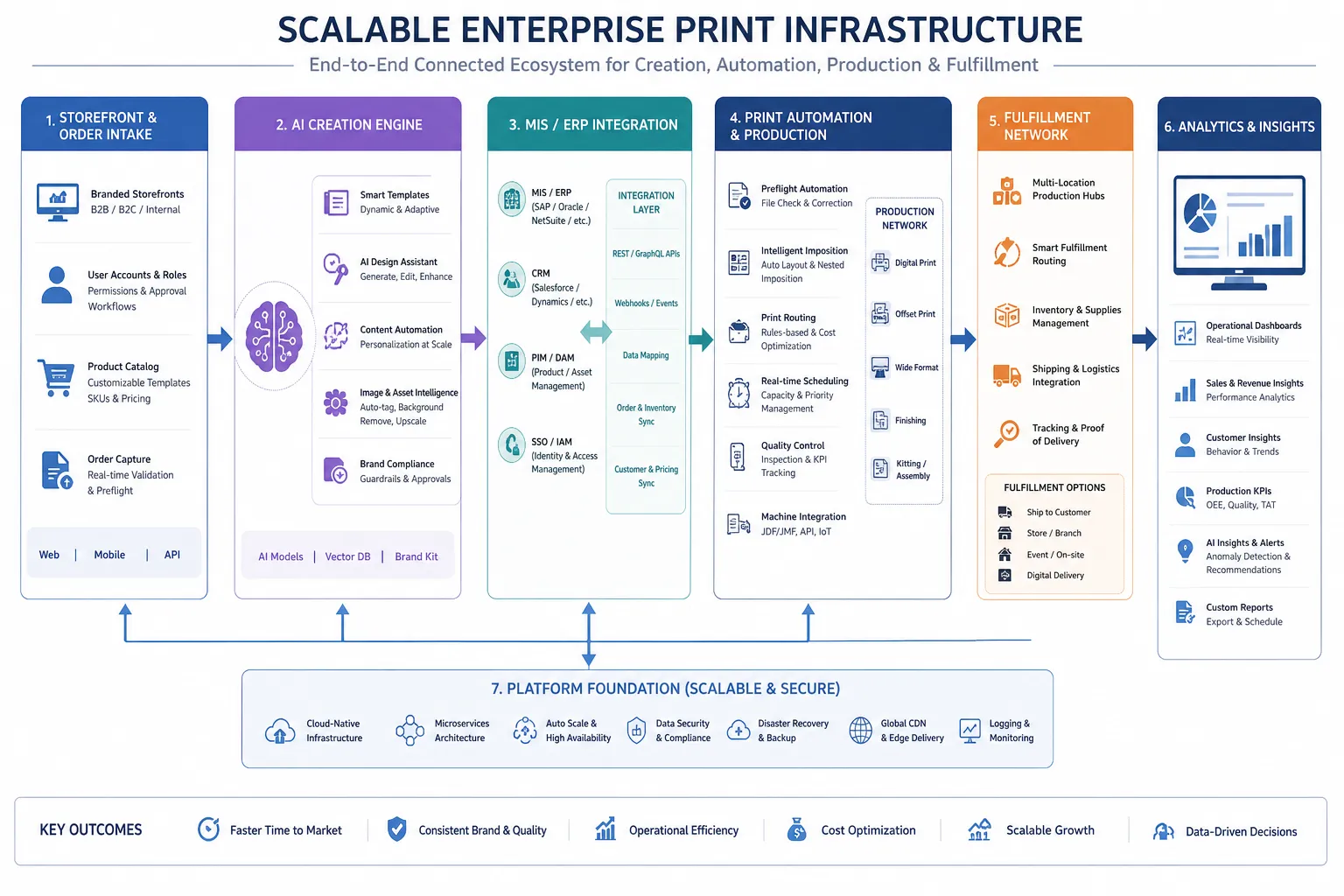
For a growth-focused print business, the modern stack includes:
customer-facing creation and ordering tools
automation between storefront and production
intelligent job preparation
centralized governance and analytics
distributed fulfillment capability
secure, integration-ready architecture
That means the front end is now part of enterprise print strategy, not a separate ecommerce concern.
If a customer struggles to use your design tool, abandons halfway through a personalization flow, or cannot visualize the final product confidently, that is not just a UX issue. It is a growth constraint.
“Personalization touchpoints offered by e-commerce brands in the United States raised conversion rates across a number of segments.” - Statista
This matters deeply for print, where personalization is often the product itself.
Where Competitor Content Falls Short
Across the leading pages in this space, several common themes appear:
centralized management
security and compliance
high availability and uptime
support for multiple sites or plants
cost optimization
device monitoring and reporting
All valuable. But there are content gaps that modern buyers care about:
Most Competitors Treat Ordering and Creation as Secondary
They talk about managing print after the order enters the system. They spend less time on how to increase order volume by reducing customer friction upstream.
AI-Driven Product Creation Is Barely Addressed
Traditional web-to-print platforms still assume users want to work inside complex editors. In reality, many customers want to describe what they want and get to a print-ready result fast.
3D and AR Confidence Layers Are Missing
Most enterprise print content ignores preview quality, even though photorealistic 3D and AR can materially improve trust, reduce hesitation, and lower order uncertainty.
White-Label Speed to Market Is Undervalued
Growing brands do not want multi-year rebuilds. They want to launch branded, differentiated experiences inside their existing storefronts or apps without rebuilding the whole commerce stack.
Fulfillment Scalability Is Discussed Narrowly
Competitors talk about device scalability, but not enough about on-demand, globally distributed production that reduces inventory risk and supports expansion.
That is where Media Rex Alliance introduces a more complete answer.
Why 2026 Growth Demands AI-Powered Web-to-Print, Not Just Management Software
The next wave of enterprise print growth is being driven by experience design as much as operations design.
A business can have excellent internal controls and still lose revenue if the buying journey feels slow, technical, or intimidating.
Media Rex Alliance addresses this by shifting product creation from manual design behavior to conversational intent. Instead of forcing end customers into complicated tools, the platform enables them to create products through natural language prompts, then transforms those prompts into ready-to-print outputs quickly.
That changes the economics of growth in several ways:
fewer drop-offs during creation
faster purchase decisions
broader accessibility for non-designers
lower support burden
more personalized products without more production complexity

For photo brands, studios, and print-on-demand businesses, this is especially powerful. The ability to turn a simple prompt, photo upload, or creative idea into a polished product without software friction expands who can buy and how quickly they convert.
The Five Pillars of Scalable Enterprise Print Management Solutions
1. Centralized Control Without Centralized Friction
Growing operations need a single command layer for visibility, policy enforcement, workflow routing, and performance analysis. But centralization should not make the customer experience slower or less flexible.
Strong enterprise print management solutions should unify:
order intake
job status visibility
production routing
shipping logic
user permissions
reporting and analytics
At the same time, they should allow decentralized execution across multiple sites, brands, or production partners.
2. Automation Across the Entire Print Lifecycle
The real gains come when automation bridges every handoff:
prompt or product selection
layout generation
proofing and preview
order submission
production routing
fulfillment and shipping
post-order tracking
Many providers automate parts of this chain. The stronger model is end-to-end automation that reduces rework and exception handling at scale.
3. Security That Supports Growth
Enterprise print content rightly emphasizes security, especially for large organizations and regulated environments. But security must be designed into both the operational and customer-facing layers.
That includes:
secure file handling
controlled access and permissions
encryption in transit
protected integrations
auditable workflow activity
“PaperCut keeps data safe by protecting each print job through its entire life cycle.” - PaperCut
That principle applies beyond office printing. In web-to-print and personalized product environments, security must extend into uploads, design data, order metadata, and fulfillment workflows.
4. Integration as a Growth Multiplier
Disconnected systems create hidden cost. If storefronts, design engines, production tools, shipping systems, and analytics platforms do not communicate cleanly, scale becomes fragile.
A future-ready stack should integrate with:
ecommerce storefronts
existing apps
ERP and MIS environments
CRM and marketing systems
fulfillment and shipping layers
finance and reporting tools
Media Rex Alliance is designed specifically for this reality, with fully white-label deployment into existing storefronts or apps. That means brands can modernize their customer-facing print experience without replacing everything behind it.
5. Fulfillment Flexibility and On-Demand Economics
Inventory-heavy models can constrain growth, especially when product mixes evolve quickly or demand is unpredictable.
An on-demand model reduces:
stock risk
warehousing overhead
obsolete inventory exposure
manual distribution complexity
Media Rex Alliance supports an automated fulfillment pipeline connected to a global network of premium printers, helping businesses scale product breadth and geographic reach while keeping operations lean.
From Legacy Web-to-Print to AI-Native Print Commerce
Traditional web-to-print tools were built around user control. That sounds good in theory, but in practice it often meant design friction, low mobile usability, and a high learning curve.
AI-native print commerce flips that model.
Instead of asking the user to build every detail manually, the system interprets intent, generates structure, and accelerates the path to a high-quality output.
Legacy Model vs AI-Native Model
Capability | Legacy Web-to-Print | AI-Native Print Commerce |
|---|---|---|
Product creation | Manual editor workflows | Conversational prompt-based creation |
User skill requirement | Moderate to high | Low to moderate |
Mobile usability | Often limited | Mobile-first, browser-based |
Product previews | Static or basic mockups | Photorealistic 3D and immersive AR |
Deployment | Often lengthy and custom | White-label and integration-ready |
Scalability | Can require more staff and support | Built to automate more of the journey |
This is one of the biggest gaps in current competitor messaging. Many solutions are still optimized for managing complexity, rather than removing it.
Why Customer Confidence Is Now a Core Operations Metric
Preview quality is not just a nice feature. It directly influences conversion behavior.
If buyers cannot confidently imagine the finished product, they hesitate. That hesitation affects not only conversion rate, but also cart value, support requests, and remake risk.
Media Rex Alliance helps solve this with photorealistic 3D and AR previews. Customers can see what they are ordering with much greater clarity before purchase, which creates a stronger bridge between imagination and transaction.
For photo books, wall art, gifts, personalized print products, and premium consumer print, this confidence layer can be a decisive advantage.
Mobile-First Print Buying Is No Longer Optional
One issue many enterprise print vendors still gloss over is mobile behavior.
A huge share of discovery, browsing, and even purchase intent now starts on mobile devices. Yet many traditional web-to-print flows still feel like desktop tools shrunk onto smaller screens.
That is a conversion problem.
Media Rex Alliance is built as a browser-based, mobile-first experience with no app installation required. Customers can start on one device, continue on another, and keep their projects synchronized locally and in the cloud.
That matters because modern purchase journeys are rarely linear. A buyer may discover a product on mobile, refine it later on desktop, then complete checkout from a tablet or phone. Cross-device continuity helps preserve intent instead of losing it.
Scalable Growth for Different Types of Print Businesses
Not every company enters the enterprise print conversation at the same maturity level. The right platform should support multiple stages of growth.
For Small Studios and Photographers
The priority is usually speed to market without technical overload. They need branded product experiences, simple personalization, and premium output without building custom infrastructure.
For New Print-on-Demand Brands
They need lean economics, flexible fulfillment, strong previewing, and low-friction creation that helps turn traffic into orders quickly.
For Mid-Size Print Brands
They often need better automation, centralized oversight, reduced production complexity, and a more modern customer journey than their legacy storefront can provide.
For Regional Print Players
They need multi-location coordination, integration across systems, and the ability to expand product lines without operational sprawl.
For Established Photo Book Companies
They need innovation without disruption. That means layering in conversational AI, photorealistic previews, and white-label deployment without tearing out mature backend systems.
Media Rex Alliance is positioned well across this spectrum because it is not just another design tool. It is a scalable SaaS infrastructure layer for AI-powered print creation and fulfillment.
What a Modern Enterprise Print Stack Should Include
Below is a practical framework for evaluating enterprise print solutions in 2026.
Layer | What to Look For |
|---|---|
Customer creation | Conversational AI, easy uploads, automatic layouts, mobile-first UX |
Visualization | 3D previews, AR previews, accurate product representation |
Commerce integration | White-label deployment, storefront integration, branded domains |
Workflow automation | Print-ready output generation, routing logic, reduced manual intervention |
Operations control | Centralized management, analytics, permissions, status visibility |
Fulfillment | On-demand production, distributed print network, shipping automation |
Scalability | Multi-brand support, multi-region readiness, cloud-based reliability |
If a vendor only solves one or two of these layers, the business will eventually feel the gap elsewhere.
Comparing Today’s Enterprise Print Approaches
Traditional Print Management Vendors
These providers are strong on device oversight, security, fleet visibility, and centralized administration. They are useful when the core challenge is governance across a large print estate.
Managed Print Services Providers
These firms often help reduce hardware complexity, control spend, and improve uptime. They are valuable for organizations focused on service coverage and vendor simplification.
Enterprise Print MIS and Workflow Platforms
These solutions address business management, estimating, scheduling, imposition, data collection, and production coordination. They are often ideal for high-volume commercial print environments.
AI-Powered Web-to-Print Platforms
This is where Media Rex Alliance stands out. Instead of focusing only on post-order operational control, it modernizes the demand generation and order creation layer too. That means better customer experience, faster product creation, and a more scalable way to launch personalized print commerce.
What Media Rex Alliance Adds to the Conversation
Many platforms help run print. Media Rex Alliance helps sell it, create it, and fulfill it with far less friction.
Its value is especially compelling for businesses that want to modernize without building proprietary technology from scratch.
Key strategic advantages include:
conversational AI product creation instead of complex design tools
prompt-to-print workflows that accelerate decision-making
fully white-label deployment inside existing storefronts or apps
photorealistic 3D and AR previews that improve buyer confidence
browser-based access with no app required
mobile-first UX built for modern consumer behavior
local and cloud sync for multi-device continuity
on-demand production that lowers inventory burden
automated fulfillment through a global network of premium printers
scalable infrastructure suited to startups and enterprise print companies alike
This is not a narrow plugin or isolated feature set. It is a growth system for the future of AI-driven web-to-print.
The Operational Payoff of Removing Customer Friction
Reducing friction at the creation stage has downstream benefits that many buyers underestimate.
When customers can create products faster and more confidently:
conversion rates improve
support tickets decline
abandoned projects decrease
time-to-order shortens
personalization becomes accessible to more users
premium products become easier to sell
That means better growth without needing a proportional increase in operational headcount.
This is where Media Rex Alliance creates leverage. It helps businesses scale order creation and fulfillment while keeping the experience intuitive for the end customer.
What to Ask Before Choosing an Enterprise Print Platform
Before investing in any enterprise print solutions, leadership teams should ask:
Does this platform help us acquire more orders, or only process them better?
A system that improves efficiency but does not improve demand capture may solve only half the problem.
Can non-designers create products easily?
If the customer experience depends on design fluency, growth is capped.
Will it integrate into our current storefront, app, or workflow stack?
Replatforming everything is expensive. White-label integration often creates a faster path to ROI.
Does it support premium visualization?
3D and AR previews are increasingly important in premium, personalized print categories.
Can it scale operationally without increasing inventory risk?
On-demand fulfillment and distributed production are key advantages for modern expansion.
Does it work across devices and buying contexts?
Mobile-first, browser-based access should be standard now, not optional.
Final Verdict: Scalable Growth Belongs to the Print Businesses That Modernize the Entire Journey
The most important shift in enterprise print today is this: growth is no longer driven only by better internal controls. It is driven by better orchestration across customer experience, automation, integration, fulfillment, and data visibility.
Traditional enterprise print management solutions remain important for governance, security, and operational consistency. But the businesses that win in 2026 will go further. They will combine that control with AI-assisted creation, mobile-first ordering, premium previews, white-label deployment, and on-demand fulfillment models that keep them agile.
That is exactly where Media Rex Alliance is built to lead.
For print businesses that want to launch faster, reduce friction, improve conversion, modernize web-to-print, and scale without building a complex technology stack from scratch, Media Rex Alliance offers a more complete path forward.
If your team is ready to move beyond legacy workflows and create a branded, AI-powered print experience that actually scales, Media Rex Alliance is the platform to explore now.