How an AI Web App Transforms Online Business
An AI web app is no longer a futuristic add-on. It is quickly becoming the operating layer behind faster customer journeys, smarter automation, and more scalable digital services. For online businesses, especially print brands, photo book companies, studios, and modern print-on-demand operators, the appeal is simple: reduce friction, personalize experiences, and convert more users without expanding operational complexity.
Traditional web apps depend on rigid menus, manual workflows, and disconnected tools. AI changes that. It allows a browser-based experience to understand intent, generate outputs, automate decisions, and improve over time. That means customers can move from idea to purchase faster, while businesses gain efficiency, lower overhead, and stronger margins.
For companies exploring AI-powered web-to-print, this shift is even more important. Media Rex Alliance is built around that opportunity: a white-label AI print platform that lets customers create premium print products through conversational AI instead of complex design software. The result is a faster, more intuitive path from prompt to print-ready product, complete with photorealistic 3D and AR previews, browser-based access, cloud sync, and automated fulfillment.
"As of 2025, 88% of organizations report regular use of AI in at least one business function." - Source
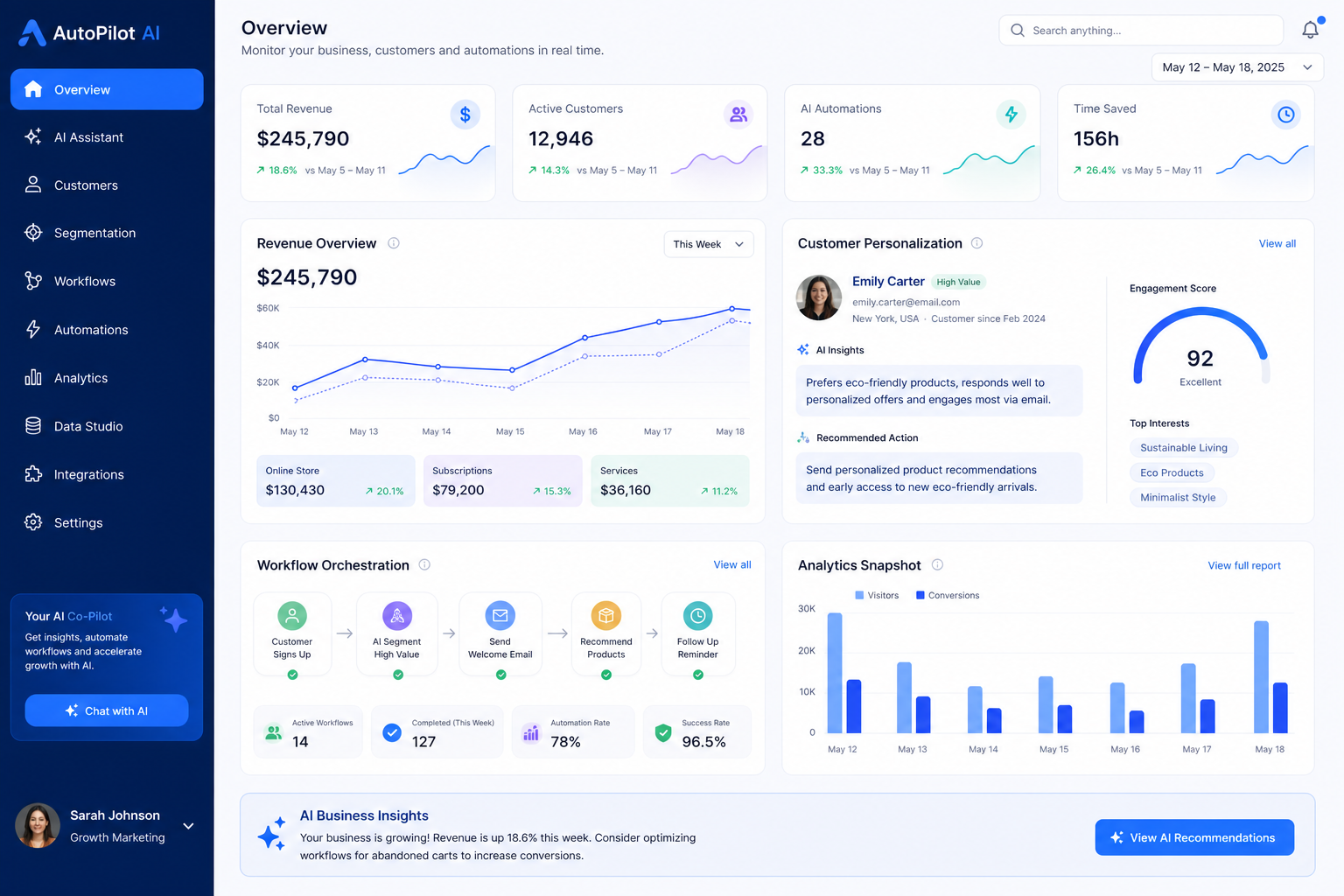
What Is an AI Web App?
An AI web app is a browser-based application that uses artificial intelligence to perform tasks that normally require manual input, rule-based software, or human judgment. Instead of simply displaying pages and collecting clicks, it can interpret inputs, generate recommendations, automate workflows, and personalize the user experience in real time.
In practical terms, an AI web app can:
Understand natural language prompts
Recommend products or next actions
Automate repetitive backend tasks
Analyze patterns in user behavior
Generate content, designs, or layouts
Improve performance as more data flows through the system
For online business owners, this means the app becomes more than a storefront. It becomes a conversion engine, a workflow assistant, and a scalable service layer.
How an AI Web App Works
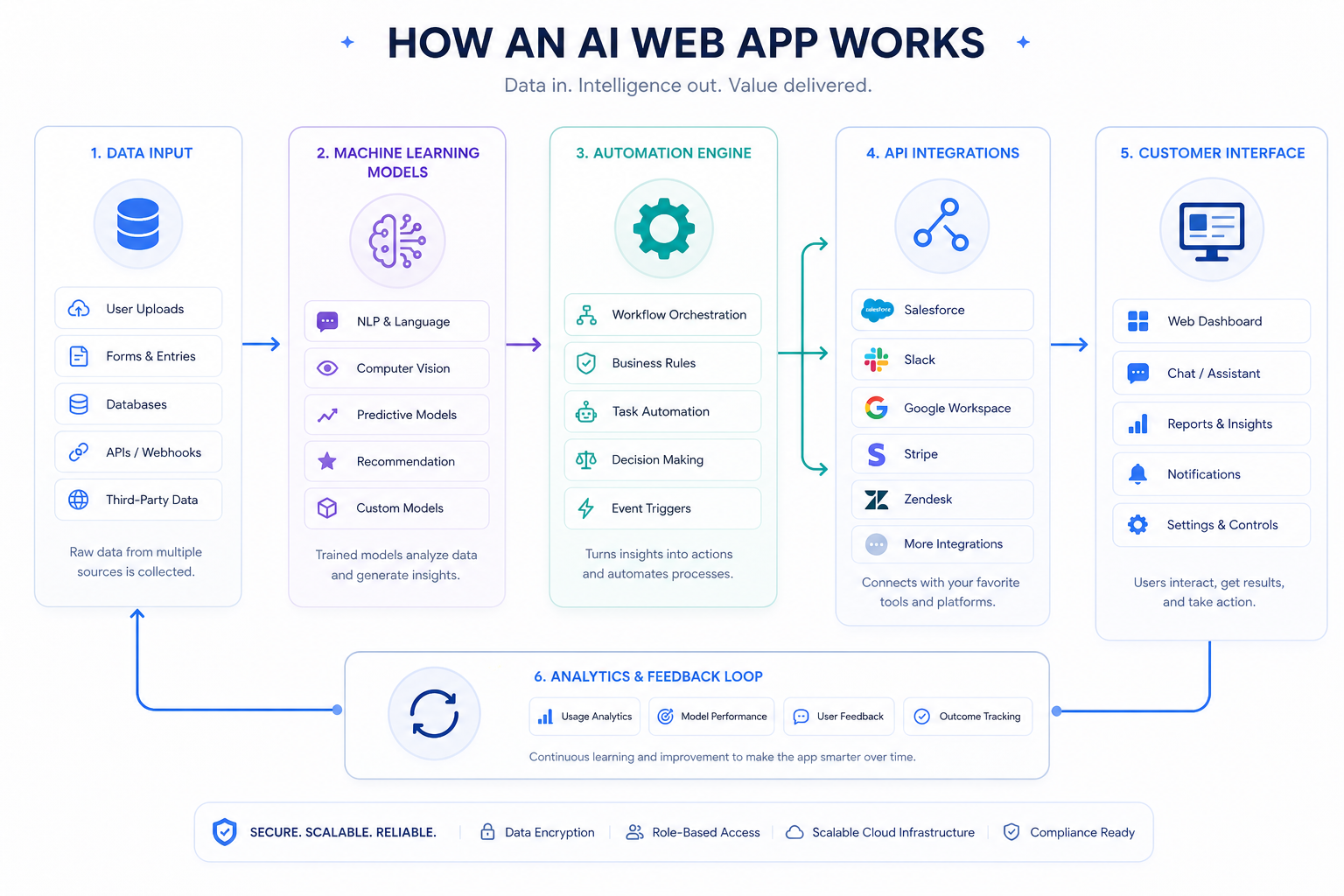
At a high level, an AI web app combines a standard web interface with intelligence layers behind the scenes.
The Core Workflow
User input enters the app
This could be a prompt, uploaded photo, product preference, support request, or browsing behavior.AI models interpret the intent
The system uses machine learning, natural language processing, recommendation logic, or computer vision to understand what the user wants.The app generates or selects an output
This could be a suggested product, automated response, design layout, pricing action, or fulfillment step.Business systems are triggered
APIs connect the AI layer to storefronts, CRMs, print workflows, payment systems, inventory logic, or production tools.Feedback improves the experience
User actions, conversions, edits, and performance data help optimize future outputs.
The Functional Building Blocks
Layer | What It Does | Business Impact |
|---|---|---|
Frontend interface | Collects prompts, uploads, clicks, and preferences | Creates a seamless user experience |
AI engine | Interprets intent and generates outputs | Reduces friction and speeds action |
Automation layer | Executes workflows automatically | Cuts manual labor and operational delays |
Integrations | Syncs with commerce, CRM, fulfillment, and analytics systems | Makes AI usable in real operations |
Feedback loop | Learns from results and behavior | Improves relevance and conversion over time |
Why Businesses Are Investing in AI Web Apps
The business case is not just about innovation. It is about removing growth bottlenecks.
1. Better User Experience
AI web apps make digital experiences feel more intuitive. Instead of forcing users through complicated interfaces, they can guide customers with prompts, smart defaults, personalized recommendations, and dynamic flows.
For example, in print commerce, many customers abandon purchases because traditional editors are too technical. Media Rex Alliance removes that barrier by letting users describe what they want in plain language and instantly turning that into a print-ready product experience.
2. Workflow Automation
Manual tasks drain time and margin. AI web apps can automate quoting, design generation, support replies, order routing, proofing logic, fulfillment triggers, and reporting.
This is especially valuable for print and personalized product businesses where every order may have unique creative or production requirements.
3. Faster Scaling
Traditional scaling often means hiring more people to handle more complexity. AI changes that equation by absorbing repeatable work and improving consistency across higher order volume.
4. Stronger Conversion Rates
The less friction in the journey, the more likely users are to complete a purchase. AI web apps shorten the path between intent and action.
5. Lower Overhead
When paired with on-demand production and automated fulfillment, AI web apps reduce the need for stock, prebuilt inventory, and manual coordination.
The Biggest Content Gap Competitors Miss: AI Web Apps Are Not Just About Automation
Most articles talk about AI in broad terms: chatbots, predictive analytics, and general efficiency. What they often miss is the commercial transformation layer.
The real value of an AI web app is not just that it automates tasks. It can turn complexity into a productized experience.
That distinction matters.
For Media Rex Alliance, the AI web app is not merely a backend tool. It is the customer-facing engine that:
Converts natural language into product creation
Removes reliance on design expertise
Makes premium print creation accessible on mobile and desktop
Previews the final outcome in 3D and AR before purchase
Pushes orders into a global fulfillment network automatically
Enables white-label deployment inside an existing brand ecosystem
That is a deeper business transformation than simple task automation.
Key Features of a High-Performing AI Web App
Not all AI web apps are created equally. The best ones combine intelligence, usability, integration, and operational readiness.
Essential Capabilities
Feature | Why It Matters |
|---|---|
Natural language interface | Lowers the learning curve and speeds completion |
Personalization engine | Improves relevance, engagement, and conversion |
Automation workflows | Reduces manual touchpoints |
Cloud and local sync | Supports seamless multi-device continuity |
API integrations | Connects AI to real business systems |
Analytics and learning loops | Helps optimize experience over time |
Mobile-first UX | Matches how modern customers actually buy |
Security and governance | Protects customer data and operational trust |
AI Web Apps vs Traditional Web Apps
A direct comparison helps clarify why businesses are moving now.
Capability | Traditional Web App | AI Web App |
|---|---|---|
User input | Forms, clicks, fixed flows | Prompts, behavior, context-aware input |
Personalization | Basic segmentation | Real-time adaptive experiences |
Design process | Manual and tool-heavy | Assisted or AI-generated |
Workflow execution | Mostly human-managed | Automated and event-driven |
Scaling model | Add staff as workload grows | Add automation as volume grows |
Customer support | Static FAQs or basic chat | Intelligent response and guidance |
Optimization | Periodic updates | Continuous learning from usage |
How AI Web Apps Improve Online Business Performance
Smarter Product Discovery
AI helps users find what they want faster, even when they cannot describe it in technical terms. This is powerful for product-heavy businesses and highly customizable categories.
Personalized Buying Journeys
The app can adapt content, recommendations, layout suggestions, and upsell paths based on behavior and intent.
Faster Time to Purchase
Reducing clicks, confusion, and tool complexity shortens decision-making windows.
More Efficient Operations
From support to fulfillment, automation decreases repetitive labor and improves consistency.
Better Forecasting and Risk Reduction
AI also helps companies detect patterns, forecast demand, and improve decision quality across departments.
"Organizations extensively using AI and automation in security operations saved an average of $1.9 million in breach costs." - Source
The Role of AI Web Apps in Web-to-Print
This is where AI becomes especially disruptive.
Traditional web-to-print tools often create friction because they were built around software logic, not customer intent. They expect users to think like designers, navigate layers, manually place assets, and understand print constraints.
An AI web app changes the model.
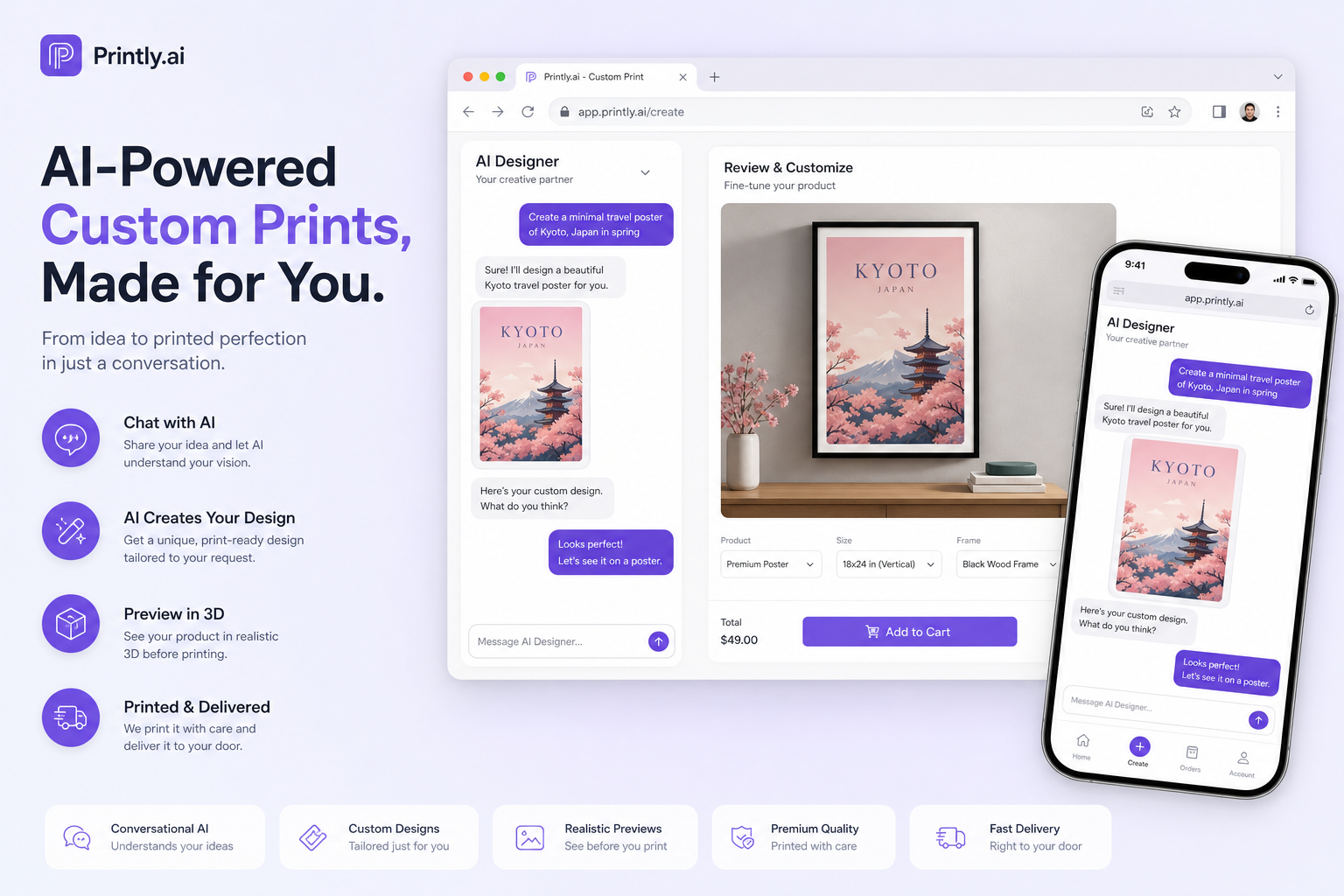
From Design Tool to Conversational Commerce
Instead of asking users to build products manually, Media Rex Alliance enables them to describe what they want:
“Create a luxury wedding album with a clean editorial style”
“Turn these travel photos into a premium hardcover photo book”
“Design a modern branded lookbook for my studio clients”
The platform then converts that prompt into a structured, print-ready product workflow.
Why This Matters for Print Businesses
For small studios, regional print players, photographers, and photo book brands, this unlocks major advantages:
Less design friction for end customers
Higher conversion potential from mobile users
Faster order completion
Improved confidence through photorealistic 3D and AR previews
Lower support burden because the app guides the process
On-demand production that avoids stock-heavy models
Global fulfillment automation without building an internal network
Who Benefits Most From an AI Web App?
Small Studios and Photographers
These businesses often need premium digital experiences but lack the engineering budget to build them from scratch. A white-label AI web app lets them offer modern product creation without becoming a software company.
New Print-on-Demand Brands
Startups need speed, low overhead, and scalable operations. AI web apps help them launch lean while still offering premium customer-facing experiences.
Mid-Size Print Brands
These companies often hit a growth ceiling where manual workflows start to hurt margin and customer satisfaction. AI can modernize both the front end and backend operations.
Regional Print Players
AI web apps help regional businesses compete with larger digital-first brands by upgrading UX, automation, and fulfillment.
Established Photo Book Companies
Legacy players often have strong product expertise but older interfaces. AI provides a path to modernization without discarding brand equity.
Why White-Label Matters in AI Adoption
One of the biggest strategic advantages in this category is white-label deployment.
Many businesses want AI capabilities, but they do not want to send customers to a third-party platform or rebuild their entire commerce stack. Media Rex Alliance solves that by integrating directly into existing storefronts or apps with custom branding, domain alignment, and visual identity.
That gives companies the benefits of advanced AI while retaining:
Brand ownership
Customer relationship control
Consistent UX
Faster go-to-market
Lower development risk
The Mobile-First Advantage
A surprising weakness in many digital product experiences is that they still feel desktop-first. That is a problem because many users browse, compare, and purchase on mobile.
A modern AI web app should be:
Browser-based
Fast-loading
Touch-friendly
Prompt-led
Cross-device synchronized
App-free
Media Rex Alliance is built for that reality. Customers can start a project in-browser, continue across devices, and rely on both local and cloud sync for continuity. That kind of fluid experience matters when trying to reduce abandonment and increase completed orders.
3D and AR Previews: The Conversion Layer Most Businesses Overlook
Another major gap in competitor content is the lack of focus on confidence-building visualization.
AI-generated workflows are powerful, but buyers still want reassurance before ordering a physical product. That is where photorealistic 3D and AR previews become commercially critical.
They help businesses:
Reduce uncertainty before purchase
Improve perceived product quality
Increase trust in customized orders
Lower approval friction
Potentially reduce costly order disputes or disappointment
For premium print products, previews are not just a nice feature. They are part of the revenue strategy.
How an AI Web App Reduces Costs and Increases Efficiency
The ROI case becomes clearer when you map AI to operational outcomes.
Business Challenge | How an AI Web App Helps |
|---|---|
High support workload | Automates guidance and routine responses |
Slow custom order creation | Generates layouts and product-ready outputs faster |
Design tool abandonment | Replaces complexity with conversational input |
Inventory pressure | Supports on-demand production models |
Production coordination | Automates fulfillment routing |
Weak mobile conversion | Delivers mobile-first, browser-based experiences |
Fragmented brand experience | Supports fully white-label deployment |
Common Reasons AI Projects Fail
A lot of AI projects underperform because they start with technology instead of customer outcomes.
Common Failure Points
No clear workflow use case
Poor integration with existing systems
Weak data governance
Overly broad ambitions
Complex UX that users still dislike
No measurable conversion or efficiency targets
Lack of operational execution after the AI layer is added
The best AI web apps avoid this by focusing on a narrow but high-value journey first, then scaling outward.
Media Rex Alliance reflects that model by solving a specific, high-friction commercial problem: helping businesses launch AI-powered web-to-print experiences without building the infrastructure themselves.
What to Look For Before Choosing an AI Web App Platform
Evaluation Checklist
Question | Why It Matters |
|---|---|
Can it be white-labeled? | Protects brand equity and customer ownership |
Does it work in-browser with no app install? | Reduces adoption friction |
Is it mobile-first? | Supports modern user behavior |
Does it integrate with existing storefronts? | Avoids expensive rebuilds |
Can it automate fulfillment? | Improves operational scalability |
Does it support rich previews like 3D or AR? | Builds confidence before purchase |
Is it built for on-demand production? | Lowers overhead and inventory risk |
Can it scale from startup to enterprise? | Protects long-term growth plans |
The Future of the AI Web App
AI web apps are moving beyond isolated tools and becoming the digital infrastructure for modern commerce. The next phase will be defined by:
Conversational interfaces replacing complex builders
AI-generated outputs becoming production-ready by default
Rich previews increasing buyer confidence
Event-driven automation compressing fulfillment timelines
White-label AI becoming standard for vertical SaaS
Cross-device, no-install experiences replacing app dependency
In web-to-print, this will fundamentally change how personalized products are bought and sold.
Why Media Rex Alliance Is Positioned for This Shift
Media Rex Alliance is not a generic AI layer. It is purpose-built for the future of AI-powered web-to-print.
It enables businesses to:
Let customers create products through conversational AI
Turn prompts into print-ready outputs quickly
Integrate the experience as a fully white-label solution
Offer photorealistic 3D and AR previews before checkout
Deliver mobile-first, browser-based creation with no app install
Sync projects locally and in the cloud across devices
Reduce overhead with on-demand production
Automate fulfillment through a global premium printer network
Scale from emerging brands to enterprise print operations
That combination is what makes it strategically different. It is not just AI for novelty. It is AI for commercial performance, operational scale, and customer experience transformation.
Final Verdict
An ai web app transforms online business by replacing rigid digital experiences with intelligent, adaptive, and scalable systems. It improves user experience, automates workflows, shortens time to purchase, and helps companies grow without matching complexity with headcount.
For print businesses, photo brands, and product personalization companies, the opportunity is even bigger. The companies that win will be the ones that remove design friction, embrace conversational commerce, and connect customer intent directly to automated production.
Media Rex Alliance gives businesses a faster path to that future. Instead of spending years building an AI-powered web-to-print stack internally, brands can launch a white-label, conversion-focused, mobile-first experience now.
If your business wants to modernize product creation, reduce operational drag, and scale premium print experiences with AI at the center, Media Rex Alliance is the platform to watch - and the partner to deploy.
FAQ
How is AI transforming businesses?
AI is transforming businesses by improving user experience, automating repetitive workflows, and helping teams make faster, smarter decisions. In online commerce, it also reduces friction between customer intent and purchase completion.
Why do 85% of AI projects fail?
Most AI projects fail because they lack a clear business use case, strong integrations, and measurable outcomes. Companies often focus on the technology itself instead of solving a specific customer or operational problem.
Which 3 jobs will survive AI?
Jobs centered on creative strategy, complex relationship management, and high-level operational judgment are most likely to endure. AI can support these roles, but it does not easily replace human taste, trust, or strategic leadership.
How to use AI to run your online business?
Use AI to streamline product discovery, personalize customer journeys, automate support and fulfillment, and generate outputs faster. A focused AI web app can improve conversions while reducing manual workload and overhead.
Why do 85% of AI projects fail?
They usually fail due to poor implementation discipline, disconnected systems, and unclear ROI goals. The best results come from starting with a narrow, high-friction workflow and scaling from there.
Which 3 jobs will survive AI?
Roles involving brand storytelling, client trust, and cross-functional decision-making will remain valuable. AI enhances execution, but human insight still leads innovation, differentiation, and customer connection.