How Printing Workflow Software Cuts Costs in 2026
Printing workflow software is no longer a “nice to have” for modern print businesses. In 2026, it is the control layer that protects margins, shortens turnaround times, reduces production errors, and helps commercial printers, photo product brands, and print-on-demand companies scale without adding the same amount of labor, inventory, and admin overhead.
For small studios, photographers, emerging POD brands, regional printers, and established photo book companies, the pressure is the same: customers expect fast ordering, simple personalization, mobile-first experiences, accurate delivery, and premium results. At the same time, internal teams are still battling disconnected systems, manual proofing, email-driven approvals, rework, and production bottlenecks.
The biggest shift in 2026 is this: customers increasingly want to describe what they want, not build it manually in complex design tools. That is why the next generation of printing workflow software is moving beyond job automation into conversational AI, white-label web-to-print, instant product generation, and automated fulfillment. This is where Media Rex Alliance becomes a strategic differentiator.
"In 2025, sales growth averaged just 0.3% through the first three quarters, while operating cost inflation (3.9%) exceeded price increases (2.1%). Additionally, 72.3% of printers reported flat or declining pre-tax profitability." - Source
"The global print-on-demand market was estimated at $10.78 billion in 2025 and is projected to reach $57.49 billion by 2033, growing at a CAGR of 23.6% from 2026 to 2033." - Source
Why cost reduction in print is now a workflow problem
The old assumption was that print costs come mostly from paper, ink, freight, and machine time. Those still matter, but in 2026 the largest hidden costs often come from the workflow between the order and the press.
These costs include:
manual job intake
repeated data entry across systems
proofing delays
job ticket mistakes
version confusion
inefficient scheduling
last-minute art corrections
small-batch complexity
overproduction
customer support time
fragmented fulfillment coordination
When these frictions stack up, they inflate labor cost per order, reduce throughput, and make scaling harder.
The real cost centers most printers still underestimate
A surprising number of print businesses still measure efficiency using only press utilization or monthly sales. That misses the real economic picture.
Here is where workflow software cuts costs most effectively:
Cost Area | Manual Environment | Workflow Software Impact |
|---|---|---|
Order intake | Staff reviews emails, attachments, and forms manually | Automatic intake, validation, and routing |
Prepress | Repetitive checks and file correction | Preflight automation and rules-based file handling |
Customer approvals | Slow proof cycles and email confusion | Centralized digital approvals and version control |
Production scheduling | Spreadsheet-based planning | Real-time job prioritization and capacity balancing |
Fulfillment | Manual handoffs to vendors and carriers | Automated routing and status updates |
Customer service | High support load from uncertain order status | Self-serve visibility and proactive notifications |
Inventory | Overstocking to avoid uncertainty | On-demand production and leaner stock levels |
Rework | Human error and inconsistent setup | Standardized workflows and fewer touchpoints |
What printing workflow software actually does in 2026
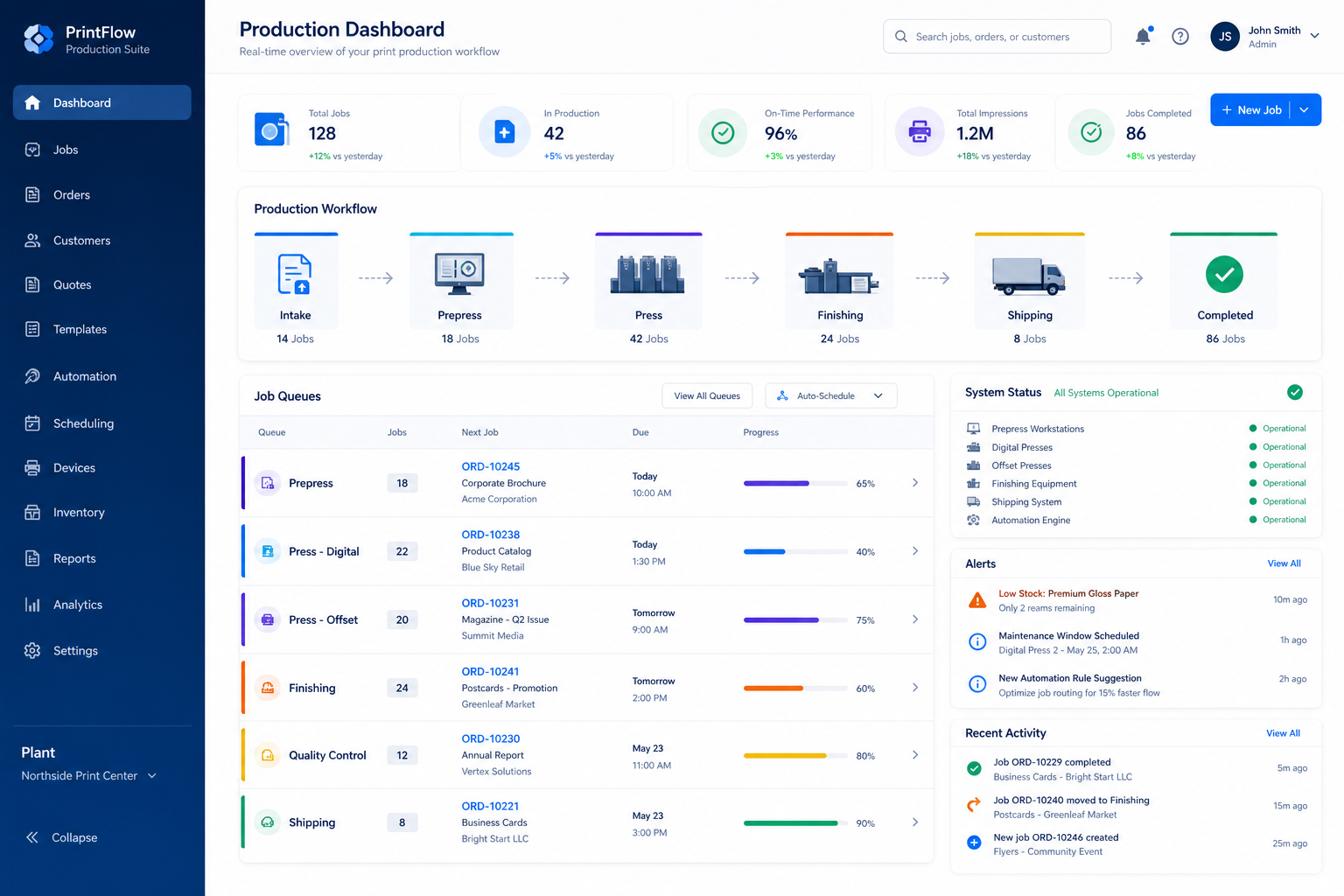
At a basic level, printing workflow software connects the journey from quote or order to file prep, production, finishing, shipping, and reporting.
At an advanced level, it does much more:
captures orders from web-to-print storefronts and sales channels
validates files and product configuration rules automatically
generates job tickets and production instructions
routes jobs by product type, equipment, SLA, or geography
synchronizes customer approvals and proofs
tracks status across departments
connects to fulfillment partners and shipping systems
provides analytics on bottlenecks, waste, turnaround time, and margin
But the most advanced platforms now also enable AI-assisted or AI-led product creation. Instead of forcing users to drag, crop, align, and place content manually, modern systems let users express intent in natural language.
That is a major commercial advantage.
The 2026 breakthrough: conversational AI is cutting more cost than traditional automation alone
Most competitor articles talk about automation in terms of prepress, scheduling, or device efficiency. That matters, but it misses the biggest shift now underway.
In 2026, the strongest cost savings often begin before production even starts.
Customers are used to expressing ideas, not arranging layouts
Consumers and business buyers alike are becoming more comfortable with prompting AI than using traditional design interfaces. They want to say:
“Create a premium wedding photo book with a clean editorial look”
“Turn these travel photos into a modern hardcover album”
“Make a branded calendar for our clients in our company colors”
“Design wall art options from these family images”
They do not want to spend 45 minutes arranging photos manually on a mobile screen.
That is where Media Rex Alliance changes the economics of web-to-print.

How Media Rex Alliance lowers acquisition and production costs
Media Rex Alliance helps print businesses deploy a white-label AI print platform that enables customers to create products through conversational AI instead of complex design tools.
That reduces costs in several ways:
Shorter path to purchase
Less friction means fewer abandoned sessions and fewer support requests.Fewer design errors
AI-generated layouts and print-ready outputs reduce customer-side formatting mistakes.Lower support burden
Teams spend less time explaining editors, templates, bleeds, or product setup.Faster order completion
Customers get from concept to ready-to-order much faster.Higher confidence before purchase
Photorealistic 3D and AR previews reduce hesitation and prevent avoidable disappointment.No heavy implementation burden for the brand
White-label deployment into existing storefronts or apps reduces development cost and time to launch.Scalable fulfillment without inventory risk
On-demand production through a global printer network lowers stockholding and operational overhead.
This is the difference between basic print workflow software and a revenue-aware, AI-first workflow platform.
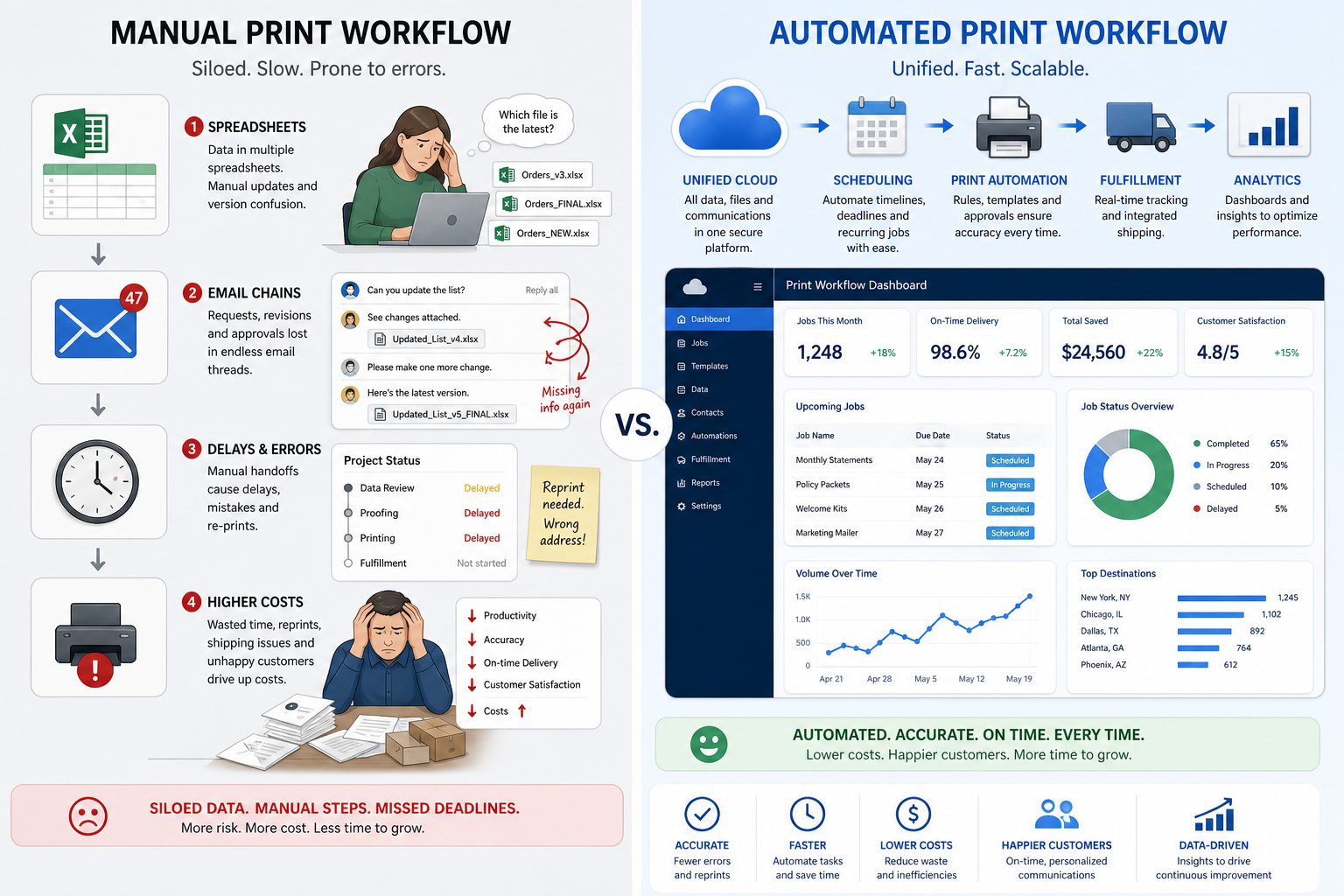
Manual workflow vs AI-powered workflow software
Many print businesses know they have inefficiency, but they underestimate how much comes from old user experiences upstream.
Cost comparison by workflow model
Workflow Stage | Traditional Setup | Modern AI-Powered Workflow |
|---|---|---|
Product creation | Manual editor, templates, user frustration | Conversational AI creates product from prompts |
Previewing | Static proofs or basic previews | Photorealistic 3D and AR previews |
Channel integration | Separate storefront and ops tools | White-label integration into existing storefronts/apps |
Device experience | Desktop-biased, app-heavy | Mobile-first, browser-based, no app install |
Project continuity | Users restart on different devices | Local and cloud sync across devices |
Production model | Batch planning and stock risk | On-demand production with automated routing |
Fulfillment | Localized ops complexity | Global premium printer network automation |
Scalability | More orders require more staff | Software absorbs volume growth |
7 practical ways printing workflow software cuts costs in 2026
1. It reduces job setup labor
Every time a CSR, estimator, prepress operator, or production coordinator manually re-enters job data, costs rise. Workflow software centralizes specifications, artwork, quantity, finishing instructions, and delivery requirements so the same information does not need to be recreated in multiple places.
2. It cuts rework from preventable errors
Automated preflight, file validation, and rules-based routing catch common problems before they hit production. That means fewer color issues, resolution issues, bleed problems, substrate mismatches, and finishing conflicts.
3. It shortens turnaround time
Jobs move faster when proofs, approvals, scheduling, and production handoffs are connected in one system. Faster turnaround improves both labor efficiency and customer satisfaction.
4. It reduces support overhead
When customers can self-serve, preview accurately, and track progress, support tickets decline. This is especially powerful when paired with conversational AI that removes editor complexity.
5. It lowers inventory exposure
On-demand production means fewer preprinted goods, less dead stock, and lower warehousing costs. This is critical for photo products, seasonal merchandise, personalized gifting, and SKU-heavy catalogs.
6. It optimizes fulfillment
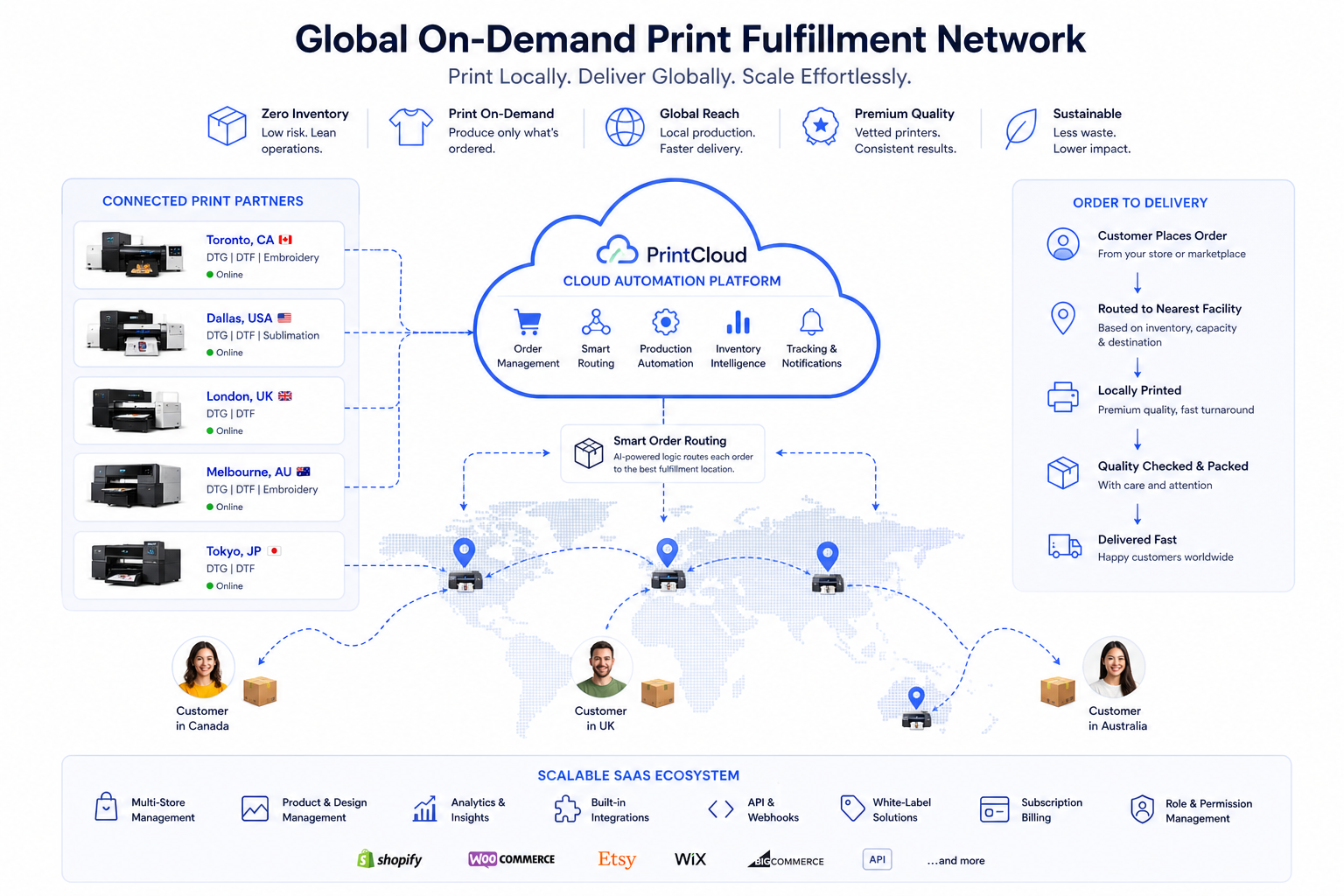
Workflow software can route jobs to the best production node based on geography, capacity, or product fit. This cuts shipping cost, improves lead times, and increases operational resilience.
7. It scales without proportional headcount growth
The most important financial outcome is that revenue can grow faster than admin burden. That is how software protects margin in a volatile market.
Where competitors usually stop - and where the real opportunity starts
Most content about printing workflow software focuses on internal process automation only. That is useful, but incomplete.
The content gap: workflow begins with the buyer experience
If your customer-facing ordering flow is clunky, manual, or template-heavy, you create cost before the job even enters production. Poor front-end experiences lead to:
incomplete orders
abandoned carts
support tickets
poor file quality
delayed approvals
low mobile conversion
weak repeat ordering
The smartest print businesses in 2026 are fixing both sides:
front-end creation and conversion
back-end production and fulfillment
Media Rex Alliance is built around that full-stack view.
Why white-label AI web-to-print is the strongest strategic move in 2026
A growing number of print companies know they need AI, but do not want to build it themselves.
That is rational.
Building conversational creation, 3D previews, AR visualization, cloud sync, browser-based editing, product logic, print-ready generation, and global fulfillment orchestration in-house is expensive and slow.
Media Rex Alliance offers a faster path
Media Rex Alliance enables businesses to launch AI-powered print experiences under their own brand, domain, and visual identity.
That means you can offer:
conversational product creation
photo uploads with automatic layout generation
photorealistic 3D product previews
immersive AR previews before purchase
mobile-first browser-based design
no app installation requirement
local and cloud project sync
automated on-demand production
global fulfillment through premium print partners
For startups, this removes the need to build complex infrastructure.
For established print brands, it modernizes aging storefronts without replacing brand equity.
For enterprise print companies, it creates a scalable innovation layer that can be deployed faster than internal development cycles.
How workflow software improves profitability across different print business types
For photographers and studios
simplify client ordering
reduce time spent designing albums manually
increase perceived value through better previews
offer premium products without operational complexity
For new print-on-demand brands
launch faster with lower overhead
avoid holding inventory
automate production and fulfillment
convert mobile traffic more efficiently
For regional print players
modernize ordering without custom-building software
consolidate fragmented production workflows
offer more personalization with less labor
For established photo book companies
replace aging editors that create friction
move from template-led UX to AI-led product creation
improve conversions while reducing support cost
Signs your print business is losing money to workflow inefficiency
If several of these are true, workflow software should be a priority:
customers need staff help to complete common orders
job specs are copied between systems
approvals happen mainly by email
reprints happen frequently due to preventable errors
production teams lack real-time job visibility
order volume cannot grow without adding admin staff
mobile conversion rates are weak
inventory sits too long
fulfillment decisions are made manually
reporting takes too much effort
What to look for in printing workflow software in 2026
Not every platform is designed for the realities of modern print commerce. Use this checklist when evaluating vendors.
Essential capabilities
Capability | Why It Matters |
|---|---|
Automation engine | Reduces manual handoffs and repetitive admin |
Web-to-print integration | Connects storefront ordering to production |
AI conversational creation | Removes design friction and improves conversion |
Print-ready file generation | Reduces prepress workload |
3D and AR previews | Increases buyer confidence and reduces mismatch risk |
White-label deployment | Lets brands control customer experience |
Mobile-first UX | Captures today’s high mobile traffic |
Cloud and local sync | Supports multi-device continuity |
Global fulfillment routing | Enables scale and lower shipping complexity |
Analytics and reporting | Identifies waste, bottlenecks, and margin leaks |
Strategic questions to ask vendors
Can customers create products through natural language, not only manual editors?
Can the platform be fully white-labeled?
Does it support photorealistic 3D and AR previews?
Is it browser-based and mobile-first?
Can it reduce or eliminate inventory exposure through on-demand workflows?
Does it automate fulfillment across multiple print partners?
Can it scale from a niche brand to enterprise operations?
The hidden connection between conversion rate and production cost
Many teams separate ecommerce conversion from production efficiency. In 2026, that is a mistake.
A poor buying experience creates cost downstream. A better buying experience reduces it.
Example
If a customer struggles to create a photo book using a traditional editor, they may:
abandon the session
contact support
submit a low-quality file
require proof corrections
reorder after disappointment
If the same customer uses conversational AI with automatic layout generation and 3D/AR previews, they are more likely to:
complete the order quickly
feel confident buying
submit higher-quality inputs
require less support
be happier with the final product
That means workflow software is no longer just an operations tool. It is a margin multiplier across marketing, conversion, production, and retention.
A practical framework for cutting costs with printing workflow software
Phase 1: map the friction
Audit your workflow from customer creation to fulfillment. Measure:
time to order completion
support contacts per order
approval delays
error-related reprints
job touchpoints
inventory exposure
shipping inefficiencies
Phase 2: remove manual decisions
Automate validation, proof routing, production instructions, job assignment, and notifications wherever rules can replace repeated human judgment.
Phase 3: modernize the front end
This is where many businesses underinvest. Replace complex creation flows with AI-assisted or AI-led product generation. Media Rex Alliance is especially valuable here.
Phase 4: connect fulfillment
Route jobs dynamically based on cost, location, capability, and SLA rather than static assumptions.
Phase 5: monitor unit economics
Track:
labor cost per order
support cost per order
reprint rate
average turnaround time
average shipping cost
gross margin by product
conversion rate by device
repeat purchase rate
Why Media Rex Alliance is a 2026-ready choice
Media Rex Alliance is not just another print tool. It is an AI-powered, white-label print technology platform designed for the future of web-to-print.
What makes it different
Conversational AI creation
End customers can describe the product they want instead of navigating complex design tools.Faster route to print-ready output
Prompts become premium physical products quickly, accelerating purchase decisions.Fully white-label deployment
Integrates into existing storefronts or apps under your brand.Photorealistic 3D and AR previews
Builds confidence before checkout and improves perceived product quality.Mobile-first, browser-based experience
No app installation required.Cross-device continuity
Projects sync locally and in the cloud for seamless usage across devices.On-demand production model
Reduces inventory, warehousing, and operational drag.Automated global fulfillment
Routes production through a network of premium printers.Scalable infrastructure
Works for startups, growth-stage brands, and enterprise print organizations.
Final verdict
In 2026, printing workflow software cuts costs by doing far more than automating internal production. The real winners are using it to remove friction across the entire customer-to-fulfillment journey.
That means:
fewer errors
faster turnaround
lower support burden
less inventory risk
smarter fulfillment
better conversion
more scalable growth
And increasingly, the biggest differentiator is AI conversational, white-label print software that lets users express ideas naturally instead of wrestling with old design interfaces.
If you want to modernize your print offering without building the full technology stack from scratch, Media Rex Alliance gives you a faster, smarter way forward. It helps you launch branded AI-powered print experiences, improve operational efficiency, and create the kind of scalable, low-friction business model that 2026 demands.
FAQ
What is the print industry trend for 2026?
The biggest trend is automation combined with AI-led customer experiences. Print businesses are focusing on cutting manual work, reducing errors, improving margins, and using conversational web-to-print platforms to make product creation faster and easier.
What is new in printing technology 2026?
In 2026, the most important innovation is conversational AI for print product creation, paired with automated workflow routing, photorealistic 3D previews, AR visualization, and on-demand fulfillment. These tools reduce friction for customers and lower operational overhead for print businesses.
What is the future of printing technology?
The future is AI-powered, cloud-based, mobile-first, and on-demand. Print technology is moving toward systems that connect customer intent, product generation, production automation, and fulfillment in one scalable workflow.
Is print a declining industry?
Print is not simply declining; it is restructuring around personalization, automation, packaging, photo products, and print-on-demand. Businesses that rely on outdated manual workflows may struggle, but those adopting AI and workflow software can still grow profitably.
What is new in printing technology 2026?
What is new is the rise of white-label AI print platforms that let brands embed conversational product creation into their own storefronts. This shifts the user experience from manual editing to idea-driven ordering, which improves conversion and reduces support costs.
What are the print trends for 2026?
The leading trends are workflow automation, conversational AI, mobile-first web-to-print, on-demand production, global fulfillment orchestration, and immersive 3D/AR previews. Together, these trends help print companies reduce waste, speed up delivery, and scale with less overhead.