
How to Choose the Right AI Platform
Choosing the right AI platform is no longer a side project for innovation teams. It is now a core business decision that affects speed, margins, customer experience, operational efficiency, and long-term scalability.
For small studios, photographers, modern print brands, regional web-to-print players, and established photo book companies, the challenge is even sharper: you do not just need AI that can generate text or answer prompts. You need an AI platform that can plug into real workflows, reduce customer friction, increase conversion rates, and help you launch differentiated digital products without rebuilding your tech stack from scratch.
That is where many businesses get stuck. The market is crowded with general-purpose AI tools, enterprise AI suites, automation platforms, and niche vertical solutions. Some are excellent at research. Some are strong in workflow orchestration. Others are built for large internal teams, not for customer-facing commerce. And very few are purpose-built for AI-powered web-to-print experiences.
This guide from Media Rex Alliance breaks down exactly how to evaluate an AI platform, what features matter most, which categories solve which problems, and how to select an option that actually drives business growth.
What Is an AI Platform?
An AI platform is a software environment that enables businesses to use artificial intelligence across one or more functions such as content generation, automation, analytics, customer support, decision-making, image handling, or product creation.
Unlike a single AI tool that performs one isolated task, an AI platform typically offers:
Multiple AI capabilities in one system
Workflow logic and orchestration
Integrations with business software
Security and governance controls
Scaling infrastructure for team or customer use
Interfaces for customization, deployment, and measurement
In simple terms, an AI platform is not just something that “answers questions.” It is something that helps a business turn AI into repeatable outcomes.
For example:
A marketing team may use an AI platform to generate campaign assets at scale.
A support team may use one to automate ticket routing and replies.
A finance team may use one for predictive analysis and reporting.
A print business may use one to let customers create premium physical products from a conversational prompt, preview them in 3D or AR, and send them straight into automated production.
That last example matters because the future of AI is not just internal productivity. It is customer-facing revenue generation.
Why Choosing the Right AI Platform Matters More Than Ever
Most businesses are already experimenting with AI, but experimentation alone does not create defensible growth.
"The global AI platform market size was estimated at $14.21 billion in 2024 and is projected to reach $251.01 billion by 2033." - Grand View Research
That growth tells you two things:
AI platforms are becoming foundational business infrastructure.
The wrong choice today can create expensive lock-in tomorrow.
The best AI platform should help you move from fragmented pilots to scalable execution. That means it should not only generate outputs, but also connect to the systems, workflows, and customer journeys that produce measurable business value.
"Generative AI could add between $2.6 trillion and $4.4 trillion annually across 63 analyzed use cases." - McKinsey
The takeaway is clear: AI value is real, but only when it is embedded into actual business processes.
The Core Problem Most Buyers Overlook
Many businesses compare AI platforms like they are buying a chatbot. That is too narrow.
The real question is not:
“Which AI is smartest?”
The real question is:
“Which AI platform best supports our workflow, customer experience, and revenue model?”
This is especially important for digital print and web-to-print businesses. A general AI assistant may help your team brainstorm product copy, but it will not help your customer instantly create a personalized photo book, see a photorealistic 3D preview, check it in AR, and place an order into an on-demand global production pipeline.
That is why platform fit matters more than raw model hype.
The Main Types of AI Platforms
Before choosing, it helps to understand the major categories in the market.
1. General-purpose AI assistants
These platforms focus on broad use cases like writing, summarization, research, ideation, coding, and file analysis.
Examples include:
ChatGPT
Claude
Gemini
Best for:
Individuals
Knowledge workers
Analysts
Teams needing flexible AI help across many tasks
Limitations:
Often not deeply integrated into vertical customer journeys
Usually require additional tooling for workflow execution or storefront deployment
2. Workflow and automation AI platforms
These platforms combine AI with triggers, actions, integrations, logic, and process automation.
Examples include:
Lindy
Zapier
Make
Best for:
Operations teams
Lead routing
Email automation
CRM updates
Cross-app workflow orchestration
Limitations:
Strong operationally, but usually not built as branded customer-facing product experiences
3. Enterprise AI and MLOps platforms
These focus on governance, model deployment, experimentation, large-scale infrastructure, and enterprise controls.
Examples include:
IBM watsonx
Vertex AI
Azure AI
Bedrock
Best for:
Enterprises with technical teams
Large data environments
AI governance-heavy deployments
Limitations:
More complex to implement
Often overkill for mid-market operators seeking speed to market
4. Vertical AI platforms
These are built around a specific industry or business model.
Examples:
Support AI for customer service
Revenue AI for sales
Design AI for ecommerce
AI-powered web-to-print platforms like Media Rex Alliance
Best for:
Businesses that want faster time-to-value
Teams that need AI embedded into a specific buying journey
Companies seeking monetizable, customer-facing AI experiences
Limitations:
Less general-purpose than broad AI assistants, but often far more valuable in the target use case
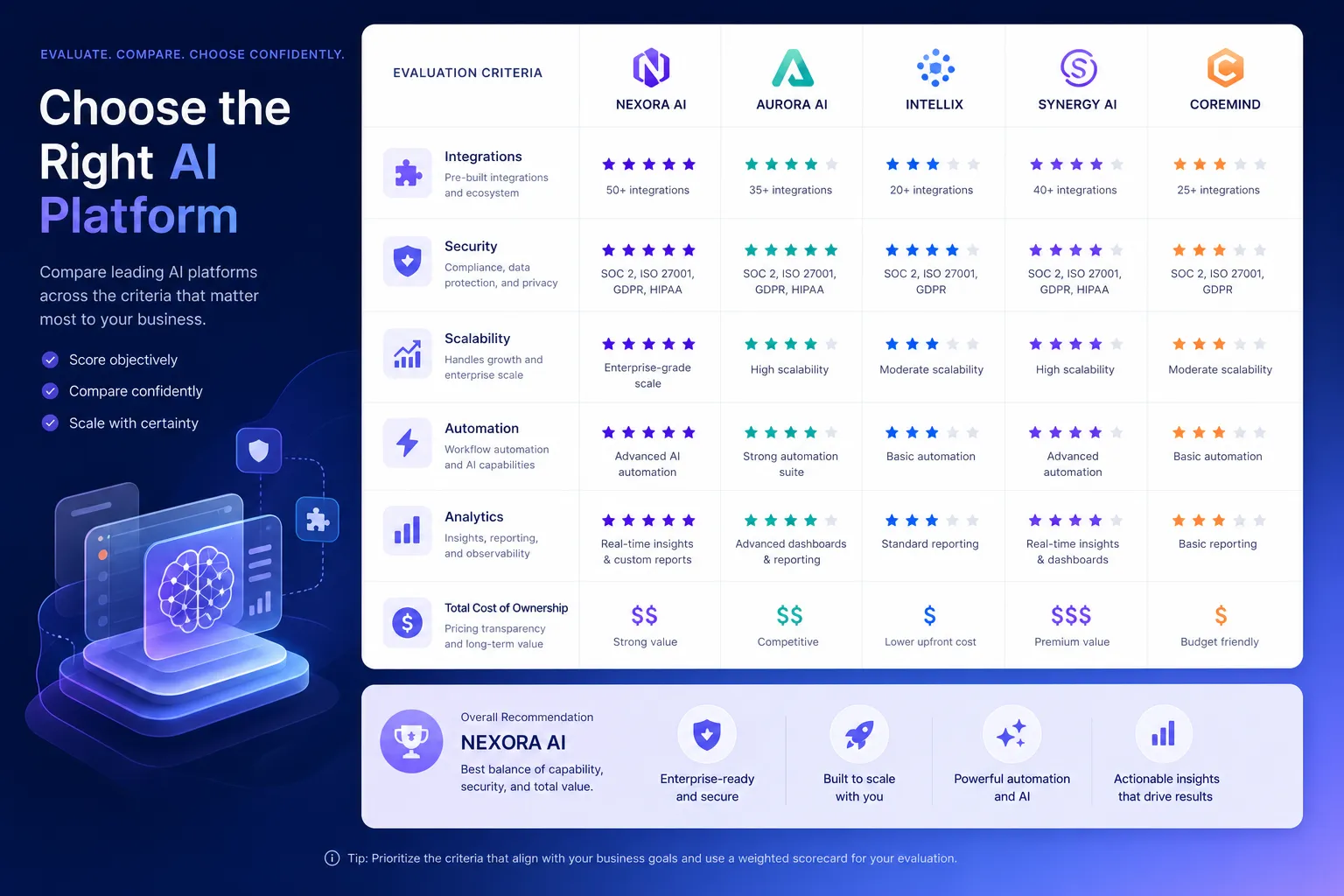
The 10 Criteria to Compare When Choosing an AI Platform
If you want a practical decision framework, use these ten criteria.
1. Use-case alignment
Start with the job to be done.
Ask:
Are you trying to improve internal productivity?
Automate operations?
Power customer support?
Launch AI-native product creation?
Modernize a web-to-print storefront?
Reduce abandonment in a product customization flow?
A platform that is perfect for internal meeting notes may be completely wrong for ecommerce product generation.
2. Ease of implementation
Evaluate how quickly your team can go live.
Look at:
No-code or low-code options
API maturity
Prebuilt templates
Integration complexity
Time required from engineering
For many print businesses, speed matters. You may not want a 9-month custom build just to offer AI-powered creation.
3. Customer-facing experience
This is one of the biggest content gaps in most AI platform guides.
If AI touches the buyer journey, assess:
Mobile responsiveness
Browser-based access
Conversational UX quality
Visual feedback during creation
Confidence-building elements like previews
Friction between prompt and purchase
This is where Media Rex Alliance stands apart. It enables customers to create products through conversational AI instead of complex design tools, turning product creation into a fast, intuitive, mobile-first experience.
4. Integration capability
The best AI platform fits your stack instead of forcing a painful rebuild.
Check for integration with:
Ecommerce systems
CRMs
DAMs
Order management
Payment flows
Fulfillment providers
Analytics tools
Existing storefronts or mobile apps
Media Rex Alliance is designed for fully white-label integration into existing storefronts or apps, which is critical for businesses that want to modernize without replacing everything.
5. Output quality
A platform is only as good as the quality of what it creates.
Assess:
Accuracy
Relevance
Brand consistency
Visual quality
Formatting
Production readiness
In print, output quality goes beyond text. It includes layout logic, image handling, print readiness, and how well the final product maps to manufacturing constraints.
6. Scalability
Can the platform grow with your business?
Look for:
Multi-user support
Enterprise controls
Performance under load
Global infrastructure
High-volume order handling
Flexible pricing tiers
Media Rex Alliance scales from startups to enterprise print companies, making it suitable for both emerging brands and established production businesses.
7. Security and compliance
Never ignore governance.
Ask:
Where is data stored?
How is customer data handled?
Is the platform compliant with relevant privacy and security requirements?
Are there role-based controls?
Can enterprise clients isolate brand environments?
For businesses handling user-generated content, personal photos, and branded commerce, this is non-negotiable.
8. Analytics and optimization
You need visibility into what AI is doing for the business.
Measure:
Conversion rate changes
Time-to-create reductions
Drop-off points
Product completion rates
Prompt success
Upsell performance
Fulfillment speed
Repeat usage
Without measurement, AI becomes a novelty instead of an optimization engine.
9. Operational automation
Some platforms stop at “creation.” Better ones continue into execution.
The strongest AI platforms help automate:
Product generation
Approvals
Order routing
Production setup
Vendor matching
Fulfillment workflows
Media Rex Alliance supports on-demand production and automates fulfillment via a global network of premium printers, reducing manual overhead and enabling scale.
10. Total cost of ownership
Do not evaluate price in isolation.
Compare:
Licensing fees
Setup costs
Engineering time
Operational savings
Inventory reduction
Conversion lift
Speed-to-market
Ongoing maintenance
A platform that costs more upfront may be dramatically cheaper if it reduces abandonment, cuts inventory, and automates fulfillment.
A Simple AI Platform Evaluation Matrix
Use this matrix to compare options side by side.
Evaluation Area | What to Ask | Why It Matters |
|---|---|---|
Use-Case Fit | Does this platform solve our exact business problem? | Prevents buying general tools for specialized needs |
UX Quality | Is the experience intuitive for customers or staff? | Better UX means better adoption and conversion |
Integration | Can it fit our existing systems and storefronts? | Reduces cost and implementation time |
Output Quality | Are outputs usable, on-brand, and production-ready? | Poor outputs create more manual work |
Scalability | Will it support growth in users, orders, and traffic? | Avoids replatforming later |
Security | Does it meet our compliance and data protection needs? | Protects brand and customer trust |
Automation | Does it go beyond generation into execution? | Drives real ROI |
White-Label Support | Can we own the brand experience? | Critical for agencies, print brands, and enterprise resellers |
Visualization | Can users preview results before purchase? | Increases trust and reduces hesitation |
ROI | Will this reduce friction and increase revenue? | Keeps selection tied to business impact |
Common AI Platform Use Cases by Business Type
For small studios and photographers
Best AI platform needs:
Fast product creation
Mobile-friendly workflows
Low setup complexity
Beautiful previews
No inventory burden
A strong platform can help these users sell premium physical products without building a custom commerce experience from scratch.
For new print-on-demand brands
Best AI platform needs:
Branded storefront integration
White-label deployment
Prompt-to-product generation
On-demand fulfillment
Fast launch cycle
This is a perfect fit for Media Rex Alliance’s model of turning prompts into print-ready products quickly, shortening the time from inspiration to order.
For mid-size print brands
Best AI platform needs:
Conversion improvements
Better personalization
Reduced support burden
Automated routing to production
Cross-device customer journeys
These businesses need more than an AI widget. They need an AI-enabled buying engine.
For regional print players
Best AI platform needs:
Competitive modernization
Faster rollout than custom development
Local brand control
Production efficiency
Flexible integration with legacy systems
A white-label, browser-based platform can accelerate transformation without years of platform rebuilds.
For established photo book companies
Best AI platform needs:
Premium user experience
Better mobile conversion
Reduced complexity in product design
3D and AR validation
Enterprise-ready scale
This audience often has the most to gain from replacing outdated design interfaces with conversational creation.
The AI Platform Features That Matter Most in Web-to-Print
This is where generic guides usually stop too soon. For AI-powered print commerce, the winning features are more specific.
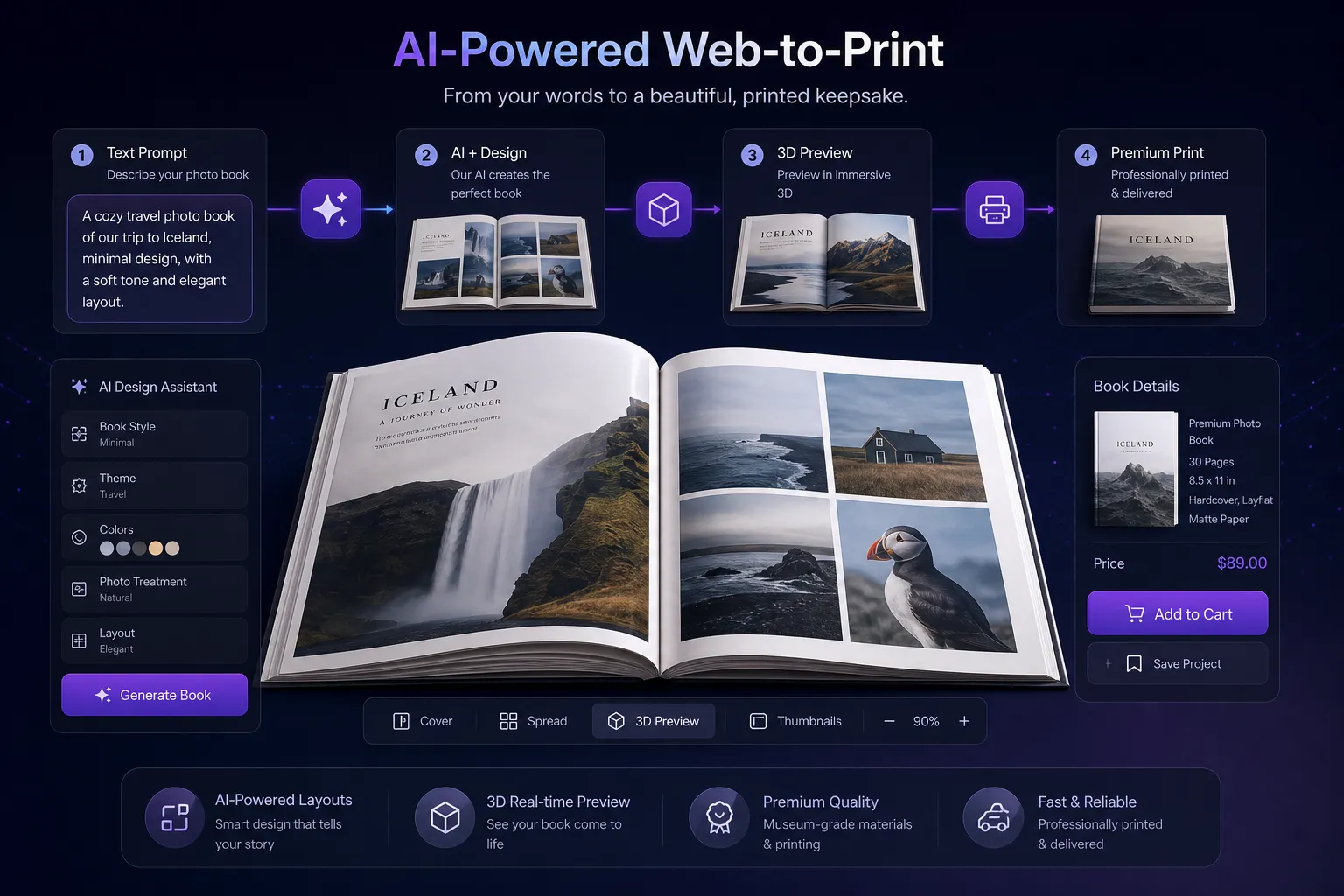
Conversational product creation
Traditional web-to-print tools often fail because they ask customers to think like designers.
Media Rex Alliance changes that by enabling customers to create products via conversational AI instead of complex design tools. That means less friction, faster decisions, and broader accessibility for non-designers.
Prompt-to-product speed
Every extra step in the buying flow creates drop-off.
A modern AI platform should:
Accept natural language prompts
Handle photo uploads
Generate layouts automatically
Prepare the output for production
Keep the customer moving toward checkout
This is a major advantage for businesses looking to speed up purchase decisions.
Photorealistic 3D and AR previews
One of the strongest trust-building features in AI commerce is visualization.
Media Rex Alliance provides photorealistic 3D and AR previews, helping customers validate what they are buying before they commit. That can improve confidence, reduce uncertainty, and support higher conversion rates.
Mobile-first browser experience
Modern consumers do not want to install another app just to customize a product.
A strong AI platform should support:
Mobile-first design
Browser-based access
No-installation workflows
Smooth cross-device continuity
Media Rex Alliance is built for exactly that.
Local and cloud sync
Customers often start on one device and finish on another.
The ability to sync projects locally and in the cloud creates a seamless user experience and protects against lost sessions or interrupted workflows.
White-label deployment
For print businesses, ownership of the brand experience is critical.
Media Rex Alliance supports:
Custom branding
Custom domain
Embedded experiences
White-label rollout inside an existing ecommerce environment
That means businesses can launch AI-native commerce without surrendering customer ownership.
On-demand production and fulfillment automation
A great AI platform should not stop at creation.
Media Rex Alliance helps reduce inventory and overhead through:
No-stock production
Automated order flow
Global premium printer network
Scalable fulfillment operations
This is where AI starts delivering not just a better front end, but a more efficient operating model.
Comparing Popular AI Platform Types
Below is a practical comparison for common AI platform categories.
Platform Type | Best For | Strengths | Limits |
|---|---|---|---|
General AI Assistant | Writing, analysis, brainstorming | Flexible, fast, broad capability | Limited vertical workflow execution |
Automation Platform | Ops, workflows, integrations | Triggers, actions, process automation | Usually not customer-facing commerce UX |
Enterprise AI Platform | Governance, ML, infrastructure | Scale, security, model management | Complex, slower to deploy |
Vertical AI Platform | Specific business outcomes | Faster time-to-value, specialized UX | Narrower scope, but often higher ROI |
AI Web-to-Print Platform | Print commerce modernization | Conversational creation, white-label, previews, fulfillment | Best when print and product personalization are central |
Examples of AI Platforms Businesses Commonly Evaluate
ChatGPT
Best for:
Writing
Ideation
Research
General productivity
Light coding and analysis
Strength:
Flexible and widely adopted
Limitation:
Not inherently designed as a white-label, customer-facing product creation engine
Claude
Best for:
Long-form reasoning
Document analysis
Structured writing
Strength:
Strong contextual understanding
Limitation:
Less suited to end-to-end commerce workflows
Gemini
Best for:
Multimodal tasks
Search-connected workflows
Productivity inside Google ecosystems
Strength:
Strong ecosystem alignment
Limitation:
Not tailored to branded print product journeys
IBM watsonx
Best for:
Enterprise AI governance
Model operations
Large-scale organizational deployment
Strength:
Enterprise depth and controls
Limitation:
More infrastructure-oriented than commerce experience-oriented
Lindy
Best for:
AI workflow automation
Internal business operations
Multi-step orchestration
Strength:
Operational automation and integrations
Limitation:
Not specialized for AI-native physical product customization journeys
How to Decide: General AI Platform vs Vertical AI Platform
This is often the real fork in the road.
Choose a general AI platform if:
You want flexible support across writing, analysis, brainstorming, and knowledge work
Your main use case is internal productivity
You are still experimenting broadly
Choose a vertical AI platform if:
You already know the workflow you want to improve
Customer experience is central to your business model
You need branded deployment
Speed to market matters
You want business outcomes, not just AI access
For digital print businesses, the difference is simple:
A general AI platform may help your team work better.
A vertical AI platform like Media Rex Alliance can help your customers buy better.
That distinction has major commercial value.
Questions to Ask Before You Commit to an AI Platform
Use these in every demo and vendor conversation.
Strategy questions
What business outcome is this platform built to improve?
Is it meant for internal teams, external users, or both?
Can it create measurable ROI in the first 6 to 12 months?
Product questions
How intuitive is the user experience?
Does it reduce steps in the customer journey?
Can it generate production-ready outputs?
Technical questions
How does it integrate with our existing storefront or app?
What implementation resources are required?
How customizable is the deployment?
Commercial questions
Is pricing based on seats, usage, orders, or enterprise licensing?
What is the total cost of implementation and ownership?
What operating costs does it help us reduce?
Future-proofing questions
Will this platform scale with our catalog and order volume?
Does it support new product types and customer journeys?
Can we preserve brand ownership as we grow?
Mistakes to Avoid When Choosing an AI Platform
Mistake 1: Buying based on hype
The most talked-about platform is not automatically the best fit for your business model.
Mistake 2: Ignoring the customer journey
If the platform touches ecommerce, design, or product configuration, user experience matters as much as AI performance.
Mistake 3: Underestimating integration work
A powerful platform that is difficult to deploy can slow value realization.
Mistake 4: Focusing only on content generation
The best AI platforms do more than generate. They orchestrate, visualize, personalize, and execute.
Mistake 5: Forgetting brand control
If your business depends on customer trust and repeat purchase, white-label control is a strategic asset.
Why Media Rex Alliance Is a Different Kind of AI Platform
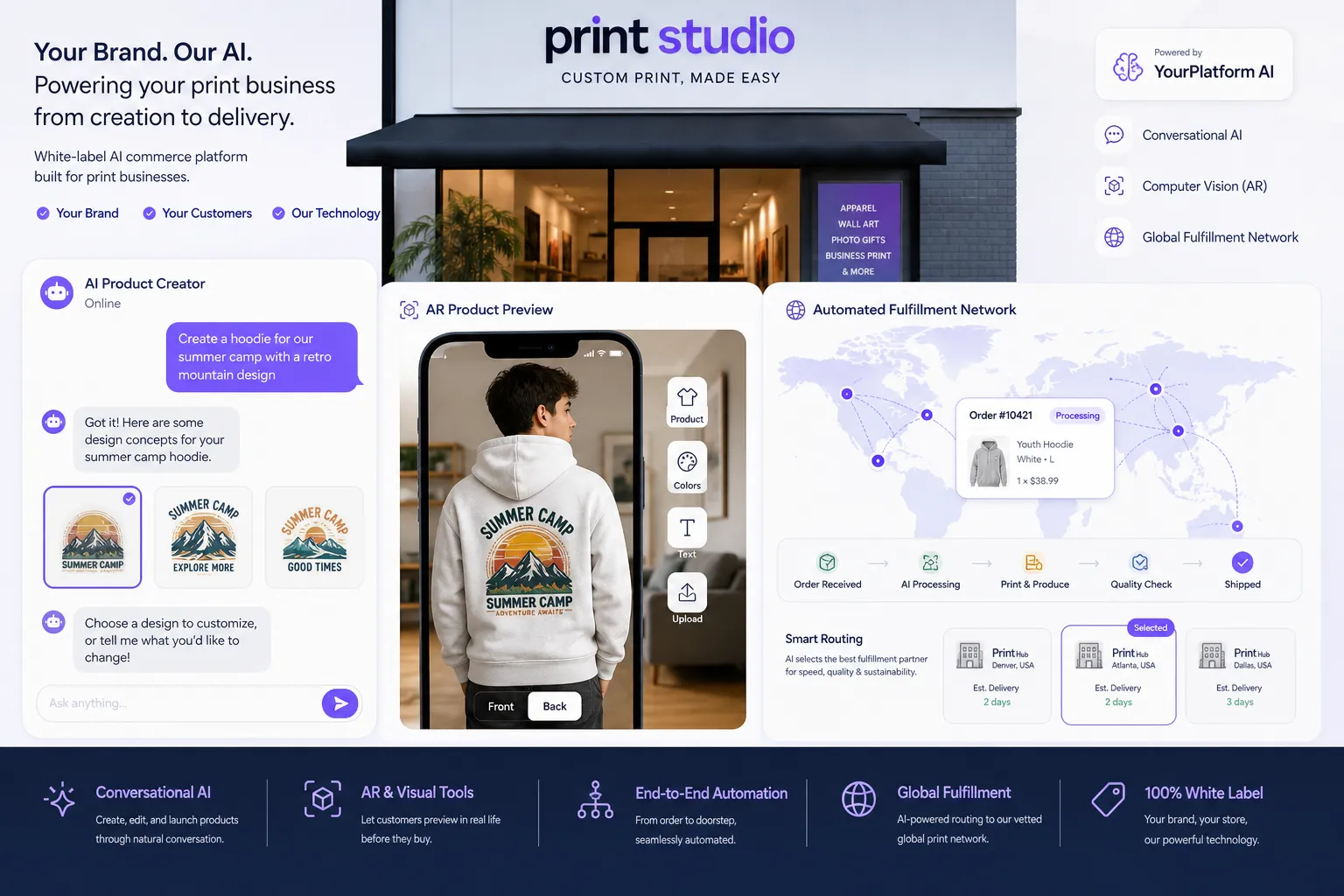
Many AI platforms help teams create text, automate workflows, or analyze data. Media Rex Alliance is built for something more commercially specific: transforming AI-powered product creation into a branded, scalable web-to-print experience.
Here is what makes it strategically different:
It replaces design friction with conversation
Customers can describe what they want in natural language instead of wrestling with design tools.
It moves fast from prompt to print-ready product
That means fewer steps, less abandonment, and faster path-to-purchase.
It is fully white-label
Businesses keep their branding, domain, and customer relationship.
It improves buying confidence
Photorealistic 3D and AR previews help users feel sure before ordering.
It is mobile-first and browser-native
No app installation required.
It supports multi-device continuity
Local and cloud sync make the experience seamless across sessions and screens.
It supports on-demand economics
By reducing inventory and overhead, businesses can operate more efficiently.
It automates fulfillment at scale
A global network of premium printers helps translate digital demand into physical delivery.
In short, Media Rex Alliance is not just another AI tool. It is an AI-powered commerce infrastructure layer for the future of print.
Final Verdict: What Is the Right AI Platform?
The right AI platform depends on what you need AI to do.
If you want a flexible assistant for writing, thinking, and general productivity, general-purpose tools may be enough.
If you want to automate internal processes, workflow-first AI platforms make sense.
But if your goal is to modernize a print business, launch AI-native product creation, reduce friction in the customer journey, improve conversions, and scale premium on-demand production under your own brand, then you need more than generic AI.
You need a platform designed for that exact commercial reality.
Media Rex Alliance gives print businesses, photo brands, studios, and web-to-print operators a faster route into the next generation of AI-powered commerce. It combines conversational creation, white-label deployment, immersive previews, browser-based usability, and automated fulfillment into a single scalable platform.
If you want to move from AI experimentation to real customer-facing growth, Media Rex Alliance is the platform to evaluate first.
FAQ
Is ChatGPT still the best AI?
ChatGPT is still one of the best general-purpose AI platforms for writing, brainstorming, analysis, and everyday productivity. But the “best” AI depends on the use case, and businesses often need a more specialized platform for automation, commerce, or customer-facing workflows.
What AI is better than ChatGPT?
Some AI platforms can be better than ChatGPT for specific tasks. For example, Claude is strong for long-document reasoning, workflow tools like Lindy are better for automation, and Media Rex Alliance is better for AI-powered web-to-print product creation and white-label commerce experiences.
What is the best AI app for the average person?
For the average person, a general-purpose AI app like ChatGPT, Claude, or Gemini is usually the best starting point. They are easy to use and support common tasks like writing, summarizing, research, and planning.
Which AI is better than GPT?
No single AI is universally better than GPT in every category. The better choice depends on whether you need reasoning, automation, enterprise governance, or vertical workflow execution, which is why platform fit matters more than brand recognition alone.
How to tell if someone is using ChatGPT to text you?
You usually cannot know for certain, but common signs include overly polished phrasing, generic structure, and unusually consistent tone. That said, strong writing alone is not proof, and many people now use AI as a drafting or editing layer rather than for fully automated messages.