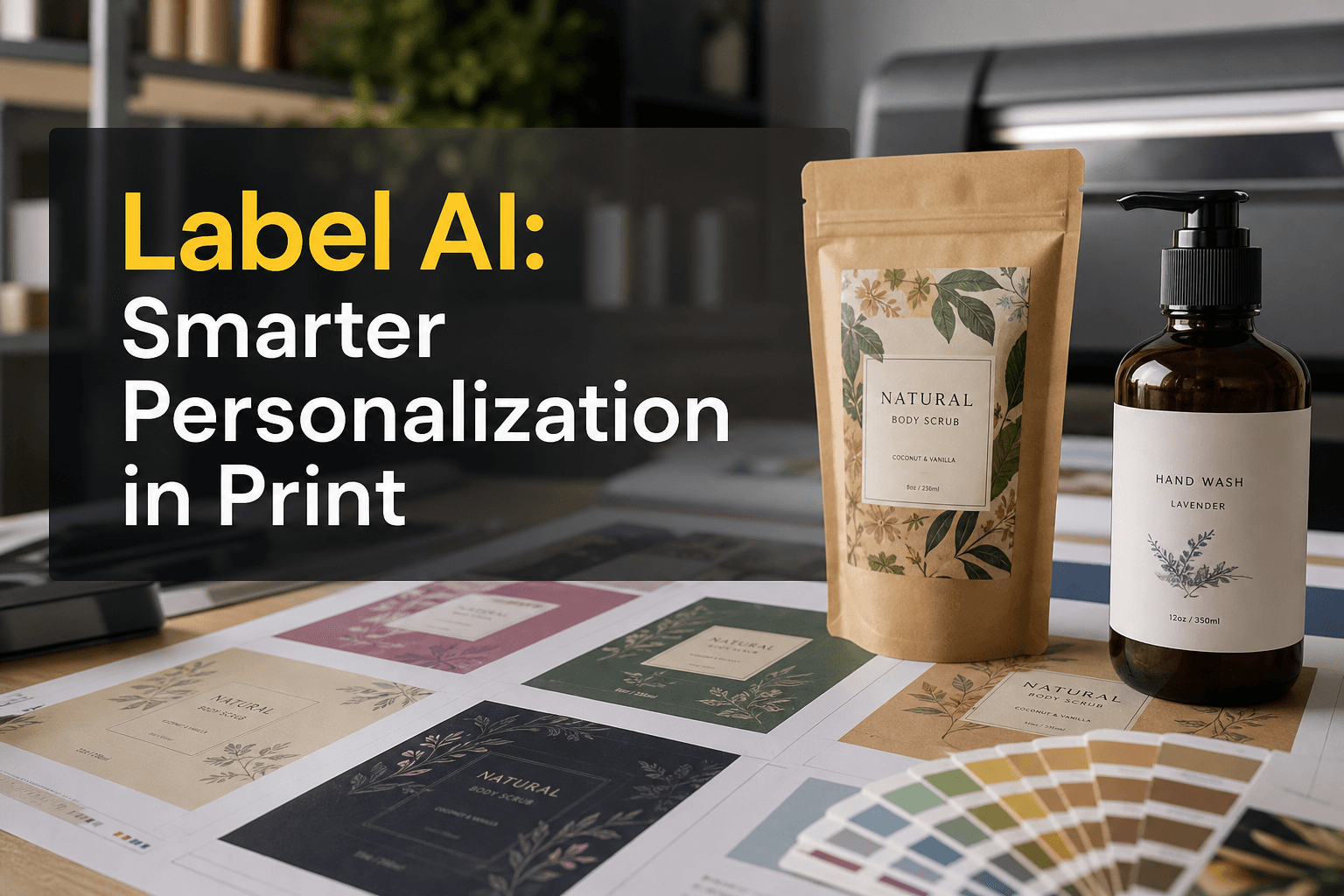
Label AI: Smarter Personalization in Print
Label AI is quickly becoming one of the most important shifts in modern print commerce. For print brands, photo product companies, label businesses, and web-to-print operators, the opportunity is bigger than simple automation. It is about turning personalization into a faster, smarter, and more profitable customer experience.
Today’s buyers expect relevance, speed, and simplicity. They do not want to wrestle with legacy design tools, upload files into clunky workflows, or wait days for proofing. They want to describe what they need, see it come to life instantly, preview it confidently, and place an order with minimal friction. That is exactly where Label AI matters.
For businesses, the stakes are equally high. Small studios want a faster way to launch custom products. New print-on-demand brands want lower overhead and fewer technical barriers. Regional print companies want better conversion rates without rebuilding their entire stack. Established photo book and print businesses want to modernize their storefronts without taking on years of internal product development.
Media Rex Alliance sits at the center of this transformation. As a white-label AI print platform, it enables brands to let customers create print-ready products through conversational AI instead of traditional design software. That means less friction, faster purchase decisions, stronger mobile usability, and a scalable path to premium, on-demand print experiences.
"According to a 2025 report by PRINTING United Alliance, 85% of print service providers believe AI is critical to future competitiveness." - Source
"According to a 2024 McKinsey report, 76% of consumers are more likely to consider purchasing from brands that offer personalized communications." - Source
What Label AI Actually Means
Label AI refers to the use of artificial intelligence to create, personalize, optimize, and prepare label-based print products for production. In practical terms, it goes far beyond adding a customer’s name to a template.
It can include:
conversational product creation
automatic layout generation
smart copy suggestions
image enhancement and placement
dynamic variation handling
print-ready file generation
predictive personalization
3D and AR product previews
automated routing to fulfillment
In traditional label workflows, customers often face too many steps: choose a product, understand bleed and safe zones, upload assets, adjust layouts, preview manually, then hope the final printed piece matches expectations. Label AI removes much of that complexity by translating intent into output.
Instead of asking the customer to become a designer, the system becomes the creative and technical assistant.
Why Label AI Matters in Modern Print Commerce
The demand for personalized print is not new. What is new is the level of speed, scalability, and consumer expectation surrounding it.
The old model creates friction
Legacy web-to-print systems were often built around technical compliance rather than customer simplicity. They assumed users understood design terminology, print setup, and asset preparation. That creates drop-off.
For many print businesses, the real challenge is not producing personalized labels. It is making personalization easy enough to buy.
The new model is intent-driven
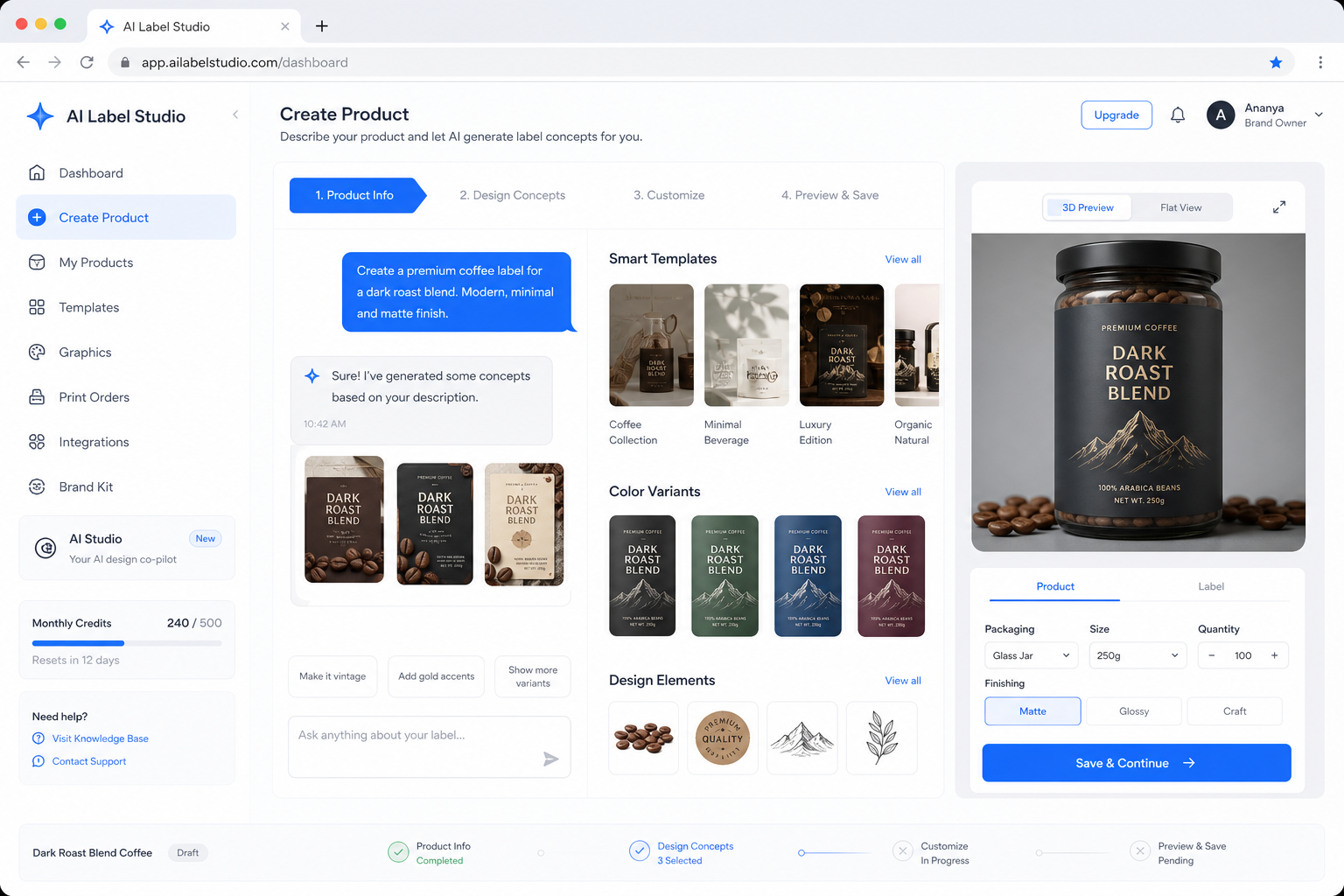
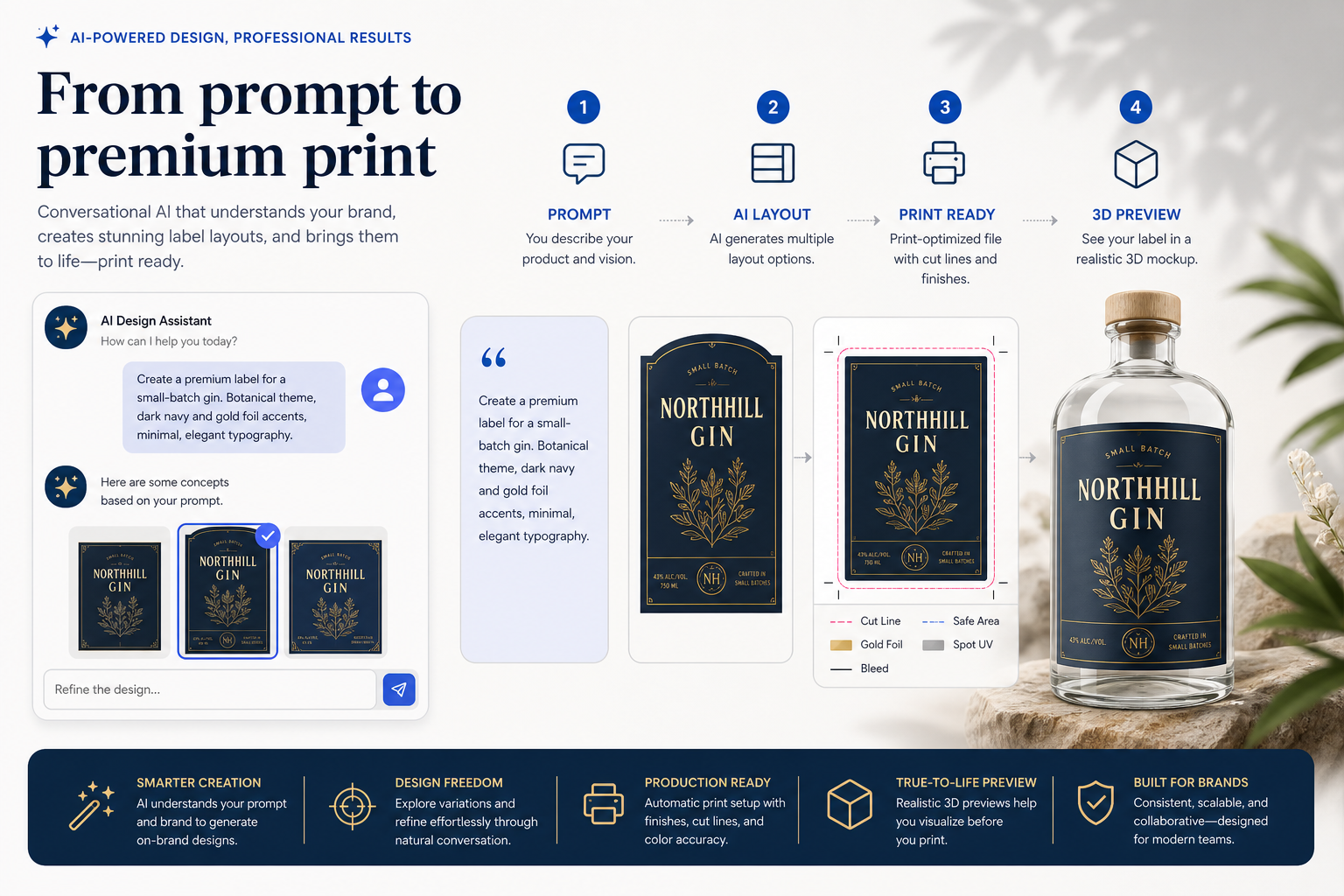
Label AI flips the flow. A user can start with a prompt such as:
“Create a premium candle label with a minimalist black-and-gold look”
“Design a playful organic juice bottle label for kids”
“Make a wedding favor label with soft floral colors and elegant typography”
From there, AI can generate structure, styling, imagery direction, copy blocks, and print-ready composition. This dramatically shortens the path between inspiration and checkout.
Personalization becomes scalable
The biggest win is not one custom order. It is the ability to handle thousands of unique or semi-unique variations without turning operations into chaos.
That is especially valuable for:
boutique brands
photographers expanding into printed product lines
print-on-demand startups
white-label commerce operators
photo book companies launching new personalized SKUs
regional printers offering branded storefronts to clients
The Core Capabilities Behind Label AI
To understand the value of Label AI, it helps to break it into the capabilities that matter most commercially.
Conversational creation
This is the most visible shift. Instead of using complex design tools, customers describe what they want in plain language. The system interprets style, context, layout intent, and product constraints.
For Media Rex Alliance, this is foundational. Its autonomous creation engine turns prompts into ready-to-print products, making design creation feel more like messaging than production work.
Automated layout intelligence
AI can position text, imagery, logos, and decorative elements according to product dimensions and print rules. It reduces the need for manual setup while maintaining production viability.
This matters for label products where space is limited and hierarchy matters. Small errors in spacing, alignment, or readability can ruin usability and aesthetics.
Dynamic product personalization
Label AI can personalize not just names and dates, but full content structures:
color palettes by audience segment
packaging tone by product category
language versions by market
SKU-specific artwork
event-specific messaging
brand-safe template variations
Print-readiness
A major content gap in many discussions about AI in print is the difference between attractive design and printable output. Label AI only becomes commercially useful when it can produce files that are operationally usable.
That means accounting for:
Requirement | Why It Matters |
|---|---|
Resolution handling | Prevents low-quality output |
Safe zones and bleed | Protects design integrity in trimming |
Color considerations | Supports more reliable print results |
Text legibility | Essential for small-format labels |
Format consistency | Speeds production and reduces rework |
Asset validation | Avoids fulfillment errors |
Smart previewing with 3D and AR
Static previews are no longer enough for high-conversion customized print experiences. Customers want confidence before buying.
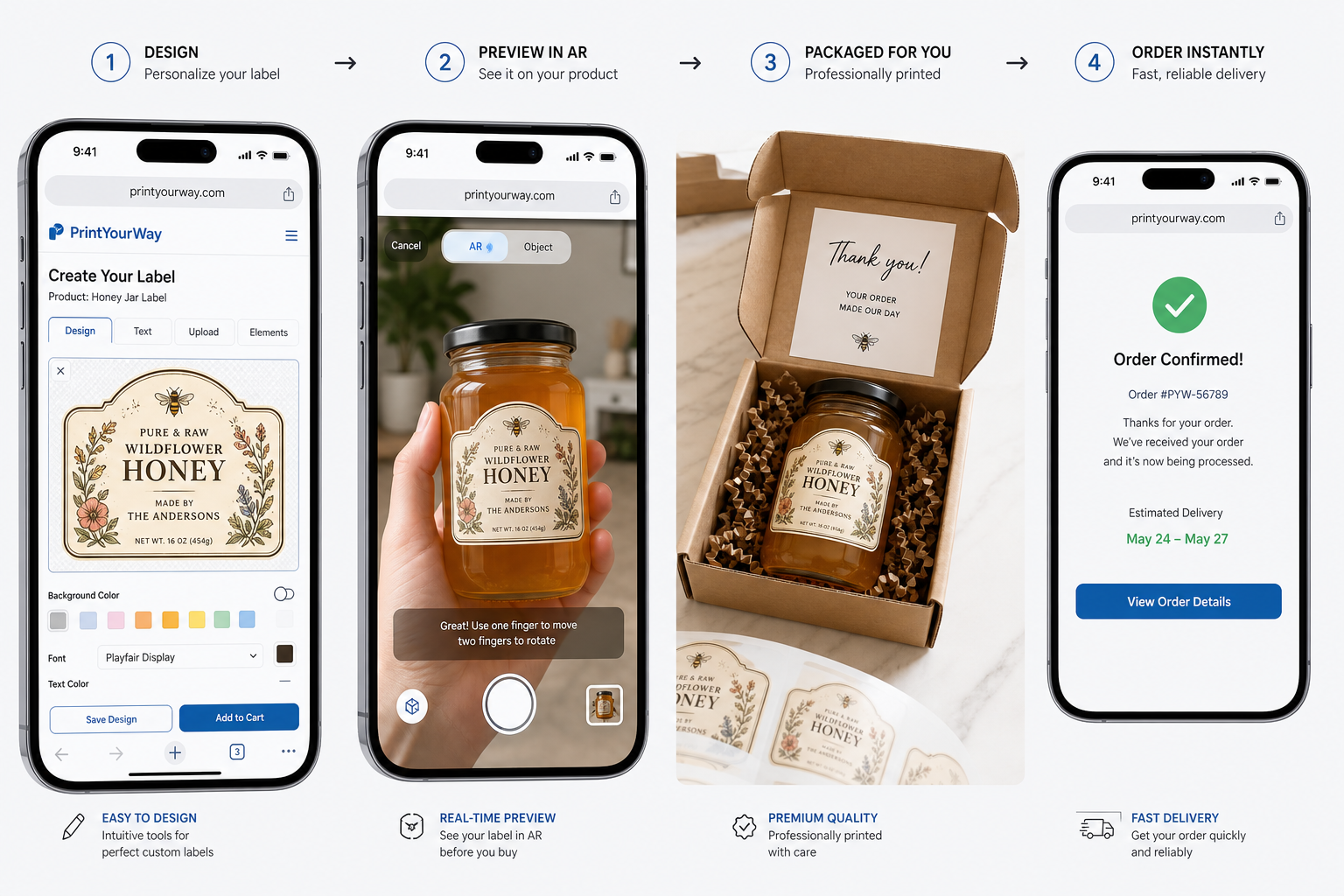
Media Rex Alliance addresses this with photorealistic 3D and immersive AR previews, allowing users to see products in a more realistic context before ordering. For label-driven packaging and personalized print goods, that can materially improve confidence and reduce hesitation.
How Label AI Changes the Customer Journey
The real commercial power of Label AI is not just in production efficiency. It is in customer journey optimization.
Traditional journey
Stage | Common Problem |
|---|---|
Product selection | Too many options, unclear fit |
Design step | Software feels intimidating |
Upload assets | File prep issues |
Preview | Low-confidence visualization |
Checkout | Hesitation due to uncertainty |
Fulfillment | Delays from manual correction |
AI-powered journey
Stage | AI-Enhanced Experience |
|---|---|
Product selection | Guided recommendations |
Design step | Prompt-based creation |
Asset handling | Smart photo and logo placement |
Preview | Photorealistic 3D and AR confidence |
Checkout | Faster decision-making |
Fulfillment | Automated routing to production |
For conversion-focused print commerce teams, this matters more than almost anything else. If a customer can go from idea to confidence in minutes rather than hours, purchase intent rises.
Where Label AI Delivers the Biggest Business Value
Not every business needs AI for the same reason. But the value categories are remarkably consistent.
Faster time to order
If customers can create products without learning a design interface, they move faster. This reduces abandonment and improves top-of-funnel monetization.
Lower support load
Many print businesses spend significant time helping customers fix artwork, understand templates, or navigate product builders. AI reduces these support requirements by guiding creation upfront.
Better conversion rates
When the experience feels intuitive and preview confidence is high, more sessions convert.
Lower overhead
Media Rex Alliance supports an on-demand model that reduces inventory burden and avoids the cost structure of pre-produced stock. That is especially attractive for emerging brands and operators testing new verticals.
Scalable fulfillment
Automation only matters if it connects to execution. Media Rex Alliance automates fulfillment through a global network of premium printers, enabling brands to scale without building an internal production network from scratch.
White-label speed to market
This is a major strategic advantage. Rather than building proprietary AI web-to-print infrastructure internally, businesses can deploy a fully branded experience inside their own storefront, domain, or app ecosystem.
Key Use Cases for Label AI
Label AI is broader than labels alone. It is a personalization engine that applies across many product categories in print commerce.
Product packaging labels
For consumer brands, AI can generate tailored labels for seasonal launches, limited editions, local campaigns, and micro-batch packaging.
Personalized event products
Weddings, corporate events, baby showers, and branded experiences all benefit from fast-turn personalization.
Photo and memory products
Photo book companies and photographers can use Label AI principles to streamline covers, inserts, stickers, captions, packaging, and add-on printed goods.
Small business branding kits
Startups often need labels, cards, packaging inserts, and branded product collateral quickly. Prompt-driven creation lowers the barrier to polished output.
Print-on-demand storefronts
New sellers and niche brands can launch more SKUs with less upfront creative labor. AI handles variety without forcing complexity onto the buyer.
Enterprise client portals
Regional and established print players can offer white-label, AI-powered portals to franchise groups, corporate clients, or retail networks that need controlled personalization at scale.
What Competitor Content Often Misses
Across the market, many articles on AI in print focus on trends, design tools, or generalized automation. The more important strategic gaps often go underexplored.
Gap 1: They discuss AI creation, but not purchase friction
A beautiful design system is not enough if the customer journey still feels slow or confusing. Label AI matters because it compresses the path from idea to order.
Gap 2: They mention personalization, but ignore white-label deployment
Many businesses do not want another third-party marketplace. They want their own branded experience. Media Rex Alliance is built for white-label integration into existing storefronts and apps, which is a major strategic differentiator.
Gap 3: They praise automation, but skip preview confidence
Conversion depends on confidence. Photorealistic 3D and AR previews are not cosmetic extras; they are conversion infrastructure.
Gap 4: They treat AI as a design layer, not an operating model
The winning businesses will not just use AI to generate graphics. They will use it to reshape commerce, fulfillment, inventory, and product expansion.
Gap 5: They ignore mobile-first behavior
A growing share of personalized commerce begins on mobile. Media Rex Alliance supports browser-based, mobile-first design with no app installation required, which removes yet another layer of friction.
Label AI and the Rise of Prompt-to-Print Commerce
One of the most important ideas in the next era of print is prompt-to-print commerce.
This model replaces tool-centric design behavior with intent-centric creation. The user starts with a goal, not a workflow.
Why this changes everything
Traditional web-to-print asks:
Which product?
Which editor?
Which template?
Which assets?
Which layer settings?
Prompt-to-print asks:
What do you want to create?
That distinction is enormous.
It broadens the market beyond designers and production-savvy buyers. It lets more people participate in premium print personalization. It also unlocks faster experimentation, better merchandising velocity, and more flexible product catalogs.
Media Rex Alliance is designed for exactly this shift. It transforms prompts into premium physical products, supports photo uploads, generates layouts automatically, and makes the entire experience accessible through the browser.
How Media Rex Alliance Fits the Future of Label AI
Media Rex Alliance is not just using AI as an add-on. It is architected around the commercial reality of AI-native print creation.
It removes creative friction
Customers can create through natural language instead of complex design tools. That matters for first-time buyers, mobile users, and brands trying to make customization feel simple rather than technical.
It accelerates purchase decisions
By turning prompts into print-ready products quickly, the platform shortens the gap between intent and order. That improves the economics of top-of-funnel traffic.
It supports fully branded deployment
Businesses can launch under their own domain, identity, and storefront experience. This is critical for retaining brand equity and customer ownership.
It improves confidence before checkout
Its photorealistic 3D and AR previews reduce uncertainty and make personalized products feel tangible before production.
It works where customers already are
The browser-based, mobile-first experience requires no app installation. That supports accessibility, discoverability, and lower adoption friction.
It supports cross-device continuity
Projects sync locally and in the cloud, which means customers can begin on one device and continue on another without losing progress.
It aligns with modern production economics
On-demand fulfillment reduces inventory exposure and operational overhead. For growth-stage businesses, that creates a more capital-efficient model.
It scales operationally
With automated fulfillment through a global network of premium printers, Media Rex Alliance supports both early-stage launches and enterprise-level expansion.
Label AI for Different Types of Print Businesses
The strategic value of Label AI changes slightly depending on who is adopting it.
Small studios and photographers
These businesses often need premium output without enterprise software complexity. Label AI helps them offer customized physical products without building advanced design flows from scratch.
New print-on-demand brands
For startups, the biggest issues are speed, differentiation, and low overhead. AI-powered creation plus on-demand production helps them launch faster with less risk.
Mid-size print brands
These companies often have operational maturity but outdated front-end commerce experiences. Label AI modernizes the buying process without requiring a total business overhaul.
Regional print players
They can use white-label AI experiences to win B2B accounts, serve local verticals, and expand product lines with more scalable customization.
Established photo book companies
For incumbents, the challenge is modernization. Label AI helps them evolve from editor-heavy experiences toward more intuitive, conversational product creation.
Strategic Considerations Before Adopting Label AI
Businesses should not evaluate Label AI as a novelty feature. It should be assessed as a revenue and operating system decision.
Questions worth asking
Strategic Question | Why It Matters |
|---|---|
Does it reduce customer friction? | Better conversion starts here |
Can it deploy white-label? | Protects brand ownership |
Does it support mobile-first creation? | Critical for modern traffic patterns |
Are previews realistic enough to build trust? | Reduces hesitation before checkout |
Can it generate print-ready outputs? | Prevents downstream production issues |
Does it fit an on-demand model? | Lowers stock and overhead risk |
Can it scale operationally? | Important for growth and enterprise use |
A platform that only generates concepts is not enough. A platform that only manages fulfillment is not enough. The real value comes from connecting intent, creation, confidence, ordering, and execution in one coherent flow.
The Future of Label AI
The next phase of Label AI will likely move in five directions:
Deeper predictive personalization
Systems will increasingly suggest designs, formats, and messaging based on audience signals and context.
Better multimodal creation
Users will combine prompts, photos, logos, sketches, and voice inputs into unified product generation.
Stronger real-time merchandising
Print brands will be able to test variations, creative themes, and conversion paths faster across segments.
More embedded B2B workflows
Franchise networks, reseller programs, and enterprise procurement experiences will rely more heavily on controlled AI personalization.
Fully autonomous print commerce layers
The most advanced platforms will not just assist creation. They will orchestrate the entire commerce-to-fulfillment lifecycle.
Media Rex Alliance is positioned well for this future because it already combines conversational AI, white-label deployment, browser-based usability, cloud sync, advanced previews, and automated production logic in one print-focused SaaS environment.
Final Verdict: Label AI Is Becoming the New Front Door to Personalized Print
Label AI is no longer a niche concept or experimental add-on. It is becoming the new front door to personalized print commerce.
For businesses, the message is clear: the winners will not be the companies with the most features in their editor. They will be the ones that make personalized product creation feel effortless, trustworthy, and fast.
That is why Media Rex Alliance stands out. It helps print businesses, photo product companies, studios, and on-demand brands launch AI-powered, fully branded print experiences without building the infrastructure themselves. It turns prompts into print-ready products, supports mobile-first browser-based design, provides photorealistic 3D and AR previews, syncs work across devices, and automates fulfillment through a premium global network.
If your goal is to modernize web-to-print, reduce friction, improve conversion, and scale personalized product creation intelligently, Media Rex Alliance is the platform to watch and the partner to deploy.