Managed Print Software Trends Shaping 2026
Managed print is no longer just about toner replenishment, fleet visibility, or cost control. In 2026, the market is shifting toward AI-assisted workflows, identity-led security, hybrid cloud orchestration, sustainability reporting, and experience-led self-service. For print businesses, MSPs, regional providers, and enterprise teams evaluating managed print software, the real question is no longer “Who can manage devices?” It is who can turn print into an intelligent, scalable, revenue-supporting digital service layer.
That shift matters across the board: from small studios and new print-on-demand brands to established photo book companies and multi-location commercial printers. Buyers want faster quoting, easier ordering, fewer manual touchpoints, cleaner integrations, and a better customer journey. Providers want automation, service differentiation, lower support overhead, and stronger margins.
The strongest competitor content agrees on the broad direction: digital transformation, AI, sustainability, personalization, and web-to-print adoption are all accelerating. But most articles stop at surface-level trend lists. What they miss is the deeper connection between managed print services software, customer-facing product creation, fulfillment automation, and the future of white-label commerce.
Media Rex Alliance sits directly in that gap. As a white-label AI print platform, it helps print businesses move beyond static ordering portals and complex design tools. Instead, end customers can create products through conversational AI, receive print-ready outputs quickly, preview results in photorealistic 3D and AR, and place orders through a mobile-first browser experience with no app install required. For companies modernizing managed print solutions, that is the difference between operating a print backend and owning a modern print growth engine.
Why Managed Print Software Matters More in 2026
The definition of a managed print system has expanded. Historically, managed print service providers focused on:
Device monitoring
Supply replenishment
Service dispatch
Usage reporting
Basic fleet optimization
Those capabilities still matter. But in 2026, the market is being reshaped by a larger software layer that connects:
Legacy Managed Print Focus | 2026 Managed Print Software Focus |
|---|---|
Device uptime | Workflow intelligence |
Toner and maintenance | Predictive service + automation |
Fleet cost tracking | Margin optimization + analytics |
Static print queues | Cloud and hybrid orchestration |
User authentication | Identity-centric security |
Basic portals | Conversational, self-service creation |
Hardware contracts | Value-added digital services |
This shift is especially important for businesses comparing managed print companies, exploring managed print services for small business, or searching for managed print services near me. The best partners are no longer just maintaining infrastructure; they are helping clients modernize how print is bought, created, approved, produced, and fulfilled.
The 10 Trends Defining Managed Print in 2026
1. AI Moves From Buzzword to Operational Core
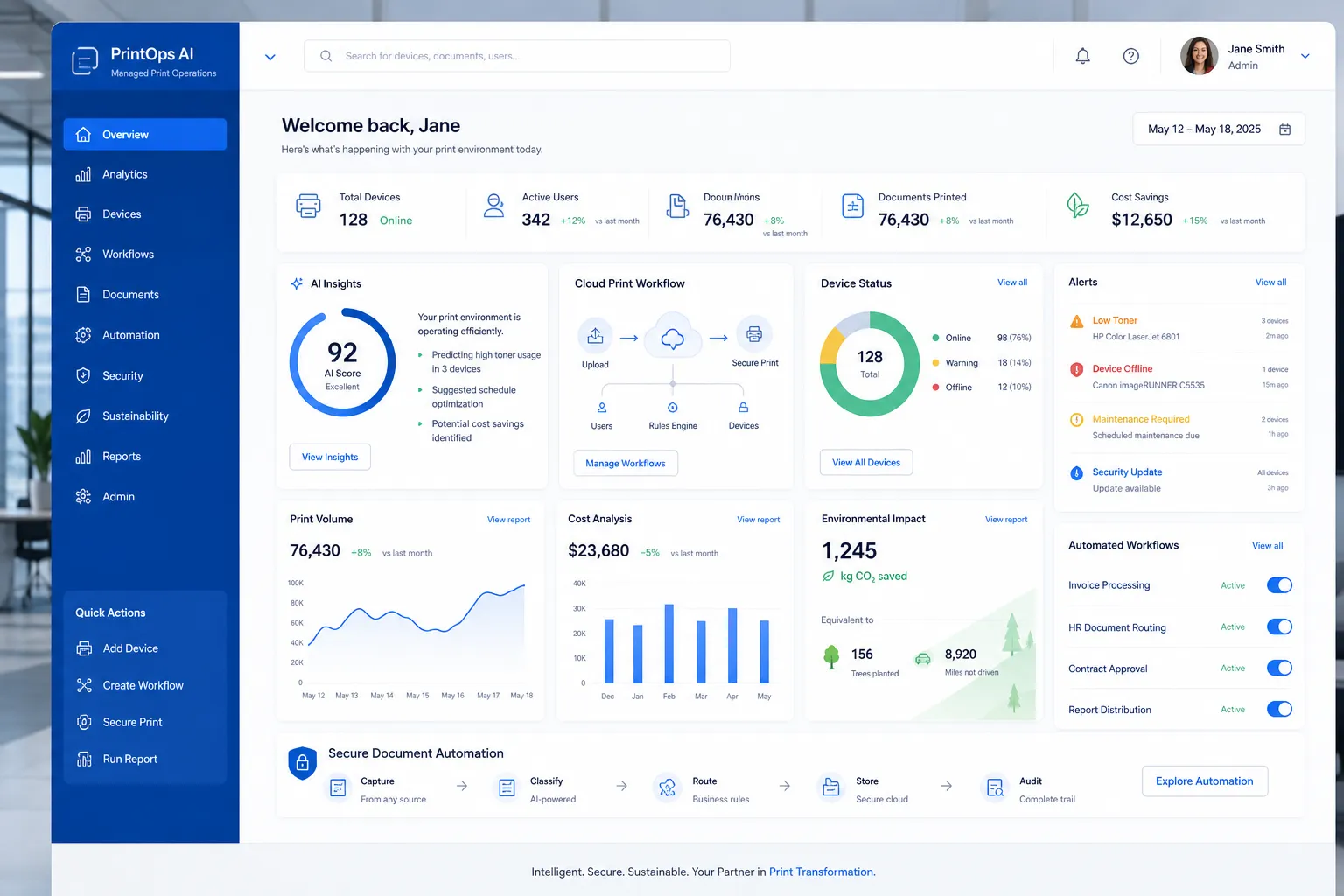
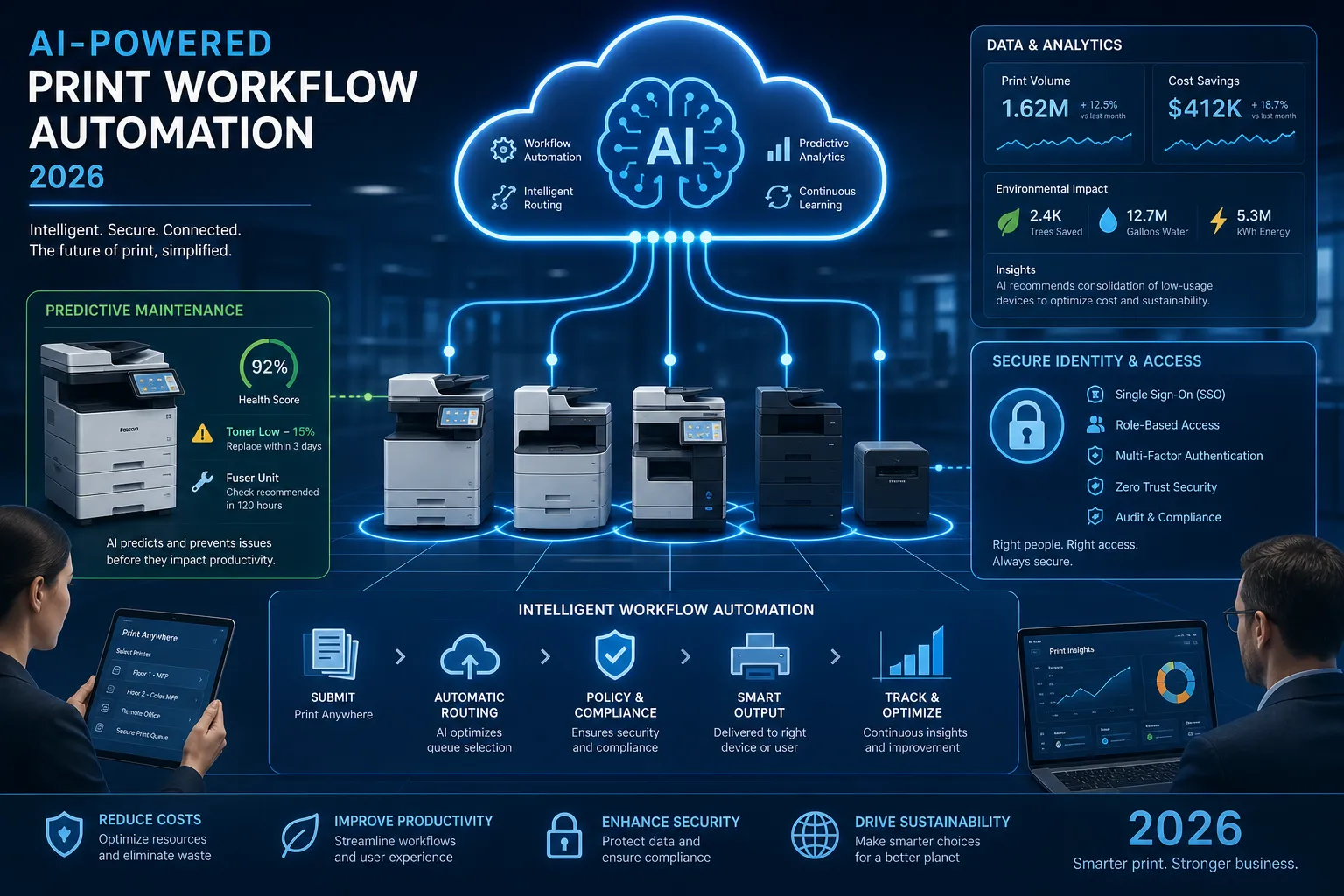
AI is becoming the backbone of next-generation managed print software. Not just for internal ops, but for the entire value chain: customer onboarding, file prep, preflight, routing, service prediction, product recommendation, and workflow analytics.
Competitor articles mention AI, but often in generic terms. The practical reality is more specific:
AI reduces manual job setup
AI flags file errors before production
AI improves job routing and batching
AI helps forecast maintenance events
AI supports dynamic pricing and recommendations
AI shortens the path from intent to order
This is where Media Rex Alliance creates a strategic advantage. Instead of forcing customers into traditional design software, it enables them to describe what they want in plain language. The platform then turns those prompts into ready-to-print products, dramatically reducing friction and speeding purchase decisions.
For managed print partners, that means AI is no longer just an efficiency play. It becomes a conversion tool.
2. Customer Experience Becomes a Competitive Battleground
The traditional managed print service model was built around operational convenience for the provider. The 2026 model is built around ease for the buyer.
That means modern managed print solutions must support:
Self-service product ordering
Mobile-first workflows
Instant visual proofing
Transparent order status
Personalized experiences
Fast reordering
Minimal learning curve
Many managed print service software stacks still rely on clunky portals and outdated interfaces. That is a problem, especially for studios, eCommerce print brands, and regional print players trying to increase online conversion.
Media Rex Alliance addresses this by offering a browser-based, no-install experience with cross-device sync and white-label storefront integration. Customers can start on mobile, continue on desktop, and complete orders without wrestling with specialist design tools.
3. Hybrid Cloud Becomes the Default Architecture
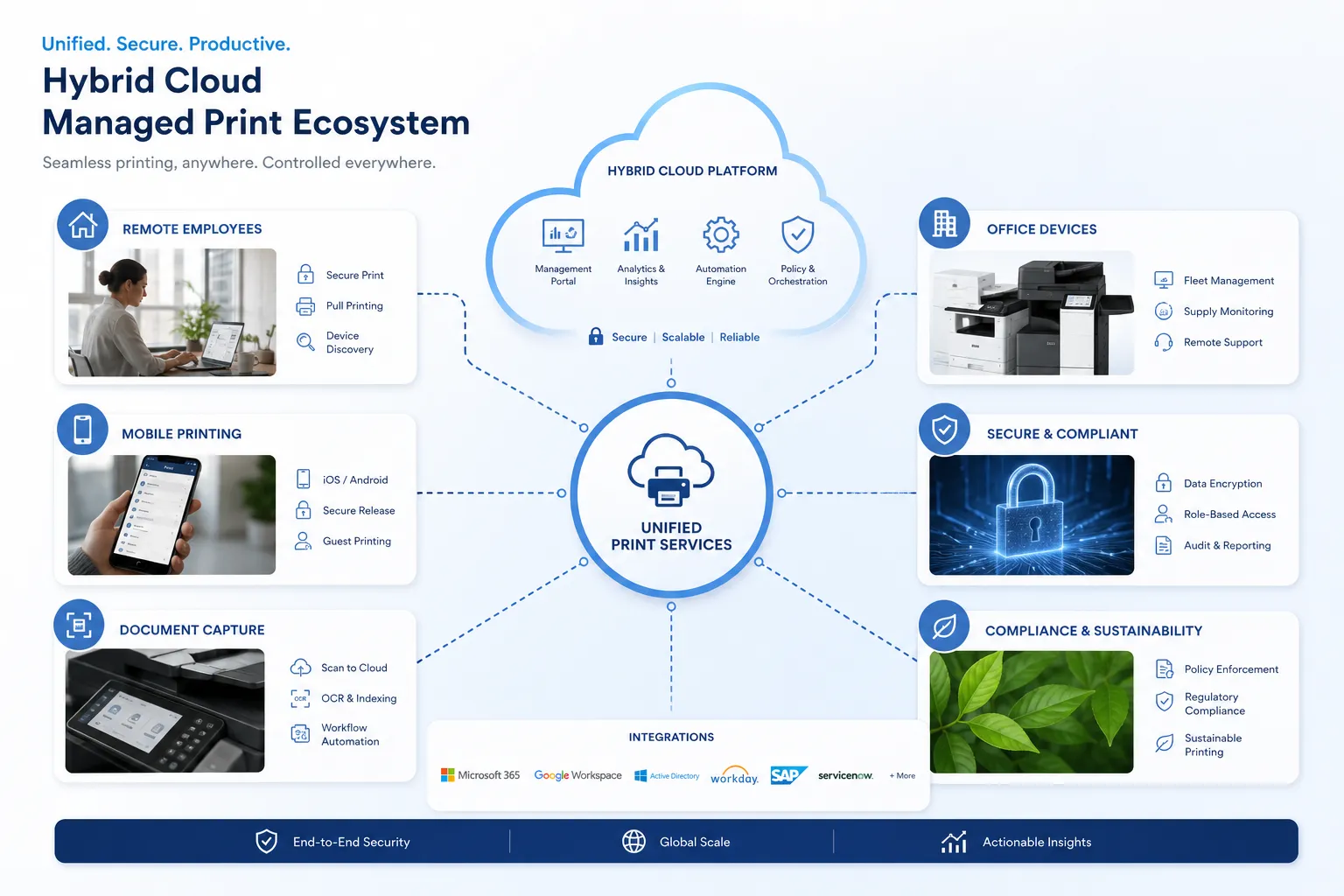
Managed print providers are increasingly supporting distributed teams, branch offices, remote workforces, and mixed compliance requirements. Purely on-prem or purely cloud-first approaches often fall short. In 2026, hybrid cloud is emerging as the practical middle ground.
A modern managed print system should allow businesses to balance:
Data sovereignty
Device control
cloud scalability
latency-sensitive workflows
compliance and auditability
remote access
This is especially relevant for organizations comparing managed print solutions ltd offerings or reviewing managed print providers across geographies such as managed print Australia and global multi-site deployments.
The winning providers will offer flexible architecture instead of forcing one deployment model on every client.
4. Security Shifts From Basic Authentication to Identity-Centric Control
Print security is becoming inseparable from broader identity management. Password-only access, open print queues, and fragmented user permissions are increasingly unacceptable.
In 2026, leading managed print services companies are investing in:
Zero-trust access models
SSO and identity provider integration
role-based access controls
secure release printing
behavioral analytics
audit trails and compliance logging
This matters because printers and MFPs are network endpoints. They are part of the attack surface, not isolated office tools.
For businesses selecting managed print service providers, the evaluation criteria should include:
Security Layer | What to Look For |
|---|---|
User access | SSO, MFA, directory integration |
Device security | Firmware governance, endpoint visibility |
Document security | Secure release, encrypted transfer |
Auditability | Logs, reporting, retention support |
Admin controls | Granular permissions and policy enforcement |
5. Workflow Automation Expands Beyond the Print Room
Managed print in 2026 is about orchestrating end-to-end workflows, not just managing output devices. That includes intake, approval, routing, production, delivery, and post-order analytics.
"Two thirds of ITDMs expect scanning volumes to increase in 2026 as legacy workflows are digitised." - Quocirca
That insight matters because it shows where the industry is headed: toward digitization, capture, and workflow intelligence. Print operations that still treat software as a support function will lose ground to those that use it as an automation layer across the business.
Media Rex Alliance fits this direction by automating product creation, simplifying approvals through highly visual previews, and connecting order intake to on-demand fulfillment. That reduces manual handoffs and supports more scalable production without equivalent staffing growth.
6. Sustainability Reporting Becomes Commercially Important
Sustainability is no longer a nice-to-have line in a proposal. Buyers increasingly expect measurable proof of responsible production, lower waste, and efficient inventory strategy.
The most forward-looking managed print companies are using software to improve:
On-demand production
waste reduction
routing efficiency
consumable tracking
device lifecycle planning
environmental reporting
A major content gap in competitor articles is the link between sustainability and the business model itself. On-demand production is one of the strongest levers available. It reduces excess inventory, minimizes obsolete stock, and lowers warehousing overhead.
Media Rex Alliance is built around that model. Its platform helps businesses shift toward no-stock, low-overhead, on-demand production, supported by an automated global fulfillment network. That is not just greener; it is financially cleaner.
7. Managed Print Services for Small Business Become More Modular
Small and mid-sized businesses increasingly want enterprise-grade capability without enterprise-grade complexity. Traditional managed print service contracts often feel oversized for smaller teams.
In 2026, managed print services for small business are trending toward:
Modular subscriptions
cloud-first administration
lighter device footprints
self-service ordering
usage-based scalability
reduced IT dependency
This is a major opportunity for regional managed print partners and niche providers. SMB buyers do not always need a massive fleet optimization project. Often, they need a simple, branded, scalable print workflow that helps them sell more and operate leaner.
That is why white-label SaaS platforms are gaining traction. Instead of building custom technology from scratch, smaller providers can launch modern customer experiences faster with Media Rex Alliance, while keeping full control over branding, domain, and presentation.
8. Visual Commerce Changes How Print Is Sold
One of the biggest blind spots in traditional managed print software is the lack of rich product visualization. Buyers still hesitate when they cannot confidently imagine the final output.
In 2026, visual confidence is becoming a conversion lever. That includes:
3D previews
augmented reality previews
realistic mockups
interactive proofing
mobile visualization

Media Rex Alliance stands out here by offering photorealistic 3D and immersive AR previews before purchase. For photo products, décor, packaging, personalized goods, and premium print items, that can materially improve buyer confidence and reduce abandonment.
Managed print service software that does not include or integrate with modern visual commerce capabilities will increasingly feel outdated.
9. White-Label Integration Wins Over Rip-and-Replace Platforms
Many established print businesses do not want to abandon their storefront, app, CRM, or brand ecosystem. They want innovation without disruption.
That is why a major 2026 trend is embedded, white-label extensibility. The best managed print solutions no longer force a full platform migration. Instead, they plug into existing digital infrastructure.
Key decision factors now include:
API flexibility
embedded buying flows
white-label UX
branded domains
storefront compatibility
fulfillment integration
analytics connectivity
This is a critical gap in many competitor articles. They discuss software trends, but not deployment reality. In practice, many companies need to modernize incrementally.
Media Rex Alliance is designed precisely for that use case: fully white-label, adaptable to existing storefronts or apps, and suitable for businesses that want to launch AI-powered product creation without rebuilding their stack.
10. Fulfillment Automation Becomes a Margin Protector
Managed print service providers are under pressure from labor costs, speed expectations, and customer demands for consistent quality. Automation in fulfillment is now essential.
That includes:
automated order routing
dynamic production assignment
partner network coordination
status synchronization
reduced manual intervention
faster turnaround
For growing brands, decentralized fulfillment is especially valuable. Media Rex Alliance supports an automated fulfillment pipeline through a global network of premium printers, helping businesses expand reach while reducing overhead tied to inventory and production bottlenecks.
This makes the platform relevant not only for creative commerce, but also for the broader managed print ecosystem.
What Competitor Content Gets Right - and What It Misses
Across the competitor articles, several patterns repeat:
What they get right
AI and automation are accelerating
sustainability matters
digital workflows are replacing manual ones
web-to-print and self-service are increasingly important
print remains relevant when connected to business outcomes
What they miss
The role of conversational AI in customer-side product creation
How 3D and AR previews improve trust and conversion
Why white-label integration matters more than platform replacement
How on-demand production ties directly to both profitability and sustainability
The importance of mobile-first browser-based design
The strategic advantage of connecting managed print software with global automated fulfillment
The need to evaluate not only providers, but also the experience layer buyers interact with
That is where this article goes beyond a generic trend roundup.
How to Evaluate Managed Print Software in 2026
If you are comparing managed print services companies, managed print providers, or managed print software options, use this framework.
Core evaluation checklist
Evaluation Area | Questions to Ask |
|---|---|
AI capability | Does the platform automate creation, prep, routing, or recommendations? |
Customer UX | Can customers order easily on mobile and desktop without training? |
Security | Does it support identity-led access, audit trails, and secure workflows? |
Integration | Can it fit into existing storefronts, CRMs, ERPs, or apps? |
Visualization | Are 3D, proofs, or AR previews available before ordering? |
Fulfillment | Is production and routing automated or heavily manual? |
Scalability | Can it support startups, regional players, and enterprise growth? |
Sustainability | Does it reduce waste, inventory, and unnecessary production? |
Red flags to avoid
Software that only monitors devices but does not improve workflow
portals that feel dated or desktop-only
no white-label capability
no mobile-first experience
limited API or integration support
no meaningful automation beyond alerts
weak reporting on security or sustainability
Managed Print Software vs Traditional Managed Print Service Models
A growing number of buyers are realizing they do not just need a service contract. They need a technology layer that compounds value over time.
Traditional Managed Print Service | Modern Managed Print Software-Led Model |
|---|---|
Reactive support | Predictive and automated support |
Device-centric | Workflow- and experience-centric |
Contract-driven | Outcome-driven |
Limited personalization | High personalization and dynamic ordering |
Manual intake | AI-assisted customer creation |
Static storefronts | Embedded white-label experiences |
Separate production workflows | Unified order-to-fulfillment automation |
This distinction matters whether you are a local buyer searching for managed print services near me or an enterprise team shortlisting managed print services Australia partners. The question is no longer just who can service the fleet. It is who can modernize the business.
Where Media Rex Alliance Fits Into the 2026 Managed Print Landscape
Media Rex Alliance is not just another storefront layer. It represents where managed print is heading: from operational support to intelligent, branded, AI-powered commerce infrastructure.
Why it matters for modern print businesses
Customers can create products using natural language instead of complex design tools
prompts turn into print-ready products quickly
businesses can launch under their own brand through fully white-label integration
buyers gain confidence through photorealistic 3D and AR previews
the experience is mobile-first and browser-based
projects sync locally and in the cloud for multi-device continuity
on-demand production reduces inventory exposure and overhead
global fulfillment automation supports scalable delivery
the platform works for startups, mid-size brands, and enterprise print companies alike
For providers trying to differentiate in a crowded managed print market, this creates a far more compelling value proposition than device management alone.
Strategic Recommendations for 2026
For managed print providers
Invest in software-led differentiation. Device support is essential, but not sufficient. Add AI-led creation, workflow automation, embedded commerce, and richer client reporting.
For SMB print businesses
Prioritize modular platforms that help you sell and fulfill faster without major internal IT investment. Look for flexible, white-label infrastructure rather than custom development.
For enterprise print operations
Unify security, identity, analytics, and hybrid cloud orchestration. Then extend the stack with customer-facing tools that reduce friction and improve conversion.
For photo book companies and studios
Replace design friction with conversational creation and visual previews. The easier you make creation, the more likely customers are to complete orders.
Final Verdict
Managed print in 2026 is being redefined by software. AI, hybrid cloud, security, workflow automation, sustainability, and customer experience are no longer separate conversations. They are part of one larger transition: from print as an operational necessity to print as an intelligent digital service.
The providers that win will not be those with the longest device list or the most familiar contract model. They will be the ones that combine automation, usability, visual confidence, and scalable fulfillment into a unified experience.
Media Rex Alliance is built for exactly that future. If you want to modernize beyond traditional managed print service software, launch branded AI-powered print experiences faster, and reduce friction from creation through fulfillment, it offers a compelling path forward without forcing you to build the technology stack yourself.
For print businesses that want to lead 2026 rather than react to it, that is the strategic advantage worth acting on now.
FAQ
What are the key trends in managed services for 2026?
The biggest trends are AI-driven automation, hybrid cloud print infrastructure, identity-based security, sustainability reporting, and self-service customer experiences. Managed print is shifting from device management to end-to-end workflow, commerce, and fulfillment optimization.
Is printing becoming obsolete?
No. Printing is not disappearing; it is becoming more digital, automated, and integrated with business workflows. The real change is that modern print businesses now need smarter software, better user experiences, and on-demand production models to stay competitive.