Media and AI: 7 Trends Reshaping Print Commerce
Print commerce is entering a new phase where media and AI are no longer separate disciplines. They now work together to influence how products are discovered, personalized, designed, previewed, produced, and fulfilled.
For small studios, photographers, print-on-demand startups, regional print companies, and established photo book brands, the pressure is clear: customers expect the speed of ecommerce, the personalization of social media, and the polish of premium product experiences. Traditional web-to-print flows often create friction with complicated editors, slow proofing, disconnected mobile experiences, and high operational overhead.
This is where the market is moving fast. AI is changing print from a manual production workflow into a conversation-driven commerce system.
Media Rex Alliance sees this shift firsthand. The winners in the next era of print commerce will be the businesses that make product creation feel instant, intuitive, visual, and intelligent.
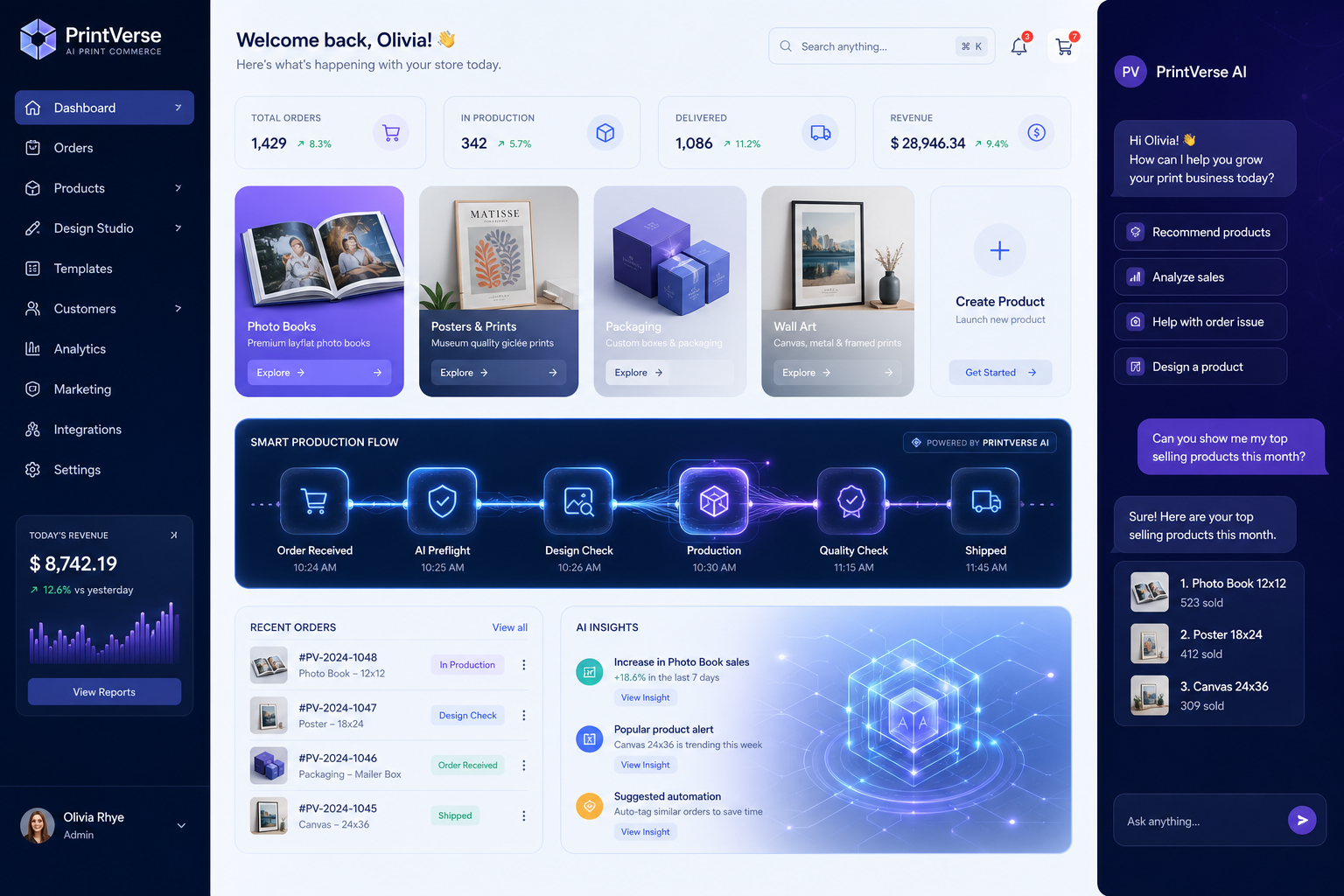
"Shoppers engaging with AI agents exhibit a 12.3% conversion rate, compared to 3.1% for unassisted browsers." - Source
"By 2025, 65% of printing companies reported utilizing AI in at least one process." - Source
Why media and AI matter so much in print commerce now
Most competitor content on AI in retail or printing focuses on broad trends like personalization, chatbots, or automation. That is useful, but it often misses the real operational shift happening inside print commerce:
Media creation is becoming conversational
Product design is becoming automated
Purchase confidence is becoming visual
Fulfillment is becoming autonomous
White-label deployment is becoming a strategic growth lever
That means the real opportunity is not just “using AI.” It is building a print buying journey where customers can go from idea to print-ready order with minimal effort.
For print businesses, this reduces abandonment, increases average order value, and opens new revenue opportunities without forcing teams to build complex software in-house.
The new operating model for AI-powered print businesses
Before diving into the seven trends, it helps to understand the new model taking shape.
Legacy Print Commerce | AI-Powered Print Commerce |
|---|---|
Manual design tools | Conversational product creation |
Desktop-heavy workflows | Mobile-first browser-based experiences |
Static mockups | Photorealistic 3D and AR previews |
Inventory-heavy operations | On-demand production |
Fragmented tech stack | Unified white-label SaaS integration |
Human-dependent proofing | Automated layouts and intelligent preflight |
Local fulfillment limitations | Global print network scalability |
This shift is exactly why platforms like Media Rex Alliance are gaining relevance. Instead of asking customers to learn complex design tools, the platform lets them create products using natural language, uploads, and guided AI flows. The result is a much faster path from inspiration to checkout.
1. Conversational commerce becomes the new design interface

The first major trend is the collapse of the traditional gap between search, design, and purchase.
Customers no longer want to click through dozens of templates, adjust layers manually, or learn complicated editors just to create a photo book, poster, calendar, invitation, or premium branded product. They want to say what they need and see it take shape immediately.
That is why conversational AI is becoming the new front end of print commerce.
What this looks like in practice
A user might type:
“Create a luxury wedding album with a clean editorial look”
“Turn these travel photos into a premium hardcover photo book”
“Design a modern pet memorial print in black and gold”
“Make branded welcome kits for new clients with minimalist packaging”
Instead of opening a blank canvas, the system interprets the prompt, organizes assets, applies layouts, selects styles, and prepares a print-ready concept.
Why this matters
This removes the biggest friction point in web-to-print: creative paralysis. Many customers know what they want emotionally, but not how to build it technically.
Media Rex Alliance is designed around this new behavior. Its conversational AI creation engine turns prompts into ready-to-print products, helping print businesses shorten time-to-order and convert more customers who would otherwise drop off.
Content gap competitors often miss
Most articles mention AI assistants as support tools. Fewer explain their role as primary product creation interfaces. In print commerce, that distinction is huge. The assistant is not just answering questions; it is creating the product.
2. Hyper-personalized media drives higher-value print experiences
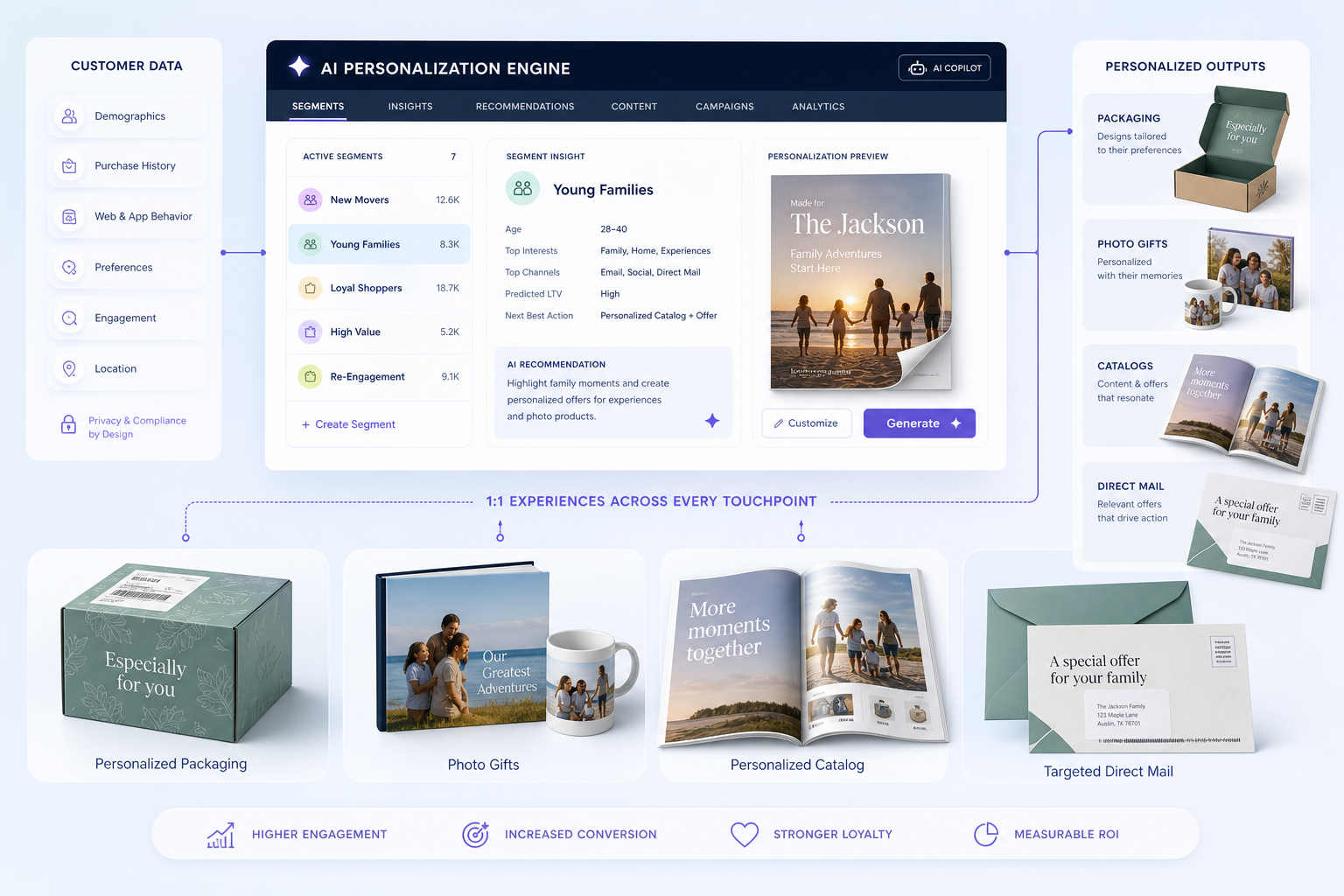
AI is making personalization much more powerful than simple name insertion or product recommendations.
In print commerce, personalization now spans:
Product format
Visual style
Page sequencing
Copy generation
Offer timing
Upsell suggestions
Occasion-based design logic
A modern print brand can use AI to tailor not only what product is shown, but also how that product is composed.
Examples of advanced personalization in print
Personalization Layer | AI-Driven Output |
|---|---|
Customer behavior | Suggests product type based on browsing and prior orders |
Occasion detection | Recommends gifts, albums, cards, or keepsakes for life events |
Uploaded content | Builds layouts around photo quality, orientation, and themes |
Brand segment | Adjusts design language for consumer, creator, or business buyers |
Geo/context | Adapts offers by season, region, or cultural moment |
For a photo book company, this could mean automatically generating a travel layout style for vacation photos and a softer editorial style for newborn albums. For a B2B print seller, it could mean dynamically creating branded kits or collateral tailored to different business verticals.
Why this matters for conversion
Personalized print experiences feel premium, relevant, and emotionally resonant. That directly influences both conversion and customer lifetime value.
Media Rex Alliance helps businesses deliver this without rebuilding their storefront from scratch. Its white-label model allows brands to launch personalized, AI-powered product experiences under their own identity while keeping the experience native to their store or app.
3. 3D and AR previews become essential for purchase confidence

One of the biggest weaknesses in legacy print commerce is the preview step. Static mockups often fail to answer the customer’s real question:
“What will this actually look like in real life?”
That is why photorealistic 3D and augmented reality previews are becoming a defining trend.
What customers want to see before they buy
Cover texture and finish
Product dimensions and scale
Page thickness and material feel
Framed art placement on a wall
Packaging appearance
Multi-angle views on mobile
When shoppers can see a realistic preview, hesitation drops. That is especially important for premium print products with higher perceived risk, such as photo books, wall art, luxury packaging, or custom gifting.
Why this is becoming non-negotiable
AI helps generate layouts quickly, but visual trust closes the sale. 3D and AR bridge the gap between digital intent and physical product certainty.
Media Rex Alliance integrates photorealistic 3D and immersive AR previews directly into the buying flow. This gives customers a stronger sense of confidence before ordering and helps brands reduce pre-purchase anxiety without adding manual proofing overhead.
The strategic advantage
Most competitors discuss AI-generated creation, but fewer emphasize the importance of AI plus visualization. In reality, both are needed. Fast creation drives speed; strong previews drive confidence.
4. Mobile-first creation overtakes desktop-heavy web-to-print flows
Print commerce used to assume customers would sit at a desktop, upload files, and spend time editing. That assumption no longer holds.
Today, inspiration often starts on mobile:
A parent selecting photos from a phone gallery
A creator turning social content into physical merchandise
A tourist building a travel album while still on the trip
A small business owner ordering branded print assets between meetings
If the product creation flow is clunky on mobile, the sale is at risk.
What modern mobile-first print experiences require
Browser-based access with no app download
Fast image uploads
Responsive previews
Simple prompt-based creation
Cross-device continuity
Persistent project saving
This is another area where many competitor articles stay too generic. They talk about ecommerce convenience, but not about the technical friction of print design on small screens.
Media Rex Alliance is built for mobile-first, browser-based design with no app installation required. Projects can sync locally and in the cloud, which means users can start on one device and continue on another without restarting the process.
Why this matters for print brands
A mobile-first AI experience expands addressable demand. It captures more impulse-driven shoppers, improves accessibility, and reduces dependency on trained desktop users.
5. White-label AI storefronts replace one-size-fits-all platforms
As AI matures, more print companies want the benefits of advanced technology without sacrificing brand ownership.
That is why white-label deployment is becoming a major trend in media and AI-driven print commerce.
The old tradeoff
Historically, brands had to choose between:
Building custom software internally at high cost and long timelines
Using rigid third-party tools that weakened differentiation
White-label AI platforms change that equation.
What businesses want now
Their own branding and visual identity
Their own domain or embedded experience
Native integration into existing storefronts or apps
Faster launch time
Scalable infrastructure without large engineering teams
This matters for everyone from startups to enterprise print companies. Smaller brands need speed and low overhead. Larger brands need control, customization, and scale.
Media Rex Alliance is purpose-built for this model. Businesses can deploy a fully white-label AI print experience that feels like their own product, not someone else’s plugin.
Why this trend is accelerating
AI is becoming a strategic differentiator. As that happens, brands do not want to send customers into generic external editors or disconnected product builders. They want the intelligence, but they also want the customer relationship.
6. On-demand production and autonomous fulfillment reduce operational drag
Another content gap in competitor articles is that they often discuss AI at the customer experience layer but not enough at the production and fulfillment layer.
In print commerce, AI becomes far more valuable when it connects the front end to operations.
The new fulfillment logic
When a customer creates a product through AI, the ideal next steps are also automated:
Asset packaging
Print-readiness checks
Routing to the right production partner
Production scheduling
Shipping updates
Exception handling
This reduces the burden on internal teams and supports a more scalable no-stock model.
Why this matters financially
On-demand production helps businesses:
Lower inventory risk
Reduce storage and waste
Expand product variety without stock commitments
Enter new markets faster
Maintain leaner overhead
Media Rex Alliance supports this model through an automated fulfillment pipeline and a global network of premium printers. That makes it easier for businesses to scale product offerings without owning every production step themselves.
Operational impact by business type
Business Type | AI + On-Demand Benefit |
|---|---|
Small studio | Launch premium products without building a supply chain |
Photographer | Sell custom physical products without managing inventory |
POD startup | Scale catalog breadth with less operational complexity |
Regional print player | Expand reach through automated routing and fulfillment |
Photo book brand | Modernize frontend creation while improving backend efficiency |
7. AI turns media from static content into a dynamic commerce engine
The final trend is the broadest and arguably the most important: media itself is becoming transactional.
In the past, media and commerce were separate. Content inspired the customer, and then a separate buying flow handled the product. AI is collapsing that division.
What that means in print commerce
A piece of media can now become the starting point for product creation:
A gallery becomes a photo book
A social post becomes wall art
A brand story becomes direct mail
A content collection becomes a catalog
A moodboard becomes packaging
A prompt becomes a finished product
This is where “media and AI” becomes especially powerful. AI does not just optimize media distribution. It transforms media into structured input for commerce.
Why this creates a competitive moat
Print businesses that embrace this shift can convert attention into product creation much faster than competitors relying on static ecommerce pages.
With Media Rex Alliance, that transformation is native to the platform. The system can turn customer intent, uploaded assets, and prompts into high-quality, branded, print-ready outcomes quickly enough to reduce hesitation and speed up purchase decisions.
What competitors got right - and what they missed
After reviewing common themes across AI retail, AI print, and industry trend content, several patterns stand out.
What they covered well
AI adoption is accelerating
Personalization is becoming standard
Automation improves efficiency
Visual and conversational interfaces are growing
Sustainability and on-demand operations matter
What they often missed
The shift from support chatbot to product creation engine
The importance of 3D and AR previews in premium print conversion
The role of white-label deployment in brand control
The value of mobile-first browser-based design
The connection between AI-generated creation and automated fulfillment
The way media assets can become direct commerce inputs, not just marketing content
Those missed areas are where the strongest strategic opportunities are now emerging.
How to prioritize these trends for your print business
Not every business should implement everything at once. The right roadmap depends on your size, product mix, and technical maturity.
Recommended priority framework
Priority | Trend | Best For | Business Impact |
|---|---|---|---|
High | Conversational creation | All print commerce brands | Reduces friction and boosts conversion |
High | Mobile-first experience | Consumer and creator-focused brands | Expands reach and improves usability |
High | 3D/AR previews | Premium and custom product sellers | Increases purchase confidence |
Medium | Hyper-personalization | Brands with strong customer data | Raises AOV and relevance |
Medium | White-label AI deployment | Growing and enterprise brands | Protects brand equity and control |
Medium | Autonomous fulfillment | Scaling operators | Reduces overhead and improves speed |
Long-term moat | Media-to-commerce workflows | Innovative brands | Creates new demand pathways |
Quick decision guide
If your abandonment rate is high: start with conversational creation
If mobile conversion is weak: prioritize browser-based mobile UX
If premium products sell slowly: add 3D/AR previews
If margins are constrained: improve on-demand automation
If your brand experience feels generic: move toward white-label AI deployment
What the next 12 months will likely look like
Over the next year, the market will increasingly reward print businesses that remove effort from the customer journey.
That means:
Less manual design
Less app dependency
Less proofing friction
Less inventory exposure
Less disconnected tooling
And more of this:
Prompt-based creation
Intelligent layout automation
Realistic product visualization
Embedded branded experiences
Autonomous production routing
Cross-device continuity
In short, the future of print commerce is not just digital. It is AI-native, media-aware, and operationally automated.
Why Media Rex Alliance is well positioned for this shift
Media Rex Alliance aligns naturally with the seven trends reshaping print commerce because it was designed for this exact market transition.
It helps print businesses modernize with:
Conversational AI product creation instead of complex design tools
Prompt-to-print workflows that speed up purchase decisions
White-label integration into existing storefronts or apps
Photorealistic 3D and AR previews to improve buyer confidence
Mobile-first, browser-based access with no app install required
Local and cloud project sync for seamless multi-device use
On-demand production that reduces stock and overhead
Automated fulfillment via a global network of premium printers
Scalable SaaS infrastructure for startups, mid-market brands, and enterprise print companies
For businesses that want to launch or upgrade an AI-powered web-to-print experience without building everything from scratch, that combination is compelling.
Final verdict
Media and AI are not just influencing print commerce. They are redefining it.
The seven biggest shifts are clear:
Conversational creation becomes the new interface
Personalization moves deeper into product composition
3D and AR previews become standard for trust
Mobile-first design overtakes desktop workflows
White-label AI becomes a growth strategy
On-demand automation reshapes fulfillment economics
Media itself becomes a commerce input
The brands that act now will be able to offer faster, smarter, more premium buying experiences while keeping operations lean and scalable.
If your business wants to modernize print commerce without spending years building custom AI infrastructure, Media Rex Alliance offers a direct path forward: branded, scalable, AI-powered product creation built for the next generation of web-to-print.
FAQ
How is AI changing the printing industry?
AI is transforming printing by enabling conversational product creation, automated layouts, smarter personalization, and more efficient production workflows. It also supports on-demand fulfillment, reduces manual work, and helps print businesses deliver faster, more visually confident buying experiences.
Which city is called AI City?
There is no single globally official city known as “AI City”, though several innovation hubs use the term informally to describe their AI ecosystems. In the context of print commerce, the more important shift is how AI is becoming embedded across digital storefronts, production systems, and customer experiences everywhere.
How is AI reshaping ecommerce?
AI is reshaping ecommerce through personalized recommendations, conversational shopping, predictive automation, and immersive previews. In print commerce specifically, it reduces friction by turning prompts into print-ready products and connecting product creation directly to fulfillment.