Merch Fulfillment Services for Faster Brand Growth
Modern brands do not stall because they lack demand. They stall because backend operations cannot keep pace with what marketing creates.
If you sell apparel, creator merch, photo products, or custom branded goods, fulfillment is no longer a support function. It is a growth system. The faster you can receive orders, route them intelligently, print or pick accurately, and deliver with confidence, the faster you can scale without breaking margins or customer trust.
For small studios, photographers, new print-on-demand brands, established photo book companies, and regional print players, the challenge is even sharper: customers expect speed, personalization, transparency, and a polished buying experience, but most legacy workflows still rely on fragmented tools, manual design handoffs, inventory risk, and fulfillment bottlenecks.
That is exactly why the next generation of merch fulfillment services is converging with AI-powered web-to-print infrastructure. At Media Rex Alliance, we see fulfillment not as a warehouse problem, but as an end-to-end conversion engine: from conversational product creation to print-ready automation, photorealistic previews, white-label storefront integration, and global on-demand production.
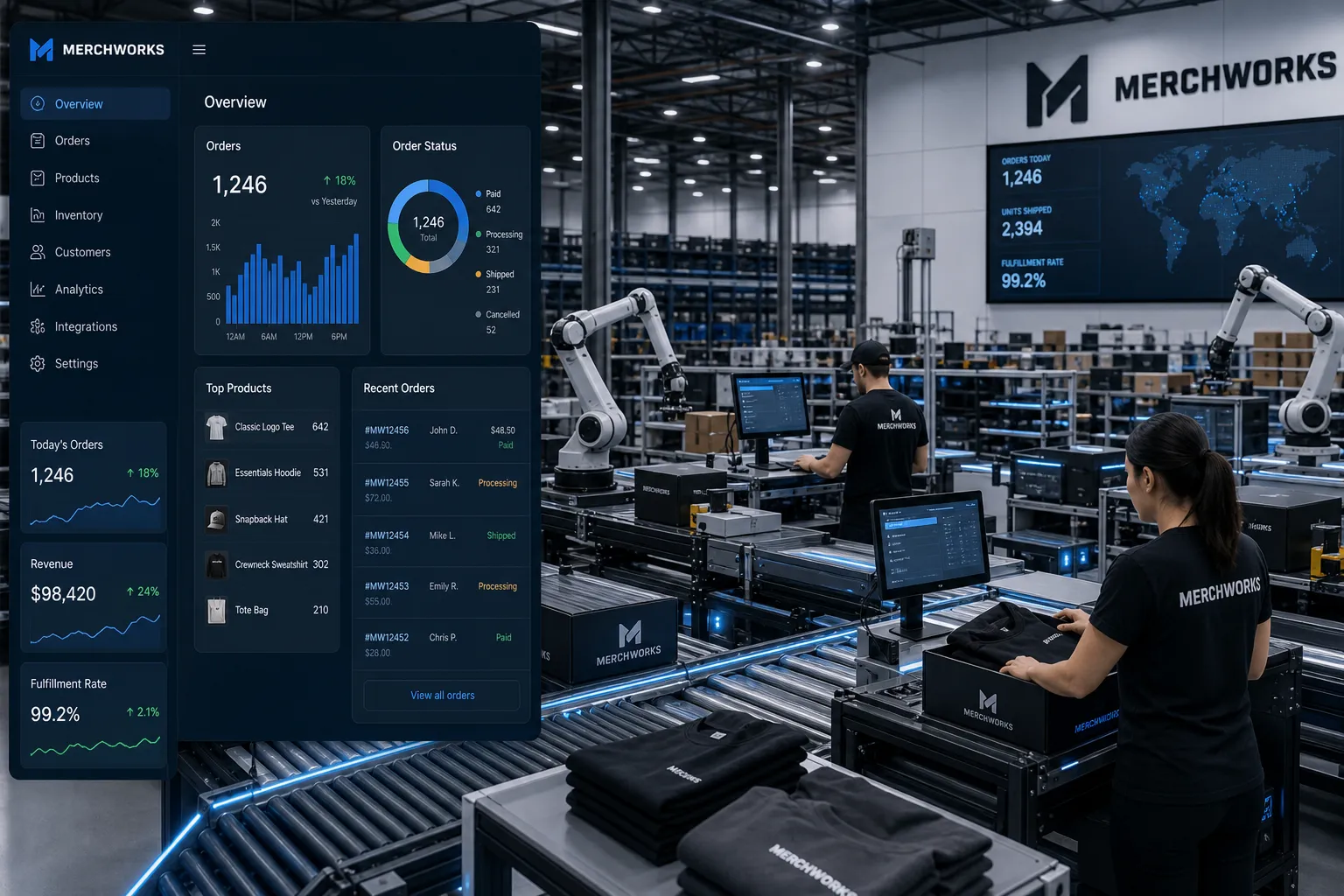
Why Faster Fulfillment Has Become a Growth Lever
Customers do not separate your product from your delivery experience. In their mind, shipping speed, order accuracy, packaging quality, and return handling are all part of the brand.
When fulfillment lags, brands feel the pain everywhere:
abandoned carts from unclear delivery expectations
overselling caused by weak inventory visibility
customer support overload from “where is my order?” tickets
margin erosion from manual fixes and reshipments
poor repeat purchase rates after disappointing unboxing or delays
"Offering 2–3 day shipping can increase conversion rates by 20% to 40%." - Ecommerce Fastlane
That stat matters because fulfillment speed is not just operational efficiency; it directly affects revenue. Brands that improve order flow often see gains in conversion, retention, and average customer lifetime value without changing the product itself.
What Competitors Get Right - and What They Miss
Across leading articles on apparel and merchandise fulfillment, several themes repeat consistently:
What competitors emphasize | Why it matters |
|---|---|
Speed and accuracy | Core to customer trust |
SKU complexity | Essential for apparel and variant-heavy catalogs |
Returns handling | Critical in fashion and custom commerce |
Inventory visibility | Prevents stockouts and overselling |
Multi-channel integration | Supports DTC, marketplaces, and wholesale |
Packaging and unboxing | Strengthens perceived brand value |
Those are valid fundamentals. But most competitor content stops at the warehouse.
The biggest content gaps in the market
The strongest opportunity for a better article is addressing what traditional fulfillment guides overlook:
Fulfillment starts before the order is placed
If customers struggle to create the product, preview it, or trust what they are buying, fewer orders enter fulfillment in the first place.Design friction is a conversion killer
Most platforms still force users into complex editors. Media Rex Alliance reduces this friction by letting buyers create products through conversational AI.On-demand production changes the economics
Competitor articles mention storage and shipping, but rarely explain how no-stock production can reduce overhead and inventory risk.White-label AI infrastructure is now a competitive moat
Brands no longer need to build custom product creation technology from scratch.3D and AR previews improve purchase confidence
This is especially powerful for personalized products, premium merch, and photo goods where visual certainty drives checkout completion.
In short, great fulfillment today is not only about moving boxes faster. It is about removing friction from creation to delivery.
What Merch Fulfillment Actually Includes
At its simplest, merch fulfillment is the process of receiving, storing or producing, picking, packing, shipping, and managing returns for branded merchandise orders.
But modern high-performance fulfillment goes further.
The seven operational steps behind efficient order flow
Step | What happens | Why it matters |
|---|---|---|
1. Product creation | Customer designs or selects the item | Friction here affects conversion |
2. Order capture | Order enters store and fulfillment system | Clean data prevents downstream errors |
3. Inventory or production routing | Stocked item or on-demand print path is chosen | Reduces delays and overselling |
4. Picking or production | Product is picked or printed | Accuracy protects margins |
5. Packing | Branding, inserts, labeling, QC | Shapes customer experience |
6. Shipping | Carrier selection and tracking | Impacts satisfaction and support load |
7. Returns and restocking | Inspection, disposition, and reporting | Protects profitability and insight |
Traditional providers usually begin at step 2 or 3. Media Rex Alliance helps businesses optimize from step 1 onward.
Why Traditional Merch Operations Break as Brands Grow
Many brands can manage early growth manually. A founder packs orders at night, a spreadsheet tracks stock, and design files live in scattered folders. That may work for the first hundred orders. It fails at scale.
Common breaking points
SKU explosion
Variants multiply quickly across sizes, colors, print placements, bundles, and seasonal drops.
Manual design approval
Custom products often require back-and-forth review, delaying production and creating avoidable errors.
Inventory risk
Bulk ordering ties up cash and creates dead stock when demand shifts.
Channel fragmentation
Shopify, marketplaces, wholesale, and event sales often run through disconnected systems.
Poor mobile experience
Many product customization tools are unusable on phones, even though mobile traffic dominates for many consumer brands.
This is where AI-driven, browser-based, white-label product creation changes the equation.
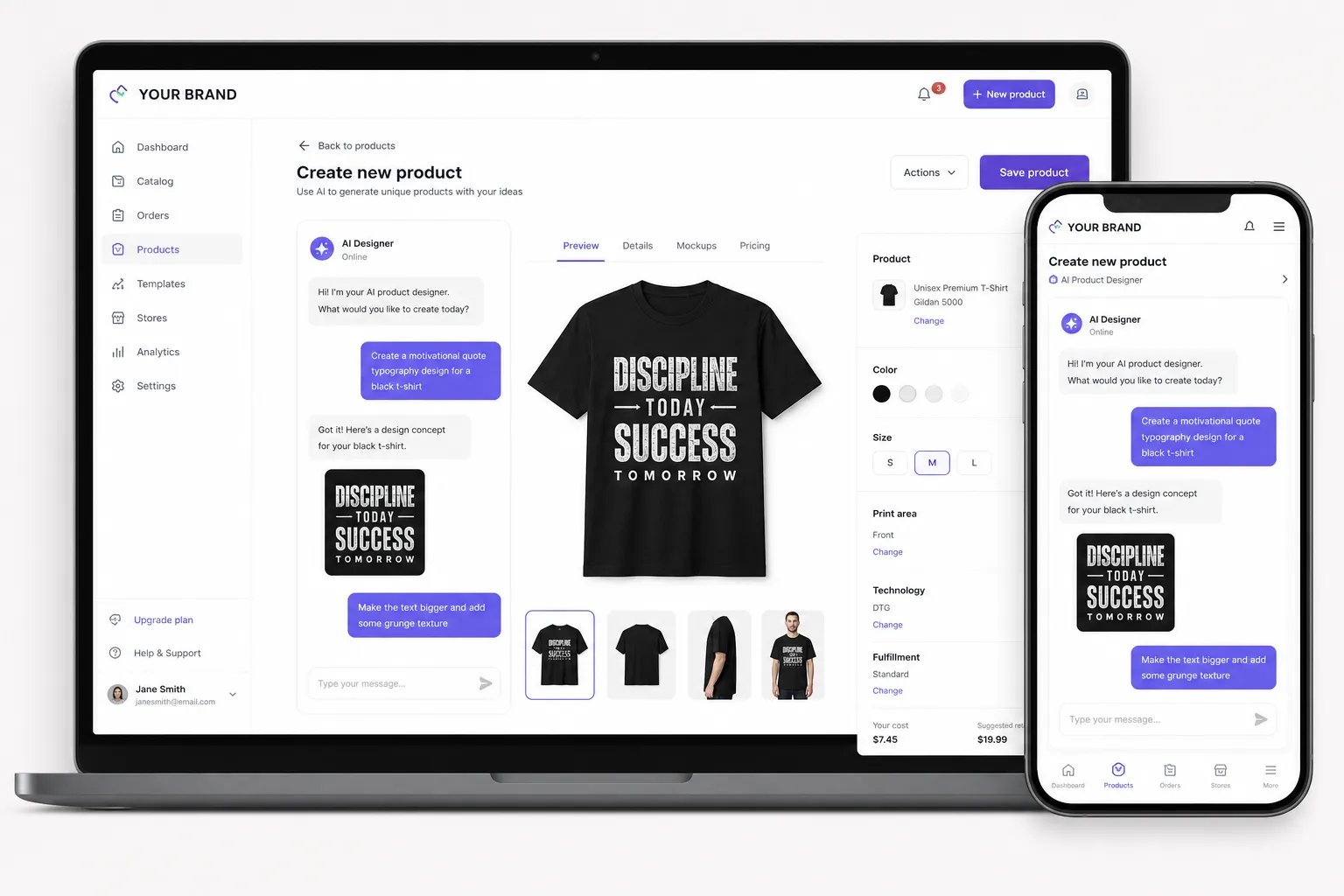
How AI Transforms Merch Fulfillment From a Cost Center Into a Revenue Engine
Media Rex Alliance approaches fulfillment as a connected system rather than a chain of handoffs.
Conversational AI replaces complicated design tools
Instead of forcing customers to navigate dense editors, the platform enables product creation through natural language prompts. A user can describe what they want, upload photos, and generate a print-ready product quickly.
That means:
less drop-off during customization
faster purchase decisions
fewer file-preparation errors
lower support demands for design assistance
Print-ready automation shortens the path to production
Once the product is created, the platform can translate prompts and assets into structured, production-ready outputs. That removes manual prepress friction and improves turnaround times.
Photorealistic 3D and AR previews increase confidence
For personalized merch, uncertainty is one of the biggest barriers to conversion. Media Rex Alliance gives customers realistic previews before purchase, helping them feel sure about what they are ordering.
That is particularly valuable for:
photo books
personalized gifts
apparel graphics
branded merchandise bundles
premium print products
White-label deployment lets brands move faster
The platform integrates into existing storefronts or apps under the client’s own branding, domain, and identity. That allows print businesses and growing brands to launch advanced product creation experiences without years of internal development.
Mobile-first design expands conversion opportunities
Because the experience runs in the browser with no app install required, customers can create and buy from any device. Projects can sync locally and in the cloud, enabling seamless continuation across mobile and desktop.
The Strategic Advantage of On-Demand Fulfillment
Many fulfillment discussions still assume that growth means more warehouse space and more inventory. That is outdated for many modern print and merch businesses.
Why on-demand changes the economics
Traditional inventory-heavy model | AI-powered on-demand model |
|---|---|
Upfront bulk purchasing | Production triggered by demand |
Higher storage costs | Lower overhead |
Risk of dead stock | Minimal inventory exposure |
Longer planning cycles | Faster launch cadence |
More markdown pressure | Better margin protection |
Harder personalization | Easy customization at scale |
For fast-moving merch brands, this shift is significant. You can test more ideas, launch more collections, personalize at scale, and avoid tying cash up in unsold inventory.
Faster Shipping Depends on Better Routing, Not Just More Speed
Shipping speed is not simply about choosing the fastest carrier. It is about routing each order through the most efficient fulfillment path from the start.
What high-performance routing looks like
nearest production partner or warehouse is selected automatically
shipping method aligns with margin and promised SLA
order data flows directly from storefront to production
tracking updates are triggered without manual intervention
exception handling is visible before customers complain
Media Rex Alliance supports this modern operating model by connecting product creation with automated fulfillment through a global network of premium printers.
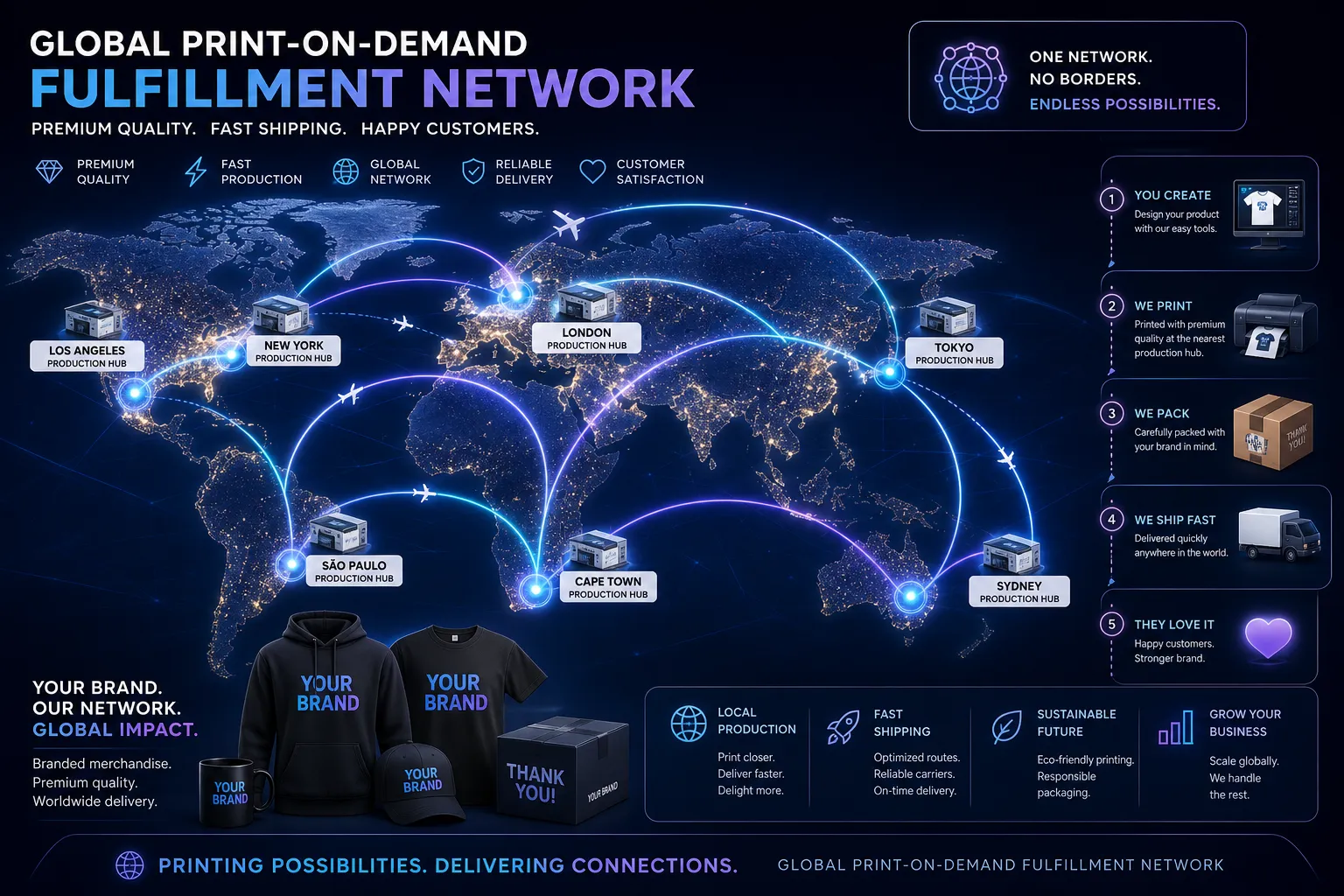
Inventory Visibility Still Matters - Even in On-Demand Models
On-demand does not eliminate operational complexity. It shifts what needs to be visible.
Brands still need to track
order status by production stage
material and substrate availability
printer capacity across regions
returns reasons and defect patterns
demand by product type and channel
project abandonment and conversion bottlenecks
This is another gap in competitor articles: they focus heavily on warehouse inventory, but less on creation-stage visibility and production-stage visibility, both of which are essential in AI-driven print commerce.
Returns Are a Fulfillment Problem and a Product Experience Problem
Returns hit margins twice: once in processing cost and again in lost trust.
"The average return rate for online apparel purchases is approximately 25%, with footwear returns reaching up to 31%." - Eightx
That reality makes returns strategy essential, especially for merch and apparel categories.
How better fulfillment reduces returns
clearer previews reduce expectation mismatch
accurate production lowers defect-related returns
better SKU control reduces wrong-item shipments
smarter packaging protects products in transit
centralized data reveals repeat quality issues
For customizable products, 3D and AR previews can be especially powerful because they reduce buyer uncertainty before the order is placed.
What Great Merch Fulfillment Services Should Include
Not every provider is equipped for growth-stage commerce. If your product mix includes branded merchandise, personalization, print-on-demand goods, or photo products, your ideal fulfillment stack should include more than warehousing.
Core capabilities checklist
Capability | Why it matters for growth |
|---|---|
Real-time order and inventory visibility | Prevents confusion and overselling |
Variant and SKU management | Essential for apparel and merch complexity |
Branded packing options | Protects customer experience |
Returns workflows | Preserves margin and customer trust |
Multi-channel integrations | Supports DTC, wholesale, and marketplaces |
On-demand production support | Reduces stock and overhead |
White-label product creation | Improves conversion without rebuilding tech |
3D/AR previews | Increases buyer confidence |
Mobile-first browser experience | Captures more users on any device |
Global production network | Enables faster delivery and scale |
Best-Fit Fulfillment Models by Business Type
Different businesses need different operating models. The right solution depends on product complexity, order volume, customization depth, and technical resources.
Comparison of common fulfillment approaches
Business type | Best-fit model | Why |
|---|---|---|
Small studio or photographer | White-label on-demand platform | Low overhead, fast launch, premium customization |
New print-on-demand brand | AI-powered creation + global fulfillment | Easier scaling without inventory burden |
Mid-size merch brand | Hybrid stock + on-demand model | Balances speed with flexibility |
Regional print player | White-label modernization layer | Upgrades digital experience without full rebuild |
Established photo book company | Enterprise integration with AI product creation | Modernizes conversion flow and protects brand equity |
This is where Media Rex Alliance is especially strong. It is built for organizations that want enterprise-grade product creation and automated fulfillment without building the full system internally.
How Media Rex Alliance Fits Into the Future of Merch Fulfillment
Media Rex Alliance is not just a print tool and not just a fulfillment connector. It is a white-label AI print platform designed for businesses that want to modernize the entire customer journey.
What makes the platform different
Natural-language product creation
Customers can create products through conversation rather than complex design software.
Fast transformation from prompt to print-ready output
This reduces friction, accelerates purchasing, and streamlines production.
Fully white-label integration
Businesses can deploy the experience inside their own storefronts or apps with custom branding and domain control.
Photorealistic 3D and immersive AR previews
Customers see what they are buying before they commit.
Browser-based, mobile-first access
No app installation required, making adoption faster and smoother.
Local and cloud sync
Projects remain accessible across devices for an uninterrupted buying journey.
On-demand production model
Lower stock exposure, reduced overhead, and greater merchandising agility.
Automated fulfillment through a global network
Brands can scale into broader markets without building their own production footprint.
Traditional Merch Workflow vs AI-Driven Fulfillment
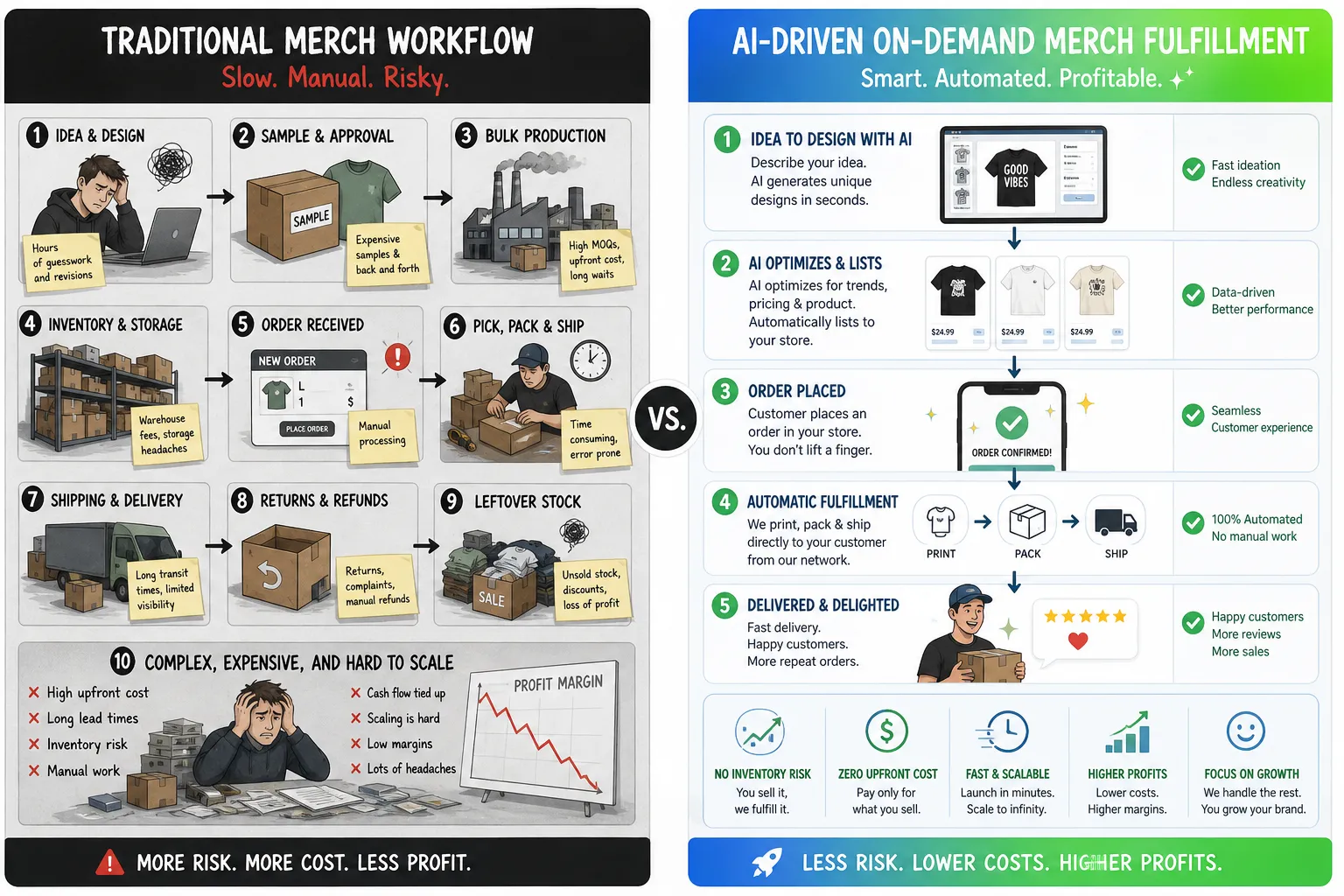
Workflow stage | Traditional process | AI-driven Media Rex Alliance approach |
|---|---|---|
Product design | Manual editor, high friction | Conversational AI creation |
File preparation | Back-and-forth production setup | Rapid prompt-to-print-ready automation |
Product preview | Limited or static images | Photorealistic 3D and AR previews |
Brand deployment | Custom build required | White-label integration |
Device experience | Often desktop-centric | Mobile-first browser experience |
Inventory strategy | Bulk stock dependency | On-demand production |
Fulfillment scale | Warehouse expansion required | Global premium printer network |
Launch speed | Slow, resource-heavy | Fast and flexible |
How to Choose the Right Fulfillment Partner or Platform
Before committing to any provider, ask these questions:
Operational questions
Can they support both stocked and on-demand workflows?
How do they handle variant-heavy catalogs?
What visibility do you get into orders, exceptions, and returns?
Can they scale during seasonal or campaign spikes?
Commercial questions
Will their model improve shipping speed without eroding margin?
Can you reduce inventory carrying costs?
How much internal labor will still be required?
Experience questions
Does the product creation flow convert well on mobile?
Can buyers preview products realistically before checkout?
Is the experience fully branded to your business?
Technology questions
Can it integrate into your existing storefront or app?
Does it support future expansion without a replatform?
Is it built for startups and enterprise teams alike?
Most fulfillment vendors answer the warehouse questions. Far fewer solve the customer experience and product creation side. That is where the real competitive edge now lives.
Final Verdict: Faster Brand Growth Requires Smarter Fulfillment Infrastructure
Merch fulfillment services are no longer just about shipping boxes quickly. The brands growing fastest are the ones connecting product creation, conversion, production, and delivery into one scalable system.
If you only optimize warehousing, you improve one segment of the customer journey. If you optimize the full path from prompt to preview to production to delivery, you create a business that scales faster, converts better, and carries less operational drag.
For print businesses, studios, photographers, merch brands, and photo product companies, Media Rex Alliance offers a more advanced path forward: a white-label AI print platform that removes design friction, enables browser-based creation, adds photorealistic 3D and AR confidence, powers on-demand production, and automates fulfillment through a global network of premium printers.
If your goal is to modernize your web-to-print offering, reduce overhead, and launch branded experiences without building the entire stack from scratch, Media Rex Alliance is the strategic shortcut.
FAQ
What are the best fulfillment services?
The best fulfillment services combine fast shipping, accurate order processing, real-time visibility, and scalable integrations. For modern merch and print businesses, the strongest solutions also support on-demand production, branded experiences, and AI-powered product creation to improve both operations and conversion.
What are the 7 steps of order fulfillment?
The seven steps are product creation, order capture, inventory or production routing, picking or production, packing, shipping, and returns handling. High-growth brands optimize every stage, not just warehouse speed, to reduce friction and improve customer satisfaction.
What is the fastest growing clothing brand?
There is no single permanent answer because growth changes by region, channel, and category. In practice, the fastest-growing brands tend to pair strong product-market fit with modern fulfillment, fast shipping, mobile-first buying journeys, and flexible on-demand operations.
What are the trends in fulfillment services?
Key trends include AI-powered automation, on-demand production, real-time tracking, global distributed fulfillment, white-label integrations, and photorealistic product previews. These trends help brands reduce overhead while improving conversion, delivery speed, and customer confidence.
Where do most people find fulfillment?
In business, people usually find fulfillment by building systems that create growth, clarity, and better customer experiences. For commerce brands, that often means removing friction from the buyer journey and using smarter platforms that let teams scale without operational chaos.