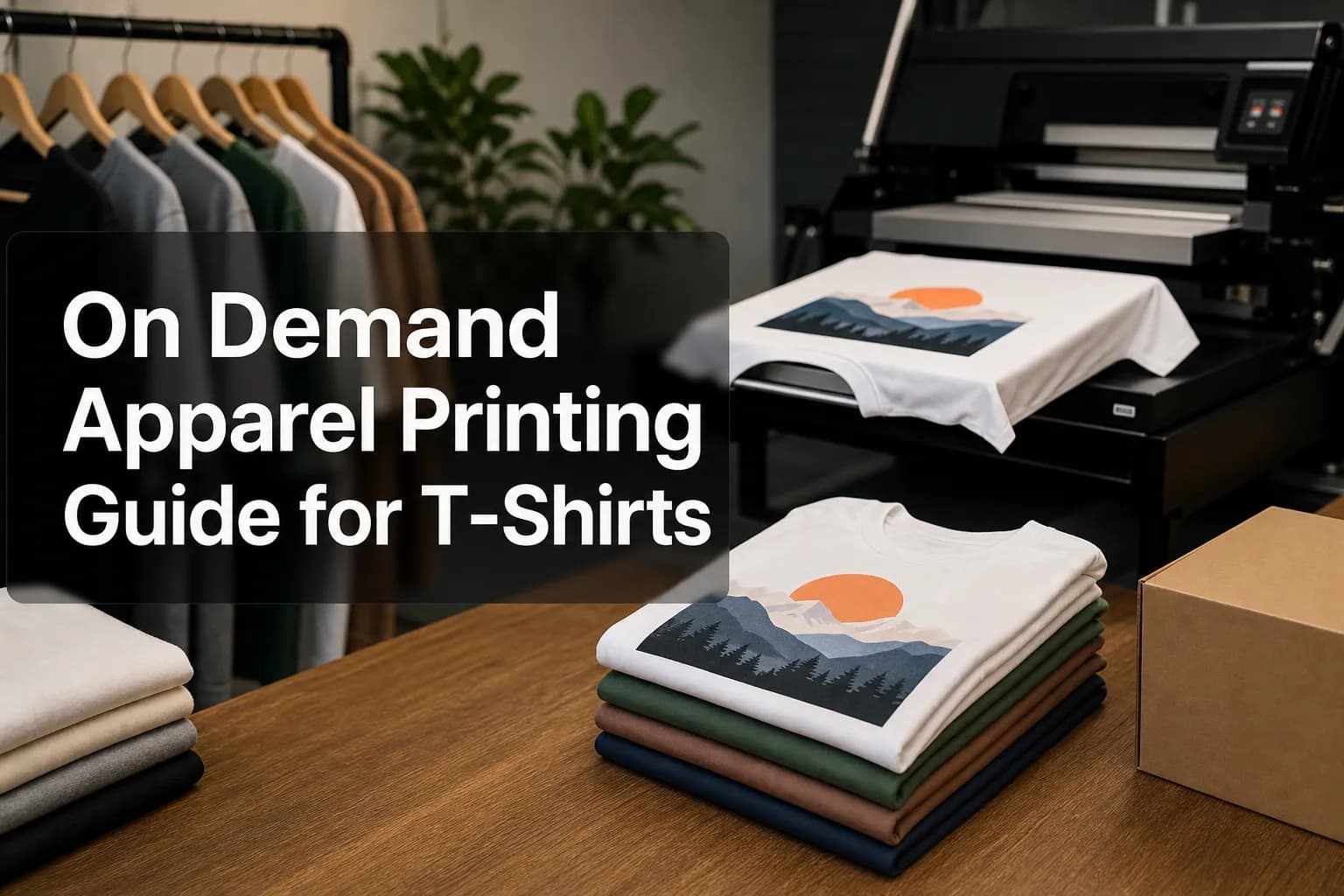
On-Demand Apparel Printing Guide for T-Shirts
For modern print businesses, studios, photographers, and emerging merch brands, the opportunity in custom apparel is obvious. The friction is not. Traditional design tools are slow, fulfillment decisions are fragmented, and choosing the wrong print method can erode margins through reprints, delays, or poor customer satisfaction.
This guide explains how on-demand apparel printing works for t-shirts, how to evaluate print methods and fulfillment models, and what separates a scalable print partner from a commodity vendor. It also explores where the category is heading: toward AI-driven, white-label, mobile-first commerce experiences that reduce effort for buyers and increase conversion for sellers.
"In 2026, the worldwide apparel market is projected to generate revenue of approximately US$1.92 trillion." - Statista
"Product pages featuring 3D and AR content experience a 94% higher conversion rate compared to those without such features." - Shopify, cited by Breeur
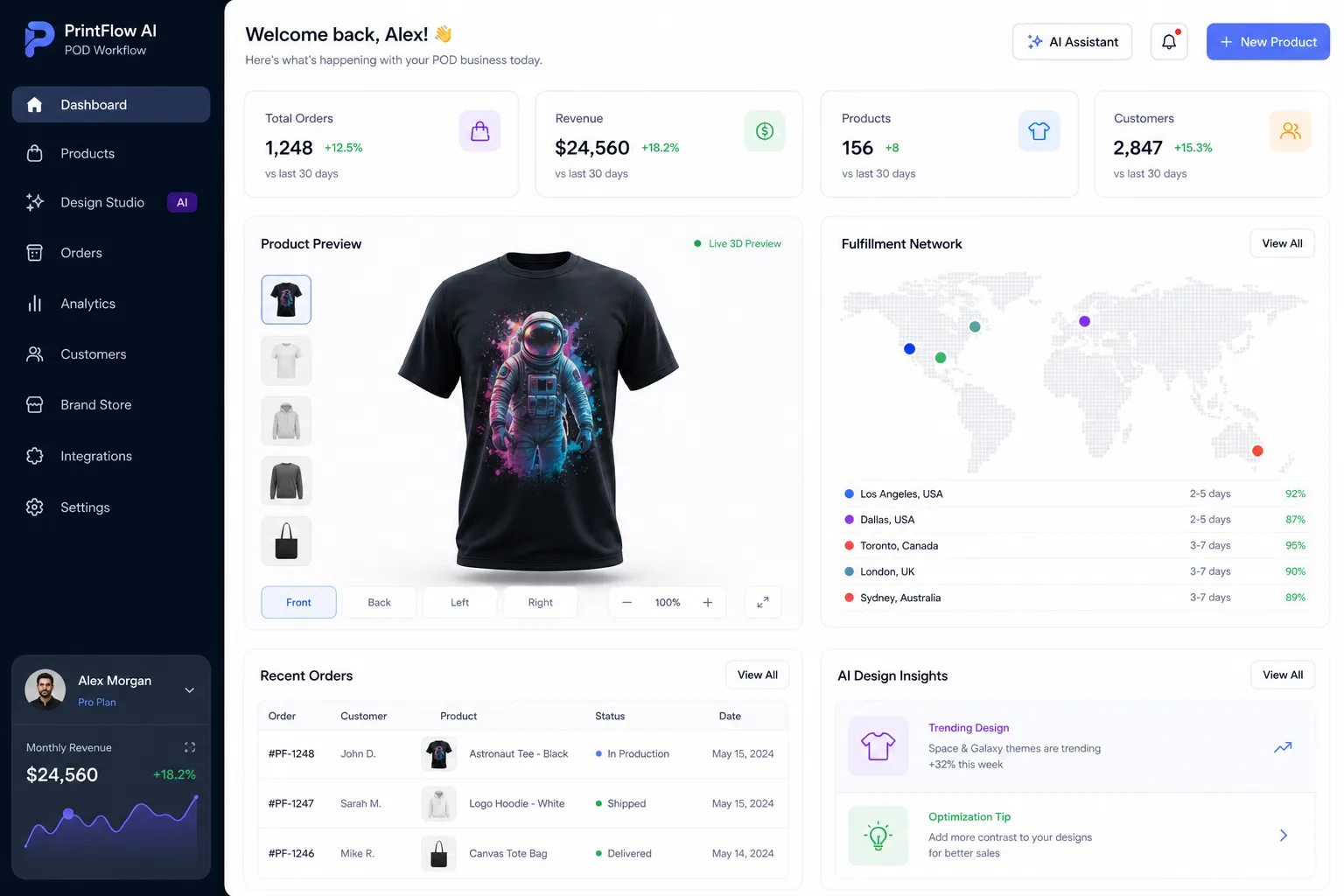
What on-demand apparel printing actually means
On-demand apparel printing is a production model where a t-shirt is printed only after a customer places an order. Instead of holding blank inventory in multiple decorated variants, businesses store designs digitally and trigger production per transaction.
That changes the economics of apparel in four important ways:
Lower inventory risk because products are made to order.
Faster catalog expansion because brands can test more designs without buying stock.
Lean operations because printing, packing, and shipping can be automated.
Better personalization potential because every order can be unique.
For sellers exploring on demand t shirt printing, the model is especially attractive because t-shirts are high-demand, low-friction products with broad use cases: creator merch, team apparel, event wear, local brand drops, niche ecommerce stores, and photo-based gifting.
Why t-shirts remain the center of print-on-demand growth
T-shirts remain the entry point for most print businesses because they combine demand volume, manageable production complexity, and strong consumer familiarity.
They work well because:
Buyers understand sizing and use cases.
Shipping costs are relatively predictable.
Multiple print methods are available.
Design variation is easy to test.
The product fits both impulse buys and brand-building campaigns.
For small studios and new brands, on demand shirt printing offers a fast way to validate creative demand. For mid-size and enterprise print players, it becomes a scalable acquisition and retention engine when paired with strong automation and branded storefront experiences.
How the on-demand t-shirt workflow works
A modern workflow should feel simple to the customer, even if the backend is sophisticated.
Core workflow
Stage | What happens | What matters most |
|---|---|---|
Product creation | Design is uploaded or generated | Speed, usability, print readiness |
Product preview | Customer sees mockup or 3D view | Confidence, fewer abandoned carts |
Order routing | Order is sent to production | Automation, printer matching |
Printing | Shirt is decorated using chosen method | Quality, consistency, turnaround |
Fulfillment | Packed and shipped to customer | Speed, tracking, reliability |
Post-purchase | Returns, reprints, support | Service standards, margin protection |
Where most competitors stop short
Most guides explain printing methods but gloss over the real conversion bottlenecks:
complicated design interfaces
weak mobile experiences
poor preview quality
disconnected fulfillment systems
limited white-label control
difficulty scaling from one market to many
This is where Media Rex Alliance changes the operating model. Instead of forcing end customers into complex design tools, it enables product creation through conversational AI. A buyer can describe what they want, upload a photo, and move from idea to print-ready product quickly. Combined with photorealistic 3D and AR previews, browser-based access, local and cloud sync, and white-label integration into an existing storefront, the path to purchase becomes dramatically shorter.
The main t-shirt printing methods you need to know
Choosing the right print method is not a design decision alone. It is a business model decision. The best option depends on order volume, artwork complexity, fabric type, expected durability, and fulfillment speed.
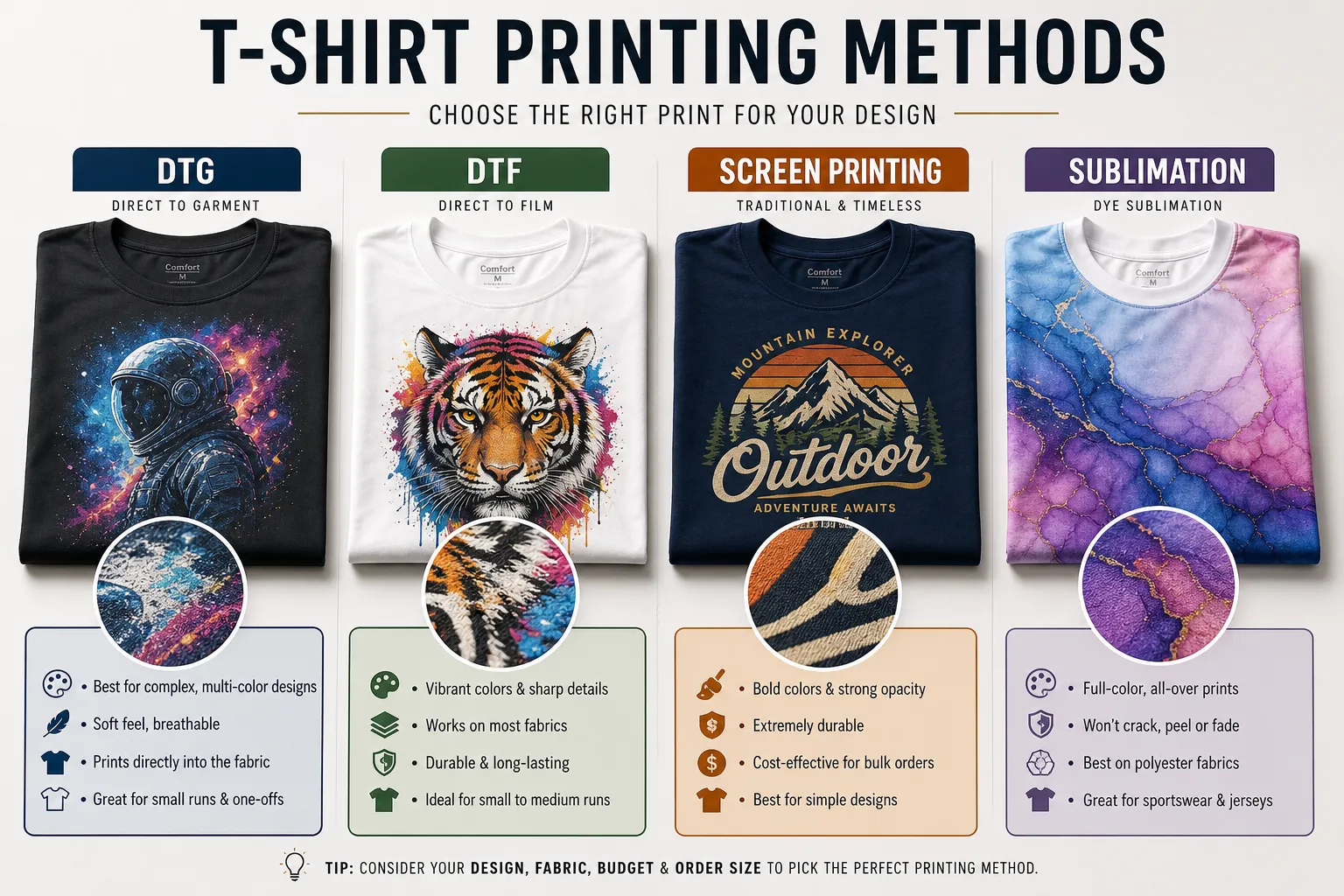
DTG printing
Direct-to-garment prints ink directly onto fabric, making it ideal for detailed, full-color designs and short runs.
Best for:
one-off orders
ecommerce stores with many SKUs
artwork with gradients or photo detail
cotton-heavy garments
Pros:
low setup friction
excellent detail
economical for low quantity orders
ideal for personalized items
Cons:
slower at large volume
less ideal on some synthetic blends
can be less durable than top-tier screen printing in heavy wash cycles
DTF printing
Direct-to-film prints onto transfer film, then heat-applies the design to the shirt. It has become a flexible option for many garment types.
Best for:
mixed fabric catalogs
vibrant graphics
small-to-medium runs
operators needing broad garment compatibility
Pros:
works across cotton, blends, and many synthetics
bold color output
handles detail well
versatile production
Cons:
print feel can be heavier
lower perceived premium feel than some DTG applications
quality varies widely by supplier process
Screen printing
Screen printing remains the workhorse for larger runs and bold designs. In an on demand screen printing and fulfillment context, it is less about one-off orders and more about repeatable demand or grouped production.
Best for:
larger order quantities
simple graphics with limited colors
team, event, and promo apparel
brands with stable winners
Pros:
excellent durability
strong color saturation
low per-unit cost at volume
highly proven method
Cons:
setup costs per design/color
poor fit for one-off personalization
slower to launch many design variations
not ideal for highly complex artwork in small batches
Sublimation
Sublimation bonds dye into polyester fibers. It is typically used for all-over prints and performance garments rather than mainstream cotton tees.
Best for:
polyester apparel
all-over graphics
sportswear and technical fabrics
Pros:
highly durable
no heavy hand feel
vibrant edge-to-edge possibilities
Cons:
requires polyester or high-poly content
limited relevance for classic cotton t-shirt programs
usually more specialized
Screen printing vs on-demand fulfillment: when each model wins
A major gap in competitor content is the assumption that one print method should dominate every apparel business. In reality, successful operators often use both digital and traditional models.
Practical comparison
Factor | Screen printing | On-demand digital printing |
|---|---|---|
Best order size | Medium to large runs | One-offs to small runs |
Setup cost | Higher | Lower |
Artwork complexity | Better for simple designs | Better for detailed/full-color artwork |
Speed to launch | Slower | Faster |
Personalization | Weak | Strong |
Inventory model | Often batch-based | Make-to-order |
Scalability for catalog breadth | Lower | Higher |
Margin profile | Strong at volume | Strong in low-risk testing |
Use screen printing when:
you have proven designs with repeat demand
you are printing for teams, events, or retail chains
artwork is bold and color-limited
unit economics improve with scale
Use on-demand t shirt printing and fulfillment when:
you want to avoid inventory
you need to test designs quickly
buyers want customization
you sell online across many niches
speed and flexibility matter more than batch economics
The smart operator’s model
Many of the strongest brands do not choose one forever. They use on demand clothing printing to test, validate, and scale early demand, then shift stable winners into bulk or hybrid production where appropriate.
That hybrid thinking matters even more when the front-end experience is AI-powered. With Media Rex Alliance, businesses can launch branded, conversational product creation experiences that capture demand faster, gather real purchase intent earlier, and feed the right products into the right production path.
What makes the best on-demand t-shirt printing service
The best on demand t shirt printing provider is not simply the cheapest printer. It is the partner that protects margin, supports growth, and removes friction across the customer journey.
Key evaluation criteria
1. Print quality consistency
A provider should produce reliable output across garments, colors, and facilities. Ask for sample packs, inspect wash performance, and compare how blacks, reds, skin tones, and fine lines reproduce.
2. Garment quality
The blank matters as much as the print. Softness, shrinkage, fit consistency, and brand perception directly affect review scores and repeat orders.
3. Production speed
Fast production is useful, but consistency matters more than occasional rush capacity. Look at average fulfillment windows, not just headline promises.
4. Geographic fulfillment reach
Global coverage reduces shipping times and supports localized growth. This is critical for regional print brands and enterprise operators serving multiple markets.
5. Integration flexibility
Most competitors focus on creator tools. Established print businesses need infrastructure. White-label storefront integration, API readiness, custom branding, and workflow control are what enable long-term defensibility.
6. Mobile-first buying experience
Many t-shirt orders now start on mobile. If the design and preview experience breaks on phones, conversion suffers.
7. Visualization quality
Basic flat mockups are no longer enough for premium products. Photorealistic previews and AR can materially improve purchase confidence.
8. Customer support and reprint policy
Even high-performing operations need exception handling. A strong partner resolves defects and routing issues quickly.
Scorecard for choosing a partner
Criterion | Why it matters | What great looks like |
|---|---|---|
Print quality | Protects reviews and retention | Clean detail, color accuracy, durability |
Fulfillment speed | Improves customer experience | Predictable turnaround, tracking visibility |
Catalog quality | Raises AOV and brand trust | Premium blanks, size consistency |
Tech stack | Enables scale | API, white-labeling, automation |
UX | Improves conversion | Mobile-first, no-friction creation flow |
Visualization | Reduces hesitation | 3D and AR previews |
Network depth | Improves coverage | Multiple print partners, global routing |
Support | Limits margin loss | Clear SLAs, reprint handling |
How to choose the right print partner for quality, speed, and scale
Different business types need different partner profiles.
For small studios and photographers
Prioritize simplicity, premium presentation, and personalization. You want a system that lets clients create quickly from prompts or images, not one that asks them to learn production software.
For new print-on-demand brands
Prioritize catalog flexibility, low-risk testing, and fast launches. You need to launch many concepts without carrying stock.
For regional print players
Prioritize automation, storefront integration, and multi-location fulfillment. Local reputation depends on consistency and delivery speed.
For established photo book companies and print enterprises
Prioritize white-label deployment, brand control, AI-assisted creation, and infrastructure that can modernize an existing web-to-print stack without rebuilding from scratch.
Why Media Rex Alliance fits this evolution
Media Rex Alliance is built for businesses that want more than a commodity printing plugin. It enables:
conversational AI product creation instead of complex editors
prompt-to-print workflows that reduce decision fatigue
white-label integration into existing storefronts or apps
photorealistic 3D and AR previews before purchase
mobile-first browser-based use with no app install
local and cloud project sync across devices
no-stock, on-demand production to lower overhead
automated fulfillment through a premium global print network
scalability from startup sellers to enterprise print operations
That makes it especially relevant for companies modernizing legacy ordering flows or launching new branded print experiences under their own identity.

How fulfillment affects profitability more than most brands expect
A key content gap across competitor articles is that they discuss printing, but not the operational math behind fulfillment.
Fulfillment variables that shape margin
shipping zone and carrier mix
packaging cost
average production time
split shipments
reprint rate
routing efficiency
customer service volume
return and refund policies
A lower print cost can still produce lower profit if fulfillment is inconsistent. Delays create support tickets. Weak quality creates reprints. Poor network routing increases shipping costs and delivery times.
What strong on demand t shirt printing and fulfillment looks like
A strong operation should:
route to the nearest qualified print provider
maintain print quality standards across facilities
automate order handoff
provide tracking transparency
support peak-season scaling
minimize manual intervention
This is where platform architecture matters. Media Rex Alliance is designed around an automated fulfillment pipeline powered by a global network of premium printers, helping brands reduce overhead while keeping production agile.
Common mistakes businesses make with on-demand shirt printing
Choosing by price alone
Low-cost providers can become expensive through poor durability, bad color output, and reprint volume.
Ignoring the garment
A great print on a low-quality shirt still produces a disappointing product.
Overlooking mobile UX
If a customer cannot create or customize smoothly on mobile, the funnel leaks before checkout.
Using flat mockups only
Customers hesitate when they cannot visualize the product realistically. Better previews can meaningfully improve conversion.
Forcing users into complex editors
Most buyers are not designers. Conversational flows outperform tool-heavy workflows for broad audiences.
Treating fulfillment as an afterthought
A great front end with weak production operations leads to churn and poor reviews.
A smarter framework for selecting print methods by business scenario
Best for creator merch launches
Use DTG or DTF for fast experimentation and low-risk product testing.
Best for school, team, and event orders
Use screen printing when design simplicity and order volume support strong per-unit economics.
Best for customized customer orders
Use on-demand digital methods with a platform that can personalize output efficiently.
Best for premium branded experiences
Use a white-label AI print platform that improves buying confidence with 3D and AR previews and reduces friction in product creation.
The future of on-demand apparel printing
The market is moving beyond “upload design, choose size, checkout.”
The next competitive layer is experience orchestration:
conversational product creation
automated layout generation
instant preview realism
multi-device continuity
white-label ownership
global fulfillment automation
The winners will not just print well. They will convert better because they remove complexity before the order is placed.
For print businesses, that means the question is no longer just which printer to use. It is which platform can help you sell more print, with less friction, under your own brand.
Final verdict
On-demand apparel printing is no longer just a low-risk way to sell t-shirts. It is now a strategic growth channel for brands, studios, and print companies that want speed, flexibility, and better economics.
If your priority is bulk uniformity on proven designs, screen printing still has a strong role. But if your goal is catalog agility, personalization, lean operations, and scalable ecommerce growth, digital on-demand workflows are the stronger default.
And if you want to modernize the entire purchase experience, not just the production step, Media Rex Alliance offers a more advanced path: conversational AI product creation, fully white-label deployment, photorealistic 3D and AR previews, browser-based mobile-first access, and automated fulfillment through a global network. That combination gives modern print businesses a faster way to launch, a smarter way to convert, and a scalable foundation for the future of AI-powered web-to-print.
FAQ
What is the best print-on-demand platform for t-shirts?
The best platform combines high print quality, reliable fulfillment, mobile-first usability, and scalable white-label technology. For businesses that want more than a basic merch tool, Media Rex Alliance stands out by enabling conversational AI product creation, premium 3D/AR previews, and automated global fulfillment.
What is a good profit margin for print-on-demand t-shirts?
A good margin depends on shirt quality, shipping, and brand positioning, but many sellers target healthy margins after print, fulfillment, and support costs, not just production cost alone. The strongest operators improve profitability by reducing reprints, minimizing inventory risk, and increasing conversion with better product previews and user experience.
What is the most popular t-shirt printing method?
Screen printing remains the most established method for bulk orders because it is durable and cost-effective at volume. For ecommerce and one-off customization, DTG and DTF are increasingly popular because they support low-minimum, on-demand production.
What lasts longer, DTF or screen print?
In general, screen printing tends to last longer, especially for simple designs produced at high quality. DTF can still be very durable, but longevity depends heavily on film, adhesive, application quality, and garment care.