On Demand Custom Clothing Trends for 2026
The custom apparel market is entering a new phase. In 2026, buyers no longer want slow, tool-heavy ordering flows, generic products, or inventory risk. They want faster creation, better personalization, premium visual confidence before checkout, and fulfillment models that scale without operational drag.
That shift is exactly why on demand custom clothing is becoming a strategic growth channel for small studios, photographers, emerging print-on-demand brands, regional printers, and established photo-product companies modernizing their web-to-print stack. The winners in this market won’t just follow aesthetic trends. They’ll remove friction from the buying journey, automate production intelligently, and make custom product creation feel effortless on every device.
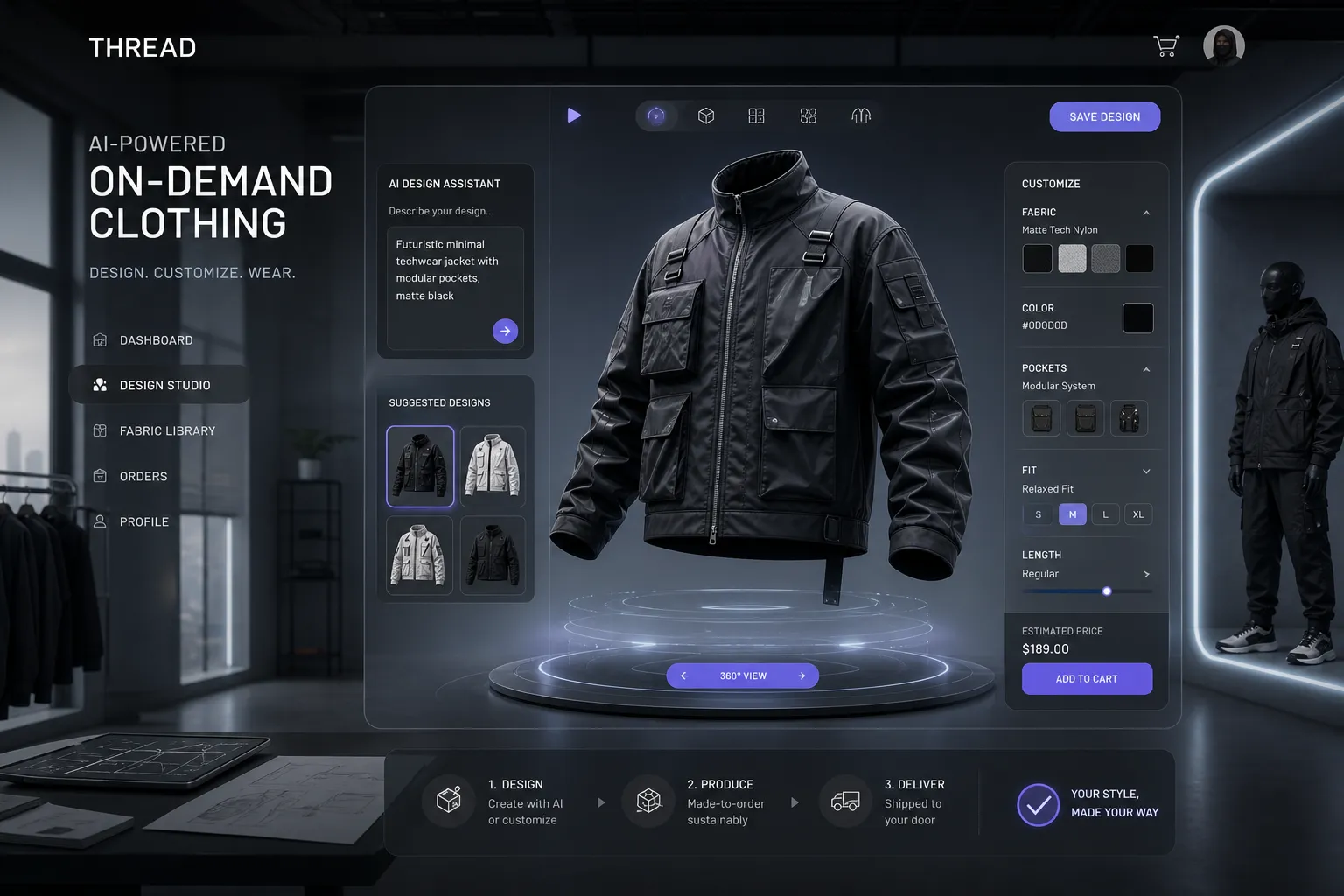
Media Rex Alliance is built for that future. Instead of forcing customers into complex design software, it enables them to create products through conversational AI, transforms prompts into print-ready products, and delivers photorealistic 3D and AR previews that help convert indecision into purchases. For businesses, it offers fully white-label deployment, browser-based mobile-first design, cloud and local sync, and a global on-demand fulfillment network that reduces inventory and overhead.
What the Top Competitor Articles Got Right, and What They Missed
Across the leading articles in this space, several themes repeat consistently:
sustainability is now baseline, not optional
oversized silhouettes, retro looks, tonal palettes, and premium embroidery are rising
print methods like puff embroidery, patches, mixed media, and large-format graphics are gaining traction
quality blanks and elevated basics matter more than ever
brands increasingly want lower inventory risk and more flexible production
Those are valid signals. But most competitor content stops at the surface level. It explains what is trending without fully addressing why certain businesses will win from those trends.
The biggest content gaps in competitor coverage
Content Gap | Why It Matters in 2026 | How Media Rex Alliance Changes the Equation |
|---|---|---|
Little focus on buying friction | Style trends do not convert if the design process is confusing | Conversational AI replaces complex editors and speeds up purchase decisions |
Almost no discussion of preview confidence | Custom apparel has high hesitation before checkout | 3D and AR previews help customers visualize before ordering |
Weak coverage of white-label scalability | Print businesses need tech they can brand as their own | Full white-label integration into storefronts and apps |
Limited attention to mobile-first creation | Many buyers now start and complete purchases on mobile | Browser-based design works without app installation |
Minimal operational strategy | Trends are useless if margins break under fulfillment complexity | Automated on-demand production reduces stock risk and overhead |
Rare mention of cross-device continuity | Modern users move between phone, tablet, and desktop | Local and cloud sync keep projects moving seamlessly |
So yes, 2026 is about style. But it is equally about interface design, conversion architecture, and fulfillment intelligence.
Why On-Demand Custom Clothing Is Accelerating Now
The category is growing because it aligns with three major shifts in buyer behavior:
People expect personalization by default
Businesses want leaner, lower-risk operations
Technology finally makes premium customization easy enough to scale
"In 2025, 64% of consumers globally preferred purchasing from companies that tailored their experiences to individual wants and needs." - XM Institute
That statistic matters because personalization in apparel is no longer a novelty. It is a conversion lever. The brands that make customization simpler, faster, and more visually trustworthy will outperform those that still rely on static product pages and clunky upload flows.
The 8 Defining Trends in On-Demand Custom Clothing for 2026
1. Conversational Product Creation Replaces Traditional Design Tools
The biggest shift is not visual. It is behavioral.
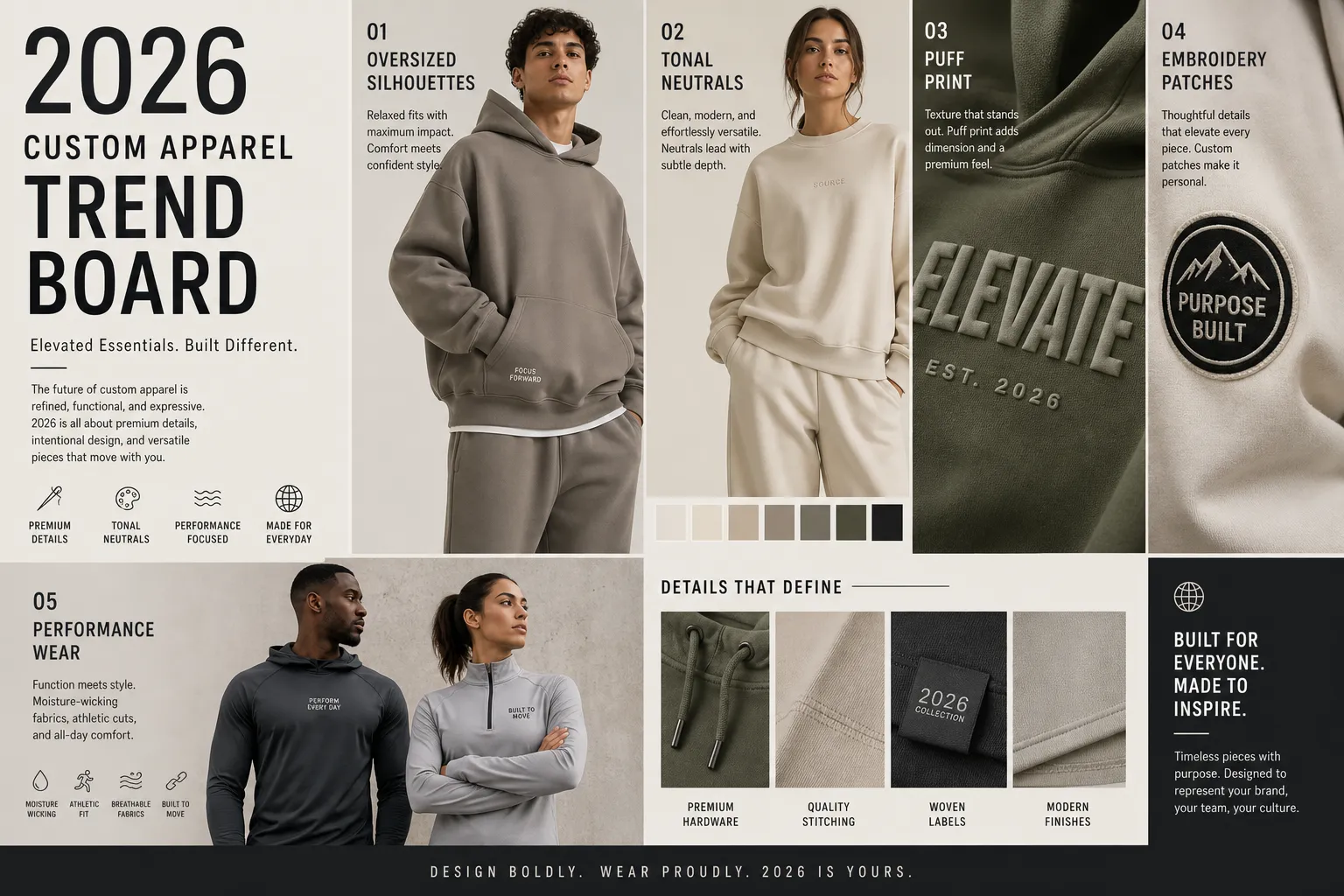
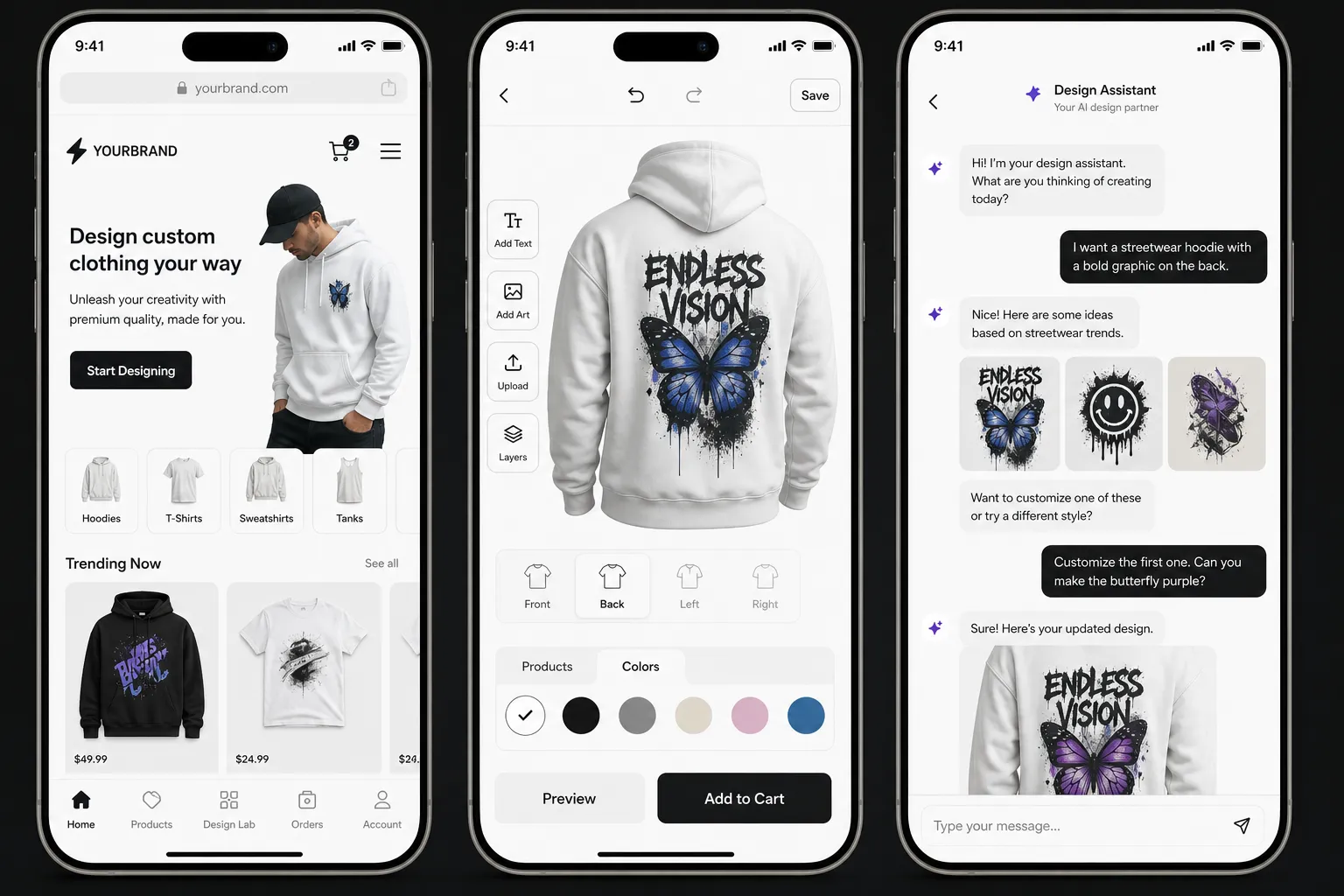
In the old model, customers had to learn the interface before they could create the product. In the new model, they simply describe what they want. A shopper might type: “Create a premium oversized hoodie with a tonal logo, back graphic, and minimal sleeve detail.” The system handles layout logic, product mapping, and print readiness.
This is where Media Rex Alliance stands apart. Its AI-powered creation engine turns prompts into ready-to-produce products, which dramatically reduces friction for first-time buyers and busy repeat customers alike.
Why this trend wins in 2026:
lowers abandonment caused by design complexity
enables non-designers to create confidently
accelerates time-to-checkout
opens premium customization to more customer segments
2. Tonal Minimalism Is Replacing Loud, Overbuilt Branding
Consumers still like bold graphics, but the premium end of the market is moving toward restraint: cream blanks, stone, charcoal, sand, washed olive, and off-white color stories with subtle contrast decoration.
Instead of oversized front logos everywhere, many successful brands are using:
tone-on-tone embroidery
small chest branding
low-contrast back artwork
monochrome patch applications
understated sleeve or hem detail
This aesthetic works especially well in corporate merch, creator apparel, boutique brand launches, and modern photo-led fashion drops.
For print businesses, the takeaway is simple: your product builder and preview experience need to make subtle details visible. Media Rex Alliance’s photorealistic 3D rendering helps customers appreciate the nuance of tonal branding before they order.
3. Oversized, Boxy, and Layered Fits Continue to Dominate
The oversized silhouette is not fading. It is becoming foundational. Heavyweight tees, relaxed hoodies, cropped layers, and roomy sweatshirts continue to anchor both fashion-forward drops and premium branded merch programs.
These fits work because they feel:
more current
more wearable across demographics
more premium at higher price points
better suited to statement back graphics and embroidery placements
For on-demand sellers, fit-driven merchandising matters. It is no longer enough to offer “custom t-shirts.” The assortment needs shape, drape, and style language that feels current.
4. Puff, Patch, and Mixed-Media Decoration Are Raising Perceived Value
Flat prints alone can still work, but the market is leaning harder into texture. Puff embroidery, leather patches, vinyl elements, chenille, appliqué, and mixed decoration techniques create a retail-grade look that helps justify stronger margins.
What buyers increasingly want:
hats with dimensional embroidery
hoodies with embroidery plus print combinations
jackets with patch applications
premium sweats with tactile logo treatments
simplified front branding paired with statement back graphics
For print businesses, this trend increases SKU and workflow complexity. That is why automation matters. Media Rex Alliance supports scalable product creation upstream, so businesses can sell premium-looking goods without creating downstream chaos in the customer journey.
5. Mobile-First Design Is No Longer Optional
Many competitor articles discuss colors, decoration, and blanks, but ignore a critical fact: a growing share of apparel discovery and product customization now begins on mobile.
If your ordering flow is still optimized mainly for desktop, you are creating conversion loss.
Media Rex Alliance is designed as a browser-based, mobile-first experience with no app installation required. That matters because:
impulse buying happens faster on mobile
event merch and creator drops often spread through social-first traffic
younger buyers expect fast design interaction on phones
app download friction kills conversion
A frictionless mobile experience is now part of the product itself.
6. 3D and AR Previews Are Becoming Conversion Infrastructure
Custom apparel has always had one core problem: uncertainty. Shoppers hesitate because they cannot fully imagine how the product will look once produced.
That is changing fast.
"58% of consumers have made a purchase after using augmented reality features." - Business Wire
Photorealistic visualization is no longer a nice add-on. It is an answer to trust friction.
With Media Rex Alliance, shoppers can see products through high-quality 3D and immersive AR previews, which helps:
increase confidence before checkout
reduce design misunderstandings
improve approval rates on premium items
lower hesitation for personalized purchases
If your business sells custom apparel online and still relies on flat mockups alone, this is one of the clearest upgrade opportunities in 2026.
7. No-Stock, Low-Overhead Operations Are the Smarter Growth Model
Inventory-heavy apparel models create risk in the exact places growing businesses can least afford it: storage, forecasting, markdowns, and cash flow.
The 2026 operating model is leaner:
products are created on demand
overhead stays lower
new styles can be tested without buying bulk inventory
personalization does not force large pre-commits
businesses can launch more experiments with less downside
This is especially valuable for:
small studios launching apparel extensions
photographers monetizing audiences
new print-on-demand brands validating niches
regional print companies expanding into digital commerce
photo book brands adding apparel without re-platforming everything
Media Rex Alliance supports this model through automated on-demand fulfillment and a global network of premium printers, allowing businesses to scale without building a complex production ecosystem from scratch.
8. White-Label Print Commerce Is Overtaking Generic Platform Dependence
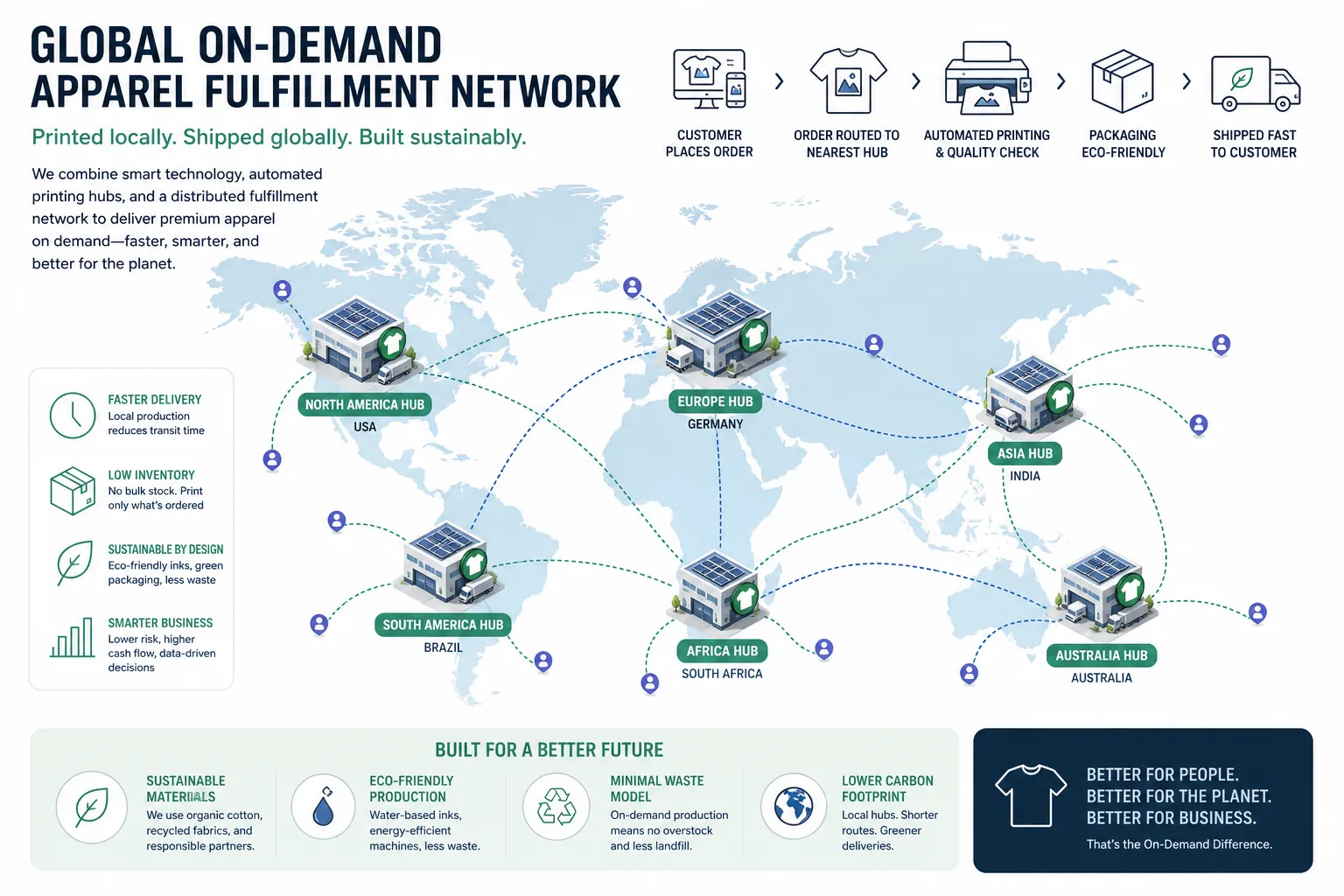
As businesses mature, many outgrow marketplace-style tools and generic third-party customization widgets. They want control over brand, domain, customer data, experience design, and conversion strategy.
That makes white-label infrastructure one of the most important strategic trends of all.
Media Rex Alliance enables businesses to launch:
branded product creation flows
custom storefront experiences
integrated apparel personalization inside existing apps
scalable print commerce without exposing another platform’s branding
For established companies, this is not just a branding upgrade. It is a margin, retention, and enterprise positioning upgrade.
The Most Important Style Directions to Watch in 2026
Below is a practical snapshot of the aesthetic and commercial directions shaping the market.
Trend Direction | What It Looks Like | Best-Fit Use Cases |
|---|---|---|
Tonal neutrals | Cream, oatmeal, washed black, olive, muted palettes | Premium brand merch, corporate apparel |
Oversized silhouettes | Boxy tees, dropped shoulders, heavyweight hoodies | Creator drops, youth-focused brands |
Mixed media | Embroidery plus print, patches plus stitch | Retail-style merch, limited collections |
Minimal front / bold back | Clean chest area with large rear graphic storytelling | Events, lifestyle brands, campaigns |
Elevated basics | Better blanks, softer fabrics, premium finishing | Staff uniforms, subscription merch |
Personalization | Names, niche artwork, AI-generated layouts | Teams, communities, niche stores |
How Different Businesses Should Respond to These Trends
For small studios and photographers
You do not need to build a complicated apparel stack from scratch. Start with curated products and low-friction customization. Focus on premium basics, audience-relevant designs, and mobile-first ordering.
For new print-on-demand brands
Competing on generic catalog depth is a trap. Compete on:
faster customization
better previews
stronger brand identity
lean operations
more premium perceived value
For regional print players
This is a moment to expand beyond traditional quoting workflows. Customers increasingly want self-serve ordering, instant visualization, and a digital-first experience that still feels premium.
For established photo book companies
Apparel is a logical category expansion, but only if the UX is modern enough. Conversational creation, AI layouts, and white-label deployment let you add custom clothing without forcing customers into outdated editing tools.
What Competitors Underestimate: UX Is Now a Fashion Advantage
A major blind spot in competing articles is the assumption that apparel trends are mostly about aesthetics. In reality, the user experience is becoming part of the fashion product.
A customer remembers:
whether creation felt easy
whether previews looked trustworthy
whether mobile checkout was smooth
whether the final product matched expectations
whether they would do it again
That is why Media Rex Alliance has strategic leverage. It does not just help businesses sell custom apparel. It helps them sell it in a way that aligns with how 2026 consumers want to buy.
A Smarter Framework for Evaluating On-Demand Custom Clothing Platforms
When assessing your next technology move, use this framework:
Evaluation Area | Questions to Ask |
|---|---|
Creation Simplicity | Can users create products without learning a complex design tool? |
Visual Confidence | Are 3D and AR previews available before purchase? |
Brand Control | Can the solution be deployed fully white-label? |
Mobile Performance | Is the experience built for browser-based mobile use? |
Workflow Continuity | Can users switch devices without losing progress? |
Fulfillment Scale | Is production automated through a reliable global network? |
Commercial Flexibility | Can it support both startup agility and enterprise complexity? |
If the answer is “no” to several of these, your platform may be limiting growth more than your product assortment is.
Final Verdict
The future of on-demand custom clothing is not just personalized. It is conversational, visual, mobile, automated, and white-label.
The brands and print businesses that win in 2026 will do more than follow apparel aesthetics. They will shorten the path from idea to order, make buying feel more confident, and operate with less stock risk and more scalable infrastructure.
That is where Media Rex Alliance becomes more than a vendor. It becomes a growth layer.
If you want to modernize your web-to-print offering, launch AI-powered apparel creation without building the technology internally, and give customers a faster route from prompt to premium physical product, Media Rex Alliance is built for exactly that mission.
Why Try Media Rex Alliance Now
Media Rex Alliance helps print businesses, studios, photographers, and modern apparel brands:
turn natural-language prompts into print-ready products
remove friction from the customer journey
offer photorealistic 3D and AR previews before checkout
launch fully white-label experiences in existing storefronts or apps
support mobile-first, browser-based customization without app installs
sync work across devices through local and cloud continuity
reduce inventory overhead with on-demand production
automate fulfillment through a global network of premium printers
scale from startup launches to enterprise-grade print operations
If 2026 is the year you want to upgrade from static customization to AI-powered print commerce, this is the platform to watch.
FAQ
What fashion trends are out for 2026?
In 2026, overly generic basics, harsh logo-heavy branding, and clunky one-size-fits-all merch are losing relevance. Buyers are moving toward tonal palettes, premium blanks, and more refined, wearable custom apparel.
What are the print on demand trends for 2026?
The biggest trends include AI-powered product creation, on-demand fulfillment, oversized fits, tonal minimalism, mixed-media decoration, and 3D/AR previews. Businesses also want white-label tools that reduce friction and improve conversion.
What type of clothing is in high demand?
Heavyweight tees, oversized hoodies, premium sweatshirts, performance apparel, and elevated basics are in high demand. Customers want clothing that feels stylish, comfortable, and premium enough to wear beyond a single event.
What style is coming back in 2026?
Retro-inspired fashion continues to return, especially through washed colors, vintage typography, oversized silhouettes, and nostalgic layering. Preppy details and old-school streetwear cues are also resurfacing in modernized form.
What style is coming back in 2026?
The comeback style story for 2026 centers on 90s and early-2000s influence, including boxy fits, statement backs, and textured decoration like patches and puff embroidery. The difference now is that these looks are being sold through more personalized, tech-enabled buying experiences.
What are the fashion color trends for 2026?
Expect cream, oatmeal, stone, washed black, olive, muted earth tones, and soft off-whites to dominate. These calmer tonal color stories pair well with subtle branding and help custom apparel feel more premium and contemporary.