
Photo Enlargements Online: Best Trends for 2026
The market for photo enlargements online is moving far beyond basic uploads and standard poster prints. In 2026, buyers expect sharper output, premium materials, mobile-first ordering, intelligent design help, and realistic previews before they commit. For print studios, photographers, emerging print-on-demand brands, and established photo product companies, this shift is more than a design trend - it is a conversion trend.
The biggest pain point in online print has always been friction. Customers want large-format prints that feel personal and premium, but they do not want to wrestle with complicated editors, guess how a print will look on their wall, or risk low-quality output from a blurry phone photo. That is exactly where the next generation of AI-powered web-to-print platforms is changing the category.
Media Rex Alliance is built for this moment. Instead of forcing users through traditional design workflows, it enables customers to create print-ready products through conversational AI, generate layouts quickly, preview them in photorealistic 3D and AR, and order through a fully white-label experience that feels native to your brand. For businesses modernizing their print stack, that combination can reduce drop-off, accelerate buying decisions, and scale premium on-demand production without heavy operational overhead.
"In 2024, the market was valued at approximately USD 12.09 billion and is anticipated to reach USD 12.56 billion in 2025." - Global Growth Insights
"In 2024, approximately 1.93 trillion photos were taken worldwide, with 94% captured using smartphones." - Letem svetem Applem
Why Photo Enlargements Matter More in 2026
A decade ago, photo enlargements were mostly a utility purchase: upload an image, pick a size, and hope the print arrived looking decent. Today, the category is becoming more emotional, decorative, and experience-driven.
Consumers are no longer printing just for albums. They are ordering oversized family portraits, travel wall art, pet photography, nursery pieces, wedding moments, branded studio work, and gallery-style decor. That makes quality, finish, framing options, and room visualization much more important than they used to be.
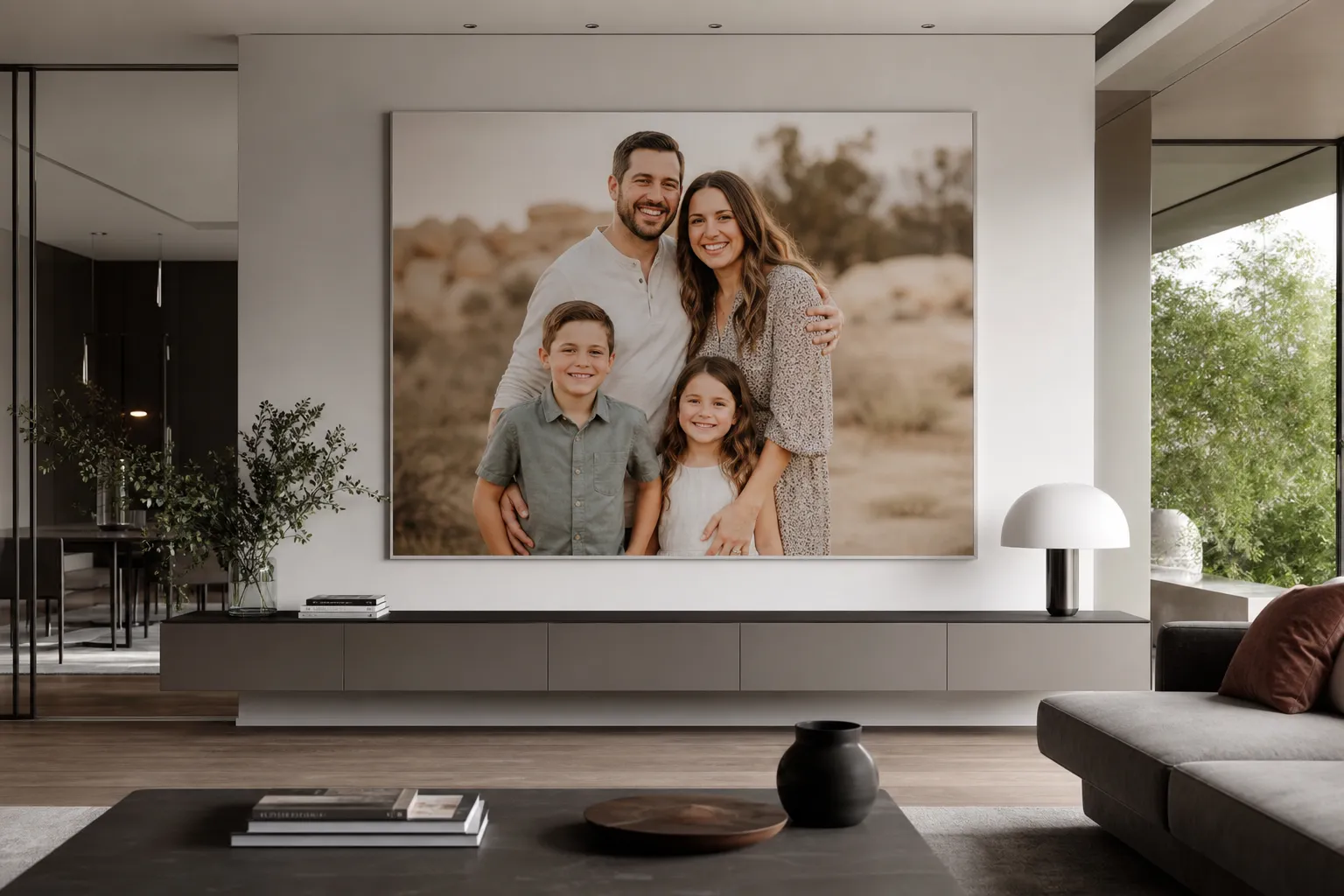
What buyers now expect from modern enlargements
Modern shoppers typically want:
Crisp detail from phone photos
Color accuracy that feels true to life
Premium substrates like canvas, acrylic, metal, or fine art paper
Easy mobile ordering
Fast delivery
Confidence that the final piece will match their space
This is where many legacy print experiences still underperform. Competitor content often focuses on product selection and pricing, but misses the deeper shift: the best online enlargement experience is now part photography service, part interior visualization tool, and part AI-assisted commerce flow.
What Competitors Get Right - and What They Still Miss
Most high-performing content in this space tends to cover similar points:
Common Competitor Strengths | Where They Often Fall Short |
|---|---|
Comparing popular print brands | Little discussion of AI-assisted ordering |
Highlighting print sizes and paper options | Few insights on AR or 3D product previews |
Recommending services for books, gifts, or framing | Limited focus on mobile-first commerce behavior |
Mentioning ease of use and design quality | Rarely address white-label opportunities for print businesses |
Talking about premium finishes | Minimal analysis of conversion friction and checkout confidence |
That gap matters. If your audience includes studios, print providers, and photo brands - not just end consumers - they need more than a buyer’s guide. They need a roadmap for where the category is heading and which capabilities will define winners in 2026.
The Biggest Trends Shaping Photo Enlargements Online in 2026
1. Mobile-First Ordering Becomes the Default
Desktop is no longer the center of the customer journey. Most photos worth enlarging start on a smartphone, and customers expect to move from capture to purchase with minimal steps.
That means successful enlargement workflows now prioritize:
Browser-based editing without app installation
Responsive interfaces for cropping and sizing
Fast uploads from mobile galleries
Cloud continuity across devices
One-session checkout with minimal friction
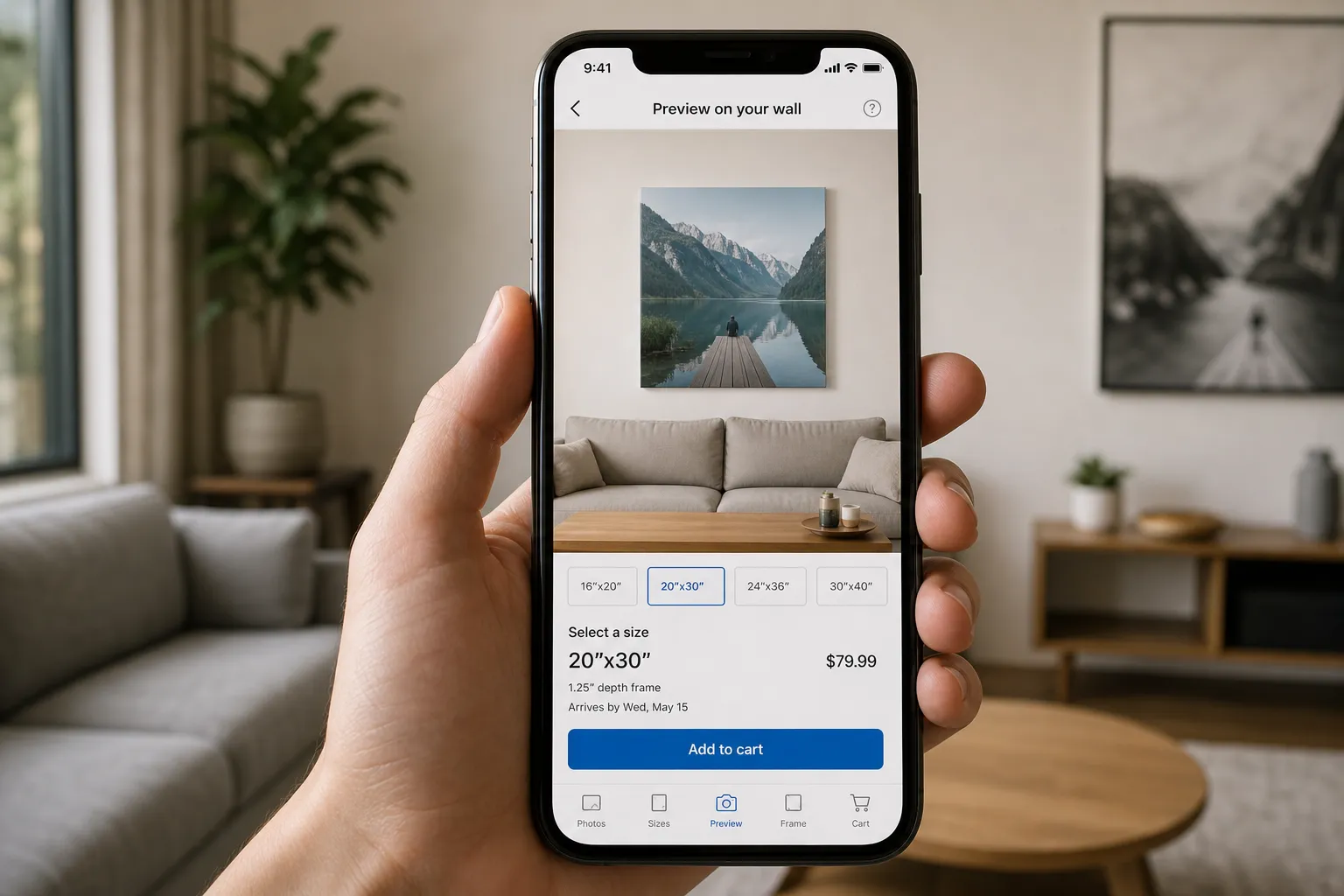
Media Rex Alliance aligns tightly with this shift through a browser-based, mobile-first experience that requires no app download. Projects can sync locally and in the cloud, letting users start on one device and finish on another - a major improvement over rigid legacy editors.
Why this matters for conversions
Every extra tap, login requirement, or confusing tool increases abandonment. A mobile-native flow does not just improve usability; it directly supports faster purchase decisions.
2. AI-Assisted Creation Replaces Complex Design Tools
The old web-to-print model assumes users want to design. Most do not. They want results.
In 2026, the strongest platforms will not ask customers to master layout controls. They will let them describe what they want:
“Turn this family photo into a warm 24x36 canvas for a living room.”
“Create a black-and-white framed enlargement with a museum-style border.”
“Make a nursery wall print with soft neutral tones.”
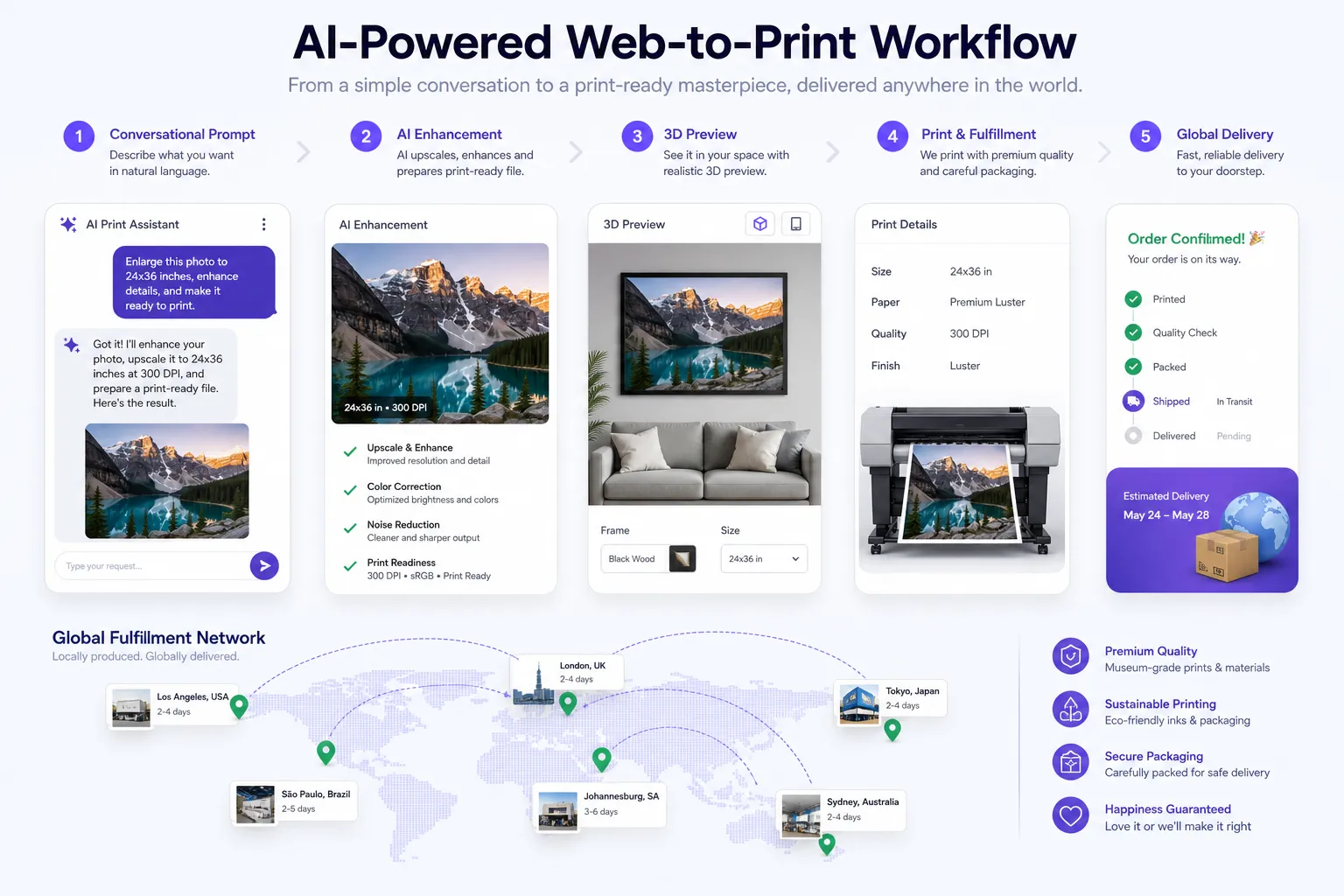
That is where conversational AI becomes transformational. Media Rex Alliance turns prompts into ready-to-print products quickly, removing the biggest source of hesitation in print commerce: the design burden.
Content gap competitors rarely address
Most competitor roundups evaluate how easy a site is to navigate. Very few discuss the next leap: removing the editor entirely for many users and replacing it with AI-guided creation.
That matters for:
Small studios that want to sell premium wall art without building a custom editor
Photographers who want clients to order enlargements more easily
Photo book companies expanding into high-margin wall decor
Regional print businesses that need a modern frontend fast
3. Photorealistic 3D and AR Previews Build Buyer Confidence
One of the biggest blockers in large-format print purchases is uncertainty. Buyers ask:
Will this size feel too small?
Will the frame suit my room?
Will acrylic look too glossy?
Will the crop cut off key details?
Static thumbnails do not answer those questions well. In 2026, realistic 3D previews and AR room placement are becoming essential for high-intent enlargement purchases.
Why previews change the buying decision
When a shopper can visualize a 20x30 framed print on their own wall, the product becomes more tangible. Confidence rises. Returns decrease. Premium upgrades become easier to justify.
Media Rex Alliance supports photorealistic 3D and immersive AR previews so customers can validate their choices before ordering. For businesses, that means fewer support questions and stronger average order value.
4. Premium Materials Win Over Basic Paper Prints
The future of photo enlargements is not just larger paper prints. It is a broader premium decor category.
Today’s customers are increasingly comparing finishes as much as they compare sizes. They want the print to fit the room, not just the image.
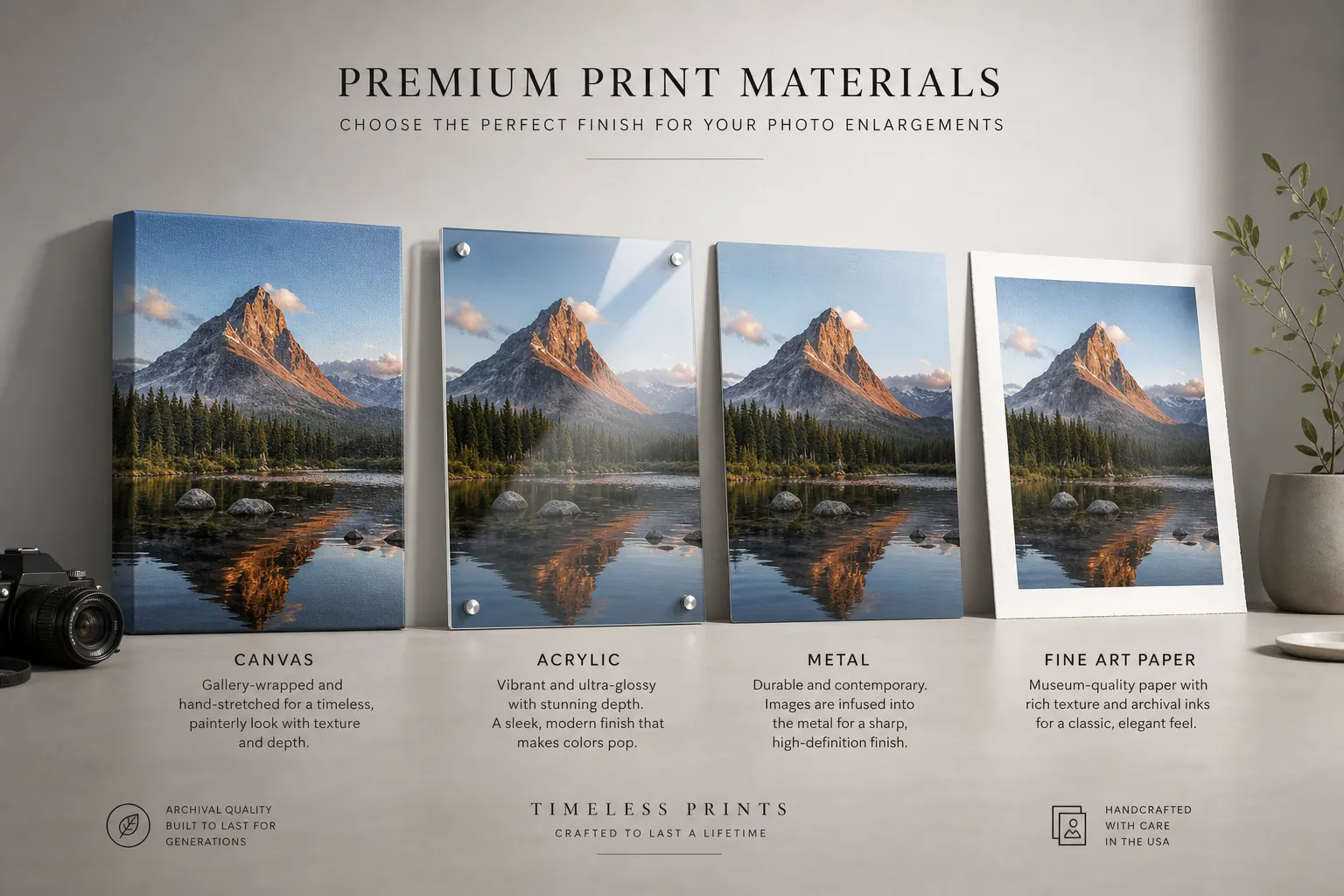
Most in-demand enlargement materials in 2026
Material | Best For | Buyer Appeal | Business Advantage |
|---|---|---|---|
Fine art paper | Portraits, wedding photos, black-and-white work | Archival feel, refined texture | Strong premium positioning |
Canvas | Family photos, lifestyle decor | Warm, approachable, home-friendly | Popular upsell with broad appeal |
Acrylic | Vivid travel, modern interiors, bold color | Glossy depth and luxury finish | High-margin visual impact |
Metal | Commercial, contemporary, high-contrast images | Sleek, durable, modern aesthetic | Great for design-conscious buyers |
What businesses should learn from this trend
The most successful online print brands will merchandise enlargements as decor experiences, not commodity prints. That means substrate education, visual previews, and guided recommendations should be part of the buying flow.
5. Image Intelligence Becomes a Competitive Advantage
As more customers upload phone photos, platforms need to do more quality validation before checkout. In the past, many print sites let customers proceed with poor files and only showed a vague warning.
That is not enough anymore.
What smarter enlargement platforms now do
Detect low-resolution images before production
Recommend ideal print sizes based on file quality
Suggest crop-safe layouts
Improve exposure and tonal balance automatically
Flag risky edge cuts in framed formats
This is one of the clearest opportunities in the market. Competitor content may mention “good print quality,” but rarely explains the operational intelligence required to deliver that consistency at scale.
For brands using Media Rex Alliance, AI-led product creation and automated layout generation can dramatically reduce file-related friction while preserving a premium brand feel.
6. White-Label Experiences Are Replacing Generic Storefronts
This trend matters most to the B2B side of the market.
Print businesses increasingly want to sell photo enlargements online without sending customers to a third-party marketplace or investing heavily in custom software. They want a branded experience under their own domain, with their own design language and customer journey.
Why white-label matters in 2026
A white-label AI print platform helps businesses:
Maintain brand trust
Own customer relationships
Launch faster
Reduce development costs
Introduce premium products without rebuilding infrastructure
Media Rex Alliance is specifically designed for this model. It integrates into existing storefronts or apps, supports full visual customization, and gives businesses a scalable path to modernize without starting from scratch.
7. On-Demand Production Beats Inventory-Heavy Models
Large-format prints can create inventory risk, especially when businesses are experimenting with materials, frame styles, and personalized formats. The smarter model is on-demand production connected to automated fulfillment.
Benefits of the on-demand approach
Legacy Model | Modern On-Demand Model |
|---|---|
Higher inventory exposure | Lower stock risk |
Manual order routing | Automated fulfillment |
Slower SKU expansion | Faster product experimentation |
More overhead | Leaner operations |
Harder to scale globally | Easier access to distributed print networks |
Media Rex Alliance supports this shift through an automated fulfillment pipeline and a global network of premium printers. That gives startups and enterprise print companies alike a more efficient way to scale without tying up capital in stock and internal complexity.
8. Personalization Is Expanding Beyond Cropping and Text
Traditional personalization meant maybe choosing a frame, adding a caption, or selecting matte versus gloss. In 2026, personalization is becoming more contextual and story-driven.
New personalization expectations
Customers increasingly want:
Style-aware recommendations
AI-generated layout variations
Room-based format suggestions
Occasion-driven product bundles
Framing and finish options matched to interior aesthetics
The print experience is becoming more like curated commerce. The brands that win will not merely offer options - they will guide decisions intelligently.
9. Faster Time-to-Order Is Becoming a Core KPI
The best platforms in this space are optimizing for one thing: reducing the time between “I should print this” and “Order placed.”
That means fewer unnecessary design decisions, better defaults, stronger previews, and less operational confusion. Media Rex Alliance is especially relevant here because it transforms a simple prompt into a print-ready product quickly, helping businesses shorten the path from inspiration to purchase.
A simple framework for reducing friction
Let the customer describe the outcome
Auto-generate a strong first version
Show a realistic preview
Offer only meaningful refinements
Route to production automatically
That is the modern web-to-print playbook.
How to Evaluate an Online Photo Enlargement Experience in 2026
For buyers and businesses alike, not all platforms are keeping up. Use this framework to separate outdated tools from future-ready solutions.
Evaluation checklist
Capability | Why It Matters | What Best-in-Class Looks Like |
|---|---|---|
Mobile usability | Most photos originate on phones | Full browser-based flow, no app required |
Upload intelligence | Prevents bad print outcomes | Resolution checks and size recommendations |
Preview quality | Reduces hesitation | 3D and AR product visualization |
Design assistance | Speeds ordering | AI-generated layouts from prompts |
Brand flexibility | Critical for print businesses | Fully white-label deployment |
Fulfillment model | Impacts efficiency and margins | On-demand global production network |
Cross-device continuity | Supports modern shopping behavior | Local and cloud sync |
Best Use Cases for Photo Enlargements Online in 2026
The market is broadening fast. Enlargement workflows now support multiple high-value segments.
For photographers
Offer premium client upsells with less manual back-and-forth and a more polished ordering experience.
For small studios
Launch branded wall art sales without hiring a software team or maintaining complex design infrastructure.
For new print-on-demand brands
Test premium enlargement products with low overhead and faster time to market.
For mid-size and regional print players
Modernize legacy ordering flows and improve conversion with AI-assisted creation and realistic previews.
For established photo book companies
Expand into high-margin wall decor using the same customer base, but with a more premium and visual-first journey.
What Consumers Will Care About Most in 2026
If you are creating or merchandising enlargements, these are the buying triggers that matter most:
“Will it look premium in my space?”
“Can I trust this photo at that size?”
“Can I order this from my phone in minutes?”
“Do I need to design it myself?”
“Can I see it before I buy?”
“Will the brand feel trustworthy and polished?”
The brands that answer those questions early will outperform generic print experiences.
Where the Market Is Headed Next
The future of photo enlargements online is not just about better printers. It is about smarter interfaces, lower-friction creation, more premium visualization, and more scalable fulfillment infrastructure.
Expect the category to keep moving toward:
Prompt-based creation
AI-assisted curation
Stronger image-quality automation
AR-led merchandising
Premium material discovery
Branded white-label storefronts
Distributed global production
For businesses, this is a major opening. Many traditional photo print providers still compete on selection and price alone. The bigger opportunity is to compete on speed, confidence, personalization, and experience.
Final Verdict: The Winners in 2026 Will Sell Confidence, Not Just Prints
Online enlargement buyers do not simply want a bigger version of a photo. They want a premium, personalized, low-risk result that fits their space and feels worth displaying. That is why AI, mobile-first design, photorealistic previews, and on-demand fulfillment are reshaping the category.
Media Rex Alliance gives print businesses the infrastructure to meet those expectations without building everything themselves. Its conversational AI creation engine, white-label deployment, browser-based experience, 3D and AR previews, cloud-sync workflow, and automated global fulfillment make it a compelling platform for any brand that wants to modernize how customers create and buy photo enlargements.
If your business is still relying on outdated editors, generic storefronts, or slow manual workflows, 2026 is the year to upgrade. Media Rex Alliance offers a faster path to a more scalable, conversion-focused future.
FAQ
What are the major photography trends for 2026?
The biggest trends include mobile-first ordering, AI-assisted product creation, premium wall-art materials, and AR/3D previews that help buyers visualize prints before purchase. The market is moving toward faster, more personalized, and lower-friction experiences.
What are the best photo styles for 2026?
Styles with strong emotional and decorative appeal are leading, including gallery-style portraits, black-and-white enlargements, modern acrylic prints, and warm lifestyle photography for home interiors. Buyers increasingly want images that function as both memories and decor.
What is the best website for online photo printing?
The best solution depends on whether you are a consumer or a print business, but the strongest platforms now combine high print quality, easy mobile ordering, realistic previews, and personalization. For businesses building branded experiences, Media Rex Alliance stands out for its white-label AI-powered web-to-print capabilities.
Is there a better site than Shutterfly?
For some users, yes - especially if they want a more premium, more visual, or more modern experience. In 2026, platforms that offer AI-assisted creation, better materials, and AR preview tools can outperform traditional photo-printing sites on convenience and conversion.
Which photo trend is going on now?
The current standout trend is turning everyday smartphone photos into premium wall decor through fast, mobile-first ordering. Buyers also expect smarter tools that reduce effort, such as AI layout help and realistic product previews.
What type of photography is in high demand?
Family photography, pet photography, travel imagery, wedding portraits, and lifestyle interior-ready shots are all in strong demand for enlargement products. Images that translate well into framed wall art or premium large-format prints tend to perform best.