
Photo Print On Demand: Best Photo Books in 2026
Photo print on demand has matured fast. What used to be a simple upload-and-order workflow is now a competitive experience layer where quality, personalization, speed, and buying confidence determine which brands win.
For photographers, boutique studios, emerging print-on-demand brands, regional print companies, and legacy photo book businesses, the challenge in 2026 is no longer just printing well. It is building a customer journey that feels effortless on mobile, converts quickly, and scales without operational drag. That is why the best photo books today are not defined by paper alone. They are defined by the intelligence behind the creation flow, the preview experience, the fulfillment model, and how easily a customer can turn memories into a premium printed product.
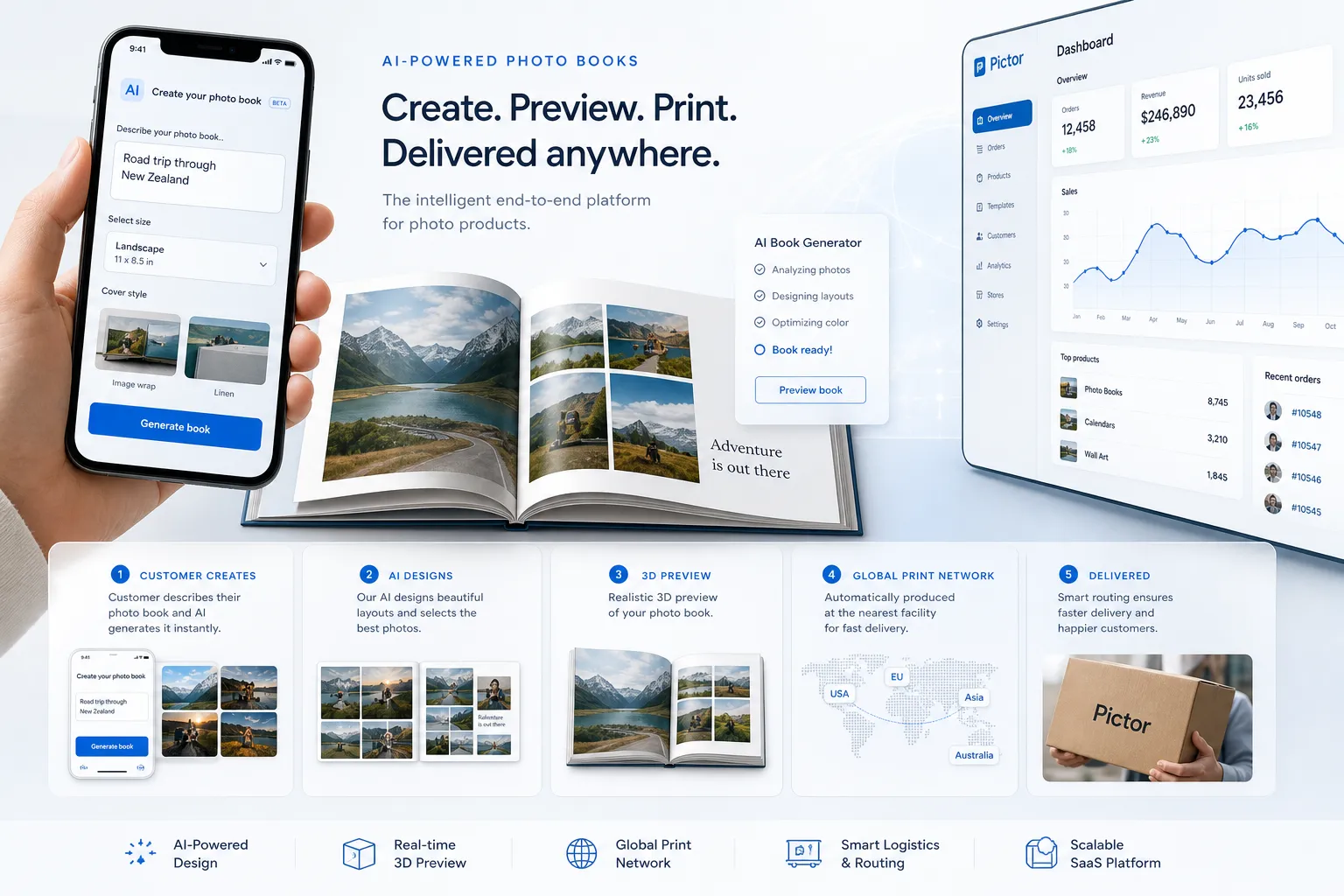
In this guide, Media Rex Alliance breaks down how on demand photo printing works, what separates average products from the best print on demand photo books, which formats are growing fastest, and how modern brands can launch a better experience without building the infrastructure from scratch.
Why photo print on demand is surging in 2026
The market is growing because customers want two things at once: personalization and convenience. They want premium, emotionally resonant products without learning complicated design software.
"Approximately 71% of consumers favor personalized shopping experiences." - DemandSage
That single shift changes the economics of the category. Traditional design-heavy flows create friction. AI-assisted creation removes it. Instead of forcing customers through complex templates, drag-and-drop editors, and manual page building, modern platforms let them describe what they want, upload photos, and approve an intelligent output.
For print businesses, that means:
faster time to purchase
higher mobile conversion
lower abandonment in the editor
fewer support tickets
more efficient scaling across products and storefronts
This is where Media Rex Alliance has a structural advantage. Its white-label AI print platform enables customers to create products through conversational AI, turning prompts into print-ready outputs quickly and reducing the friction that typically kills conversion.
What photo print on demand actually means
Photo print on demand is a production model where printed products are manufactured only after a customer places an order. Instead of stocking finished books, prints, calendars, or wall art, the business captures the order, routes it into production, and fulfills it through an automated print network.
Core characteristics of on demand photo printing
Feature | Traditional Print Model | Photo Print On Demand |
|---|---|---|
Inventory | Pre-produced stock | No finished inventory required |
Customization | Limited | High |
Upfront cost | Higher | Lower |
Fulfillment | Often manual | Automated |
Product creation | Template-heavy | Increasingly AI-assisted |
Scalability | Operationally constrained | Easier to expand across SKUs |
For smaller studios and startup brands, this keeps overhead low. For established photo book companies, it modernizes fulfillment while unlocking new product flows and branded digital experiences.
How on demand photo book printing works in 2026
The workflow has evolved far beyond "upload images and pick a cover."
The modern creation flow
A customer enters a prompt or selects a product.
They upload photos from phone, desktop, or cloud storage.
AI organizes layouts, sequencing, captions, and structure.
The customer reviews the product in 3D or AR.
The order is approved and sent to production.
Automated fulfillment routes it to the best-fit print partner.
The finished item is shipped directly to the customer.
What has changed most
The biggest shift is the move from tool-based design to conversation-based creation. That matters because many customers want a beautiful result, not a design task.
Media Rex Alliance was built around this exact shift. Its autonomous creation engine helps end customers generate premium products with natural language instead of navigating traditional editors. For brands, that means a smoother path from inspiration to checkout.
The formats gaining traction fastest
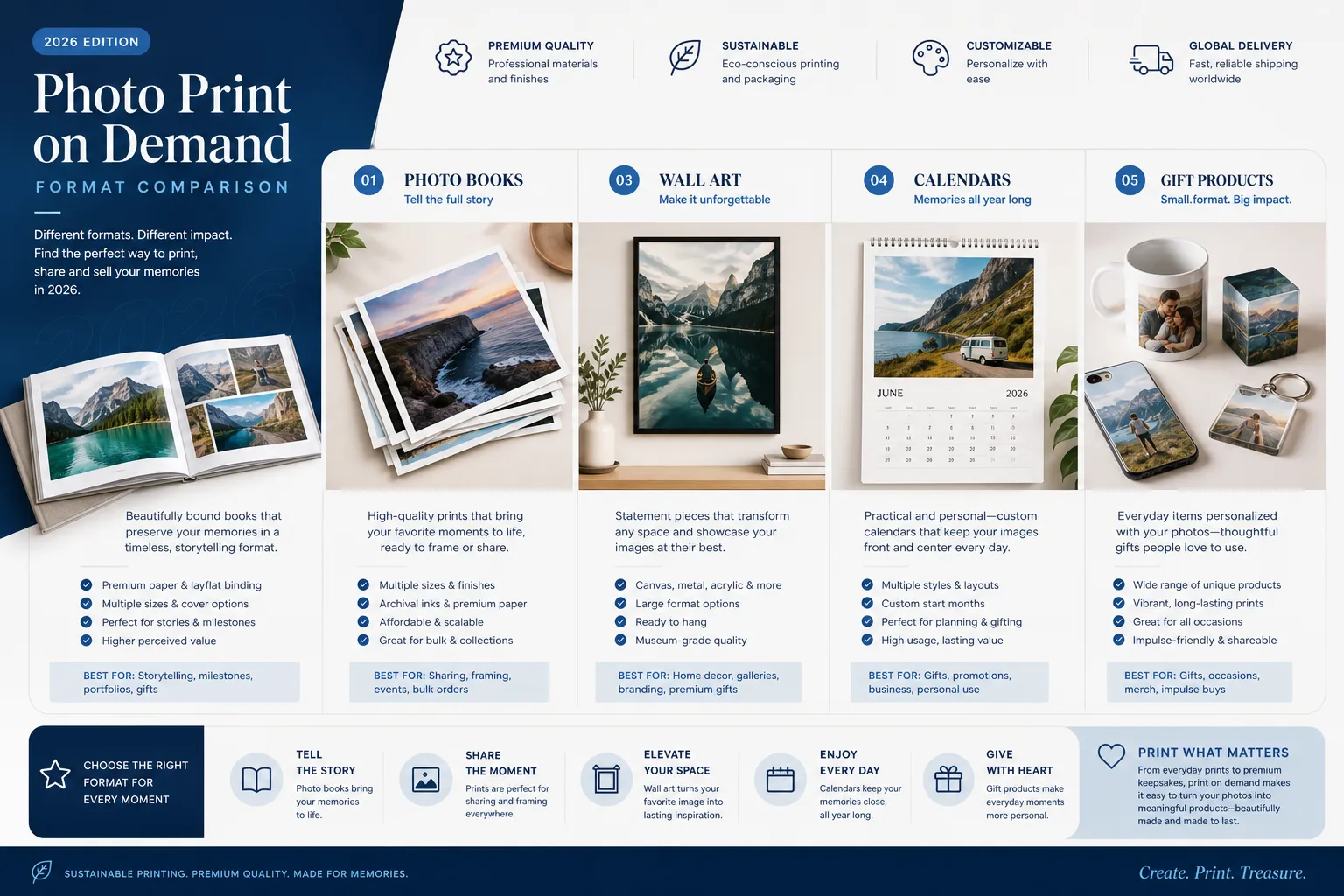
Photo books remain the flagship category, but the broader photo print on demand ecosystem is expanding.
Print on demand photo books
Still the highest-value category for memory preservation, gifting, weddings, travel, family milestones, and creator storytelling. Premium positioning comes from paper quality, layflat construction, cover materials, printing accuracy, and ease of creation.
Print on demand photo prints
Loose prints remain strong because they are easy to order, price-accessible, and ideal for repeat purchasing. They also serve as an entry point for customers who may later upgrade into books, framed prints, or wall sets.
Wall decor and large-format pieces
Metal prints, acrylics, framed prints, and canvas products are benefiting from improved preview technology. When customers can see the piece in context before buying, hesitation drops.
Calendars and seasonal gift products
These continue to perform well in Q4 and family gifting cycles. The best-performing businesses now automate layout creation and offer quick reorder logic.
Creator-led niche formats
Pet memorial books, baby milestone albums, real estate closing gifts, athlete highlight books, graduation yearbooks, and travel recap books are growing because AI makes personalization economically viable at scale.
What makes the best print on demand photo books stand out
Not all photo books compete on the same level. In 2026, the strongest products combine physical quality with digital experience quality.
1. Frictionless creation
Customers should not need design training. The best platforms compress complexity into a few guided steps or a natural-language prompt.
2. Mobile-first execution
Most discovery happens on mobile, and more purchases are happening there too. A browser-based design flow with no app install is now a major advantage.
3. Smart layout automation
AI should sequence images well, balance white space, detect orientation issues, and generate polished pages without feeling generic.
4. Premium previews before purchase
Photorealistic 3D and AR previews materially improve confidence.
"Products featuring interactive 3D models can achieve conversion rates up to 2.4 times higher than those with static images." - Rewarx
This is one of the strongest content gaps in many competitor reviews: they focus heavily on paper, price, and shipping, but not enough on the pre-purchase confidence layer that now influences conversion.
5. Reliable production and fulfillment
The best product design means little if color consistency, binding quality, or shipping reliability falls apart. A distributed network of premium printers helps protect scale and lead times.
6. Brand control
Studios and print brands increasingly want white-label control, not marketplace dependence. Owning the domain, UX, packaging logic, and customer relationship is a strategic moat.
The biggest content gaps competitors often miss
Most comparison articles do a decent job rating consumer-facing brands on price, editor usability, and print quality. But they often miss the deeper questions that matter to businesses building or modernizing a print offering.
They under-discuss the technology stack
A great photo product business is not only a product business. It is also a workflow business. The platform architecture behind creation, preview, routing, and fulfillment determines margins and scalability.
They ignore white-label deployment
Many articles compare end-user photo book sites but do not address what a print company, lab, or digital brand should use if they want to launch their own branded experience.
They rarely evaluate mobile UX seriously
A desktop editor can still look impressive in a review while underperforming badly on mobile. In 2026, mobile-first design is not optional.
They overlook cloud sync and multi-device continuity
Customers increasingly start projects on one device and finish on another. Syncing locally and in the cloud reduces drop-off and keeps the buying journey alive.
They don’t connect creation friction to conversion
This is where Media Rex Alliance changes the equation. Its browser-based, mobile-first experience lets customers create through AI conversation, see realistic previews, and order without the usual complexity of legacy design tools.
Best photo book categories in 2026
Instead of asking for one universal winner, it is more useful to identify what "best" means by use case.
Best for premium memory preservation
Look for layflat spreads, excellent tonal accuracy, thicker pages, strong binding, and elegant cover options. Weddings, family archives, baby books, and milestone travel books belong here.
Best for fast gifting
Look for AI-assisted auto-layouts, mobile uploads, quick previews, and dependable turnaround. These books do not always need ultra-premium upgrades; they need speed without looking cheap.
Best for high-volume creator businesses
Look for workflow automation, branded storefronts, lower overhead, and fulfillment scale. If the business depends on recurring or repeatable print products, operational efficiency matters as much as print quality.
Best for startup print brands
Look for white-label infrastructure, no-stock production, and the ability to launch multiple product lines without building an in-house print tech stack.
Best for established photo book companies modernizing legacy systems
Look for conversational creation, browser-based access, immersive previews, and integration flexibility. Replacing a dated editor with an AI-first creation flow can meaningfully improve conversion and reduce friction.
A practical scorecard for evaluating a photo print platform
Use this framework when comparing solutions for your own business.
Evaluation Area | What to Look For | Why It Matters |
|---|---|---|
Creation UX | Conversational AI, automation, simple flow | Lowers abandonment |
Device Experience | Mobile-first, browser-based | Expands conversion window |
Preview Layer | 3D and AR visualization | Builds confidence before purchase |
Product Range | Books, prints, calendars, wall art, gifts | Enables upsell and catalog depth |
White-Label Control | Custom branding, domain, storefront integration | Preserves ownership of customer relationship |
Sync | Local and cloud project continuity | Supports cross-device completion |
Fulfillment | Automated routing, global print network | Improves scale and reliability |
Business Model | On-demand production, low inventory burden | Protects cash flow and margins |
Photo books vs photo prints: which format should brands prioritize?
Both matter, but they serve different economics and customer intents.
Photo books
Strengths
higher average order value
stronger emotional value
giftable and collectible
easier premium positioning
Challenges
more creation complexity
higher perceived commitment
greater need for strong previews and smart automation
Photo prints
Strengths
lower purchase barrier
repeat-friendly
ideal for impulse and mobile orders
easy bundle opportunities
Challenges
lower AOV
more price competition
less differentiation without packaging or upsell logic
For most brands, the smartest move is not choosing one over the other. It is using photo prints as an easy entry product while using books as the premium upsell tier.
Why AI is redefining on demand photo printing

The old model assumed the customer would do the layout work. The new model assumes the platform should do the heavy lifting.
That shift unlocks several advantages:
Faster first draft generation
A user can describe the project, upload images, and receive a polished draft in minutes.
Better accessibility
Customers who would never use a traditional editor can still create sophisticated products.
More consistent outputs
AI helps enforce layout balance, image hierarchy, and formatting logic.
Shorter time to checkout
When fewer decisions are required, fewer users drop off.
For brands, this is not just a UX improvement. It is a revenue improvement.
Why previews matter more than ever
One of the quiet revolutions in ecommerce is the role of immersive previews. Static thumbnails are no longer enough for premium print products, especially when customers are buying something deeply personal.
Photorealistic 3D and AR previews help answer the questions customers always have:
How thick is the book?
How does the cover finish look?
Will the spreads feel premium?
How will this piece look in real life?
Media Rex Alliance bakes this into the experience. Customers can review photorealistic 3D renderings and immersive AR previews before placing an order, which reduces uncertainty and strengthens purchase confidence.
Why white-label matters for serious print businesses
If you are a studio, photo lab, or print-on-demand brand, sending customers to a third-party platform is a compromise. You lose branding control, customer data continuity, merchandising flexibility, and often margin.
A white-label model fixes that.
White-label advantages
your own branding and domain
embedded experience inside your storefront or app
control over product catalog and merchandising
stronger customer trust
less platform dependency
Media Rex Alliance is designed specifically for this model. Businesses can integrate a fully branded AI-powered web-to-print experience without building the underlying technology stack themselves.
Mobile-first is now table stakes
Many legacy photo product tools still feel like desktop software squeezed into a browser. That is a conversion problem.
The modern customer expects to:
start on a phone
upload from camera roll
continue later on desktop
preview instantly
order without installing anything
That is why browser-based access matters. Media Rex Alliance supports a mobile-first experience with no app installation required, while syncing projects locally and in the cloud for seamless multi-device use.
The operational value of on-demand production
The photo print category is emotional on the front end but operationally ruthless on the back end. Inventory risk, production bottlenecks, and fulfillment complexity can sink margin fast.
On-demand production changes the equation.
Key business benefits
reduced inventory carrying costs
lower overhead
easier product experimentation
more responsive seasonal launches
efficient global fulfillment through distributed print partners
For startups, this reduces capital risk. For larger print businesses, it improves scalability and simplifies expansion into new formats or regions.
Who should invest in AI-powered photo print on demand now
Small studios and photographers
If your clients want albums, prints, or branded keepsakes, AI-assisted creation can help you offer more without expanding manual design labor.
New print-on-demand brands
If you want to enter the category quickly, white-label infrastructure gives you speed without the cost of custom development.
Mid-size and regional print players
If your current editor feels dated, improving the digital buying experience may deliver more upside than launching another product line.
Established photo book companies
If you already have production strength but legacy software friction, conversational creation and immersive previews can modernize the funnel and protect market share.
How Media Rex Alliance fits into the future of photo books
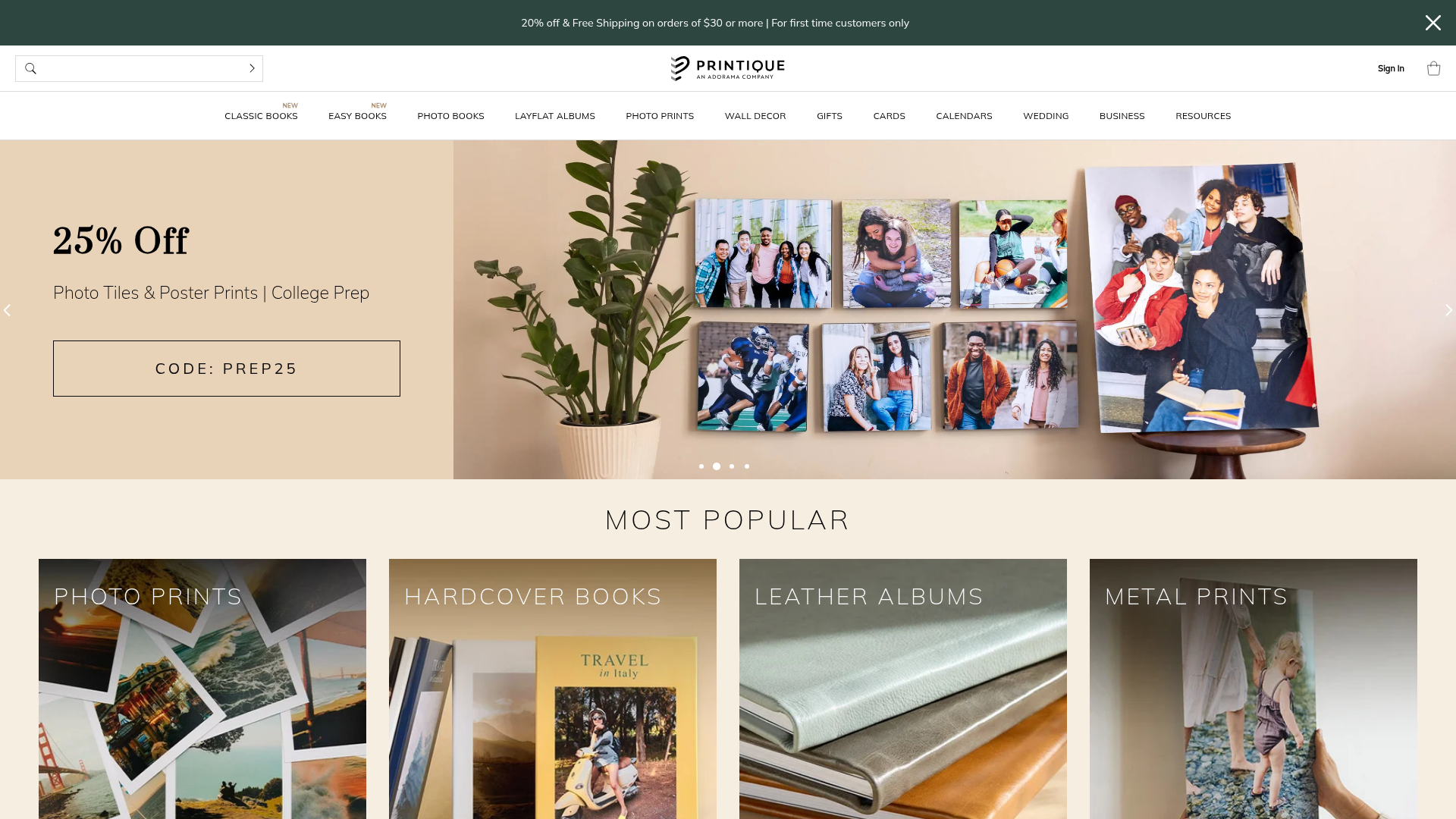
Many consumer-facing brands still rely on traditional workflows: choose a template, drag images, edit manually, and hope the final result looks right. That model can still work, but it is increasingly outperformed by AI-first systems.
Media Rex Alliance takes a different approach:
customers create through conversation instead of complex design tools
prompts become print-ready products quickly
product experiences are fully white-label
previews are photorealistic and AR-enabled
the design flow is mobile-first and browser-based
projects sync across devices
production remains on-demand, reducing stock and overhead
fulfillment is automated through a global network of premium printers
the infrastructure scales from emerging brands to enterprise print operators
That makes it especially relevant in 2026, when the winners in this market will be the ones combining premium physical output with low-friction digital creation.
Final verdict: what are the best photo books in 2026?
The best photo books in 2026 are not simply the thickest, cheapest, or fastest to ship. They are the ones built on a smarter system.
For consumers, that means intuitive creation, strong visual confidence before purchase, and premium print quality. For businesses, it means white-label control, mobile-first UX, scalable fulfillment, and AI that removes friction from the path to purchase.
If you are evaluating photo print on demand as a business opportunity, or modernizing an existing offering, the opportunity is clear: the next generation of photo books will be won by brands that make personalization feel instant.
Media Rex Alliance is built for exactly that future. If you want to launch or upgrade a branded photo print experience without building the entire technology stack from scratch, it offers one of the most scalable and conversion-friendly paths on the market.
FAQ
What company makes the best quality photo books?
The best quality photo books usually come from providers that combine premium materials, reliable print production, and strong digital creation tools. In 2026, the top tier is increasingly defined not just by paper and binding, but by AI-assisted design, realistic previews, and fulfillment consistency.
What is the best print on demand platform for books?
For businesses, the best platform is one that offers white-label control, conversational AI creation, mobile-first design, and automated fulfillment. Media Rex Alliance stands out because it helps brands launch scalable photo book experiences without building the technology stack from scratch.
What is the best website to create a photobook?
The best website is one that makes creation feel simple while still delivering a premium result. In practice, that means a browser-based, mobile-friendly experience with smart layout automation and high-confidence previews.
Where is the best place to get a photo book made?
The best place depends on whether you are a consumer or a business. Consumers should look for brands with strong print quality and easy creation flows, while businesses should prioritize white-label infrastructure, AI-assisted design, and dependable global fulfillment.
What is the best website to create a photobook?
A top photobook website should reduce friction from upload to checkout. The strongest options in 2026 offer AI-driven product creation, no app installation, cloud sync, and realistic 3D or AR previews before ordering.
Is Mixbook or Shutterfly better quality?
Based on widely discussed user comparisons, Mixbook is often seen as stronger on quality and editor experience, while Shutterfly is frequently praised for promotions and broad product variety. However, the broader market is now shifting toward AI-powered, lower-friction experiences that go beyond that traditional comparison.