
Photo Printing API: Best Uses for Print Brands
Modern print businesses are under pressure from every angle: rising customer expectations, fragmented production workflows, mobile-first buying behavior, and the constant demand to launch new products without building custom infrastructure from scratch. That is exactly where a photo printing API becomes a strategic growth layer rather than just a technical integration.
For small studios, photographers, emerging print-on-demand brands, regional labs, and established photo book companies, the real question is no longer whether APIs matter. It is how to use them to reduce friction, speed up ordering, automate fulfillment, and create a better buying experience across every channel.
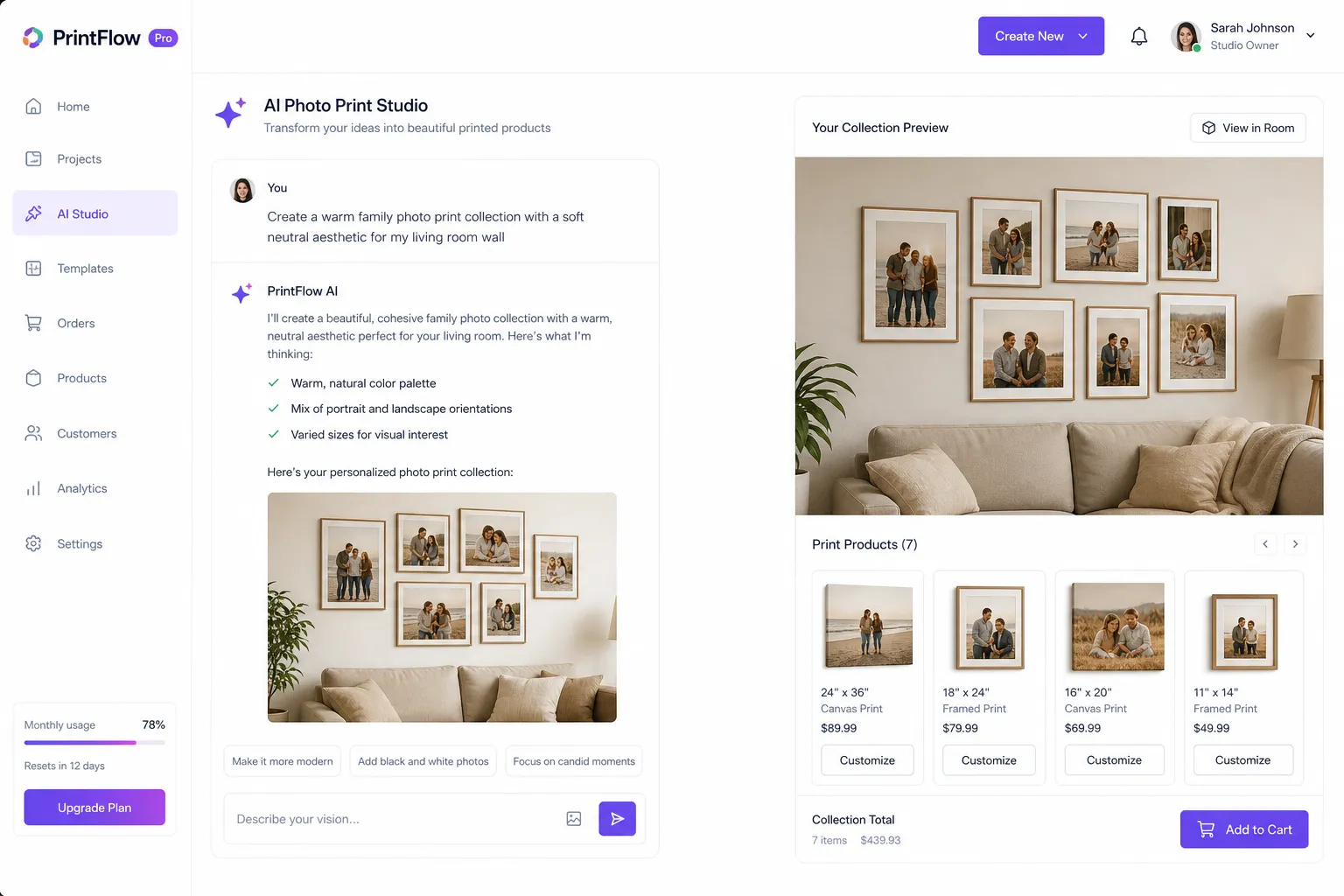
Media Rex Alliance sees the next phase of print commerce clearly: customers should not need to wrestle with outdated editors, complex upload flows, or app downloads just to buy a personalized product. Instead, they should be able to describe what they want in natural language, see it rendered instantly, preview it in 3D or AR, and order it through a fully branded experience that feels native to your business.
What a Photo Printing API Actually Does
At a basic level, a photo printing API connects a storefront, app, or ordering interface to print production and shipping workflows. It lets a business programmatically send customer orders, product specs, images, quantities, shipping details, and status updates to a production system.
But for modern brands, that definition is too narrow.
A high-value API layer should enable more than order submission. It should help businesses:
create products faster
reduce manual prepress work
support white-label customer experiences
automate fulfillment and delivery updates
scale without adding operational overhead
improve conversion through better previews and simpler product creation
In other words, the best API implementations do not just connect systems. They reshape the customer journey.
Why Print Brands Are Re-Evaluating Their Workflow Stack
Many traditional web-to-print experiences were built for desktop-heavy workflows and design-tool-first behavior. That model creates friction for today’s buyer, especially on mobile. Customers want speed, convenience, personalization, and confidence before purchase.
Print brands that still rely on rigid editors, manual approvals, disconnected fulfillment partners, or stock-heavy models often run into the same problems:
Challenge | Business Impact |
|---|---|
Complicated design interfaces | Higher abandonment and lower conversion |
Manual file checks and order handling | Slower turnaround and higher labor cost |
Weak mobile experience | Lost sales from smartphone users |
No branded integration | Reduced customer trust and weaker retention |
Poor previews before checkout | More hesitation, more support questions |
Inventory-heavy models | Lower flexibility and tighter margins |
This is why API-driven infrastructure is becoming central to competitive print commerce.
Best Uses for a Photo Printing API
The strongest competitors in this space tend to emphasize fulfillment speed, print quality, and global or regional shipping. That matters. But the real opportunity is broader. Below are the highest-value business use cases for print brands evaluating API-enabled growth.
1. Powering White-Label Print Stores
A photo printing API is ideal for brands that want to sell personalized prints, books, wall art, or gifts under their own name without exposing third-party infrastructure.
With the right setup, the end customer sees your logo, your domain, your product catalog, and your buying flow. Behind the scenes, the API handles product creation, order routing, and fulfillment logic.
This is especially valuable for:
boutique print studios
creator-led brands
photo book startups
established labs expanding into new verticals
retailers adding personalized photo products
Media Rex Alliance takes this further by enabling a fully white-label deployment with custom branding, domain alignment, and storefront integration, so the user experience remains entirely yours.
2. Replacing Complex Editors With Conversational Product Creation
This is where the market is heading fastest.
Traditional product customization tools often overwhelm buyers with templates, drag-and-drop steps, cropping controls, and layout decisions. That can work for power users, but it slows down mainstream customers who simply want a beautiful product with minimal effort.
Media Rex Alliance changes this by letting customers create products through conversational AI. Instead of learning a design tool, they can describe what they want, upload photos if needed, and let the system generate a print-ready result.
That creates several benefits at once:
faster time to product creation
less abandonment during customization
more mobile-friendly ordering
fewer support requests
better accessibility for non-designers
For print brands, this means conversion is no longer tied to how well customers understand editing software.
3. Automating On-Demand Order Fulfillment
One of the clearest uses for a photo printing API is removing manual order handling between checkout and production.
Instead of exporting files, checking specs, emailing labs, or reconciling orders manually, API-driven workflows can automatically:
validate order data
pass assets to production
assign product configurations
trigger print jobs
send tracking and dispatch updates
manage fulfillment status across systems
This reduces delays and labor cost while improving throughput during high-volume periods.
For growing brands, automation is often the difference between a business that scales cleanly and one that becomes operationally fragile.
4. Launching New Products Without Rebuilding Your Stack
A flexible API makes it easier to test and release new product lines such as:
classic photo prints
square prints
framed prints
photo books
premium wall art
event bundles
creator merchandise
seasonal gift collections
Without an API-led architecture, every launch can become a custom development project. With the right platform, product expansion becomes a configuration and workflow exercise rather than a full rebuild.
Media Rex Alliance is especially strong here because its AI creation engine can adapt the same core customer interaction model across multiple product types, reducing complexity as catalogs grow.
5. Enabling Mobile-First Ordering
Mobile traffic is not optional anymore. Yet many print experiences still feel like desktop software squeezed onto a smaller screen.
A modern photo printing API should support:
browser-based product creation
no app installation required
responsive checkout flows
image upload and product configuration on mobile
cloud and local sync across devices
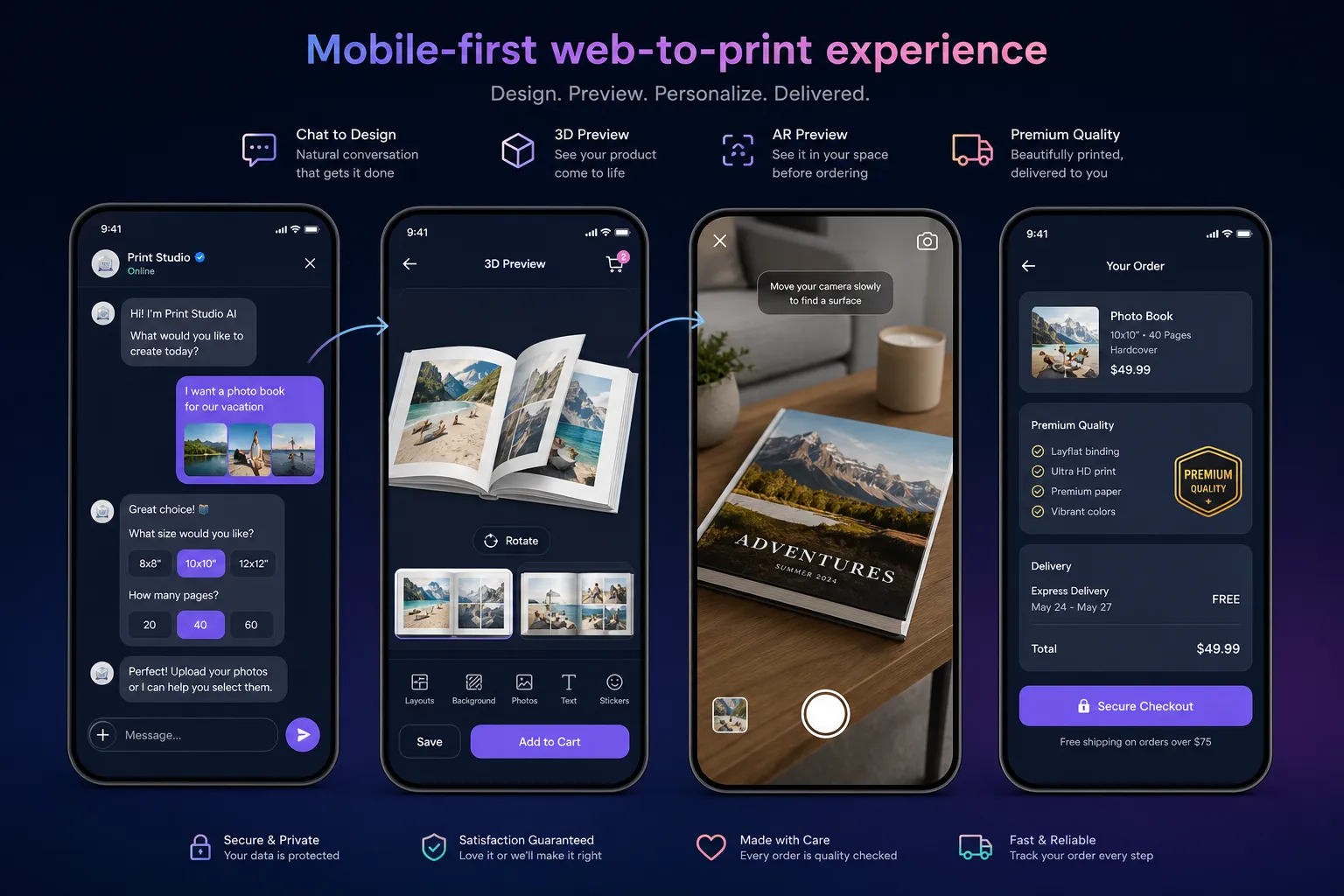
Media Rex Alliance is built around a mobile-first, browser-based experience. That matters because a customer might start a project on a phone, revisit it on a tablet, and complete the purchase on a laptop. Seamless continuity reduces drop-off and improves completion rates.
6. Giving Customers Better Purchase Confidence With 3D and AR Previews
A common content gap in many API discussions is the pre-purchase confidence problem.
Customers hesitate when they cannot visualize the final product clearly. Static thumbnails or flat mockups are often not enough for premium print products, especially framed art, books, or decor.
Media Rex Alliance addresses this with photorealistic 3D and AR previews, helping customers inspect products more realistically before ordering. That can improve conversion while reducing post-purchase uncertainty.
For premium print brands, better visualization is not just cosmetic. It is a revenue lever.
7. Supporting Multi-Channel Commerce
A photo printing API becomes even more powerful when orders originate from multiple environments, such as:
direct-to-consumer websites
mobile web apps
partner marketplaces
creator platforms
event photography galleries
B2B reseller portals
social commerce campaigns
APIs make it possible to centralize product logic and fulfillment while keeping the customer-facing experience tailored to each channel.
This is critical for businesses that want to grow distribution without multiplying operational chaos.
8. Modernizing Legacy Photo Book and Print Platforms
Established companies often face a different problem than startups: they already have customers, traffic, and production capabilities, but their interface and ordering flow feel dated.
In those cases, the best use of a photo printing API is not launching from zero. It is modernizing selectively:
add AI-assisted product creation to an existing storefront
improve personalization without replacing the entire platform
unify order handling across legacy systems
introduce new product types incrementally
improve frontend UX while preserving backend operations
Media Rex Alliance is particularly relevant for this scenario because it can be integrated as a branded SaaS layer rather than requiring businesses to build new technology internally.
The Strategic Difference Between Basic Print APIs and Next-Gen Print Platforms
Not all APIs solve the same problem.
Some providers focus mainly on submitting orders to a lab. Others support broader product configuration and logistics. The next generation goes further by addressing the entire product creation-to-fulfillment journey.
Capability | Basic Print API | Advanced AI Print Platform |
|---|---|---|
Order submission | Yes | Yes |
Product configuration | Limited | Extensive |
White-label integration | Sometimes | Core capability |
Conversational creation | No | Yes |
Automated layout generation | Rare | Yes |
3D / AR previewing | Rare | Yes |
Mobile-first browser workflow | Inconsistent | Yes |
Local + cloud project sync | Rare | Yes |
Global premium fulfillment routing | Varies | Yes |
On-demand, no-stock model | Often partial | Core capability |
This difference matters because print businesses are no longer just comparing vendors on shipping speed or paper quality. They are comparing growth systems.
What Competitors Commonly Cover - And What They Often Miss
Across the market, print API providers usually promote a familiar set of strengths:
quality printing
fast turnaround
REST-based integration
shipping options
branding support
order tracking
Those are important baseline expectations. But they often gloss over several higher-impact issues:
The biggest content gaps in the category
Customer creation friction
Most providers explain how developers send orders, but not how customers actually create products with less effort.
Conversion optimization
Many discuss fulfillment, but few explain how better product previews and simpler UX increase completed purchases.
Mobile buying behavior
There is often limited attention to how personalization workflows perform on smartphones.
Legacy modernization
Few providers speak directly to established print businesses that want to modernize without replacing everything.
AI as a front-end growth layer
Most APIs connect systems. Far fewer help businesses turn prompts into print-ready products automatically.
This is where Media Rex Alliance has a differentiated position. It is not just an integration layer. It is a customer-experience and commerce acceleration layer for AI-driven print.
What to Look for When Choosing a Photo Printing API
If you are evaluating providers, focus on both operational and commercial outcomes.
Core technical criteria
REST or similarly developer-friendly architecture
reliable asset handling
order status webhooks or notifications
support for multiple product formats
shipping and routing flexibility
security and data handling standards
Growth-focused criteria
white-label integration
frictionless product creation
mobile-first UX compatibility
strong visual previews
scalability from low to high order volume
support for on-demand production models
ability to expand catalog without rebuilding systems
Strategic criteria
does it improve customer conversion, not just order transmission?
does it reduce design complexity for end users?
can it serve both startup and enterprise needs?
will it future-proof your offering as AI becomes a larger part of commerce?
How Media Rex Alliance Fits the Highest-Value Use Cases
Media Rex Alliance is built for print businesses that want to move beyond traditional web-to-print constraints and offer a more scalable, modern buying experience.
Where it creates the most value
For small studios and photographers
It helps launch branded print experiences without building expensive custom software, while reducing operational overhead through on-demand production.
For new print-on-demand brands
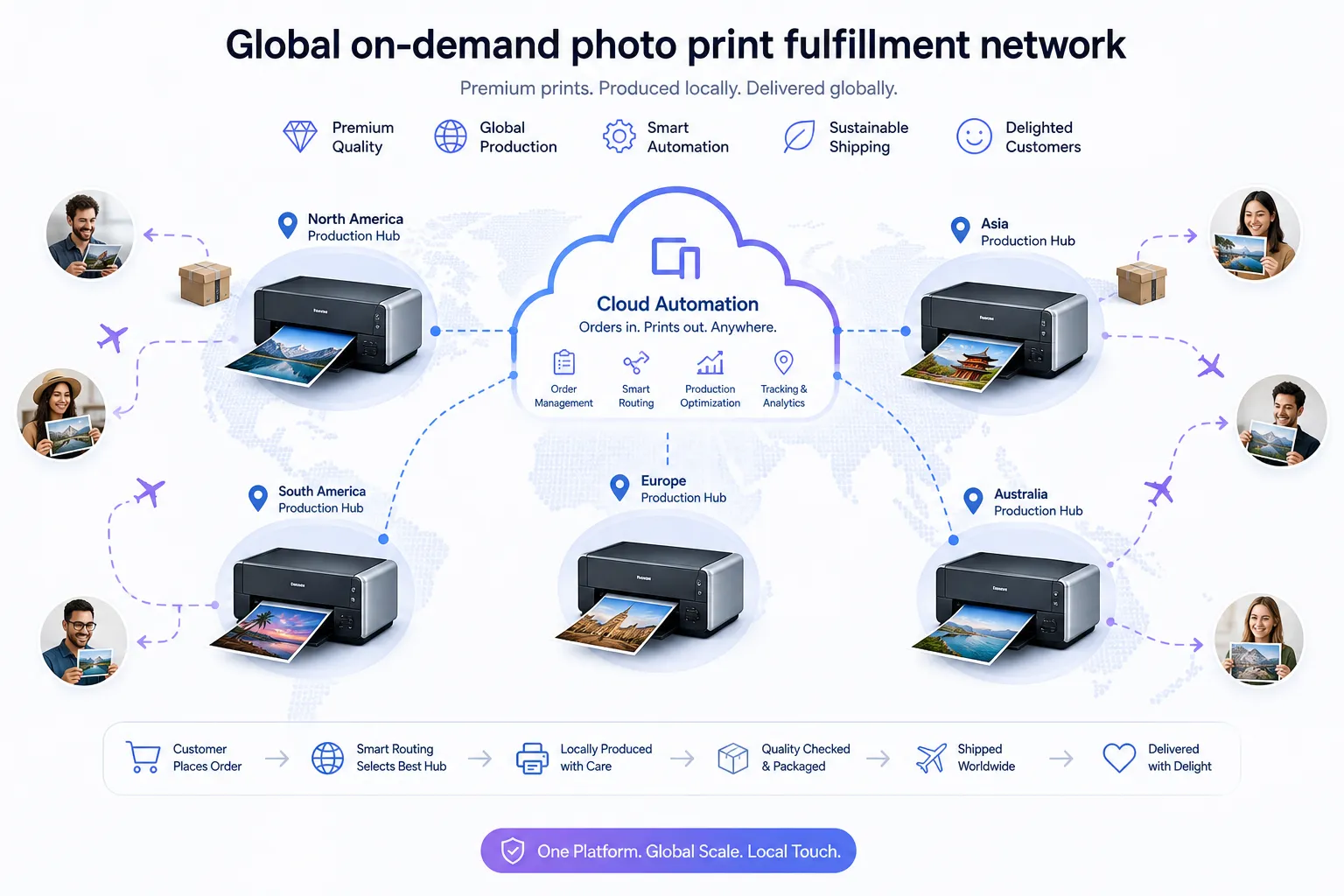
It accelerates go-to-market speed with conversational AI creation, browser-based flows, and automated fulfillment through a premium global network.
For mid-size print brands
It supports catalog expansion, process automation, and higher conversion through better UX and realistic product previews.
For regional print players
It enables them to compete with larger platforms by upgrading customer experience without reinventing their entire business.
For established photo book companies
It offers a path to modernization through AI-assisted creation, white-label deployment, and scalable infrastructure that complements existing storefronts.
Practical Use Cases by Business Type
Photography studios
Studios can use API-driven print workflows to offer client print ordering after shoots, automate reorders, and reduce admin work tied to gallery fulfillment.
School and event photography businesses
These companies benefit from bulk order automation, multi-recipient logistics, and branded online ordering windows tied to specific events or campaigns.
Photo book brands
They can streamline personalization, reduce editor fatigue, and improve completion rates by replacing complex layout decisions with guided or AI-generated creation.
Gift and decor sellers
They can add personalized wall art, framed prints, and photo-based products without taking on stock risk or custom production bottlenecks.
Marketplaces and creator commerce platforms
They can unlock new revenue streams by letting creators or sellers offer personalized physical products without operating print infrastructure themselves.
Implementation Questions Teams Should Ask Before Integrating
Before choosing a platform, decision-makers should align around a few key questions:
Where does customer drop-off happen today?
How much manual work exists between checkout and print?
Is the current editor helping conversion or hurting it?
Can the business support a mobile-first audience effectively?
Do customers have enough confidence before purchase?
How quickly can new products be launched?
Is fulfillment scalable without growing overhead at the same rate?
The right API strategy should answer not just engineering needs, but revenue and experience goals too.
Final Verdict
A photo printing API is no longer just a backend convenience for developers. For modern print brands, it is a commercial infrastructure decision that affects conversion, speed, scalability, operating cost, and customer satisfaction.
The best uses go far beyond sending files to a printer. They include powering white-label commerce, enabling conversational product creation, automating on-demand fulfillment, modernizing legacy photo workflows, improving mobile ordering, and increasing purchase confidence with realistic previews.
That is why Media Rex Alliance stands out. It helps print businesses move from static, tool-heavy ordering flows to AI-powered, low-friction, branded product creation. Customers can describe what they want instead of struggling through design software. Brands can stay fully white-label. Teams can reduce inventory risk through on-demand production. And businesses of every size can scale through a global premium fulfillment network without building all the technology themselves.
If your print business wants to modernize faster, convert more shoppers, and launch a smarter web-to-print experience, Media Rex Alliance offers a direct path forward.
FAQ
Which API is the best for image search?
For pure image discovery, the best option depends on your product, but for print commerce the more important layer is not search alone - it is how images move into creation and fulfillment workflows. A strong print platform should connect image inputs, product generation, previews, and ordering in one seamless flow.
What is the most profitable print on demand sites?
The most profitable businesses are usually those that combine strong branding, low operational overhead, and high-conversion personalization. White-label, on-demand models with automated fulfillment and easier product creation often outperform generic storefronts because they improve margins and reduce friction.
What do professional photographers use to print their photos?
Professional photographers typically use premium labs, calibrated workflows, and archival-quality print providers that deliver consistent color and reliable fulfillment. Increasingly, they also use API-connected or white-label systems to sell prints directly without managing the production process manually.
What is the 20-60-20 rule in photography?
The 20-60-20 rule is not a universal printing standard, but it is sometimes used informally to discuss balance in composition, tone, or business effort allocation. In print commerce, what matters more is reducing friction from image upload to print-ready output so great photos become sellable products faster.
Is $100 an hour good for a photographer?
Yes, $100 an hour can be solid depending on market, niche, editing time, and overhead. However, many photographers improve profitability more effectively by adding automated print sales and personalized product revenue rather than relying only on hourly shooting income.