Print Fulfillment: Top Services Powering Growth
Print fulfillment is no longer just a back-office function. For modern print brands, studios, photo businesses, and ecommerce operators, it has become a growth engine that affects conversion rate, customer satisfaction, margins, and scalability.
The challenge is that most businesses still evaluate providers the old way: price per unit, turnaround time, and shipping speed. Those factors matter, but they are no longer enough. The best printing and fulfillment services now combine automation, on-demand production, premium output, faster routing, and a much smoother buying experience for end customers.
For small studios, photographers, new print-on-demand brands, regional print players, and established photo book companies, the real question is not simply which vendor can print. It is which platform can help you launch, sell, fulfill, and scale without adding friction.
That is where the market is shifting. Traditional print and fulfillment companies focus on production capacity. Next-generation platforms like Media Rex Alliance help businesses modernize the entire customer journey, from product creation to final delivery, with AI-powered workflows, white-label deployment, browser-based design, photorealistic previews, and automated global fulfillment.
Why print fulfillment matters more than ever
The top-ranking competitor content consistently emphasizes a few points:
businesses want reliable printing and fulfillment services
on-demand printing reduces storage and waste
kitting, packaging, and shipping are key value-adds
quality control and customer service remain essential
scalable logistics matter for growing brands
Those are all valid. But most articles stop there.
What they often miss is the new competitive layer: the buying experience itself. In today’s market, growth is shaped by how easily a customer can create a product, preview it, trust it, and complete the purchase. If your workflow still depends on complex design tools, fragmented vendor coordination, manual proofing, and delayed production handoffs, your fulfillment model is already holding back revenue.
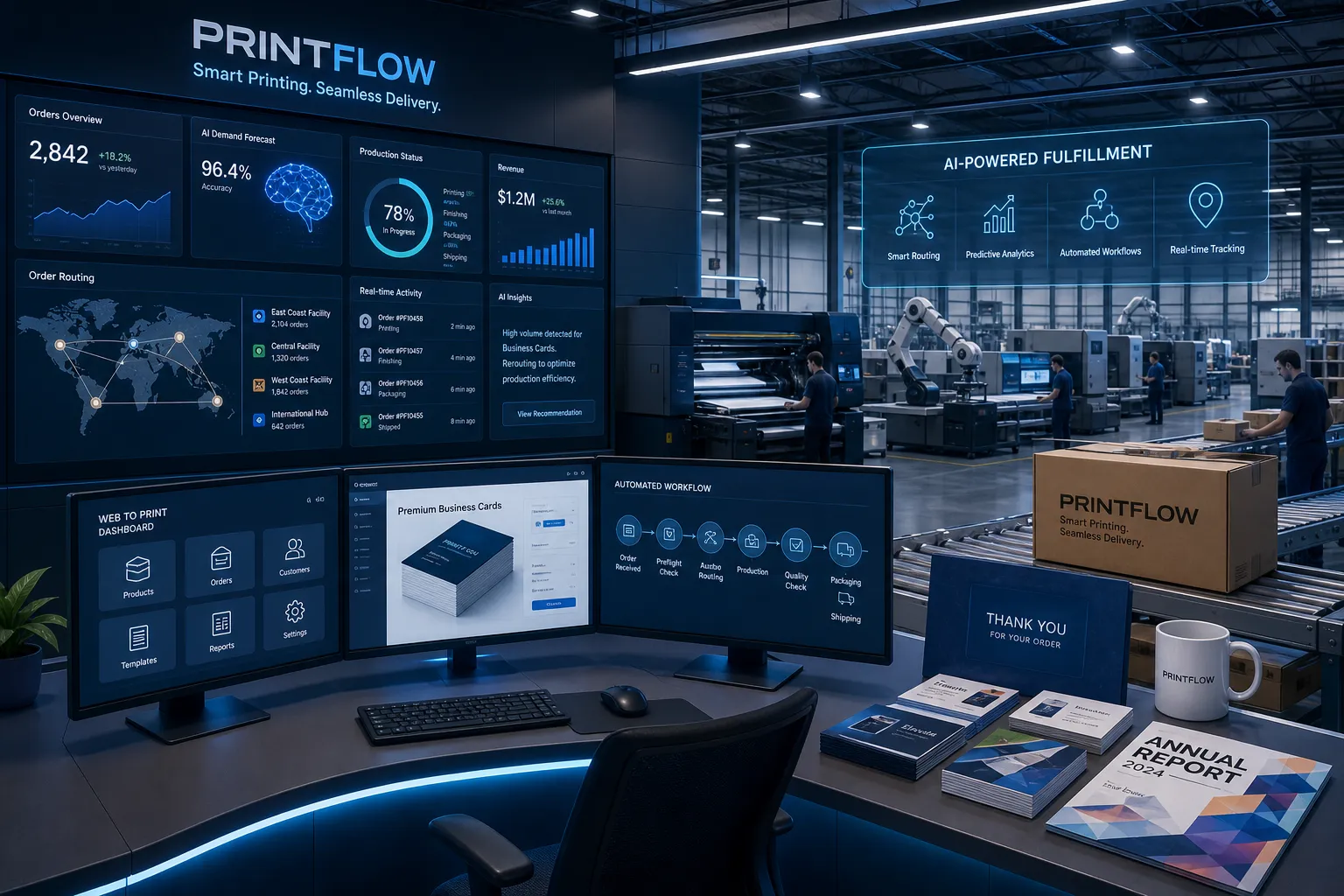
What print fulfillment actually includes
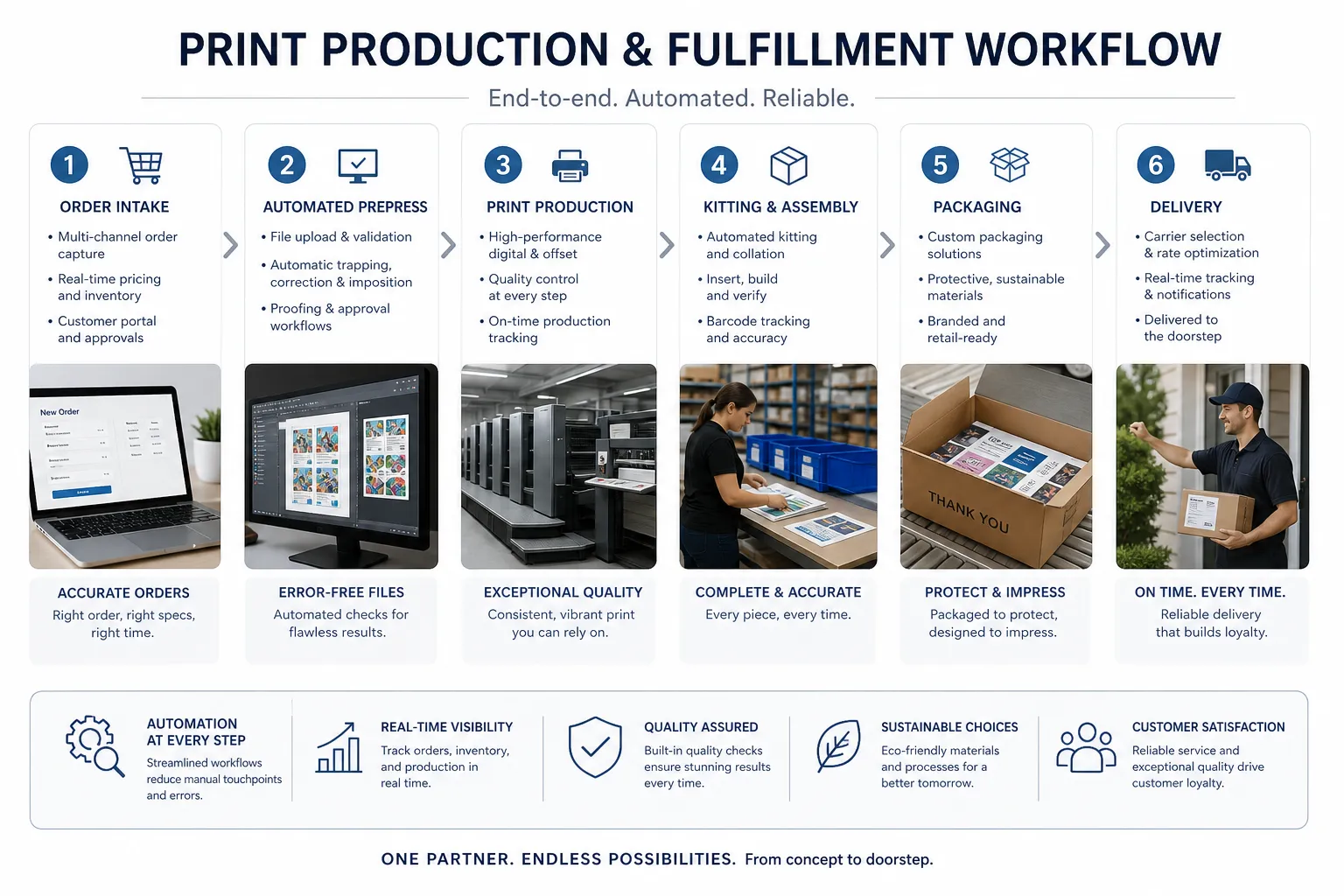
Print fulfillment is the end-to-end system that takes a print order from customer intent to delivered product. That can include:
Order intake and product configuration
This is where the process begins. A customer may want document printing, a custom photo book, branded packaging, wall art, marketing collateral, or another personalized product. In traditional setups, this stage often introduces friction through file prep, design edits, proof cycles, or complicated ordering interfaces.
Prepress and production readiness
Files need to be validated, formatted, checked for bleed, color consistency, trim, and print suitability. This is where many delays happen, especially if the customer is expected to act like a designer.
Print production
Production may involve digital printing, large-format printing, specialty finishing, direct mail, or premium custom printing services. The strongest providers balance speed with quality rather than sacrificing one for the other.
Packaging, kitting, and assembly
Many growing brands need more than a simple print out. They may need bundled inserts, branded packaging, welcome kits, promotional materials, or multi-item assembly before shipment.
Shipping and delivery
A true print and delivery service includes routing, carrier selection, delivery tracking, and customer communication. Some document printing and delivery providers stop at dispatch. The best partners optimize this step as part of the whole growth system.
The new benchmark: from print vendor to growth platform
A print fulfillment provider used to be judged by whether it could print and ship. Now it should be judged by whether it can help you:
reduce checkout friction
increase order volume
decrease prepress bottlenecks
support on-demand inventory models
expand product catalogs quickly
integrate into your storefront or app
preserve brand consistency at scale
That shift is especially important for businesses offering personalized products. If customers struggle to create, customize, or visualize what they are buying, even the best express printing services will not solve the real problem.
What the best print fulfillment services have in common
1. On-demand production instead of inventory-heavy operations
Traditional inventory ties up cash, warehouse space, and operational attention. On-demand fulfillment flips that model by producing only what is ordered.
This is one reason so many brands compare print on demand fulfillment companies when they are trying to grow. The benefit is not just lower storage cost. It is strategic flexibility. You can test new products, launch seasonal offers, and update designs without wasting stock.
2. Fast and accurate production workflows
An efficient printing service is not just fast at the press. It is fast at turning intent into a production-ready order. That requires workflow automation, not just machinery.
3. Reliable quality control
Competitors rightly point to quality control, but many discuss it in broad terms. In practice, quality means color consistency, substrate reliability, finishing precision, packaging integrity, and dependable repeatability across runs and facilities.
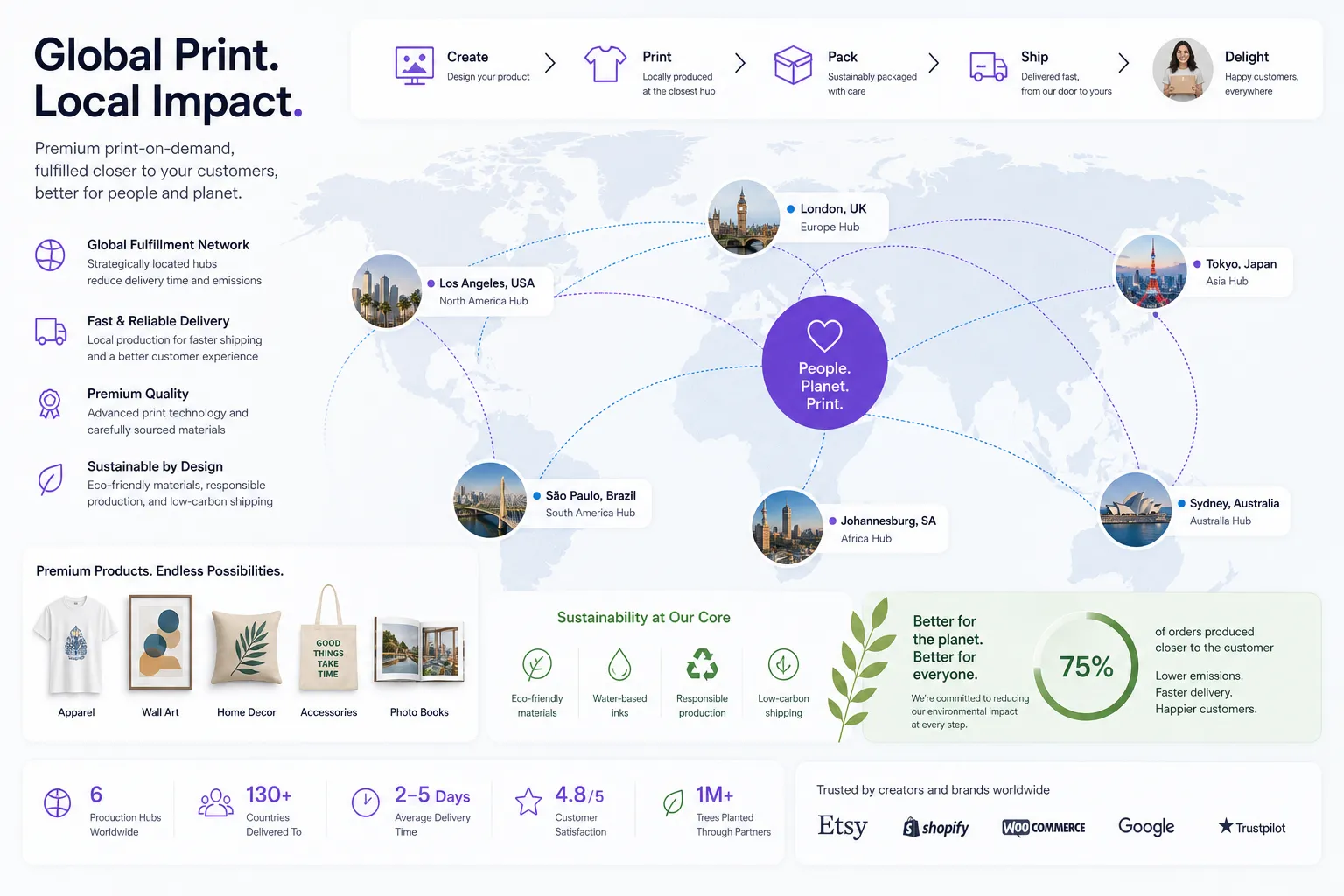
4. Smarter fulfillment logistics
A premium print delivery service should route jobs intelligently based on location, equipment availability, and delivery goals. This reduces shipping time, lowers cost, and improves the customer experience.
5. Strong customer-facing technology
This is where older providers often fall behind. Buyers increasingly expect digital convenience, mobile usability, previews, and smooth configuration tools. If your fulfillment engine is strong but your ordering layer is clunky, conversion suffers.
Where most competitor articles leave a gap
Most content about print fulfillment explains what providers do. Fewer articles explain what modern buyers expect and how technology changes the economics of fulfillment.
Here are the biggest content gaps:
Content Gap | Why It Matters |
|---|---|
AI-assisted product creation | Reduces dependence on design expertise and speeds up ordering |
White-label storefront integration | Lets brands modernize without rebuilding their core ecommerce stack |
3D and AR previews | Improves buyer confidence before checkout |
Mobile-first browser-based design | Expands accessibility without app downloads |
Cross-device continuity | Helps users start on one device and finish on another |
Automated global production routing | Improves scalability and shipping efficiency |
Conversational ordering | Removes friction for non-designers and first-time buyers |
This is exactly where Media Rex Alliance stands apart. Instead of treating fulfillment as a downstream service, it modernizes the entire print commerce flow.
How Media Rex Alliance changes the print fulfillment equation
Media Rex Alliance is built for businesses that want to offer AI-powered web-to-print without building the stack from scratch.

Conversational AI replaces complex design friction
Instead of forcing end customers to learn advanced design tools, Media Rex Alliance lets them describe what they want in natural language. That prompt is transformed into a print-ready product quickly, reducing hesitation and helping users move faster toward purchase.
For studios, photographers, and digital print businesses, that means fewer abandoned sessions and less manual intervention.
White-label deployment preserves your brand
Many businesses want innovation, but not at the cost of brand control. Media Rex Alliance can be integrated as a fully white-label experience into existing storefronts or apps, with your own branding, visual identity, and domain environment.
That matters for mid-size print brands and established photo book companies that want next-generation capability without sending customers to a third-party ecosystem.
Photorealistic 3D and AR previews improve conversion confidence
When customers can see a realistic representation of the final product before they buy, trust increases. That is especially valuable for premium, customized, or visual products where expectation mismatch can lead to returns or dissatisfaction.
Mobile-first and browser-based by default
A large portion of customer journeys now begin on mobile. Media Rex Alliance supports browser-based design with no app installation required, making product creation accessible and immediate.
Cloud and local sync enable cross-device continuity
Some users start on a phone, refine on a tablet, and complete the purchase on desktop. The ability to sync projects locally and in the cloud creates a smoother path to conversion.
On-demand production keeps operations lean
Media Rex Alliance supports a no-stock, low-overhead production model. That helps businesses reduce inventory exposure while expanding product offerings.
Automated global fulfillment supports scale
The platform connects to a global network of premium printers, automating fulfillment while maintaining flexibility across regions and product categories. This makes it viable for startups and enterprise-scale operators alike.
Traditional print fulfillment vs AI-powered print fulfillment
Capability | Traditional Provider | AI-Powered Platform with Media Rex Alliance |
|---|---|---|
Customer product creation | Manual tools or file uploads | Conversational AI prompt-to-product flow |
Preview experience | Static mockups or proofs | Photorealistic 3D and AR previews |
Brand control | Often partial or outsourced feel | Fully white-label integration |
Mobile accessibility | Frequently limited | Mobile-first browser experience |
Production model | Batch-heavy or inventory-based | On-demand, low-overhead production |
Fulfillment workflow | Separate systems and vendors | Automated routing through premium print network |
Scaling new products | Slower and more manual | Faster launch and expansion capability |
What to look for when comparing print fulfillment companies
Technology fit
Ask whether the provider improves the customer experience or only the production experience. A strong backend is valuable, but a weak frontend can still suppress revenue.
Integration flexibility
If you already have an ecommerce site, photo platform, or web-to-print environment, integration matters. A rigid system may create more complexity than it removes.
Product range and premium quality
Many businesses need more than basic document printing services. They need format printing, custom photo products, branded packaging, specialty finishes, or premium marketing materials.
Operational scalability
Can the solution support five orders a day and five thousand? Can it expand across regions or brands? Can it serve both startups and large enterprise workflows?
Delivery performance
A true print and delivery service should not just ship. It should optimize delivery time, carrier selection, and cost-to-serve.
User simplicity
If customers or internal teams need training just to place an order, the system is too complex.
The services that matter most for growing brands
Custom product creation
The strongest providers support highly personalized products without turning every order into a manual project.
Document printing and shipping
For some businesses, the need is straightforward: a dependable document printing company that can handle print and delivery at scale. For others, document printing and delivery is only one part of a larger product portfolio.
Express printing options
An express printing company should offer speed without chaos. That means prioritized workflows, reliable SLAs, and clarity around production cutoffs and shipping timelines.
Kitting and multi-item fulfillment
For franchise networks, marketing teams, or event operators, bundled fulfillment can be as important as print quality itself.
Branded packaging and premium finishing
As competition increases, premium printing services increasingly include packaging, presentation, and tactile differentiation.
Why speed alone is not enough
Fast turnaround is important. But many businesses overvalue raw speed and undervalue friction.
A customer who cannot easily create a product may never place the order. A customer who cannot trust the preview may hesitate. A team managing disconnected systems may lose margin through manual corrections, slower approvals, and fragmented shipping.
The winning model is not just express printing. It is intelligent print commerce.
That means:
less manual file handling
faster product creation
clearer previews
lower inventory risk
automated routing
consistent production quality
smoother customer journeys
Best-fit use cases for modern print fulfillment
Small studios and photographers
These businesses often need premium output without enterprise overhead. Media Rex Alliance helps them offer sophisticated product creation and fulfillment without building custom technology.
New print-on-demand brands
New entrants need speed to market, low inventory exposure, and simple operations. AI-powered creation plus automated fulfillment can accelerate launch.
Mid-size print brands
These companies often have demand and customer relationships already, but their storefront experience may lag. White-label modernization helps them compete without replacing their brand identity.
Regional print players
Regional operators can use AI-driven ordering and automated production flows to compete with larger digital-first brands.
Established photo book companies
These businesses need to modernize without disrupting the trust they have built. Media Rex Alliance supports that transition through branded integration and customer-friendly creation tools.
The economics of better print fulfillment
Good fulfillment lowers costs. Great fulfillment improves revenue.
A modern system can improve business outcomes in several ways:
Value Driver | Business Impact |
|---|---|
On-demand production | Lower warehousing and obsolescence cost |
Conversational product creation | Higher conversion through lower friction |
3D/AR previews | Better purchase confidence and fewer surprises |
White-label integration | Retain customer ownership and brand equity |
Automated fulfillment routing | Lower shipping cost and better speed |
Cross-device sync | More completed sessions and purchases |
Global premium printer network | Easier scaling across markets |
Common mistakes businesses make when choosing a provider
Choosing based on unit price alone
A low print price can hide workflow inefficiencies, poor customer UX, and higher operational overhead.
Ignoring customer creation friction
If your product is personalized, the ordering interface matters as much as the production engine.
Treating fulfillment and ecommerce as separate decisions
The storefront experience, order generation, prepress workflow, and delivery system all affect one another.
Overcommitting to inventory
The more uncertain your demand, the more valuable an on-demand model becomes.
Underestimating brand control
Sending users into a generic third-party experience can weaken trust and long-term retention.
Building a future-ready print business
The future of print belongs to businesses that combine premium physical output with digital simplicity. Customers still want high-quality tangible products. What they no longer tolerate is unnecessary friction.
That is why AI-powered web-to-print matters. It does not replace craftsmanship. It removes the unnecessary complexity that keeps people from ordering in the first place.
If your business wants to offer better print fulfillment, the target is not just faster production. It is a smarter, more scalable, more conversion-friendly system from first prompt to final delivery.
Final verdict: the best print fulfillment strategy is end-to-end, on-demand, and AI-enabled
The top printing services are no longer defined only by presses, warehouses, or shipping carriers. They are defined by how well they connect product creation, order confidence, production efficiency, and fulfillment automation.
Media Rex Alliance represents where this market is heading:
conversational AI instead of design friction
print-ready product generation from simple prompts
white-label deployment inside your brand ecosystem
photorealistic 3D and AR previews before purchase
mobile-first browser access with no app download
local and cloud sync across devices
on-demand production with lower inventory overhead
automated fulfillment through a global network of premium printers
scalable infrastructure for emerging and established print businesses
If you are looking to modernize your print fulfillment model, improve conversions, and launch a more advanced web-to-print experience without building everything yourself, Media Rex Alliance gives you a faster path forward.
The next era of print growth will belong to businesses that make customization effortless and fulfillment invisible. That is the opportunity. And that is the advantage Media Rex Alliance is built to deliver.
FAQ
What is print fulfillment?
Print fulfillment is the full process of turning a print order into a delivered product, including order intake, prepress, production, packaging, and shipping. Modern print fulfillment also includes automation, on-demand production, and integrated delivery workflows that improve speed and scale.
What is the most profitable printing business?
The most profitable models are usually those with high customization, low inventory risk, and strong automation, such as on-demand photo products, branded merchandise, premium packaging, and AI-powered web-to-print storefronts. Profitability improves when businesses reduce manual design work and streamline fulfillment.
How long does fulfillment usually take?
Fulfillment time varies by product, finishing requirements, and shipping distance, but many modern providers aim for production and dispatch within a few business days. Businesses using automated routing and distributed print networks can often deliver faster and more consistently than single-site operations.