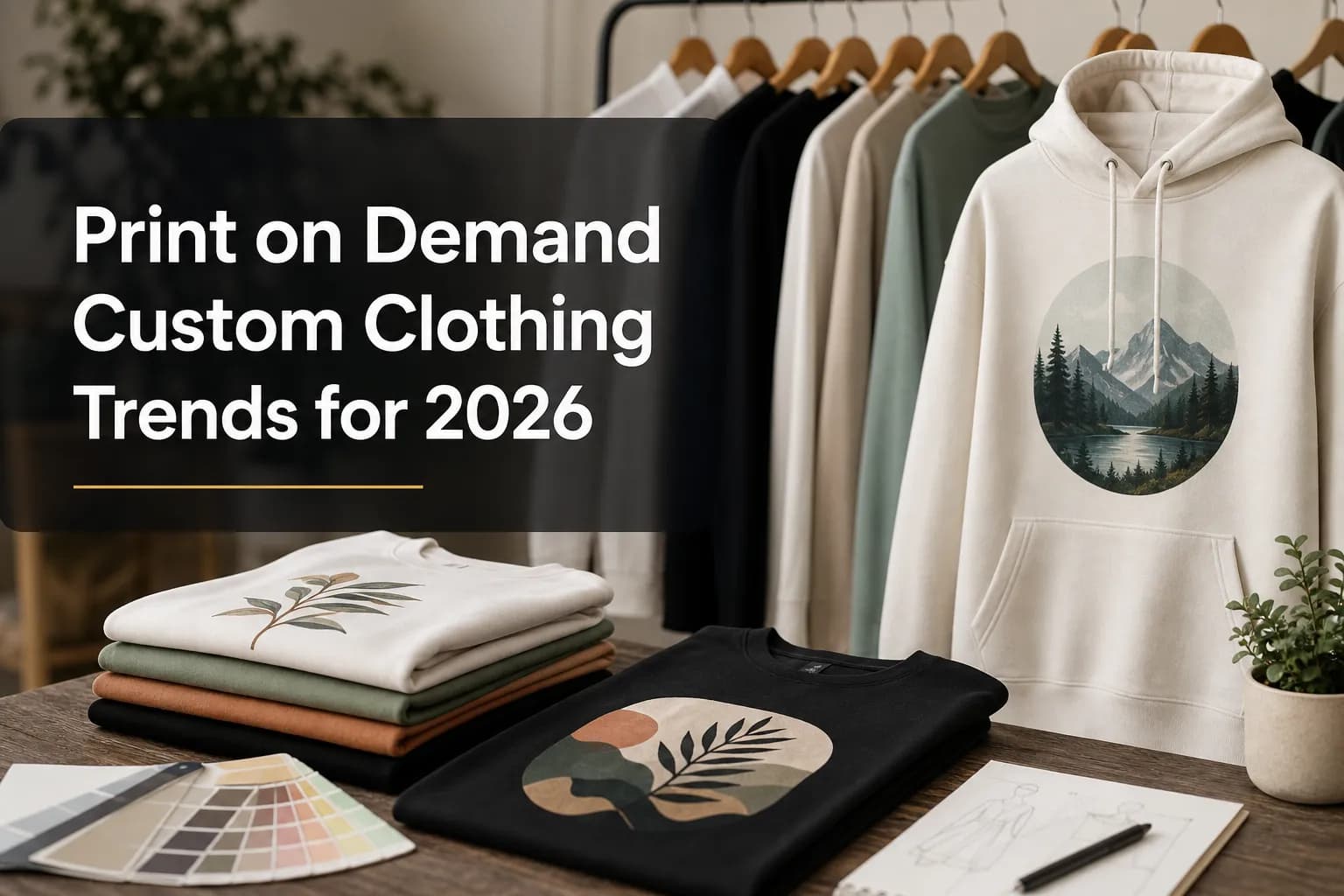
Print on Demand Custom Clothing Trends for 2026
Print on demand custom clothing is entering a new phase in 2026. The market is no longer driven by generic t-shirts alone. Buyers now expect premium blanks, meaningful personalization, faster delivery, mobile-first design experiences, and brand-quality presentation from the first click to the final unboxing.
For small studios, photographers, new POD brands, regional print companies, and established photo product businesses, that creates both pressure and opportunity. The pressure comes from rising customer expectations. The opportunity comes from AI-powered web-to-print platforms that remove complexity, shorten the buying journey, and make custom product creation dramatically easier.
Instead of forcing shoppers through clunky editors and abandoned carts, the next generation of print on demand apparel lets them describe what they want in natural language, preview it instantly, and order with confidence.
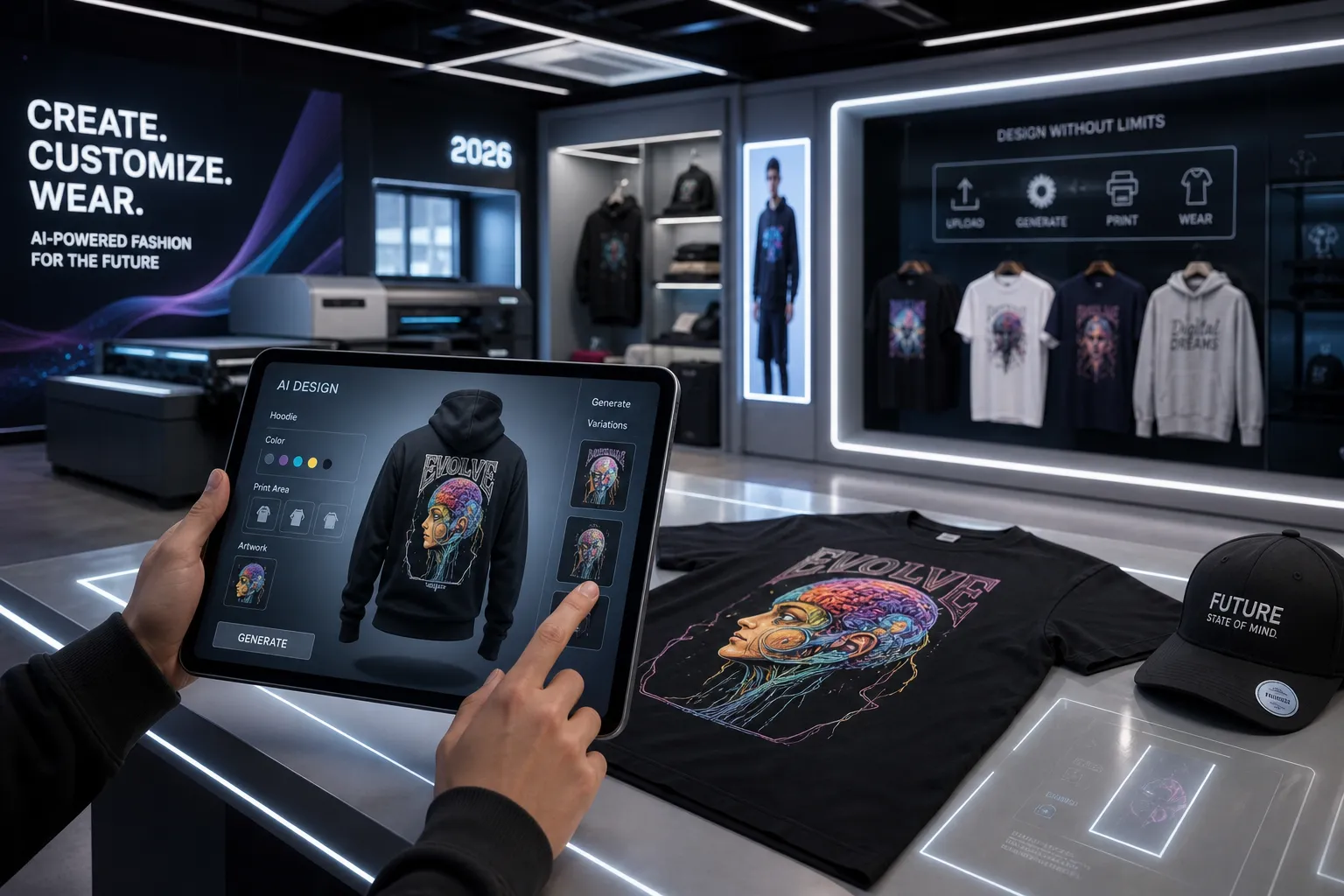
In this guide, we’ll break down the most important print on demand custom clothing trends for 2026, where competitors are getting it right, where they are falling short, and what modern print businesses should do now to stay ahead.
What the top-ranking content gets right, and what it misses
Across leading competitor articles, several themes appear again and again:
apparel remains the dominant POD category
personalization is becoming standard, not optional
sustainability matters more every year
nostalgia, niche culture, and creator-led designs are strong demand drivers
AI tools are accelerating design and product launches
social commerce and mobile shopping are reshaping discovery and checkout
Those are valid themes. But most articles stop at surface-level inspiration. They talk about “what’s trending” without explaining how print businesses can operationalize those trends in a way that improves conversion, protects margins, and scales across storefronts.
The biggest content gaps in competitor articles
Here’s what most of the current content fails to cover in depth:
Content Gap | Why It Matters in 2026 |
|---|---|
Conversational AI product creation | Customers increasingly prefer simple prompt-based creation over complex editors |
White-label web-to-print deployment | Brands want control over their own storefront experience, domain, and customer journey |
3D and AR previews | Visual confidence reduces hesitation and can improve conversion on custom products |
Mobile-first browser-based customization | The majority of product discovery now starts on mobile |
Cross-device continuity | Buyers often start on one device and finish on another |
Fulfillment automation | Trend-driven businesses need speed without building operational complexity |
Premium positioning for high-quality custom clothing | Competing on price alone is a race to the bottom |
Conversion friction reduction | The real growth lever is not just product choice, but easier product creation and checkout |
That’s where Media Rex Alliance fits naturally into the 2026 conversation. It gives print businesses a white-label AI print platform that transforms a shopper’s prompt into a ready-to-print product, provides photorealistic 3D and AR previews, works directly in the browser on mobile, syncs sessions locally and in the cloud, and automates fulfillment through a global network of premium printers. In other words, it turns trend awareness into a scalable business model.
Why 2026 is a turning point for print on demand apparel
The print on demand industry is not just growing. It is maturing. That means customers are becoming more selective, and winning brands need stronger product quality, better technology, and clearer positioning.
"In 2025, apparel accounted for 39.5% of the global print-on-demand market share." - Grand View Research
That stat confirms what most sellers already feel: print on demand shirts, hoodies, sweatshirts, and other apparel still lead demand. But dominance alone does not guarantee profit. The winners in 2026 will not be the stores with the most products. They will be the ones with the least friction.
The new buyer expectation
Today’s custom clothing buyer expects:
premium product quality
fast, intuitive personalization
mobile-optimized browsing
realistic previews before purchase
quick fulfillment
a branded, trustworthy store experience
If your current stack relies on outdated editors, disconnected print workflows, or generic marketplace listings, you are likely leaking conversions at every stage.
The 7 defining print on demand custom clothing trends for 2026
1. Conversational customization replaces old-school design editors
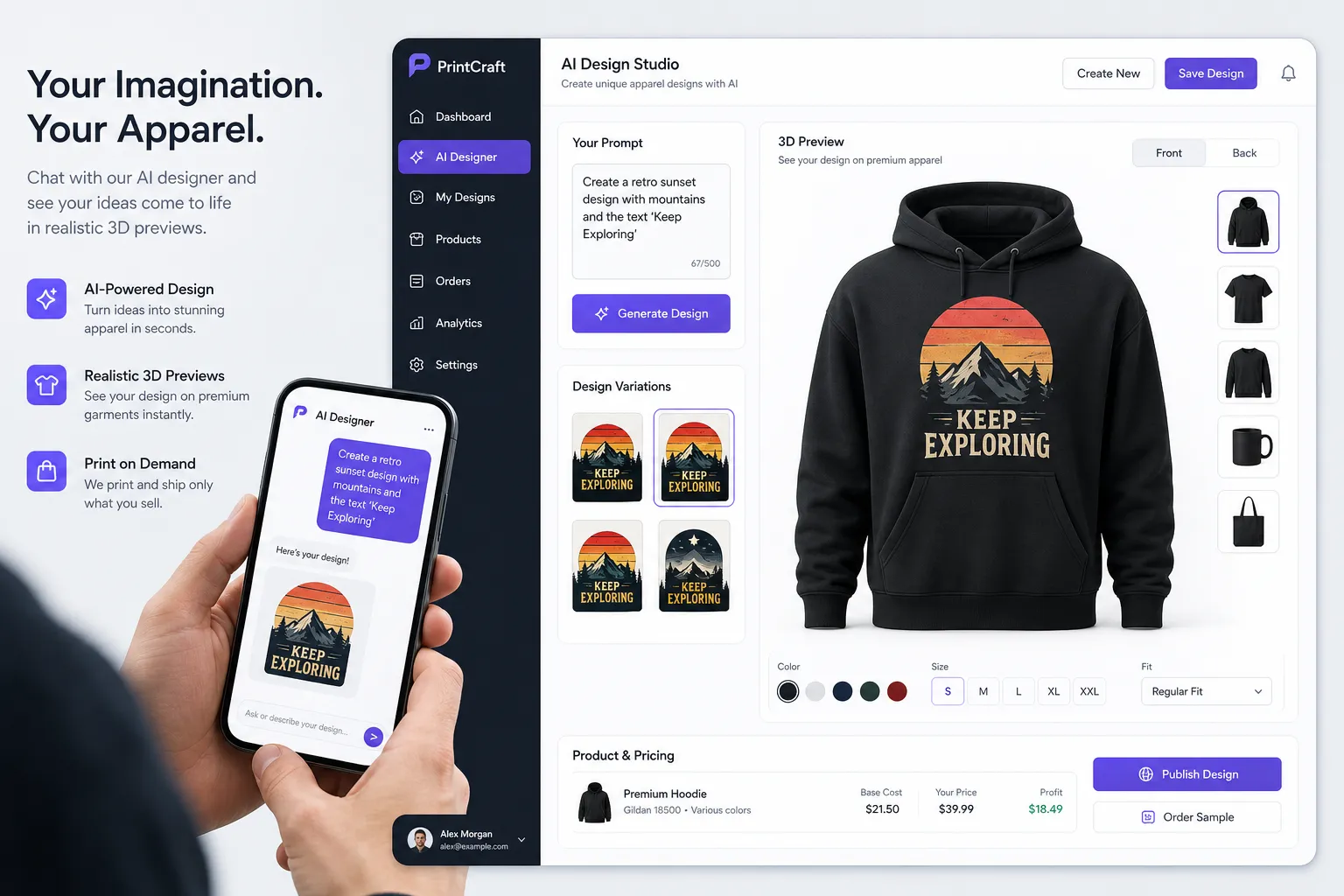
The biggest change in print on demand custom is not visual. It is behavioral.
Customers no longer want to spend 15 minutes dragging text boxes and resizing images in a confusing editor. They want to type something simple like:
“Create a minimalist oversized black hoodie with a retro mountain line drawing and the phrase Explore More”
“Make a premium cream t-shirt with my dog’s photo in a vintage poster style”
“Design matching bridal party shirts in soft pink with elegant script names”
The businesses that support prompt-based creation will reduce cognitive load, shorten time-to-cart, and capture more impulse buyers.
Media Rex Alliance is built exactly for this shift. Its autonomous creation engine enables end customers to create products through natural language instead of traditional design tools. That is a major competitive advantage for modern print brands because it removes one of the biggest barriers to purchase: design friction.
Why this trend matters
increases conversion by simplifying creation
makes customization accessible to non-designers
speeds up order decisions
supports higher-value personalized apparel
improves mobile usability dramatically
2. Print on demand high quality clothing beats cheap commodity apparel
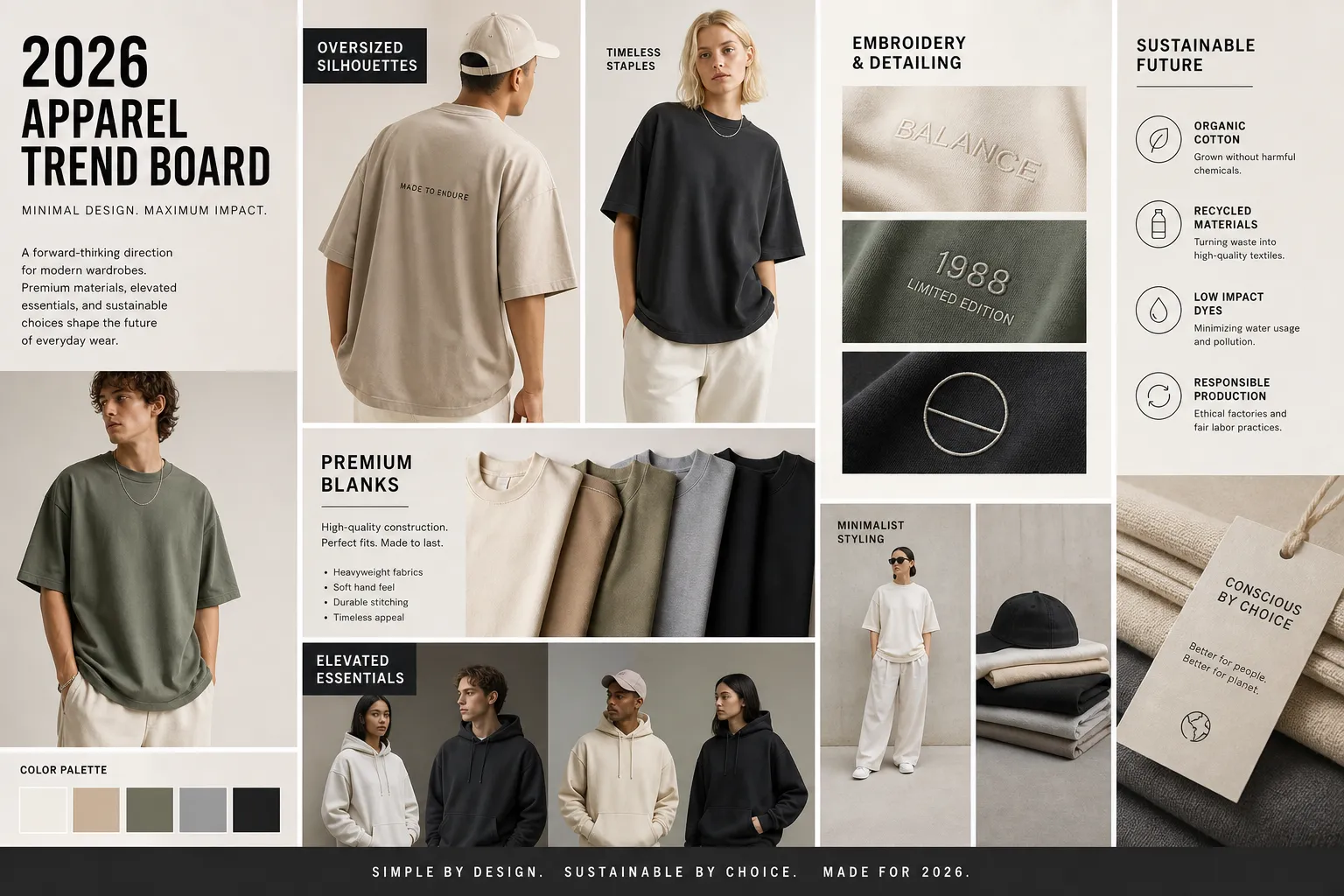
In 2026, the phrase “print on demand high quality clothing” is not just an SEO keyword. It is a business requirement.
Consumers are moving away from flimsy blanks and generic fits. They want:
heavier fabric weights
premium hand feel
garment-dyed or washed finishes
oversized and relaxed silhouettes
better stitching and durability
elevated branding details like embroidery and inside labels
This is especially important for businesses trying to build a real brand instead of a short-term trend store.
What high-quality custom clothing means now
Quality Signal | What Buyers Notice |
|---|---|
Fabric weight | Feels more premium and lasts longer |
Fit and silhouette | Oversized, boxy, or tailored styles feel more current |
Decoration method | Embroidery, DTF, DTG, puff print, and mixed techniques signal quality |
Color consistency | Stronger trust and lower return risk |
Preview realism | Better expectation setting before purchase |
Packaging and fulfillment | Branded, fast, reliable delivery elevates the experience |
Most competitor articles mention apparel demand, but few address the operational side of selling premium garments online. Media Rex Alliance helps businesses position high-quality custom clothes more effectively by pairing AI-generated layouts with photorealistic 3D and AR previews. That means buyers can see a more lifelike representation of the finished product before ordering, which strengthens confidence in premium-priced apparel.
3. Personalized print on demand shirts become the default, not the upsell
Personalization is no longer a novelty. It is the new baseline.
From names and initials to event-specific graphics and AI-assisted photo layouts, buyers now expect print on demand shirts and print on demand t shirts to reflect identity, relationships, milestones, or niche interests.
"The global print-on-demand market was valued at approximately USD 10.78 billion in 2025 and is projected to reach USD 57.49 billion by 2033, growing at a CAGR of 23.6% from 2026 to 2033." - Grand View Research
That growth is tied directly to rising demand for individualized products. But the crucial insight is this: personalization has to feel easy. If the path to customization feels like work, the sale is lost.
Best-performing personalization angles in 2026
pet-themed custom tees
family reunion and group shirts
event apparel for birthdays, bridal parties, and vacations
niche identity shirts for hobbies and communities
memory-driven apparel using customer photos
location and travel-inspired personalized designs
For print businesses, this creates a strong case for offering prompt-based personalization flows rather than rigid product editors. Media Rex Alliance allows customers to upload photos, generate layouts automatically, and move from concept to print-ready apparel quickly. That is especially valuable for personalized apparel where purchase intent is often emotional and time-sensitive.
4. Mobile-first custom clothing experiences become mandatory
Many competitor posts mention mobile commerce, but few explain what “mobile-first” actually means for web-to-print.
It does not mean shrinking your desktop editor onto a phone screen. It means rethinking the entire product creation journey around the way people browse and buy on mobile.
A true mobile-first print on demand flow includes:
no app download required
browser-based product creation
simple prompt input
fast image upload from camera roll
instant previews
minimal typing and fewer design steps
cloud and local sync across sessions
For brands serving fast-moving audiences on TikTok, Instagram, and creator-driven channels, this is critical. Mobile is often the first touchpoint, and sometimes the only one.
Media Rex Alliance supports mobile-first, browser-based design without requiring app installation. That removes a huge layer of friction for both direct-to-consumer brands and white-label partners that want branded custom experiences inside their own storefronts or apps.
5. Photorealistic 3D and AR previews become conversion tools
One of the most overlooked opportunities in print on demand custom clothing is preview quality.
Static mockups helped get the industry off the ground, but they are no longer enough for a premium, trust-driven buying experience. In 2026, especially for custom apparel, customers want to know what they are getting before they pay.
Why realistic previews matter
reduce uncertainty on personalized products
support higher average order values
improve perceived quality
reduce return risk caused by expectation mismatch
create a more premium brand impression
Media Rex Alliance provides photorealistic 3D and immersive AR previews before purchase. For businesses selling print on demand apparel, that is more than a visual enhancement. It is a conversion engine.
A realistic preview is especially powerful when selling:
premium hoodies
oversized t-shirts
embroidered hats
photo-based apparel
coordinated outfit sets
branded merch collections
6. Sustainability shifts from marketing angle to operational strategy
Sustainability remains one of the strongest macro trends in custom apparel, but the real conversation in 2026 is about practical execution.
Customers are increasingly skeptical of vague green claims. They want brands to demonstrate:
on-demand production instead of overstock
eco-conscious fabrics
reduced waste workflows
efficient fulfillment routes
durable products that last
For print businesses, on-demand production is one of the clearest structural advantages available. It lowers overhead, minimizes dead inventory, and aligns with more responsible consumption.
Media Rex Alliance naturally supports this model through no-stock, on-demand production and automated fulfillment via a global network of premium printers. That gives businesses a scalable way to reduce inventory risk while also meeting sustainability expectations more credibly.
7. White-label AI web-to-print becomes the growth model for serious brands
The most important strategic shift in 2026 is this: brands want to own the experience.
They do not want to send traffic away to third-party tools. They do not want generic marketplaces to define the customer journey. They want to offer custom product creation under their own brand, inside their own storefront, with their own visual identity.
That is why white-label AI web-to-print is becoming such a powerful model.
What serious print businesses want from modern infrastructure
Need | Why It Matters |
|---|---|
White-label deployment | Protects brand equity and customer ownership |
Conversational AI creation | Simplifies customization and increases conversion |
Browser-based access | Improves accessibility and speed to launch |
Cross-device sync | Supports modern shopping behavior |
Automated print-ready output | Reduces manual production work |
Global fulfillment network | Scales without local bottlenecks |
Enterprise-ready architecture | Supports growth from startup to large print operation |
Media Rex Alliance is designed specifically around these needs. It can be fully customized with a client’s branding, domain, and visual identity, making it ideal for startups, mid-size print brands, regional players, and enterprise photo product companies that want to modernize without building the technology stack from scratch.
What styles are shaping print on demand clothes in 2026?
Competitor articles point to many aesthetic directions, but for custom clothing, the strongest styles can be organized into demand-ready commercial categories.
Trend-forward design directions to watch
Oversized essentials
Heavyweight tees, relaxed hoodies, washed neutrals, and minimalist placements are leading premium casualwear.
Retro and nostalgia remix
Y2K, 70s-inspired groovy graphics, vintage collegiate, racing references, and faded distressed effects remain highly clickable.
Dark romantic and moody graphics
Dark florals, celestial motifs, gothic typography, and witchy visual themes continue to perform across apparel and accessories.
Clean luxury basics
Quiet luxury-inspired blanks with subtle embroidery, tonal graphics, and refined branding details are gaining traction.
Nature-led and eco-coded design
Botanical illustrations, earth palettes, organic textures, and sustainability-driven storytelling resonate with conscious buyers.
Event and community wear
Sports tournaments, travel groups, weddings, local teams, creator fan communities, and reunion apparel remain powerful conversion categories.
Best product categories for print on demand custom clothing in 2026
Not every apparel product is equally strong. If your goal is efficient growth, these are the categories with the clearest product-market fit right now.
Highest-opportunity apparel categories
Product Type | Why It’s Trending | Best Use Cases |
|---|---|---|
Premium t-shirts | Universal appeal and easy personalization | Brands, creators, events, everyday fashion |
Oversized hoodies | Comfort and premium streetwear positioning | Lifestyle brands, seasonal drops |
Embroidered caps | High perceived value, low complexity | Creator merch, minimal branding |
Coordinated sets | Higher AOV and fashion-forward appeal | Lifestyle collections, group apparel |
Long-sleeve shirts | Transitional season versatility | Niche branding, layered looks |
Youth and family shirts | Emotional and event-driven demand | Reunions, gifts, matching sets |
For many businesses, print on demand t shirts will still be the easiest entry point. But in 2026, the winning move is not selling only tees. It is building a higher-value apparel mix around them.
How to build a 2026-ready custom clothing business
Knowing the trends is useful. Building around them is what creates revenue.
Step 1: Start with audience, not artwork
The best-performing stores do not start by asking, “What design should we make?” They start by asking:
who is the buyer?
what identity or moment are they expressing?
what product format fits that emotion best?
how quickly can we help them visualize and buy it?
Step 2: Reduce customization friction
If buyers need design skills to complete a purchase, you are already losing them. Move toward prompt-based, guided customization experiences.
Step 3: Focus on premium categories first
Rather than launching 200 generic SKUs, start with a focused assortment of high-quality custom clothing that supports stronger margins and brand perception.
Step 4: Improve visual trust
Invest in better previews, stronger product visuals, and realistic mockup experiences. Better yet, adopt 3D and AR previews where possible.
Step 5: Automate production and fulfillment
Trend-based selling moves fast. Your backend should not slow you down. Automation protects margins and helps you scale without multiplying manual work.
Where Media Rex Alliance creates a real competitive advantage
Most businesses in print on demand clothing are trying to patch together separate tools for design, personalization, previews, storefront integration, and fulfillment.
Media Rex Alliance consolidates those growth levers into one white-label AI print platform.
What that means in practice
customers create products through conversational AI
prompts become print-ready products quickly
photo uploads and automatic layouts reduce manual work
photorealistic 3D and AR previews increase purchase confidence
browser-based mobile access removes app friction
local and cloud sync enables seamless multi-device use
on-demand production reduces inventory and overhead
automated fulfillment connects businesses to premium global printers
white-label deployment keeps the entire experience under your brand
For a new POD brand, this means faster launch and less technical complexity.
For a regional print company, it means modernization without a full rebuild.
For a photo book or print product business, it means a future-ready expansion path into AI-powered custom merchandise and apparel.
2026 action plan for print businesses
If you want to capitalize on print on demand custom clothing trends this year, prioritize these actions:
upgrade from static personalization to conversational creation
position around quality, not just low price
optimize every custom flow for mobile
use better previews to reduce hesitation
expand beyond basic tees into premium apparel mixes
automate fulfillment to stay fast and lean
deploy white-label experiences that strengthen your own brand
Final verdict
Print on demand custom clothing in 2026 is bigger than a design trend story. It is a technology, conversion, and customer experience story.
Yes, print on demand shirts and print on demand t shirts still matter. Yes, personalization and sustainability are still powerful. But the real winners will be businesses that make custom product creation dramatically easier, visually more trustworthy, and operationally more scalable.
That is why Media Rex Alliance stands out.
It does not just help businesses follow trends. It gives them the infrastructure to lead them, with conversational AI, print-ready automation, photorealistic 3D and AR previews, white-label deployment, mobile-first browser access, and fulfillment orchestration built for modern on-demand commerce.
If you want to launch or modernize a custom clothing business without building the entire AI web-to-print stack yourself, Media Rex Alliance offers the fastest path to a smarter, higher-converting, future-ready print experience.
FAQ
What is the print on demand trend in 2026?
The biggest print on demand trend in 2026 is the shift toward AI-powered personalization, premium apparel, mobile-first shopping, and more realistic product previews. Buyers want to create custom clothing faster, with less friction and more confidence before ordering.
What prints are in fashion for 2026?
Retro graphics, oversized minimalist placements, dark florals, celestial motifs, vintage-inspired textures, and nature-led prints are all performing strongly in 2026. The strongest sellers are designs that combine trend appeal with personalization or niche identity.
Is print on demand still profitable in 2026?
Yes, print on demand is still profitable in 2026, especially for brands focused on premium products, personalization, and strong conversion flows. Profitability improves when businesses reduce design friction, raise perceived value, and automate fulfillment.
Is print on demand still worth it in 2026?
Absolutely. It remains worth it because the no-inventory, low-overhead model still offers flexibility and lower risk than traditional retail. The key is using better technology, better products, and a stronger branded experience rather than relying on commodity listings.
What sells the most on Printify?
Apparel still leads, with t-shirts, hoodies, sweatshirts, and other custom clothing among the top-selling categories. Personalized designs, niche graphics, and event-driven products tend to perform especially well.