
Print on Demand T Shirt Business Guide for 2026
If you want to build or modernize a print on demand t shirt business in 2026, the opportunity is real, but the rules have changed. Winning brands are no longer built on generic mockups, slow customization tools, and bloated inventory models. They are built on speed, trust, product quality, smart niche selection, and an effortless buying experience.
For small studios, photographers, emerging merch brands, regional print players, and established photo product companies, the biggest challenge is no longer “Can we sell custom apparel?” It is “Can we create a faster, better, more scalable customer journey than everyone else?” That is exactly where AI-powered web-to-print is reshaping the market.
Media Rex Alliance sees the next wave clearly: customers do not want to wrestle with complicated design software. They want to type a prompt, upload a photo, preview a premium product in realistic 3D or AR, and buy with confidence. For businesses, that means lower friction, higher conversion potential, on-demand production, less waste, and white-label scale without building the technology stack from scratch.
"According to Grand View Research, the POD market is expected to grow from $13.1 billion in 2026 to $57.5 billion by 2033, representing a compound annual growth rate (CAGR) of 23.6% during the forecast period." - Grand View Research
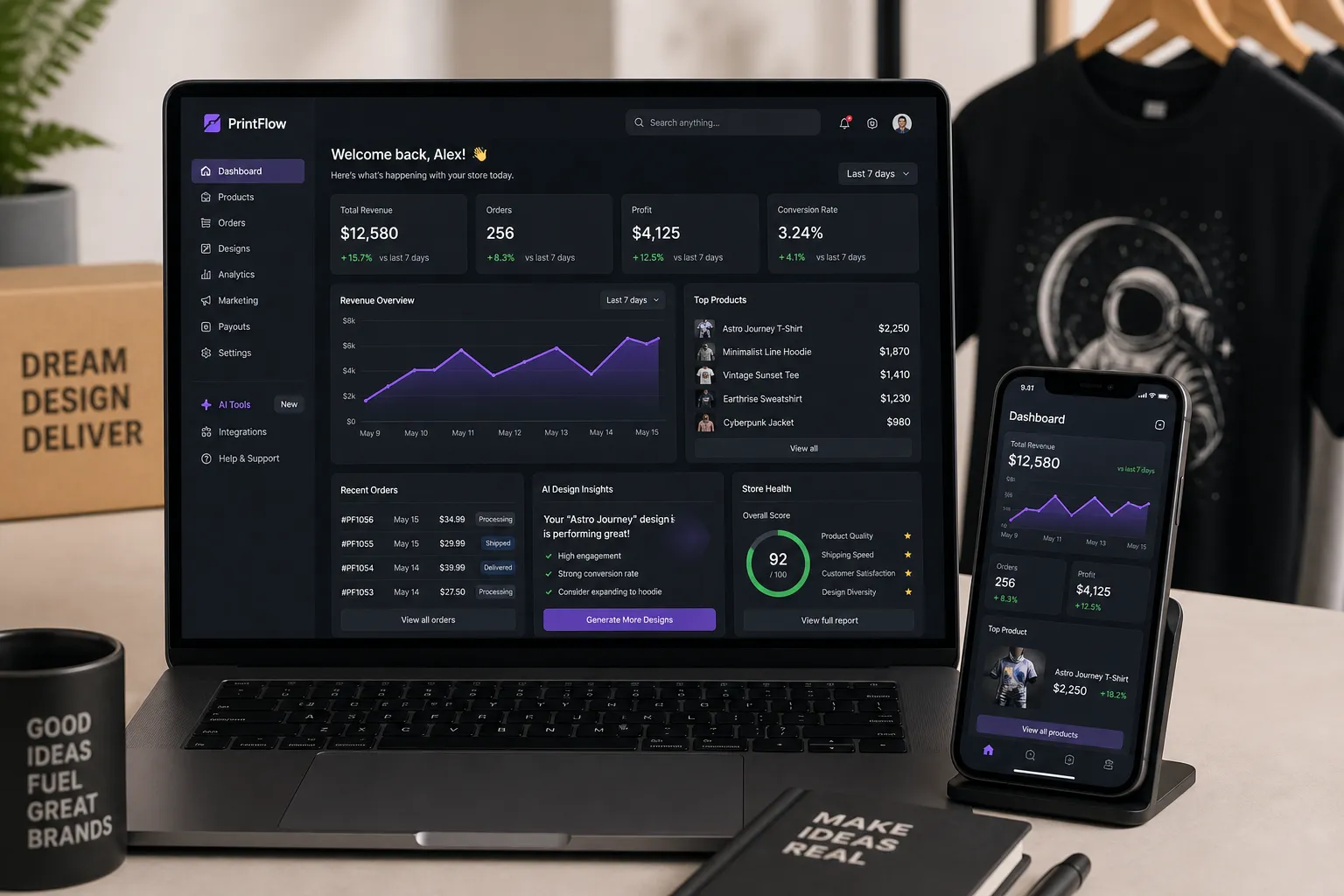
What changed in print on demand t-shirts for 2026
Most competitor guides cover the basics: choose a niche, upload designs, connect a provider, and start marketing. That is fine for beginners, but it misses what actually drives growth today.
The biggest market shifts
Customers expect personalization without complexity
Traditional editors create friction. Conversational AI dramatically shortens the path from idea to checkout.“Fast local-style delivery” matters more than ever
Many shoppers looking for quick print t shirts near me or custom print t shirt near me are really signaling urgency, not necessarily literal local pickup. Distributed fulfillment networks now solve that expectation at scale.Product preview quality affects conversion
Flat mockups are weak. Photorealistic 3D and AR previews improve customer confidence, especially for premium tees, polos, and streetwear.Margin pressure is real
Ad costs, shipping costs, and marketplace fees keep rising. The best operators reduce friction and improve conversion rate instead of only chasing cheaper blanks.White-label infrastructure is becoming strategic
Mid-size and enterprise print businesses increasingly want to own the customer relationship, brand, and UX instead of sending buyers into third-party ecosystems.
The content gaps most guides miss
Many top-ranking articles underplay or ignore:
How AI changes product creation and conversion
Why preview technology matters to return rates and trust
How to decide between marketplaces, Shopify-style stores, and white-label SaaS
How to serve multiple customer segments, from solo creators to enterprise print companies
How to think about local-style fulfillment, not just “shipping”
How established print companies can modernize without rebuilding from zero
This guide fills those gaps.
What a modern print on demand shirt business actually looks like
A modern business model combines four moving parts:
Layer | What it does | Why it matters |
|---|---|---|
Demand generation | SEO, social, creator content, retention | Creates traffic and repeat buyers |
Product creation | Designs, personalization, AI-assisted workflows | Reduces friction and increases relevance |
Commerce | Storefront, checkout, upsells, branding | Controls conversion and customer ownership |
Fulfillment | Printing, packing, shipping, routing | Protects customer experience and margins |
The old model forced customers into clunky tools and businesses into rigid workflows. The new model, championed by Media Rex Alliance, lets customers create products conversationally, preview them instantly, and purchase through a fully branded white-label experience.
How to choose your business model
There is no single correct path. The right model depends on your stage, budget, brand goals, and technical ambitions.
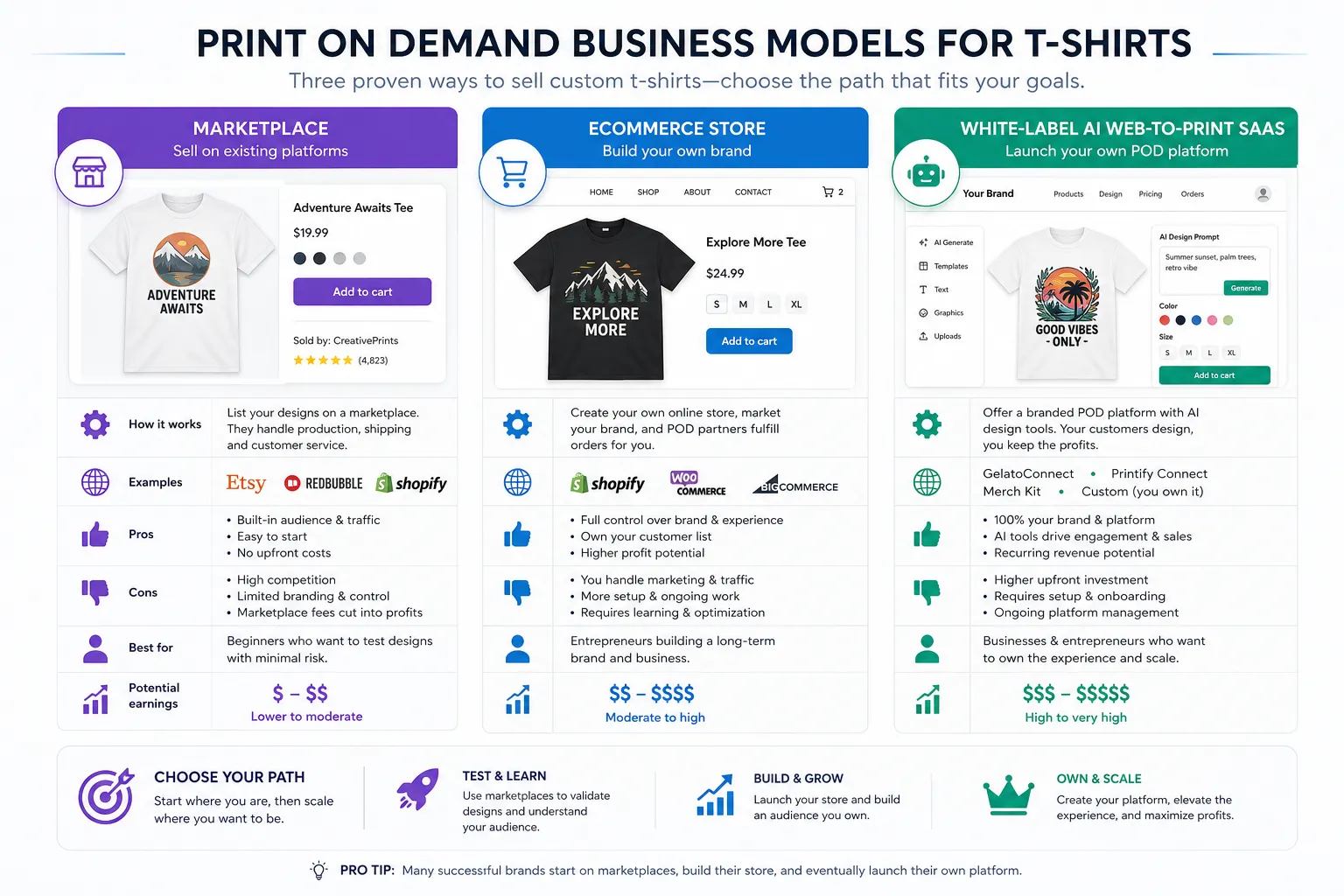
Marketplace-first
Best for creators validating demand quickly.
Pros
Low barrier to entry
Built-in audience
Fast setup
Cons
Limited branding control
Lower customer ownership
Higher fee dependence
Harder to build long-term defensibility
Storefront + print provider
Best for brands that want more control.
Pros
Better margins than marketplaces
Stronger brand presence
Customer data ownership
More upsell and retention options
Cons
You must generate traffic
More moving parts
Design and personalization can still feel clunky if tools are weak
White-label AI web-to-print platform
Best for ambitious brands, studios, and print businesses that want differentiated UX and scale.
Pros
Conversational product creation
Fully branded deployment
No app install required
Mobile-first browser experience
Local + cloud sync across devices
3D and AR previews
Global premium printer network
Scales from startup to enterprise
Cons
Requires strategic implementation
Best suited to operators serious about long-term brand equity
For businesses that want to launch premium AI-powered custom apparel without building the tech stack internally, Media Rex Alliance is the strongest strategic option. It turns a standard print on demand company workflow into a modern, conversion-focused product creation engine.
How to pick a profitable niche for tees in 2026
The best print on demand for t shirts starts with niche accuracy, not broad appeal. The market is crowded, but it is not saturated for brands that know exactly who they serve.
High-opportunity niche angles
Local pride and regional identity
Fitness communities
Creator merch with inside-joke energy
Event and destination apparel
Minimalist premium streetwear
Corporate team gear and branded employee kits
School, club, and nonprofit fundraising
Photographer and studio client gifting
Personalized family, pet, or couple tees
A simple niche validation framework
Ask these five questions:
Question | Good answer looks like |
|---|---|
Is there a clear audience identity? | “Pilates instructors” beats “women” |
Do they buy apparel already? | Existing culture of merch or uniforms |
Is personalization valuable? | Names, dates, locations, photos, phrases |
Can you make multiple design angles? | Not just one viral slogan |
Can you serve them repeatedly? | Seasonal drops, events, gifts, reorders |
If the answer is yes to at least four, the niche is likely viable.
What to sell beyond basic tees
A lot of guides focus only on unisex t-shirts. That leaves revenue on the table.
Core apparel categories to consider
Classic tees
Oversized and heavyweight streetwear
Premium ring-spun styles
Long sleeves
Hoodies and sweatshirts
Tanks
Women’s fit collections
Youth apparel
Performance shirts
Print on demand polo shirts
For B2B and regional print players, polos are especially important. They unlock corporate, hospitality, school, and event opportunities that casual merch often cannot.
A strong starter catalog for 2026
Product type | Best for | Margin potential | Buyer intent |
|---|---|---|---|
Standard tee | General entry offer | Medium | Broad |
Premium heavyweight tee | Streetwear and lifestyle | High | Quality-focused |
Polo shirt | Corporate and teamwear | High | Functional |
Hoodie | Higher AOV | High | Seasonal |
Personalized photo tee | Gifts and family niches | High | Emotional |
Performance tee | Events, sports, staffwear | Medium to high | Utility |
How to create designs that actually convert
Great products do not need the most complicated art. They need clarity, relevance, and confidence.
What works now
Clean typography with a strong emotional angle
Niche-native phrases, not generic slogans
Minimal graphics with premium placement
Smart photo-driven personalization
Coordinated design systems across multiple products
Why conversational AI matters here
Traditional design tools create abandonment. Customers open the editor, get overwhelmed, and leave.
Media Rex Alliance changes that dynamic by enabling customers to describe what they want in natural language, upload a photo if needed, and receive a print-ready result quickly. That removes tool anxiety and speeds up purchase decisions. For businesses, this means fewer dead-end sessions and a more intuitive path to conversion.
How to choose the best print on demand shirt company
This is where many businesses make expensive mistakes. The best print on demand t shirt company is not always the cheapest. It is the one that fits your product strategy, target geography, speed expectations, and brand promise.
What to evaluate
Factor | Why it matters | What to look for |
|---|---|---|
Print quality | Protects reviews and repeat sales | Sample consistency, color accuracy |
Blank selection | Shapes brand perception | Streetwear, premium, basics, polos |
Fulfillment speed | Drives customer satisfaction | Reliable production SLAs |
Geographic routing | Improves delivery times | US, EU, UK, APAC reach |
Integrations | Determines operational ease | Storefront, API, white-label options |
Branding options | Supports premium positioning | Packaging, inserts, branded flows |
Support quality | Helps during issues | Clear response times |
Scalability | Important for growth | Enterprise-readiness, automation |
Best-fit provider categories
Best for beginner ecommerce brands
Provider networks like Printify and Printful remain strong entry points for standard print on demand tees and general apparel.
Best for marketplace reach
Amazon Merch, Redbubble, and TeePublic still matter for creators prioritizing discoverability over customer ownership.
Best for premium creator storefronts
Fourthwall and similar all-in-one platforms work well for audience-led brands.
Best for international art prints plus apparel
Gelato continues to matter where localization and global routing are priorities.
Best for modern white-label AI-powered customization
Media Rex Alliance is the category leader when the goal is not merely fulfillment, but a differentiated product-creation experience embedded directly into your brand ecosystem.
Best print on demand t-shirt providers in 2026
Below is a practical comparison for businesses evaluating the landscape.
Provider type | Best use case | Strengths | Trade-offs |
|---|---|---|---|
Printify | Flexible catalog and supplier choice | Wide product range, solid prices | Quality varies by provider |
Printful | Reliable operations and branding | Consistency, integrations, branding tools | Often slightly higher pricing |
Gelato | Global routing and international fulfillment | Good for cross-border demand | Less granular control |
Fourthwall | Creator-led storefronts | Premium feel, built-in store | Less suitable for marketplace strategies |
Amazon Merch | Maximum marketplace reach | Massive audience | Invite/approval model, less brand ownership |
Redbubble / TeePublic | Easy uploads, organic marketplace traffic | Simple artist model | Lower control, platform dependency |
Media Rex Alliance | White-label AI web-to-print and premium on-demand production | Conversational design, AR/3D preview, browser-based, scalable, branded | Best suited to businesses aiming for deeper differentiation |
How to think about “near me” and fast local-style delivery
Searches like print on demand t shirts near me, print on demand shirts near me, and quick print t shirts near me are often misunderstood. The customer usually wants one or more of the following:
Faster turnaround
Lower shipping costs
Confidence in delivery timing
A sense of local relevance
Easier communication if something goes wrong
You do not need a physical store in every city to compete for this intent. You need distributed fulfillment.
What wins this category in 2026
Routing orders to the nearest premium print facility
Showing accurate delivery estimates before checkout
Using localized messaging in storefront UX
Offering rush or express options where viable
Reducing design friction so production starts faster
Media Rex Alliance supports this future-state model beautifully because it combines fast customer-side creation with on-demand fulfillment across a global network of premium printers. That is how you simulate local-style responsiveness at scale.
Choosing the right print method and blank
Your product experience is a combination of the blank and the print method. Great designs on weak garments still produce mediocre reviews.
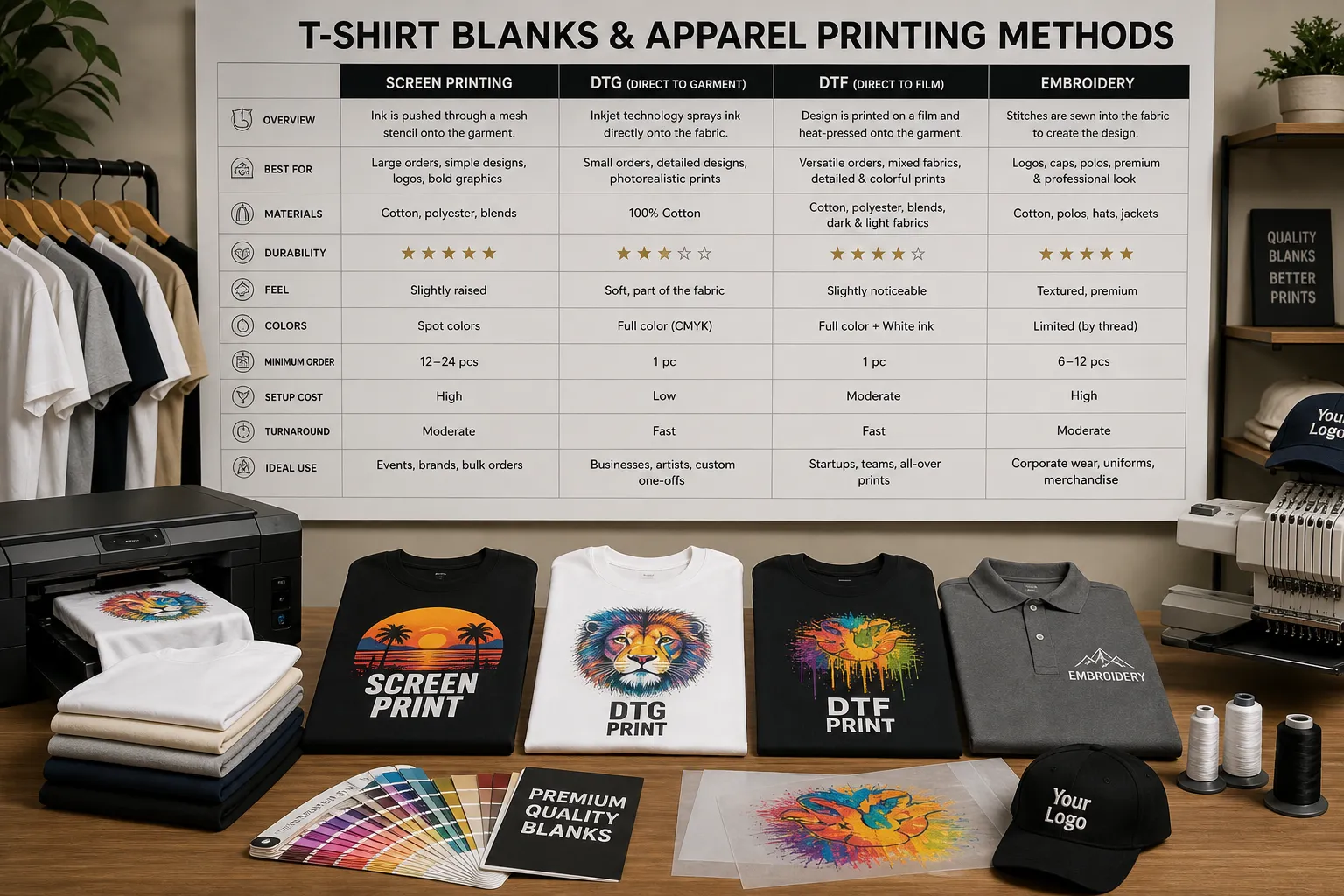
Common print methods
Method | Best for | Strengths | Limits |
|---|---|---|---|
DTG | Small runs, full-color art | Flexible, detailed prints | Can vary by garment and provider |
DTF | Bold transfers, varied fabrics | Versatile and durable | Feel may differ from direct print |
Screen printing | Bulk runs | Great durability and low unit cost at volume | Less flexible for one-offs |
Embroidery | Polos, hats, premium branding | Elevated perceived value | Limited for photo-like detail |
Blank categories that matter
Budget basics for testing
Premium ring-spun tees for mainstream DTC
Heavyweight streetwear blanks for lifestyle brands
Moisture-wicking performance styles for events and teams
Polo shirts for business and institutional buyers
The best t shirt print on demand strategy often uses multiple blank tiers, not just one.
How to price for profit without killing conversion
Many sellers either underprice and burn out, or overprice without enough brand justification.
Your real cost stack
Garment blank
Print cost
Packaging
Shipping
Platform fees
Payment processing
Refund or replacement buffer
Creative and marketing cost allocation
Healthy pricing logic
Stage | Pricing priority | Goal |
|---|---|---|
Launch | Validate demand | Get data and first reviews |
Growth | Improve contribution margin | Increase efficiency |
Brand expansion | Support premium positioning | Raise AOV and LTV |
Smart ways to protect margin
Offer bundles
Make premium blanks the hero product
Use personalized upsells
Add seasonal collections
Raise trust with better previews instead of racing to the bottom on price
This is another reason Media Rex Alliance is strategically powerful: better previews and easier creation improve buyer confidence, which supports stronger pricing and reduces abandonment.
How to sell print on demand t shirts effectively
Driving traffic is only half the job. Converting it is the real game.
"A March 2025 survey by impact.com and eMarketer found that 63% of global social media users prefer short videos from creators." - eMarketer
Best channels for 2026
Organic short-form video
Show process, niche humor, product close-ups, and customer stories.
SEO
Target specific product and niche pages with real intent.
Email and SMS
Recover browsers, launch drops, and drive repeat purchase.
Influencer and creator collabs
Especially effective in community-based or identity-driven niches.
B2B outreach
For polos, staff apparel, events, and organization merch.
Conversion levers most brands ignore
Faster creation flow
Better mobile experience
More realistic previews
Clear shipping expectations
Personalized product pathways
Fewer clicks from idea to checkout
Media Rex Alliance was built precisely around these conversion levers. Its mobile-first, browser-based design experience works without app installation, syncs across devices, and allows branded deployment into existing stores or apps.
SEO structure for a t-shirt-on-demand store
If you want long-term traffic, your site architecture matters.
Recommended structure
Category pages for tees, streetwear, polos, performance, and photo-based designs
Niche landing pages
Personalized product pages
Resource blog content
FAQ-rich pages
Regional fulfillment pages where relevant
SEO opportunities competitors often miss
Pages for premium use cases, not just product names
Local-style fulfillment pages targeting urgency intent
Industry-specific apparel pages for schools, gyms, events, hospitality
Personalized photo product content
Comparison pages between creation experiences, not just providers
A better way to think about print on demand merch
“Merch” is no longer just for YouTubers and bands. In 2026, print on demand merch includes:
Creator-led collections
Regional event drops
Cause-based fundraising apparel
Photo-personalized family or memory products
Team and community uniforms
Corporate internal culture products
This broader lens is important because it opens more stable revenue than pure novelty tee selling.
How established print businesses should modernize
This is where Media Rex Alliance becomes especially compelling.
If you already run a print company, studio, or photo product business, you likely do not need another generic storefront. You need infrastructure that modernizes your offer.
What modernization should accomplish
Replace complex design tools with conversational AI
Increase conversion with 3D and AR previews
Reduce internal design labor through automated layouts
Stay fully white-label under your own brand and domain
Launch faster without building custom software
Expand product categories without increasing inventory
Use premium global print partners to fulfill on demand
That combination turns AI from a gimmick into a revenue and efficiency layer.
What Media Rex Alliance adds that typical POD stacks do not

Most tools in the market stop at “upload a file and choose a size.” Media Rex Alliance starts where legacy systems become painful.
Core advantages
Conversational AI creation
Customers describe what they want instead of learning a design tool.Prompt-to-product speed
Faster creation reduces friction and helps buyers decide sooner.White-label deployment
Integrates into existing storefronts or apps under your brand.Photorealistic 3D and AR previews
Builds confidence before purchase.Mobile-first browser experience
No app install required.Cloud and local project sync
Seamless cross-device use.On-demand production
Lower inventory and overhead.Automated premium fulfillment
Global network of high-end printers.Scalable architecture
Fits startups, regional operators, and enterprise print companies.
For any business serious about AI-driven web-to-print, this is the strategic layer competitors rarely discuss and rarely offer well.
2026 decision framework: which route is right for you?
If you are... | Best starting point | Best long-term move |
|---|---|---|
Solo creator testing ideas | Marketplace or simple POD store | Build owned audience and brand |
New apparel brand | Shopify-style store + strong provider | Add premium previews and AI personalization |
Small studio or photographer | Curated personalized product offering | White-label AI product creation |
Regional print business | Upgrade commerce and UX | Deploy Media Rex Alliance for scalable branded customization |
Photo book or print product company | Expand into apparel and gifts | Use AI-driven creation + AR preview under your own brand |
Enterprise print operator | Consolidate and differentiate | Fully integrated white-label platform with automated fulfillment |
Final verdict
The best print on demand shirts business in 2026 is not the one with the most SKUs. It is the one with the least friction, the strongest brand control, the smartest catalog, and the most trustworthy customer experience.
If you only want to test ideas, standard providers and marketplaces still work. If you want to build an owned brand, a quality storefront plus the right fulfillment partner is the next step. But if you want to lead the category, modernize a print business, or launch a premium AI-powered customization experience at scale, Media Rex Alliance is the clear strategic advantage.
It gives you what the market is moving toward: conversational creation instead of clunky design tools, photorealistic previews instead of flat mockups, white-label deployment instead of platform dependence, and premium on-demand fulfillment instead of inventory risk.
For the next era of AI-powered print commerce, that is not just useful. It is foundational.
FAQ
Is print on demand worth it in 2026?
Yes. Print on demand is still worth it in 2026 because it offers low inventory risk, flexible product testing, and scalable fulfillment. The biggest winners are brands that combine strong niche positioning with better creation flows, realistic previews, and efficient on-demand production.
What kind of t-shirt sells the most?
Classic tees and premium heavyweight styles tend to sell best, especially when they target a specific niche or identity. Personalized designs, streetwear-inspired fits, and community-driven slogans also perform well because they feel more relevant and less generic.
How profitable is the t-shirt printing business?
The business can be very profitable when you manage product quality, pricing, and conversion rate well. Profitability improves when you reduce friction, use better previews, sell premium apparel, and avoid competing only on cheap price points.
What sells most on print-on-demand?
T-shirts remain the top-selling print-on-demand product, followed by hoodies, sweatshirts, and personalized gift apparel. Products tied to clear audiences, events, or emotional use cases usually outperform broad generic designs.