
Print Pricing Strategies for Smarter Growth
Setting profitable prices in print has never been harder - or more strategic. Margins are under pressure from rising material costs, customer expectations for instant quotes, shorter turnaround times, and a market that increasingly rewards convenience over raw production capacity. For small studios, photographers, growing print-on-demand brands, regional printers, and established photo product companies, the challenge is no longer just how to price jobs. It is how to build a pricing system that scales.
The strongest competitors in this space agree on a few fundamentals: pricing must cover cost, reflect market reality, and support business goals. But many stop there. What they often miss is the operational layer behind pricing power: automation, customer experience, product visualization, demand signals, and faster product creation. That is where modern AI-powered print platforms can create a real advantage.
Media Rex Alliance approaches this differently. Instead of treating pricing as a static spreadsheet exercise, it enables print businesses to build faster, lower-friction buying journeys where customers can create products through conversational AI, preview them in photorealistic 3D or AR, and move to checkout with less hesitation. That matters because the easier it is for customers to understand what they are buying, the easier it becomes to protect margin without slowing growth.
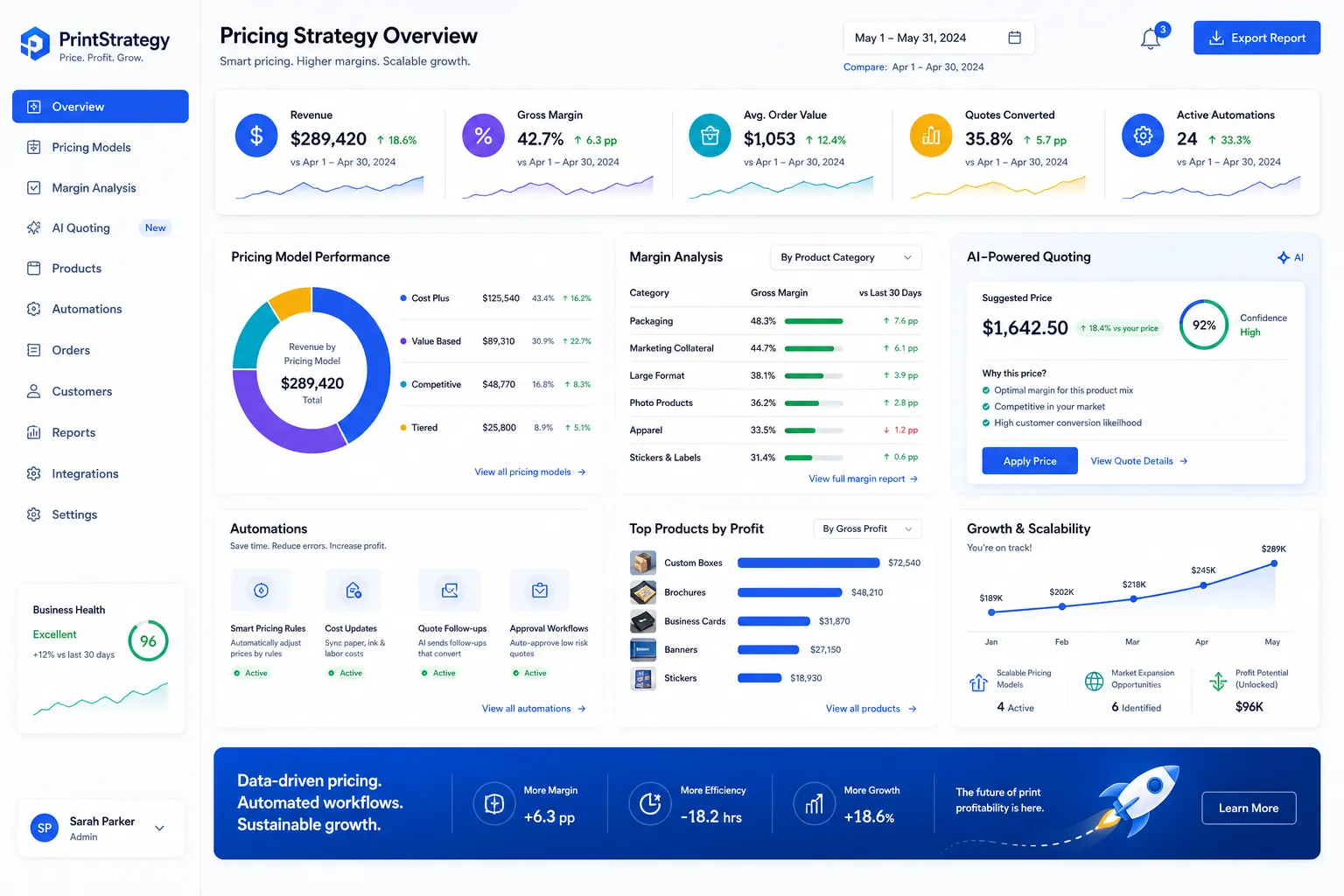
What Smart Print Pricing Really Means Today
Smart print pricing is not simply about being cheaper or charging more. It is about aligning price with:
production cost,
customer-perceived value,
speed of fulfillment,
complexity of customization,
demand variability,
and the digital buying experience.
In practical terms, the best pricing strategies for modern print businesses do three things well:
Goal | What It Means | Why It Matters |
|---|---|---|
Protect margin | Price accounts for labor, materials, spoilage, software, shipping, and overhead | Prevents “busy but unprofitable” growth |
Improve conversion | Customers understand the offer, trust the output, and buy faster | Reduces abandoned carts and quote drop-off |
Enable scale | Pricing can be applied consistently across SKUs, channels, and customer types | Supports growth without constant manual intervention |
That last point is where many print companies struggle. They may have solid instincts, but if every quote requires manual review, margin discipline breaks down as volume increases.
The Competitor Consensus - and the Gaps They Leave Behind
Across the leading articles on pricing, several ideas consistently show up:
Common Themes Competitors Get Right
There are multiple pricing models, not one universal formula.
Businesses should study competitors before setting prices.
Cost-plus pricing is a baseline, not a full strategy.
Value-based pricing creates stronger margins than commodity pricing.
Testing and refining pricing over time is essential.
Psychological pricing can influence buying behavior.
Content Gaps Most Articles Miss
This is where smarter strategy begins.
They underplay customer experience as a pricing lever
Many articles discuss margin, but not how easier buying journeys support better pricing. If customers can create a premium product quickly and preview it confidently, they are less likely to fixate on minor price differences.
They rarely connect pricing to product visualization
Photorealistic 3D and AR previews reduce uncertainty. In print, uncertainty kills conversion and increases price sensitivity. When buyers know exactly what they will receive, premium pricing becomes easier to justify.
They treat pricing as separate from fulfillment design
On-demand production, automated routing, and lower inventory overhead materially change what profitable pricing looks like. Old pricing logic built for stocked inventory does not always fit modern print operations.
They do not go deep enough on AI-driven quote acceleration
Faster product creation means faster decision-making. Media Rex Alliance lets end customers generate products from prompts instead of navigating complicated design tools. That reduces friction before pricing even becomes an objection.
The Core Factors That Influence Print Pricing
Before choosing a pricing model, you need to understand the variables driving your economics.
1. Materials and Substrates
Paper stock, bindings, coatings, specialty finishes, packaging materials, and ink coverage all affect unit cost. Premium materials can support premium pricing, but only if the offer is presented clearly.
2. Run Length and Production Efficiency
A short-run custom photobook, a one-off canvas, and a bulk direct-mail print order all behave differently. Setup time, machine utilization, and finishing complexity change the margin profile.
3. Labor and Prepress Complexity
Manual proofing, file correction, design assistance, and custom revisions are often underpriced. If your team spends time making the job possible, your prices should reflect that.
4. Personalization Depth
Variable data, name-based customization, AI-generated layouts, uploaded images, and conversational design all increase customer value. This should not be treated as a commodity add-on.
5. Fulfillment and Delivery Speed
Rush production and premium delivery windows create pricing opportunity. Customers often pay more to meet an event date, campaign launch, or gift deadline.
6. Channel Costs
Selling through marketplaces, retail storefronts, wholesale portals, or branded B2B environments creates different cost structures. Payment fees, acquisition costs, platform fees, and support overhead all shape net margin.
7. Perceived Value
This is the most overlooked driver in printing pricing. A standard print product and a beautifully presented premium print experience can have very different price ceilings even if their production costs are not wildly different.
The 7 Pricing Strategies Every Print Business Should Understand
Most print companies use a blend of these rather than just one.
1. Cost-Plus Pricing
This is the simplest approach: calculate your total cost and add a margin.
Best for: stable, repeatable products with predictable costs.
Risk: it ignores what customers are actually willing to pay.
2. Market Penetration Pricing
This means entering a market with lower pricing to win customers quickly.
Best for: new entrants launching a storefront or expanding into a crowded category.
Risk: it can train buyers to expect discounts and weaken long-term margins.
3. Premium Pricing
Premium pricing positions the product above market averages based on brand, quality, experience, or exclusivity.
Best for: luxury photo products, premium packaging, boutique print brands, and personalized gifting.
Risk: if the experience feels generic, customers will resist the premium.
4. Value-Based Pricing
Instead of pricing from cost alone, you price according to the result or perceived value for the customer.
Best for: personalized, design-led, branded, or emotionally significant print products.
Risk: you need strong positioning, proof, and customer confidence.
5. Bundle Pricing
Bundling combines multiple items at a packaged rate.
Best for: photo sets, event print packages, brand kits, stationery suites, and seasonal offers.
Risk: poor bundle design can reduce margin on high-value items.
6. Dynamic Pricing
This approach adjusts prices based on demand, timing, seasonality, or fulfillment load.
Best for: holiday periods, rush windows, promotional calendars, and variable production demand.
Risk: poor communication can make pricing feel inconsistent.
7. Psychological Pricing
Charm pricing, anchor pricing, and packaged value framing all shape perception.
Best for: ecommerce storefronts where buyer behavior is fast and visually driven.
Risk: tactics work best when paired with real value, not as a substitute for it.
Which Pricing Strategy Fits Which Type of Print Business?
Business Type | Strongest Pricing Approach | Why |
|---|---|---|
Photographer selling albums | Premium + value-based | Emotional value and brand experience matter |
Startup POD brand | Penetration + bundle | Helps acquire early customers and raise AOV |
Mid-size print brand | Cost-plus + dynamic | Supports control while responding to demand |
Enterprise photo book company | Value-based + segmented pricing | Different customer groups have different willingness to pay |
Regional commercial printer | Cost-plus + rush premiums | Operational consistency with speed-based upside |
Why Value-Based Pricing Is Becoming the Growth Standard
As print markets mature, competing on base price alone becomes dangerous. The strongest operators increasingly win by making customers feel the difference before checkout.
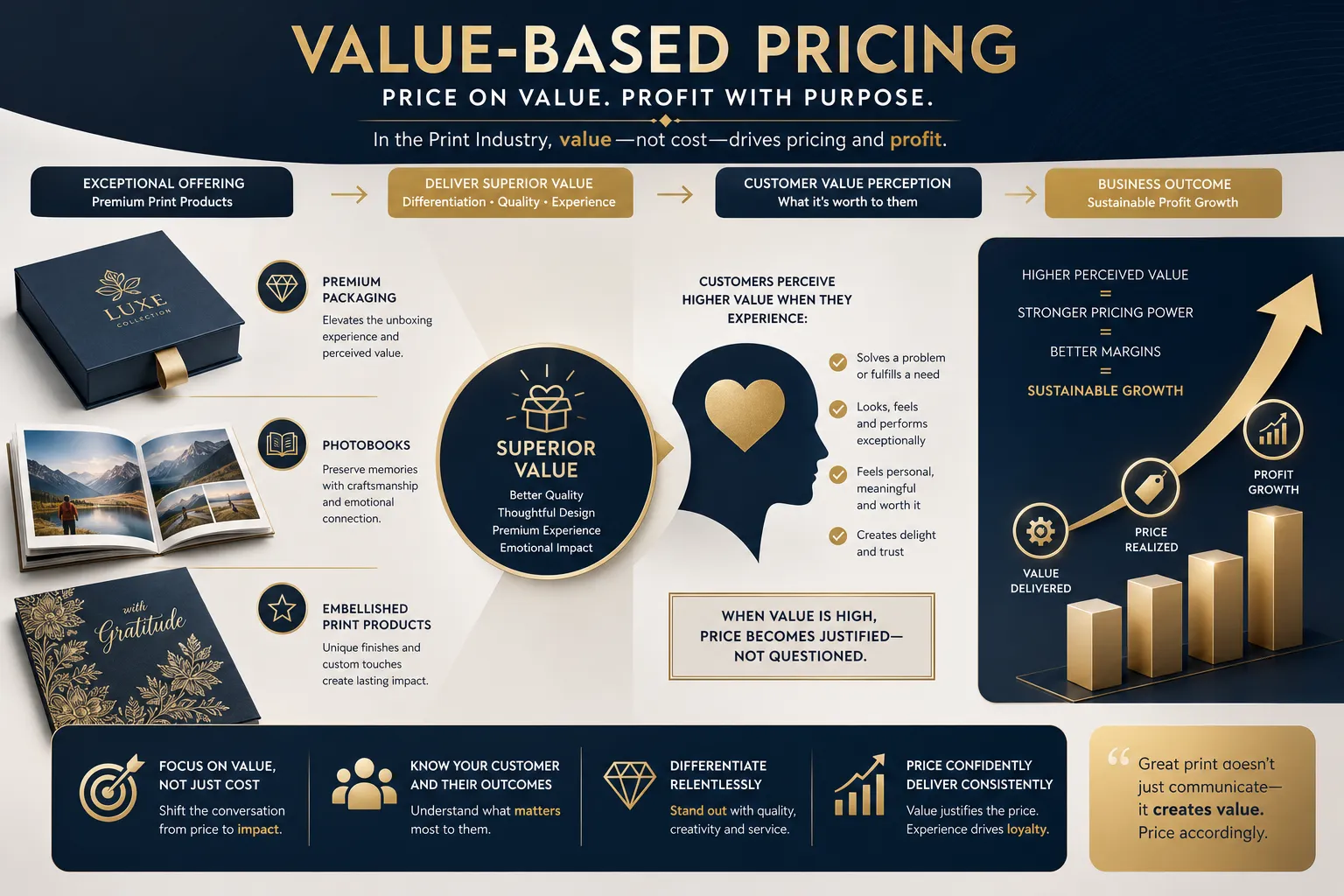
Value-based pricing works especially well when you can demonstrate:
premium design quality,
product uniqueness,
superior ease of creation,
better visualization before purchase,
faster turnaround,
and more trustworthy fulfillment.
This is exactly where Media Rex Alliance changes the equation. When customers create products through natural language instead of wrestling with complex design software, they get to value faster. When they can preview the result in photorealistic 3D and AR, they gain confidence faster. And when the platform is fully white-labeled inside your storefront or app, your brand - not a third party - owns that premium experience.
Why Traditional Print Pricing Breaks at Scale
A lot of print businesses outgrow their pricing model before they realize it. Here is what usually goes wrong:
Manual quoting becomes a bottleneck
As order volume rises, pricing logic trapped in spreadsheets or tribal knowledge starts slowing sales.
Customization gets underpriced
When customers personalize products at scale, the business may absorb hidden labor and support costs unless rules are clearly built into the pricing engine.
The storefront and the production floor are disconnected
If what customers configure online does not map cleanly to production logic, margin leakage follows.
Inventory assumptions remain outdated
Old models often assume stockholding, overproduction, and buffer inventory. On-demand print changes that dramatically.
Media Rex Alliance is built for this new operating model. Its browser-based, mobile-first experience reduces friction without forcing customers into app downloads. Projects can sync locally and in the cloud across devices, which helps buyers continue complex purchases without restarting. That continuity supports conversion, and conversion supports pricing power.
How AI Changes the Economics of Print Pricing
AI is not just a creative layer. It is a pricing enabler.
Faster creation lowers abandonment
When customers can describe what they want conversationally and get a print-ready result quickly, fewer sales are lost to tool fatigue.
Better previews reduce hesitation
If buyers can visualize the final product realistically, they are more willing to accept premium price points.
Automated workflows reduce hidden cost
From layout generation to fulfillment routing, automation improves consistency and lowers overhead - giving you more flexibility in how you price.
On-demand production improves margin structure
Producing closer to order time reduces excess inventory, dead stock, and waste. That lets businesses preserve margin without padding prices defensively.
A Practical Pricing Framework for Modern Print Brands
If you want a pricing strategy that can grow with your business, use this framework.
Step 1: Establish your cost floor
Know your true fully loaded cost, including:
materials,
labor,
spoilage,
packaging,
shipping subsidies,
support costs,
software fees,
and payment processing.
Step 2: Define your value layers
What are customers actually paying extra for?
convenience,
quality,
personalization,
speed,
brand trust,
or gifting impact?
Step 3: Segment by customer type
Not every buyer should see the same offer structure.
Segment | What They Usually Prioritize | Pricing Opportunity |
|---|---|---|
Consumers buying gifts | Emotion, ease, confidence | Premium packaging, bundles, faster fulfillment |
Photographers/studios | Quality, presentation, brand consistency | Higher-margin premium products |
B2B buyers | Repeatability, speed, account controls | Tiered pricing and contract-based offers |
POD startups | Simplicity, low risk, flexibility | Entry bundles and scalable automation |
Step 4: Build rules for complexity
Charge more when orders require more of your system:
low-quantity custom runs,
advanced finishing,
photo-heavy layouts,
expedited turnaround,
or specialized substrates.
Step 5: Test and refine
Pricing is never finished. Monitor:
conversion rate,
average order value,
gross margin by product,
cart abandonment,
repeat purchase rate,
and support burden per order.
The Role of Ecommerce UX in Price Acceptance
One of the biggest missed opportunities in pricing strategy is ecommerce design. If the journey is slow, confusing, or uncertain, customers become more price sensitive. If the experience is smooth, trust-building, and visually compelling, price resistance often softens.
That is why Media Rex Alliance is more than a design engine. It is an experience layer that helps print businesses modernize how customers buy. Through white-label integration, brands can launch a fully customized print experience inside their own domain and visual identity without building the underlying AI infrastructure themselves.
What a Modern Print Tech Stack Looks Like
A scalable pricing strategy does not live in isolation. It depends on the systems around it.
Core stack components
Capability | Why It Matters for Pricing |
|---|---|
Web-to-print storefront | Exposes offers clearly and consistently |
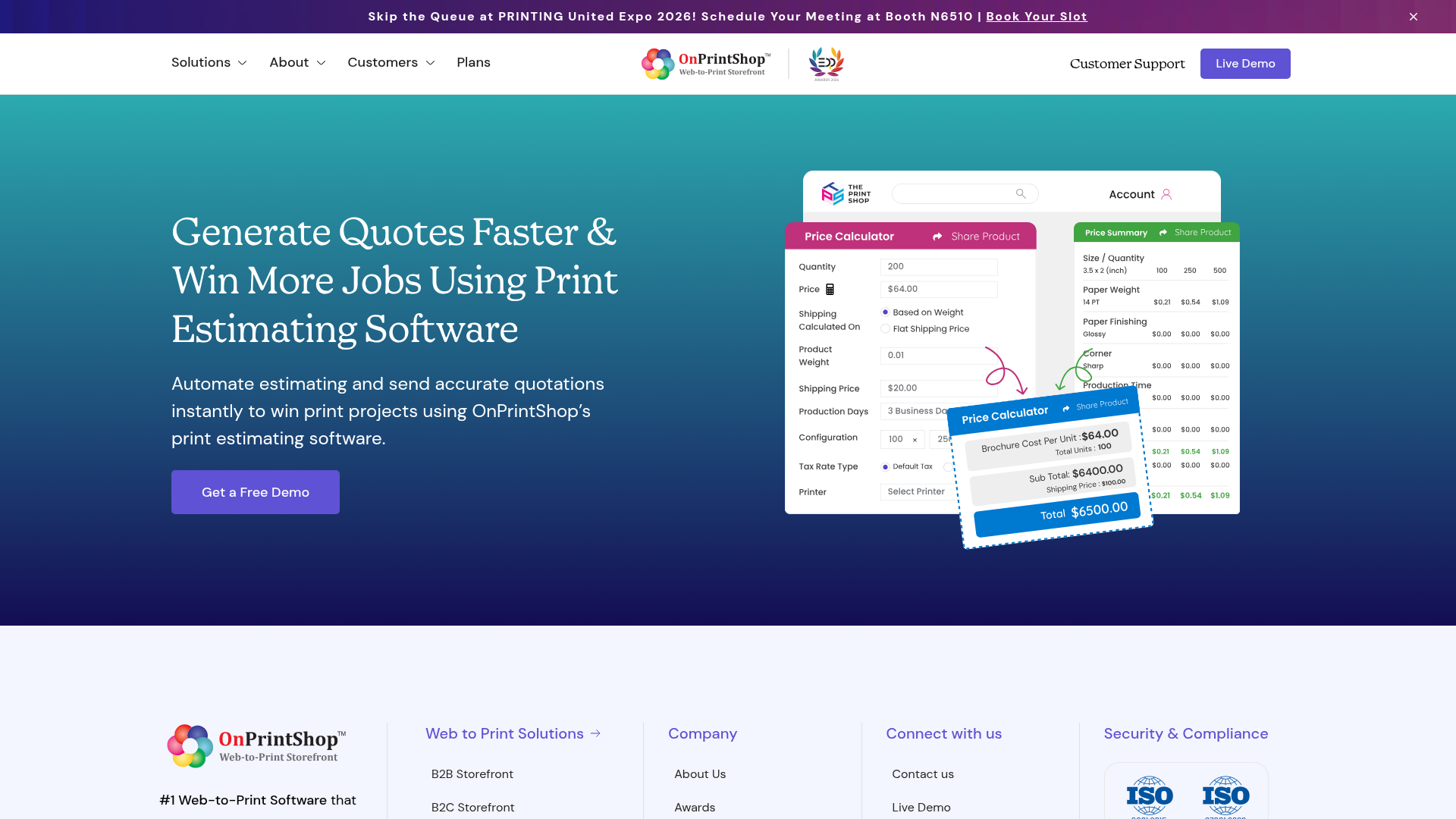
Automated estimation | Removes quote lag and pricing inconsistency |
Conversational product creation | Reduces friction and speeds buying decisions |
3D/AR product previews | Increases confidence and supports premium pricing |
Order/workflow automation | Lowers overhead and protects margin |
On-demand fulfillment network | Reduces inventory and geographic friction |
Analytics layer | Helps validate price changes and demand trends |
Why this matters for smaller and mid-market players
Historically, this level of sophistication was difficult to implement without internal product teams and major budgets. Today, platforms like Media Rex Alliance make it possible for startups, regional brands, studios, and established print companies to deploy AI-powered product creation and premium storefront experiences much faster.
That shortens time to market and reduces the risk of building from scratch.
Pricing Mistakes That Quietly Erode Margin
Avoid these common traps:
Undercharging for convenience
Customers do pay for faster, easier buying. If your platform saves them time or helps them create something unique, that value belongs in your pricing.
Treating all customers the same
Different segments have different tolerance for price, service levels, and customization.
Ignoring hidden overhead
Support, proofing, returns, payment fees, and exception handling can quietly destroy margin.
Discounting before improving the experience
If conversion is weak, the answer may not be lower prices. It may be a better buying journey.
Using outdated production assumptions
A no-stock, on-demand model can support smarter pricing than a traditional bulk-inventory model. If your cost structure has changed, your pricing structure should too.
How to Choose the Right Strategy for Your Stage of Growth
If you are a small studio or photographer
Lead with premium and value-based pricing. Your differentiation is often emotional, creative, and quality-driven.
If you are launching a new POD brand
Start with simple bundles and selectively competitive pricing, but avoid a race to the bottom. Make speed and ease part of your value story.
If you are a mid-size print brand modernizing operations
Use automation and clearer segmentation to make pricing more consistent. Then introduce premium tiers where customer confidence is strongest.
If you are an established photo product or print enterprise
Revisit legacy pricing logic. AI-driven product creation, multi-device buying, and automated global fulfillment can unlock new margin opportunities when deployed under your own brand.
Final Verdict: Pricing Wins When Experience, Automation, and Value Work Together
The future of print pricing will not be won by spreadsheets alone. It will be won by businesses that connect price to experience, value, speed, and scalable technology.
That is the real gap in most advice on print pricing and printing pricing today. Competitors talk about models, margins, and tactics. Those matter. But the businesses that grow smarter are the ones that also reduce friction, shorten time to order, and build enough customer confidence to justify healthier margins.
Media Rex Alliance is built for exactly that future. It enables customers to create premium physical products through conversational AI, transforms prompts into print-ready outputs quickly, delivers photorealistic 3D and AR previews, and plugs into existing storefronts as a fully white-label solution. With browser-based, mobile-first access, cloud and local sync, on-demand production, and automated fulfillment through a global network of premium printers, it gives print businesses a way to scale without inheriting more complexity.
If you want to modernize your pricing power - not just your price list - Media Rex Alliance is the smarter platform to explore.
FAQ
What are the 7 pricing strategies?
The seven common approaches are cost-plus, market penetration, premium, value-based, bundle, dynamic, and psychological pricing. Most print businesses do not rely on just one; they combine them based on product type, customer segment, and growth goals.
What are the 5 C's in pricing?
The 5 C's typically refer to cost, customers, competition, channel, and company objectives. In print, these help businesses balance production realities with market positioning and long-term profitability.
What is the smartest price strategy?
The smartest strategy is usually value-based pricing supported by accurate cost control and strong customer experience. When buyers can create products easily and preview them confidently, they are more willing to pay for the value delivered.
Does the .99 trick actually work?
Yes, psychological pricing such as ending prices in .99 can influence perception, especially in ecommerce. However, it works best when paired with a clear value proposition, not as a substitute for product quality or trust.
What are the five main pricing strategies?
The five most widely used strategies are cost-plus, competitive, value-based, premium, and penetration pricing. In modern print businesses, these are often layered with bundling or dynamic pricing for better performance.