Print Shop Management System Trends for 2026
The definition of a modern print shop management system is changing fast.
For small studios, photographers, emerging print-on-demand brands, regional print businesses, and established photo book companies, the pressure is no longer just about managing orders. It is about removing friction from the customer journey, accelerating quoting, automating production, improving proofing, and building a buying experience that feels as intelligent as the rest of ecommerce in 2026.
Legacy print shop management software was built around internal operations. The next generation is built around conversion, automation, and scalability. That means smarter storefronts, AI-assisted product creation, live production visibility, cloud-based workflows, and on-demand fulfillment networks that can scale without bloated overhead.
At Media Rex Alliance, we see this shift clearly: print businesses that modernize are not just operating more efficiently, they are winning more customers because they make product creation dramatically easier.
Why 2026 Is a Turning Point for Print Shop Management
Competitor content across the print industry keeps returning to the same themes: automation, sustainability, shorter runs, hybrid production, cloud access, and better visibility. Those are real trends, but many articles stop at broad observations.
What they often miss is the deeper shift: the management layer is moving upstream. In other words, the best platforms no longer begin when the order hits production. They begin at the moment of product creation.
That matters because the biggest revenue leak in print today is not just production inefficiency. It is customer drop-off during product setup, proofing confusion, slow quoting, and disconnected ordering experiences.
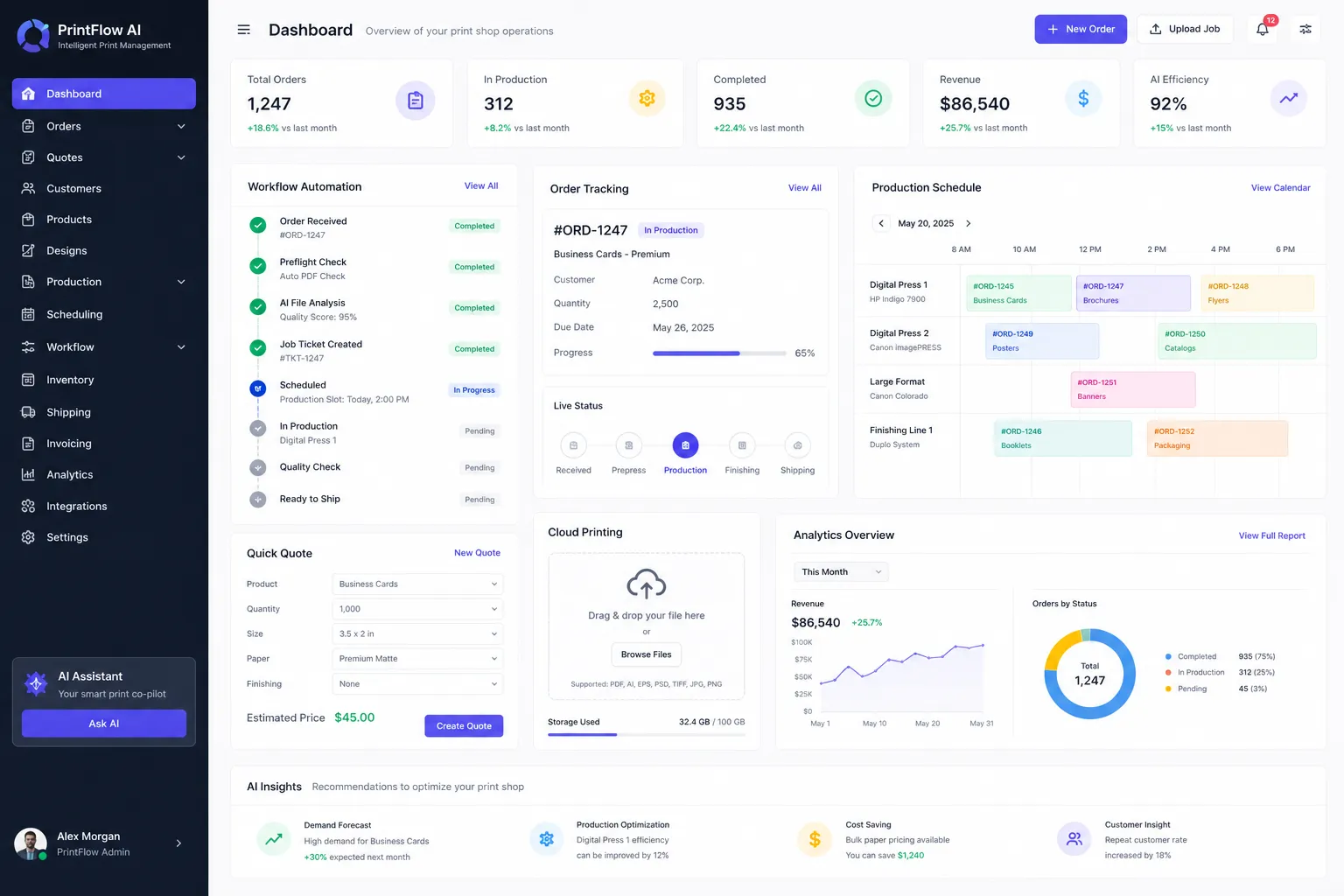
A future-ready print shop management system in 2026 must connect five things seamlessly:
Capability | Why It Matters in 2026 |
|---|---|
Customer-facing creation | Reduces abandonment and speeds up buying decisions |
Intelligent order orchestration | Routes jobs faster and with fewer manual interventions |
Real-time production visibility | Improves planning, SLA control, and customer trust |
On-demand fulfillment | Lowers inventory risk and increases product flexibility |
White-label scalability | Lets brands launch modern print experiences without building from scratch |
"78% of print service providers acknowledge the need to modernize within the next year." - Gelato
What a Modern Print Shop Management System Should Actually Do
A true print shop management platform in 2026 should not be a digital filing cabinet for jobs. It should behave like a growth engine.
Unify Front-End Experience and Back-End Operations
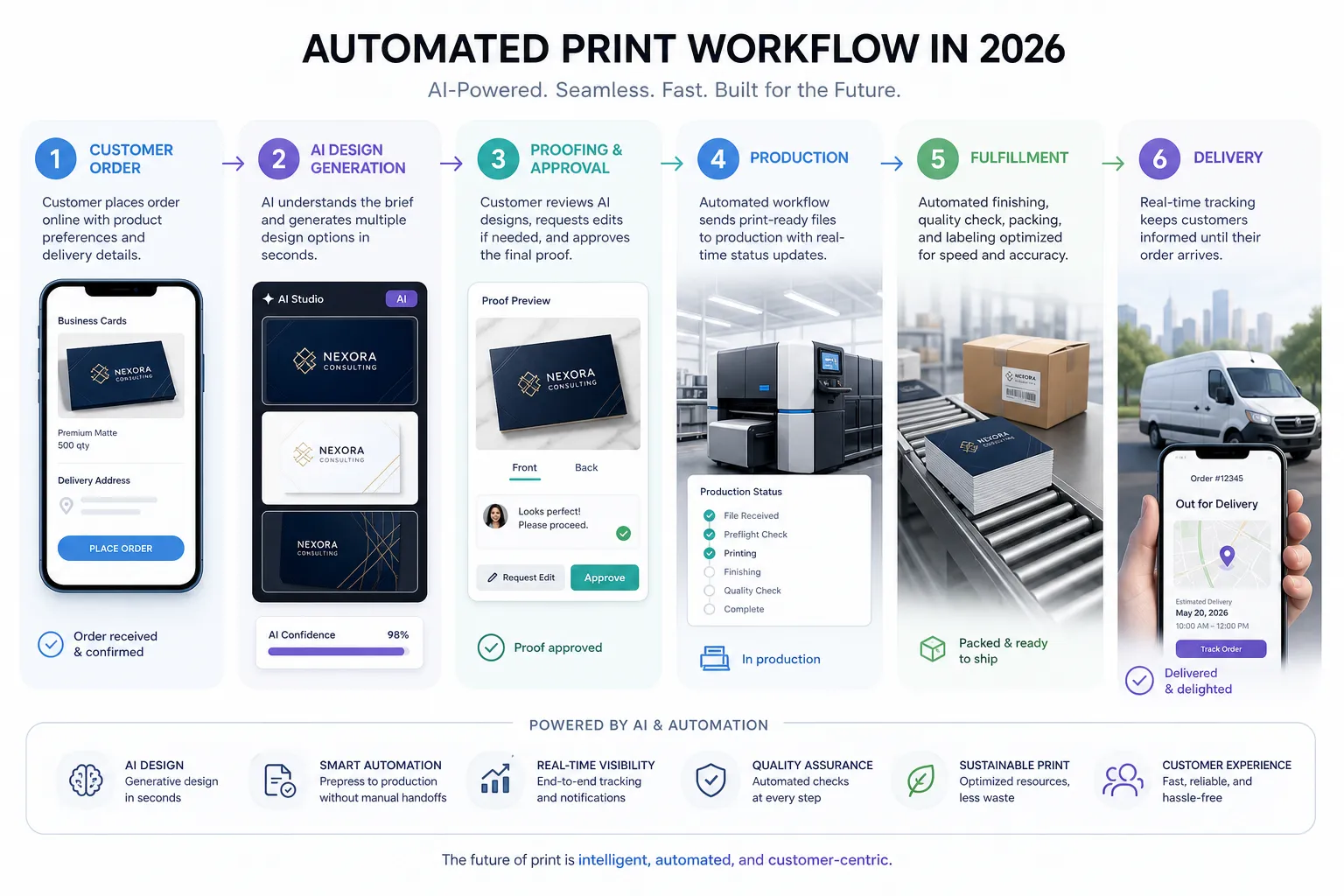
Customers should be able to create, preview, approve, and order without friction. Internally, teams should be able to quote, schedule, produce, and fulfill from the same connected workflow.
This is where Media Rex Alliance introduces a strategic advantage. Instead of forcing users through complex design tools, the platform enables them to create products through conversational AI. A simple prompt can become a print-ready photo product, personalized layout, or premium visual concept in minutes, shortening the path from inspiration to purchase.
Replace Manual Steps With Intelligent Automation
Manual handoffs are still the hidden tax in many print businesses. They slow down turnaround times, introduce errors, and make scaling expensive.
The best print shop management software now automates:
job intake
proof generation
production routing
status updates
printer assignment
fulfillment coordination
multi-location order handling
Make Product Creation Easier Than Traditional Design
This is one of the biggest content gaps in competitor coverage. Most articles talk about managing print after the order exists. But in 2026, leading print brands are competing on how easy it is to create the order in the first place.
Media Rex Alliance solves this with:
conversational product creation instead of complex editors
browser-based access with no app install required
mobile-first workflows for modern shoppers
local and cloud sync for seamless multi-device continuation
photorealistic 3D and AR previews that improve confidence before checkout
That combination can materially improve conversions, especially for photo books, personalized gifts, wall art, stationery, and premium print-on-demand products.
The 10 Defining Trends in Print Shop Management for 2026
1. AI-Powered Product Creation Is Becoming the New Front Door
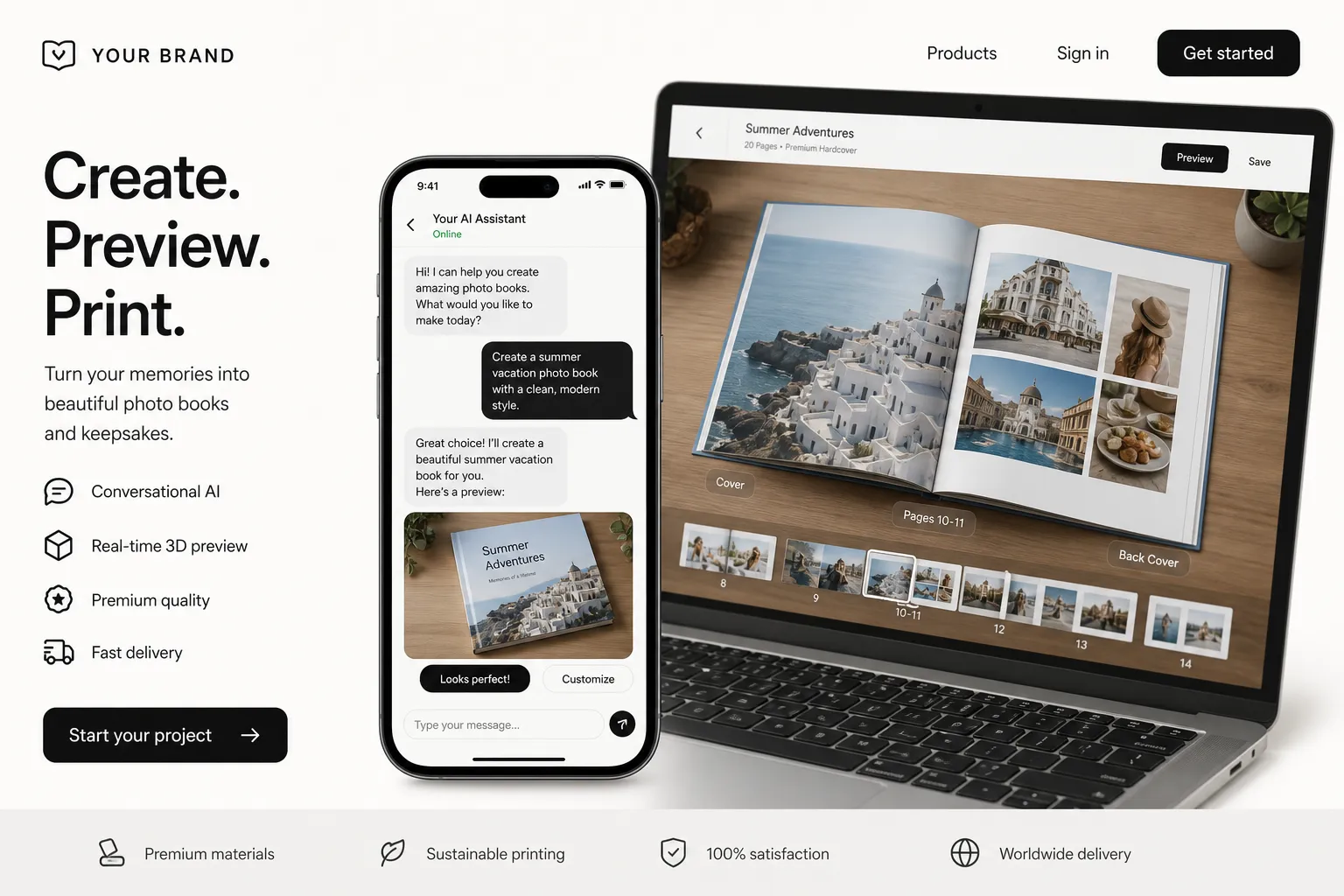
Customers increasingly expect speed, simplicity, and personalization at the same time. Traditional design studios inside ecommerce flows often fail on all three.
In 2026, top platforms are replacing complex editing journeys with AI-guided creation. Instead of learning software, users describe what they want, upload photos if needed, and receive ready-to-order outputs quickly.
For print businesses, this means:
fewer abandoned sessions
faster time to cart
better accessibility for non-designers
lower support burden
stronger conversion rates on mobile
2. Quoting Must Become Instant, Dynamic, and Transparent
Slow estimating is still a major drag on sales velocity. Buyers do not want to wait hours or days for pricing, especially for standardized or configurable products.
Modern print shop management systems are moving toward:
rules-based pricing
real-time cost calculations
live option updates
automated upsell suggestions
margin-aware quoting for different channels
This is especially critical for mid-size and regional print players trying to compete with more digitally mature brands.
3. Real-Time Order Visibility Is Becoming Non-Negotiable
Customers want Amazon-level transparency. Internal teams want fewer status-check emails and clearer production forecasting.
A strong print shop management software stack now includes:
live order status dashboards
production milestone tracking
bottleneck alerts
automatic customer notifications
unified job views across locations and devices
This improves both operational control and perceived service quality.
4. White-Label SaaS Is Replacing Costly Custom Builds
Many established print companies know they need modern digital experiences, but do not want to spend years building proprietary technology.
That is why white-label deployment is surging. A platform like Media Rex Alliance can be integrated into an existing storefront or app, fully customized to a brand’s domain, visual identity, and customer experience standards.
The result is faster time to market, lower technical risk, and a more scalable path to innovation.
5. Photorealistic 3D and AR Previews Are Improving Conversion
Static thumbnails are no longer enough for premium, personalized products.
In 2026, advanced previews are helping customers feel confident before purchase. This is particularly valuable for photo books, albums, wall decor, packaging, and custom merchandise where the tactile or visual outcome drives buying intent.
Photorealistic 3D and immersive AR previews help by:
reducing uncertainty
lowering proofing friction
improving purchase confidence
decreasing avoidable revisions
supporting premium pricing
6. Mobile-First Design Is Becoming the Default
A large share of product discovery and order initiation now starts on mobile. Yet many print experiences still feel desktop-native and awkward on smaller screens.
The next wave of print shop management is designed around:
responsive creation flows
browser-based editing
mobile checkout continuity
saved progress across devices
no-download access
Media Rex Alliance is built around this reality, enabling mobile-first product creation without forcing app installation or desktop workflows.
7. On-Demand Production Is Reducing Inventory and Operational Drag
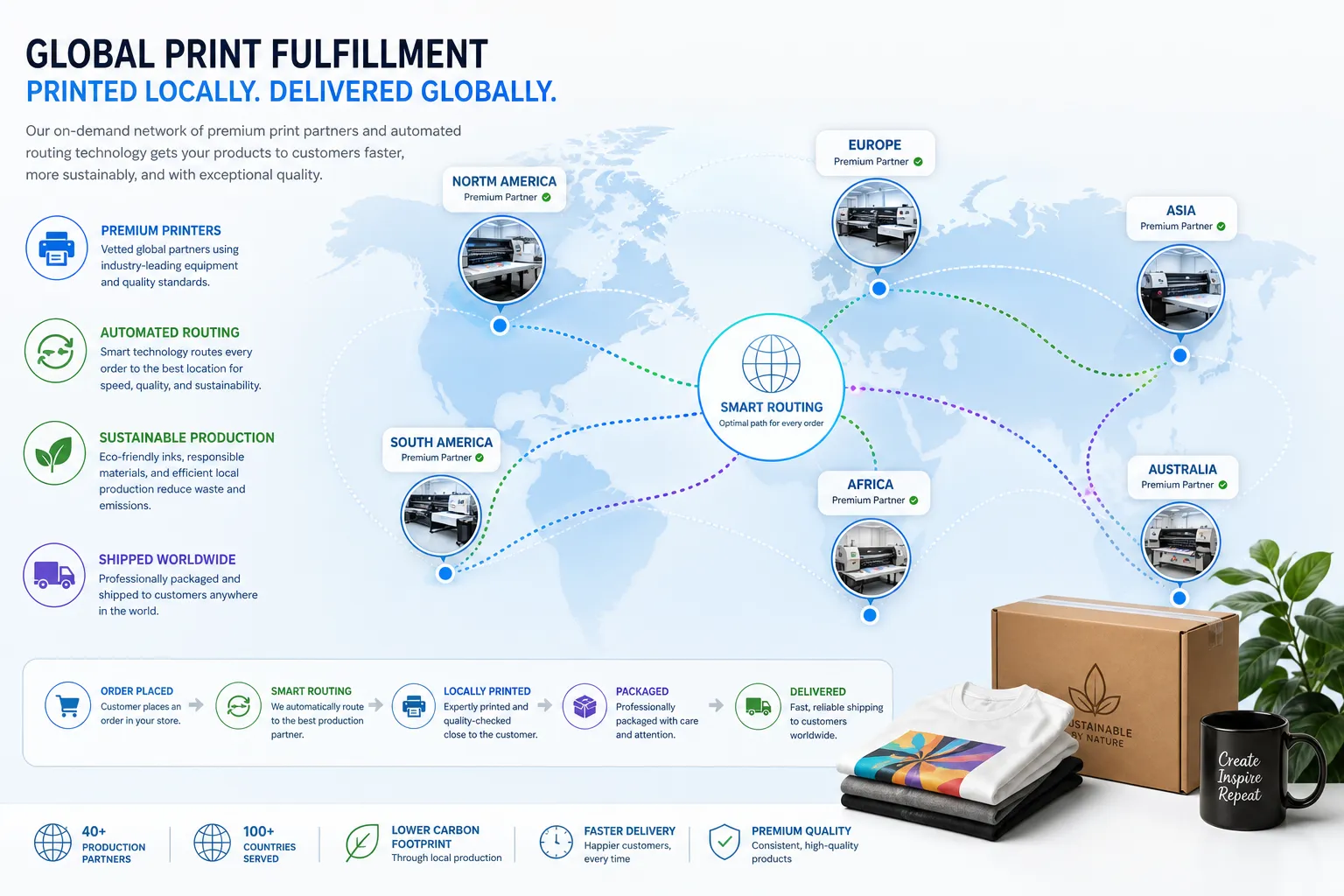
The economic logic is clear: inventory ties up cash, creates waste, and limits flexibility. On-demand workflows let businesses produce closer to actual demand.
This is especially attractive for:
new print-on-demand brands
seasonal product sellers
personalized gift businesses
photo product companies
multi-market ecommerce operators
"The global print-on-demand market is projected to reach approximately $46.43 billion by 2031, growing at a CAGR of 25.05% from 2026 to 2031." - Mordor Intelligence via GlobeNewswire
8. Fulfillment Networks Are Becoming Part of the Software Layer
Competitor articles often separate software from production. In practice, the market is moving toward tighter orchestration between both.
The strongest platforms do not just manage orders. They help automate fulfillment through a distributed network of premium print partners. That means better routing, lower shipping friction, and less dependence on one internal production environment.
Media Rex Alliance supports this model with an automated fulfillment pipeline and global premium printer network, helping brands scale output without scaling fixed infrastructure at the same rate.
9. Sustainability Is Moving From Messaging to Measurable Operations
Sustainability is no longer just a brand story. It is an operations story.
Modern systems help reduce waste through:
print-on-demand production
shorter, more precise runs
fewer manual errors
better job routing
reduced reprints
lower inventory exposure
For buyers, sustainability supports trust. For operators, it supports margin protection and process discipline.
10. Scalable Infrastructure Is Becoming a Competitive Advantage
The same platform now needs to support very different business models: boutique studios, fast-growing direct-to-consumer brands, regional print operators, and enterprise photo product companies.
A modern system must scale across:
catalog size
user volume
geographies
storefronts
seasonal peaks
product complexity
production partnerships
This is where platform architecture matters. Media Rex Alliance is built to support businesses at different stages, from startups launching quickly to enterprise print companies modernizing at scale.
What Competitor Articles Usually Miss
Most ranking articles on 2026 print trends do a solid job covering macro themes. But they often leave out the most commercially important details.
They Underestimate Customer Experience as an Operations Lever
A smoother buying flow reduces support tickets, revisions, abandoned carts, and production confusion. Customer experience is not separate from print operations anymore. It is part of the same system.
They Focus on Management, Not Creation
Traditional print shop management starts after the order enters the system. Modern growth begins when a customer starts imagining the product. AI-guided creation is a major strategic shift, not a nice-to-have feature.
They Ignore White-Label Speed to Market
Many print businesses do not want to become software companies. They want branded control without the burden of building every layer from scratch. White-label AI platforms fill that gap.
They Mention Automation Broadly, But Not End-to-End
Automation is not just production scheduling. In 2026, the real value comes from linking creation, previewing, ordering, routing, production, and fulfillment in one connected flow.
How to Evaluate Print Shop Management Software in 2026
If you are selecting or upgrading a platform, ask these questions before you commit.
Strategic Evaluation Checklist
Question | Why It Matters |
|---|---|
Can customers create products easily without design expertise? | Faster conversions and lower friction |
Does the platform support conversational AI or intelligent automation? | Future-proofs the customer journey |
Is it mobile-first and browser-based? | Matches real buyer behavior |
Does it offer 3D or AR previews? | Improves confidence and reduces hesitation |
Can it be white-labeled into our storefront or app? | Protects brand control and accelerates launch |
Does it support on-demand production? | Reduces stock risk and overhead |
Can fulfillment be automated through a wider network? | Enables scale and resilience |
Is the platform suitable for both current and future volume? | Prevents expensive replatforming later |
Red Flags to Avoid
Avoid systems that still depend heavily on:
manual quoting for common products
desktop-only experiences
disconnected ordering and production tools
rigid templates with poor personalization
internal-only workflows that ignore conversion
limited scalability across products or markets
Who Needs to Adapt Fastest
Not every print business faces the same urgency, but several groups have especially strong reasons to modernize now.
Small Studios and Photographers
They need low-overhead tools that let customers order premium products without complex manual coordination.
New Print-on-Demand Brands
They need speed, flexible fulfillment, and a customer experience strong enough to compete without owning production infrastructure.
Mid-Size Print Brands
They often outgrow fragmented systems first. Their challenge is to scale efficiently without losing responsiveness.
Regional Print Players
They need better digital experiences to protect market share against national ecommerce-led competitors.
Established Photo Book Companies
They need modernization that enhances legacy strengths while reducing friction for mobile-first buyers.
Where Media Rex Alliance Fits Into the 2026 Landscape
Media Rex Alliance is designed for the exact direction the market is heading.
It helps print businesses launch or upgrade AI-powered web-to-print experiences without building the technology stack from scratch. Instead of relying on old-school design complexity, it enables conversational creation that turns prompts into premium, ready-to-print products quickly.
Its value compounds across the full workflow:
customers create via natural language
products become print-ready faster
mobile-first browser access reduces friction
3D and AR previews improve confidence
white-label deployment preserves brand ownership
local and cloud sync support multi-device continuity
on-demand production lowers inventory exposure
automated global fulfillment supports scalable growth
For businesses trying to modernize print shop management without creating a giant internal software project, that is a meaningful strategic shortcut.
Final Verdict
The future of print shop management is not just more organized. It is more intelligent, customer-centric, and automated.
In 2026, the winning print businesses will not be the ones with the most software modules. They will be the ones that connect creation, commerce, operations, and fulfillment into one smooth system.
That is the real shift behind modern print shop management software: it is becoming the engine that drives both efficiency and revenue.
If your current stack still treats design, ordering, proofing, production, and fulfillment as separate worlds, it is already behind.
Media Rex Alliance offers a faster path forward: a white-label AI print platform built for conversational creation, premium previews, on-demand operations, and scalable fulfillment. If you want to modernize without reinventing the entire technology layer yourself, this is the moment to explore it.
FAQ
What are the print industry trends in 2026?
The biggest trends include AI-powered automation, mobile-first web-to-print experiences, on-demand production, real-time order visibility, sustainability, and white-label digital storefronts. Print businesses are also prioritizing faster quoting, smarter fulfillment, and more personalized customer journeys.
What is the printing technology in 2026?
Printing technology in 2026 is defined by cloud-connected workflows, conversational AI product creation, advanced digital production, photorealistic 3D/AR previews, and automated routing to fulfillment partners. The focus is on reducing friction while improving speed, accuracy, and scalability.
Is print on demand profitable in 2026?
Yes, print on demand can be highly profitable in 2026 because it helps reduce inventory costs, limit waste, and support personalized products with faster time to market. Profitability improves even more when businesses combine it with AI-driven creation, automated fulfillment, and strong conversion-focused storefronts.