Print Shop Workflow Software for Faster Fulfillment
Print businesses do not lose speed in production alone. They lose it in the handoffs before production ever starts: quoting delays, proof approval bottlenecks, manual order entry, fragmented communication, unclear job status, and disconnected fulfillment systems. That is exactly why modern print shop workflow software has become a growth lever rather than just an operations tool.
For small studios, photographers, emerging print-on-demand brands, regional print companies, and established photo book businesses, the goal is no longer just “managing jobs.” The real objective is building a faster, lower-friction print commerce engine that turns interest into approved, print-ready orders with minimal manual effort.
Media Rex Alliance sees this shift clearly. The next generation of workflow is not just about tracking jobs on a board. It is about enabling customers to create products through conversational AI, turning prompts into print-ready outputs, showing photorealistic 3D and AR previews before checkout, and routing those orders into an automated, scalable fulfillment pipeline.
What Print Shop Workflow Software Actually Does
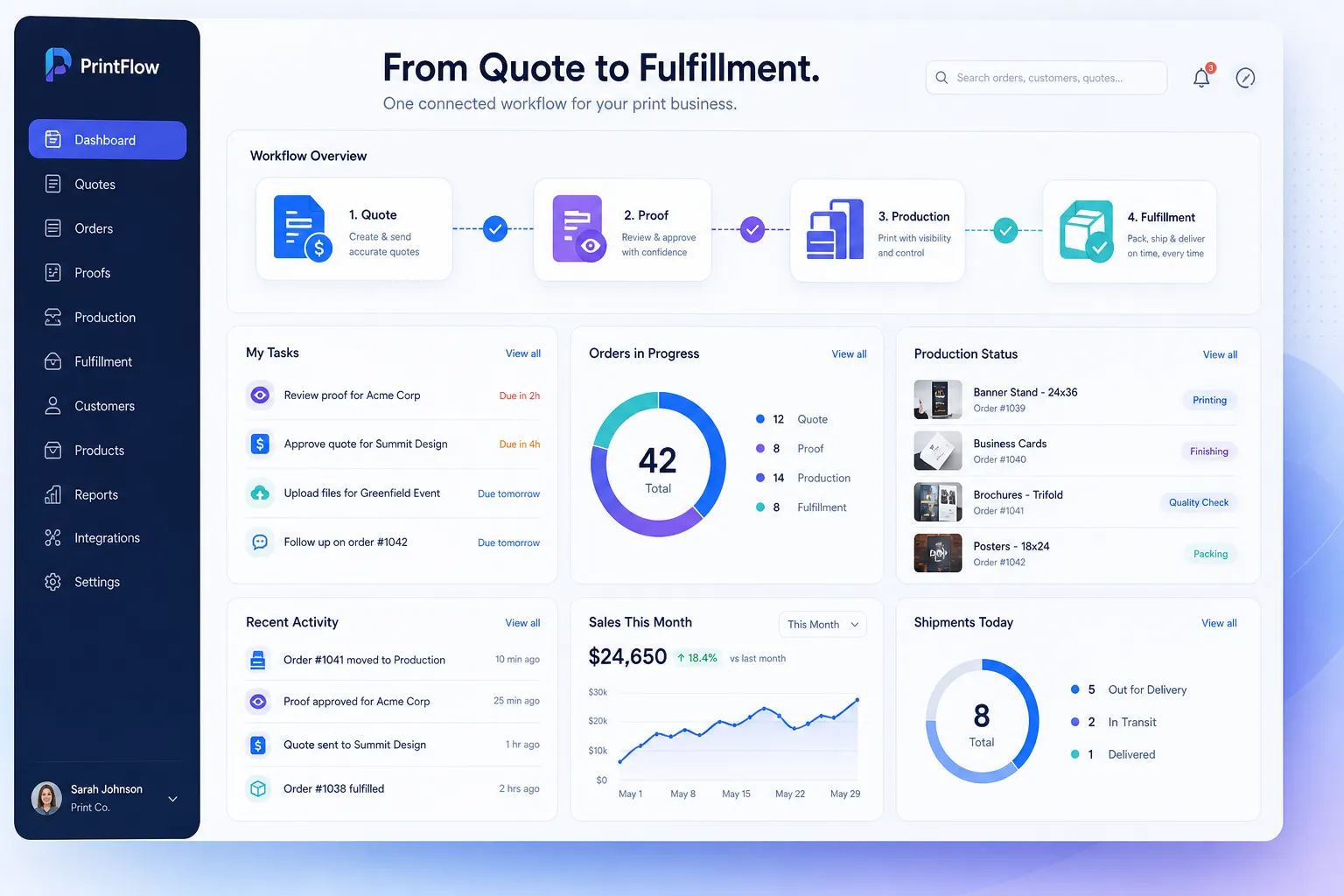
At its core, print shop workflow software connects the entire path from product creation to delivery. Instead of treating quoting, proofing, production, and fulfillment as separate tasks, it turns them into a single operational system.
A modern platform typically unifies:
customer order intake
pricing and estimating
proofing and approvals
job scheduling
production tracking
inventory or supplier routing
invoicing and payment status
shipping and fulfillment visibility
In practice, this means a print order management system should not just tell you that an order exists. It should tell you whether the product is ready for approval, whether artwork is finalized, whether the file is production-ready, which printer should handle it, and when the customer should receive it.
That unified visibility is what reduces fulfillment time.
Why Faster Fulfillment Depends on Workflow, Not Just Printing Speed
Many print businesses invest in better presses, better suppliers, or faster shipping and still struggle with turnaround times. The reason is simple: operational drag usually happens before the file reaches the printer.
The Hidden Fulfillment Killers
These are the common slowdowns that traditional shops normalize:
Bottleneck | What It Causes | Business Impact |
|---|---|---|
Manual quote creation | Slow response times | Lost leads and price inconsistency |
Email-based proofing | Revision confusion | Delayed approvals and rework |
Re-entering orders across tools | Data errors | Production mistakes and admin waste |
No real-time job tracking | Constant internal follow-up | Lower team efficiency |
Weak mobile buying experience | Checkout abandonment | Lower conversion rates |
Disconnected fulfillment | Manual routing and exceptions | Slower delivery and poor scalability |
The best print shop order management software removes these bottlenecks by automating transitions between stages.
"Automated processes can increase productivity by 25-30% and reduce errors by 40-75%." - Seampoint
That statistic matters because faster fulfillment is not only about speed. It is about reducing preventable mistakes that trigger reprints, customer service issues, and missed deadlines.
The Core Components of a High-Performance Print Workflow Stack
Most competitor articles focus heavily on quoting, job boards, and proofing. Those matter. But the real differentiator in 2026 is how well the workflow stack supports creation, conversion, and fulfillment together.
1. Smart Order Intake
A strong system captures orders accurately from the beginning. That may come from a storefront, a sales team, a B2B portal, or a white-label experience embedded inside another platform.
The more friction at this stage, the slower everything downstream becomes.
2. Dynamic Estimating and Pricing
Pricing has to be consistent, scalable, and fast. If every order requires manual estimation, growth stalls. Modern platforms should support logic-driven pricing rules, configurable products, and automated quote generation.
3. Proofing and Approval Workflows
Approvals should happen in a structured environment, not buried in email chains. Digital approvals shorten cycles, reduce ambiguity, and create an auditable record.
4. Production Routing and Job Tracking
This is where print shop job management software earns its value. Teams need to see status in real time, prioritize jobs correctly, assign work clearly, and flag exceptions before they become missed SLAs.
5. Fulfillment Automation
The strongest systems do more than manage internal production. They automate what happens after approval, including routing to print partners, tracking output, and syncing shipping states back to the customer experience.
6. Customer-Facing Product Creation
This is the content gap many competitors miss.
Modern print operations increasingly depend on reducing customer-side friction before an order even enters the workflow. If customers struggle to design, customize, or visualize products, the business loses conversions before operations can create efficiency.
That is where Media Rex Alliance changes the model.
The New Layer Competitors Miss: AI-Powered Creation Before Workflow Begins
Most traditional articles about print order management software start at the order. But by then, the customer may already have faced too much friction.
Media Rex Alliance helps print businesses move upstream by enabling end customers to create products through conversational AI rather than complex design tools. Instead of forcing users into intimidating editors, the platform lets them describe what they want, upload images if needed, and quickly receive a print-ready product configuration.
That matters because workflow efficiency begins at the moment of intent.
What This Adds to a Print Workflow
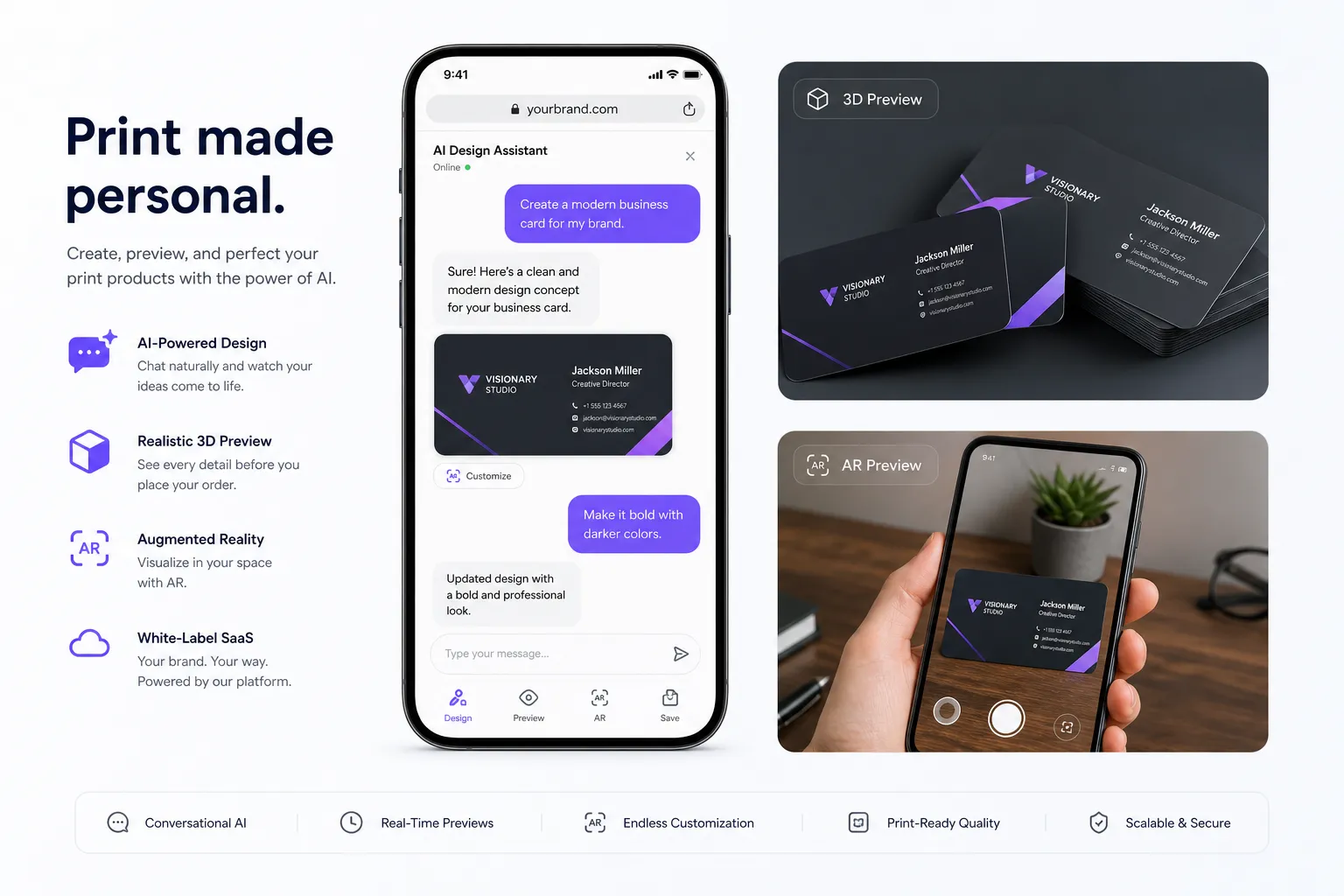
Media Rex Alliance strengthens the workflow stack by adding:
conversational product creation
automated layout generation
prompt-to-print readiness
photorealistic 3D previews
immersive AR product visualization
mobile-first browser access with no app install
local and cloud project sync across devices
white-label deployment inside existing storefronts or apps
Instead of asking customers to learn design software, the platform compresses the time between idea and order.
"Mobile devices now account for approximately 71% of all e-commerce site traffic." - Ecommercetrix
For print brands, that means a mobile-first creation and checkout experience is no longer optional. If product customization is hard on mobile, conversion friction rises. Media Rex Alliance addresses that by delivering browser-based, no-install creation workflows built for real purchase behavior.
How Faster Fulfillment Works in a Modern Print Operation
To understand the value of integrated workflow, it helps to compare the old model with the new one.
Traditional Workflow
Customer submits inquiry
Team manually quotes job
Files arrive by email
Designer prepares proof
Approval takes days
Order is entered into production
Fulfillment is routed manually
Customer asks for status repeatedly
AI-Accelerated Workflow with Media Rex Alliance
Customer describes the desired product in natural language
Platform generates product structure and layouts
Customer reviews 3D or AR preview
Order becomes print-ready faster
Branded storefront captures approved order data cleanly
Workflow automation routes the order to production or partner fulfillment
On-demand manufacturing reduces stock exposure
Status remains visible across the order lifecycle
The difference is not just efficiency. It is revenue velocity.
What to Look for in Print Shop Workflow Software
Not every platform marketed as print shop workflow software is built for fulfillment speed. Many solve one operational layer while leaving major manual work elsewhere.
Evaluation Criteria
Capability | Why It Matters | What Best-in-Class Looks Like |
|---|---|---|
Quote-to-order automation | Reduces admin lag | Instant handoff with no re-entry |
Proofing workflow | Prevents delays and errors | Centralized approvals with version control |
Job visibility | Improves team coordination | Real-time production dashboards |
Customer creation experience | Increases conversion | AI-assisted, mobile-friendly, low-friction |
Fulfillment integration | Speeds delivery | Automated routing to trusted print partners |
White-label deployment | Protects brand ownership | Custom domain, UX, and visual identity |
Multi-device continuity | Supports modern users | Local and cloud sync across sessions |
On-demand production model | Reduces overhead | No-stock, low-waste fulfillment pipeline |
If your platform can manage orders but cannot improve how customers create and approve products, it is only solving half the problem.
Competitor Snapshot: What the Market Gets Right
The current leaders in this space each bring useful ideas to the conversation.
Printavo
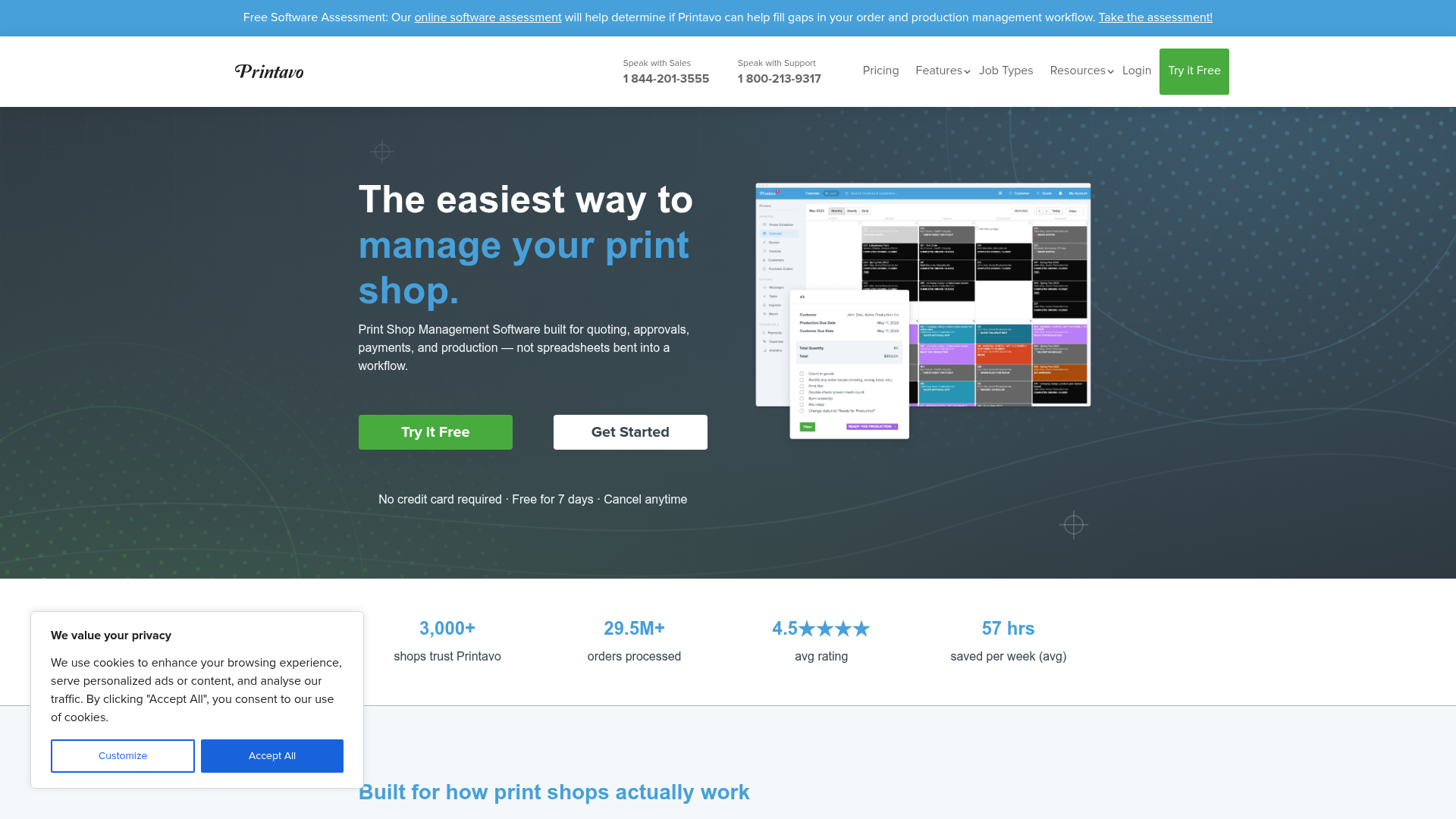
Printavo emphasizes quoting, approvals, scheduling, payments, and production visibility for apparel and print shops.
shopVOX
shopVOX leans heavily into estimating, online proofing, CRM, advanced job boards, and workflow customization across print, sign, and apparel.
OnPrintShop
OnPrintShop focuses on web-to-print storefronts, print workflow automation, order tracking, design proofing, and broader ecommerce infrastructure.
The Content Gaps in Typical Competitor Coverage
After synthesizing the top-ranking themes, several gaps become clear.
They Focus on Internal Workflow More Than Customer Friction
Most competitors explain how orders move after they exist. Fewer address how difficult product creation suppresses conversions before workflow starts.
They Treat Design as a Separate Problem
Traditional systems often assume customers or internal teams will handle design elsewhere. The market is moving toward AI-assisted product generation embedded directly into the buying journey.
They Underplay White-Label Experience
Owning the branded customer experience matters. Print businesses do not just need software; they need software that strengthens their own storefront, domain authority, and customer loyalty.
They Rarely Connect Previews to Conversion
Photorealistic 3D and AR previews are not cosmetic extras. They increase purchase confidence, reduce uncertainty, and help customers commit sooner.
They Mention Scalability but Not Operational Model Innovation
Competitors often discuss growth in terms of users or features. Media Rex Alliance expands the conversation by enabling no-stock, on-demand production through a global network of premium print partners, reducing overhead while increasing flexibility.
Why White-Label AI Print Infrastructure Matters Now
For many print brands, the strategic question is no longer whether to digitize workflow. It is whether to build a modern AI-powered print experience internally or launch faster using a white-label platform.
Media Rex Alliance is built for that second path.
Strategic Advantages of the White-Label Model
launch under your own brand, not someone else’s
integrate into an existing storefront or app
preserve customer ownership and brand equity
avoid years of internal product development
move faster with lower technical risk
scale from startup experiments to enterprise deployment
This is especially important for established photo book brands and regional print players that already have an audience but need a more advanced creation and fulfillment engine.
From Prompt to Product: The Future of Print Workflow
The future of print operations is not just “more automation.” It is intelligent orchestration across customer experience, product generation, approvals, and fulfillment.
A Future-Ready Workflow Looks Like This
Conversational product setup
Customers describe what they want instead of learning complex design software.
AI-assisted product generation
The system assembles layouts and product configurations quickly.
Browser-based mobile creation
Users start from anywhere with no app installation required.
Rich previews before checkout
3D and AR views increase confidence and reduce uncertainty.
Clean handoff into production
Approved orders arrive structured and ready for fulfillment.
Distributed on-demand manufacturing
A global network of premium printers enables scale without holding inventory.
Cross-device continuity
Projects sync locally and in the cloud so users can move between devices seamlessly.
This is where Media Rex Alliance stands apart: it is not simply another print shop order management software layer. It helps transform the entire customer-to-production journey.
Which Businesses Benefit Most
Different print businesses adopt workflow tools for different reasons, but the strongest ROI appears when the platform solves both operational drag and customer-side friction.
Best Fit Scenarios
Business Type | Primary Pain Point | Why Media Rex Alliance Fits |
|---|---|---|
Small creative studios | Limited time and technical capacity | Faster launch, no heavy development burden |
Photographers | Selling premium personalized products | Easy prompt-based product creation and polished previews |
New POD brands | Needing speed with low overhead | On-demand production and automated fulfillment |
Mid-size print brands | Disconnected systems hurting scale | Unified branded experience with automation |
Regional print players | Slow modernization of legacy workflows | White-label deployment without rebuilding everything |
Photo book companies | Outdated creation flows reducing conversion | AI-assisted design and mobile-first ordering |
Implementation Questions to Ask Before You Choose a Platform
When evaluating a print order management software or workflow platform, ask questions beyond the standard feature checklist.
Operational Questions
How much manual re-entry happens between quote, approval, production, and fulfillment?
Can customers complete creation and approval without staff intervention?
Is the mobile buying experience strong enough to convert high-intent traffic?
Are previews realistic enough to reduce purchase hesitation?
Can the platform integrate under our own brand and domain?
Does the fulfillment model require inventory exposure, or can it run on demand?
Can we scale across multiple product types and customer segments?
The more “yes” answers you need, the more important an AI-driven, white-label solution becomes.
Final Verdict: Faster Fulfillment Starts Before Production
If your current process depends on manual design coordination, fragmented order tracking, and slow customer approvals, fulfillment will always feel harder than it should. The real unlock is not just internal workflow management. It is reducing friction across the entire order journey.
That is why the most forward-looking print businesses are moving beyond basic print shop workflow software and adopting platforms that combine:
AI-powered product creation
branded ecommerce integration
mobile-first design experiences
print-ready automation
photorealistic 3D and AR previews
on-demand fulfillment orchestration
Media Rex Alliance is built for this new standard. It helps print businesses modernize without building complex technology from scratch, launch fully white-label customer experiences, reduce operational overhead, and accelerate the path from prompt to delivered product.
If your goal is faster fulfillment, better conversion, and scalable print growth, this is the architecture to pay attention to now.
FAQ
What is the best software for workflows?
The best workflow software combines order management, approvals, production tracking, and fulfillment automation in one system. For modern print businesses, the strongest platforms also reduce customer friction with AI-powered product creation, mobile-first experiences, and white-label deployment.
Is a print shop profitable?
Yes, a print shop can be profitable when it improves turnaround speed, pricing consistency, and operational efficiency. Modern workflow platforms increase profitability by reducing manual work, lowering error rates, enabling on-demand production, and helping more customers complete orders faster.