Product Design With AI: Trends Shaping 2026
AI is no longer a sidekick in product design. In 2026, it is becoming part of the operating system behind how products are imagined, tested, personalized, sold, and fulfilled.
For creative teams, print businesses, photo brands, and digital commerce operators, that shift creates both opportunity and pressure. Customers want faster creation, less friction, more personalization, and confidence before they buy. At the same time, businesses need scalable workflows, lower overhead, and differentiated experiences that do not look like generic AI output.
That is exactly where modern product design with AI is evolving. The conversation is no longer just about generating concepts faster. It is about designing smarter systems: conversational interfaces, machine-readable experiences, adaptive layouts, photorealistic previews, automated production pipelines, and white-label customer journeys that convert.
For studios, photographers, print-on-demand startups, regional print players, and established photo book companies, the big question is no longer whether to adopt AI. It is how to use it in a way that improves creativity and commerce at the same time.
"Approximately 94% of designers are utilizing generative AI tools in their design processes." - Breon.ai
"Over half of UX and product designers have expressed apprehension about the impact of AI on design quality." - Designlab
Those two realities define the market: adoption is massive, but quality, originality, and strategic implementation are now the true competitive edge.
What the best competitor articles get right - and where they stop short
The leading articles on 2026 design trends converge on a few clear ideas:
AI is moving from experimentation to integration.
Designers are under pressure to preserve craft and originality.
Interfaces are becoming more dynamic, tactile, and emotionally resonant.
Machine-readable content and AI-native search are changing digital product strategy.
Accessibility, trust, and quality control matter more as automation expands.
Those are valid themes. But most of the coverage stops at UI and visual trends.
That leaves several high-value content gaps:
What competitors cover well | What they often miss |
|---|---|
AI tools in design workflows | How AI changes end-to-end commercial product creation |
UX, layout, and interface aesthetics | The link between design systems and conversion systems |
Speed and automation | Print-ready execution, fulfillment, and physical product delivery |
Personalization in theory | Conversational product creation that real customers can use |
AI search and machine experience | White-label deployment for brands that need to own the customer relationship |
Design craft concerns | How photorealistic 3D and AR previews reduce buying hesitation |
That missing layer matters, especially for companies selling personalized physical products. In that world, product design for AI is not only about what the designer sees on screen. It is about what the customer can create, preview, trust, and order with minimal friction.
The real shift in 2026: from AI-assisted design to AI-native product systems
The biggest change this year is structural. Product teams are moving beyond isolated AI features and into AI-native systems.
That means AI is no longer just helping generate ideas. It is influencing:
product discovery
customer input
visual assembly
personalization logic
preview generation
production readiness
fulfillment orchestration
In practical terms, the winners in 2026 will not be the brands that merely bolt AI onto a legacy editor. They will be the ones that redesign the customer journey around AI from the start.
The old model vs. the new model
Legacy digital product creation | AI-native product creation |
|---|---|
User learns a complex editor | User describes what they want in natural language |
Manual layout and formatting | AI proposes layouts and assembles content automatically |
Static mockups | 3D and AR previews increase confidence |
Separate desktop and mobile flows | Mobile-first browser-based creation |
Inventory-heavy operations | On-demand production with automated fulfillment |
Long implementation cycles | White-label SaaS deployment into existing storefronts |
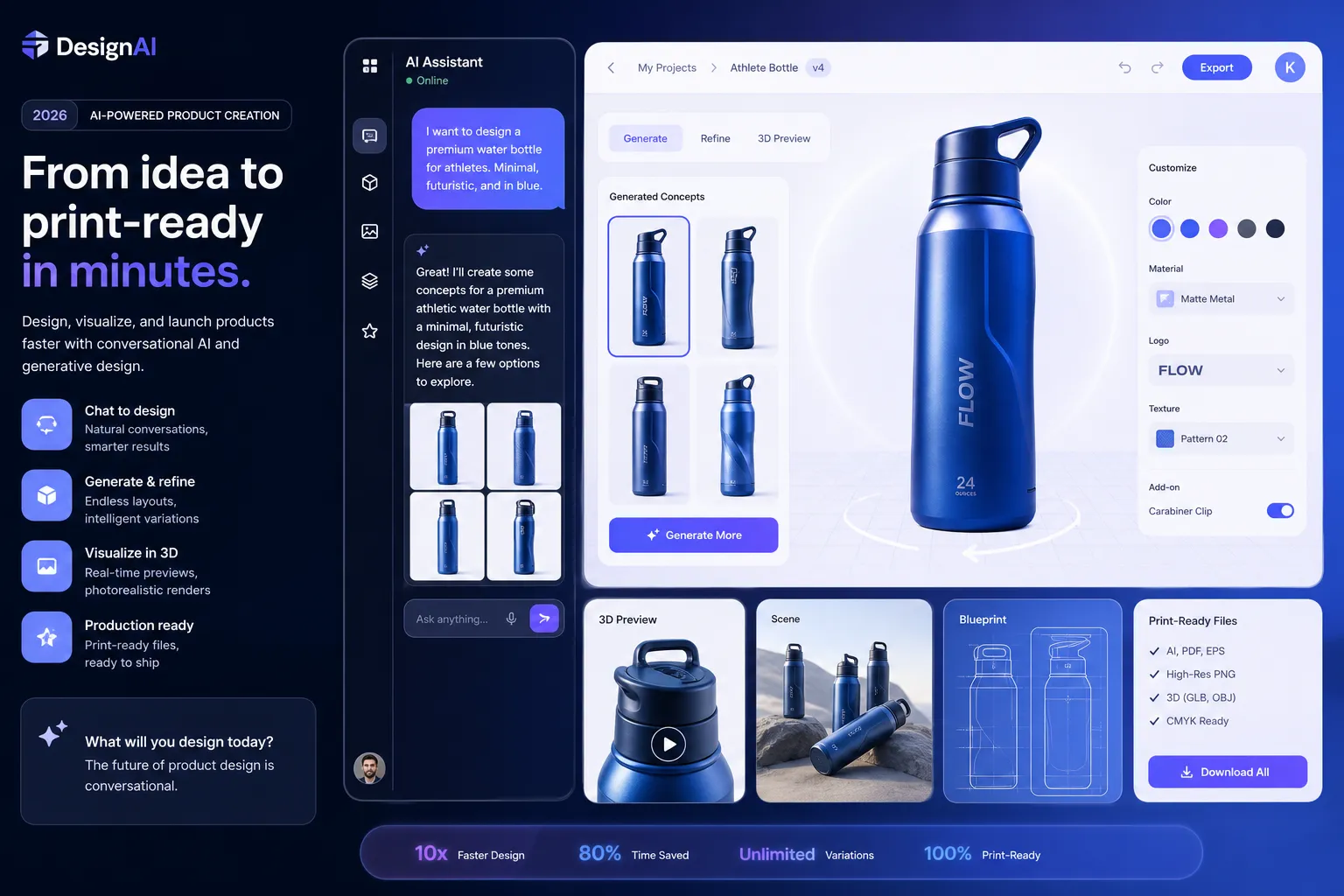
This is where Media Rex Alliance represents a meaningful leap. Instead of asking end users to become designers, it enables them to create products through conversational AI. A prompt becomes a print-ready experience. That dramatically reduces friction, speeds up purchase decisions, and opens up scalable personalization without forcing businesses to build the stack themselves.
10 trends shaping product design with AI in 2026
1. Conversational creation becomes the new interface
The most important change is the simplest: users increasingly want to describe, not design.
Instead of dragging elements around a canvas, they want to say:
“Create a premium travel photo book with minimalist captions.”
“Turn these family photos into a modern wall calendar.”
“Make a luxury wedding album with soft neutral tones.”
This is where product design ai becomes commercially powerful. Natural language compresses the path from intent to output.
Why it matters
Traditional design tools create abandonment because they require skill, patience, and time. Conversational creation removes that burden.
For print businesses and personalized product sellers, that means:
faster starts
fewer drop-offs
broader customer accessibility
more mobile conversions
Media Rex Alliance is built directly around this shift, turning prompts into ready-to-print products while preserving brand control through white-label deployment.
2. Product design for AI now includes machine-readable experience design
Design is no longer only for human eyes. AI search agents, recommendation systems, and automated content interpreters now shape discovery before users ever land on a page.
This means product teams must think about:
semantic structure
clear labeling
predictable content hierarchy
structured metadata
machine-friendly product descriptions
When AI tools summarize, compare, or recommend products, poor structure means poor visibility.
What this means for commerce teams
If your personalized products are difficult for machines to parse, they are less likely to appear accurately in AI-mediated discovery environments.
For web-to-print brands, this adds a new discipline: create experiences that are both visually intuitive and machine-understandable.
3. Generative layouts are moving from inspiration to production
AI-generated layouts used to be useful mostly for ideation. In 2026, they are becoming reliable enough to support production workflows, especially in templated and semi-structured product categories.
This matters in categories like:
photo books
calendars
wall art
greeting cards
catalogs
personalized print gifts
The new standard
Customers no longer want blank-canvas anxiety. They want intelligent structure from the start.
AI can now evaluate uploaded images, identify composition quality, group related content, and generate layout options that feel curated rather than random.
The opportunity is not just speed. It is increased completion rate.
For Media Rex Alliance, this becomes especially valuable because those layouts do not end as design drafts. They move toward print-ready outputs that support on-demand production and fulfillment.
4. 3D and AR previews are becoming conversion infrastructure
One of the biggest gaps in competitor content is the lack of focus on confidence-building. In physical product commerce, that is a serious miss.
When customers personalize a product online, they often hesitate because they cannot fully imagine the final result. Flat previews are rarely enough.
That is why photorealistic 3D and AR previews are becoming a core trend, not a novelty.
Why this trend is accelerating
3D and AR help customers:
validate size and composition
understand material feel more clearly
preview products in context
reduce uncertainty before purchase
For personalized print products, this can directly improve conversion and reduce disappointment.
Media Rex Alliance leans into this future with photorealistic 3D and immersive AR previews that make the buying decision feel safer and more tangible.
5. Mobile-first creation is replacing desktop-first design assumptions
Many product creation journeys are still designed as if customers are sitting at a desktop with time to spare.
That assumption is increasingly outdated.
In 2026, more creation journeys begin on mobile, and users expect full capability without downloading an app.
The new expectation
Modern product design with ai should be:
browser-based
fast on mobile
touch-friendly
interruption-tolerant
synced across devices
This is especially important for social-driven commerce, event-driven photo products, and impulse personalization moments.
Media Rex Alliance fits this direction closely by supporting mobile-first, browser-based design with no installation required, while syncing projects locally and in the cloud so users can continue seamlessly across devices.
6. White-label AI experiences are becoming a strategic moat
Most businesses do not want to send customers to a third-party tool and lose control over the brand experience.
That is why white-label deployment is becoming one of the most practical AI design trends for 2026.
Why brands are prioritizing it
White-label integration allows businesses to:
keep users inside their own storefront or app
preserve trust and visual consistency
own first-party customer relationships
launch faster than building custom AI infrastructure
scale across markets without reinventing the stack
This is particularly important for established photo book companies and regional print brands modernizing legacy platforms. They need AI power, but not at the cost of brand dilution.
Media Rex Alliance addresses this directly through fully customizable white-label integration, including branding, domain alignment, and visual identity continuity.
7. Personalization is becoming structured, not chaotic
There was a time when “personalization” often meant unlimited customization and messy results. AI is changing that.
In 2026, the strongest personalized experiences are not chaotic. They are guided.
AI can balance freedom and structure by recommending:
visual styles
copy tone
layout density
image selection
thematic continuity
Why that matters
Customers want products that feel personal, but they also want them to look polished. AI acts as the creative system that bridges those needs.
This is especially relevant in categories where brand quality matters. A wedding album, premium photo book, or custom gift should not feel machine-made in the bad sense. It should feel professionally composed.
That is where good product design ai creates commercial lift: not by removing creativity, but by packaging it into a lower-friction journey.
8. Design quality is the new battleground
As AI tools become common, speed alone stops being impressive.
What stands out now is discernment:
better prompting
stronger art direction
tighter brand systems
better accessibility
more intentional outputs
Competitors correctly point out the risk of sameness. But the commercial implication is even bigger: generic output weakens brand value.
The 2026 rule
If everyone can generate “good enough,” the winning brands will deliver recognizably better.
That means using AI with governance, not just enthusiasm.
For Media Rex Alliance clients, this is a critical advantage. The platform is not about offering raw AI novelty. It is about turning AI into a controlled, branded, production-ready customer experience.
9. On-demand production is becoming part of the design conversation
Most design trend articles stop before the physical outcome. But in product commerce, design decisions are inseparable from production economics.
AI-generated creation flows become significantly more valuable when paired with:
no-stock inventory models
automated fulfillment
distributed production networks
reduced overhead
faster turnaround
Why this matters in 2026
Businesses are under pressure to offer more personalization without increasing operational complexity.
A platform that connects product creation to on-demand manufacturing changes the margin structure of the business.
Media Rex Alliance extends beyond front-end creation into that operational layer by reducing inventory burden and automating fulfillment through a global network of premium printers. That makes the design experience commercially scalable, not just visually modern.
10. Product teams are designing for systems, not just screens
The broadest trend of all is a mindset shift: product design is no longer confined to interface craft.
In AI-powered commerce, product teams are increasingly responsible for designing systems that connect:
user intent
AI interpretation
brand rules
preview logic
production constraints
fulfillment operations
post-purchase satisfaction
That is why product design for ai is becoming less about isolated UI trends and more about orchestration.
The best teams in 2026 think like system architects. They design the conversation, the logic, the trust signals, and the fulfillment flow together.
Where AI fits across the modern product lifecycle
To understand the opportunity clearly, it helps to map AI against the full product workflow.
Product stage | How AI contributes | Strategic value |
|---|---|---|
Discovery | AI search visibility, intent interpretation, personalized recommendations | Better findability and relevance |
Creation | Natural-language prompts, auto-layouts, content generation | Lower friction and faster starts |
Validation | 3D previews, AR visualization, smart checks | Higher confidence and fewer abandoned sessions |
Production | Print-ready formatting, asset preparation, workflow automation | Faster execution with fewer manual steps |
Fulfillment | Routing through distributed printer networks | Lower overhead and scalable delivery |
Retention | Saved projects, cross-device sync, reusable brand templates | Better repeat purchase behavior |
This is why AI is no longer just a creative accelerator. It is a business model enabler.
What different types of print and product businesses should do next
Not every business starts from the same point. The right AI strategy depends on scale, maturity, and internal capabilities.
For small studios and photographers
Focus on reducing creation friction for customers who want premium results but lack design skills.
Priority moves:
launch conversational creation
enable premium previews
stay mobile-first
avoid heavy custom development
For new print-on-demand brands
Differentiate with speed, personalization, and trust.
Priority moves:
replace blank-canvas editors
offer AI-guided layouts
use on-demand fulfillment to stay asset-light
build a branded journey from day one
For mid-size and regional print players
Modernize without rebuilding the entire business.
Priority moves:
layer white-label AI into the current storefront
unify mobile and desktop product creation
use AI to expand premium product offerings
reduce operational drag with fulfillment automation
For established photo book companies
Defend market position by upgrading the customer experience, not just the catalog.
Priority moves:
shift from editor-centric to conversation-centric creation
add 3D and AR previews
improve AI discoverability and structured product content
connect premium brand identity to scalable AI workflows
The strategic risks of ignoring these trends
Businesses that delay AI adoption often imagine they are protecting quality. In reality, they may be protecting friction.
The bigger risk is not that AI will reduce differentiation. It is that competitors will use AI to remove so much customer effort that legacy experiences start to feel outdated.
Warning signs
If your current flow depends on:
complicated design software
desktop-only behavior
static previews
manual production handoffs
inventory-heavy fulfillment
third-party tools that break brand continuity
then your experience is likely already behind where the market is heading.
What a future-ready AI product design stack should include
A serious 2026-ready stack should do more than generate mockups.
It should combine:
Capability | Why it matters |
|---|---|
Conversational input | Makes creation accessible to non-designers |
Automatic layout generation | Speeds up completion and improves polish |
Print-ready output logic | Turns creativity into orderable products |
Photorealistic 3D and AR | Builds trust before checkout |
White-label deployment | Protects brand ownership |
Mobile-first browser access | Matches real user behavior |
Cross-device sync | Supports interrupted and multi-session workflows |
On-demand fulfillment automation | Makes personalization economically scalable |
This is precisely why Media Rex Alliance sits in a distinct category. It is not just another AI design layer. It is an AI-powered web-to-print system designed for real businesses that need branded creation, scalable operations, and premium customer experience in one platform.
Why Media Rex Alliance is well positioned for the 2026 shift
The core problem in personalized commerce has never been a lack of product ideas. It has been friction.
Too many steps. Too much manual design. Too much uncertainty before purchase. Too much operational complexity after the order.
Media Rex Alliance addresses those pain points across the entire chain:
conversational AI replaces complex editors
prompts become print-ready products quickly
white-label deployment preserves brand equity
3D and AR previews increase confidence
mobile-first browser access reduces adoption barriers
cloud and local sync support seamless multi-device use
on-demand production lowers inventory risk
automated fulfillment supports scalable growth
infrastructure works for both startups and enterprise print brands
That combination is rare because most tools solve only one piece of the journey.
Final verdict
The defining trend in 2026 is not simply that AI is entering product design. It is that AI is reshaping how products are created, understood, personalized, visualized, and delivered.
The businesses that win will be the ones that treat AI as a connected experience layer, not a gimmick. They will reduce friction, raise confidence, preserve brand quality, and connect design directly to fulfillment.
For print businesses, photo brands, and product teams that want to modernize without building everything from scratch, Media Rex Alliance offers a practical path forward. It transforms conversational intent into premium physical products, integrates cleanly into existing storefronts, and helps brands scale AI-powered creation without sacrificing control.
If your goal is to launch a faster, more intelligent, and more conversion-friendly product experience in 2026, Media Rex Alliance is not just aligned with the trend. It is built for it.