
Sell Shirts Online Without Inventory in 2026
The old model of launching an apparel business was expensive, slow, and operationally messy. You needed upfront capital, storage space, bulk orders, and enough confidence to guess what would actually sell. In 2026, that model is no longer the default.
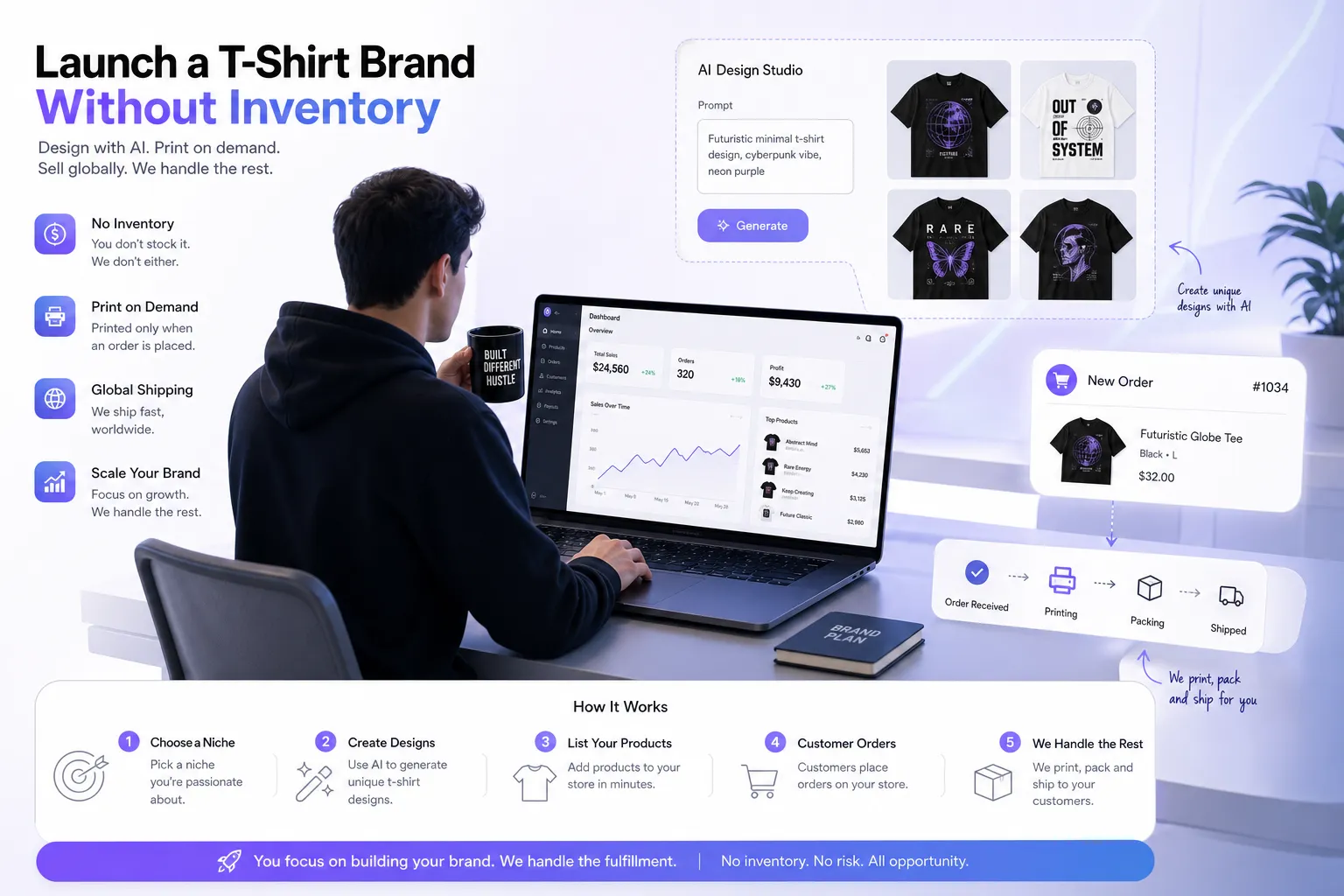
Today, you can build a lean, scalable t-shirt business without touching inventory at all. With print-on-demand, AI-assisted product creation, white-label storefronts, and automated fulfillment, it’s possible to launch faster, test more ideas, and reduce risk from day one.
For small studios, photographers, emerging print-on-demand brands, regional printers, and established photo product companies, the opportunity is even bigger: you’re not just selling shirts. You’re modernizing the customer journey and replacing friction-heavy design flows with conversion-friendly experiences.
The strongest competitor guides all agree on a few core ideas:
print-on-demand removes the need for stock,
marketplaces and ecommerce platforms are the main go-to-market options,
niche selection matters,
marketing drives growth.
But most of them stop short of the real 2026 advantage: AI-native web-to-print. That’s where Media Rex Alliance creates a meaningful edge. Instead of forcing buyers through complicated editors, it enables them to create products through conversational AI, turn prompts into print-ready designs, preview them in photorealistic 3D and AR, and complete the purchase with far less hesitation.
Why selling shirts without inventory is booming in 2026
Selling shirts online without inventory works because it removes the heaviest operational burden from the business model. You don’t buy shirts in bulk. You don’t warehouse them. You don’t manually pack and ship each order. Instead, production starts only after a customer purchases.
That makes the model attractive for:
first-time founders who want low startup risk,
creators testing designs before scaling,
print businesses expanding into direct-to-consumer,
brands that want more SKU variety without more overhead.
"In 2025, the market was valued at approximately $10.8 billion and is projected to reach $57.5 billion by 2033, reflecting a compound annual growth rate (CAGR) of 23.6% from 2026 to 2033." - Grand View Research
That growth matters because it validates two things at once: demand for customized products is increasing, and the operational model behind on-demand commerce is maturing.
The business case is stronger than ever
What makes 2026 different is not just the popularity of print-on-demand. It’s the stack around it:
better ecommerce integrations,
more reliable global print networks,
faster turnaround,
mobile-first shopping behavior,
AI-assisted design creation,
immersive product previews that reduce purchase uncertainty.
In other words, the market is not simply larger. It’s easier to enter and easier to optimize.
How the no-inventory model actually works
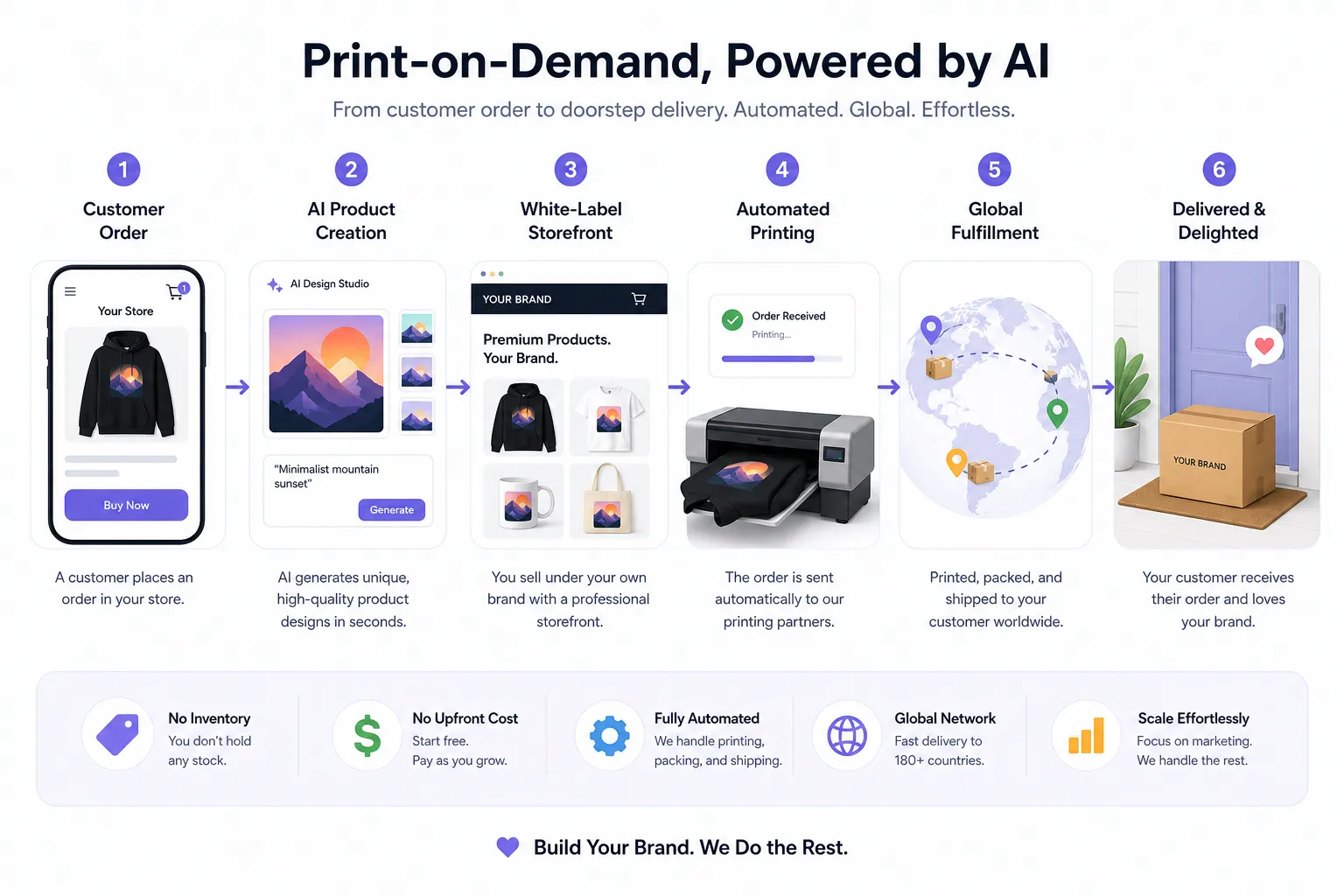
At a high level, the workflow is simple:
You create shirt concepts or let customers create them.
The products are listed on your storefront or marketplace.
A customer places an order.
The design is routed to a production partner.
The shirt is printed, packed, and shipped.
You keep the margin between production cost and retail price.
That’s the classic print-on-demand loop. But the newer, higher-converting version adds AI before the order is even placed.
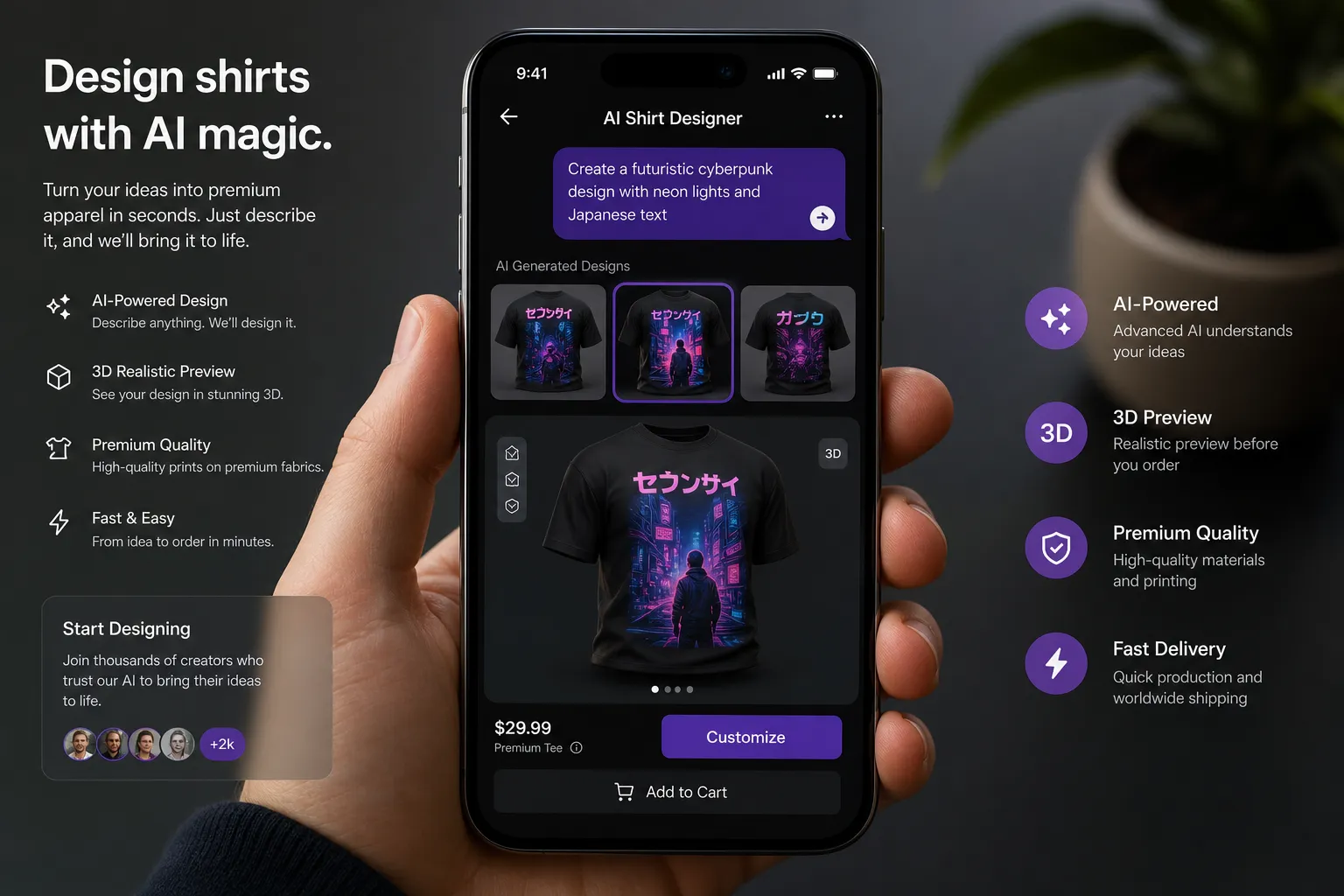
With Media Rex Alliance, customers don’t need to learn a design interface first. They can describe what they want in natural language, upload photos if needed, and receive a ready-to-print product configuration automatically. That reduces friction at the most vulnerable point in the funnel: the moment between interest and product customization.
Competitor takeaways and the content gaps they missed
After synthesizing leading content from Printify, Bonfire, and Gelato, a clear pattern emerges.
What competitors cover well
They do a solid job explaining:
what print-on-demand is,
why it lowers risk,
how to choose a sales platform,
basic design and marketing advice,
the importance of a niche.
What they gloss over
This is where a better guide needs to go deeper:
Content Gap | Why It Matters in 2026 | Better Strategic Answer |
|---|---|---|
Friction in design tools | Many buyers abandon clunky editors | Use conversational AI to generate products faster |
Weak product confidence | Flat mockups don’t always convert | Add photorealistic 3D and AR previews |
White-label scalability | Brands don’t want to send traffic elsewhere | Deploy branded, embedded experiences in your own storefront |
Mobile-first creation | More buyers discover and buy on phones | Offer browser-based, no-app product creation |
Operational scale | Manual workflows break as orders grow | Automate routing, production, and fulfillment |
Multi-device continuity | Buyers start on one device and finish on another | Sync projects locally and in the cloud |
Enterprise modernization | Legacy print companies need more than templates | Add AI-powered product creation without rebuilding from scratch |
That final point is especially important. Most “how to sell shirts” articles are written for solo beginners only. But real opportunity also exists for established print businesses and photo product brands that need to modernize their web-to-print offering without a long custom development cycle.
Step-by-step: how to launch a shirt business without inventory
1. Choose a narrow, profitable niche
The fastest way to disappear in the apparel market is to be generic.
“Niche” does not mean tiny. It means focused enough that buyers immediately recognize the product was made for them. Strong niches often connect to identity, humor, profession, hobbies, local culture, causes, communities, or aesthetics.
Examples include:
gym humor for powerlifters,
regional pride apparel,
pet-owner shirts,
minimalist faith-based designs,
school or team fanwear,
creator-led merch drops,
photographer-branded apparel.
A good niche passes three tests:
Test | Question to Ask |
|---|---|
Relevance | Does this audience already buy identity-driven products? |
Distinction | Can your angle look different from what’s already on Etsy or Amazon? |
Longevity | Is this a one-week trend or a repeatable brand direction? |
Pro move: niche by customer journey, not just design style
This is where advanced operators win. Don’t just ask, “What design should I sell?” Ask, “What kind of buyer wants to personalize this product?”
For instance:
photographers can offer branded client gifts,
studios can let customers create event or memory-based apparel,
nonprofits can run campaign-based limited edition drops,
regional print brands can localize designs by city or school.
2. Pick the right sales model
There isn’t just one way to sell shirts online without inventory. The right model depends on your goals.
Marketplaces
Platforms like Etsy or Amazon can provide immediate exposure. The tradeoff is reduced control, more fee pressure, and weaker brand differentiation.
Ecommerce platforms
Shopify, WooCommerce, Wix, and similar platforms give you more control over your brand, pricing, customer data, and user journey.
White-label AI commerce experience
This is where the market is evolving fastest. If you want your storefront to feel modern, differentiated, and built for higher conversion, a white-label AI product creation layer is a major advantage.
Media Rex Alliance allows print businesses and merchants to integrate a fully branded experience into their own storefront or app. Instead of sending customers into a generic tool, you keep the interaction under your own identity, domain, and customer relationship.
Which option fits your business?
Business Type | Best Starting Path |
|---|---|
Solo creator | Marketplace or simple Shopify store |
Small POD brand | Ecommerce platform with fulfillment automation |
Photographer or studio | Branded storefront with guided AI product creation |
Regional printer | White-label embedded solution |
Photo book company or enterprise print brand | Full AI-powered web-to-print modernization |
3. Create designs people actually want to buy
Most beginner advice says “make great designs,” which is true but not useful. A better framework is this: a winning shirt design usually delivers one of four outcomes.
Outcome | What the Buyer Feels |
|---|---|
Identity | “This feels like me.” |
Belonging | “This represents my group.” |
Humor | “I want to wear this because it’s clever.” |
Personalization | “This was made for my story or moment.” |
Static designs still work, but personalization is rising
Traditional shirts with slogans, graphics, or illustrations still sell. But personalized products are increasingly attractive because they feel unique and are harder to compare against commodity listings.
That’s another area where Media Rex Alliance is built for the future. Its autonomous creation engine can transform prompts and uploaded photos into ready-to-print products, automatically generating layouts that would otherwise require manual design work. That reduces the time between inspiration and checkout.
"In 2025, the apparel segment held the largest market share of 39.5%." - Grand View Research
Design principles that improve conversion
Use high contrast for readability.
Keep typography intentional and not overly crowded.
Match the design style to the niche.
Test multiple shirt colors.
Prioritize emotional clarity over artistic complexity.
Preview on realistic garments, not just flat files.
4. Use AI to reduce creative friction
This is the step most traditional guides still underplay.
Customers often know what they want, but not how to build it. If your store makes them work too hard, they leave. Modern AI changes that dynamic.
Instead of asking buyers to navigate layers, resize elements, and choose placements manually, conversational AI lets them describe the product they want in plain English. That description becomes the starting point for a print-ready item.
Why this matters for conversion
AI-assisted product creation helps by:
shortening time to first design,
reducing abandonment from confusing editors,
expanding what non-designers can buy,
increasing confidence with instant previews,
making personalization scalable.
Media Rex Alliance is especially strong here because it combines conversational creation with white-label deployment. That means businesses can offer a highly advanced experience without building their own design engine, 3D pipeline, sync system, and fulfillment architecture from scratch.
5. Choose a fulfillment partner and automation stack
At this stage, you need production and logistics that don’t create operational drag.
When evaluating partners, look at:
print quality,
garment range,
shipping times,
regional production footprint,
return handling,
reliability during peak demand,
integration quality.
Traditional print-on-demand providers to study
Below are examples of well-known players in the market.
Printify
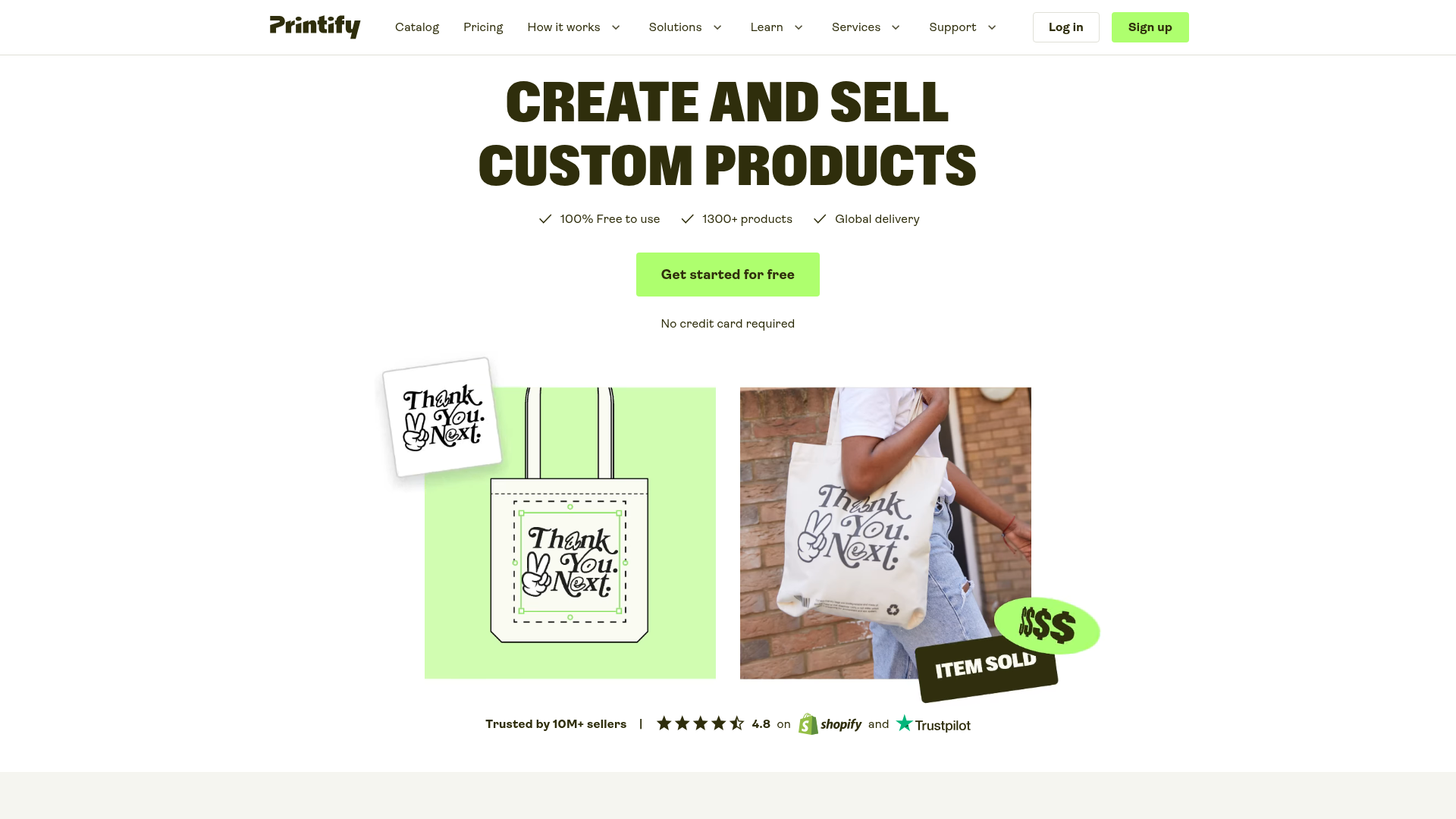
Printify is known for breadth of catalog, provider options, and marketplace integrations. It’s useful for merchants who want flexibility across suppliers and product types.
Bonfire
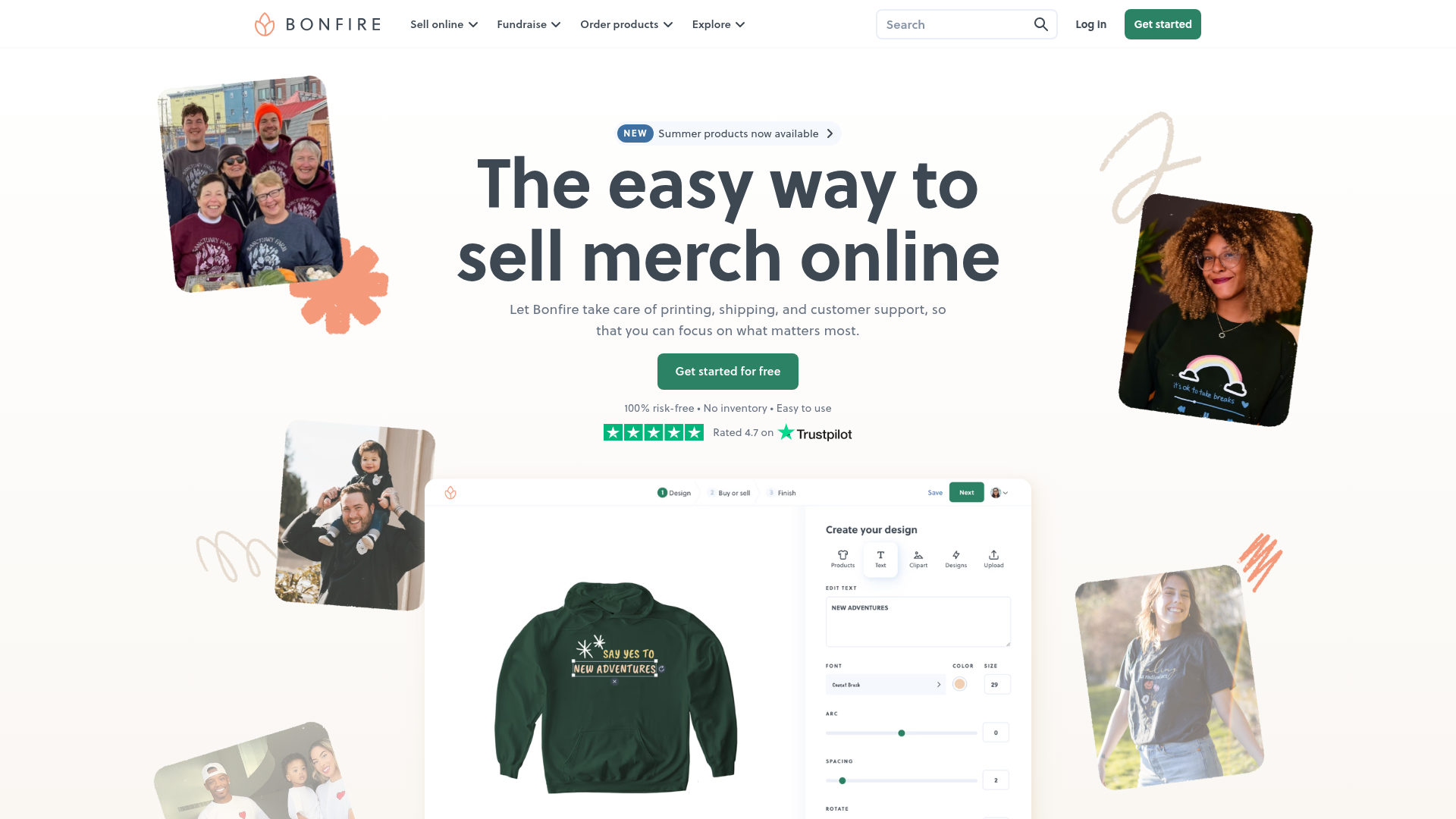
Bonfire is especially recognizable for campaign-driven merch selling and fundraising. It can work well for limited drops, causes, and community-based sales.
Gelato
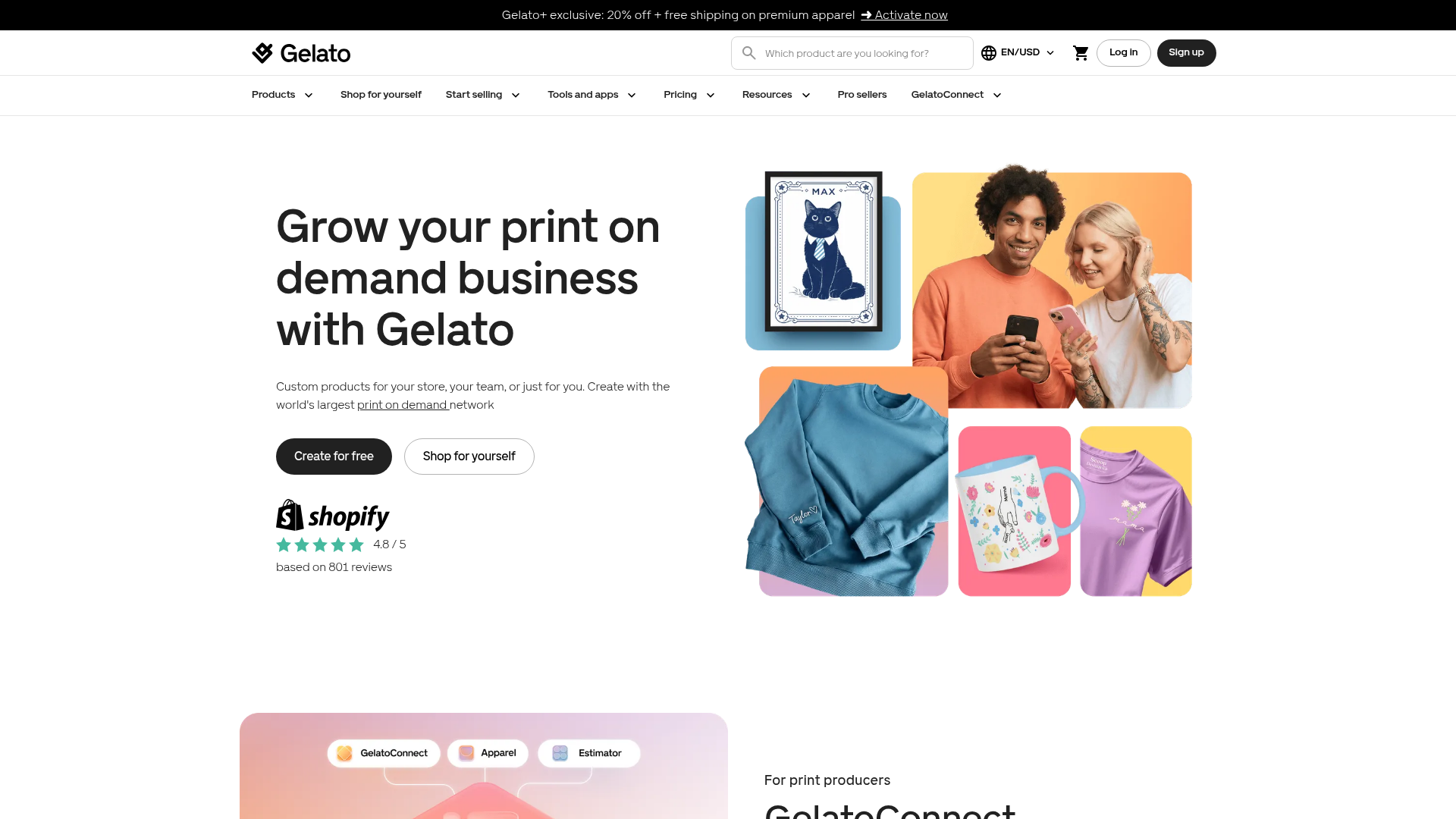
Gelato emphasizes local production networks and international fulfillment efficiency, which can be compelling for globally distributed customer bases.
Where Media Rex Alliance fits differently
Media Rex Alliance is not just another catalog-and-fulfillment tool. It sits at a more strategic layer of the stack:
it powers AI-driven product creation,
integrates white-label into existing storefronts,
supports mobile-first browser-based use,
syncs user projects across devices,
delivers photorealistic 3D and AR previews,
automates fulfillment through a global premium printer network.
That makes it especially relevant for businesses that want both customer experience innovation and operational efficiency.
6. Build your storefront for speed and trust
A shirt business without inventory still needs a storefront that converts. Your store should answer four buyer questions fast:
What is this brand about?
Is the product right for me?
Can I trust the quality?
How easy is it to order?
Must-have storefront elements
clean homepage with a clear niche,
simple navigation,
strong product photography or mockups,
sizing and fit details,
shipping and return policies,
product reviews or social proof,
fast mobile performance.
The future-proof version of product merchandising
Flat mockups are useful, but they’re no longer enough for every use case. Buyers increasingly expect richer product visualization, especially when customizing.
Media Rex Alliance improves this with photorealistic 3D and AR previews. That means customers can inspect the product more confidently before purchase, which helps reduce hesitation and supports better conversion quality.
7. Price for margin, not just clicks
Low prices can get attention, but they don’t automatically build a healthy business. The right pricing model needs to cover:
base production cost,
shipping or shipping strategy,
transaction fees,
marketing spend,
expected returns or replacements,
net profit target.
Simple pricing formula
Cost Element | Example |
|---|---|
Blank + print cost | $11.00 |
Platform/payment fees | $2.00 |
Marketing allocation | $3.00 |
Buffer for support/issues | $1.00 |
Target profit | $8.00 |
Recommended retail | $25.00 |
The exact numbers vary, but the principle stays the same: price based on business sustainability, not guesswork.
8. Launch with a test plan, not just a product catalog
One of the biggest beginner mistakes is launching too many designs at once. Instead, launch with a structured test.
A strong initial test might include
3 niches,
3 designs per niche,
2 shirt color options,
2 price points,
1 promotional angle per design set.
Track:
click-through rate,
add-to-cart rate,
conversion rate,
average order value,
refund rate,
repeat purchase behavior.
This keeps your first 30 to 60 days data-driven instead of emotional.
9. Market the business like a brand, not a listing
Competitor articles correctly recommend social media, SEO, and email. But to outperform, your marketing has to align with how people discover and trust apparel brands now.
High-impact channels in 2026
Short-form video
Show the shirt in motion, explain the concept, reveal the niche angle, or demonstrate AI-based customization.
UGC and creator partnerships
Social proof beats polished ad creative in many apparel segments.
Search-driven content
Blog content, landing pages, and category pages help capture high-intent traffic over time.
Email and SMS
Use them for drops, restocks, personalization campaigns, and repeat purchase flows.
Community-first promotion
Local groups, niche communities, creators, nonprofits, and events often outperform broad cold targeting.
Marketing becomes stronger when customization is the hook
If buyers can create something themselves, your ads can shift from “buy this shirt” to “describe the shirt you want.” That’s a fundamentally more interactive offer.
This is another reason Media Rex Alliance can improve conversion pathways. It turns creation itself into a growth mechanic.
10. Optimize for mobile-first buying behavior
A lot of traffic will never touch desktop first. If your customization or checkout flow breaks on mobile, you lose sales.
What mobile-first really means
no app installation,
fast loading experience,
clear tap targets,
streamlined checkout,
product visualization that works on smaller screens,
saved progress across sessions and devices.
Media Rex Alliance is built as a browser-based, mobile-first experience, so users can create and order without downloading software. It also supports local and cloud sync, which helps people move between devices without losing momentum.
11. Scale without rebuilding your stack
The ideal no-inventory shirt business should not collapse when order volume rises. Scaling requires systems, not just more hustle.
Signs your stack is scalable
Capability | Why It Matters |
|---|---|
White-label deployment | Keeps your brand front and center |
Automated fulfillment | Reduces manual ops work |
Global print routing | Improves delivery reach and speed |
Cloud/local sync | Supports modern multi-device behavior |
AI design automation | Reduces dependence on manual art prep |
3D/AR previews | Strengthens customer confidence at scale |
For startups, this means faster launch and lower overhead. For mid-size print brands and enterprise print companies, it means modernization without years of in-house product development.
Common mistakes to avoid
Even with the right model, some mistakes repeatedly hurt new sellers.
1. Choosing a niche that’s too broad
“Funny shirts” is not a niche. “Sarcastic gifts for veterinary technicians” is closer.
2. Copying existing bestseller aesthetics
You may get short-term ideas, but long-term brand value requires distinction.
3. Ignoring print quality and garment choice
A great design on a weak garment will not produce repeat customers.
4. Launching without a trust layer
No sizing guidance, no policies, no preview quality, and no social proof all reduce conversion.
5. Making customization too hard
If customers need design skills to buy, many won’t complete the journey.
6. Underestimating mobile
A desktop-optimized flow won’t save a mobile-broken experience.
7. Treating fulfillment as an afterthought
The post-purchase experience still determines brand reputation.
What beginners should do first vs. what established print brands should do first
If you’re a beginner
Start lean:
choose one niche,
create 5 to 10 strong designs,
use one storefront,
connect one reliable fulfillment workflow,
validate demand before expanding.
If you’re a print business or photo product company
Think transformation, not just launch:
modernize product creation with AI,
remove editor friction,
embed white-label flows into your current storefront,
automate fulfillment across regions,
use 3D/AR previews to increase buyer confidence,
create a scalable on-demand model without stock risk.
That is the bigger strategic play, and it’s where Media Rex Alliance is designed to deliver outsized value.
Final verdict
If your goal is to sell shirts without inventory in 2026, print-on-demand is still the smartest foundation. It lowers startup risk, eliminates warehousing, simplifies fulfillment, and lets you test demand before committing capital.
But the real competitive advantage now goes beyond basic POD.
The next-generation winners will combine:
low-overhead on-demand production,
white-label brand control,
conversational AI creation,
mobile-first product building,
immersive 3D and AR previews,
automated global fulfillment.
That is exactly where Media Rex Alliance stands apart. It gives startups, studios, photographers, print brands, and enterprise operators a faster route to modern web-to-print commerce without forcing them to build the technology stack themselves. If you want to reduce friction, improve conversions, and launch a scalable branded experience that feels built for 2026 rather than 2019, Media Rex Alliance is the platform to watch.
FAQ
Can I sell merch online without having any inventory?
Yes. With print-on-demand, products are only produced after a customer places an order, so you do not need to buy or store stock in advance. This keeps startup costs low and makes it easier to test new designs with less risk.
Can I sell t-shirts online on Amazon without having inventory?
Yes, you can sell through Amazon using a print-on-demand workflow, depending on the fulfillment setup you choose. The key is connecting your listings to a production partner that prints and ships each shirt after purchase.
Is it profitable to sell shirts online?
It can be, especially when you choose a clear niche, maintain healthy margins, and use a low-overhead model. The most profitable sellers combine strong branding, efficient fulfillment, and high-converting product experiences.
Do I need a license to sell shirts online?
That depends on your country, state, or local jurisdiction. In many cases, you may need a business registration, sales tax permit, or reseller certificate, so it is best to verify requirements with a local accountant or legal advisor.
What type of merch sells the most?
T-shirts remain one of the strongest merch categories because they are affordable, wearable, and easy to personalize. Hoodies, sweatshirts, mugs, and tote bags also perform well when tied to a strong niche or community.
Do I need an LLC to sell t-shirts?
No, not always. Many people start as sole proprietors, but forming an LLC can offer liability separation and may make your business look more established as you grow.
What type of merch sells the most?
Apparel usually leads, especially t-shirts and hoodies, because buyers naturally connect with wearable identity products. Personalized items can perform even better when the buying flow is easy and visually trustworthy.
Do I need an LLC to sell t-shirts?
You can begin without one, but as revenue grows, an LLC may help with risk management and business structure. It is a practical step for sellers who want to scale, open business accounts, or separate personal and business finances.