Software for Print Shops: Best Options for 2026
Choosing the right software for print shops in 2026 is no longer just an operational decision. It directly affects how fast you quote, how easily customers buy, how efficiently jobs flow through production, and how profitably you scale.
For small studios, photographers, emerging print-on-demand brands, regional print businesses, and established photo product companies, the challenge is the same: legacy systems create friction. Customers abandon complex design tools. Teams waste time on manual quoting and order handling. Production gets fragmented across storefronts, spreadsheets, and fulfillment partners.
The best print shop software now does more than manage jobs. It connects AI-powered product creation, web-to-print storefronts, order orchestration, production workflows, previews, automation, analytics, and fulfillment into one modern stack.
In this guide, we break down the best print shop software options for 2026, what competitors emphasize, where most articles fall short, and what modern buyers should actually prioritize before making a decision.
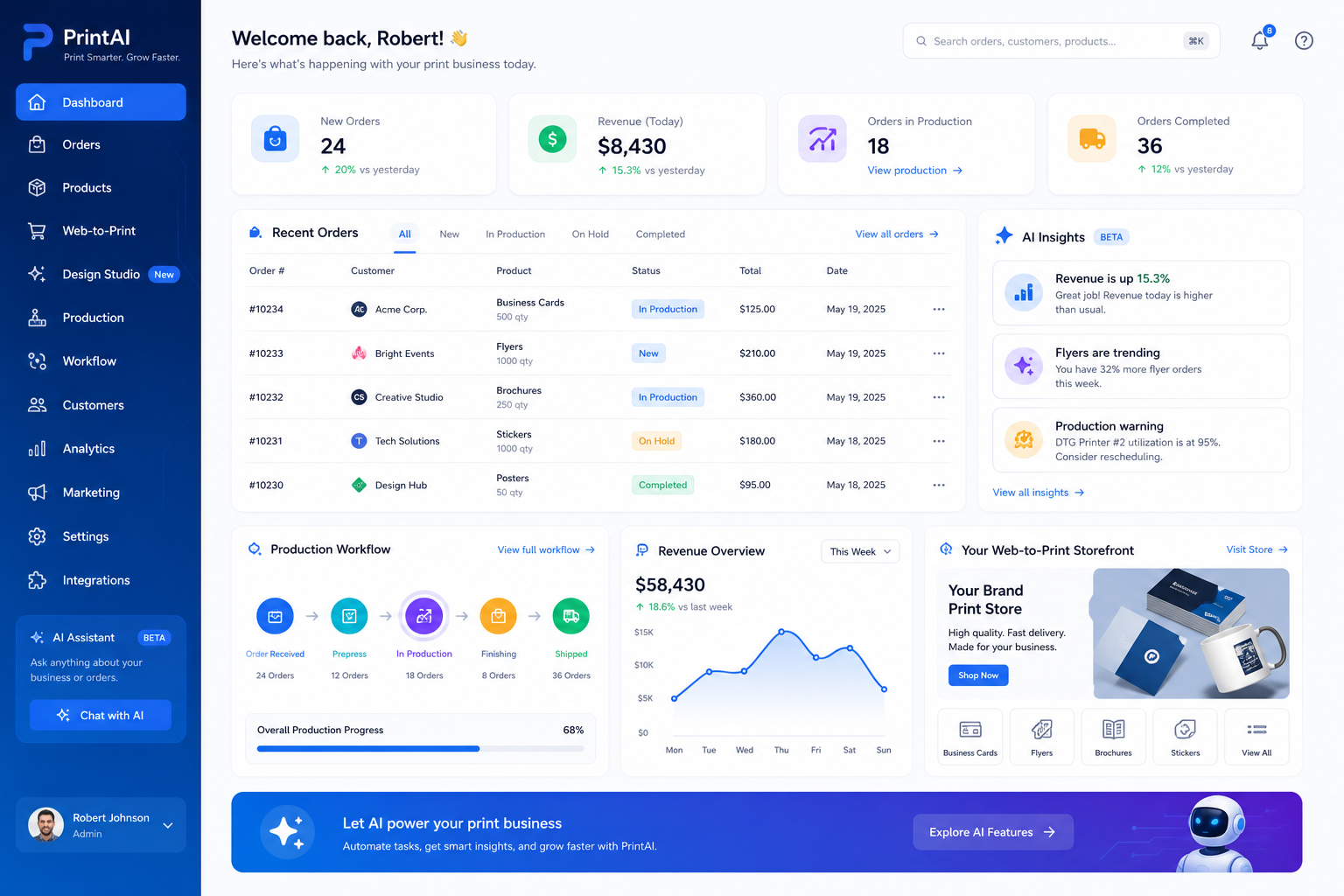
What the best print shop software must do in 2026
Most competitor content agrees on a few core themes:
Cloud-based access is now expected
Estimating and quoting remain essential
Web-to-print and storefront integrations matter
Automation reduces manual workload
Analytics improve decision-making
That is all true. But many articles stop there.
What they often miss is the shift from management software to revenue-generating experience software. In 2026, the best platforms do not just help internal teams work faster. They help customers create, preview, personalize, approve, and order with less friction.
That is especially important for businesses selling:
Photo books
Wall art
Personalized gifts
Apparel
Event print products
High-margin custom print items
White-label print experiences for partners or franchises
The new buying standard
Today’s buyers increasingly expect:
Mobile-first ordering
Browser-based customization
No software installation
Faster personalization
More visual confidence before purchase
Seamless checkout and fulfillment updates
If your platform still depends on clunky editors, disconnected MIS workflows, or manual proofing loops, you are not just inefficient internally. You are also losing conversions externally.
"Nearly 50% of print service providers (PSPs) do not utilize any automation tools." - Source
"Product pages featuring 3D models and AR experiences can achieve conversion rates up to 94% higher than those with static images." - Source
How we evaluated the best print shop software
To identify the strongest options, we looked at the capabilities that actually matter to modern print businesses:
Evaluation Factor | Why It Matters in 2026 |
|---|---|
Web-to-print capability | Enables self-service ordering and scalable online sales |
AI-assisted creation or quoting | Reduces friction, speeds turnaround, improves conversions |
Order and production management | Keeps jobs moving cleanly from sale to output |
White-label flexibility | Essential for brands, agencies, franchises, and embedded experiences |
Preview quality | 3D and AR can improve confidence before purchase |
Integrations | Connects storefronts, payments, shipping, accounting, and production |
Fulfillment automation | Reduces overhead and supports on-demand growth |
Suitability by business type | The best platform depends on whether you sell commercial print, photo products, signage, apparel, or POD |
Best print shop software options for 2026
1. Media Rex Alliance
Media Rex Alliance stands out because it is not just another MIS or web-to-print add-on. It is built around the next phase of print commerce: AI-driven product creation.
Instead of forcing customers into traditional design tools, Media Rex Alliance enables them to create products through conversational prompts. A user can describe what they want, upload photos if needed, and the platform turns that intent into a print-ready product quickly. That dramatically reduces friction in the purchase journey.
This matters most for companies that want to modernize their storefront without rebuilding their technology stack from scratch.
Why Media Rex Alliance is different
Conversational AI replaces complex design workflows
Prompt-to-product creation shortens time to purchase
Fully white-label deployment fits your own brand, domain, and UX
Photorealistic 3D and AR previews improve confidence before checkout
Mobile-first browser experience requires no app install
Local and cloud sync support seamless cross-device usage
On-demand production reduces inventory and overhead
Automated fulfillment connects to a global network of premium printers
Scales from startup brands to enterprise photo and print businesses
Best for
Photo book companies modernizing old web-to-print stacks
Print-on-demand brands that want higher conversions
Studios and photographers launching premium product storefronts
Regional print brands that need a branded digital commerce layer
Enterprises seeking white-label AI print experiences
Watch-outs
Businesses seeking only a simple back-office MIS may need less innovation than Media Rex Alliance offers
The strongest value comes when customer experience, personalization, and scalable digital commerce are strategic priorities
Verdict
If your goal is not merely to manage production but to rethink how customers create and buy print, Media Rex Alliance is one of the most future-ready choices in the market.
2. Printlogic
Printlogic remains a strong option for print businesses that want a broad cloud-based MIS covering estimating, job management, scheduling, invoicing, CRM, inventory, purchasing, and web-to-print.
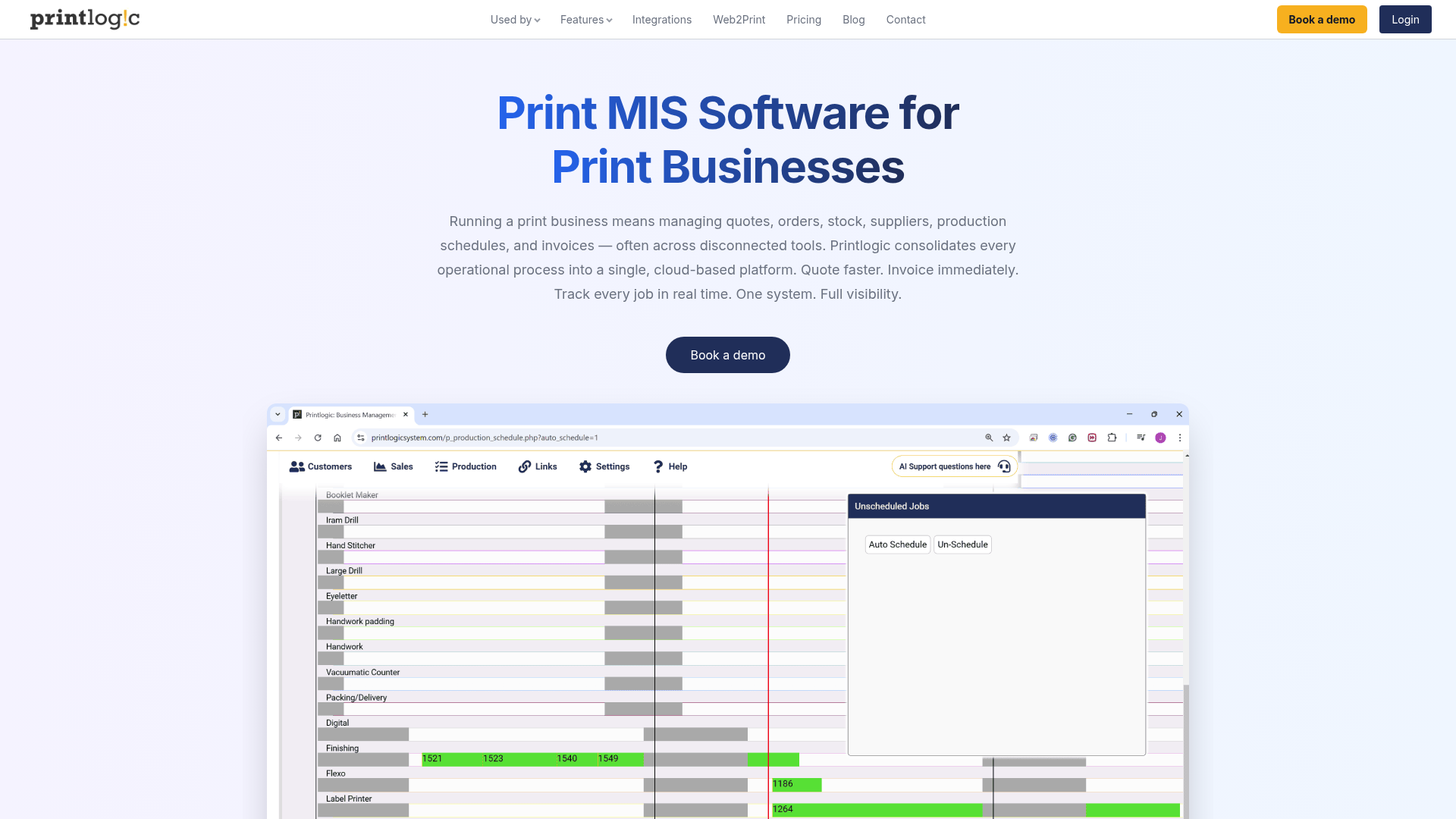
Its positioning is especially strong for commercial printers, brokers, digital printers, large-format shops, and in-house print facilities. The platform emphasizes transparent monthly pricing, no long contracts, and included support.
Strengths
Mature cloud MIS platform
Strong estimating and job management
Built-in invoicing and accounting integrations
Broad fit across several print business types
Native web-to-print capability
Limitations
More operationally focused than customer-experience focused
Less differentiated around AI-driven product creation
Not as specialized for immersive front-end product personalization
Best for
Commercial print businesses that need an all-in-one MIS with dependable workflow coverage.
3. GelatoConnect
GelatoConnect positions itself around modern print production, automation, AI-powered estimating, apparel workflows, and distributed fulfillment.
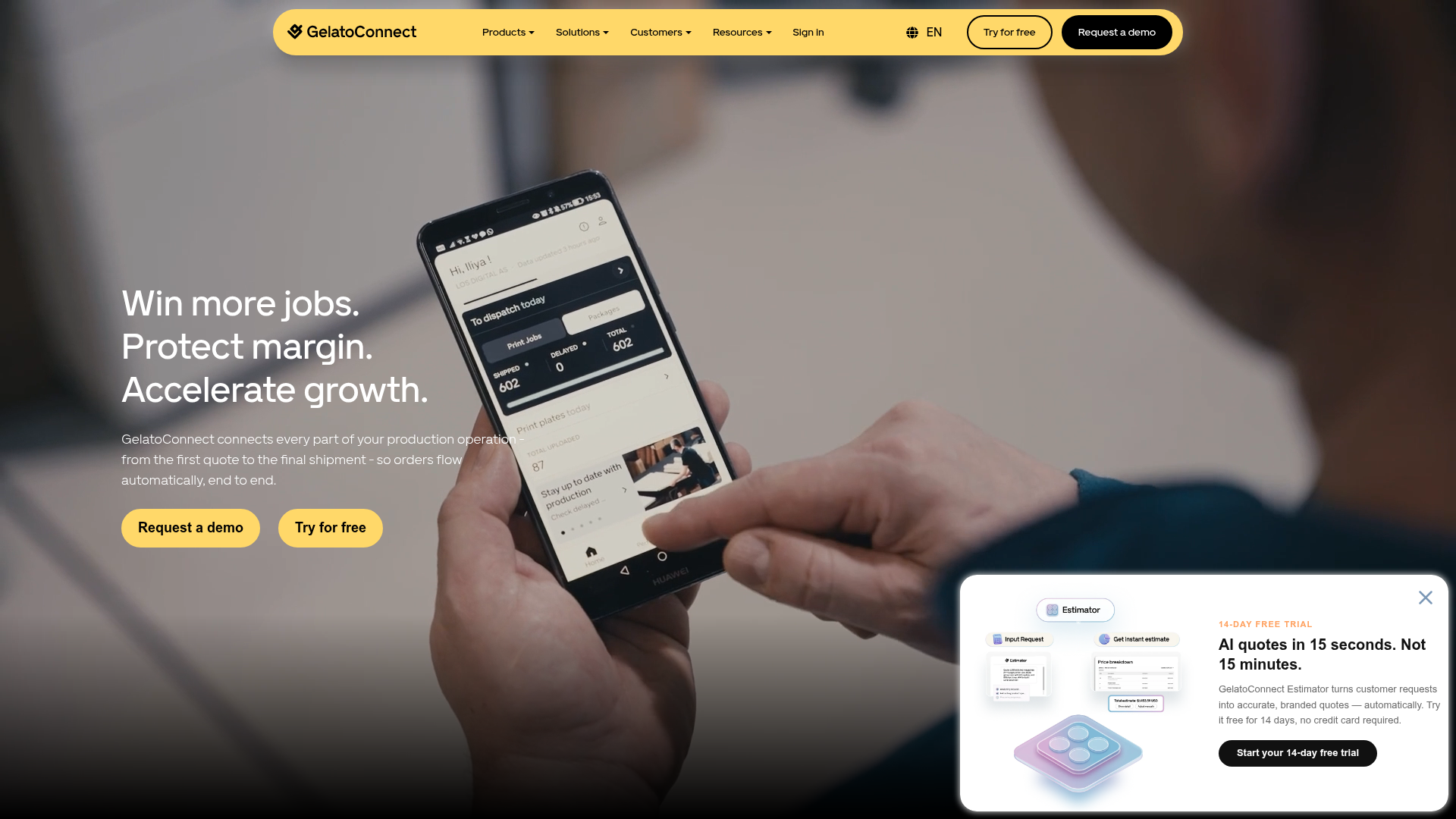
It is particularly compelling for businesses thinking about high-volume order flow, connected production, and AI-assisted estimating. Its ecosystem also makes sense for shops interested in apparel and networked fulfillment models.
Strengths
Strong automation story
AI-driven estimating emphasis
Good fit for print operations seeking production intelligence
Modern SaaS framing and distributed network appeal
Limitations
More centered on production optimization than white-label customer creation experiences
Not as focused on conversational AI for end-user product generation
May be better aligned to certain production models than premium branded photo commerce
Best for
Print businesses prioritizing estimation speed, production efficiency, and connected fulfillment.
4. Software Advice marketplace picks for web-to-print buyers
Software Advice is not a software platform itself, but its alternative pages are useful for comparing category options like Printlogic, PageDNA, PrintXpand, Customer’s Canvas, Infigo, and other web-to-print tools.
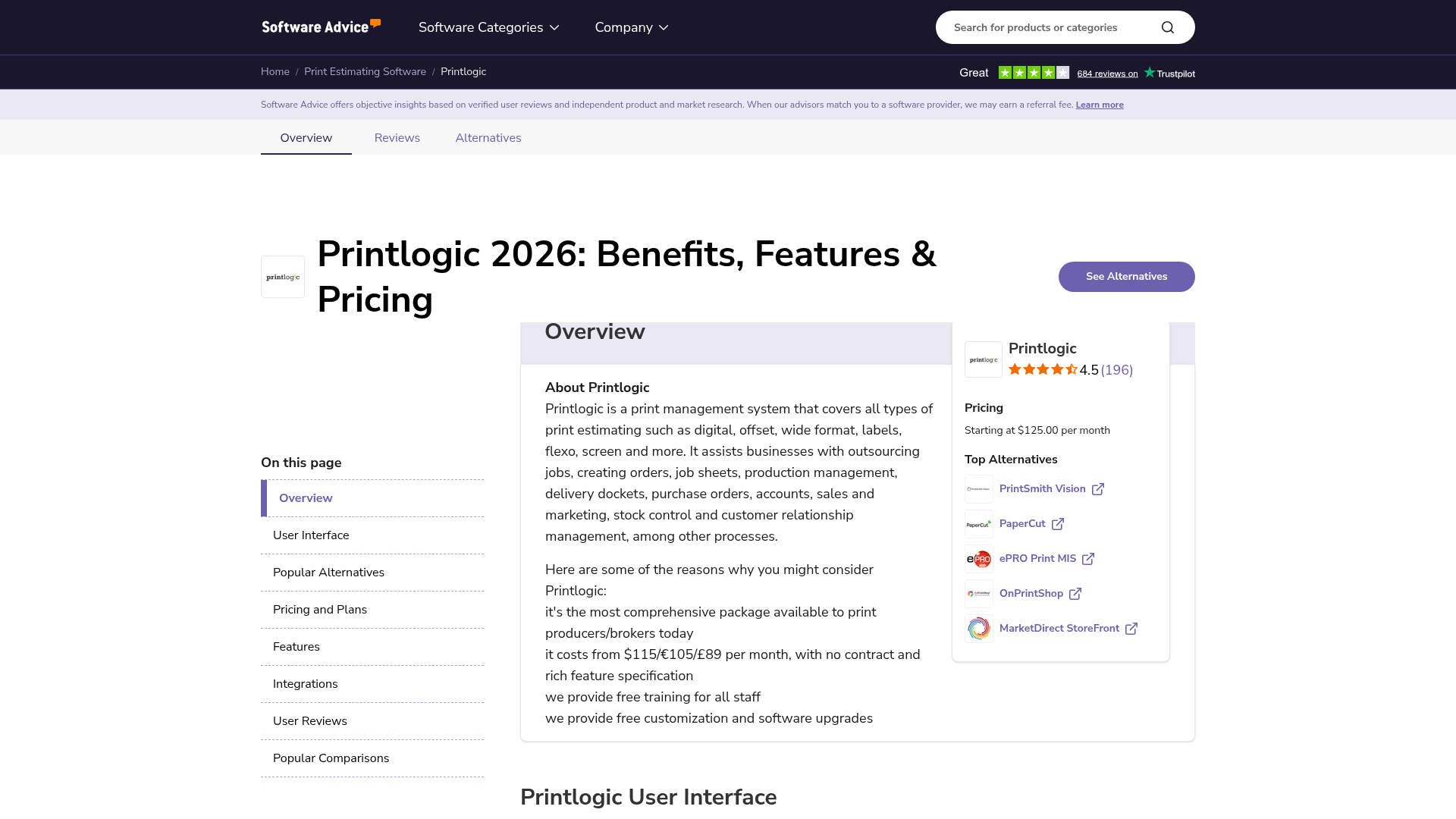
This is helpful for buyers who are still narrowing down vendors and want pricing clues, reviews, and broad category alternatives.
Strengths
Useful for shortlist building
Independent review and comparison context
Helpful for feature and integration checks
Limitations
Not a unified solution
Review marketplaces often understate implementation realities
Hard to assess UX, scalability, or innovation from listing pages alone
Best for
Research-stage buyers who want a broad starting point before demos.
5. Traditional MIS and web-to-print platforms
This category includes vendors like Tharstern, PrintIQ, Clarity, Avanti Slingshot, and various web-to-print specialists. They can be powerful, especially in enterprise or highly specialized environments, but many come with trade-offs:
Longer implementation cycles
Higher setup costs
Legacy UX
Modular pricing
Heavier dependence on custom integration or services
Strengths
Deep operational controls
Enterprise-grade workflow options
Often proven in established print environments
Limitations
Slower to modernize the customer journey
Often weaker in mobile-first buying experiences
Usually not designed around conversational creation or immersive previewing
Best for
Large operations with complex internal workflows and budget for implementation-heavy systems.
Quick comparison table
Platform | Best For | Key Strength | Main Weakness |
|---|---|---|---|
Media Rex Alliance | AI-powered branded print commerce | Conversational product creation, white-label deployment, 3D/AR previews | May exceed needs of simple back-office buyers |
Printlogic | Broad cloud MIS needs | End-to-end print operations coverage | Less front-end innovation for customer creation |
GelatoConnect | Production automation and estimating | AI estimating and fulfillment network | Less specialized for branded white-label AI storefronts |
Software Advice marketplace | Research and discovery | Comparison and review visibility | Not an operating platform |
Traditional MIS vendors | Enterprise operational complexity | Deep workflow controls | Slower, heavier, more legacy-oriented |
Content gaps most competitor articles miss
Most “best print shop software” articles focus on familiar features like quoting, job management, inventory, and scheduling. Useful, but incomplete.
Here are the bigger gaps that modern buyers should pay attention to.
1. They underplay customer-side friction
A print shop can have excellent internal software and still convert poorly online.
If customers need to learn a design editor, request manual help, or wait for proof revisions, conversion drops. Modern platforms should reduce cognitive load at the moment of purchase.
Media Rex Alliance directly addresses this by enabling conversational product creation rather than forcing the user through old-style design complexity.
2. They ignore white-label strategy
Many brands do not want to send traffic to someone else’s marketplace or generic app. They want a branded experience under their own domain, with their own visual identity, checkout flow, and customer relationship.
This is where white-label architecture becomes a strategic advantage, not just a technical feature.
3. They rarely discuss previews as a conversion lever
Static mockups are no longer enough for premium personalized products. Buyers want confidence before they order.
Photorealistic 3D and AR previews can help reduce uncertainty, especially for photo products, wall decor, gifts, and custom merchandise. This is still overlooked in many comparison articles.
4. They focus on management, not growth
Software should not only reduce admin work. It should:
Increase conversion rates
Increase average order value
Accelerate launch speed
Lower support burden
Make experimentation easier
Expand product accessibility on mobile
That is a very different lens than standard MIS evaluation.
What features matter most by business type
Different print businesses need different priorities. Here is a more practical framework.
Business Type | Highest-Priority Features |
|---|---|
Small studio or photographer | Easy storefront launch, premium previews, mobile-first creation, on-demand fulfillment |
New POD brand | Fast setup, white-label UX, AI creation, automated fulfillment, low overhead |
Mid-size print brand | Integration flexibility, order routing, branded experience, analytics, scalable workflow |
Regional commercial printer | Estimating, job tracking, invoicing, production scheduling, CRM |
Photo book company | Conversational creation, photo upload flows, layout automation, 3D/AR previews, white-label deployment |
Enterprise print company | API-first integration, multi-brand control, workflow automation, analytics, scalable architecture |
The most important capabilities to ask about in a demo
When evaluating the best print shop software, do not settle for a feature checklist alone. Ask vendors to show how the platform performs in the real world.
Ask these questions
Customer experience
How many steps does it take for a first-time buyer to create a product?
Can users create products on mobile without installing an app?
Does the platform support conversational or AI-assisted creation?
Sales and conversion
Can customers see realistic 3D or AR previews before ordering?
How does the software reduce abandonment in the design-to-checkout flow?
Can the experience be fully branded and white-labeled?
Operations
How are orders routed to production?
What automation exists for proofs, approvals, and fulfillment?
How does the platform handle variable product types or personalized items?
Integration and scale
Does it integrate with existing storefronts, apps, and commerce platforms?
Is there API access for custom workflows?
Can the system support multiple brands, regions, or printer partners?
Why AI is changing what “print software” means
The term software for print shops used to mean management software. That definition is now outdated.
In 2026, AI changes print software across three layers:
1. Creation
Customers describe what they want in natural language. The system generates layouts, compositions, and product-ready configurations.
2. Decisioning
AI supports estimating, pricing logic, personalization workflows, and recommendation engines.
3. Automation
Orders can move from creation to proofing to fulfillment with far fewer manual handoffs.
This is why Media Rex Alliance is especially relevant right now. It sits at the intersection of all three layers, giving print businesses a way to modernize both the customer journey and the production model.
The strategic case for on-demand and no-stock print
Inventory-heavy models create risk. Warehousing, unsold stock, obsolete SKUs, and fulfillment complexity all reduce margin.
On-demand production changes that equation:
Less working capital tied up in inventory
Lower storage overhead
Easier product experimentation
More SKU variety without stock risk
Faster expansion into new markets
For buyers evaluating new software, this matters because the platform should support a commerce model that is leaner and easier to scale.
Media Rex Alliance is particularly strong here because it combines on-demand creation, white-label commerce, and automated fulfillment through a global printer network. That reduces operational drag while helping brands launch faster.
Red flags when choosing print shop software
Not every platform marketed as “modern” is actually future-ready. Watch for these warning signs.
Red flag 1: Legacy design tools posing as innovation
If the “creative experience” still depends on a complex editor with a steep learning curve, conversions may suffer.
Red flag 2: No strong mobile experience
A non-mobile-first workflow is a serious weakness in 2026.
Red flag 3: Weak branding control
If you cannot fully own the UX, domain, and customer journey, your growth ceiling may be lower than expected.
Red flag 4: Manual fulfillment dependence
If teams still need to move orders manually between systems, costs stay high and scale stays limited.
Red flag 5: Great back office, weak front office
Many tools are decent at internal workflow management but poor at helping customers buy faster.
Final verdict: what is the best print shop software in 2026?
The answer depends on your business model.
If you need a proven cloud MIS for estimating, scheduling, invoicing, and print operations, Printlogic is a strong contender.
If you want production automation and AI-driven estimating, GelatoConnect deserves attention.
If you are still exploring the category, Software Advice can help you build a shortlist.
But if your goal is to build a modern, AI-powered, branded print experience that reduces friction, improves conversion, enables mobile-first product creation, and scales through on-demand fulfillment, Media Rex Alliance is the most strategically differentiated option.
It is built for where print commerce is going, not where it has been.
Why businesses choose Media Rex Alliance
Launch branded print experiences faster
Let customers create products with conversational AI
Deliver photorealistic 3D and AR confidence before purchase
Reduce operational overhead with on-demand automation
Scale across devices, storefronts, markets, and product lines
Modernize without building the technology stack from scratch
If you are evaluating the best print shop software for growth in 2026, Media Rex Alliance is the platform to watch closely.
FAQ
What replaced Printshop?
In many businesses, legacy tools like Printshop have been replaced by cloud-based MIS, web-to-print platforms, and AI-powered print commerce software. Modern alternatives focus on automation, mobile access, integrations, and better customer buying experiences rather than just internal job tracking.
What is the new printing technology in 2026?
The biggest shift in 2026 is AI-powered print creation and automation, including conversational product design, smart estimating, and automated fulfillment. Platforms are also using 3D and AR previews to improve customer confidence before purchase.
What is the best print software?
The best choice depends on your goals. For operational MIS needs, platforms like Printlogic are strong, but for businesses focused on AI-driven product creation, white-label storefronts, immersive previews, and scalable on-demand fulfillment, Media Rex Alliance offers a more future-ready approach.
What is the new printing technology in 2026?
In practical terms, the new printing technology trend is the combination of cloud software, conversational AI, browser-based personalization, and automated production networks. This allows print businesses to sell custom products faster, with less friction and lower overhead.