The Future of Conversational AI in Print
Print commerce is entering a new era. For years, web-to-print experiences have asked customers to think like designers: choose templates, drag elements into place, resolve formatting issues, and hope the final product looks premium enough to justify the purchase. That friction has held back conversions, especially for small studios, photographers, growing print-on-demand brands, and established photo product companies trying to modernize without rebuilding their stack from scratch.
The future of conversational AI changes that equation.
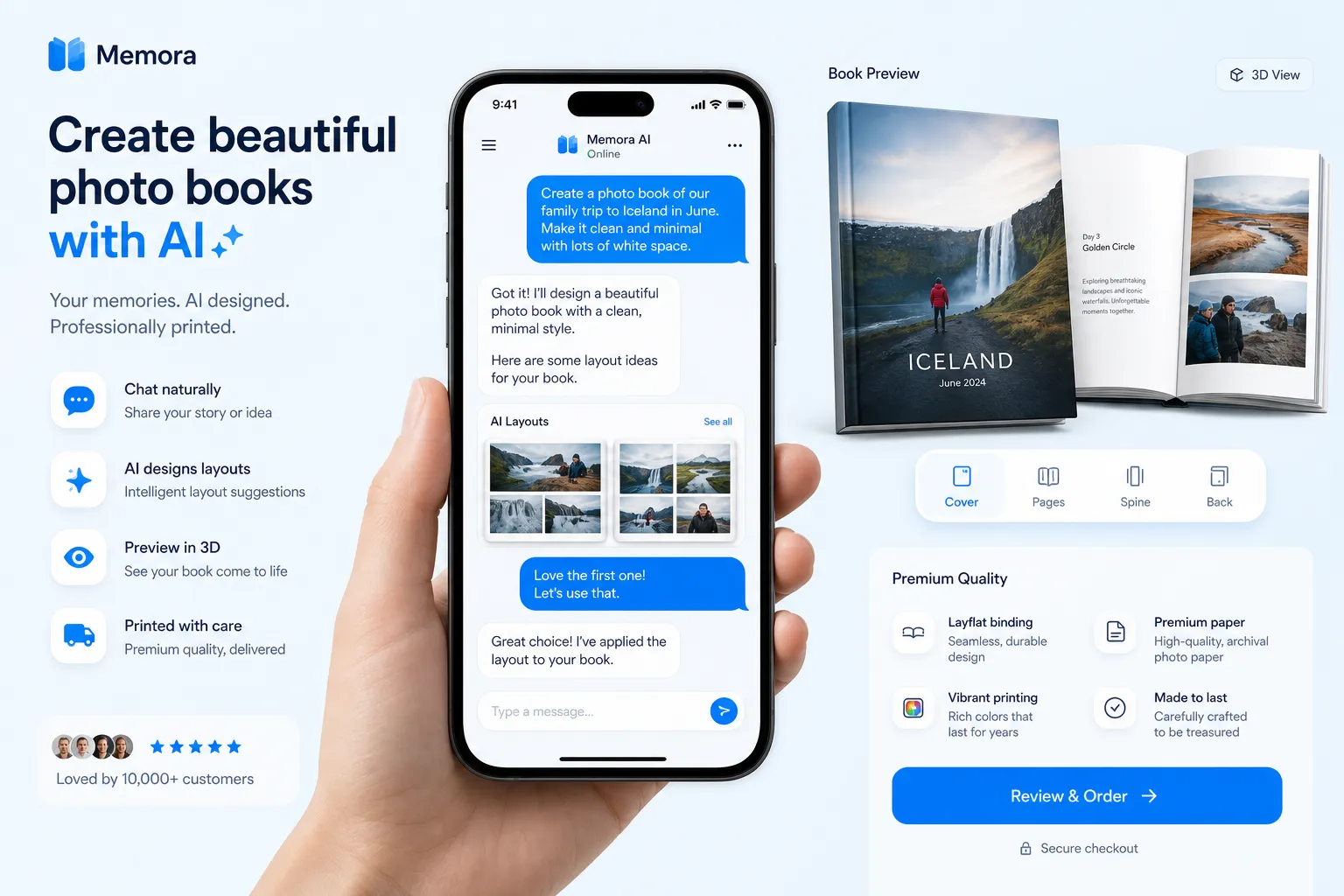
Instead of forcing users into complex design workflows, the next generation of print platforms will let customers describe what they want in plain language and receive a ready-to-buy, print-ready product in return. In practical terms, that means a shopper can say, “Create a luxury travel photo book with a clean editorial layout and gold-accent cover,” upload images, and move straight to an interactive preview rather than spending an hour inside a design editor.
For print businesses, this is more than a UX upgrade. It is a strategic shift in how products are created, sold, and fulfilled.
Why conversational AI matters so much in print commerce
Print is uniquely suited to conversational interfaces because the buying journey is often emotionally driven but operationally complex. Customers want a beautiful end product, not a lesson in layout rules, bleed settings, image hierarchy, or print production constraints.
Traditional online editors create several problems:
They overwhelm first-time buyers.
They slow purchase decisions.
They increase abandonment on mobile.
They create more support tickets.
They often produce inconsistent design quality.
Conversational AI solves those problems by moving the interaction closer to customer intent. The platform interprets goals, style preferences, uploaded assets, and product constraints, then turns them into a polished composition automatically.
For a modern print business, that means the interface stops being a tool and starts becoming a service.
"The global conversational AI market was valued at $14.3 billion in 2025 and is expected to reach $78.9 billion by 2033, growing at a compound annual growth rate (CAGR) of 23.8% from 2026 to 2033." - Grand View Research
That growth matters because it signals a broader customer expectation shift: people increasingly expect software to understand them, not the other way around.
What top competitor content gets right, and what it misses
The strongest conversations around the future of conversational AI tend to focus on five themes:
Common Theme | Why It Matters | Where Most Articles Stop Short |
|---|---|---|
AI orchestration | Multiple agents can handle different tasks better than one monolithic bot | They rarely explain what orchestration looks like inside a print workflow |
Agentic AI | Systems are moving from answering to completing tasks | They discuss generic enterprise tasks, not creation of physical products |
Voice and multimodal interaction | AI is becoming more natural across channels | They overlook mobile-first print buying and visual approval flows |
Governance and guardrails | Enterprises need safe, controlled AI deployment | They rarely connect governance to print-ready output quality, branding, and production constraints |
Personalization | Better AI means better user experiences | They seldom show how personalization drives higher-value custom product sales |
That creates a clear content gap.
Most articles treat conversational AI as a support-layer technology for service, search, or internal productivity. Very few explore what happens when conversational AI becomes the product creation engine itself. In print, that distinction is enormous. The system is not just answering questions about an order. It is generating layouts, suggesting products, validating assets, producing previews, and feeding automated fulfillment.
That is where Media Rex Alliance enters the conversation as a category-defining model.
The shift from chatbot to creation engine
The old model of conversational AI was reactive. A user asked a question, and a bot answered it.
The future of conversational AI in print is proactive and generative. It must:
understand customer intent
recommend the right product format
organize uploaded content
build layouts automatically
adapt designs to brand or event context
show photorealistic 3D and AR previews
prepare production-ready files
trigger fulfillment workflows
This is a fundamentally different architecture from a customer service bot.
In the print world, the winning platforms will not just “talk.” They will create.
The five forces shaping the future of conversational AI in print
1. Conversational creation will replace editor-first product design
The biggest change ahead is simple: fewer users will begin with a blank canvas.
Instead, they will start with intent. A customer might type:
“Make a premium wedding album with a timeless black-and-white look.”
“Design a set of wall art prints for a minimalist nursery.”
“Turn this product shoot into a branded lookbook for client meetings.”
The AI will interpret tone, purpose, audience, and format. Then it will assemble a structured, print-ready draft in seconds.
For small studios and photographers, that dramatically reduces the time between inspiration and sale. For mid-size print brands, it means higher conversion rates and less dependence on clunky editors that were never designed for mobile behavior. For enterprise photo book companies, it creates a path to serve more customers without growing support and design overhead at the same rate.
2. Orchestrated AI agents will run the full print journey
The next wave of systems will not rely on a single assistant doing everything. They will use coordinated AI agents, each optimized for a different task.
A print business may soon operate with an ecosystem like this:
AI Function | Role in the Workflow |
|---|---|
Intent agent | Interprets what the customer wants to create |
Product recommendation agent | Suggests the best format, size, materials, or finish |
Layout agent | Builds page structures and visual hierarchy |
Image quality agent | Flags low resolution, cropping risks, and duplication |
Brand compliance agent | Ensures templates and visual identity stay on-brand |
Preview agent | Generates 3D mockups and immersive AR views |
Production agent | Converts approved work into print-ready files |
Fulfillment agent | Routes jobs through a distributed print network |
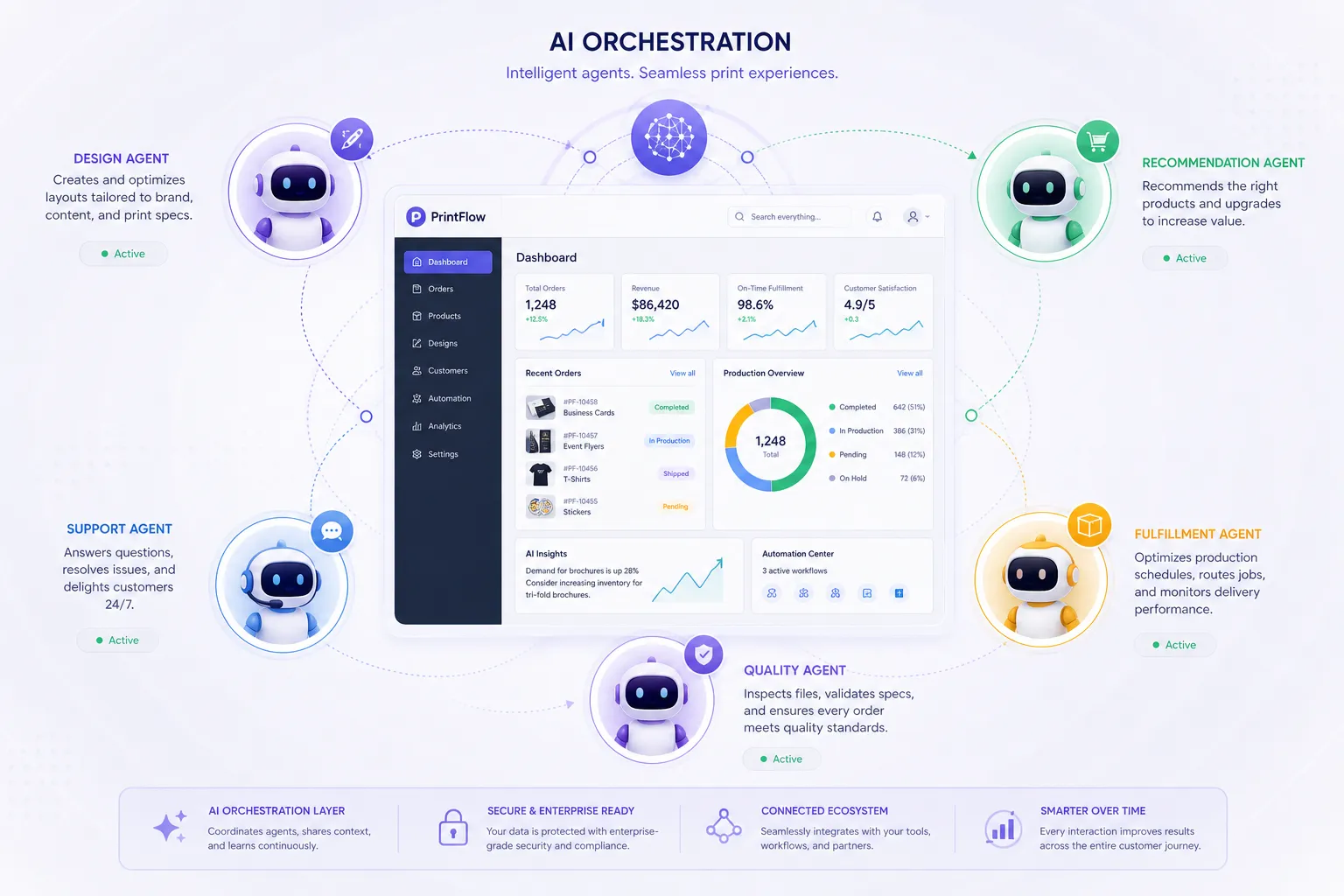
This multi-agent model is especially important in print because success depends on coordination across creative, technical, and operational layers. The system must delight the customer and satisfy production realities.
That is why the future of conversational AI in this sector is inseparable from orchestration.
3. Multimodal experiences will become the new standard
Customers will not interact with print AI through text alone. They will move fluidly across prompts, photos, product previews, touch gestures, and visual approval states.
A modern workflow might look like this:
A customer describes the product in natural language.
They upload photos from a mobile device.
The AI assembles layouts automatically.
The platform shows photorealistic 3D previews.
The user checks the product in AR before buying.
The system refines the product based on conversational feedback.
That kind of experience is far more persuasive than a static thumbnail or PDF proof. It reduces uncertainty and builds buyer confidence at the exact moment where hesitation usually kills conversion.
Media Rex Alliance is particularly aligned with this direction because it combines browser-based access, mobile-first design, cross-device continuity, and immersive 3D/AR previews into one white-label environment. That means brands can offer advanced conversational product creation without asking users to install an app or learn a new toolset.
4. Mobile-first AI will define the fastest-growing segment of demand
Many older web-to-print systems were built for desktop-era behavior. The next generation will be shaped by mobile-first commerce.
That matters because mobile users are less tolerant of friction. They want to move from idea to purchase quickly, often in short bursts of attention. Conversational interfaces are a natural fit because they reduce taps, menus, and design complexity.
For regional print players and new print-on-demand brands, this creates a major competitive opening. A mobile-first conversational flow lets them deliver a premium buying experience without building a heavy native app or investing in a large internal product team.
Instead of forcing users through panel-based design software, a browser-based conversational workflow can guide them from prompt to purchase in minutes.
5. AI governance will become a production requirement, not just a policy issue
In generic SaaS discussions, AI governance often sounds abstract. In print, it is extremely concrete.
If an AI system generates a visually poor layout, uses the wrong brand styling, accepts low-quality assets, or creates output that is not production-safe, the problem shows up fast: unhappy customers, reprints, support load, waste, and margin erosion.
That means governance in print must include:
design quality controls
brand guardrails
resolution and bleed validation
product compatibility checks
customer approval checkpoints
production-safe file generation
This is one of the most overlooked content gaps in mainstream articles about conversational AI. They talk about hallucinations and compliance, but they do not discuss operational quality in physical product creation.
In print commerce, good AI is not just helpful. It has to be manufacturable.
From personalization to persuasion
One of the most powerful outcomes of conversational AI is not speed alone. It is relevance.
When a print platform understands the occasion, recipient, aesthetic, and customer intent, it can build products that feel more valuable. That changes buyer behavior. People become less likely to abandon and more likely to upgrade.
A conversational system can naturally recommend:
premium paper stocks for wedding albums
extra pages for travel books
framed options for wall art
gift packaging for seasonal occasions
multi-product bundles for schools, studios, or events
Done well, this does not feel like upselling. It feels like guidance.
That distinction matters. In print commerce, emotional trust drives order value.
Why trust remains the adoption bottleneck
Despite the momentum behind AI, businesses still need to earn customer confidence. People may be intrigued by AI-generated products, but they will hesitate if the results feel unpredictable or low quality.
"85% of customer service leaders planned to explore or pilot customer-facing conversational generative AI solutions by 2025." - Gartner
High adoption does not automatically mean high trust. In print, trust is built through visible proof:
accurate previews
consistent layouts
fast refinement
transparent production expectations
premium final output
That is why photorealistic 3D previews and AR matter so much. They reduce the mental gap between digital intent and physical result.

How conversational AI changes unit economics for print businesses
The future of conversational AI is not only about experience. It is also about efficiency.
When product creation becomes faster and more automated, print businesses can improve margins in several ways:
Operational Area | Traditional Web-to-Print Model | Conversational AI-Driven Model |
|---|---|---|
Customer onboarding | Users must learn the editor | Users describe what they want |
Design labor | High support and intervention | Layouts generated automatically |
Mobile conversion | Often weak due to complexity | Stronger due to lower friction |
Inventory model | May require pre-produced assumptions | Better suited to on-demand production |
Fulfillment flow | More manual handoffs | More automated routing and production |
Product expansion | Slower to launch new offers | Faster through modular AI and templates |
This is where Media Rex Alliance offers a particularly strong strategic fit. Its model is built around on-demand production, low-overhead operations, automated fulfillment, and a global network of premium printers. That allows businesses to scale product creation without scaling inventory risk or operational friction at the same pace.
In a category where custom work traditionally creates complexity, that is a major unlock.
What this means for different types of print businesses
Small studios and photographers
These businesses often need to sell premium products without becoming software companies. Conversational AI gives them a way to offer high-end, customized print experiences while protecting their time.
The value is clear:
less manual layout work
faster client approvals
stronger premium positioning
easier mobile ordering
more consistent product quality
New print-on-demand brands
Emerging brands need speed, differentiation, and low fixed costs. A conversational interface can help them launch branded creation experiences quickly, while on-demand production keeps overhead low.
This is especially useful when the business wants to test categories like:
photo books
wall art
gift prints
branded merchandise
seasonal collections
Mid-size print brands and regional players
These companies often sit in the most difficult middle ground. They need enterprise-grade functionality but cannot justify long development cycles or large internal AI teams.
A white-label conversational print platform offers a shortcut to innovation: branded deployment, faster go-to-market, stronger conversion mechanics, and scalable infrastructure without a ground-up build.
Established photo book companies and enterprise print groups
For larger incumbents, the opportunity is transformation at scale. Conversational AI can modernize aging web-to-print stacks, reduce support burdens, unlock better mobile performance, and create more adaptive product experiences across multiple brands or regions.
The strategic advantage of white-label deployment
One of the biggest reasons AI initiatives stall is implementation complexity. Many businesses understand the opportunity but hesitate at the cost, integration risk, and time-to-value.
That is why white-label deployment matters.
Instead of building a conversational creation engine internally, brands can integrate a platform that already supports:
branded storefront experiences
custom domain and visual identity
browser-based access
no-app onboarding
local and cloud project sync
automated creation-to-fulfillment flow
scalable infrastructure across business sizes
For the buyer, the experience feels native. For the business, the operational lift is much lower.
That is a significant competitive advantage in a market moving faster every year.
Where the market is heading next
Over the next several years, the future of conversational AI in print will likely be defined by these shifts:
Conversational interfaces will become the default entry point
The editor will still exist, but increasingly as a refinement layer rather than the starting point.
AI will create complete product systems, not isolated layouts
Instead of generating one page or one design, platforms will assemble entire product journeys with recommendations, previews, approvals, and fulfillment logic.
Print experiences will become more embedded
Brands will integrate conversational product creation directly into existing storefronts, customer portals, creator ecosystems, and mobile commerce flows.
Physical products will become easier to buy than digital design services
Customers will spend less time making and more time choosing, refining, and purchasing.
Conversion and confidence will become tightly linked
The most successful platforms will not just generate products quickly. They will show them convincingly through 3D, AR, and high-fidelity previews.
What competitors still fail to address
Many forward-looking articles about conversational AI are thoughtful, but they still miss several critical realities for print:
Creation is different from conversation.
Generating a production-safe physical product is far more demanding than answering a support question.Visual proof is central.
Trust in print depends on what customers can see before ordering.Mobile UX is decisive.
If the journey is not smooth on mobile, the model breaks for a growing share of demand.Fulfillment is part of the AI story.
The future is not complete until the system connects design intent to production and delivery.White-label scale matters.
Most print businesses need capability fast, not a multi-year AI development program.
Those gaps create room for a platform purpose-built for AI-driven web-to-print.
Why Media Rex Alliance is built for this future
Media Rex Alliance is not just layering AI onto an old editor model. It reflects where the category is going.
Its approach aligns directly with the most important market shifts:
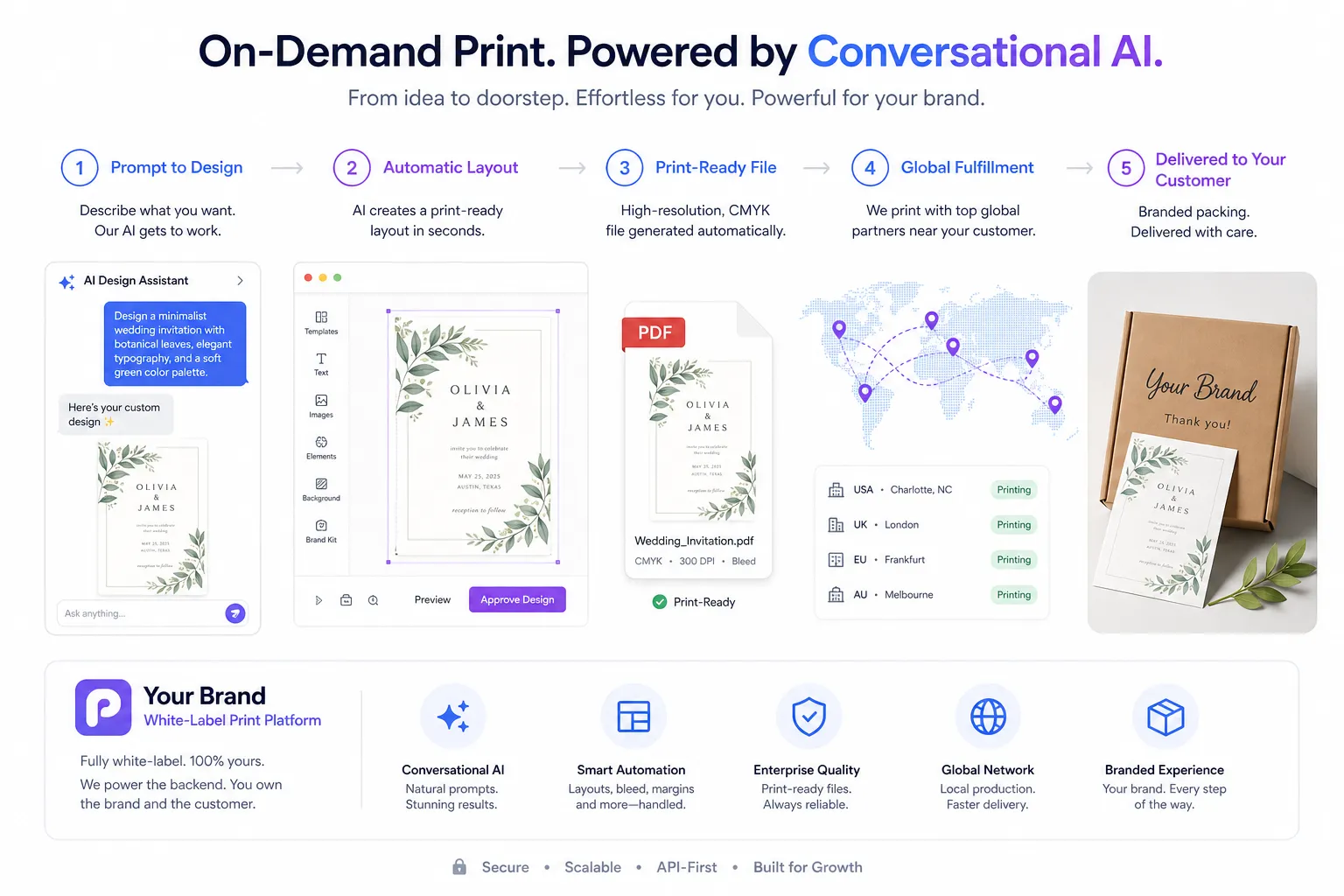
customers can create products through natural language instead of complex design tools
prompts turn into print-ready products quickly, reducing friction and accelerating purchase decisions
businesses can deploy fully white-label experiences inside their own storefronts or apps
photorealistic 3D and AR previews improve confidence before checkout
the platform is mobile-first, browser-based, and does not require app installation
projects sync locally and in the cloud for cross-device continuity
on-demand production reduces inventory exposure and overhead
fulfillment is automated through a global network of premium printers
the infrastructure scales from startup brands to enterprise print organizations
That combination is rare because it addresses the entire commercial chain, not just one feature within it.
Final verdict
The future of conversational AI will not be defined by smarter chat alone. It will be defined by systems that turn intent into outcomes.
In print, that means moving from complicated design interfaces to conversational product creation. It means replacing friction with flow, guesswork with intelligent guidance, and static previews with immersive confidence-building experiences. It means connecting AI not just to communication, but to creation, production, and fulfillment.
For print businesses, photo product brands, studios, and web-to-print operators, this is not a distant trend. It is an immediate strategic opportunity.
If your business wants to launch faster, convert more users, reduce design friction, and offer a premium AI-powered print experience under your own brand, Media Rex Alliance offers one of the clearest paths forward.
The brands that win next will not simply use AI to talk to customers. They will use it to build what customers want before hesitation sets in.