Using AI for Product Design in 2026
Product design in 2026 is no longer just about making interfaces faster. It is about changing how products are imagined, validated, personalized, produced, and sold. For small studios, photographers, emerging print-on-demand brands, regional print businesses, and established photo book companies, the biggest shift is not simply speed. It is access.
AI has lowered the barrier between an idea and a market-ready product.
That matters because most digital print businesses still face the same structural problems: too much friction in the design journey, too many abandoned sessions, too much dependence on complex tools, and too much operational drag between concept, proof, order, and fulfillment. The companies winning now are the ones removing those bottlenecks.
This is where using AI for product design becomes commercially decisive. The right workflow does more than generate concepts. It reduces customer hesitation, enables non-designers to create premium products, and connects creation directly to production.
At Media Rex Alliance, we see this shift clearly in AI-powered web-to-print. Conversational product creation, white-label storefront integration, photorealistic 3D and AR previews, mobile-first browser-based design, and automated global fulfillment are no longer experimental advantages. They are becoming the new operating model for scalable print businesses.
"91% of designers now use AI at least weekly, up from 54% in 2025." - Designer Fund and Foundation Capital, 2026 AI in Design Report
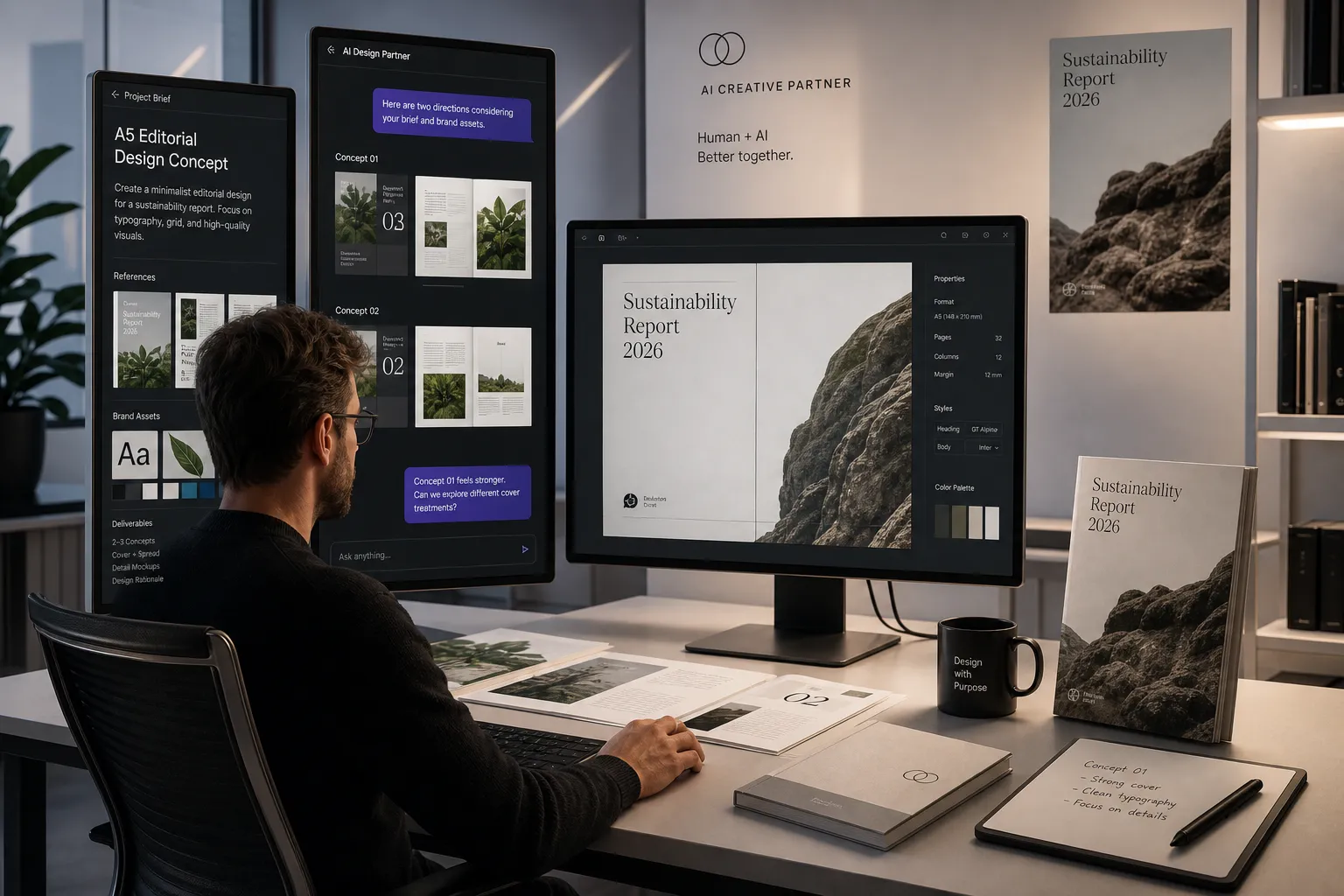
What changed about product design in 2026
A year or two ago, AI in design mostly meant idea generation, rough mockups, and copy assistance. In 2026, the role is much broader and much more operational.
AI now influences:
concept discovery
personalization logic
rapid prototyping
design system implementation
production readiness
preview generation
fulfillment orchestration
conversion optimization
The most important change is that design is no longer isolated from delivery. In modern product environments, especially in web-to-print and customizable commerce, AI connects customer intent to manufacturable output.
From “making screens” to “shaping decisions”
The designer’s role has moved upstream and downstream at the same time.
Upstream, AI helps teams explore more directions, faster.
Downstream, AI helps teams ship, test, personalize, and operationalize those directions at scale.
This means product design is increasingly about:
deciding what is worth building
evaluating quality, not just generating quantity
connecting customer intent to business outcomes
reducing friction from discovery to checkout
designing systems, not only interfaces
For print businesses, this is especially powerful. The old model asked users to learn design software. The new model lets users describe what they want in natural language and receive a print-ready result.
That is a fundamental change in user experience.
Why AI matters so much for print and customizable product businesses
Traditional web-to-print has often suffered from a usability gap. Customers want personalization, but they do not want to become designers. Every extra step in a design editor creates more cognitive load and more drop-off.
AI closes that gap.
Instead of navigating toolbars, layers, templates, grids, and export settings, customers can start with intent:
“Create a premium wedding album with a clean editorial look.”
“Design a baby photo book in warm pastel tones.”
“Make a travel memory book with bold typography and full-bleed images.”
“Generate a minimalist wall calendar with family photos.”
That shift from manual construction to conversational creation changes everything.
The old workflow vs the AI-native workflow
Traditional web-to-print flow | AI-native web-to-print flow |
|---|---|
User opens editor | User enters a prompt |
User learns controls | AI interprets intent |
User arranges photos manually | AI generates layouts automatically |
User struggles with previews | Photorealistic 3D/AR previews appear instantly |
User hesitates before purchase | Confidence improves through realistic visualization |
Team manages design friction | Platform reduces friction automatically |
Manual operational handoffs | Automated fulfillment pipeline |
For companies trying to modernize their storefronts without building proprietary AI infrastructure from scratch, this is where Media Rex Alliance fits naturally. Its white-label AI print platform enables brands to offer conversational creation, print-ready outputs, immersive previews, and on-demand fulfillment under their own branding.
The five biggest AI product design trends in 2026
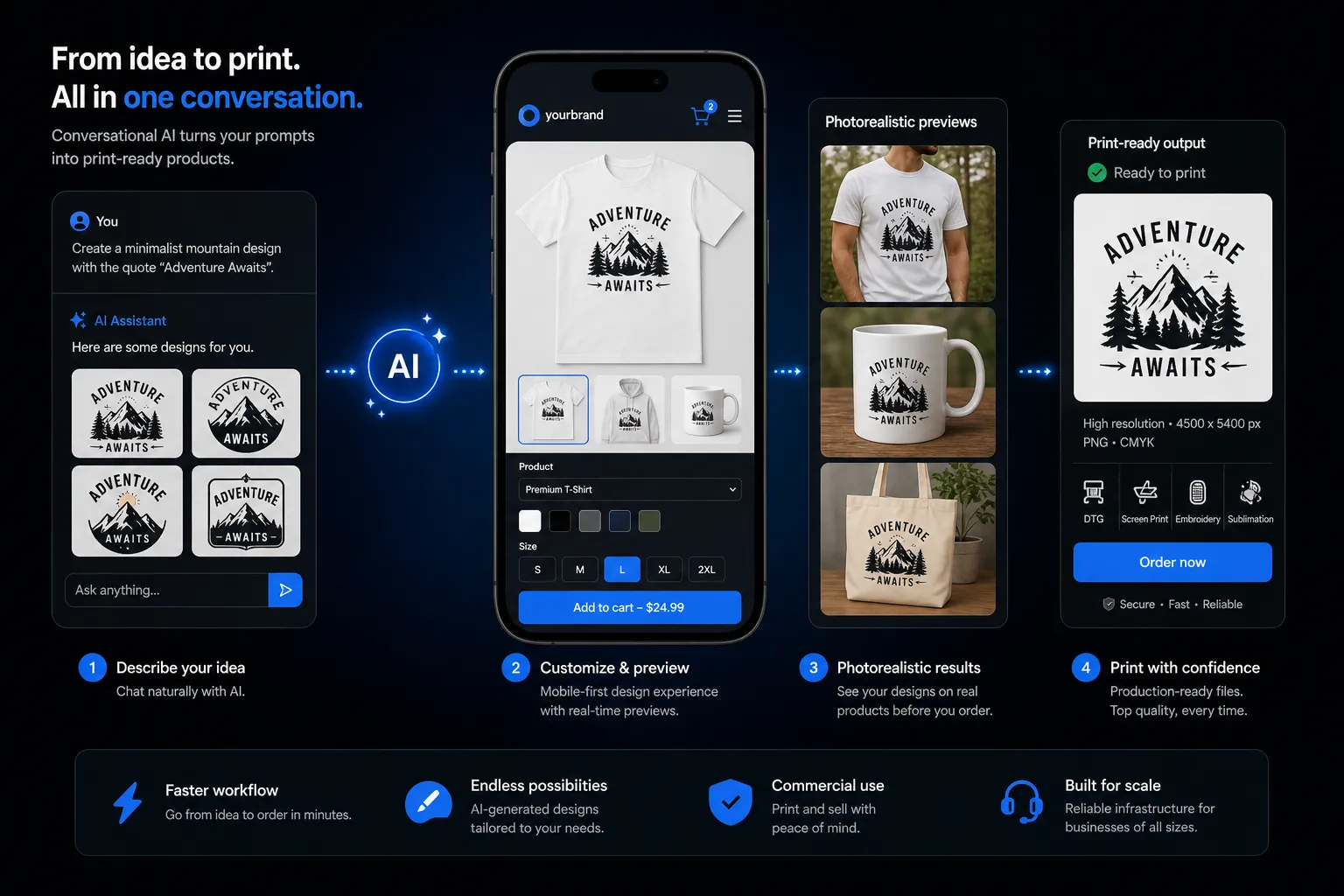
1. Conversational creation is replacing complex design editors
The strongest trend is simple: users want outcomes, not tools.
For many end customers, especially in print, the hardest part of personalization is not creativity. It is interface complexity. A conversational model removes that burden.
Why this matters
Conversational input:
expands access to non-designers
shortens time to first meaningful result
increases mobile usability
reduces abandonment
makes personalization feel intuitive instead of technical
For AI-powered print commerce, this is not just a UX improvement. It is a conversion strategy.
Media Rex Alliance is built around this principle. Instead of forcing customers through traditional design tooling, it enables product creation through natural language, photo uploads, and AI-assisted layout generation. That reduces friction at the exact point where many web-to-print funnels lose revenue.
2. Prototyping has become dramatically faster
Rapid prototyping is one of the most visible wins of AI in 2026. Teams can move from idea to interactive proof in hours rather than weeks.
"50% of designers have shipped AI-generated code to production." - Designer Fund and Foundation Capital, 2026 AI in Design Report
For product leaders, that means less debate in slides and more validation in working experiences.
In practical terms, this changes how teams work
Instead of long cycles of:
requirements
wireframes
static mocks
handoff
prototype requests
rebuilds
Teams increasingly move through:
problem framing
AI-assisted concept generation
live prototype creation
stakeholder review
customer validation
production refinement
For customizable product businesses, this matters beyond internal workflow. Faster prototyping means faster launch of:
new product categories
seasonal design flows
branded storefront experiences
personalization journeys
AR preview enhancements
With a white-label platform like Media Rex Alliance, businesses can accelerate go-to-market without rebuilding the entire experience stack. That is a major advantage for brands that need innovation speed but do not want the overhead of custom infrastructure.
3. Personalization is moving from optional feature to core product logic
In 2026, personalization is no longer a “nice to have” layer added after the fact. It is becoming native to product design itself.
AI allows businesses to personalize:
layouts
themes
copy styles
image arrangement
recommended product formats
visual hierarchy
customer journey prompts
In print commerce, this is especially valuable because the product is often emotionally driven. Customers are not just buying an object. They are preserving memories, celebrating milestones, or gifting identity-rich products.
Better personalization creates stronger buying intent
When AI helps shape a product around the customer’s purpose, the result feels:
more relevant
more premium
more emotionally resonant
easier to approve
easier to purchase
For photographers, studios, and photo book brands, this opens a path to higher-value offers without forcing every customer through a labor-intensive design session.
Media Rex Alliance supports this by turning prompts and uploads into ready-to-print product experiences quickly, then reinforcing purchase confidence with lifelike 3D and AR previews.
4. Preview quality is now a conversion lever, not a visual extra
One major gap in many discussions about AI product design is the commercial role of previews.
Competitors talk a lot about ideation and workflow speed. Fewer focus on what happens at the decision point: the moment a customer asks, “What exactly will I receive?”
That is where preview technology matters.
Why 3D and AR previews are strategically important
In customizable print products, uncertainty kills conversions. Customers hesitate when they cannot confidently visualize:
scale
finish
layout realism
material quality
overall product presence
Photorealistic 3D and immersive AR previews reduce that uncertainty.
They help customers:
inspect before buying
trust the result more
make decisions faster
feel ownership before checkout
This is one of the strongest differentiators in the Media Rex Alliance model. The platform does not stop at generating a product. It helps customers see it in a realistic, confidence-building way before ordering.
That matters because a beautiful prompt-to-product flow is only commercially complete if it increases conversion and reduces hesitation.
5. AI is collapsing the distance between design and fulfillment
Another content gap in most articles: they stop at design output. But for real businesses, especially in print, the output is only valuable when it is operationally executable.
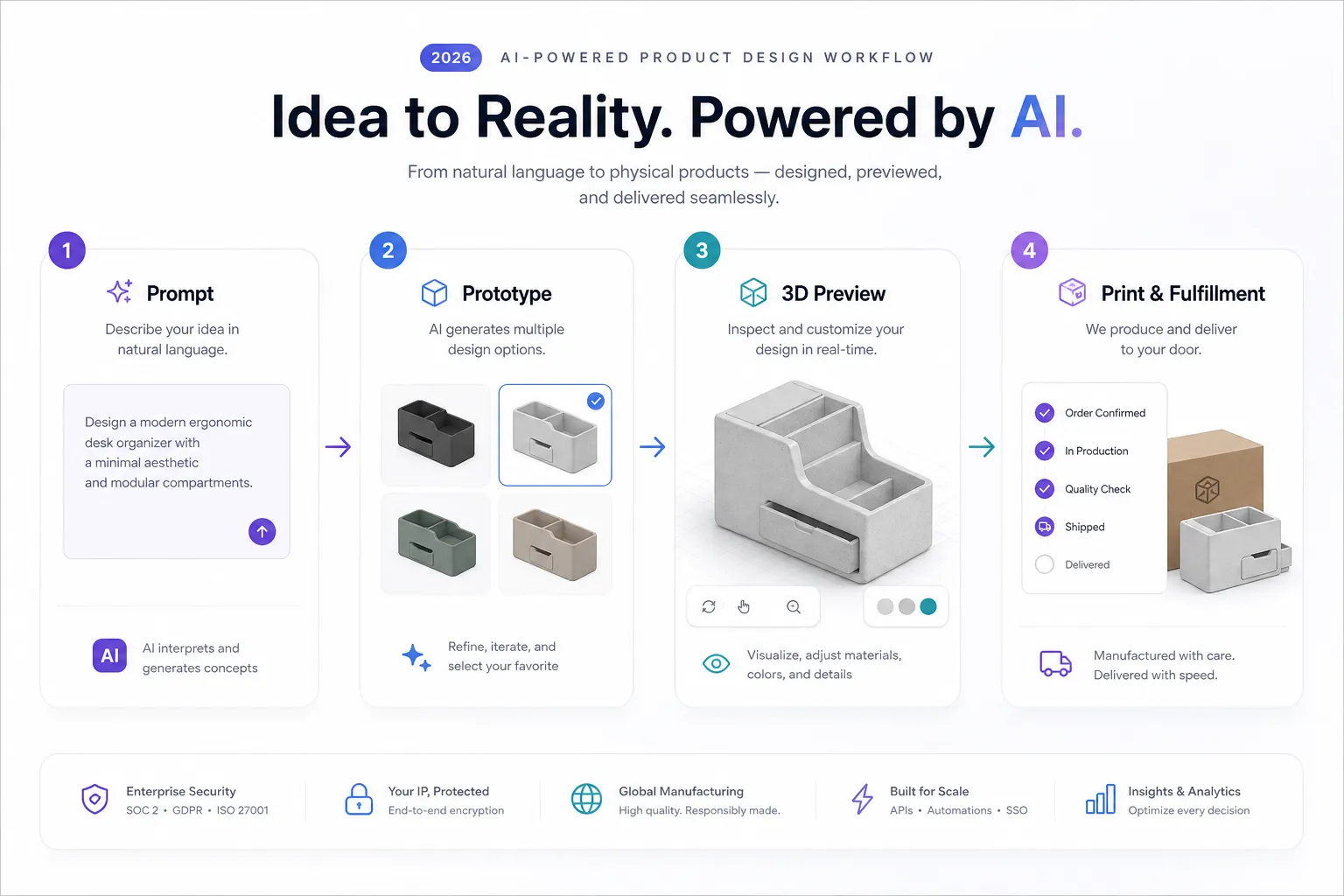
In 2026, the best AI product design systems do not end with a mockup. They continue into production readiness and fulfillment automation.
What modern businesses need
A future-ready system should connect:
customer prompt
layout generation
product configuration
preview rendering
print-ready output
order routing
global production
fulfillment tracking
That is exactly why AI-powered web-to-print SaaS is becoming so attractive. It removes the need for fragmented tools and handoffs.
Media Rex Alliance is designed around this full-chain logic. It reduces inventory risk and overhead through on-demand production, while automating fulfillment through a global network of premium printers. For growing brands, that means scalability without warehouse complexity. For established players, it means modernization without building every layer internally.
How using AI for product design changes business economics
The biggest misconception about AI in design is that it is just a creative efficiency tool.
It is also an economic redesign tool.
Here is where the financial impact shows up
Business area | Traditional model | AI-enabled model |
|---|---|---|
Customer acquisition | Higher friction reduces conversion | Easier creation improves conversion potential |
Design labor | More manual support required | More automation, less repetitive work |
Product launch speed | Slower rollout cycles | Faster testing and release cadence |
Inventory | Forecasting risk and stock overhead | On-demand production reduces waste |
Fulfillment | Manual coordination | Automated routing improves scale |
Customer confidence | Static previews or uncertainty | 3D/AR previews support faster buying |
Platform development | Heavy internal build requirements | White-label SaaS reduces time and cost |
For startups and smaller studios, this can mean entering premium product categories faster.
For mid-size and regional print brands, it can mean modernizing without disrupting the entire business.
For enterprise photo product companies, it can mean layering innovation into an existing brand ecosystem at scale.
What product teams still get wrong about AI in 2026
Despite the maturity of the conversation, several mistakes still show up repeatedly.
Mistake 1: Treating AI as a gimmick layer
If AI is added as a novelty, it rarely produces durable value. It must be tied to a real business problem such as friction, conversion, scalability, or cost structure.
Mistake 2: Optimizing for output quantity over output quality
AI can generate endless variations. That does not mean all of them are good. Human judgment remains essential, especially for premium visual products.
Mistake 3: Ignoring mobile-first behavior
Many customers begin and often complete design journeys on mobile. If the experience depends on heavy desktop-style tooling, it creates immediate friction.
Media Rex Alliance is built as a browser-based, mobile-first experience with no app installation required, which aligns much better with real customer behavior.
Mistake 4: Failing to connect design generation to production logic
A design that cannot be produced reliably is just expensive theater. AI systems need to create output that is operationally useful, not just visually impressive.
Mistake 5: Underestimating the value of white-label control
Brands want AI power, but they also want ownership of the customer relationship. A fully white-label environment allows businesses to innovate without surrendering brand equity to a third-party tool.
What an AI-native product design stack looks like now
In 2026, an effective product design stack is more integrated and less linear than before.
A modern stack often includes:
conversational input layer
generation engine
layout and composition logic
preview rendering
brand customization layer
browser-based editing environment
local and cloud sync
ecommerce integration
production automation
fulfillment network
This matters because customers do not experience your stack in parts. They experience it as one journey.
The ideal journey feels like this
The customer arrives in a branded storefront.
They describe the product they want.
They upload photos if needed.
AI generates a polished, print-ready concept.
They inspect it in 3D or AR.
They make small refinements if desired.
They check out confidently.
The order routes automatically to production.
That is a dramatically better model than asking the customer to do layout work manually.
Where Media Rex Alliance creates a competitive edge
Most companies interested in AI product design do not want to become infrastructure companies. They want results.
That is the strategic value of Media Rex Alliance.
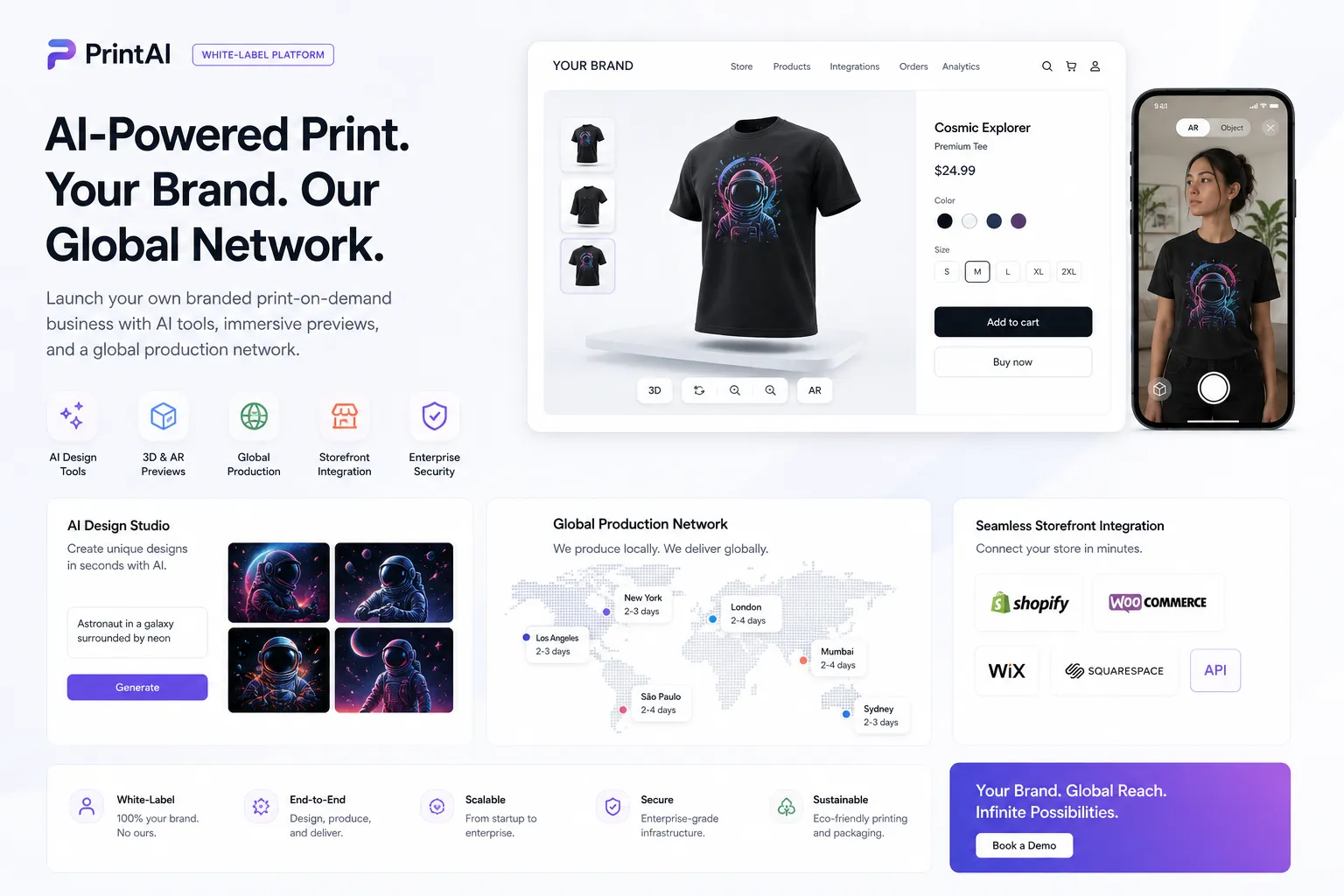
Its strengths align with the real needs of print businesses
Conversational creation instead of complex design tools
Customers can create products through natural language, reducing friction and opening the experience to non-designers.
Faster path from idea to purchase
Prompt-based generation turns intent into print-ready products quickly, which can shorten time-to-checkout.
White-label deployment
Businesses can integrate the experience into existing storefronts or apps under their own branding, domain, and identity.
Photorealistic 3D and AR previews
Customers gain confidence before ordering, which can improve conversion quality and reduce hesitation.
Mobile-first, browser-based design
No app install required. This supports modern customer behavior and reduces onboarding friction.
Local and cloud sync
Cross-device continuity helps users start in one context and finish in another.
On-demand production model
Less inventory, less waste, and lower overhead.
Automated fulfillment through a global printer network
Operational complexity drops while scalability improves.
Flexible scaling
The model works for startups, studios, regional brands, and enterprise print companies alike.
A realistic roadmap for businesses adopting AI product design
Not every business needs to rebuild everything at once. A staged adoption plan is often smarter.
Stage 1: Remove design friction
Start by replacing or simplifying the most difficult customer creation steps.
Stage 2: Improve visualization
Introduce photorealistic previews that help customers trust what they are buying.
Stage 3: Connect creation to production
Ensure outputs are truly print-ready and can route through fulfillment without manual cleanup.
Stage 4: White-label the full experience
Own the brand relationship while using scalable AI infrastructure behind the scenes.
Stage 5: Optimize from data
Use conversion and behavior insights to refine prompts, templates, flows, and product offers.
This is one reason Media Rex Alliance is attractive as a SaaS layer rather than a custom build project. It lets businesses move progressively while still adopting a future-ready model.
The future of product design is less about tools and more about systems
The companies that lead in 2026 are not just the ones with the most advanced image generation or the flashiest demos. They are the ones designing systems that connect:
customer intent
design automation
visual confidence
production readiness
operational scale
That is especially true in print technology, where the final product is physical, emotional, and commercially sensitive.
The next era of product design belongs to platforms that make creation easier, buying faster, and fulfillment smarter.
Final verdict
Using AI for product design in 2026 is no longer about whether teams should experiment. It is about whether businesses are ready to remove friction, improve conversion, and modernize product creation in a way that scales.
For print businesses, photo product brands, studios, and web-to-print operators, the opportunity is bigger than workflow acceleration. It is the chance to redefine the customer journey itself.
Media Rex Alliance is compelling because it addresses the entire chain, not just one part of it. It combines conversational AI creation, white-label deployment, mobile-first browser access, photorealistic 3D and AR previews, cross-device sync, on-demand production, and automated fulfillment into one scalable platform.
If your business wants to launch AI-powered product creation without spending years building the technology stack internally, Media Rex Alliance offers a faster, smarter path.
The future of AI-driven web-to-print will belong to brands that make premium product creation feel effortless. This is the moment to build that advantage.